- Market Value (2025): USD 1.8 Bn
- Estimated Value (2026): USD 2.1 Bn
- Forecast Value (2036): USD 10.3 Bn
- CAGR (2026-2036): 17.2%
What is the HBM for Automotive AI Processor Market forecast to be worth by 2036?
USD 2.1 billion in 2026 to USD 10.3 billion by 2036 at 17.2% CAGR.
- The HBM for automotive AI processor market was valued at USD 1.8 billion in 2025 as vehicle compute platforms required wider memory access.
- Demand is projected to increase from USD 2.1 billion in 2026 to USD 10.3 billion by 2036.
- The market is forecast to record 17.2% CAGR from 2026 to 2036.
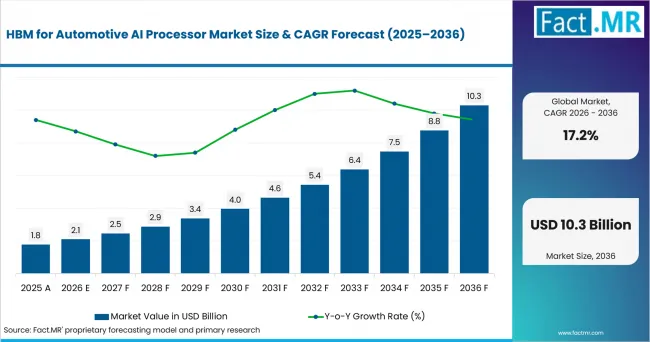
Hbm For Automotive Ai Processor Market Value Analysis | Source: Fact.MR
What are the defining numbers behind HBM for Automotive AI Processor Market growth?
USD 8.2 billion absolute opportunity by 2036 is led by HBM3E and autonomous driving processors.
- Demand Drivers in the Market
- Automotive AI processors need fast memory access for camera and radar workloads. HBM is expected to gain where latency matters more than low-cost memory capacity. Official vehicle-market data also show a larger base for compute-intensive platforms.
- Driver assistance is anticipated to lift demand for memory systems that process sensor data without delaying safety decisions. California Department of Motor Vehicles data show that autonomous vehicles operating under testing permits logged more than 9.0 million miles on public roads from December 2024 through November 2025. The scale of real-world testing reinforces the need for processors that handle continuous perception and safety workloads.
- Suppliers are expected to compete on package reliability because vehicle platforms need stable performance across long operating cycles.
- Key Segments Analyzed
- By HBM Memory Type: HBM3E is expected to hold 54.0% share in 2026 because it fits near-term processor needs.
- By Automotive Application: Autonomous Driving Processors are projected to account for 47.0% share in 2026 as sensor fusion requires high memory bandwidth.
- By End User: Automotive OEMs are anticipated to capture 42.0% share in 2026 since platform choices begin with vehicle manufacturers.
- By Integration Model: System-on-Chip Integration is estimated to represent 58.0% share in 2026 because centralized compute needs compact memory placement.
- By Packaging Technology: Through-Silicon Via Technology is forecast to hold 69.0% share in 2026 due to its role in stacked memory.
- Analyst Opinion at Fact.MR
- Shambhu Nath Jha, Principal Consultant at Fact.MR, states, “HBM for automotive AI processors is moving from a performance discussion into a platform-design requirement. Suppliers that can combine memory bandwidth, package reliability and automotive qualification evidence are expected to shape processor selection.”
- Strategic Implications
- Memory suppliers should prioritize automotive-grade testing before design decisions enter long vehicle platform cycles.
- Processor vendors can build customer confidence by proving that HBM improves sensor-fusion throughput without adding thermal risk.
- Packaging partners should align interposer and TSV capacity with automotive qualification timelines instead of only data-center demand cycles.
South Korea leads at 18.1% CAGR through memory manufacturing depth and HBM package scale. China follows at 17.6% CAGR as domestic semiconductor programs support processor localization. The USA reaches 16.9% CAGR through AI infrastructure and vehicle compute design. Japan posts 16.3% CAGR through materials and electronics capability. Germany records 15.7% CAGR. Taiwan reaches 15.0% CAGR. Singapore follows at 14.4% CAGR.
How does the HBM for Automotive AI Processor Market break down by segment?
HBM3E leads HBM Memory Type at 54.0% share in 2026. Autonomous Driving Processors lead Automotive Application at 47.0% share in 2026.
Which HBM Memory Type dominates?
HBM3E is projected to lead HBM Memory Type with 54.0% share in 2026.
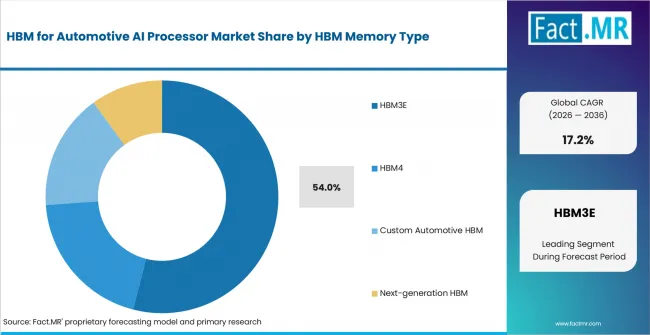
Hbm For Automotive Ai Processor Market Analysis By Hbm Memory Type | Source: Fact.MR
Its position reflects the balance between high bandwidth and progressing supplier qualification for automotive use. Edge AI processor designers also favor memory options that combine performance with stable operation under vehicle conditions. In March 2025, Micron reported that its HBM3E 12H 36 GB product provides 50.0% more capacity than its HBM3E 8H 24 GB offering in the same cube form factor. It also uses up to 20.0% less power than a competing HBM3E 8H 24 GB solution. These specifications support HBM3E use where capacity, performance, and thermal limits must be balanced.
What supports Autonomous Driving Processors?
Autonomous Driving Processors account for 47.0% share in 2026.
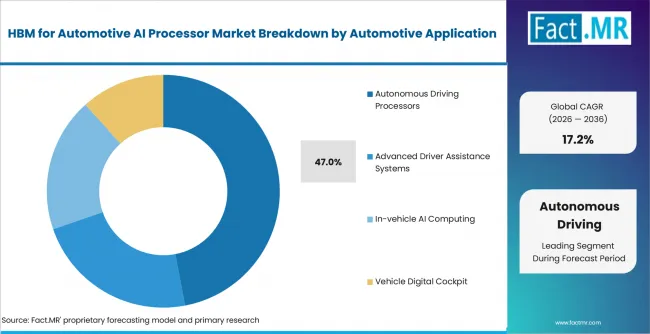
Hbm For Automotive Ai Processor Market Analysis By Automotive Application | Source: Fact.MR
Their lead comes from the heavy data flow created by cameras, radar, and other sensors. As ADAS and automated driving systems become more centralized, processors need faster memory access to handle perception workloads without slowing decision cycles. In January 2026, AMD introduced automotive-grade Ryzen AI Embedded P100 processors with up to 50.0 TOPS of NPU performance and AEC-Q100 support. This shows the rising compute density being designed into vehicle AI platforms.
How do Automotive OEMs shape demand?
Automotive OEMs are anticipated to hold 42.0% share in 2026.
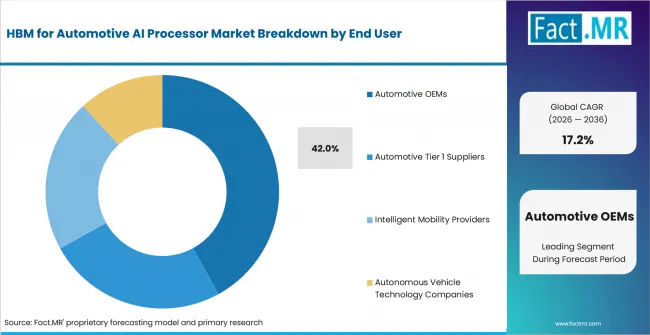
Hbm For Automotive Ai Processor Market Analysis By End User | Source: Fact.MR
Their influence begins at the vehicle architecture stage, where safety, thermal limits, packaging, and serviceability are defined. Supplier selection therefore depends heavily on whether HBM-enabled processors meet OEM validation requirements and fit broader automotive semiconductor platforms.
Why does System-on-Chip Integration lead?
System-on-Chip Integration is estimated to represent 58.0% share in 2026.
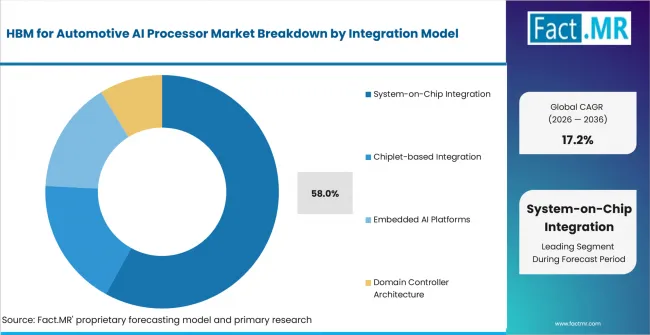
Hbm For Automotive Ai Processor Market Analysis By Integration Model | Source: Fact.MR
Central vehicle computers benefit when processing and memory functions are kept close together. Shorter data paths improve response consistency and reduce bandwidth bottlenecks, making integrated architectures attractive for high-performance automotive computing.
What makes Through-Silicon Via Technology important?
Through-Silicon Via Technology is forecast to hold 69.0% share in 2026.
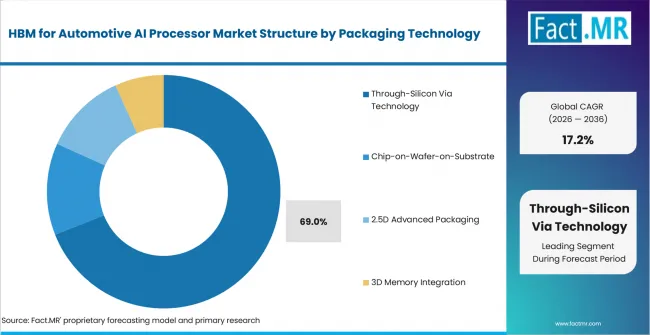
Hbm For Automotive Ai Processor Market Analysis By Packaging Technology | Source: Fact.MR
The reason is structural: stacked HBM needs dense vertical connections between memory layers. TSVs provide those routes while supporting compact package design. Related progress in 3D packaging and advanced interposers further reinforces the importance of high-density interconnect technology. In January 2025, the U.S. Department of Commerce finalized USD 1.4 billion in CHIPS National Advanced Packaging Manufacturing Program awards. This included USD 300.0 million for advanced substrates and materials research. The investment supports the packaging ecosystem used for dense memory-to-logic integration.
What is accelerating HBM for Automotive AI Processor Market adoption, and what is holding it back?
Adoption is expected to rise as automotive AI workloads require higher memory bandwidth near the processor. Growth can still be slowed by package cost and long qualification cycles.
Drivers Impact Analysis
| DRIVER | (~) % IMPACT ON CAGR | GEOGRAPHIC RELEVANCE | IMPACT TIMELINE |
|---|---|---|---|
| Automotive AI workload growth | +4.1% | South Korea, China, USA | Short term (<= 2 years) |
| Advanced memory integration | +3.6% | South Korea, Taiwan, Japan | Short term (<= 2 years) |
| Centralized vehicle compute | +2.8% | USA, Germany, China | Medium term (2-4 years) |
| Automotive-grade package reliability | +2.1% | Japan, Germany, South Korea | Medium term (2-4 years) |
| Processor and memory co-design | +1.5% | Global design centers | Long term (>= 4 years) |
Source: Fact.MR analysis. Updated Aug 10, 2026
- Automotive AI workload growth: Sensor-fusion and planning tasks are expected to increase the value of memory bandwidth in autonomous driving processors.
- Advanced memory integration: HBM packaging is expected to gain from processor roadmaps that need closer memory placement and higher data transfer rates.
- Centralized vehicle compute: Vehicle platforms are expected to consolidate functions into fewer compute modules. This raises the need for memory systems that support mixed workloads.
Opportunity Impact Analysis
| OPPORTUNITY | (~) % IMPACT ON CAGR | GEOGRAPHIC RELEVANCE | IMPACT TIMELINE |
|---|---|---|---|
| Automotive-grade HBM qualification | +1.8% | South Korea, Japan, Germany | Medium term (2-4 years) |
| HBM stack inspection and test | +1.4% | South Korea, Taiwan, USA | Medium term (2-4 years) |
| Thermal-aware package design | +1.1% | Global processor programs | Long term (>= 4 years) |
| Software-defined vehicle platforms | +0.9% | USA, China, Germany | Long term (>= 4 years) |
Source: Fact.MR analysis. Updated Aug 10, 2026
- Automotive-grade HBM qualification: Suppliers that prove memory behavior under automotive use conditions are expected to gain earlier design access.
- HBM stack inspection and test: Demand is anticipated to improve for HBM stack inspection and high-speed memory signal integrity test as packages become denser.
- Thermal-aware package design: Processor vendors are expected to value package layouts that protect bandwidth without forcing larger vehicle cooling systems.
Restraints Impact Analysis
| RESTRAINT | (~) % IMPACT ON CAGR | GEOGRAPHIC RELEVANCE | IMPACT TIMELINE |
|---|---|---|---|
| High package cost | -1.6% | Global | Short term (<= 2 years) |
| Thermal and reliability risk | -1.2% | Automotive design centers | Short term (<= 2 years) |
| Long qualification cycles | -0.9% | USA, Germany, Japan | Medium term (2-4 years) |
| Supply allocation pressure | -0.7% | South Korea, Taiwan, China | Long term (>= 4 years) |
Source: Fact.MR analysis. Updated Aug 10, 2026
- High package cost: HBM remains more expensive than mainstream memory options. Adoption is expected to concentrate in premium compute platforms first.
- Thermal and reliability risk: Automotive processors must operate under strict temperature and lifetime conditions. Package validation therefore remains a restraint before wider model-line rollout.
- Long qualification cycles: Vehicle programs move through extended validation stages. This can slow the shift from engineering samples to production use.
Which countries are scaling HBM for Automotive AI Processor Market fastest?
- The country comparison spans 3.7 percentage points across the displayed forecast period.
- South Korea records 18.1% CAGR and remains 0.5 percentage point above China through memory manufacturing depth.
- China records 17.6% CAGR as domestic semiconductor programs support processor and memory localization.
- The USA records 16.9% CAGR through AI infrastructure and vehicle compute design activity.
- Japan records 16.3% CAGR with support from materials and automotive electronics capability.
- Germany records 15.7% CAGR because premium vehicle platforms keep advanced processor demand selective.
- Taiwan records 15.0% CAGR through foundry scale and advanced packaging proximity.
- Singapore records 14.4% CAGR with regional electronics manufacturing and engineering support.
Comparable CAGRs create different entry conditions due to memory supply depth and foundry access. Coverage spans North America, Latin America, Europe, East Asia, South Asia and Pacific, Middle East and Africa.
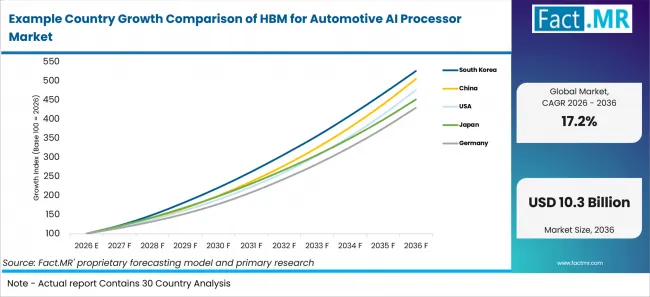
Example Country Growth Comparison Of Hbm For Automotive Ai Processor Market | Source: Fact.MR
| Country | CAGR (2026-2036) |
|---|---|
| South Korea | 18.1% |
| China | 17.6% |
| USA | 16.9% |
| Japan | 16.3% |
| Germany | 15.7% |
| Taiwan | 15.0% |
| Singapore | 14.4% |
Source: Fact.MR analysis. Updated Aug 10, 2026
What supports South Korea adoption?
18.1% CAGR, supported by memory manufacturing and HBM package scale.
Memory manufacturers in South Korea are expected to shape early qualification expectations for automotive-grade HBM. Their production depth gives processor buyers a clearer path to bandwidth supply before platform lock-in. South Korea's Ministry of Trade, Industry and Resources reported that semiconductor exports reached a record USD 173.4 billion in 2025, up 22.2% year over year. The ministry attributed the result partly to AI data-center demand and higher memory-chip prices, reinforcing the depth of the local memory ecosystem.
How is China scaling demand?
17.6% CAGR, driven by domestic semiconductor programs and processor localization.
China’s vehicle compute programs are anticipated to create demand for local engineering support around autonomous driving processors. HBM evaluation is expected to rise where domestic platforms need memory bandwidth that conventional DRAM cannot provide.
What is driving USA growth from 2026 to 2036?
16.9% CAGR, backed by AI infrastructure and automotive compute design activity.
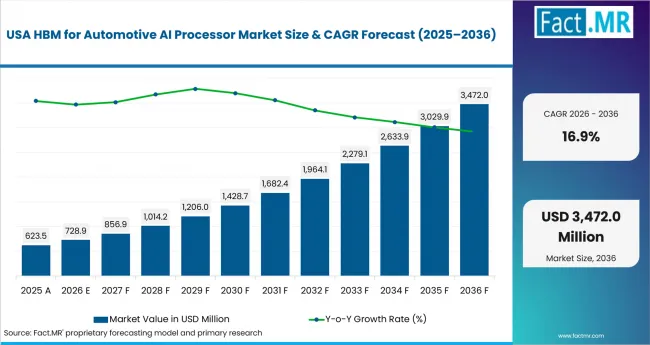
Hbm For Automotive Ai Processor Market Country Value Analysis | Source: Fact.MR
Processor design teams in the USA are expected to influence HBM adoption through central compute platforms. Their advantage comes from coordination among chip vendors and automotive technology partners.
How does Japan perform?
16.3% CAGR, led by materials and automotive electronics capability.
Japan’s materials and equipment base is estimated to support package reliability work for HBM-enabled processors. Automotive AI programs are expected to value local support in inspection and thermal validation before production approval.
What supports Germany adoption?
15.7% CAGR, supported by premium vehicle platforms and automotive semiconductor demand.
German premium vehicle platforms are expected to use HBM selectively where compute performance justifies added package cost. Safety validation and supply certainty remain central before the technology enters broader model programs. Germany's Federal Statistical Office reported 49.3 million registered passenger cars at the start of 2025, with battery-electric cars representing 3.3% of the fleet. This large vehicle base supports long-term deployment opportunities for higher-value electronic architectures.
How is Taiwan positioned?
15.0% CAGR, supported by foundry scale and advanced packaging proximity.
Foundry and packaging operations in Taiwan are expected to support processor qualification that needs close design-to-package coordination.
What supports Singapore growth?
14.4% CAGR, backed by regional electronics manufacturing and engineering support.
Singapore’s electronics cluster is forecast to support selective packaging and test activity. Interest in backside power metrology aligns with tighter checks for reliable processor packages.
Who leads the HBM for Automotive AI Processor Market?
SK hynix and Samsung Electronics show the strongest direct relevance, while Micron Technology adds further depth in advanced HBM supply.
SK hynix supports automotive AI processor development through HBM3E production and memory bandwidth capability. Samsung brings high-capacity HBM expertise for demanding compute platforms. Micron contributes HBM innovation across edge and AI workloads. TSMC strengthens the packaging side through advanced integration, while AMD adds processor expertise for AI-driven embedded and automotive-class computing platforms. In September 2025, SK hynix completed HBM4 development and stated that bandwidth doubled while power efficiency improved by more than 40.0% compared with the previous generation.
Which companies are the key providers?
Companies profiled include SK hynix Inc., Samsung Electronics Co., Ltd., Micron Technology, Inc., Taiwan Semiconductor Manufacturing Company Limited, and Advanced Micro Devices, Inc.
- SK hynix Inc.
- Samsung Electronics Co., Ltd.
- Micron Technology, Inc.
- Taiwan Semiconductor Manufacturing Company Limited
- Advanced Micro Devices, Inc.
Bibliography
- Advanced Micro Devices, Inc. (2024, April 9). AMD extends leadership adaptive SoC portfolio with new Versal Series Gen 2 devices delivering end-to-end acceleration for AI-driven embedded systems.
- Micron Technology, Inc. (2025, March 18). Micron innovates from the data center to the edge with NVIDIA. https://investors.micron.com/news-releases/news-release-details/micron-innovates-data-center-edge-nvidia
- SK hynix Inc. (2024, March 19). SK hynix begins volume production of industry’s first HBM3E.
- California Department of Motor Vehicles. (2026, February 20). Autonomous vehicle permit holders in California logged more than 9 million test miles between December 1, 2024 and November 30, 2025.
- Advanced Micro Devices, Inc. (2026, January 5). AMD introduces Ryzen AI Embedded processor portfolio, powering AI-driven immersive experiences in automotive, industrial and physical AI.
- U.S. Department of Commerce. (2025, January 3). Biden-Harris Administration awards Semiconductor Research Corporation Manufacturing Consortium Corporation $285M for new CHIPS Manufacturing USA Institute for Digital Twins, headquartered in North Carolina.
This Report Answers
- The report covers HBM Memory Type and Automotive Application choices.
- Segment analysis covers HBM3E and Autonomous Driving Processors as 2026 share leaders.
- Country outlook evaluates South Korea, China, USA, Japan, Germany, Taiwan and Singapore.
- Competitive analysis profiles HBM suppliers, processor vendors and automotive semiconductor providers.
- Technology assessment covers TSV, SoC Integration and package validation.
What does the HBM for Automotive AI Processor Market cover?
High-bandwidth memory is used with vehicle AI processors where fast data movement supports perception workloads.
The HBM for Automotive AI Processor Market covers memory used with autonomous driving, ADAS and cockpit AI platforms. It includes integration approaches that connect HBM stacks with processor logic for reliable vehicle use.
What is included in the scope?
HBM for automotive AI processors is used across automotive OEMs, Tier 1 suppliers, semiconductor companies and autonomous vehicle developers.
The scope includes HBM Memory Type and Automotive Application alongside End User, Integration Model and Packaging Technology. Coverage spans HBM2E, HBM3, HBM3E and HBM4. It includes autonomous driving processors, ADAS processors and cockpit AI processors.
What is excluded from the scope?
General DRAM use outside automotive AI processor applications remains outside the scope of this market.
The scope excludes conventional vehicle microcontrollers and infotainment memory without AI acceleration. Non-automotive HBM demand is excluded. Company revenue without direct HBM-enabled vehicle processor relevance is outside scope.
How Was the Analysis Built?
The analysis draws on 120+ sources, 35+ company portfolios, 25+ countries, and more than 20 industry interviews.
- Primary Research: Primary research includes discussions with manufacturers, service providers, technology developers, distributors, end users, procurement teams, and subject-matter experts. These conversations examine purchasing priorities, product adoption, operational challenges, approval requirements, competitive positioning, and the factors that influence wider market acceptance.
- Desk Research: Desk research covers government statistics, regulatory publications, company filings, trade data, technical studies, industry associations, standards, public policy, and other authoritative sources. Every source used in the analysis is documented in the bibliography.
- Market Sizing and Forecasting: Market estimates combine historical performance, demand indicators, pricing and volume trends, segment shares, company participation, country-level growth, adoption patterns, investment activity, and barriers to market expansion.
- Data Validation and Update Cycle: Findings are validated by comparing primary interviews with public data, company activity, regulatory changes, trade patterns, and industry developments. Regular updates review new product launches, capacity changes, partnerships, approvals, procurement trends, and shifts in commercial adoption.
Segmentation
What is the report’s scope and coverage?
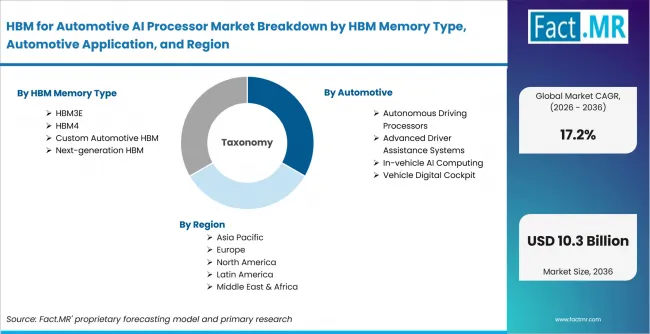
Hbm For Automotive Ai Processor Market Breakdown By Hbm Memory Type, Automotive Application, And Region | Source: Fact.MR
| Attribute | Details |
|---|---|
| Quantitative Units | USD billion in 2026 to USD billion by 2036 at CAGR |
| Market Definition | High-bandwidth memory used with automotive AI processors that support perception, sensor fusion, cockpit intelligence and autonomous driving compute |
| HBM Memory Type | HBM2E; HBM3; HBM3E; HBM4; Other HBM types |
| Automotive Application | Autonomous Driving Processors; ADAS Processors; Cockpit AI Processors; Sensor Fusion Processors; Central Vehicle Compute |
| End User | Automotive OEMs; Tier 1 Suppliers; Semiconductor Companies; Autonomous Vehicle Developers; Mobility Technology Providers |
| Integration Model | System-on-Chip Integration; Chiplet Integration; Co-Packaged Memory; Accelerator Module Integration; Custom Board Integration |
| Packaging Technology | Through-Silicon Via Technology; Silicon Interposer Packaging; Hybrid Bonding; Advanced Substrate Packaging; Other Advanced Packaging |
| Regions Covered | North America; Latin America; Europe; East Asia; South Asia and Pacific; Middle East and Africa |
| Countries Covered | South Korea; China; USA; Japan; Germany; Taiwan; Singapore |
| Key Companies Profiled | SK hynix Inc.; Samsung Electronics Co., Ltd.; Micron Technology, Inc.; Taiwan Semiconductor Manufacturing Company Limited; Advanced Micro Devices, Inc. |
| Forecast Period | 2026 to 2036 |
| Approach | Hybrid top-down and bottom-up approach using memory demand; automotive AI processor adoption; packaging readiness; country growth; segment shares; provider review |
Source: Fact.MR analysis. Updated Aug 10, 2026
How is the market segmented?
-
By HBM Memory Type
- HBM3E
- 8-Hi HBM3E
- 12-Hi HBM3E
- HBM4
- Pre-production HBM4
- Early Production HBM4
- Custom Automotive HBM
- Low-power HBM
- Automotive-grade HBM
- Next-generation HBM
- High-bandwidth AI Memory
- Functional Safety HBM
- HBM3E
-
By Automotive Application
- Autonomous Driving Processors
- Level 4 Autonomous Driving
- Level 5 Autonomous Driving
- Advanced Driver Assistance Systems
- Surround View Processing
- Driver Monitoring Systems
- In-vehicle AI Computing
- In-cabin Intelligence
- Predictive Safety Systems
- Vehicle Digital Cockpit
- Infotainment AI
- Occupant Monitoring
- Autonomous Driving Processors
-
By End User
- Automotive OEMs
- Passenger Vehicle Manufacturers
- Commercial Vehicle Manufacturers
- Automotive Tier 1 Suppliers
- AI Processor Developers
- Automotive Electronics Manufacturers
- Intelligent Mobility Providers
- Smart Mobility Companies
- Robotaxi Developers
- Autonomous Vehicle Technology Companies
- Connected Vehicle Platform Providers
- Software-defined Vehicle Developers
- Automotive OEMs
-
By Integration Model
- System-on-Chip Integration
- AI Domain Controllers
- Centralized Vehicle Computing
- Chiplet-based Integration
- Heterogeneous Integration
- Multi-chip Module Integration
- Embedded AI Platforms
- Vehicle Compute Platforms
- Edge AI Computing Modules
- Domain Controller Architecture
- Central Vehicle Computer
- Next-generation ECU Integration
- System-on-Chip Integration
-
By Packaging Technology
- Through-Silicon Via Technology
- Advanced TSV Integration
- Hybrid Bonding
- Chip-on-Wafer-on-Substrate
- Micro-bump Packaging
- Fine-pitch Interconnect
- 2.5D Advanced Packaging
- High-density Silicon Interposer
- Advanced Redistribution Layer
- 3D Memory Integration
- High-density Wafer Bonding
- Automotive-qualified Advanced Packaging
- Through-Silicon Via Technology
-
By Region
- North America
- Latin America
- Western Europe
- Eastern Europe
- East Asia
- South Asia and Pacific
- Middle East & Africa
Frequently Asked Questions
How big is the HBM for automotive AI processor market in 2026?
What is the CAGR of the HBM for automotive AI processor market from 2026 to 2036?
Which HBM memory type leads the HBM for automotive AI processor market?
Which automotive application leads the HBM for automotive AI processor market?
Who are the leading companies in the HBM for automotive AI processor market?
Who worked on this report


Preview the report firsthand - request a free sample
Free SampleGet the brochure for pricing and purchase details
Download PDF