- Market Value (2025): USD 4.3 Bn
- Estimated Value (2026): USD 4.6 Bn
- Forecast Value (2036): USD 8.2 Bn
- CAGR (2026-2036): 6.0%
What is the Bean Bag Chairs Market forecast to be worth by 2036?
USD 8.2 billion by 2036 at a 6.0% CAGR.
- The Bean Bag Chairs Market reached USD 4.3 billion in 2025.
- Demand is projected to increase from USD 4.6 billion in 2026 to USD 8.2 billion by 2036.
- The market is projected to expand at a 6.0% CAGR from 2026 to 2036.
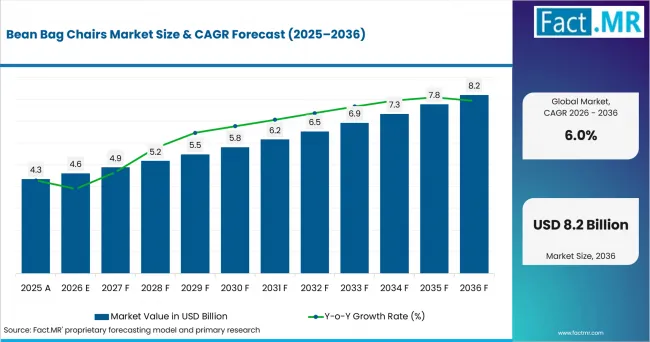
Bean Bag Chairs Market Value Analysis | Source: Fact.MR
What are the defining numbers behind Bean Bag Chairs Market growth?
An absolute opportunity of USD 3.6 billion is expected between 2026 and 2036.
- Demand Drivers in the Market
- E-commerce makes bean bag chairs easier to sell beyond traditional furniture stores, especially because many models can be compressed for shipping. The U.S. Census Bureau reported that e-commerce accounted for 17.1% of total U.S. retail sales in the second quarter of 2026. In Europe, Eurostat found that 19% of EU internet users bought furniture, home accessories or gardening products online in 2024. Bean bag chairs are well suited to this channel when sellers use compact packaging, provide clear size information and make returns easy to manage.
- Bean bag chairs also appeal to households looking for seating that can serve more than one purpose. Unlike framed furniture, they can be moved between living rooms, bedrooms, reading spaces and gaming areas as needs change. Yogibo, for example, markets its Max as a chair, recliner, bed and sofa. This flexibility allows one product to support several everyday uses.
- Easy cleaning matters in homes with children or pets. Washable and replaceable covers make fabric seating easier to maintain and reduce concerns about spills or frequent use. Lovesac offers machine-washable and replaceable covers across its Sacs range, while CordaRoy’s promotes machine-washable outer covers for its convertible chair-to-bed products. This makes bean bag seating more practical for high-use rooms.
- Outdoor materials are giving bean bag chairs a role beyond indoor lounging. Fatboy’s Original Outdoor bean bag uses UV-, water- and dirt-resistant Olefin fabric, refillable EPS and washable construction. Features such as these allow suppliers to address balconies, patios and terraces, as well as outdoor hospitality areas where standard indoor fabrics would be less suitable.
- Safety remains an important consideration because many bean bag chairs contain loose foam pellets. The U.S. Consumer Product Safety Commission identifies suffocation and choking risks and notes that the voluntary bean bag chair standard includes requirements for locking or permanently disabled zippers, warning labels and durability. Better control over zipper access, seams and fill containment can therefore make these products more acceptable for homes and institutional settings.
- Physical stores continue to play an important role even as online sales expand. The U.S. Census Bureau counted 21,964 employer furniture-store establishments in 2023. These stores allow buyers to judge the size and comfort of a bean bag chair before purchasing, while online channels give them access to a wider range of colours and sizes than a showroom can typically stock.
- Smaller household sizes also support demand for seating that is easy to move or adapt. Statistics Korea reported that one-person households accounted for 35.5% of Korean households in 2023. Japan’s Statistical Handbook reported that one-person households represented about 38% of private households in 2020. In these homes, furniture that can be repositioned easily or switch between sitting and sleeping uses can make better use of limited space.
- Key Segments Analyzed
- Classic Bean Bag Chairs account for 68.4% of Product in 2026 because the familiar round and pear-shaped designs work across a wide range of household settings. They require little setup, are available across broad price bands and suit everyday lounging without asking buyers to adapt to an unfamiliar format.
- Residential Use accounts for 37.2% of Application in 2026 as bean bag chairs fit naturally into informal areas of the home. They can be shifted between bedrooms and living spaces for reading, gaming, television viewing or casual seating, making them useful as secondary furniture rather than fixed room pieces.
- Household Consumers account for 74.8% of End Use in 2026 because the category serves several types of buyers within the same home. Adults may use bean bags for casual seating, while children and families use them in bedrooms or shared spaces. Apartment households also benefit from furniture that is easier to move than conventional chairs.
- Advanced Filling Technology accounts for 52.6% of Technology in 2026 because the filling material has a direct effect on how the chair feels and performs. EPS and alternative foam systems influence body support, rebound and overall weight, while also affecting compression during shipping and the ease with which a chair can be refilled after prolonged use.
- Premium Comfort Configurations account for 61.9% of Formulation in 2026 as brands use fabric quality and construction to move beyond basic price competition. Deeper seating and washable covers, along with more supportive designs, give buyers clearer reasons to choose one product over another when visual differences alone are limited.
- Analyst Opinion at Fact.MR
- Shambhu Nath Jha, Principal Consultant, Fact.MR, notes: "Bean bag chairs are becoming more engineered even when their appearance stays simple. Fill behavior, washable covers, zipper safety, fabric durability, pack size and the ability to switch between lounging, gaming, outdoor and guest-use roles now determine whether a product can command repeat retail space or online visibility. Suppliers that design around those practical ownership details will be better positioned than companies competing only on color and price."
- Strategic Implications
- Manufacturers should treat filling design and cover engineering as the core product system. EPS bead size, shredded-foam density, recovery after compression, refill access, seam strength, zipper control and fabric stretch all shape comfort and durability. Product teams therefore need to test the chair after repeated sitting, washing, refilling and transport cycles rather than qualifying only the new product.
- Packaging economics deserve equal attention. Bean bag seating occupies substantial volume after unpacking, so the ability to compress foam or ship fill efficiently can materially change parcel cost, warehouse density and e-commerce viability. The Lovesac Company has long used compressed packaging for its Sacs, and its current 2026 filing still positions Sacs as premium foam beanbag chairs within an omnichannel furniture model.
- Portfolio planning should be benchmarked against the wider furniture market and home furniture categories because bean bags compete for discretionary room space even when their construction is distinct. Suppliers can defend that space through lighter weight, flexible placement, cleanable covers and products that solve more than one seating task.
- Outdoor product lines should be designed as a separate specification rather than a fabric-color extension of indoor models. The adjacent outdoor furniture category places more weight on UV stability, water repellence, cleanability, refillability and seasonal storage. These properties create room for premium outdoor loungers in patios, terraces, resorts and cafes.
- Age- and activity-specific ranges also warrant distinct merchandising. The kids furniture and playroom furniture categories overlap with bean bags where households want soft, movable seating for reading, gaming, sleepovers and play. In these applications, safety, washability and right-sized dimensions matter more than decorative novelty alone.
How does the Bean Bag Chairs Market break down by segment?
The market is analyzed by Product, Application, End Use, Technology, Formulation and Distribution Channel.
Why do Classic Bean Bag Chairs lead Product?
Classic Bean Bag Chairs are projected to account for a 68.4% share of Product in 2026.
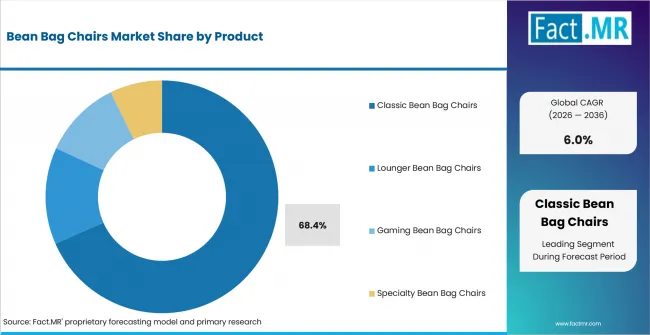
Bean Bag Chairs Market Analysis By Product | Source: Fact.MR
Round and pear-shaped bean bag chairs remain widely used because they deliver the basic appeal of the category without complicated construction. A flexible outer cover and contained filling allow the chair to mould around the user, while the absence of a rigid frame keeps assembly to a minimum. The same basic format can therefore serve children’s rooms and adult lounging areas across different price points.
Their familiarity also makes them easier to sell. Furniture stores can display a few representative sizes and fabrics, allowing shoppers to experience the characteristic sink and support before selecting a preferred colour or cover. Online retailers benefit from the same recognisable shape because buyers already understand how the product is intended to be used, even when it is delivered compressed or partially filled.
Manufacturers can still add higher-value features without changing the underlying design. Lovesac uses shredded Durafoam and replaceable machine-washable covers in its Sacs range, while Yogibo combines adaptive EPS micro-beads with washable covers. These upgrades improve comfort and maintenance while preserving the familiar bean bag format.
Why does Residential Use lead Application?
Residential Use is projected to account for a 37.2% share of Application in 2026.
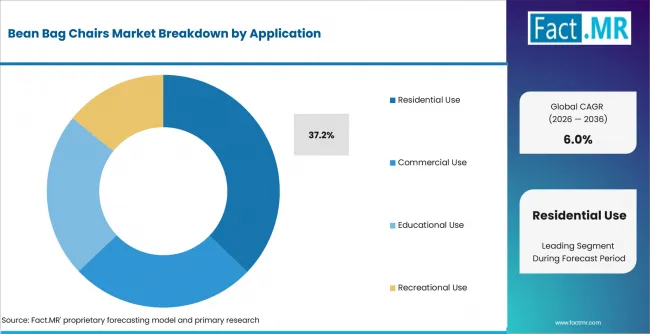
Bean Bag Chairs Market Analysis By Application | Source: Fact.MR
Homes create more opportunities for bean bag seating because the same chair can move with the household rather than remain tied to one room. It may be used in a living room one day and shifted to a bedroom, gaming corner or reading area the next. For buyers who want extra seating without adding another heavy framed chair, that flexibility is a practical advantage.
Online furniture shopping extends this residential reach. Eurostat reported that 19% of EU internet users purchased furniture, home accessories or gardening products online in 2024, with higher participation among adults aged 25 to 44. In the USA, e-commerce accounted for 17.1% of retail sales in the second quarter of 2026. These channels make it easier for households to compare sizes and order replacement covers or filling even when local stores carry only a limited range.
Residential buyers also place value on products that can adapt to occasional needs. Yogibo markets seating that can be used for sitting, reclining or sleeping, while CordaRoy’s offers bean bag chairs that convert into beds and use washable outer covers. Such features are useful in homes where buyers want an extra sleeping or lounging option without permanently giving up floor space to rigid furniture.
Why do Household Consumers lead End Use?
Household Consumers are projected to account for a 74.8% share of End Use in 2026.
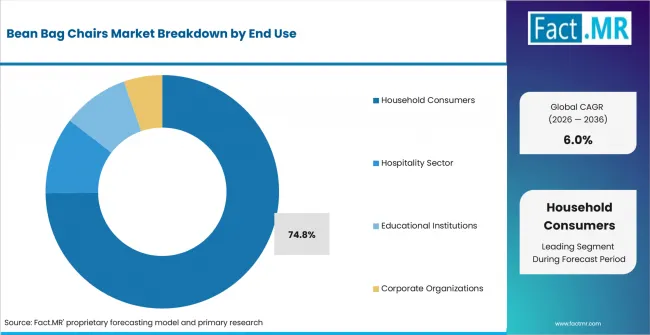
Bean Bag Chairs Market Analysis By End Use | Source: Fact.MR
Household demand comes from many everyday situations rather than a single purchasing cycle. Adults may add a bean bag for casual seating, parents may buy one for a child’s room, and renters or gamers may use it where a conventional chair feels too bulky. Purchases can also follow a room refresh, a dorm move or the need for occasional extra seating, giving the household segment several recurring entry points.
Ease of maintenance matters once the product is in regular use. Spills and pet hair, along with frequent movement between rooms, make removable covers and refillable filling more valuable over time. Fatboy offers refillable and cleanable outdoor bean bags, Yogibo sells refill beads and washable covers, and Lovesac provides replaceable machine-washable Sac covers. These features can extend product life while creating follow-on demand for covers and filling.
Safety has greater visibility in household use because children may come into direct contact with zippers and loose filling. The U.S. Consumer Product Safety Commission states that refillable bean bag chairs should use locking zippers that require a special tool, while non-refillable products should use permanently disabled zippers or no zipper. Secure seams and controlled access to filling therefore influence household confidence as much as comfort or appearance.
Why does Advanced Filling Technology lead Technology?
Advanced Filling Technology is projected to account for a 52.6% share of Technology in 2026.
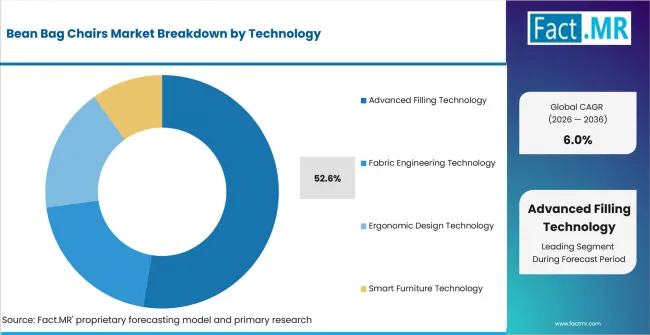
Bean Bag Chairs Market Analysis By Technology | Source: Fact.MR
Filling material has a direct effect on how a bean bag chair feels in use. It determines how quickly the chair shapes around the body, how far the user sinks and how easily the product can be moved. EPS beads create a lighter structure that shifts readily with movement, while shredded foam usually produces a denser feel and can be compressed more efficiently for transport.
Products on the market use both approaches. Fatboy specifies expanded polystyrene filling in its Original Outdoor range, while Yogibo uses EPS micro-beads that move with the user. Lovesac takes a different route with a proprietary shredded Durafoam blend in its Sacs. The presence of both bead-based and foam-based designs shows that filling is a visible part of product performance rather than a minor internal component.
Filling technology also affects how well the chair can be maintained over time. Bead-filled products can be topped up when the filling settles, while foam-filled products can often be refluffed to restore volume. Suppliers that manage fill density and material consistency well can deliver a more predictable comfort experience and reduce the need for early replacement.
Why do Premium Comfort Configurations lead Formulation?
Premium Comfort Configurations are projected to account for a 61.9% share of Formulation in 2026.
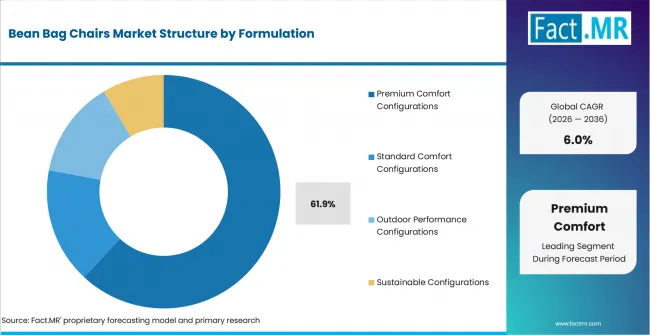
Bean Bag Chairs Market Analysis By Formulation | Source: Fact.MR
Premium comfort comes from how the filling, liner and outer cover work together. Buyers notice differences in softness, support and surface feel immediately, which makes these features easier to demonstrate in a showroom than technical product claims. Replacement covers also allow owners to refresh the appearance or feel of the chair without replacing the entire product.
Washability adds practical value because bean bag chairs are used in close contact with the body and are exposed to spills, dust and pet hair. Lovesac, Yogibo and CordaRoy’s all promote machine-washable covers across their current or recent ranges. CordaRoy’s also uses CertiPUR-US certified foam in its convertible products, giving buyers an additional indication of material quality in a product where the filling is normally hidden from view.
Premium configurations can also justify higher prices by serving more than one purpose. Deeper loungers, gaming-oriented designs and chair-to-bed formats can replace the need for separate pieces of furniture. This is particularly useful in apartments, dorm rooms and guest spaces where buyers weigh comfort against available floor space and the cost of adding another conventional chair or bed.
Why do Furniture Retail Stores lead Distribution Channel?
Furniture Retail Stores are projected to account for a 45.7% share of Distribution Channel in 2026.
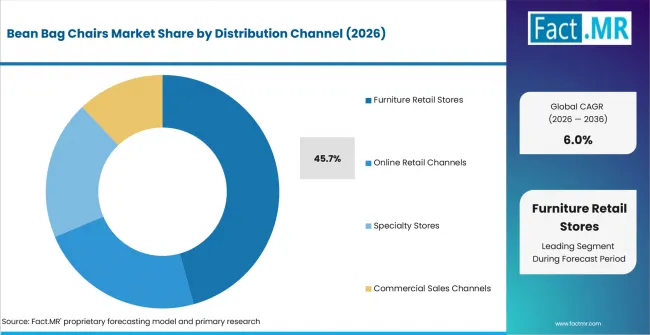
Bean Bag Chairs Market Analysis By Distribution Channel | Source: Fact.MR
Bean bag chairs are highly tactile products. Diameter, seat height, sink depth, ease of standing up, fabric stretch and perceived fill density are hard to judge from product photography alone. Physical stores therefore remain useful for trial, especially for premium products or households comparing a bean bag with lounge chairs, ottomans and other soft seating.
The U.S. Census Bureau counted 21,964 employer furniture-store establishments in 2023, illustrating the reach of physical furniture distribution. Stores can hold demonstration units while fulfilling additional colors or sizes from central inventory, which reduces the need to keep every bulky configuration on the sales floor.
Online retail is nevertheless changing how the store functions. In the UK, the Office for National Statistics reported that internet sales represented 24.7% of household-goods retail in 2025 and 25.9% in the second quarter of 2026. The practical response is an omnichannel model in which shoppers test comfort or size in person, then order a specific cover, color or delivery option digitally.
What is accelerating Bean Bag Chairs Market adoption, and what is holding it back?
Adoption is being supported by e-commerce reach, flexible household layouts, gaming and entertainment use, washable covers, refillable filling systems and product designs that combine lounging with sleeping or outdoor use. These features expand the role of a bean bag from low-cost occasional seating toward a configurable furniture purchase with clearer durability and serviceability attributes.
Drivers Impact Analysis
| Factor | (~) % Impact on CAGR | Geographic Relevance | Impact Timeline |
|---|---|---|---|
| E-commerce and direct-to-consumer furniture buying | +1.0% | USA, UK, Europe, Japan and South Korea | Short term (<= 2 years) |
| Residential flexible and multipurpose seating | +0.8% | Global urban households | Medium term (2-4 years) |
| Gaming, reading and home entertainment seating | +0.6% | USA, Europe and East Asia | Medium term (2-4 years) |
| Washable, refillable and serviceable product design | +0.5% | Global | Medium term (2-4 years) |
| Hospitality, education and informal lounge adoption | +0.4% | Europe, USA and East Asia | Long term (> 4 years) |
Source: Fact.MR analysis. Updated Aug 26, 2026
Opportunity Impact Analysis
| Factor | (~) % Impact on CAGR | Geographic Relevance | Impact Timeline |
|---|---|---|---|
| Higher-performance EPS, foam and hybrid fill systems | +0.6% | Global | Medium term (2-4 years) |
| Weather-resistant outdoor bean bag ranges | +0.5% | USA, UK, France, Germany, Italy and Japan | Long term (> 4 years) |
| Convertible chair-to-bed and small-space designs | +0.5% | South Korea, Japan, Europe and USA | Medium term (2-4 years) |
| Recycled material and lower-waste configurations | +0.4% | Europe, USA and Japan | Long term (> 4 years) |
| Omnichannel specialty retail and brand-owned websites | +0.4% | Global | Medium term (2-4 years) |
Source: Fact.MR analysis. Updated Aug 26, 2026
Restraints Impact Analysis
| Factor | (~) % Impact on CAGR | Geographic Relevance | Impact Timeline |
|---|---|---|---|
| Discretionary furniture spending pressure | -0.7% | France, Italy, Germany and UK | Short term (<= 2 years) |
| Zipper, seam and fill-containment safety requirements | -0.5% | USA and regulated export markets | Short term (<= 2 years) |
| Foam, EPS, fabric and bulky-freight cost exposure | -0.5% | Global | Short term (<= 2 years) |
| Long replacement cycle for durable seating | -0.4% | Mature household markets | Long term (> 4 years) |
Source: Fact.MR analysis. Updated Aug 26, 2026
Which countries are scaling the Bean Bag Chairs Market through 2036?
- USA: A deep furniture-store network and high e-commerce participation support both trial and direct ordering. Safety engineering around zippers, seams and fill containment is also an important differentiator for products used in family environments.
- UK: Household-goods retail has a substantial online component, which favors brands that can combine compressed delivery, clear dimensions and easy cover-care instructions with physical furniture retail and specialty showrooms.
- France: Online furniture and home-goods purchasing gives casual seating broad digital reach, while softer conventional furniture consumption increases the importance of multifunctional products, differentiated fabrics and value-oriented positioning.
- Germany: A high share of consumers already buys furniture, home accessories or garden products online. Durable, practical seating with clear care instructions can serve both apartment households and omnichannel furniture buyers.
- Italy: Online purchasing of household articles is established even as conventional furniture sales remain uneven. Growth therefore depends on design differentiation, price discipline, movable seating and direct-to-consumer visibility rather than broad furniture-category expansion alone.
- South Korea: The high incidence of one-person households and strong online shopping activity support compact, repositionable and digitally merchandised seating that can fit bedrooms, studios, gaming spaces and multipurpose living areas.
- Japan: Household goods, furniture and interiors already have a high e-commerce ratio, while a large one-person household base supports products that are movable, space-conscious and capable of serving more than one function.
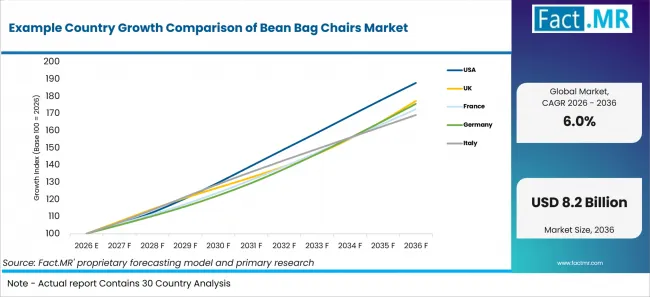
Example Country Growth Comparison Of Bean Bag Chairs Market | Source: Fact.MR
| Country | CAGR, 2026-2036 |
|---|---|
| USA | 6.5% |
| UK | 5.9% |
| France | 5.6% |
| Germany | 5.8% |
| Italy | 5.4% |
| South Korea | 6.2% |
| Japan | 5.7% |
Source: Fact.MR analysis. Updated Aug 26, 2026
What is driving USA's growth through 2036?
The USA is forecast to expand at a 6.5% CAGR from 2026 to 2036.
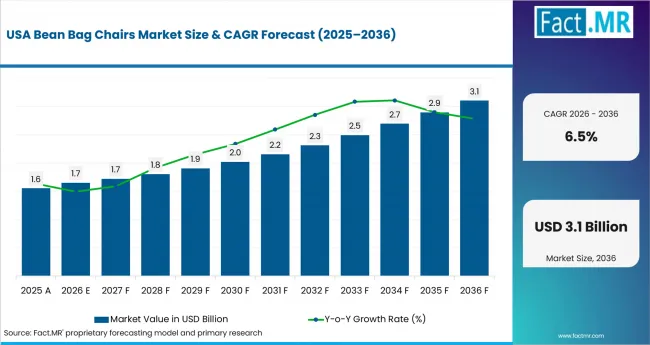
Bean Bag Chairs Market Country Value Analysis | Source: Fact.MR
The country combines a broad furniture retail network with a growing digital share of total commerce. The U.S. Census Bureau reported 21,964 employer furniture-store establishments in 2023. It also reported that e-commerce represented 17.1% of total retail sales in the second quarter of 2026, up 12.2% year on year. This gives bean bag brands several routes to market, from tactile store trial to direct shipment of compressed products.
Product safety also shapes category quality. The U.S. Consumer Product Safety Commission identifies suffocation and choking hazards from loose foam pellets and points to locking or permanently disabled zippers, warning labels and durability requirements in the voluntary standard. Suppliers that engineer fill containment into kids, residential and institutional lines can turn compliance capability into retailer acceptance and consumer trust.
The USA also supports premium foam and omnichannel models. The Lovesac Company’s fiscal 2026 Form 10-K describes Sacs as premium foam beanbag chairs filled with proprietary Durafoam and fitted with removable, machine-washable covers. The company sells through showrooms and online channels, demonstrating how physical demonstration and digital fulfillment can be combined in a higher-value bean bag proposition.
What is driving UK's growth through 2036?
The UK is forecast to expand at a 5.9% CAGR from 2026 to 2036.
Online household-goods purchasing is already deeply embedded. The Office for National Statistics reported that internet sales represented 24.7% of household-goods retail in 2025 and 25.9% in the second quarter of 2026 on a seasonally adjusted basis. Bean bag chairs can benefit because digital assortments can carry far more colors, sizes and covers than a physical floor display while stores still provide a place to test comfort.
The UK channel also suits products with easy-care and outdoor attributes. Weather-resistant bean bags can extend beyond bedrooms and living rooms into patios, balconies and hospitality terraces, while washable covers help family use. Fatboy’s current Original Outdoor specification, for example, combines water repellence, high UV resistance, refillable EPS and washable construction, showing the kind of feature bundle that supports higher-value casual seating.
What is driving France's growth through 2036?
France is forecast to expand at a 5.6% CAGR from 2026 to 2036.
Digital buying creates an accessible route to consumers even in a mature furniture market. Insee reported that 20% of people aged 15 or over bought furniture, home items or gardening products online in the three months before its 2024 survey, rising to 25% among people aged 15 to 44. This supports online discovery of casual seating, especially when brands provide strong product photography, dimensions and delivery information.
At the same time, conventional furniture demand is not uniformly strong. Insee reported that French household furniture purchases declined in volume in 2025. Bean bag growth therefore depends less on broad category uplift and more on taking room share through movable, washable and multifunctional products that can be used for gaming, reading, children’s spaces or occasional guests.
What is driving Germany's growth through 2036?
Germany is forecast to expand at a 5.8% CAGR from 2026 to 2036.
Furniture e-commerce is well established. Destatis reported that 23% of people aged 16 to 74 bought furniture, home accessories or garden products online in 2024, with the share reaching 29% among people aged 25 to 54. Digital comparison therefore matters for bean bag brands, but product specifications must make size, fabric, fill and washability easy to compare.
What is driving Italy's growth through 2036?
Italy is forecast to expand at a 5.4% CAGR from 2026 to 2036.
Online household purchasing is increasingly relevant. Istat reported that 13.7% of people aged 14 or over bought household items, furniture or gardening products online in the three months before its 2024 survey. In June 2025, Italian online retail sales were 4.1% higher year on year, showing continued digital channel expansion even when individual non-food categories moved differently.
What is driving South Korea's growth through 2036?
South Korea is forecast to expand at a 6.2% CAGR from 2026 to 2036.
Household structure supports compact and movable furniture. Statistics Korea reported 7.829 million one-person households in 2023, equal to 35.5% of all households. A bean bag chair can serve as primary casual seating in a bedroom or studio, move for gaming or guests and be stored or repositioned more easily than many framed chairs.
The online channel reinforces that fit. The Ministry of Data and Statistics reported that South Korea's online shopping transaction value rose 13.3% year on year in September 2025, with mobile shopping representing 75.9% of the total. Bean bag brands that optimize product pages for mobile discovery, package dimensions and delivery scheduling can reach apartment and single-person households without relying on large showroom networks.
Gaming and entertainment use adds another demand route. Flexible seating can be merchandised for console play, streaming and floor-level lounging, while washable covers and refillable bead systems address frequent use. Suppliers should keep dimensions and ingress-egress comfort clear because small homes reward space efficiency but punish oversized products that are difficult to return or store.
What is driving Japan's growth through 2036?
Japan is forecast to expand at a 5.7% CAGR from 2026 to 2036.
Japan already has a strong digital channel for household goods. The Ministry of Economy, Trade and Industry reported that household goods, furniture and interiors had a 32.58% e-commerce ratio in 2024. This supports wide digital assortments of colors, fabrics and compact seating formats, particularly when suppliers can ship products in compressed packaging and make cover replacement available online.
Who Leads the Bean Bag Chairs Market?
Key players in the Bean Bag Chairs Market include LoveSac, Fatboy, Yogibo, Sumo Lounge, Comfy Sacks, Ultimate Sack, CordaRoy’s, Big Joe, MUJI and Ace Bayou Corp.
Competition is shaped by comfort engineering, fabric selection, fill technology, washable or replaceable covers, outdoor durability, safety design, pack size, price architecture and the ability to sell consistently across physical and digital channels. The category is visually simple, so small differences in fill behavior, seam quality and serviceability can create a large difference in consumer experience after several months of use.
Which companies are the key providers?
Key providers are LoveSac, Fatboy, Yogibo, Sumo Lounge, Comfy Sacks, Ultimate Sack, CordaRoy’s, Big Joe, MUJI and Ace Bayou Corp.
- LoveSac
- Fatboy
- Yogibo
- Sumo Lounge
- Comfy Sacks
- Ultimate Sack
- CordaRoy’s
- Big Joe
- MUJI
- Ace Bayou Corp.
Bibliography
- U.S. Census Bureau. (2026). Quarterly Retail E-Commerce Sales, Second Quarter 2026. U.S. Department of Commerce.
- U.S. Census Bureau. (2026). County Business Patterns: Furniture Stores, 2023. U.S. Department of Commerce.
- U.S. Consumer Product Safety Commission. (2021). Resellers Guide to Selling Safer Products: Bean Bag Chairs. U.S. Consumer Product Safety Commission.
- Eurostat. (2025). E-commerce Statistics for Individuals: Online Purchases of Goods, EU, 2024. European Commission.
- Office for National Statistics. (2026). Internet Sales: Household Goods Stores, Proportion of Retail. UK Statistics Authority.
- Insee. (2025). Achats de produits et de services en ligne. Institut national de la statistique et des études économiques.
- Insee. (2026). Household Consumption in 2025. Institut national de la statistique et des études économiques.
- Statistisches Bundesamt. (2024). 83% der 16- bis 74-Jährigen kaufen online ein. Federal Statistical Office of Germany.
- Statistisches Bundesamt. (2025). Private Consumption Expenditure of Households by Size of Household. Federal Statistical Office of Germany.
- Istat. (2025). Citizens and ICT - Year 2024. Italian National Institute of Statistics.
- Istat. (2025). Retail Trade - June 2025. Italian National Institute of Statistics.
- Istat. (2025). Italy’s Economic Outlook 2025-2026. Italian National Institute of Statistics.
- Statistics Korea. (2024). 2024 Statistics of One-person Households. Statistics Korea.
- Ministry of Data and Statistics. (2025). Online Shopping in September 2025. Republic of Korea.
- Ministry of Economy, Trade and Industry. (2025). Results of FY2024 E-Commerce Market Survey Compiled. Government of Japan.
- Statistics Bureau of Japan. (2025). Statistical Handbook of Japan 2025. Ministry of Internal Affairs and Communications.
- The Lovesac Company. (2026). Annual Report on Form 10-K for the Fiscal Year Ended February 1, 2026. The Lovesac Company.
- Fatboy. (2026). Original Outdoor Product Specifications. Fatboy.
- Yogibo. (2026). Yogibo Max Product Specifications. Yogibo.
- CordaRoy’s. (2026). Convertible Bean Bag Product Specifications. CordaRoy’s.
This Report Answers
- How the Bean Bag Chairs Market is expected to progress from USD 4.6 billion in 2026 to USD 8.2 billion by 2036.
- Why Classic Bean Bag Chairs, Residential Use, Household Consumers, Advanced Filling Technology, Premium Comfort Configurations and Furniture Retail Stores hold their 2026 leadership positions.
- How e-commerce, flexible household layouts, gaming and entertainment use, washability, outdoor fabrics and convertible designs influence purchases.
- Why USA, UK, France, Germany, Italy, South Korea and Japan follow different demand pathways through 2036.
- How fill technology, cover engineering, safety, pack size, retail trial, digital fulfillment and serviceability shape competition among key providers.
What does the Bean Bag Chairs Market cover?
The market covers revenue from complete bean bag chairs and related finished flexible-seating products sold in the specified Product, Application, End Use, Technology, Formulation and Distribution Channel categories. It includes classic round and pear-shaped chairs, loungers, gaming bean bags, convertible bean bag chairs and kids bean bag chairs supplied with EPS, foam or alternative filling systems and a functional cover and liner system.
Revenue is counted at the finished seating-product level through furniture retail stores, e-commerce marketplaces, brand-owned websites, specialty stores and commercial procurement channels. Residential, hospitality, educational, recreational and corporate purchases are included when the product is sold as bean bag seating within the specified taxonomy.
What is included in the scope?
Included are indoor and outdoor bean bag chairs, round and pear-shaped classic formats, loungers, gaming products, convertible chair-to-bed products and kids bean bags. The scope includes EPS and alternative fill systems, indoor and outdoor fabric engineering, ergonomic support systems, premium, standard, outdoor-performance and sustainable configurations, and complete products sold through the listed retail and commercial channels.
Commercial sales to hotels, resorts, restaurants, cafes, schools, universities, small and medium businesses and large enterprises are included when the purchase is for finished bean bag seating. Replacement covers or refill material are treated as supporting product revenue only when they are sold as part of maintaining a bean bag chair offering rather than as unrelated textile or chemical products.
What is excluded from the scope?
The scope excludes conventional framed armchairs, sofas, recliners, ottomans and mattresses that are not marketed as bean bag chairs or convertible bean bag products. Loose EPS beads, bulk foam, fabric rolls, zippers and liners sold as independent raw materials are excluded from finished chair revenue unless supplied within a complete chair or an associated refill or replacement program.
The market also excludes unrelated floor cushions, pet beds, inflatable furniture and rigid gaming chairs. Revenue from e-commerce platforms, furniture stores or hospitality projects is counted only for the bean bag chair product itself, not for the full value of adjacent furniture, room renovation, logistics or interior-design services.
How Was the Analysis Built?
The analysis combines primary interviews with bean bag chair manufacturers, furniture retailers, e-commerce sellers, commercial buyers and material specialists with secondary research across public retail statistics, household expenditure data, e-commerce adoption, consumer-product safety guidance and first-party product specifications. The analysis draws on more than 120 sources, over 35 company portfolios and more than 20 industry interviews across at least 25 countries.
Primary respondents included furniture product managers, soft-seating designers, fill and foam specialists, fabric and cover engineers, furniture-store buyers, e-commerce category managers, hospitality procurement teams, education buyers, logistics managers and consumer-product safety specialists. Interviews focused on product mix, pricing, comfort attributes, fill performance, packaging, returns, replacement covers, retail trial, channel economics and demand by use case.
Sizing variables included retail and online furniture activity, installed distribution reach, household and commercial seating demand, product price tiers, classic versus specialty product mix, EPS versus alternative filling systems, indoor versus outdoor configurations, replacement and refill behavior, sales-channel mix, country growth patterns and supplier portfolio depth. Triangulation was used to reconcile demand-side purchasing signals with supplier-side product and channel evidence.
Segmentation
What is the report's scope and coverage?
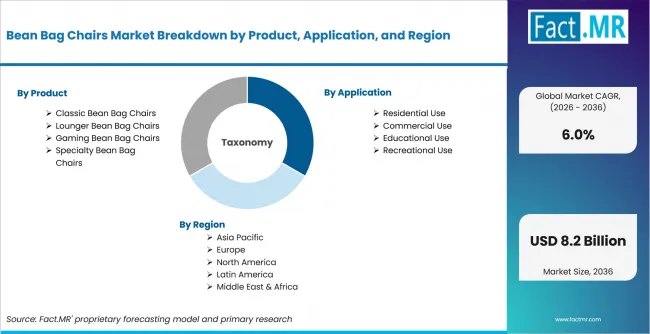
Bean Bag Chairs Market Breakdown By Product, Application, And Region | Source: Fact.MR
| Metric | Coverage |
|---|---|
| Quantitative Units | USD billion |
| Market Definition | Finished bean bag chairs and flexible bean bag seating sold across the specified product, application, end-use, technology, formulation and distribution categories |
| Base Year | 2026 |
| Historical Reference | 2021-2025 |
| Forecast Period | 2026-2036 |
| 2025 Market Value | USD 4.3 billion |
| 2026 Market Value | USD 4.6 billion |
| 2036 Market Value | USD 8.2 billion |
| Forecast CAGR | 6.0% |
| Absolute Opportunity | USD 3.6 billion |
| Countries | USA, UK, France, Germany, Italy, South Korea and Japan |
| Primary Buyers | Households, hospitality operators, educational institutions, corporate organizations and recreational users |
| Channels | Furniture retail stores, online retail, specialty stores and commercial sales channels |
| Competitive Coverage | LoveSac, Fatboy, Yogibo, Sumo Lounge, Comfy Sacks, Ultimate Sack, CordaRoy’s, Big Joe, MUJI and Ace Bayou Corp |
Source: Fact.MR analysis. Updated Aug 26, 2026
How is the market segmented?
-
By Product:
- Classic Bean Bag Chairs
- Round Bean Bag Chairs
- Pear Shaped Bean Bag Chairs
- Lounger Bean Bag Chairs
- Indoor Lounger Bean Bags
- Outdoor Lounger Bean Bags
- Gaming Bean Bag Chairs
- Console Gaming Bean Bags
- PC Gaming Bean Bags
- Specialty Bean Bag Chairs
- Convertible Bean Bag Chairs
- Kids Bean Bag Chairs
- Classic Bean Bag Chairs
-
By Application:
- Residential Use
- Living Room Applications
- Bedroom Applications
- Commercial Use
- Hospitality Applications
- Office Applications
- Educational Use
- School Applications
- Higher Education Applications
- Recreational Use
- Gaming Applications
- Entertainment Applications
- Residential Use
-
By End Use:
- Household Consumers
- Urban Consumers
- Suburban Consumers
- Hospitality Sector
- Hotels & Resorts
- Restaurants & Cafes
- Educational Institutions
- Schools
- Universities
- Corporate Organizations
- Small & Medium Businesses
- Large Enterprises
- Household Consumers
-
By Technology:
- Advanced Filling Technology
- Expanded Polystyrene Fill Systems
- Alternative Fill Systems
- Fabric Engineering Technology
- Indoor Fabric Systems
- Outdoor Fabric Systems
- Ergonomic Design Technology
- Body Support Systems
- Comfort Optimization Systems
- Smart Furniture Technology
- Connected Seating Systems
- Modular Furniture Systems
- Advanced Filling Technology
-
By Formulation:
- Premium Comfort Configurations
- Luxury Fabric Configurations
- Enhanced Support Configurations
- Standard Comfort Configurations
- Everyday Use Configurations
- Balanced Performance Configurations
- Outdoor Performance Configurations
- Weather Resistant Configurations
- Heavy Duty Configurations
- Sustainable Configurations
- Recycled Material Configurations
- Eco Friendly Configurations
- Premium Comfort Configurations
-
By Distribution Channel:
- Furniture Retail Stores
- Large Format Retailers
- Independent Retailers
- Online Retail Channels
- E Commerce Marketplaces
- Brand Owned Websites
- Specialty Stores
- Home Decor Stores
- Kids Furniture Stores
- Commercial Sales Channels
- Hospitality Procurement Channels
- Corporate Procurement Channels
- Furniture Retail Stores
-
By Region:
- North America
- Latin America
- Western Europe
- Eastern Europe
- East Asia
- South Asia and Pacific
- Middle East & Africa
Frequently Asked Questions
How large is the Bean Bag Chairs Market in 2026?
What CAGR is forecast for the Bean Bag Chairs Market from 2026 to 2036?
What will the Bean Bag Chairs Market be worth by 2036?
Which Product segment leads the Bean Bag Chairs Market in 2026?
Which Application segment leads the Bean Bag Chairs Market in 2026?
Which End Use segment leads the Bean Bag Chairs Market in 2026?
Which Technology segment leads the Bean Bag Chairs Market in 2026?
Which Formulation segment leads the Bean Bag Chairs Market in 2026?
Which Distribution Channel leads the Bean Bag Chairs Market in 2026?
What is USA's growth outlook in the Bean Bag Chairs Market?
Which companies are profiled in the Bean Bag Chairs Market?
Who worked on this report


Preview the report firsthand - request a free sample
Free SampleGet the brochure for pricing and purchase details
Download PDF