- Market Value (2025): USD 6911.3 Mn
- Estimated Value (2026): USD 8217.5 Mn
- Forecast Value (2036): USD 46404.3 Mn
- CAGR (2026-2036): 18.9%
What is the Behind-the-Meter Energy Storage Market forecast to be worth by 2036?
USD 8,217.5 million in 2026 to USD 46,404.3 million by 2036, at 18.9% CAGR.
- The behind-the-meter energy storage market crossed a valuation of USD 6,911.3 million in 2025 across residential and commercial customer sites.
- Demand is projected to increase from USD 8,217.5 million in 2026 to USD 46,404.3 million by 2036.
- The market is forecast to record an 18.9% CAGR from 2026 to 2036 as homeowners and facility managers seek flexible onsite power.
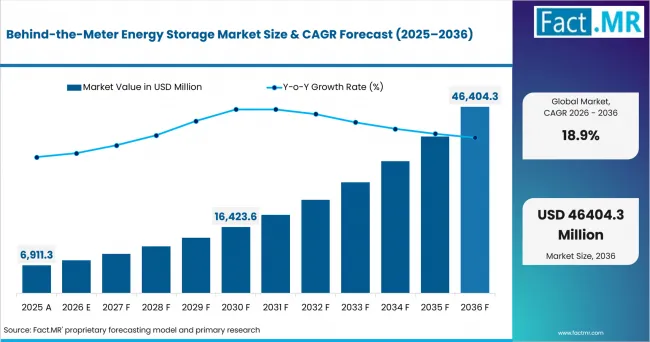
Behind The Meter Energy Storage Market Market Value Analysis | Source: Fact.MR
What are the defining numbers behind Behind-the-Meter Energy Storage Market growth?
USD 38,186.8 million absolute opportunity by 2036 led by Lithium-ion Battery alongside Customer-owned systems.
- Demand Drivers in the Market
- Homeowners need outage-ready storage supported by rooftop solar deployment and time-based electricity tariffs across many service territories.
- Commercial facility managers need peak control owing to demand charges and more variable interval pricing across electricity procurement contracts.
- Plant operators need resilient onsite power shaped by process continuity requirements and power-quality exposure during short grid interruptions.
- Energy service companies need dispatchable customer fleets because aggregated storage creates grid-service revenue pathways beyond individual site savings.
- Key Segments Analyzed
- By Technology: Lithium-ion Battery is expected to account for 68.0% share in 2026, supported by high energy density and broad inverter compatibility.
- By Application: Peak Shaving is projected to account for 34.0% share in 2026, owing to demand reduction needs across tariff-exposed customer sites.
- By Ownership: Customer-owned is estimated to represent 52.0% share in 2026, attributable to direct asset control and retained energy savings.
- Analyst Opinion at Fact.MR
- Shambhu Nath Jha, Senior Analyst at Fact.MR states: “Behind-the-meter storage draws attention when one asset solves several customer problems instead of serving only emergency backup. Demand is expected to favor systems that combine tariff response and outage protection with verifiable dispatch controls. Suppliers should pair safe hardware with installer coverage and interoperable controls alongside clear utility-program enrollment support.”
- Strategic Implications
- Home energy installers should standardize site surveys around load priority and tariff structure before selecting battery capacity or control settings.
- Commercial energy managers should model peak demand reduction separately from outage value before approving storage payback assumptions for each facility.
- Industrial engineering teams should require documented transfer performance and maintenance procedures before connecting storage to process-critical loads.
- Aggregators should verify telemetry quality and customer consent workflows before enrolling distributed storage fleets into utility flexibility programs.
Manufacturers are expanding their product portfolios to support a wider range of customer energy needs through scalable and adaptable storage systems. Enphase Energy launched the IQ Battery 5P with FlexPhase in India in October 2025 for homes and small businesses using single-phase or three-phase power. Each modular unit provides 5 kWh of storage and supports expansion for larger customer loads. The move reflects the wider shift toward customer-site systems that combine backup power with self-consumption controls and flexible system sizing.
India is expected to record a 20.7% CAGR during the forecast period, supported by rooftop solar expansion and recurring backup requirements. China is projected to post a 20.0% CAGR between 2026 and 2036, owing to storage deployment scale and renewable energy time shifting. Australia is anticipated to advance at an 18.7% CAGR over the assessment period, attributable to battery incentives and extensive rooftop solar ownership. The United Kingdom is estimated to record an 18.4% CAGR from 2026 to 2036, shaped by home-upgrade policy and time-based electricity use. The United States is forecast to post an 18.2% CAGR across the forecast horizon, driven by resilience spending and virtual power plant participation. Germany is projected to record a 17.9% CAGR during the forecast period, supported by solar-plus-storage adoption and commercial self-consumption requirements. Japan is anticipated to expand at a 17.6% CAGR over the assessment period, driven by resilience planning and customer-side energy management.
How does the Behind-the-Meter Energy Storage Market break down by segment?
Lithium-ion Battery accounts for 68.0% while Customer-owned leads with 52.0%.
Which Technology category is projected to hold the largest share?
Lithium-ion Battery is projected to account for 68.0% share in 2026.
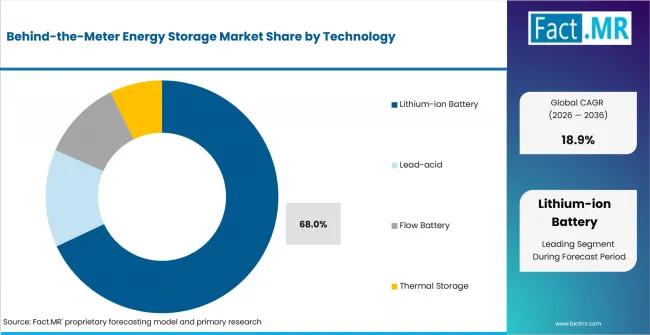
Behind The Meter Energy Storage Market Analysis By Technology | Source: Fact.MR
Lithium-ion Battery is expected to capture 68.0% share in 2026, supported by compact system design and established inverter integration. Lead-acid systems remain relevant where customers prioritize familiar service channels and lower initial equipment spending. Flow Battery systems suit selected sites that value repeated cycling and longer discharge duration across planned operating windows. Thermal Storage supports facilities that can shift cooling or heating demand without converting stored electricity through battery cells. The International Energy Agency reported 108 GW of new battery storage deployment worldwide during 2025. Deployment at that scale supports deeper supply chains and greater installer familiarity across customer-site projects with varied load profiles.
Which Application category is projected to capture the largest share?
Peak Shaving is projected to garner 34.0% share in 2026.
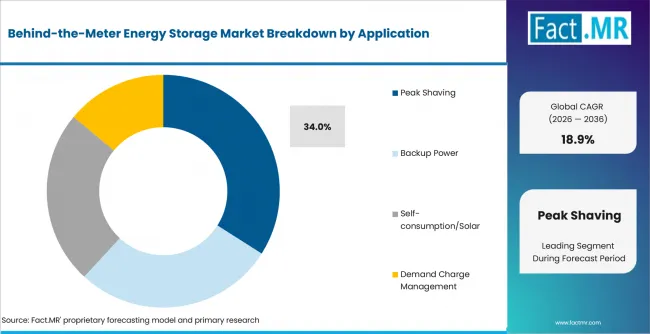
Behind The Meter Energy Storage Market Analysis By Application | Source: Fact.MR
Peak Shaving is projected to account for 34.0% share in 2026, owing to demand charges and short periods of elevated site load. Backup Power remains important where customers must protect essential circuits during outages and short grid interruptions. Self-consumption/Solar applications store onsite generation for use after production falls or electricity prices increase. Demand Charge Management coordinates storage dispatch against measured facility peaks and contracted tariff structures. The United Kingdom technical annex estimates savings of up to £550 annually for a home package combining solar and battery storage with a heat pump. A broader value stack supports storage procurement for daily energy management alongside emergency power protection.
What supports Customer-owned systems within Ownership?
Customer-owned systems account for 52.0% share in 2026.
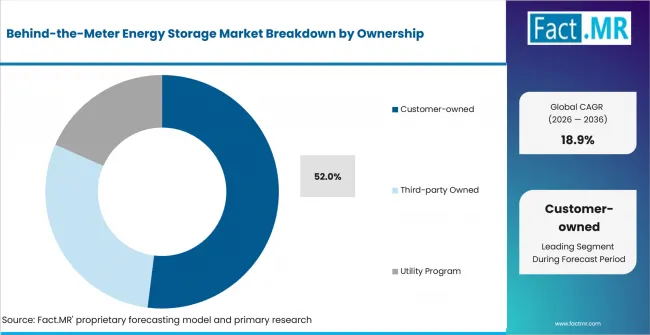
Behind The Meter Energy Storage Market Analysis By Ownership | Source: Fact.MR
Customer-owned systems are estimated to represent 52.0% share in 2026, attributable to direct control and retained bill savings. Third-party Owned systems reduce upfront spending when providers recover costs through leases or energy service agreements. Utility Program structures support installations when enrolled customers provide dispatchable capacity under defined control and compensation terms. Direct ownership remains attractive where customers can combine bill management and resilience value within one investment decision.
What is accelerating Behind-the-Meter Energy Storage Market adoption, and what is holding it back?
Lower storage cost drives it; interconnection delays and payback uncertainty restrain it.
Drivers Impact Analysis
| DRIVER | (~) % IMPACT ON CAGR | GEOGRAPHIC RELEVANCE | IMPACT TIMELINE |
|---|---|---|---|
| Battery cost and supply expansion | +3.0% | Global | Near term (<= 2 years) |
| Rooftop solar pairing | +2.5% | India and Australia | Medium term (2-4 years) |
| Resilience and backup demand | +2.1% | United States and Asia Pacific | Medium term (2-4 years) |
| Time-based tariff optimization | +1.6% | Europe and Australia | Medium term (2-4 years) |
| VPP and utility aggregation | +1.2% | North America and Europe | Long term (>= 4 years) |
Source: Fact.MR analysis. Updated Jul 9, 2026
- Battery supply expansion: Manufacturing scale and broader product choice are reducing procurement friction for customer-site projects across many capacity bands. The International Energy Agency reported that new battery storage deployment reached 108 GW during 2025. Greater equipment availability is expected to shorten supplier selection where installer compatibility and warranty support remain clear.
- Rooftop solar pairing: Solar owners gain more control when stored generation shifts from midday output into evening consumption periods and reduces grid purchases. India had 27.88 GW of grid-connected rooftop solar capacity by May 2026 according to the Ministry of New and Renewable Energy. Storage attachment is projected to expand where installers package controls and backup functions with existing solar systems.
- Resilience and backup demand: Customer-site storage protects prioritized loads without relying on generator fuel logistics during shorter grid interruptions. Facility managers increasingly separate essential circuits from discretionary loads during storage design and commissioning to protect backup duration during outages. Adoption is anticipated to widen where outage costs clearly exceed the annualized storage expense for critical operations.
- Time-based tariff optimization: Storage creates value when customers charge during lower-cost periods and discharge before expensive consumption windows. The United Kingdom technical annex estimates additional savings from time-of-use operation for households using batteries within an integrated home energy package. Demand is estimated to favor control platforms that explain tariff behavior without requiring constant manual intervention.
- VPP and utility aggregation: Aggregated customer batteries give program operators a dispatchable flexibility pool while preserving local backup capability. The U.S. Department of Energy stated in January 2025 that 80 to 160 GW of virtual power plants by 2030 is enough to serve ten to twenty percent of peak load. Enrollment is forecast to expand where telemetry requirements and customer compensation are transparent before households or businesses commit assets to dispatch programs.
Opportunity Impact Analysis
| OPPORTUNITY | (~) % IMPACT ON CAGR | GEOGRAPHIC RELEVANCE | IMPACT TIMELINE |
|---|---|---|---|
| Commercial peak shaving | +1.1% | Europe and North America | Medium term (2-4 years) |
| Third-party ownership models | +0.9% | United States and Australia | Medium term (2-4 years) |
| Thermal storage integration | +0.7% | Europe and industrial markets | Long term (>= 4 years) |
| Small-system program expansion | +0.6% | Australia and India | Near term (<= 2 years) |
Source: Fact.MR analysis. Updated Jul 9, 2026
- Commercial peak shaving: Commercial sites create opportunities where short demand peaks drive a meaningful part of monthly electricity costs. SMA positions its commercial storage solutions around self-consumption and peak load shaving across business energy applications. Opportunity is expected to favor integrators that connect meter data with site load controls before sizing the storage asset.
- Third-party ownership models: Service contracts reduce upfront equipment spending while customers retain backup and bill-management benefits under defined operating terms and dispatch agreements. Financing providers gain recurring revenue when they manage system performance and utility-program participation across pooled assets. Opportunity is projected to expand where contracts state dispatch rights and battery replacement responsibilities in plain terms.
- Thermal storage integration: Facilities with large cooling or process-heat loads can shift energy demand across operating periods without relying only on electrical batteries. Ofgem reported in April 2025 that a 20 GW long-duration storage target is estimated to save the electricity system £24 billion between 2030 and 2050. Customer-site opportunities are anticipated where industrial load profiles justify thermal storage within a coordinated energy management strategy.
- Small-system program expansion: Public incentives move households and small businesses from initial interest toward installation when upfront costs remain the primary barrier to customer adoption. Australia reported more than 160,000 battery installations under its federal program by December 2025. Opportunity is estimated to remain visible for installer networks that manage eligibility checks and commissioning without adding customer complexity.
Restraints Impact Analysis
| RESTRAINT | (~) % IMPACT ON CAGR | GEOGRAPHIC RELEVANCE | IMPACT TIMELINE |
|---|---|---|---|
| Interconnection and permitting delay | -1.4% | Global urban grids | Near term (<= 2 years) |
| Safety and code compliance cost | -1.0% | Europe and North America | Medium term (2-4 years) |
| Financing and payback uncertainty | -0.8% | Price-sensitive markets | Medium term (2-4 years) |
| Chemistry and supply concentration | -0.6% | Global | Long term (>= 4 years) |
Source: Fact.MR analysis. Updated Jul 9, 2026
- Interconnection and permitting delay: Customer projects still face utility review and local approval steps that differ across service territories. The U.S. Department of Energy published its Distributed Energy Resource Interconnection Roadmap in January 2025 to address persistent process barriers. Near-term deployment is expected to remain uneven where installers cannot predict approval timing before customer contracts are signed.
- Safety and code compliance cost: Battery siting requires attention to electrical protection and fire risk alongside ventilation or separation requirements. Compliance work raises engineering costs where local authorities interpret newer storage rules differently across building types and installation environments. Adoption is projected to favor suppliers that provide clear certification files and installer training before equipment reaches the project site.
- Financing and payback uncertainty: Customer economics depend on tariff design and outage value alongside available incentives or grid-service payments. A single savings estimate becomes unreliable when dispatch behavior changes or customer load profiles differ materially from modeled assumptions during operation. Procurement is anticipated to remain selective where providers cannot separate guaranteed contract terms from forecast operating benefits.
- Chemistry and supply concentration: Heavy dependence on one chemistry creates exposure to supplier concentration and common component constraints across battery portfolios. The International Energy Agency reported that lithium iron phosphate represented around 90% of battery storage deployments in 2025. Procurement teams are estimated to give more weight to qualified alternate suppliers and documented replacement pathways.
Which countries are scaling Behind-the-Meter Energy Storage Market fastest?
India 20.7%; China 20.0%; Australia 18.7%; United Kingdom 18.4%; United States 18.2%; Germany 17.9%; Japan 17.6%.
Behind-the-Meter Energy Storage Market is segmented across North America and Europe. It also covers East Asia and South Asia & Pacific alongside Middle East & Africa.
| COUNTRY | CAGR |
|---|---|
| India | 20.7% |
| China | 20.0% |
| Australia | 18.7% |
| United Kingdom | 18.4% |
| United States | 18.2% |
| Germany | 17.9% |
| Japan | 17.6% |
Source: Fact.MR analysis. Updated Jul 9, 2026
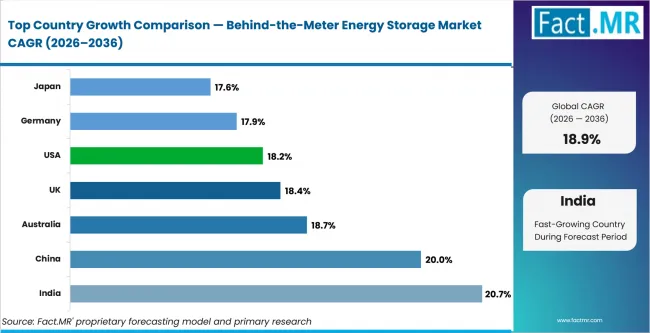
Behind The Meter Energy Storage Market Cagr Analysis By Country | Source: Fact.MR
What is powering India’s growth outlook?
20.7% CAGR, driven by rooftop solar expansion and recurring backup requirements.
India’s behind-the-meter stationary storage market is projected to grow from 32 GWh of annual demand in 2025 to more than 39 GWh by 2033. The same assessment notes that lead-acid batteries still held more than 85% of the BTM market in 2025, while lithium-ion batteries accounted for 77% of new telecom installations. Demand is expected to record a 20.7% CAGR during the forecast period, supported by rooftop solar pairing and recurring power continuity needs. Local integrators gain a clearer route when products support common residential wiring patterns and small-business backup requirements.
How is China scaling Behind-the-Meter Energy Storage demand?
20.0% CAGR, owing to storage deployment scale and renewable energy time shifting.
China’s new-type energy storage reached 73.76 GW/168 GWh in 2024, increasing by more than 130% year on year and accounting for over 40% of the global total. Lithium-ion batteries remained dominant, comprising 96.4% of installed new-type storage capacity. Market is projected to record a 20.0% CAGR between 2026 and 2036, owing to renewable power integration and flexible customer energy management.
What supports the Australia outlook?
18.7% CAGR, attributable to battery incentives and extensive rooftop solar ownership.
Australia’s Cheaper Home Batteries Program provides a discount of around 30% on the upfront cost of eligible small-scale battery systems from 5 kWh to 100 kWh. Clean Energy Regulator data showed more than 55,000 applications under the program by September 2025. The applications represented over 1 GWh of storage capacity across installed and approved systems. Industry is anticipated to post an 18.7% CAGR over the assessment period, attributable to incentive support and widespread rooftop solar ownership. Installer networks benefit when eligibility checks and system commissioning remain simple for households or small businesses.
What underpins United Kingdom growth?
18.4% CAGR, shaped by home-upgrade policy and time-based electricity use.
United Kingdom home-energy policy increasingly treats batteries as part of integrated property upgrades instead of isolated hardware purchases. The Warm Homes Plan aims to grow the heat pump market to more than 450,000 annual installations by 2030. It also identifies solar panels and batteries alongside heat pumps and insulation as combined bill-reduction measures. Demand is estimated to record an 18.4% CAGR during the forecast period, shaped by finance access and flexible electricity use.
How is the United States developing customer-site storage demand?
18.2% CAGR, driven by resilience spending and virtual power plant participation.
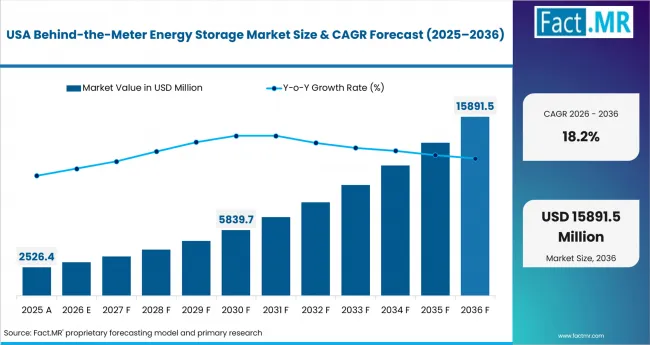
Behind The Meter Energy Storage Market Country Value Analysis | Source: Fact.MR
The U.S. Department of Energy states that virtual power plants can aggregate distributed resources into dispatchable grid assets. Eligible resources include rooftop solar and behind-the-meter batteries alongside electric vehicles and flexible building loads. DOE estimates that VPP capacity could grow to 80 GW to 160 GW by 2030, enough to serve 10% to 20% of peak demand. Demand is forecast to post an 18.2% CAGR between 2026 and 2036, driven by resilience spending and broader distributed flexibility programs. Utility programs gain reach when customer compensation and dispatch schedules remain understandable before enrollment across different customer groups and service territories.
Why is distributed storage strengthening Germany’s market outlook?
17.9% CAGR, supported by solar-plus-storage adoption and commercial self-consumption requirements.
Germany’s customer-side storage market is gaining depth as distributed generation creates stronger demand for onsite consumption control and peak management. In June 2025, the Federal Ministry for Economic Affairs and Energy reported that battery storage capacity increased by around 50% during 2024. The market is projected to record a 17.9% CAGR during the forecast period as businesses seek greater control over distributed generation and site-level electricity use. Storage providers gain stronger opportunities when systems combine energy management with load visibility and dependable integration across commercial facilities.
How are resilience and energy coordination shaping Japan’s storage demand?
17.6% CAGR, driven by resilience planning and customer-side energy management.
Japan’s market is developing around the need to coordinate onsite generation and stored electricity across facilities with demanding continuity requirements. In November 2025, the Agency for Natural Resources and Energy stated that national electricity demand is expected to increase for the first time in 20 years. The market is anticipated to expand at a 17.6% CAGR over the assessment period as customer-side storage becomes more relevant for resilience and energy balancing. Providers gain traction when storage controls integrate with building energy systems and support coordinated response across distributed customer assets.
Who leads the Behind-the-Meter Energy Storage Market?
Tesla Energy and sonnen GmbH remain major competitors across battery systems and customer energy services.
Tesla Energy focuses on Powerwall systems that combine backup power and tariff management within one customer application. LG Energy Solution supports residential and commercial storage demand through battery products and broader ESS integration capabilities. sonnen GmbH combines customer batteries with virtual power plant services that coordinate distributed assets for energy market participation. These suppliers compete on installation simplicity and control reliability alongside service coverage across different ownership models.
Generac Holdings positions PWRcell systems around modular backup and customer energy management for residential sites. Enphase Energy combines modular IQ Batteries with system controls for solar-linked backup and customer energy monitoring. Stem Inc. focuses on energy management software and supervisory controls for storage and solar assets across commercial portfolios. SMA Solar Technology supports residential and commercial storage through battery inverters and coordinated energy management solutions. Competition over the assessment period is expected to be shaped by installer reach and software interoperability alongside utility-program compatibility.
Which companies are the key providers?
Tesla Energy, LG Energy Solution, sonnen GmbH, Generac Holdings, Enphase Energy, Stem Inc., SMA Solar Technology.
- Tesla Energy
- LG Energy Solution
- sonnen GmbH
- Generac Holdings
- Enphase Energy
- Stem Inc.
- SMA Solar Technology
Bibliography
- Australian Government Department y, the Environment and Water. (2025, May 20). Discounted batteries for households through the Cheaper Home Batteries Program. energy.gornment Department of Climate Change, Energy, the Environment and Water. (2025, December 15). Six months of the Cheaper Home Batteries Program.
- Clean Energy Regu26). Cheaper Home Batteries surpass Australia’s biggest battery. Clean Energy Regulator.
- Department for Energy Security and Net Zero. (2026, March 18). Warm Homes Plan. GOV.UK.
- Department for Energy Security and Net Zero. (2026, March 18). Warm Homes Plan: Technical annex. GOV.UK.
- Federal Ministry for Economic Affairs and Eneew energy storage for Germany*. Federal Government of Germany.
- International Energy Agency. (2026). Technology: Battery storage - Global Energy Review 2026. IEA.
- Ministry of New and Renewable Energy. (2026, May 31). Physical Achievements. Government of India.
- International Energy Agency. (2026). Technology: Battery storage - Global Energy Review 2026. IEA.
- Ministry of New and Renewable Energy. (2026, May 31). Physical Achievements. Government of India.
- U.S. DeparJanuary 16). Distributed Energy Resource Interconnection Roadmap. U.S. Department of Energy.
- U.S. Energy Information AdministratioNew U.S. electric generating capacity expected to reach a record high in 2026. U.S. Energy Informa. Agency for Natural Resources and Energy. (2025, November 11). A closer look at the 7th Strategic Energy Plan. Ministry of Economy, Trade and Industry, Government of Japan.
- LG Energy Solution. (2025, May 7). LG Energy Solution showcases ESS leadership at ees Europe 2025 in Munich. LG Energy Solution.
- sonnen GmbH. (2024, March 26). sonnen starts its new virtual power plant in Sweden. sonnen.
- SMA Solar Technology AG. (2025, March 20). Shaping the future: SMA enhances storage solutions portfolio with powerful battery inverter Sunny Central Storage UP-S. SMA.
This Report Addresses
- The report provides strategic intelligence on the Behind-the-Meter (BTM) Energy Storage market across technology, ownership, application, and end-user segments shaping distributed energy management strategies.
- Segment analysis covers Lithium-Ion Battery Energy Storage Systems and Commercial & Industrial installations as the principal market contributors supporting energy cost optimization and grid resilience.
- Regional outlook evaluates North America and Europe alongside Asia-Pacific. The assessment also covers Latin America and the Middle East & Africa, with key country analysis including the United States, China, Germany, the United Kingdom, Japan, and India.
- Competitive analysis profiles Tesla Energy and Fluence alongside Wärtsilä Energy Storage. The competitive landscape also covers Schneider Electric, ABB, Siemens Energy, BYD, Sungrow, Enphase Energy, and LG Energy Solution.
- Technology assessment covers Lithium-Ion Batteries and Flow Batteries alongside Lead-Acid Batteries, Sodium-Based Batteries, and other advanced energy storage technologies.
- Ownership assessment covers Customer-Owned Systems and Third-Party-Owned Systems, evaluating financing structures, operational benefits, and deployment trends.
- Application assessment covers Peak Shaving and Demand Charge Management alongside Backup Power, Renewable Energy Integration, Load Shifting, Energy Arbitrage, and Microgrid Support.
- End User assessment covers Commercial & Industrial and Residential sectors alongside Institutional, Government, Healthcare, Educational, and Utility-Related applications.
- Market dynamics analysis evaluates rising electricity costs, renewable energy adoption, grid modernization initiatives, energy resilience requirements, policy incentives, and technological advancements driving market growth.
- The report examines emerging opportunities in virtual power plants, AI-enabled energy management systems, distributed energy resources, smart buildings, and next-generation battery storage solutions supporting decentralized energy infrastructure.
What does the Behind-the-Meter Energy Storage Market cover?
Lithium-ion Battery and Thermal Storage systems used behind customer meters for resilience and energy cost control.
The Behind-the-Meter Energy Storage Market covers energy storage assets physically located on the customer side of the electricity meter. Systems store energy for backup power or peak control while also supporting onsite generation and flexible electricity use.
The market differs from utility-scale storage because value is tied to a specific customer site and its meter arrangement. Grid-side bulk storage remains outside the boundary unless the asset is physically installed behind a customer meter under a utility program.
What is included in the scope?
Behind-the-meter storage systems used at residential, commercial and industrial customer sites.
The scope includes Lithium-ion Battery and Lead-acid systems alongside Flow Battery and Thermal Storage technologies that operate behind customer meters. Applications cover Peak Shaving and Backup Power alongside Self-consumption/Solar and Demand Charge Management. End Use coverage includes Commercial & Industrial and Residential customer sites. Ownership coverage spans Customer-owned and Third-party Owned systems alongside Utility Program structures that retain assets behind participating customer meters. Adjacent distributed energy storage systems provide context for decentralization across customer sites and local power networks. Residential energy storage informs household procurement patterns while thermal energy storage materials provide context for non-battery technologies.
What is excluded from the scope?
Front-of-meter utility-scale storage and mobile traction batteries are outside the scope.
The scope excludes grid-side bulk storage that is dispatched independently of a customer meter and primarily serves wholesale or transmission-level functions. Electric vehicle traction batteries and portable power stations are excluded unless they operate as a permanently integrated customer-site storage resource. Standalone generators are also excluded because their primary function is electricity generation instead of energy storage.
How was the analysis built?
120+ sources, 40+ company portfolios, 25+ countries, 20+ interviews.
- Primary Research:
- Primary research includes interviews with behind-the-meter energy storage system providers, battery manufacturers, project developers and commercial energy managers. It also includes input from utilities, energy consultants, EPC contractors, software platform providers and facility operators involved in energy storage deployment and optimization.
- Desk Research:
- Desk research reviews energy storage industry statistics, electricity market developments, renewable energy integration trends, government policy frameworks and company product portfolios. Industry publications, regulatory updates, project announcements, technology roadmaps and supplier catalogs are also assessed to evaluate market trends and competitive positioning.
- Market-Sizing and Forecasting:
- Forecasting uses commercial and industrial energy storage adoption, distributed energy resource deployment, battery system pricing, electricity cost trends and renewable energy investments across major regions. Models consider peak demand management, backup power requirements, self-consumption optimization, grid service participation and energy resilience initiatives influencing market growth.
- Data Validation and Update Cycle:
- Forecasts are validated through provider checks and industry interviews that test assumptions on storage deployment, customer adoption and investment activity. Portfolio mapping, project pipeline assessment and stakeholder feedback help confirm market direction, while ongoing reviews of policy developments, technology advancements and market announcements support forecast updates.
Segmentation
What is the report’s scope and coverage?
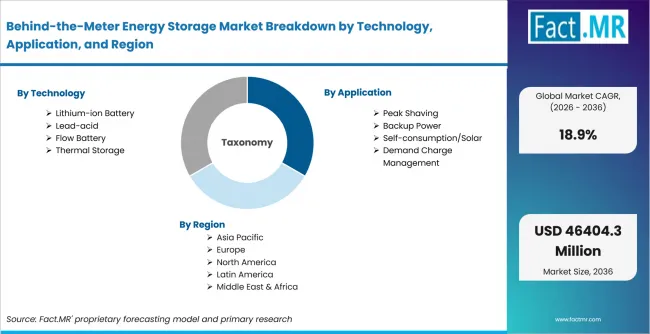
Behind The Meter Energy Storage Market Breakdown By Technology, Application, And Region | Source: Fact.MR
| Attribute | Details |
|---|---|
| Quantitative Units | USD million |
| Market Definition | Customer-site energy storage assets located behind the electricity meter for backup power; peak control; renewable integration; tariff management |
| Technology | Lithium-ion Battery; Lead-acid; Flow Battery; Thermal Storage |
| Application | Peak Shaving; Backup Power; Self-consumption/Solar; Demand Charge Management |
| End Use | Commercial & Industrial; Residential |
| Ownership | Customer-owned; Third-party Owned; Utility Program |
| Regions Covered | North America; Europe; East Asia; South Asia & Pacific; Middle East & Africa |
| Countries Covered | India; China; Australia; United Kingdom; United States; Germany; Japan |
| Key Companies Profiled | Tesla Energy; LG Energy Solution; sonnen GmbH; Generac Holdings; Enphase Energy; Stem Inc.; SMA Solar Technology |
| Forecast Period | 2026 to 2036 |
| Approach | Hybrid top-down and bottom-up approach using customer-site deployment; rooftop solar attachment; tariff exposure; outage value; ownership structures; application shares; end-use shares; official statistics; provider portfolio validation |
Source: Fact.MR analysis. Updated Jul 9, 2026
How is the market segmented?
-
By Technology:
- Lithium-ion Battery
- Lead-acid
- Flow Battery
- Thermal Storage
-
By Application:
- Peak Shaving
- Backup Power
- Self-consumption/Solar
- Demand Charge Management
-
By End Use:
- Commercial & Industrial
- Residential
-
By Ownership:
- Customer-owned
- Third-party Owned
- Utility Program
-
By Region:
- North America
- United States
- Canada
- Europe
- Germany
- United Kingdom
- France
- Italy
- Spain
- Asia Pacific
- India
- China
- Japan
- South Korea
- Australia
- Latin America
- Brazil
- Argentina
- Mexico
- Chile
- Middle East & Africa
- UAE
- Saudi Arabia
- South Africa
- North America
Frequently Asked Questions
How are Lithium-ion Batteries positioned within the Behind-the-Meter Energy Storage Market?
What role does Peak Shaving play in the Behind-the-Meter Energy Storage Market?
How prominent is the Commercial & Industrial segment in the Behind-the-Meter Energy Storage Market?
What contribution do Customer-owned systems make to market demand?
Which country shows notable growth potential in the Behind-the-Meter Energy Storage Market?
How is the Behind-the-Meter Energy Storage Market expected to develop in China?
What outlook is anticipated for Australia in the Behind-the-Meter Energy Storage Market?
How is demand projected to evolve in the United Kingdom?
What trend characterizes the United States Behind-the-Meter Energy Storage Market?
How does Germany perform in the Behind-the-Meter Energy Storage Market?
What growth pattern is anticipated for Japan?
What factor primarily supports market expansion?
Which challenge continues to influence market adoption?
Why do Lithium-ion Batteries remain important in the Behind-the-Meter Energy Storage Market?
What supports Commercial & Industrial adoption of behind-the-meter energy storage systems?
Who worked on this report


Preview the report firsthand - request a free sample
Free SampleGet the brochure for pricing and purchase details
Download PDF