- Market Value (2025): USD 229.5 Mn
- Estimated Value (2026): USD 229.5 Mn
- Forecast Value (2036): USD 774.2 Mn
- CAGR (2026-2036): 11.7%
What is the Bio-Based PMMA Market forecast to be worth by 2036?
USD 256.3 million in 2026 to USD 774.2 million by 2036 at an 11.7% CAGR.
- As per Fact.MR analysis, the bio-based PMMA market was valued at USD 229.4 million in 2025.
- Market value is projected to increase from USD 256.3 million in 2026 to USD 774.2 million by 2036.
- The forecast indicates an 11.7% CAGR from 2026 to 2036 as manufacturers explore renewable feedstocks and lower-carbon material options for acrylic applications.
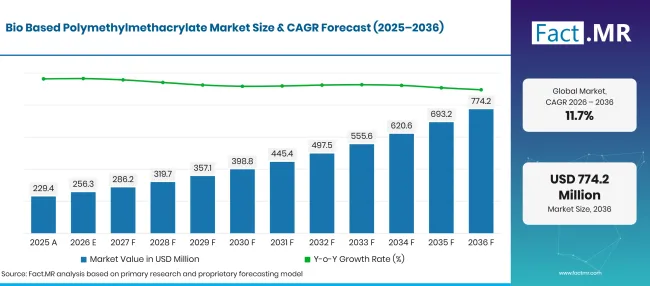
Bio Based Polymethylmethacrylate Market Forecast Global | Source: Fact.MR
| Year | Basis | Market Value (USD million) |
|---|---|---|
| 2025 | Actual | 229.4 |
| 2026 | Estimate | 256.3 |
| 2036 | Forecast | 774.2 |
| CAGR 2026 to 2036 | Forecast period | 11.7% |
Source: Fact.MR analysis. Updated Oct 28, 2026
What are the defining numbers behind Bio-Based PMMA Market growth?
USD 517.9 million absolute opportunity between 2026 and 2036.
- Demand Drivers in the Market
- Increasing Renewable Feedstock Development has supported market development as Mitsubishi Chemical advances technology for producing methyl methacrylate (MMA) monomer from plant-derived materials. Its pilot plant began operating in 2023 with commercial-scale application identified as a development objective for 2026 [1].
- Growing Demand for Circular and Resource-Efficient Plastics has strengthened interest in alternative feedstocks as the European Commission highlights plastic pollution and dependence on imported fossil resources. The European Commission's plastics policy identifies the need to reduce plastic pollution and dependence on imported fossil resources. Its plastics overview reports that Europe generates almost 32 million tonnes of plastic waste annually [2].
- Rising Automotive Material Requirements have supported interest in acrylic materials for selected vehicle components requiring optical clarity appearance and durability. Germany produced approximately 4.069 million passenger cars in 2024, according to the German Federal Statistical Office's international production table [3].
- Expanding Zero-Emission Vehicle Markets have increased the relevance of advanced automotive materials. The UK Department for Transport reported 161,000 first-time zero-emission vehicle registrations in the second quarter of 2026 representing a 36.9% increase year over year [4].
- Increasing Emphasis on Material Traceability has encouraged verification of bio-based content in chemical supply chains.
- Key Segments Analyzed
- By Product Type: Extruded Sheets are projected to account for 38.5% of the market in 2026, driven by consistent thickness and suitability for transparent durable components.
- By Application: Automotive holds 36.8% share in 2026, supported by demand for lightweight materials offering optical clarity and weather resistance in vehicle components.
- By End-User: Automotive leads with 35.2% of the market in 2026, reflecting manufacturers’ interest in durable acrylic materials for styling and functional applications.
- Analyst Opinion at Fact.MR
- Shambhu Nath Jha, Principal Consultant at Fact.MR, states, “Bio-based PMMA adoption will depend on more than renewable feedstock availability. Material suppliers must demonstrate that bio-based content can be verified while maintaining the optical quality, durability and processing performance expected by automotive and electronics customers.”
- Strategic Implications
- Material producers need to disclose verified bio-based carbon content and distinguish bio-based feedstocks from recycled inputs and mass-balance attribution.
- Automotive suppliers must prioritize optical performance weather resistance and dimensional stability alongside sustainability criteria.
- Sheet and resin manufacturers need to validate processing conditions and end-use performance before expanding bio-based grades into existing production lines.
- Purchasing teams should evaluate the cost and availability of bio-based materials against conventional PMMA and other acrylic alternatives.
- Companies investing in renewable MMA need to demonstrate feedstock traceability and confirm commercial-scale production capability before making broad availability claims.
Germany is set to record a 13.6% CAGR through 2036. Brazil is projected to grow at 11.9%, followed by Japan at 11.6%. The UK is estimated to advance at 10.0%, while the USA is forecast to register 9.6%.
How does the Bio-Based PMMA Market break down by segment?
Fact.MR identifies Extruded Sheets as the leading Product Type at 38.5%. Automotive leads the Application category at 36.8% and also leads the End-User category at 35.2%.
Which Product Type dominates?
Extruded Sheets are set to hold a 38.5% share in 2026.
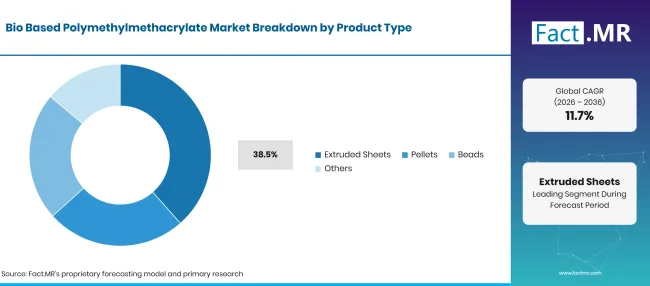
Bio Based Polymethylmethacrylate Market Breakdown Product Type | Source: Fact.MR
| Product Type | Share (2026) |
|---|---|
| Extruded Sheets (Leading segment) | 38.5% |
| Other segments combined | 61.5%* |
| Total | 100.0% |
Source: Fact.MR analysis. Updated Oct 28, 2026
Extruded PMMA sheets are used where transparency, surface quality and dimensional consistency are important. Bio-based or bio-attributed grades must meet the performance requirements of the intended application in addition to demonstrating credible feedstock credentials. Pellets and beads represent alternative product forms that may serve different conversion processes and end uses.
What leads the Application segment?
Automotive is set to represent a 36.8% share in 2026.
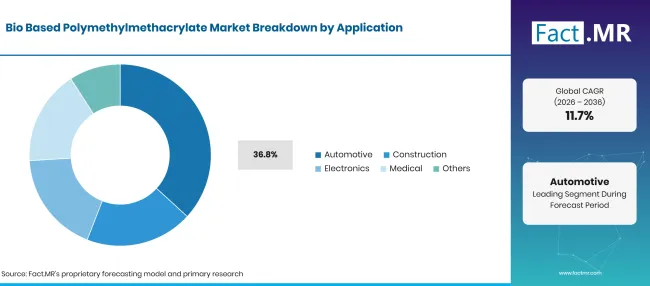
Bio Based Polymethylmethacrylate Market Breakdown Application | Source: Fact.MR
| Application | Share (2026) |
|---|---|
| Automotive (Leading segment) | 36.8% |
| Other segments combined | 63.2%* |
| Total | 100.0% |
Source: Fact.MR analysis. Updated Oct 28, 2026
Automotive applications can include selected transparent, decorative and interior components where appearance and durability are important. Material selection depends on the specific component, optical requirements, weathering performance and processing method. Renewable feedstock content alone does not establish suitability for automotive use; the finished material must meet the relevant technical specifications.
Which End-User segment leads?
Automotive is projected to account for a 35.2% share in 2026.
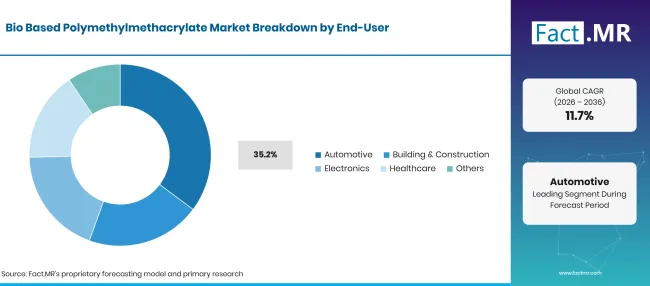
Bio Based Polymethylmethacrylate Market Breakdown End User | Source: Fact.MR
| End-User | Share (2026) |
|---|---|
| Automotive (Leading segment) | 35.2% |
| Other segments combined | 64.8%* |
| Total | 100.0% |
Source: Fact.MR analysis. Updated Oct 28, 2026
Automotive companies can influence material adoption through procurement requirements and component-level sustainability targets. However, end-user demand also depends on qualification cycles, material costs and supply reliability. Electronics, construction and healthcare buyers have their own performance and compliance requirements. These uses should be evaluated separately rather than assuming that a grade suitable for one industry will automatically meet another industry's specifications.
What is accelerating Bio-Based PMMA Market adoption, and what is holding it back?
Interest in renewable feedstocks and material traceability creates opportunities for bio-based PMMA. Higher production costs, limited commercial supply and the need for end-use qualification can slow adoption.
Drivers Impact Analysis
| Driver | (~) % IMPACT ON CAGR | Geographic relevance | Impact timeline |
|---|---|---|---|
| Development of renewable MMA feedstocks | +1.0% | Europe, Japan | Medium term (2–4 years) |
| Sustainability targets in automotive supply chains | +0.8% | Europe, Asia | Medium term (2–4 years) |
| Demand for transparent acrylic materials | +0.6% | Global | Short to medium term |
| Verified bio-based content and traceability | +0.5% | Europe, North America | Medium term (2–4 years) |
| Expansion of bio-attributed polymer portfolios | +0.4% | Global | Long term (4+ years) |
Source: Fact.MR analysis. Updated Oct 28, 2026
Opportunity Impact Analysis
| Opportunity | (~) % IMPACT ON CAGR | Geographic relevance | Impact timeline |
|---|---|---|---|
| Commercial-scale plant-derived MMA | +0.9% | Japan, Europe | Long term (4+ years) |
| Bio-based grades for automotive components | +0.7% | Europe, Asia | Medium term (2–4 years) |
| Certified renewable feedstock supply | +0.6% | Global | Medium term (2–4 years) |
| Bio-based extruded acrylic sheets | +0.5% | Europe, North America | Medium term (2–4 years) |
| Customer demand for lower-carbon materials | +0.4% | Global | Long term (4+ years) |
Source: Fact.MR analysis. Updated Oct 28, 2026
Restraints Impact Analysis
| Restraint | (~) % IMPACT ON CAGR | Geographic relevance | Impact timeline |
|---|---|---|---|
| Premium pricing versus conventional PMMA | -0.9% | Global | Short term (≤2 years) |
| Limited availability of renewable feedstocks | -0.7% | Global | Medium term (2–4 years) |
| Qualification and testing requirements | -0.6% | Automotive, electronics | Medium term (2–4 years) |
| Confusion between bio-based and recycled content | -0.5% | Global | Short term (≤2 years) |
| Scale-up and process consistency challenges | -0.4% | Global | Long term (4+ years) |
Source: Fact.MR analysis. Updated Oct 28, 2026
Which countries are scaling the Bio-Based PMMA Market through 2036?
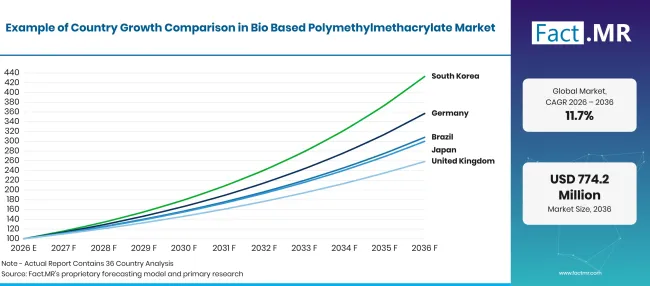
Bio Based Polymethylmethacrylate Market Growth Index | Source: Fact.MR
| Country | CAGR (2026–2036) |
|---|---|
| Germany | 13.6% |
| Brazil | 11.9% |
| Japan | 11.6% |
| UK | 10.0% |
| USA | 9.6% |
Source: Fact.MR analysis. Updated Oct 28, 2026
What supports Germany adoption?
13.6% CAGR, supported by automotive manufacturing and demand for advanced acrylic materials.
Germany’s automotive manufacturing base creates opportunities for acrylic materials used in vehicle components requiring optical clarity and durability. Bio-based PMMA suppliers may benefit by demonstrating consistent material performance and verified renewable content. Adoption will depend on competitive pricing reliable supply and successful qualification by automotive manufacturers.
How is Brazil developing bio-based PMMA adoption?
11.9% CAGR, driven by automotive manufacturing and access to renewable feedstocks.
Brazil’s market potential depends on automotive production capacity and the availability of competitively priced renewable raw materials. Bio-based PMMA may attract interest from manufacturers seeking transparent acrylic materials with documented renewable content. Suppliers can strengthen adoption by improving feedstock availability and validating processing performance for industrial applications. Commercial growth will depend on pricing and reliable supply.
What supports United States adoption?
9.6% CAGR, backed by automotive components and specialized acrylic applications.
The United States offers opportunities for bio-based PMMA across automotive components electronics and specialty acrylic products. Manufacturers may consider renewable alternatives when they meet optical mechanical and processing specifications. Suppliers can support adoption by providing independently verified bio-based content and demonstrating compatibility with existing production systems. Market expansion will depend on the cost premium and commercial availability.
How is the United Kingdom building adoption?
10.0% CAGR, shaped by advanced manufacturing and demand for traceable material attributes.
The UK market opportunity is supported by automotive manufacturing and the shift toward resource-efficient production. Automotive manufacturers are increasingly focused on circular manufacturing and material efficiency. Bio-based PMMA suppliers may benefit by demonstrating verified renewable content and meeting automotive requirements for optical clarity and durability. Market adoption will depend on competitive pricing, consistent material quality and reliable commercial supply.
What supports Japan adoption?
11.6% CAGR, led by renewable MMA technology development and advanced materials expertise.
Japan’s established chemical industry and materials research capabilities create opportunities for renewable acrylic feedstock development. Key companies headquartered in Japan are focused on advancing technology to produce methyl methacrylate (MMA) from plant-derived materials. This initiative highlights Japan’s role in developing alternatives to fossil-based chemical inputs. Wider bio-based PMMA adoption will depend on scalable production processes consistent material quality competitive pricing and reliable commercial availability.
Who leads the Bio-Based PMMA Market?
Fact.MR identifies Kuraray Co., Ltd., Mitsubishi Chemical Corporation, Asahi Kasei Corporation and CHIMEI Corporation as companies with relevant activities across the PMMA and renewable methacrylate value chain.
Kuraray has established ISCC PLUS certification for selected thermoplastic elastomers and liquid rubber products under a mass-balance approach. Its March 2025 announcement does not confirm PMMA-specific certified supply. Mitsubishi Chemical Corporation is developing plant-derived methyl methacrylate (MMA) production technology for acrylic resin applications.[5]
Competition depends on renewable feedstock traceability and the ability to maintain optical performance and mechanical properties alongside consistent processing characteristics and supply reliability. Buyers must distinguish finished PMMA containing renewable carbon from upstream bio-based monomers and mass-balance-attributed materials. Chemically recycled PMMA represents a separate circular production pathway and does not establish bio-based content.
Which companies are the key providers?
Key companies profiled include Kuraray Co., Ltd.; Mitsubishi Chemical Corporation; Asahi Kasei Corporation; and CHIMEI Corporation.
- Kuraray Co., Ltd.
- Mitsubishi Chemical Corporation
- Asahi Kasei Corporation
- CHIMEI Corporation
Bibliography
- [1] Mitsubishi Chemical Group Corporation. (n.d.). Development of plant-derived materials. Mitsubishi Chemical Group source
- [2] European Commission, Directorate-General for Environment. (n.d.). Plastics. Retrieved European Commission source
- [3] Statistisches Bundesamt (Destatis). (2025, November 19). International statistics: Key table—Production of passenger cars. Destatis source
- [4] Department for Transport. (2026, September 23). Vehicle licensing statistics: April to June 2026. GOV.UK. GOV.UK source
- [5] Kuraray Co., Ltd. (n.d.). Sustainability initiatives. Kuraray source
This Report Answers
- The report examines the projected value of the Bio-Based PMMA Market in 2036 and its forecast CAGR from 2026 to 2036.
- Segment analysis compares the specified product types and their market shares in 2026.
- Application and end-user analysis discusses automotive demand alongside construction electronics and healthcare applications.
- Country analysis covers Germany Brazil the USA the UK and Japan.
- The competitive overview profiles Kuraray Co., Ltd., Mitsubishi Chemical Corporation, Asahi Kasei Corporation, and CHIMEI Corporation.
- Material analysis distinguishes bio-based PMMA from recycled PMMA and mass-balance-attributed acrylic materials.
- Market assessment examines the factors that could accelerate or restrain adoption including renewable feedstock availability material performance production costs and supply consistency.
What does the Bio-Based PMMA Market cover?
The market covers polymethyl methacrylate (PMMA) products manufactured using qualifying renewable or bio-attributed feedstocks under the specified market definition. Product coverage follows the defined material categories and forms while application coverage includes automotive construction electronics and healthcare. Purchasing decisions depend on transparency durability mechanical performance processability and the ability to verify renewable content.
What is included in the scope?
Included products comprise bio-based PMMA grades that meet the report's defined feedstock criteria.
The product boundary covers specified forms such as extruded sheets pellets and beads. Application coverage includes automotive components construction materials electronic products and healthcare applications. The analysis also considers relevant residential commercial and industrial end users alongside country-level forecasts for Germany Brazil the USA the UK and Japan.
What is excluded from the scope?
The analysis excludes conventional fossil-based PMMA without qualifying renewable feedstock content.
Recycled PMMA without qualifying bio-based feedstock is excluded from the core market and treated separately as a circular materials comparator where relevant. Chemically different bio-based polymers are outside the defined PMMA product boundary. Upstream bio-based methacrylate monomers sold solely as ingredients are excluded where the market measures finished PMMA resin. Equipment sales conversion services and unrelated acrylic products are also excluded.
How was the analysis built?
The analysis considers market forecasts, industry developments, company activities, technical requirements and relevant government statistics to assess market conditions and growth opportunities.
- Primary Research: Primary research includes discussions with manufacturers, service providers, technology developers, distributors, end users, and subject-matter experts. These conversations examine purchasing priorities, product adoption, operational challenges, approval requirements, competitive positioning, and the factors that influence wider market acceptance.
- Desk Research: Desk research covers government statistics, regulatory publications, company filings, trade data, technical studies, industry associations, standards, public policy, and other authoritative sources. Every source used in the analysis is documented in the bibliography.
- Market Sizing and Forecasting: Market estimates combine historical performance, demand indicators, pricing and volume trends, segment shares, company participation, country-level growth, adoption patterns, investment activity, and barriers to market expansion.
- Data Validation and Update Cycle: Findings are validated by comparing primary interviews with public data, company activity, regulatory changes, trade patterns, and industry developments. Regular updates review new product launches, capacity changes, partnerships, approvals, and shifts in commercial adoption.
Segmentation
What is the report’s scope and coverage?
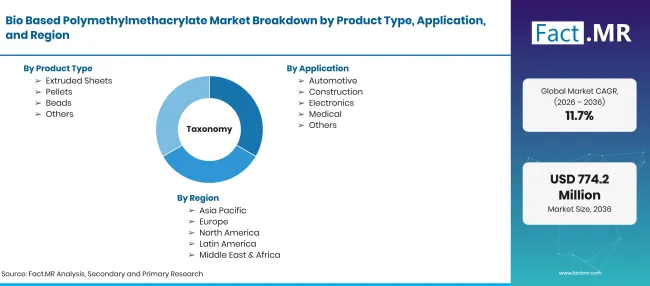
Bio Based Polymethylmethacrylate Market Taxonomy | Source: Fact.MR
| Attribute | Details |
|---|---|
| Quantitative units | USD million |
| Market definition | PMMA and relevant acrylic materials using renewable or bio-attributed feedstocks, subject to the defined market boundary |
| Product Type | Extruded Sheets; Pellets; Beads; Others |
| Application | Automotive; Construction; Electronics; Medical; Others |
| End-User | Automotive; Building & Construction; Electronics; Healthcare; Others |
| Regions Covered | North America; Latin America; Western Europe; Eastern Europe; East Asia; South Asia & Pacific; Middle East & Africa |
| Countries covered | Germany; Brazil; USA; UK; Japan |
| Companies profiled | Kuraray; Mitsubishi Chemical Corporation; Evonik; Sumitomo Chemical |
| Forecast period | 2026–2036 |
| Approach | Market segmentation and forecast analysis supported by official industrial statistics and company product documentation |
Source: Fact.MR analysis. Updated Oct 28, 2026
How is the market segmented?
-
By Product Type
- Extruded Sheets
- Pellets
- Beads
- Others
-
By Application
- Automotive
- Construction
- Electronics
- Medical
- Others
-
By End-User
- Automotive
- Building & Construction
- Electronics
- Healthcare
- Others
-
By Region
- North America
- Latin America
- Western Europe
- Eastern Europe
- East Asia
- South Asia & Pacific
- Middle East & Africa
Frequently Asked Questions
How big is the Bio-Based PMMA Market in 2026?
What is the CAGR from 2026 to 2036?
Which Product Type has the largest share?
Which Application leads the market?
Which companies are covered?
Who worked on this report


Preview the report firsthand - request a free sample
Free SampleGet the brochure for pricing and purchase details
Download PDF