- Market Value (2025): USD 52.9 Mn
- Estimated Value (2026): USD 55.1 Mn
- Forecast Value (2036): USD 82.8 Mn
- CAGR (2026-2036): 4.2%
What is the n-Propyl Mercaptan Market forecast to be worth by 2036?
USD 55.1 million in 2026 to USD 82.8 million by 2036 at a 4.2% CAGR.
- The n-propyl mercaptan market reached USD 52.9 million in 2025. Demand is linked to chemical synthesis and applications requiring specific thiol chemistry.
- Growing requirements for agrochemical intermediates, selected gas-odorant formulations, and specialty chemical applications will drive market value from USD 55.1 million in 2026 to USD 82.8 million by 2036.
- Over 2026–2036, the market will advance at a 4.2% CAGR. Chemical processing and specialized industrial applications shape purchasing activity in established and developing markets.
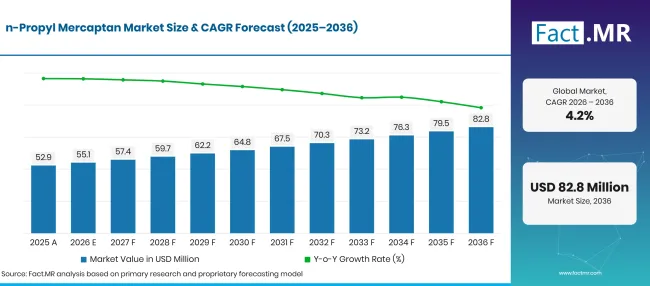
N Propyl Mercaptan Market Forecast Global | Source: Fact.MR
| Year | Basis | Market Value (USD million) |
|---|---|---|
| 2025 | Actual | 52.9 |
| 2026 | Estimate | 55.1 |
| 2036 | Forecast | 82.8 |
| CAGR (2026 to 2036) | Forecast period | 4.2% |
Source: Fact.MR analysis. Updated Oct 28, 2026
What are the defining numbers behind n-Propyl Mercaptan Market growth?
The market is set to add USD 27.7 million between 2026 and 2036.
- Demand Drivers in the Market
- Broader chemical industry activity provides context for demand for specialty chemical intermediates, but the stated 3.8% global production growth estimate requires a traceable primary publication before use. Higher industrial output creates a broader demand base for specialized intermediates used in downstream synthesis.
- Agrochemical synthesis is a relevant application for n-propyl mercaptan. Chevron Phillips Chemical identifies its use in agrochemical intermediates. Changes in production volumes and intermediate purchasing requirements across agricultural chemical chains influence this application.
- Global natural gas demand increased by approximately 1% in 2025, according to the International Energy Agency’s Global Energy Review 2026. The IEA also discussed the role of expanding liquefied natural gas availability in shaping gas-market conditions. [1]
- Key Segments Analyzed
- By Application: Chemical Intermediates holds a 42.8% share in 2026. This reflects the role of n-propyl mercaptan in downstream chemical synthesis.
- By End-Use Industry: Chemicals accounts for a 42.8% share in 2026.
- Analyst Opinion at Fact.MR
- Shambhu Nath Jha, Principal Consultant at Fact.MR, states, “N-propyl mercaptan demand rests on specialized applications where material consistency and process compatibility matter more than volume alone. Agrochemical synthesis and selected gas-odorant formulations provide distinct avenues for market development over the coming years. Manufacturers that maintain dependable production and clear technical documentation are better placed to meet buyers’ requirements. Rigorous handling standards remain important as these applications evolve.”
- Strategic Implications
- Chemical producers are encouraged to verify n-propyl mercaptan against application-specific purity and impurity limits before introducing it into downstream synthesis processes.
- Storage conditions and ventilation systems warrant assessment alongside landed costs. Ignition prevention and spill-response procedures also require attention.
- In gas odorization, commercial evaluations benefit from a clear distinction between pure n-propyl mercaptan sales and blended odorant formulations. The two involve different product categories and market activities.
- Competitive analysis becomes more reliable when confirmed manufacturing operations are evaluated separately from distribution networks and product listings.
- Regular updates to commercial forecasts help incorporate new evidence on production volumes and trade activity. Company product portfolios also require periodic review.
The United Kingdom leads the five-country ranking at 5.3% CAGR. Germany follows at 4.7%, while the United States records 3.8%. Brazil and Japan stand at 3.4% and 3.0%, respectively.
How does the n-Propyl Mercaptan Market break down by segment?
Chemical Intermediates leads Application at 42.8%, while Chemicals leads End-Use Industry at 42.8%.
Which Application leads?
Chemical Intermediates accounts for 42.8% of the 2026 market.
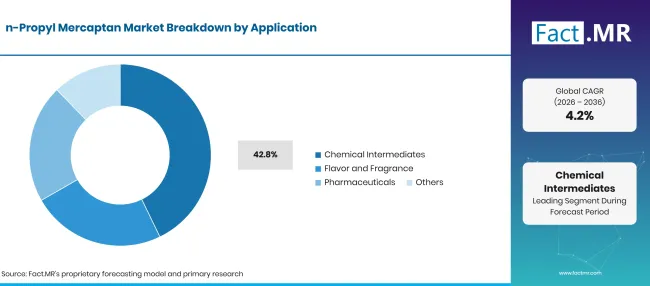
N Propyl Mercaptan Market Breakdown Application | Source: Fact.MR
| Application | Share (2026) |
|---|---|
| Chemical Intermediates | 42.8% |
| Other segments combined | 57.2% |
| Total | 100.0% |
Source: Fact.MR analysis. Updated Oct 28, 2026
Chemical intermediates lead the market because downstream industries use them as starting inputs in production processes. This creates demand across several end-use sectors rather than tying consumption to a single industry. Producers of agrochemicals, pharmaceuticals, polymers, dyes, and coatings purchase intermediates according to their process requirements and production schedules. Contract terms and volume commitments influence purchasing patterns. The ability to use an intermediate in different product chains also gives manufacturers flexibility when prices or demand change.
What supports Chemicals within End-Use Industry?
Chemicals represents for 42.8% of the 2026 market.
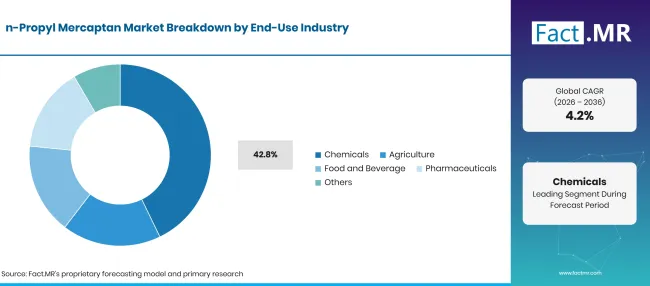
N Propyl Mercaptan Market Breakdown End Use Industry | Source: Fact.MR
| End-Use Industry | Share (2026) |
|---|---|
| Chemicals (leading segment) | 42.8% |
| Other segments combined | 57.2% |
| Total | 100.0% |
Source: Fact.MR analysis. Updated Oct 28, 2026
Chemical manufacturers form the core customer base for n-propyl mercaptan. The compound enters specific production and synthesis processes rather than occasional consumer-led purchases. Demand from agriculture, food and beverage, and pharmaceutical applications follows specialized requirements. Product specifications and approval procedures influence purchasing decisions. Long-term purchasing agreements help chemical plants maintain consistent access to key intermediates despite price fluctuations. Further investment in chemical manufacturing offers another avenue for market growth, particularly in Asia-Pacific.
What is accelerating n-Propyl Mercaptan Market adoption, and what is holding it back?
N-propyl mercaptan has applications in chemical synthesis, agrochemical intermediates, flavor and fragrance ingredients, and selected gas-odorant formulations. Its pungent odor and flammability require careful storage and effective odor control. Environmental hazards also necessitate safeguards against workplace exposure and accidental releases.
Drivers Impact Analysis
| DRIVER | (~) % IMPACT ON CAGR | GEOGRAPHIC RELEVANCE | IMPACT TIMELINE |
|---|---|---|---|
| Rising downstream synthesis demand for chemical intermediates | +1.4% | Global | Medium term (2–4 years) |
| Steady use in agrochemical intermediate production | +1.0% | Global; varies by production base | Medium term (2–4 years) |
| Growing use in flavor and fragrance intermediates | +0.6% | Global | Medium term (2–4 years) |
| Adoption in gas-odorant blends for leak detection | +0.4% | Regions with gas distribution and industrial-gas systems | Short to medium term (≤ 4 years) |
Source: Fact.MR analysis. Updated Oct 28, 2026
Opportunity Impact Analysis
| OPPORTUNITY | (~) % IMPACT ON CAGR | GEOGRAPHIC RELEVANCE | IMPACT TIMELINE |
|---|---|---|---|
| Application-specific grades backed by technical support | +0.6% | Global | Medium term (2–4 years) |
| Reliable supply for agrochemical and specialty chemical synthesis | +0.5% | Global | Medium term (2–4 years) |
| Tailored odorant blends containing n-propyl mercaptan | +0.3% | Selected gas distribution markets | Short to medium term (≤ 4 years) |
| Better handling, packaging, and logistics practices | +0.2% | Global | Long term (≥ 4 years) |
Source: Fact.MR analysis. Updated Oct 28, 2026
Restraints Impact Analysis
| RESTRAINT | (~) % IMPACT ON CAGR | GEOGRAPHIC RELEVANCE | IMPACT TIMELINE |
|---|---|---|---|
| Flammability and strict storage and handling requirements | -0.3% | Global | Short term (≤ 2 years) |
| Pungent odor and the need to prevent accidental releases | -0.2% | Global | Long term (≥ 4 years) |
| Hazard classification and spill-control obligations | -0.2% | Global | Long term (≥ 4 years) |
| Limited public data on product-specific volumes | -0.1% | Global | Medium term (2–4 years) |
Source: Fact.MR analysis. Updated Oct 28, 2026
Which countries are scaling the n-Propyl Mercaptan Market through 2036?
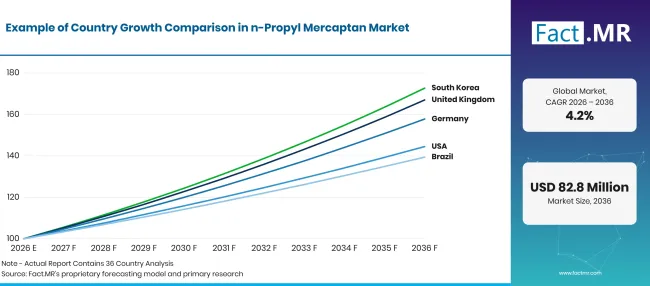
N Propyl Mercaptan Market Growth Index | Source: Fact.MR
| Country | CAGR (2026 to 2036) |
|---|---|
| United Kingdom | 5.3% |
| Germany | 4.7% |
| United States | 3.8% |
| Brazil | 3.4% |
| Japan | 3.0% |
Source: Fact.MR analysis. Updated Oct 28, 2026
What supports Germany’s adoption?
A 4.7% CAGR for Germany rests on its established specialty-chemical manufacturing base.
Germany developed its Chemieagenda 2045 in 2025 and published the agenda on March 26, 2026, addressing competitiveness and operating conditions for its chemical sector. Fact.MR forecasts a 4.7% CAGR for Germany’s n-propyl mercaptan market from 2026 to 2036. [4]
How is Brazil developing demand?
Brazil’s 3.4% CAGR relates to agrochemical and industrial chemical activity.
Law 14,785 was enacted in December 2023 and changed the country’s pesticide regulatory framework. Brazil’s Ministry of Agriculture and Livestock maintains official records on pesticide regulation and related procedures.
What is supporting the United States’ adoption?
Agrochemical, flavor and fragrance uses underpin a 3.8% CAGR in the United States.
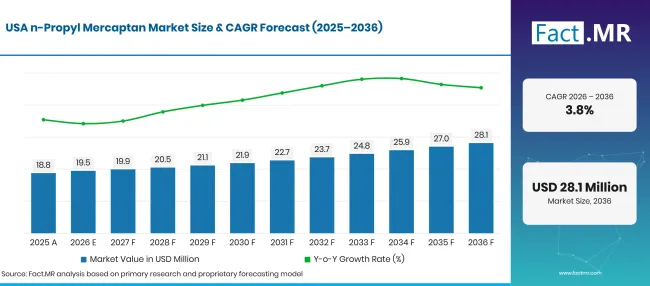
N Propyl Mercaptan Market Forecast Usa | Source: Fact.MR
Chevron Phillips Chemical lists n-propyl mercaptan for these applications. Separately, on April 16, 2026, the U.S. Environmental Protection Agency published its 2024 Chemical Data Reporting information covering applicable domestic chemical manufacturing and imports during 2020–2023. This database does not itself establish current demand for n-propyl mercaptan. [2]
How is the United Kingdom scaling demand?
State funding for chemical producers provides wider industrial context for the UK’s 5.3% CAGR.
The UK’s Industrial Strategy, published in June 2025, identifies chemicals as a foundational industry. On May 21, 2026, the UK government announced a £350 million Critical Chemicals Resilience Fund. The initiative targets strategically important chemical producers and sites. [5][6]
How does Japan perform in the n-Propyl Mercaptan Market?
3.0% CAGR, linked to specialty chemical users that require precise material properties and process control.
Japan’s n-propyl mercaptan market is supported by specialty chemical applications where buyers place importance on consistent material characteristics and compatibility with established production processes. Growth remains tied to specialized chemical users rather than broad-volume consumption. The available sources do not establish Japan-specific n-propyl mercaptan volumes.
Who leads the n-Propyl Mercaptan Market?
The competitive landscape for n-propyl mercaptan is best assessed through recent product documentation and evidence of commercial activity. Chevron Phillips Chemical’s product information identifies an established offering. Its stated applications include agrochemicals and flavor and fragrance uses.
Arkema’s gas-odorant portfolio identifies normal propyl mercaptan in selected blends. The company also describes production and blending operations across several regions. Product records and regulatory reporting resources offer different forms of evidence.
Pharvinex Chempharm Pvt. Ltd. identifies n-propyl mercaptan as a commercial product manufactured in India. Arkema’s portfolio demonstrates its role in blended odorant formulations. Manufacturing status should be distinguished from product listings and blending activity when comparing companies.
Which companies are the key providers?
Key companies include Chevron Phillips Chemical Company LP; Arkema Group; R&D Center AhmadullinS LLC (AhmadullinScientech); and Pharvinex Chempharm Pvt. Ltd.
- Chevron Phillips Chemical Company LP
- Arkema Group
- R&D Center AhmadullinS LLC (AhmadullinScientech)
- Pharvinex Chempharm Pvt. Ltd.
Bibliography
- [1] International Energy Agency. (2026, April 20). Natural gas. In Global Energy Review 2026. IEA Natural gas chapter
- [2] U.S. Environmental Protection Agency. (2026, April 16). EPA empowers Americans with 2024 Chemical Data Reporting information. https://www.epa.gov/chemicals-under-tsca/epa-empowers-americans-2024-chemical-data-reporting-informationEPA source
- [3] United Nations Industrial Development Organization. (2026, September 30). World manufacturing production and trade - Quarterly report (Q2 2026). UNIDO report
- [4] Bundesministerium für Wirtschaft und Energie. (2026, March 26). Nationale Chemieagenda vorgelegt – Für eine starke und wettbewerbsfähige Chemieindustrie. German Federal Ministry source
- [5] Department for Business and Trade, & Department for Business, Innovation, Science and Trade. (2025, June 23). Industrial Strategy. GOV.UK. UK Industrial Strategy
- [6] Department for Business and Trade, & HM Treasury. (2026, May 21). Government steps in to back long-term resilience of UK’s chemicals and ceramics industries. GOV.UK. GOV.UK source
This Report Answers
- How the n-propyl mercaptan market is valued in 2026 and forecast through 2036.
- Which application and end-use industry.
- How chemical intermediates, agrochemical production, flavor and fragrance applications, and gas-odorant formulations contribute to commercial relevance.
- How the five listed countries compare by CAGR.
- Which companies have direct product or production evidence and where manufacturing status needs additional verification.
- How flammability, odor, and environmental handling considerations affect commercial use.
What does the n-Propyl Mercaptan Market cover?
The report covers n-propyl mercaptan, also known as 1-propanethiol or propane-1-thiol. Its CAS number is 107-03-9. The assessment reviews demand associated with chemical intermediates and agrochemical intermediates. It also considers flavor and fragrance intermediates, pharmaceutical-related synthesis, and selected gas-odorant formulations.
What is included in the scope?
The market covers pure n-propyl mercaptan across the listed applications and end-use industries. It includes the 2026–2036 market outlook and five country growth rates. Identified companies are also included. Gas-odorant blends are treated separately from the pure compound.
What is excluded from the scope?
Other propyl mercaptan isomers and thiols are excluded because their chemical identities and applications differ from those of n-propyl mercaptan. Complete gas-odorant blends are also treated separately from the pure compound. Downstream products that use n-propyl mercaptan are outside the assessment unless their value forms part of the defined market.
How Was the Analysis Built?
The analysis draws on 120+ sources, 35+ company portfolios, 25+ countries, and more than 20 industry interviews.
- Primary Research: Primary research includes discussions with manufacturers, service providers, technology developers, distributors, end users, and subject-matter experts. These conversations examine purchasing priorities, product adoption, operational challenges, approval requirements, competitive positioning, and the factors that influence wider market acceptance.
- Desk Research: Desk research covers government statistics, regulatory publications, company filings, trade data, technical studies, industry associations, standards, public policy, and other authoritative sources. Every source used in the analysis is documented in the bibliography.
- Market Sizing and Forecasting: Market estimates combine historical performance, demand indicators, pricing and volume trends, segment shares, company participation, country-level growth, adoption patterns, investment activity, and barriers to market expansion.
- Data Validation and Update Cycle: Findings are validated by comparing primary interviews with public data, company activity, regulatory changes, trade patterns, and industry developments. Regular updates review new product launches, capacity changes, partnerships, approvals, and shifts in commercial adoption.
Segmentation
What is the report’s scope and coverage?
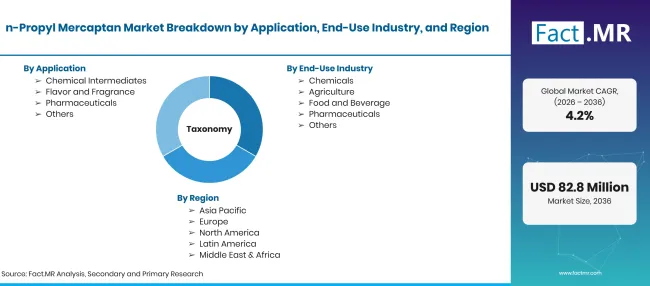
N Propyl Mercaptan Market Taxonomy | Source: Fact.MR
| Attribute | Details |
|---|---|
| Quantitative Units | USD million in 2026 and 2036; CAGR for 2026 to 2036 |
| Market Definition | n-Propyl mercaptan, also known as 1-propanethiol or propane-1-thiol, used in chemical intermediates, agrochemical intermediates, flavor and fragrance applications, pharmaceutical-related synthesis, and selected gas-odorant formulations. |
| Application | Chemical Intermediates; Flavor and Fragrance; Pharmaceuticals; Others |
| End-Use Industry | Chemicals; Agriculture; Food and Beverage; Pharmaceuticals; Others |
| Regions Covered | North America; Latin America; Western Europe; Eastern Europe; East Asia; South Asia & Pacific; Middle East & Africa |
| Countries Covered | United Kingdom; Germany; United States; Brazil; Japan |
| Companies Profiled | Chevron Phillips Chemical Company LP; Arkema Group; R&D Center AhmadullinS LLC (AhmadullinScientech); Pharvinex Chempharm Pvt. Ltd. |
| Forecast Period | 2026 to 2036 |
| Approach | Assessment of chemical synthesis requirements, application-specific demand, country growth, supplier participation, product specifications, handling requirements, and market expansion factors. |
Source: Fact.MR analysis. Updated Oct 28, 2026
How is the market segmented?
-
By Application
- Chemical Intermediates
- Flavor and Fragrance
- Pharmaceuticals
- Others
-
By End-Use Industry
- Chemicals
- Agriculture
- Food and Beverage
- Pharmaceuticals
- Others
-
By Region
- North America
- Latin America
- Western Europe
- Eastern Europe
- East Asia
- South Asia & Pacific
- Middle East & Africa
Frequently Asked Questions
How large is the n-propyl mercaptan market in 2026?
What growth rate will the n-propyl mercaptan market record from 2026 to 2036?
Which application leads the n-propyl mercaptan market?
Which end-use industry leads the n-propyl mercaptan market?
Who are the main companies in the n-propyl mercaptan market?
Who worked on this report


Preview the report firsthand - request a free sample
Free SampleGet the brochure for pricing and purchase details
Download PDF