- Market Value (2025): USD 630.7 Mn
- Estimated Value (2026): USD 690.0 Mn
- Forecast Value (2036): USD 1694.4 Mn
- CAGR (2026-2036): 9.4%
What is the Bio Housing Relays Market forecast to be worth by 2036?
The Bio Housing Relays market is projected to increase from USD 690.0 million in 2026 to USD 1694.4 million by 2036 at a CAGR of 9.4%.
- 2025 Market Value: USD 630.7 million
- 2026 to 2036 Market Progression: USD 690.0 million to USD 1694.4 million
- Forecast CAGR (2026-2036): 9.4%
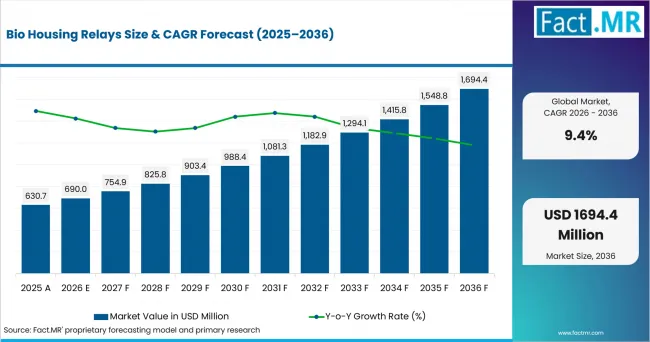
Bio Housing Relays Value Analysis | Source: Fact.MR
What are the defining numbers behind Bio Housing Relays Market growth?
The market adds USD 1004.4 million in absolute opportunity between 2026 and 2036.
- Demand Drivers in the Market
- Qualified bio-based housings are moving from material trials into electrical products. Relay and control-equipment manufacturers can now specify renewable-content housings without changing the switching function when the material clears thermal, dielectric and fire-safety requirements.
- Mass-balance engineering plastics can enter existing molding specifications with fewer process changes. BASF and Covestro both offer renewable-attributed engineering polymers designed as drop-in alternatives, allowing molders to retain established processing routes while changing the attributed feedstock and product carbon footprint.
- Product-level sustainability requirements are reaching component specifications. The EU Ecodesign for Sustainable Products Regulation creates a framework that can address recycled content, sustainable renewable materials and carbon footprints for physical goods, including components and intermediate products.
- Electronics and industrial buyers are placing more weight on material circularity. EPA electronics guidance links environmentally preferable design with recycled content, durability and recyclability, increasing the relevance of housing-material choices inside electrical and electronic assemblies.
- Key Segments Analyzed
- Housing Polymer: Bio-PA accounts for 31.0% in 2026, supported by renewable polyamide routes that combine heat resistance, dimensional stability and moldability for electrical housings.
- Relay Type: PCB power relay represents 34.0% in 2026 because compact board-mounted switching is widely used where enclosure size, insulation and consistent molding tolerances matter.
- End-use: Industrial automation accounts for 28.0% in 2026 as relay interfaces remain embedded in control panels, PLC I/O layers and machine-control circuits where material changes can be introduced during product redesign and qualification.
- Sustainability Claim: Mass-balance bio-attributed holds 36.0% in 2026 because manufacturers can substitute renewable feedstock at the material-production stage while retaining familiar polymer specifications and processing behavior.
- Analyst Opinion at Fact.MR
- “Bio housing adoption will depend on qualification economics more than on the availability of renewable feedstock alone. Relay suppliers need housing compounds that can enter existing molding and certification workflows without forcing a redesign of contact systems, coil assemblies or board layouts. Mass-balance PA and PBT therefore have a practical route into volume programs, while directly bio-based polymers will expand where their performance window is already proven,” notes Shambhu Nath Jha, Senior Consultant, Fact.MR.
- Strategic Implications
- Relay manufacturers should treat polymer substitution as a design-control program rather than a purchasing-only change. Housing grades must be screened against flammability, heat aging, dielectric behavior, dimensional tolerances and seal integrity before procurement teams can move them into recurring production.
- Resin producers and compounders can improve acceptance by supplying a qualified material package rather than a sustainability claim alone. Consistent molding behavior, traceable chain-of-custody documentation and application-specific fire or electrical data reduce the burden on relay OEM engineering teams.
- Industrial automation and automotive programs are especially relevant because both use repeated relay architectures across product families. Once a housing compound is validated on a platform, follow-on variants can improve the economics of broader material substitution.
How does the Bio Housing Relays Market break down by segment?
The market is segmented by Housing Polymer, Relay Type, End-use and Sustainability Claim.
Why does Bio-PA lead Housing Polymer?
Bio-PA accounts for 31.0% of Housing Polymer in 2026.
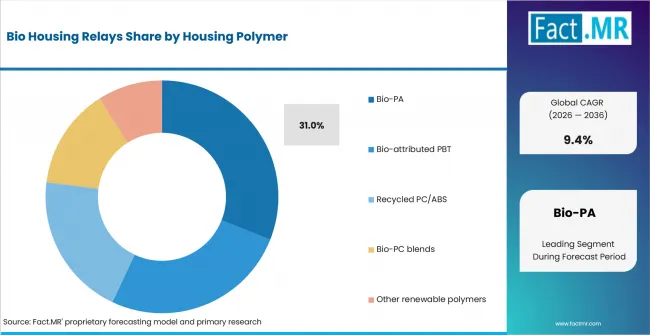
Bio Housing Relays Analysis By Housing Polymer | Source: Fact.MR
Polyamide has an established role in demanding molded components, while renewable routes reduce the change in material logic for designers. Arkema states that castor-oil-based PA11 combines chemical resistance, dimensional stability and performance across a broad temperature range. BASF also offers biomass-balance polyamide with the same properties as its conventional counterpart. This gives relay housing engineers a pathway to lower fossil feedstock use while preserving the engineering characteristics expected from engineering thermoplastics.
Relay OEMs are more likely to approve a renewable-content polymer when its molding window and component performance remain close to a qualified incumbent grade. That limits tooling changes and reduces the engineering work required before the new housing material can enter production.
Why does PCB power relay lead Relay Type?
PCB power relay accounts for 34.0% of Relay Type in 2026.
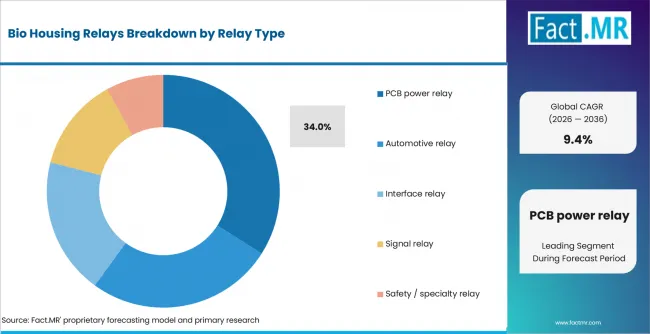
Bio Housing Relays Analysis By Relay Type | Source: Fact.MR
PCB power relays combine compact board integration with switching of loads that would otherwise require a larger external device. Current relay portfolios include board-mounted power relays for control and power interfaces, while automotive relays extend similar switching logic into vehicle electronics. Housing material must therefore support tight molded geometry around terminals and moving assemblies while maintaining electrical isolation.
IEC 61810-1 defines functional and safety requirements for electromechanical relays used across industrial equipment, appliances, building automation and vehicles. A bio-attributed housing does not remove those requirements. Buyers therefore favor materials that can enter PCB relay platforms without creating a new reliability risk.
Why does Industrial automation lead End-use?
Industrial automation accounts for 28.0% of End-use in 2026.
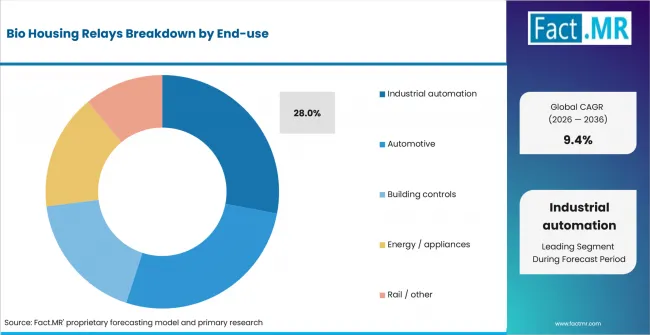
Bio Housing Relays Analysis By End Use | Source: Fact.MR
In industrial automation, control cabinets and machine systems use relays between controllers and field devices for switching, isolation and signal interfacing. Phoenix Contact describes its PLC-INTERFACE platform as the interface between controller and system I/O, showing why compact relay modules remain embedded in automation architectures.
Siemens' SIRIUS 3RQ4 shows how the material change can enter an existing automation relay platform without changing the switching function. Industrial buyers can therefore evaluate renewable-content housings within familiar control architectures and established relay qualification workflows.
Why does Mass-balance bio-attributed lead Sustainability Claim?
Mass-balance bio-attributed accounts for 36.0% of Sustainability Claim in 2026.
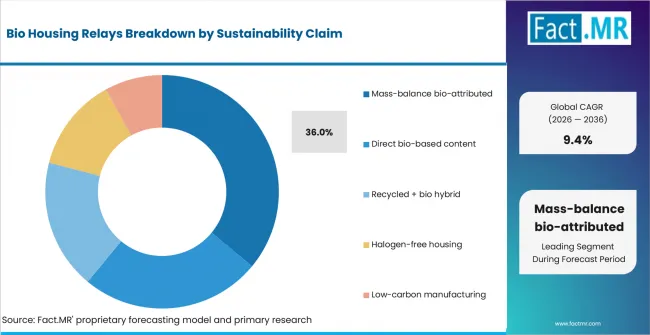
Bio Housing Relays Analysis By Sustainability Claim | Source: Fact.MR
Mass balance separates the renewable-feedstock change from the physical performance of the finished resin. BASF states that biomass-balanced Ultramid and Ultradur can replace fossil feedstock at the start of the value chain without a loss of product quality or performance. Covestro similarly positions renewable-attributed polycarbonate as a drop-in route using bio-circular feedstocks. That operating model aligns with the wider biomass-balanced polymers category.
For relay OEMs, this lowers the risk attached to a housing-material change. The sustainability claim can be supported through chain-of-custody systems while design teams continue to work with material families already familiar to injection molding and electrical-component qualification.
What is accelerating Bio Housing Relays Market adoption, and what is holding it back?
Adoption is being accelerated by direct proof that bio-based polymers can be used in electrical housings, wider availability of renewable-attributed PA, PBT and polycarbonate grades, and buyer pressure to document product-level material footprints. The main restraint is qualification burden. Relay housings are functional electrical parts, so a material change must preserve flame performance, insulation, heat resistance, dimensional stability and long-term reliability.
Drivers Impact Analysis
| Factor | (~) % Impact on CAGR | Geographic Relevance | Impact Timeline |
|---|---|---|---|
| OEM material-decarbonization specifications for electrical components | +1.7% | Europe, Japan, USA, South Korea | Near to Mid-term |
| Qualified bio-based housing use in relay and control-equipment platforms | +1.3% | Germany, Japan, UK, USA | Near-term |
Opportunity Impact Analysis
| Factor | (~) % Impact on CAGR | Geographic Relevance | Impact Timeline |
|---|---|---|---|
| Drop-in mass-balance PA and PBT for existing molding lines | +1.2% | Germany, USA, Japan | Near-term |
| Relay redesign cycles in industrial automation and automotive electronics | +0.8% | Germany, Japan, South Korea, USA | Mid-term |
| Hybrid recycled and bio-attributed housing formulations | +0.6% | UK, Europe, USA, South Korea | Mid to Long-term |
Restraints Impact Analysis
| Factor | (~) % Impact on CAGR | Geographic Relevance | Impact Timeline |
|---|---|---|---|
| Flammability, dielectric and relay requalification burden | -1.0% | Global | Near to Mid-term |
| Cost and availability gaps for qualified engineering grades | -0.7% | Global | Near-term |
| Chain-of-custody and sustainability-claim verification complexity | -0.5% | Europe, UK, Japan, USA | Mid-term |
Which countries are scaling the Bio Housing Relays Market through 2036?
- Japan: The Ministry of the Environment’s bioplastics roadmap targets broad substitution of fossil plastics and aims for approximately 2 million tons of bio-based plastics by 2030, creating a policy context for renewable polymers in durable manufactured products.
- Germany: Bioeconomy policy and direct industrial deployment are converging. Germany’s bioeconomy strategy supports biogenic material value chains, while Siemens has introduced low-voltage switching equipment using bio-based relay housings.
- USA: Electronics stewardship increasingly incorporates material choice, with EPA guidance encouraging recycled content, durability and recyclability. North American supply of renewable-attributed PA and polycarbonate also reduces material-access friction.
- South Korea: The 2026 plastic circular-economy plan targets a 30% reduction in virgin plastic against the 2030 forecast and includes 2 million tons of recycled raw-material use, creating a stronger basis for lower-fossil polymer specifications in electronics and industrial components.
- UK: The Environmental Improvement Plan identifies chemicals and plastics alongside electrical and electronic equipment as sectors for circular-economy action, increasing attention to material composition across electrical product supply chains.
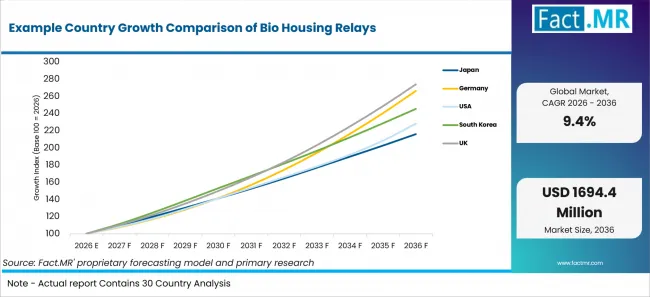
Example Country Growth Comparison Of Bio Housing Relays | Source: Fact.MR
| Country | CAGR (2026-2036) |
|---|---|
| Japan | 8.0% |
| Germany | 10.3% |
| USA | 8.6% |
| South Korea | 9.4% |
| UK | 10.6% |
What is driving Japan's growth through 2036?
Japan is projected to expand at a CAGR of 8.0% from 2026 to 2036.
- Japan’s 2024 Bioeconomy Strategy sets policy direction through 2030 for expanding bio-related markets and commercial applications. This supports a manufacturing environment in which renewable carbon can move from chemical production into durable components, including engineering-plastic housings.
- In Japan, adoption depends on qualifying new housing grades within established electronics and automotive supply chains. Bio-PA keeps the engineering material family familiar while changing the renewable-content profile, reducing the need for a complete polymer-system redesign.
What is driving Germany's growth through 2036?
The market in Germany is set to grow at a CAGR of 10.3% from 2026 to 2036.
- Germany combines policy support for a bio-based circular economy with direct industrial use of renewable-attributed engineering plastics. The federal bioeconomy framework calls for marketable bio-based products and development of value chains that use biogenic resources.
- Siemens provides a direct German example through the SIRIUS 3RQ4 coupling relay, which uses a housing with about 70% bio-based plastic made using biomass waste feedstock. The product shows that renewable-content housings can move from polymer qualification into recurring industrial switching applications.
What is driving USA's growth through 2036?
The USA bio housing relays market is projected to expand at a CAGR of 8.6% from 2026 to 2036.
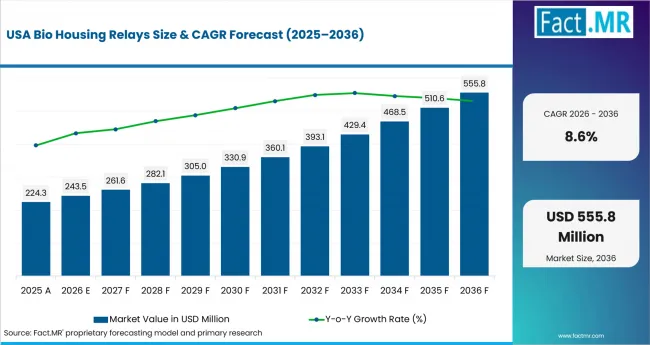
Bio Housing Relays Country Value Analysis | Source: Fact.MR
- EPA electronics guidance treats product design and manufacturing as part of sustainable electronics management and specifically points to recycled materials, durability and recyclability. This encourages OEMs to examine plastics within electronic assemblies rather than focusing only on end-of-life collection.
- Material availability is also improving. BASF introduced biomass-balance nylon 6 in North America using renewable natural gas attributed through mass balance, while Covestro has expanded ISCC PLUS-certified renewable-attributed polycarbonate supply in the United States. Relay manufacturers can therefore source lower-fossil engineering polymers closer to established molding operations.
What is driving South Korea's growth through 2036?
South Korea bio housing relays demand is set to grow at a CAGR of 9.4% from 2026 to 2036.
- South Korea’s plastic circular-economy plan shifts attention from waste treatment alone toward source reduction and replacement of virgin resin with recycled feedstock. This increases the commercial relevance of lower-fossil housing materials for domestic electronics, electrical equipment and automotive supply chains.
- The government is also building a broader bioeconomy policy framework. The Ministry of Science and ICT established the National Bio Committee to coordinate bioeconomy policy across sectors including resources, energy and the environment, with white biotechnology included in its remit. That supports longer-term development of bio-derived industrial materials.
What is driving UK's growth through 2036?
The UK bio housing relays market is anticipated to grow at a CAGR of 10.6% from 2026 to 2036.
- The UK Environmental Improvement Plan 2025 places electrical and electronic equipment, chemicals and plastics within the circular-economy work program. For component suppliers, this creates more reason to document housing composition and end-of-life compatibility when selling into equipment platforms with sustainability requirements.
- WEEE rules reinforce the lifecycle view by requiring regulated treatment, recovery and evidence for reuse or recycling. Bio-attributed housing adoption will therefore benefit where suppliers can pair renewable-content claims with material choices that do not hinder established product safety, reuse or recycling requirements.
Who Leads the Bio Housing Relays Market?
Key players in the Bio Housing Relays market include Omron, Panasonic Industry, TE Connectivity, Finder, Phoenix Contact and Hongfa.
Omron’s Device & Module Solutions business became Aratas Corporation on July 1, 2026. The relay and electronic-components business now operates under Aratas, while the Omron name remains relevant to products and market history preceding the transition.
Supplier advantage in this market depends on translating sustainable materials into qualified relay platforms. A broad relay catalog is useful, but buyers still require application-specific evidence covering molding stability and long-term reliability before approving a housing change.
Which companies are the key providers?
Key providers in the Bio Housing Relays market include Omron, Panasonic Industry, TE Connectivity, Finder, Phoenix Contact and Hongfa.
- Omron
- Panasonic Industry
- TE Connectivity
- Finder
- Phoenix Contact
- Hongfa
Bibliography
- Arkema. (n.d.). Rilsan PA11 Resin: High-performance polyamide of renewable origin. Arkema.
- BASF. (2025). BASF expands sustainable polyamide 6 portfolio in North America with Ultramid LowPCF and Ultramid BMB. BASF.
- Covestro. (2025). RE Series: Unlock the next level of carbon footprint reduction for your business. Covestro.
- European Union. (2024). Regulation (EU) 2024/1781 establishing a framework for the setting of ecodesign requirements for sustainable products. Official Journal of the European Union.
- Federal Ministry of Education and Research and Federal Ministry of Food and Agriculture. (2020). National Bioeconomy Strategy. Federal Government of Germany.
- International Electrotechnical Commission. (2019). IEC 61810-1:2015+AMD1:2019, Electromechanical elementary relays: General and safety requirements. IEC.
- Cabinet Office, Government of Japan. (2024). Bioeconomy Strategy. Integrated Innovation Strategy Promotion Council.
- Japan Ministry of the Environment. (2021). Roadmap for Bioplastics Introduction. Government of Japan.
- Korea Ministry of Climate, Energy and Environment. (2026). Plan for transition to a sustainable plastic circular economy. Government of the Republic of Korea.
- Korea Ministry of Science and ICT. (2024). Mobilizing nationwide public-private resources to take the lead in the global bioeconomy. Government of the Republic of Korea.
- Phoenix Contact. (2024). CO2 reduction through the use of bio-based plastics in device connection technology. Phoenix Contact.
- Phoenix Contact. (n.d.). Highly compact relay modules: PLC-INTERFACE. Phoenix Contact.
- Siemens. (2025). From frying oil to coupling relays: Siemens and Envalior collaborate on more sustainable electrical products. Siemens AG.
- UK Department for Environment, Food & Rural Affairs. (2025). Environmental Improvement Plan 2025. UK Government.
- UK Environment Agency. (2026). Waste electrical and electronic equipment: Reuse and treatment. UK Government.
- UL Solutions. (n.d.). Combustion fire tests for plastics. UL Solutions.
- US Environmental Protection Agency. (2026). Electronics basic information, research, and initiatives. US EPA.
- OMRON Corporation. (2026). Notice regarding absorption-type company split of the Device & Module Solutions business and transfer of shares of the succeeding company. OMRON Corporation.
This Report Answers
- How quickly is revenue from bio housing relays projected to expand through 2036?
- Which housing polymer currently accounts for the primary share of market revenue?
- Why are mass-balance sustainability claims being adopted in relay housings?
- How do relay safety and flammability requirements affect material substitution?
- Which relay type accounts for the primary revenue share in 2026?
- How do industrial automation and automotive design cycles affect qualification demand?
- What market mechanisms support adoption in Japan, Germany, USA, South Korea and the UK?
- Which suppliers are positioned across relay portfolios relevant to bio housing adoption?
What does the Bio Housing Relays Market cover?
The market counts revenue from complete relay products in which the external housing or principal molded enclosure carries a renewable-attributed, directly bio-based, recycled-bio hybrid, halogen-free or lower-carbon material claim that fits the defined segmentation. It covers relay products sold into industrial automation, automotive, building controls, energy and appliances, rail and other specified applications.
The material boundary includes bio-PA, bio-attributed PBT, recycled PC/ABS, bio-PC blends and other renewable polymers used as relay housing materials. It intersects with the broader bioplastics market, but the revenue counted here remains the relay product rather than polymer resin shipments.
What is included in the scope?
- PCB power relay, Automotive relay, Interface relay, Signal relay and Safety / specialty relay products that meet the housing-material criteria.
- Housing polymers classified as Bio-PA, Bio-attributed PBT, Recycled PC/ABS, Bio-PC blends and Other renewable polymers.
- Industrial automation, Automotive, Building controls, Energy / appliances and Rail / other end-use applications.
- Mass-balance bio-attributed, Direct bio-based content, Recycled + bio hybrid, Halogen-free housing and Low-carbon manufacturing claims where they apply to the relay housing or its polymer system.
What is excluded from the scope?
- Standalone polymer resin, compound or additive sales when they are not sold as part of a complete relay product.
- Contactors, circuit breakers, switches, terminal blocks and control modules that do not meet the relay definition, even when they use bio-based plastics.
- Relay products using conventional housing materials with no qualifying sustainability claim under the defined taxonomy.
- Upstream biomass, monomers and feedstock transactions that are not incorporated into the commercial relay offering.
How Was the Analysis Built?
- Primary Research:
- Primary validation focuses on relay product engineers, electrical-component procurement managers, resin compounders, injection molders, industrial automation OEMs, automotive electrical-system suppliers and compliance engineers. Interviews test where sustainable housing materials enter the qualification process and what technical or commercial conditions determine adoption.
- Desk Research:
- Desk research uses relay safety standards, polymer flammability guidance, government circular-economy and bioeconomy policy, electronics stewardship guidance, first-party product documentation and current corporate disclosures. Evidence is used to explain adoption mechanisms and company status.
- Market Sizing and Forecasting:
- Market sizing maps relay unit demand by relay type and end-use to the share of products using qualifying housing materials. Forecasting considers housing-polymer substitution, qualification cycles, resin availability, sustainability-claim adoption and country exposure to industrial automation, automotive electronics and circular-material policy.
- Data Validation and Update Cycle:
- Validation checks relay product status, housing-material availability, standards requirements, company identity, country policy changes and evidence of commercial deployment. Updates focus on material qualification events, new relay platforms and changes in renewable or recycled engineering-plastic supply.
What is the report's scope and coverage?
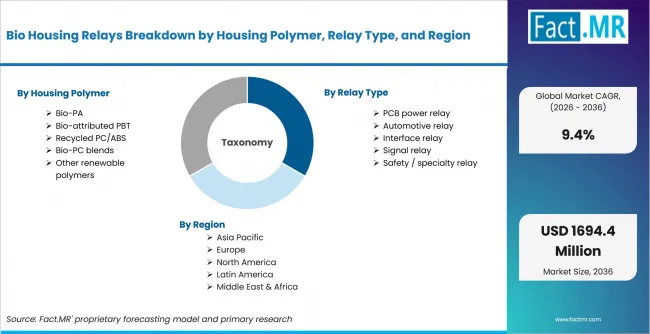
Bio Housing Relays Breakdown By Housing Polymer, Relay Type, And Region | Source: Fact.MR
| Metric | Value |
|---|---|
| Quantitative Units | USD million |
| Market Definition | Complete relays using qualifying renewable-attributed, bio-based, recycled-bio hybrid, halogen-free or lower-carbon housing polymer approaches |
| Segments | Housing Polymer; Relay Type; End-use; Sustainability Claim |
| Countries | Japan; Germany; USA; South Korea; UK |
| Key Companies | Omron; Panasonic Industry; TE Connectivity; Finder; Phoenix Contact; Hongfa |
| Forecast Period | 2026-2036 |
| Base Year | 2026 |
| Market Value, 2026 | USD 690.0 million |
| Market Value, 2036 | USD 1,694.4 million |
| CAGR, 2026-2036 | 9.4% |
| Absolute Opportunity | USD 1,004.4 million |
| Approach | Bottom-up relay demand by type and end-use, adjusted for qualified housing-material substitution and sustainability-claim adoption |
How is the market segmented?
-
By Housing Polymer
- Bio-PA
- Bio-attributed PBT
- Recycled PC/ABS
- Bio-PC blends
- Other renewable polymers
-
By Relay Type
- PCB power relay
- Automotive relay
- Interface relay
- Signal relay
- Safety / specialty relay
-
By End-use
- Industrial automation
- Automotive
- Building controls
- Energy / appliances
- Rail / other
-
By Sustainability Claim
- Mass-balance bio-attributed
- Direct bio-based content
- Recycled + bio hybrid
- Halogen-free housing
- Low-carbon manufacturing
-
By Region
- North America
- Latin America
- Western Europe
- Eastern Europe
- East Asia
- South Asia and Pacific
- Middle East & Africa