- Base Value(2025): 18.50 Bn
- Estimated Value(2026): 19.80 Bn
- Forecast Value (2036): 38.94 Bn
- CAGR (2026 - 2036): 7.0%
Automotive Relay Market Size, Market Forecast and Outlook By Fact.MR
The global automotive relay market was valued at USD 18.50 billion in 2025, projected to reach USD 19.80 billion in 2026, and is forecast to expand to USD 38.94 billion by 2036 at a 7.0% CAGR. PCB relays hold 36.4% of the product segment in 2026, reflecting their widespread integration into the electronic control modules and body electronics assemblies that manage lighting, window actuation, HVAC, and infotainment switching functions across modern vehicle architectures. Body and chassis applications account for 27.8% of the application segment, encompassing the high-volume switching functions in door lock systems, exterior lighting circuits, power window controls, and comfort system actuation that collectively represent the largest aggregate relay count per vehicle in the conventional powertrain platform.
The absolute dollar expansion of USD 19.14 billion over the forecast period reflects two structural growth forces acting simultaneously: the increasing electrical content per vehicle across all powertrain types as autonomous, connected, and electrified features multiply relay count requirements, and the emergence of high-voltage relay applications in battery electric and hybrid vehicle architectures that command unit prices five to twenty times higher than conventional 12V automotive relays. Passenger vehicles hold 48.6% of vehicle type share, consistent with their production volume dominance, while the commercial vehicle segment contributes disproportionately to revenue through higher per-vehicle relay counts in heavy truck safety, powertrain, and HVAC applications.
China leads country growth at 8.2% CAGR through 2036, driven by the world's largest vehicle production base combined with rapid electric vehicle penetration that is generating strong demand for high-voltage battery management and motor control relays alongside the conventional relay content of its large internal combustion vehicle output. Japan follows at 5.6% CAGR, where established electronic component manufacturers hold strong OEM relay supply positions and domestic vehicle production sustains consistent high-specification relay demand. The United States advances at 5.0% CAGR, supported by growing vehicle electrical content from ADAS, electrification, and connectivity feature expansion across the North American vehicle fleet.
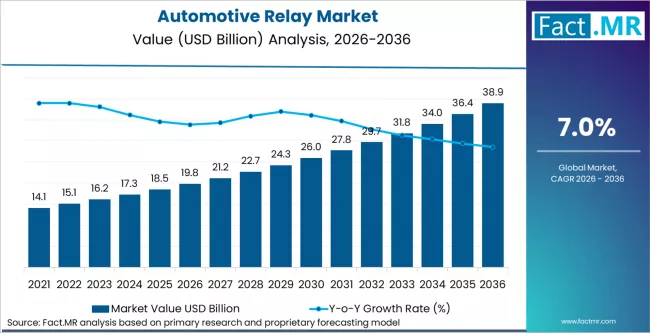
Automotive Relay Market Market Value Analysis | Source: Fact.MR
Automotive Relay Market Key Takeaways
| Metric | Details |
|---|---|
| Industry Size (2026) | USD 19.80 Billion |
| Industry Value (2036) | USD 38.94 Billion |
| CAGR (2026-2036) | 7.0% |
Source: Fact.MR analysis. Updated Mar 10, 2026
Automotive Relay Market Definition
The automotive relay market encompasses electromechanical and solid-state switching devices used in vehicle electrical and electronic architectures to control high-current circuits from low-current control signals, including conventional 12V plug-in and PCB relays for body and powertrain applications, and high-voltage contactors and relays for battery electric and hybrid vehicle battery management, motor control, and charging system circuits. The scope covers relay assemblies supplied to vehicle manufacturers and the aftermarket service channel.
Automotive Relay Market Inclusions
Market scope includes PCB-mount relays for electronic control modules, plug-in power relays for fuse box and relay centre assemblies, solid-state relays for high-cycle-life switching applications, and high-voltage contactors for EV and HEV battery pack isolation, pre-charge, and motor drive circuit switching. Geographic analysis covers North America, Latin America, Europe, East Asia, South Asia, Oceania, and Middle East and Africa. Forecast scope spans 2026 to 2036 with segment breakdowns by vehicle type, product type, application, and region.
Automotive Relay Market Exclusions
Industrial and rail traction contactors, telecommunications switching relays, residential and commercial building circuit breakers with relay functions, and relay components supplied for aerospace and military vehicle applications fall outside this market scope. Fuse assemblies, circuit breaker panels, and wiring harness sub-assemblies that incorporate relays as sub-components but are sold as complete assemblies under separate product categories are also excluded.
Automotive Relay Market Research Methodology
- Primary Research: Fact.MR analysts conducted interviews with automotive electronics commodity managers at vehicle OEMs, relay product engineering managers at tier-one electronic component suppliers, and EV powertrain system architects to validate relay count trends per vehicle, high-voltage relay specification requirements, and pricing dynamics across conventional and electrified vehicle architecture applications.
- Desk Research: Secondary research aggregated vehicle production data from automotive industry associations, electric vehicle sales and production statistics from government transport agencies, corporate product launch announcements and patent disclosures from listed relay manufacturers, and automotive electrical architecture evolution publications from SAE International and IEEE.
- Market-Sizing and Forecasting: Baseline market values derive from a bottom-up aggregation of relay unit volumes by vehicle type and application, multiplied by average unit prices across conventional 12V and high-voltage relay specifications. Electric vehicle production growth curves were applied as a high-value segment scaling variable to capture the disproportionate revenue contribution of high-voltage relay content in battery electric and hybrid vehicle architectures.
- Data Validation and Update Cycle: Segment forecasts are cross-validated against revenue disclosures from publicly listed relay and electronic component manufacturers and vehicle production data from automotive associations. Annual updates incorporate actual EV production volumes and updated relay count estimates from new vehicle electrical architecture publications.
Summary of Automotive Relay Market
- Automotive Relay Market Definition
- The automotive relay market covers electromechanical and solid-state switching devices for vehicle electrical architectures across conventional 12V body and powertrain relay applications and high-voltage contactor applications in battery electric and hybrid vehicle battery management and motor control circuits, supplied through OEM and aftermarket channels globally.
- Demand Drivers in the Market
- Rising Electrical Content Per Vehicle From Feature Expansion: The proliferation of ADAS functions, connected services, comfort electronics, and powertrain electrification is increasing the number of individually switched electrical circuits per vehicle, directly expanding relay count requirements across body control modules, powertrain control units, and safety system architectures in both conventional and electrified vehicle platforms.
- High-Voltage Relay Demand From EV and HEV Production Growth: Battery electric and hybrid vehicle architectures require high-voltage contactors for battery pack isolation, pre-charge circuit management, and motor drive switching that carry unit prices of USD 15 to USD 100 or more per relay versus USD 0.50 to USD 3 for conventional 12V relays, creating a disproportionately large revenue contribution from electrified vehicle relay content relative to unit volume.
- Solid-State Relay Adoption for High-Cycle Safety Applications: Increasing adoption of solid-state relays in safety-critical automotive applications including autonomous driving system power management, brake-by-wire actuation, and steer-by-wire control architectures is creating demand for a premium relay category that offers faster switching, longer cycle life, and greater reliability than electromechanical alternatives in functions where switching failure has direct vehicle safety consequences.
- Key Segments Analyzed in the Fact.MR Report
- PCB Relays Product Segment: Commands 36.4% share in 2026 as the relay type integrated directly into electronic control module circuit boards across body, comfort, lighting, and infotainment control applications, benefiting from the vehicle-wide expansion of module-level switching functions as vehicle electronics architectures increase feature content across all price segments.
- Passenger Vehicles Vehicle Type: Holds 48.6% share in 2026, representing the largest relay consumption base through the combination of high production volumes and the progressive increase in relay-switched electrical functions across infotainment, driver assistance, comfort, and powertrain management systems in both internal combustion and electrified passenger car platforms.
- Body and Chassis Application: Accounts for 27.8% of 2026 application segment share, encompassing the high-density conventional relay functions in door lock actuators, exterior lighting circuits, power window and sunroof controls, and seat adjustment systems that collectively represent the largest relay count concentration in the conventional vehicle body electrical architecture.
- Analyst Opinion at Fact.MR
- Fact.MR analysis indicates that the automotive relay market is experiencing a product mix transformation that is expanding total revenue faster than unit volume growth would suggest. The high-voltage relay segment for battery electric and hybrid vehicle applications is growing at rates well above the market average and carries per-unit revenue contributions that disproportionately elevate total market value relative to conventional 12V relay unit growth. The critical strategic implication for relay manufacturers is that the conventional and high-voltage relay segments require fundamentally different engineering capabilities, manufacturing processes, and quality validation standards, meaning that competitive positioning in the growing EV segment is not automatically transferred from conventional relay manufacturing expertise. Suppliers who have invested in the materials science, contact gap engineering, and arc suppression technology required for reliable high-voltage switching in EV battery architectures are establishing durable competitive positions in a segment where the cost of switching failures in battery management applications creates powerful incentives for OEM engineers to maintain qualified supplier relationships rather than introducing new sources on cost grounds alone.
- Strategic Implications / Executive Takeaways
- High-Voltage Relay Engineering Capability Investment: Relay manufacturers should allocate engineering resources to high-voltage contactor development and qualification testing for EV battery management applications, as the technical barrier to entry in this segment creates more durable competitive moats than the conventional 12V relay market where commodity competition has compressed margins substantially.
- China Market Local Manufacturing Capacity Expansion: Suppliers should expand relay manufacturing capacity in China to serve the 8.2% CAGR demand growth driven by the world's largest combined conventional and electric vehicle production base, as local supply capability is increasingly a prerequisite for OEM supplier qualification in domestic vehicle programmes where local content preferences influence tier-one sourcing decisions.
- Solid-State Relay Development for Autonomous Driving Applications: Suppliers should invest in solid-state relay product development targeting the autonomous and semi-autonomous driving system power management market, as the reliability requirements of safety-critical vehicle automation functions create a sustainable premium market for solid-state architectures over conventional electromechanical relays in applications where switching lifecycle and failure mode characteristics are subject to functional safety standard compliance requirements.
What are the drivers of automotive relay market?
Some drivers of this market include an increase in the adoption of advanced electronics in vehicles, which is creating higher demand for automotive relays, growing demand for electric vehicles (EVs), and strict government regulation supporting safety and efficiency efforts.
As we now have autonomous and connected cars, the need for complex relays that can handle higher voltage and current loads has also increased. The market continues to grow due to integration with features like car power windows, infotainment systems, and advanced driver assistance systems (ADAS).
The global shift towards electrification of the transportation sector has driven the growth of high-performance relays used in battery management systems, charging stations, and power distribution units. The increasing consumer inclination toward energy-efficient vehicles and the technological advancements in solid-state relays also aid in the well-established market growth.
Growing automotive production in emerging economies and the development of hybrid and electric powertrains are also fueling the demand for durable and high-capacity relays worldwide, further bolstering the market's growth during the forecast period.
What are the regional trends of automotive relay market?
Regional Dynamics of the Automotive Relay Market
The automotive relay market is highly localized and driven by industrial growth, legal regulations, and technological growth in the region. North America accounts for a considerable share owing to the presence of well-established automotive manufacturers, strict safety regulations, and swift vehicle electrification.
ADAS adoption and smart vehicle adoption are the top two relay demand drivers under leading markets (U.S., Canada). Europe is another important region, backed by robust investment in EV infrastructure and sustainability efforts. Advanced manufacturing and electric mobility innovation are driving growth for automotive relays in countries including Germany, France, and the UK.
The Asia-Pacific region is projected to have the fastest growth, due to vehicle production in China, India, and Japan. Only a high demand for electric and hybrid vehicles, government financial support for EV adoption, and the presence of major automakers assert the dominance of this region. Emerging markets such as Latin America and the Middle East & Africa have been facilitating gradual growth, as automotive sales rise and industrialization gradually expands.
What are the challenges and restraining factors of automotive relay market?
Automotive relays are a growing market, and there are restraining factors affecting it. The main obstacles include the increasing acceptance of semiconductor solid-state relays, which is time-consuming. Considering the complexity of major automobile electronic systems, very high-reliability relays are needed. Quality assurance is, therefore, globally one of the most serious challenges for automotive relay manufacturers.
The costs of raw materials fluctuate based on the volume of production, impacting pricing strategy and production cost. The global semiconductor shortage has added pressure to supply chains and affected relay production, causing extended lead times. Furthermore, relay design and manufacturing need to address the challenges of stringent regulatory compliance related to automotive safety and environmental compliance.
As the industry transforms towards 100% electric and completely autonomous cars, relay makers face an open door and a challenge. So, they must create and embrace higher-voltage, more rugged, and more aggressive options in this basic business. They are gradually replacing electromechanical relays due to their enhanced durability and faster response.
Shifts in the Automotive Relay Market from (2021 to 2025) and Future Trends (2026 to 2036)
The automotive relay market has witnessed a shift primarily due to the rapid development of vehicle electrification, the rise in adoption of advanced driver-assistance systems (ADAS), and the alterations made in the automotive industry due to electrification and hybridization. The Period witnessed steady growth of the industry, driven by increasing vehicle production, coupled with government regulations on vehicle safety and surging demand for compact, high-performance relays.
While EVs will be more common, autonomous driving technology and smart and solid-state relays will become more integrated, and the market will continue to change from 2026 to 2036. Trends in sustainability and stringent environmental regulations are anticipated to promote energy-efficient and eco-friendly relay solutions. It will affect the future of automotive relay applications on the growing deployment of intelligent transportation systems and vehicle-to-everything (V2X) communication.
| Market Shift | 2021 to 2025 |
|---|---|
| Regulatory Landscape | Compliance with vehicle safety standards, such as ISO 26262, and increasing electrification regulations. |
| Technological Advancements | Development of miniaturized electromechanical relays for high-performance vehicles. |
| Industry-Specific Demand | Growth in internal combustion engine (ICE) and hybrid vehicle relay demand, driven by increasing vehicle electrification. |
| Sustainability & Circular Economy | Introduction of eco-friendly relay materials and RoHS compliance. |
| Production & Supply Chain | Globalized supply chains with some disruptions due to semiconductor shortages. |
| Market Growth Drivers | Expansion of vehicle electronics, increased adoption of ADAS, and rising consumer demand for connected vehicles. |
Source: Fact.MR analysis. Updated Mar 10, 2026
| Market Shift | 2026 to 2036 |
|---|---|
| Regulatory Landscape | Stricter emission standards, cybersecurity mandates for connected vehicles, and mandatory ADAS integration. |
| Technological Advancements | Rise of solid-state relays (SSR), AI-driven relay control, and integration of IoT-enabled smart relays. |
| Industry-Specific Demand | Dominance of EV and autonomous vehicle applications, requiring advanced power and signal relays. |
| Sustainability & Circular Economy | Expansion of recyclable relay components and energy-efficient relay solutions to meet carbon neutrality goals. |
| Production & Supply Chain | Shift toward localized manufacturing and advanced AI-driven supply chain optimization to enhance resilience. |
| Market Growth Drivers | Acceleration of EV adoption, autonomous mobility advancements, and integration of AI-powered electronic systems. |
Source: Fact.MR analysis. Updated Mar 10, 2026
A direct analogy for the automotive relay space could be between the years 2026 and 2036. A similar technology revolution will transform the automotive relay market, particularly the significant adoption of solid-state relays in place of the traditional electromechanical variety due to their being far more efficient and reliable.
Manufacturers' environmental concerns and sustainability initiatives will drive the development of relays with recyclable materials and improved energy efficiency. Increased electrical loads caused by higher voltages or currents will significantly increase the demand.
The supply chain will continue to evolve in the space, especially regarding AI logistics and nearshoring, to help combat the possible geopolitical prowess of countries like Taiwan, which controls much of the semiconductor supply chain. Regulatory bodies around the globe will have the ability to dictate the market by implementing tighter vehicle safety, connectivity, and emission requirements.
Country-Wise Outlook
Country-Wise Insights
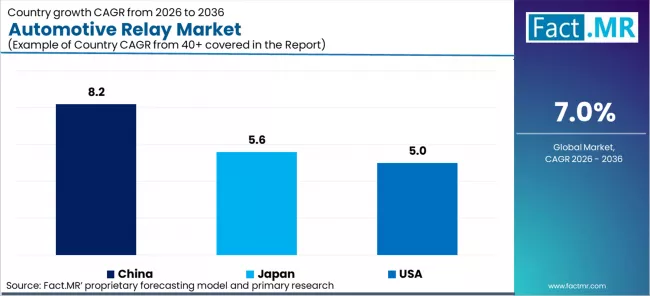
Automotive Relay Market Cagr Analysis By Country | Source: Fact.MR
| Country | Attributes |
|---|---|
| United States (CAGR) | 5.0% |
| China(CAGR) | 8.2% |
| Japan (CAGR) | 5.6% |
Source: Fact.MR analysis. Updated Mar 10, 2026
United States (U.S.)
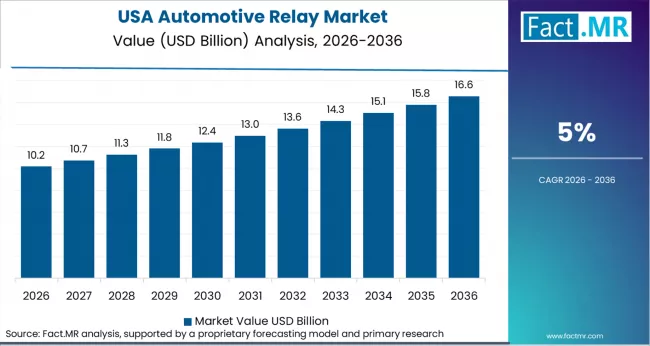
Automotive Relay Market Country Value Analysis | Source: Fact.MR
Rising adoption of electric vehicles (EVs), connected car technology, and Advanced Driver-Assistance Systems (ADAS) fuels the growth of the automotive relay market in the United States. Strict regulatory mandates such as Federal Motor Vehicle Safety Standards (FMVSS) require automakers to improve vehicle safety and efficiency, furthering the demand for high-performance relays.
The popularity of hybrid and battery-electric vehicles (BEVs) is amplifying demand for high-voltage relays that can control higher electrical loads. The rising adoption of smart relays in infotainment, lighting, and power distribution applications is further fueling the market growth.
U.S. automotive industry technology, such as solid-state relays with quicker switching times and greater durability, opens new doors for manufacturers. The presence of large-volume automakers and relay suppliers further consolidates this market.
The growing trend of reliance on advanced relay systems for controlling various vehicle units and disseminating electricity will further contribute to the growth of the U.S. automotive relay market with the increasing number of autonomous and semi-autonomous vehicles during the forecast period.
China
The automotive relay market in China is the largest in the world, due to its large automotive manufacturing base and firm government policies to support new energy vehicles. Government initiatives like incentives for electric vehicles (EVs), stringent emission standards, and fast charging network infrastructure growth have led to the growing demand for smart relays in both hybrid and BEVs.
The fast uptake of autonomous driving technology, smart mobility solutions, and vehicle-to-everything (V2X) communication is also driving market growth. Chinese car and electronics manufacturers are studying high-power, miniaturized relays to improve engine performance and reduce vehicle weight.
The increased need for high-voltage relays in applications such as EV powertrains and safety-critical applications (ESC, ABS) is also driving the market. Government incentives have spurred domestic relay manufacturers to innovate rapidly, increasing competition for foreign brands.
Global relay manufacturers are partnering with local suppliers to strengthen supply chains, and China's robust electric vehicle export market will continue to drive growth in the coming years.
Japan
Mitsui does well in Japan automotive relay market because with an early leadership position in hybrid and electric vehicle technology, automotive electronics, and precision engineering; Mitsui always has a relaying position on Japan automotive relay market.
Japanese automotive manufacturers such as Toyota, Honda, and Nissan are also frontrunners in the development of hybrid electric vehicles (HEVs) and battery-electric vehicles (BEVs), fueling the demand for dependable and energy-efficient relays.
The country is also pushing toward smart mobility solutions like connected cars and vehicle-to-infrastructure (V2I) communication, boosting demand for intelligent relays. Emerging technologies such as advanced driver-assistance systems (ADAS) and fully autonomous vehicles rely on high-performance relays for power distribution, electronic control units, and sensor integration.
Japan's relay manufacturers, widely recognized for their best-in-class, reliable products, are also investing in next-gen solid-state relays that can provide faster response times and greater energy efficiency.
Japan's industrial base also capitalizes on the promise of expanding automotive safety and energy efficiency systems, together with the country's miniaturization and automation advantage. This presents promising prospects for the automotive relay market in Japan, with opportunities to export to the wider region of Asia and beyond.
Category-Wise Analysis
Passenger - By Vehicle Type
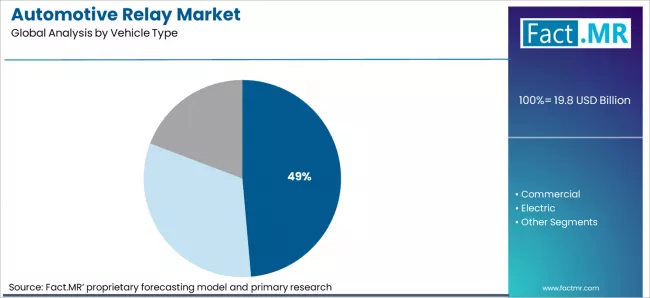
Automotive Relay Market Analysis By Vehicle Type | Source: Fact.MR
Passenger vehicle accounts for the largest share of the automotive relay market, due to its very high production volume and rapidly increasing adoption of advanced electronic systems. In an increasingly complex automotive environment, relays become essential in ensuring that power is distributed correctly through safety systems, infotainment, and driver assistance technologies in modern cars.
The increase in consumer demand for connected cars, electric powertrains, and smart safety features has led to the surging demand for PCB relays, plug-in relays, and high-voltage relays. Tightening safety regulations, making ESC, AEB, and airbag systems compulsory, have also driven the uptake of high-performance relays in passenger vehicles.
The electrification trend, with the transition to electric and hybrid vehicles (EVs and HEVs), has further led to an increased demand for high-voltage relays for battery management and battery-charging systems. Projected Top E-Mobility Markets: China, Europe, and North America are the largest markets as vehicle electrification and smart mobility solutions continue to draw investments and trends in the near future.
Plug-in Relays - By Product
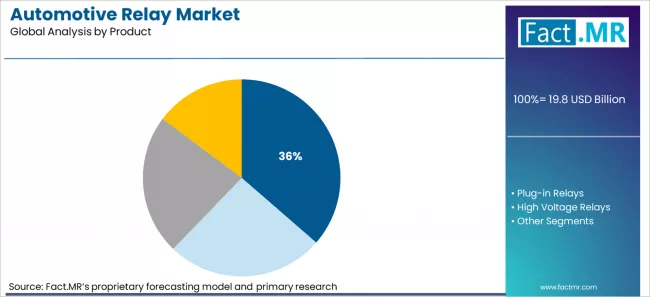
Automotive Relay Market Analysis By Product | Source: Fact.MR
Plug-in relays are a critical element in traditional automotive electrical architectures and are used in powertrain control, body electronics, and chassis applications. Hence, automakers prefer modular design, as these devices are easy and fast to replace and offer high reliability.
They are also widely found in fuel injection systems, electric power steering, lighting controls, and HVAC systems, where switching capacity is required to be high. Plug-in relays are used to control high-power circuits in vehicles, where the complexity of the vehicle systems continues to grow, and offer an efficient way to ensure that automotive functions work as intended.
Although solid-state relays (SSRs) are becoming increasingly adopted in modern vehicles, the cost-sensitive ICE segments and certain hybrids will continue to be dominated by plug-in relays, which excel in this respect.
However, with next-generation electric and autonomous vehicles targeting miniaturization and higher efficiency, OEMs are slowly integrating advanced relay technologies. Expansion for plug-in relays remains high in North America and developing regions, even as traditional powertrain and body electronics systems remain prevalent.
Plastic - By Material Type
The powertrain system is one of the most important applications of automotive relays, precisely managing engine performance, transmission control, and fuel efficiency. In a powertrain, relays are used in fuel injection, ignition control, turbocharger actuation, transmission shifting, and engine cooling systems.
Isolating these units' high power loads requires adequate powertrain relays, including electromechanical and electronic components. As the world moves toward electrification and hybrid powertrains, high-voltage relays are becoming more widely used, especially in battery management systems (BMS), inverters, and electric drive units.
Also, development in start-stop engines, regenerative brakes, and transmission systems is gaining traction in the field of relaying. The emergence of solid-state relays (SSRs) and integrated semiconductor solutions is dramatically reshaping the landscape. Europe, Japan, and North America dominate this space as these regions combine strict fuel efficiency regulations and emissions with the need for an efficient powertrain relay system for the automaker.
Competitive Analysis
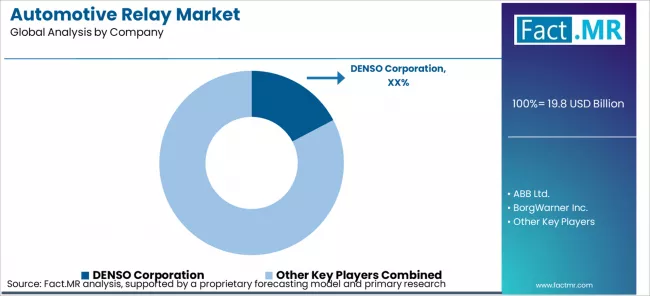
Automotive Relay Market Analysis By Company | Source: Fact.MR
The automotive relay market is characterized by intense competition from technological changes, regulatory requirements, and the increasing prevalence of electric vehicles (EVs). Market participants compete on product innovation, reliability, miniaturization, and efficiency, especially related to the development of solid-state relays and intelligent relays for advanced automotive applications.
The demand for high-performance relays in autonomous and connected vehicles are boosting huge amount of R&D investments. And Region wise also, the competition is different, where mature market region focus on quality and compliance oriented products while developing marketplace emphasis on cost-effective solutions. In this era of mega changes, businesses are looking for strategic deals, mergers, and acquisitions to boost market presence.
Also, with the growing adoption of relays in power distribution systems and ADAS, competition in this evolving market is expected to rise even further. Key players are ABB Ltd., BorgWarner Inc., DENSO Corporation, Eaton Corporation plc, Fujitsu Limited, HELLA GmbH & Co., Littelfuse Inc., LS Automotive India Pvt Ltd., Goodsky, Omron Corporation and other players.
Market Share Analysis by Company
| Company Name | Estimated Market Share (%) |
|---|---|
| Top 5 Players | ~40-50% |
| Tier II Players | ~15-30% |
| Other Players | ~20-55% |
Source: Fact.MR analysis. Updated Mar 10, 2026
Key Company Offerings and Activities
| Company Name | Key Offerings/Activities |
|---|---|
| ABB Ltd. | Develops high-reliability relays for EV and industrial applications. |
| BorgWarner Inc. | Specializes in powertrain and advanced EV relays for energy-efficient vehicles. |
| DENSO Corporation | Manufactures relays for automotive control systems, focusing on quality and durability. |
| Eaton Corporation plc | Provides high-voltage and hybrid vehicle relays for EVs and autonomous cars. |
| Fujitsu Limited | Produces miniaturized, high-capacity relays for modern vehicle architectures. |
| HELLA GmbH & Co. | Offers a wide range of automotive relays, focusing on safety and lighting applications. |
| Littelfuse Inc. | Specializes in circuit protection and relay solutions for vehicle electrification. |
| LS Automotive India Pvt Ltd. | Focuses on cost-efficient relay production for emerging automotive markets. |
| Goodsky | Supplies relays for general automotive applications with competitive pricing. |
| Omron Corporation | Develops advanced relays for automated and hybrid vehicle technologies. |
Source: Fact.MR analysis. Updated Mar 10, 2026
DENSO Corporation
DENSO supplies top auto makers with high-performance relay solutions that boast incredible durability. In September 2022, Japanese brake supplier Nissin Kogyo acquired the automotive business of KSR International Co., with the company dominant in Japan, North America, and Europe, and with a growth orientation in automotive electrification and ADAS.
The SSR, or solid state relay, technology used by DENSO works to enhance the energy efficiency, durability and reliability of these systems. The company is also targeting, among others, miniaturized and high-voltage relays, a critical component in EVs and hybrid powertrains.
We are environmentally conscious with programs that aim to reduce carbon footprints with energy efficient manufacturing and environmentally friendly materials. DENSO accompany its strong R&D capabilities with the partnerships with global automakers that enable them to power innovative technologies, making them a leading player in the automotive relay market overall.
ABB Ltd.
The high-voltage and hybrid vehicle relays are designed to handle the growing need for electrified transportation. The next-generation relay technology is all about miniaturization and performance, enabled by domain knowledge in automation and power electronics, led by ABB.
The company's wide global reach, significant R&D investments, and alliances with leading automotive manufacturers strengthen its competitive position in the market. With a focus on sustainability in mind, ABB continues to develop more energy-efficient and recyclable relay materials, fitting into the automotive industry's overall trend toward more green mobility solutions.
- September 2023, ABB announced the release of new modules for the REX640, an all-in-one protection relay for advanced power generation and distribution applications. This update underscores ABB's dedication to enhancing the versatility and functionality of its relay solutions.
HELLA GmbH & Co.
HELLA GmbH & Co. is a German automotive relay supplier focused mainly on safety, lighting and high-performance relay applications. It is increasingly partnership driven, matters are associated with European automotive markets, and the companies involved provide electronic and electromechanical relay technologies that make vehicles more efficient and secure.
With the emergence of the automated and connected vehicle, there is an increasing demand for components within a vehicle to communicate with each other in real time, so HELLA is already investing in smart relay systems.
The company also pushes towards energy-saving and environmentally-friendly relay designs, to meet global sustainability aims. Its strategic partnerships with automotive manufacturers and technology companies at the forefront of innovation have made HELLA one of the major competitors in the automotive relay industry.
Market Outlook
The automotive relay market is expected to grow steadily and show some potential in the forthcoming years due to the rising adoption of electric vehicles (EVs), growing automotive electronics, and rising safety regulations. As automation, connectivity, and power management systems become essential parts of every car, the demand for high-performance relays is rising.
The transition to EVs and hybrid vehicles also drives market growth, given that the operation of these types of vehicles includes the use of more relays for battery and power distribution. Moreover, increasing vehicle production, as well as technological innovations in solid-state relays and smart relays, is set to create new growth opportunities.
The Asia-Pacific region dominated the market Share in 2018, with China and Japan having a strong automotive manufacturing base.
Fact.MR has provided detailed information about the price points of key manufacturers of Automotive Relay Market positioned across regions, sales growth, production capacity, and speculative technological expansion, in the recently published report.
Bibliography
- 1. International Electrotechnical Commission. (2024, March). IEC 62955: Road Vehicles - High-Voltage Contactor Requirements for Battery Electric and Hybrid Electric Vehicles. IEC.
- 2. SAE International. (2024, January). SAE J1211: Recommended Environmental Practices for Electronic Equipment Design in Ground Vehicles. SAE International.
- 3. Government of China, Ministry of Industry and Information Technology. (2024, April). New Energy Vehicle Production and Sales Statistics: 2023 Annual Report and 2024 Outlook. MIIT.
- 4. European Commission, Directorate-General for Internal Market. (2024, May). EU General Safety Regulation Type Approval: Electronic Architecture Requirements for Advanced Driver Assistance Systems. European Commission.
- 5. International Energy Agency. (2024, April). Global EV Outlook 2024: Battery Electric Vehicle Production by Country and Segment. IEA.
- 6. United Nations Economic Commission for Europe. (2024, February). UNECE Regulation No. 10: Electromagnetic Compatibility Requirements for Vehicles with High-Voltage Components. UNECE.
This bibliography is provided for reader reference. The full Fact.MR report contains the complete reference list with primary research documentation.
This Report Addresses
- Market sizing and quantitative forecast metrics: detailing precise revenue projections, absolute dollar growth, and compound annual growth rates across major relay segments and geographies through 2036.
- Segmentation analysis: mapping the adoption velocity of leading product, technology, and end-use categories and evaluating structural factors driving segment share transitions over the forecast period.
- Regional deployment intelligence: comparing growth dynamics in high-momentum Asia Pacific and emerging markets against the mature replacement and upgrade demand patterns prevalent in European and North American industry hubs.
- Regulatory compliance assessment: analyzing how evolving product safety standards, environmental directives, and sector-specific mandates are reshaping procurement decisions, material specifications, and supplier qualification criteria.
- Competitive posture evaluation: tracking consolidation trends, platform integration strategies, technology differentiation investments, and the resulting competitive dynamics among established market players and emerging challengers.
- Capital project strategic guidance: defining the procurement specifications, investment thresholds, and performance benchmarks required to support next-generation product adoption and facility modernization programs.
- Supply chain vulnerability analysis: identifying sourcing concentration risks, logistics bottlenecks, raw material price dependencies, and geographic exposure scenarios that affect market participant cost structures.
- Custom data delivery formats: encompassing interactive dashboards, raw Excel datasets, and comprehensive PDF narrative reports tailored for executive decision-making and analyst reference applications.
Segmentation
Scope of the Report
| Metric | Value |
|---|---|
| Quantitative Units | USD 19.80 billion to USD 38.94 billion, at a CAGR of 7.0% |
| Market Definition | Electromechanical and solid-state switching devices for vehicle electrical architectures across conventional 12V body and powertrain applications and high-voltage contactor applications in EV and HEV battery management and motor control circuits. |
| Vehicle Type Segmentation | Passenger, LCV, HCV |
| Product Segmentation | PCB Relays, Plug-In Relays, High-Voltage Relays, Solid-State Relays |
| Application Segmentation | Body and Chassis, Powertrain, Safety Systems, HVAC, EV Battery Management |
| Regions Covered | North America, Latin America, Europe, East Asia, South Asia, Oceania, Middle East and Africa |
| Countries Covered | China, Japan, USA, and 40 plus countries |
| Key Companies Profiled | DENSO Corporation, ABB Ltd., BorgWarner Inc., Eaton Corporation plc, Fujitsu Limited, HELLA GmbH and Co., Littelfuse Inc., LS Automotive India Pvt Ltd., Goodsky, Omron Corporation |
| Forecast Period | 2026 to 2036 |
| Approach | Bottom-up aggregation of relay units by vehicle type and application with EV production growth curve adjustment for high-voltage relay segment |
Source: Fact.MR analysis. Updated Mar 10, 2026
Segmentation of Automotive Relay Market
-
By Vehicle Type :
- Passenger
- Commercial
- Electric
-
By Product :
- PCB Relays
- Plug-in Relays
- High Voltage Relays
- Others
-
By Application :
- Powertrain Systems
- Body & Chassis
- Convenience
- Safety & Security
- Driver Information
- Others
Frequently Asked Questions
How large is the automotive relay market in 2026?
What will the relay market size be by 2036?
What is the expected CAGR between 2026 and 2036?
Which product type leads the market in 2026?
Which application segment holds the largest share?
What is driving China's 8.2% CAGR leadership?
How are electric vehicles reshaping the relay market?
What is excluded from the scope of this report?
Who worked on this report


Preview the report firsthand - request a free sample
Free SampleGet the brochure for pricing and purchase details
Download PDF