- Base Value(2025): 1.4 Bn
- Estimated Value(2026): 1.6 Bn
- Forecast Value (2036): 4.8 Bn
- CAGR (2026 - 2036): 11.9%
Bioelectrochemical Systems for Wastewater Treatment Market Analysis and Forecast by Fact.MR
- The global market for bioelectrochemical systems for wastewater treatment is estimated to be around US$ 1.6 billion in 2026 and has been forecast to expand at a CAGR of 11.9% to end up at US$ 4.8 billion by 2036.
- Bioelectrochemical systems use microbial metabolism to convert organic pollutants in wastewater into electrical energy or value-added chemicals.
- Configurations include microbial fuel cells, microbial electrolysis cells, and microbial desalination cells in single or dual chamber formats.
- Growth reflects tightening discharge regulations, rising interest in energy-neutral wastewater treatment, expanding pilot-to-commercial deployments, and the need for decentralized treatment solutions in regions with constrained infrastructure.
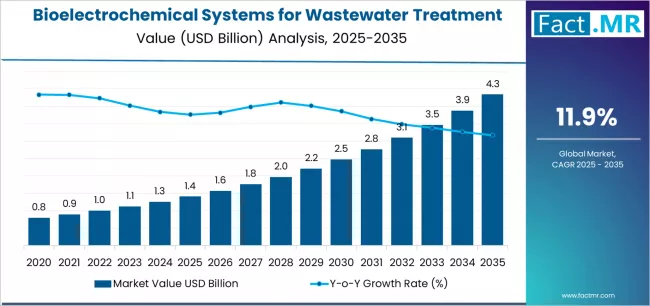
Bioelectrochemical Systems For Wastewater Treatment Market Market Value Analysis | Source: Fact.MR
Summary of Bioelectrochemical Systems for Wastewater Treatment Market
- Market Snapshot
- In 2025, the global Bioelectrochemical Systems for Wastewater Treatment Market was valued at approximately USD 1.4 billion.
- The market is estimated to reach USD 1.6 billion in 2026 and is projected to attain USD 4.8 billion by 2036.
- The bioelectrochemical systems for wastewater treatment market is likely to expand at a CAGR of 11.9% during the forecast period.
- The market is anticipated to create an absolute dollar opportunity of USD 3.3 billion between 2026 and 2036.
- Microbial Fuel Cells (MFCs) accounts for 46% of cell type share in 2026.
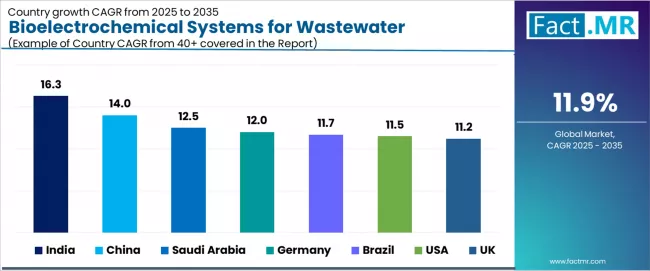
- India (16.3%) and China (14%) are the key growth markets during the forecast period.
- Demand and Growth Drivers
- Tightening wastewater discharge regulations in Asia Pacific and Latin America are increasing demand for treatment technologies with higher organic removal efficiency.
- Growing interest in energy-neutral wastewater treatment is driving pilot and commercial deployments of microbial fuel cell systems.
- Rising demand for decentralized wastewater treatment in regions with limited infrastructure is creating opportunities for modular bioelectrochemical systems.
- Increasing research funding and government grants for clean water technologies are accelerating the transition from laboratory to field applications.
- Industrial wastewater producers in food processing, brewing, and chemicals are evaluating bioelectrochemical systems for energy recovery from high-strength effluent.
- Product and Segment View
- Microbial Fuel Cells (MFCs) accounts for 46% of cell type share in 2026, supported by consistent demand across primary end-use applications.
- Industrial Wastewater accounts for 42% of application share in 2026, supported by consistent demand across primary end-use applications.
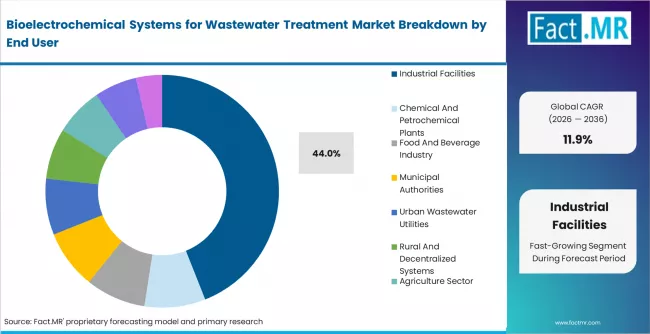
- Industrial Facilities accounts for 44% of end user share in 2026, supported by consistent demand across primary end-use applications.
- Key segmentation includes:
- Cell Type: Microbial Fuel Cells (MFCs), Dual Chamber MFC, Single Chamber MFC, Microbial Electrolysis Cells (MECs), Hydrogen Production MEC, Methane Production MEC, Others, Microbial Desalination Cells, Hybrid Bioelectrochemical Systems
- Application: Industrial Wastewater, Chemical Industry Effluents, Food And Beverage Effluents, Municipal Wastewater, Sewage Treatment Plants, Decentralized Treatment Systems, Agriculture Wastewater, Livestock Wastewater, Irrigation Runoff Treatment, Others, Landfill Leachate, Industrial Mixed Effluents
- End User: Industrial Facilities, Chemical And Petrochemical Plants, Food And Beverage Industry, Municipal Authorities, Urban Wastewater Utilities, Rural And Decentralized Systems, Agriculture Sector, Livestock Farms, Irrigation Systems
- Reactor Configuration: Single Chamber Systems, Dual Chamber Systems, Stacked And Modular Systems
- These systems enable:
- Simultaneous organic pollutant removal and electricity generation from wastewater using microbial metabolism
- Modular and scalable configurations suitable for both centralized and decentralized treatment applications
- Potential for resource recovery including biogas, hydrogen, and value-added chemicals from waste streams
- Geography and Competitive Outlook
- Asia Pacific leads growth with India at 16.3%, China at 14%, supported by expanding industrial capacity and infrastructure investment.
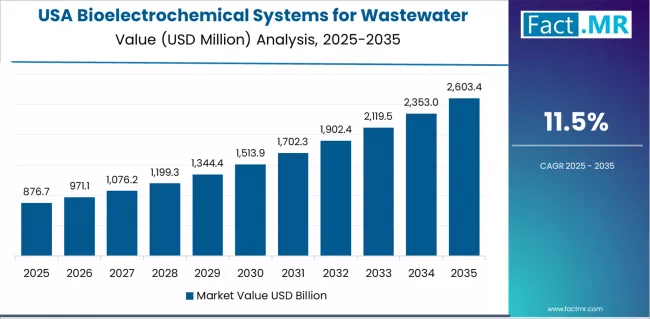
- North America shows steady demand with USA at 11.5%, reflecting established end-use markets and investment activity.
- European demand remains steady with Germany at 12%, UK at 11.2%, supported by regulatory requirements and technology upgrades.
- India (16.3%) and China (14%) are the key growth markets during the forecast period.
- Leading participants include Cambrian Innovation, MFC Systems GmbH, Applied CleanTech, Electrochaea GmbH, METawater, Paques BV.
- Analyst Opinion
- Shambhu Nath Jha, Principal Consultant at Fact.MR, says 'The bioelectrochemical systems market is transitioning from research-stage technology to early commercial deployment. Microbial fuel cells lead adoption because they offer the most direct path to energy recovery from organic wastewater. Industrial facilities with high-strength effluent, particularly in food processing and brewing, are early adopters. The real scaling opportunity is in municipal wastewater, where energy costs represent a significant share of operating budgets. Companies that can demonstrate reliable performance at pilot scale and offer modular, low-maintenance configurations are best positioned to capture procurement from utilities evaluating alternatives to conventional activated sludge systems.'
Key Growth Drivers, Constraints, and Opportunities
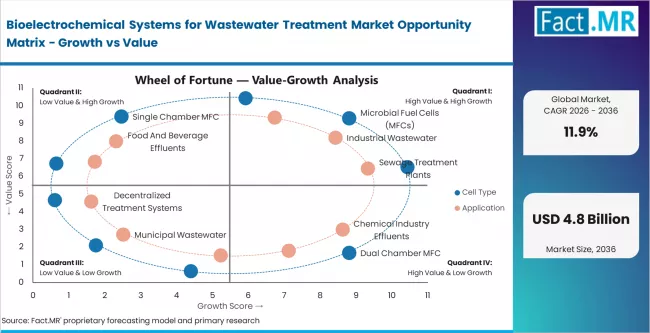
Bioelectrochemical Systems For Wastewater Treatment Market Opportunity Matrix Growth Vs Value | Source: Fact.MR
Key Factors Driving Growth
- Transition from pilot-scale to early commercial deployments is creating procurement opportunities for microbial fuel cell systems in industrial wastewater treatment.
- Energy cost pressure on municipal wastewater operators is driving interest in treatment technologies that offset electricity consumption through on-site recovery.
- Government clean water mandates and research grants in India, China, and Southeast Asia are supporting technology adoption in markets with large unmet needs.
Key Market Constraints
- Limited commercial track record and long payback periods relative to conventional treatment technologies slow procurement decisions among risk-averse utilities.
- Electrode degradation, membrane fouling, and biofilm management increase maintenance complexity compared to established biological treatment systems.
- Scale-up from laboratory and pilot configurations to full commercial throughput remains a technical and economic challenge for most designs.
Key Opportunity Areas
- Integration of bioelectrochemical systems with existing treatment trains as a polishing or energy recovery stage reduces adoption risk for utilities upgrading existing facilities.
- Development of modular, containerized systems for decentralized treatment creates addressable demand in remote communities and small industrial facilities.
- Hydrogen production through microbial electrolysis cells opens a potential value stream beyond electricity generation, improving system economics.
Segment-wise Analysis of the Bioelectrochemical Systems for Wastewater Treatment Market
- Microbial Fuel Cells (MFCs) holds 46% of the cell type segment in 2026, supported by established demand across primary end-use applications.
- Industrial Wastewater represents 42% of the application segment in 2026, with consistent adoption across core applications.
- Industrial Facilities accounts for 44% of the end user segment in 2026, reflecting concentrated demand in the leading vertical.
The bioelectrochemical systems for wastewater treatment market is segmented by cell type, application, end user, reactor configuration, and region. Microbial Fuel Cells (MFCs) leads by value in the near term, while emerging categories are expected to drive the next phase of growth as end-use requirements evolve.
Which Cell Type Segment Dominates the Bioelectrochemical Systems for Wastewater Treatment Market?
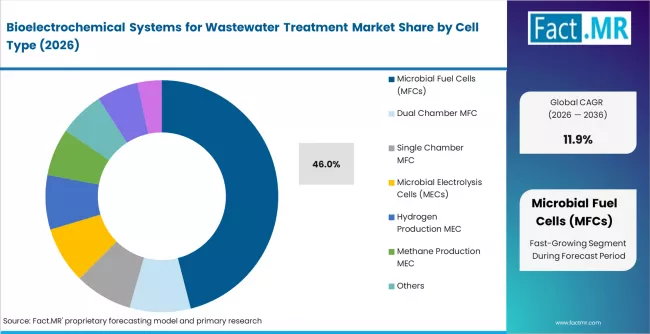
Bioelectrochemical Systems For Wastewater Treatment Market Analysis By Cell Type | Source: Fact.MR
Microbial Fuel Cells (MFCs) is expected to account for 46% of the cell type segment in the global Bioelectrochemical Systems for Wastewater Treatment Market by 2026. Demand is supported by consistent procurement across primary end-use applications, where established performance requirements and pricing accessibility sustain the installed base.
The segment is expected to maintain its position through the forecast period as replacement demand and capacity expansion in core verticals continue to generate steady procurement. Emerging alternatives are gaining share, but microbial fuel cells (mfcs) remains the primary volume category because of buyer familiarity and application suitability across mature and developing markets.
Which Application Segment Dominates the Bioelectrochemical Systems for Wastewater Treatment Market?
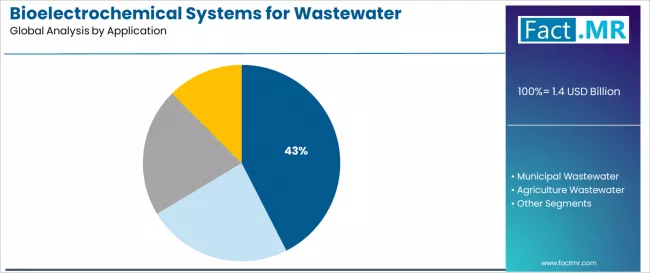
Bioelectrochemical Systems For Wastewater Treatment Market Analysis By Application | Source: Fact.MR
Industrial Wastewater is expected to account for 42% of the application segment in the global Bioelectrochemical Systems for Wastewater Treatment Market by 2026. Demand is supported by consistent procurement across primary end-use applications, where established performance requirements and pricing accessibility sustain the installed base.
The segment is expected to maintain its position through the forecast period as replacement demand and capacity expansion in core verticals continue to generate steady procurement. Emerging alternatives are gaining share, but industrial wastewater remains the primary volume category because of buyer familiarity and application suitability across mature and developing markets.
Which End User Segment Dominates the Bioelectrochemical Systems for Wastewater Treatment Market?
Bioelectrochemical Systems For Wastewater Treatment Market Analysis By End User | Source: Fact.MR
Industrial Facilities is expected to account for 44% of the end user segment in the global Bioelectrochemical Systems for Wastewater Treatment Market by 2026. Demand is supported by consistent procurement across primary end-use applications, where established performance requirements and pricing accessibility sustain the installed base.
The segment is expected to maintain its position through the forecast period as replacement demand and capacity expansion in core verticals continue to generate steady procurement. Emerging alternatives are gaining share, but industrial facilities remains the primary volume category because of buyer familiarity and application suitability across mature and developing markets.
Which Product Trend is Shaping the Next Phase of Growth in the Bioelectrochemical Systems for Wastewater Treatment Market?
Microbial fuel cells are the most commercially advanced configuration within the bioelectrochemical systems category. Their share is projected to expand as early adopters in food processing, brewing, and municipal treatment demonstrate sustained performance at pilot and pre-commercial scale. The direct electricity generation pathway offers a clearer value proposition than alternative configurations, particularly for industrial operators with high organic loading.
The shift toward microbial fuel cells reflects the market prioritizing configurations with the shortest path to economic viability. While microbial electrolysis and desalination cells offer promising capabilities, microbial fuel cells require less external energy input and produce a more readily monetizable output. As electrode materials improve and system designs become more standardized, microbial fuel cells are expected to account for an increasing share of new deployments.
Regional Outlook Across Key Markets
.webp "Top Country Growth Comparison Bioelectrochemical Systems For Wastewater Treatment Market Cagr (2026 2036)")
Top Country Growth Comparison Bioelectrochemical Systems For Wastewater Treatment Market Cagr (2026 2036) | Source: Fact.MR
- India leads growth at 16.3%, supported by expanding domestic demand, industrial capacity, and broadening end-use adoption.
- The U.S. at 11.5% reflects established demand patterns with replacement and technology upgrade activity.
- European demand remains steady with the UK at 11.2% and Germany at 12%, supported by regulatory compliance and technology upgrades.
CAGR Table
| Country | CAGR (%) |
|---|---|
| India | 16.3% |
| China | 14% |
| Saudi Arabia | 12.5% |
| Germany | 12% |
| Brazil | 11.7% |
| USA | 11.5% |
| UK | 11.2% |
Source: Fact.MR analysis. Updated May 19, 2026
Source: Fact MR (FMR) analysis, based on proprietary forecasting model and primary research.
Bioelectrochemical Systems For Wastewater Treatment Market Cagr Analysis By Country | Source: Fact.MR
Market Outlook for Bioelectrochemical Systems for Wastewater Treatments in India
The India bioelectrochemical systems for wastewater treatment market is projected to grow at a CAGR of 16.3% through 2036. Demand is supported by expanding end-use activity and growing adoption of higher-specification products across key application segments.
- Expanding end-use demand supports procurement across primary applications.
- Infrastructure investment is broadening the installed equipment base.
- Growing performance requirements support mid-range and premium demand.
Demand Trends for Bioelectrochemical Systems for Wastewater Treatments in China
The China bioelectrochemical systems for wastewater treatment market is projected to grow at a CAGR of 14% through 2036. Demand is supported by expanding end-use activity and growing adoption of higher-specification products across key application segments.
- Expanding end-use demand supports procurement across primary applications.
- Infrastructure investment is broadening the installed equipment base.
- Growing performance requirements support mid-range and premium demand.
Growth Assessment for Bioelectrochemical Systems for Wastewater Treatments in Saudi Arabia
The Saudi Arabia bioelectrochemical systems for wastewater treatment market is projected to grow at a CAGR of 12.5% through 2036. Demand is supported by expanding end-use activity and growing adoption of higher-specification products across key application segments.
- Expanding end-use demand supports procurement across primary applications.
- Infrastructure investment is broadening the installed equipment base.
- Growing performance requirements support mid-range and premium demand.
Market Growth Outlook for Bioelectrochemical Systems for Wastewater Treatments in Germany
The Germany bioelectrochemical systems for wastewater treatment market is projected to grow at a CAGR of 12% through 2036. Demand is supported by expanding end-use activity and growing adoption of higher-specification products across key application segments.
- Expanding end-use demand supports procurement across primary applications.
- Infrastructure investment is broadening the installed equipment base.
- Growing performance requirements support mid-range and premium demand.
Market Opportunity Outlook for Bioelectrochemical Systems for Wastewater Treatments in Brazil
The Brazil bioelectrochemical systems for wastewater treatment market is projected to grow at a CAGR of 11.7% through 2036. Demand is supported by expanding end-use activity and growing adoption of higher-specification products across key application segments.
- Expanding end-use demand supports procurement across primary applications.
- Infrastructure investment is broadening the installed equipment base.
- Growing performance requirements support mid-range and premium demand.
Demand Analysis for Bioelectrochemical Systems for Wastewater Treatments in USA
Bioelectrochemical Systems For Wastewater Treatment Market Country Value Analysis | Source: Fact.MR
The USA bioelectrochemical systems for wastewater treatment market is projected to grow at a CAGR of 11.5% through 2036. Demand is supported by expanding end-use activity and growing adoption of higher-specification products across key application segments.
- Expanding end-use demand supports procurement across primary applications.
- Infrastructure investment is broadening the installed equipment base.
- Growing performance requirements support mid-range and premium demand.
Growth Forecast for Bioelectrochemical Systems for Wastewater Treatments in UK
The UK bioelectrochemical systems for wastewater treatment market is projected to grow at a CAGR of 11.2% through 2036. Demand is supported by expanding end-use activity and growing adoption of higher-specification products across key application segments.
- Expanding end-use demand supports procurement across primary applications.
- Infrastructure investment is broadening the installed equipment base.
- Growing performance requirements support mid-range and premium demand.
Competitive Benchmarking and Company Positioning
Bioelectrochemical Systems For Wastewater Treatment Market Analysis By Company | Source: Fact.MR
Bioelectrochemical Systems for Wastewater Treatment Market Analysis By Company
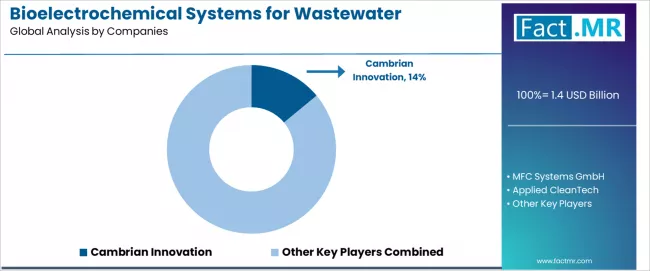
- Cambrian Innovation, MFC Systems GmbH, Applied CleanTech, Electrochaea GmbH hold strong positions in the global bioelectrochemical systems for wastewater treatment market through broad product portfolios and established brand recognition.
- METawater, Paques BV, Biowater Technology AS, AquaVenture Holdings participate meaningfully across specific price tiers and regional channels, with competition shaped by product quality and distribution access.
- Technology integration and aftermarket service capability create differentiation in higher-specification product categories.
The competitive landscape is moderately fragmented, with established players, specialized manufacturers, and value-oriented producers. Cambrian Innovation, MFC Systems GmbH, Applied CleanTech, Electrochaea GmbH compete through product breadth, technical capability, and visibility across primary end-use applications.
Competition is shaped by differences between standard and premium product categories. Standard products attract price-sensitive buyers, while higher-specification systems create a premium layer of competition built around performance and service support.
Strategic priorities include expanding product portfolios, strengthening service networks, and widening reach across direct and e-commerce distribution channels.
Key Companies in the Bioelectrochemical Systems for Wastewater Treatment Market
- Cambrian Innovation, MFC Systems GmbH, Applied CleanTech, Electrochaea GmbH are among the leading players in the bioelectrochemical systems for wastewater treatment market globally, supported by strong product portfolios and established market presence.
- METawater, Paques BV, Biowater Technology AS, AquaVenture Holdings hold established positions across specific application segments and regional markets.
- Organica Water, Genesis Water Technologies continue to compete through focused product offerings and niche application strength.
Recent Industry Developments
- Cambrian Innovation – Product Portfolio Expansion (2025)
- Cambrian Innovation expanded its product portfolio with new models targeting higher-specification applications. The expansion strengthens the company's position in the growing premium segment.
- MFC Systems GmbH – Technology Upgrade Launch (2026)
- MFC Systems GmbH introduced upgraded technology capabilities across core product lines, improving operational efficiency and application versatility for end users.
- Applied CleanTech – Geographic Expansion (2025)
- Applied CleanTech expanded its distribution and service network into high-growth markets in Asia Pacific and Latin America, strengthening access to institutional procurement channels.
Leading Companies Shaping the Bioelectrochemical Systems for Wastewater Treatment Market
- Cambrian Innovation
- MFC Systems GmbH
- Applied CleanTech
- Electrochaea GmbH
- METawater
- Paques BV
- Biowater Technology AS
- AquaVenture Holdings
- Organica Water
- Genesis Water Technologies
Sources and Research References
- Cambrian Innovation. Product portfolio updates and corporate announcements.
- MFC Systems GmbH. Product portfolio updates and corporate announcements.
- Applied CleanTech. Product portfolio updates and corporate announcements.
- Industry association publications, government regulatory databases, trade statistics, customs databases, and company product catalogs.
- Primary interviews with manufacturers, distributors, system integrators, end users, and industry consultants.
This bibliography is provided for reader reference and is not exhaustive. The full report contains the complete reference list and detailed citations.
Key Questions This Report Addresses
- What is the current and future size of the Bioelectrochemical Systems for Wastewater Treatment Market?
- How fast is the Bioelectrochemical Systems for Wastewater Treatment Market expected to grow between 2026 and 2036?
- Which cell type is likely to lead the market by 2026?
- Which application segment is expected to account for the highest demand by 2026?
- What factors are driving demand globally?
- How is technology evolution influencing market growth?
- Which countries are projected to show the fastest growth through 2036?
- What is driving market expansion in India and China?
- Who are the key companies active in the Bioelectrochemical Systems for Wastewater Treatment Market?
- How does Fact.MR estimate and validate the market forecast?
Bioelectrochemical Systems for Wastewater Treatment Market Definition
The bioelectrochemical systems for wastewater treatment market covers microbial fuel cells, microbial electrolysis cells, and related systems that use biological processes to treat wastewater while recovering energy or producing value-added outputs. It includes single and dual chamber configurations deployed across municipal, industrial, and decentralized wastewater treatment applications.
Bioelectrochemical Systems for Wastewater Treatment Market Inclusions
- The scope covers global and regional market size and forecasts for 2026 to 2036 across cell type, application, end user, reactor configuration, and region.
- It includes regional demand analysis across major geographies, based on end-use activity levels, regulatory requirements, infrastructure investment, and technology adoption.
- The report includes pricing and cost analysis across entry-level, mid-range, and premium product categories.
- It covers technology trends, market drivers and constraints, and the competitive landscape of leading players.
Bioelectrochemical Systems for Wastewater Treatment Market Exclusions
- The scope excludes conventional biological treatment systems such as activated sludge, trickling filters, and membrane bioreactors that do not incorporate electrochemical energy recovery.
- It excludes standalone electrochemical water treatment technologies such as electrocoagulation and electro-oxidation that do not rely on microbial metabolism.
- The report excludes laboratory research equipment, academic prototypes without commercial production intent, and sensor-only monitoring platforms.
- It also excludes chemical dosing systems, sludge handling equipment, and water recycling systems not integrated with bioelectrochemical treatment processes.
Bioelectrochemical Systems for Wastewater Treatment Market Research Methodology
- The methodology combines secondary research, primary interviews, and forecast modelling.
- It draws on 120+ secondary sources and benchmarks 65+ company product portfolios.
- Market sizing covers 30+ countries through a demand-side model, supported by top-down validation.
- Key inputs include end-use activity levels, regulatory requirements, procurement patterns, and technology adoption rates.
- The model cross-checks demand with shipments, pricing trends, channel mix, and product launches.
- Primary validation includes 25+ interviews across manufacturers, distributors, system integrators, and end users.
- Final estimates go through trade-flow checks, sales-pattern review, and sensitivity testing.
Segmentation
Scope of Analysis
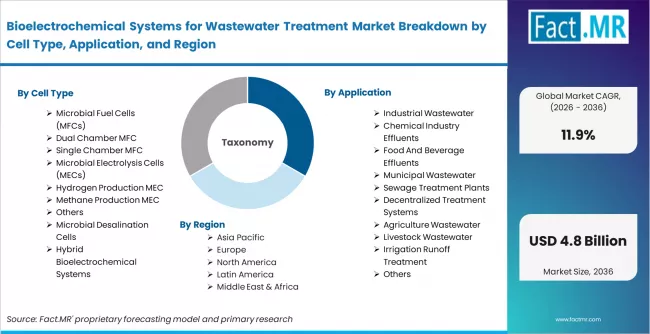
Bioelectrochemical Systems For Wastewater Treatment Market Breakdown By Cell Type, Application, And Region | Source: Fact.MR
| Parameter | Details |
|---|---|
| Quantitative Units | USD 1.6 billion to USD 4.8 billion, at a CAGR of 11.9% |
| Market Definition | Microbial fuel cells and related bioelectrochemical systems that treat wastewater while recovering energy, deployed across municipal and industrial applications. |
| Regions Covered | North America, Latin America, Europe, East Asia, South Asia and Pacific, Middle East and Africa |
| Countries Covered | India, China, Saudi Arabia, Germany, Brazil, USA, UK, 30 plus countries |
| Key Companies | Cambrian Innovation, MFC Systems GmbH, Applied CleanTech, Electrochaea GmbH, METawater, Paques BV, Biowater Technology AS, AquaVenture Holdings, Organica Water, Genesis Water Technologies |
| Forecast Period | 2026 to 2036 |
| Approach | Hybrid demand-side and top-down methodology built on country-level application demand, product benchmarking, pricing analysis, shipment validation, and primary interviews across manufacturers, distributors, and end users |
Source: Fact.MR analysis. Updated May 19, 2026
Bioelectrochemical Systems for Wastewater Treatment Market Segmentation
-
Bioelectrochemical Systems for Wastewater Treatment marketSegmented by Cell Type:
- Microbial Fuel Cells (MFCs)
- Dual Chamber MFC
- Anode Cathode Separation Systems
- High Efficiency Power Generation
- Laboratory And Pilot Scale Use
- Anode Cathode Separation Systems
- Single Chamber MFC
- Air Cathode Systems
- Low Cost Design
- Scalable Wastewater Treatment
- Air Cathode Systems
- Microbial Electrolysis Cells (MECs)
- Hydrogen Production MEC
- Biohydrogen Generation Systems
- Energy Recovery From Wastewater
- Industrial Effluent Treatment
- Biohydrogen Generation Systems
- Methane Production MEC
- Biomethane Generation Systems
- Anaerobic Treatment Integration
- Sludge Energy Conversion
- Biomethane Generation Systems
- Others
- Microbial Desalination Cells
- Salinity Reduction Systems
- Wastewater Reuse Applications
- Water Recovery Systems
- Salinity Reduction Systems
- Hybrid Bioelectrochemical Systems
- Integrated Treatment Technologies
- Combined MFC MEC Systems
- Enhanced Pollutant Removal
- Integrated Treatment Technologies
-
Bioelectrochemical Systems for Wastewater Treatment marketSegmented by Application:
- Industrial Wastewater
- Chemical Industry Effluents
- Toxic Wastewater Treatment
- Heavy Metal Removal
- Organic Contaminant Degradation
- Toxic Wastewater Treatment
- Food And Beverage Effluents
- Organic Waste Treatment
- High COD Reduction
- Biodegradable Waste Processing
- Organic Waste Treatment
- Municipal Wastewater
- Sewage Treatment Plants
- Urban Wastewater Treatment
- Nutrient Removal Systems
- Energy Recovery Integration
- Urban Wastewater Treatment
- Decentralized Treatment Systems
- Small Scale Community Plants
- Rural Wastewater Management
- On Site Treatment Units
- Small Scale Community Plants
- Agriculture Wastewater
- Livestock Wastewater
- Animal Farm Effluents
- Nutrient Recovery Systems
- Organic Load Reduction
- Animal Farm Effluents
- Irrigation Runoff Treatment
- Agricultural Drainage Water
- Pesticide And Fertilizer Removal
- Water Reuse Systems
- Agricultural Drainage Water
- Others
- Landfill Leachate
- Solid Waste Treatment
- Toxic Leachate Processing
- Environmental Protection Systems
- Solid Waste Treatment
- Industrial Mixed Effluents
- Combined Waste Streams
- Complex Pollutant Removal
- Advanced Treatment Systems
- Combined Waste Streams
-
Bioelectrochemical Systems for Wastewater Treatment marketSegmented by End User:
- Industrial Facilities
- Chemical And Petrochemical Plants
- Toxic Effluent Treatment Systems
- Heavy Metal Removal
- Organic Pollutant Degradation
- Toxic Effluent Treatment Systems
- Food And Beverage Industry
- Organic Wastewater Treatment
- High COD Reduction
- Biodegradable Waste Processing
- Organic Wastewater Treatment
- Municipal Authorities
- Urban Wastewater Utilities
- Sewage Treatment Operations
- Nutrient Removal Systems
- Energy Recovery Integration
- Sewage Treatment Operations
- Rural And Decentralized Systems
- Small Scale Treatment Units
- On Site Wastewater Processing
- Community Level Installations
- Small Scale Treatment Units
- Agriculture Sector
- Livestock Farms
- Animal Wastewater Treatment
- Nutrient Recovery Systems
- Organic Load Reduction
- Animal Wastewater Treatment
- Irrigation Systems
- Runoff Water Treatment
- Pesticide Removal
- Water Reuse Applications
- Runoff Water Treatment
-
Bioelectrochemical Systems for Wastewater Treatment marketSegmented by Reactor Configuration:
- Single Chamber Systems
- Air Cathode Reactors
- Simplified Design
- Low Cost Operation
- Compact Reactors
- Small Scale Applications
- Decentralized Treatment
- Air Cathode Reactors
- Dual Chamber Systems
- Anode Cathode Separation
- High Efficiency Operation
- Controlled Reaction Environment
- Membrane Based Systems
- Enhanced Ion Transfer
- Improved Performance
- Anode Cathode Separation
- Stacked And Modular Systems
- Modular Reactor Units
- Scalable Installations
- Industrial Deployment
- Multi Stack Configurations
- High Capacity Treatment
- Energy Recovery Optimization
- Modular Reactor Units
- Single Chamber Systems
-
Bioelectrochemical Systems for Wastewater Treatment marketSegmented by Energy Output Type:
- Electricity Generation
- Power Producing Systems
- Waste To Energy Conversion
- Low Power Generation
- Sensor And Monitoring Use
- Waste To Energy Conversion
- Grid Support Systems
- Energy Recovery Integration
- Supplementary Power Supply
- Microgrid Applications
- Energy Recovery Integration
- Hydrogen Production
- Biohydrogen Systems
- Clean Fuel Generation
- Industrial Hydrogen Use
- Energy Storage Applications
- Clean Fuel Generation
- Methane And Biogas Production
- Biomethane Generation
- Anaerobic Integration Systems
- Fuel Gas Production
- Biomethane Generation
-
Bioelectrochemical Systems for Wastewater Treatment marketby Region:
- North America
- USA
- Canada
- Mexico
- Latin America
- Brazil
- Chile
- Rest of Latin America
- Western Europe
- Germany
- UK
- Italy
- Spain
- France
- Nordic
- BENELUX
- Rest of Western Europe
- Eastern Europe
- Russia
- Poland
- Hungary
- Balkan & Baltic
- Rest of Eastern Europe
- East Asia
- China
- Japan
- South Korea
- South Asia and Pacific
- India
- ASEAN
- Australia & New Zealand
- Rest of South Asia and Pacific
- Middle East & Africa
- Kingdom of Saudi Arabia
- Other GCC Countries
- Turkiye
- South Africa
- Other African Union
- Rest of Middle East & Africa
- North America
Frequently Asked Questions
How big is the bioelectrochemical systems for wastewater treatment market in 2025?
What will be the size of the bioelectrochemical systems for wastewater treatment market in 2036?
How much will the bioelectrochemical systems for wastewater treatment market grow between 2026 and 2036?
What are the key cell types in the bioelectrochemical systems for wastewater treatment market?
Which segment will contribute the most share in the Bioelectrochemical Systems for Wastewater Treatment Market in 2026?
Which countries are growing fastest in the Bioelectrochemical Systems for Wastewater Treatment Market?
Who are the key companies in the Bioelectrochemical Systems for Wastewater Treatment Market?
Who worked on this report


Preview the report firsthand - request a free sample
Free SampleGet the brochure for pricing and purchase details
Download PDF