- Base Value(2025): 1371.1 Mn
- Forecast Value (2035): 2825.8 Mn
- CAGR (2035): 8.8%
Biodegradable Sheets Market Outlook 2025 to 2035
The global biodegradable sheets market is expected to reach USD 2,825.8 million by 2035, up from USD 1,371.1 million in 2025. During the forecast period 2025 to 2035, the industry is projected to expand at a CAGR of 7.5%.
The growth trends and increased investment in bio-refinery technologies and the consistent decline in the cost of production of PLA increases the demand of the biodegradable sheets market. The dynamic growth is expected to be witnessed as the growth in the capacity of the major suppliers in North America, China, and Europe will be in line with the surge in consumption in retail and e-commerce packaging.
Government strict policies on the use of plastic, increasing public awareness and benefits of biodegradable material packaging, motivate customers to choose biodegradable sheets over conventional plastics. This led to continuous increases in the demand for the biodegradable sheet market in the coming year.
Market expansion is also supported by alignment within the corporate sustainability agendas. The world's food and beverage brands are moving towards the use of PLA based lidding and flow-wraps, and agriculture is using PLA mulch films to get the benefit of soil health. The policies of the circular economy and green financing avenues are motivating its fast-track implementation, whereas the ability of PLA to work with composting facilities makes it better than conventional plastics
Quick Stats for Biodegradable Sheets Market
- Industry Value (2025): USD 1,371.1 Million
- Projected Value (2035): USD 2,825.8 Million
- Forecast CAGR (2025 to 2035): 7.5%
- Leading Segment (2025): Extruded Cast Sheets (34.8% Market Share)
- Fastest Growing Country (2025-2035): China (9.7% CAGR)
- Top Key Players: Amcor PLC, BASF SE, BioSphere Plastic, CloudFilm, Danimer Scientific, GoodNatured Products, Mondi Group, and Novamont
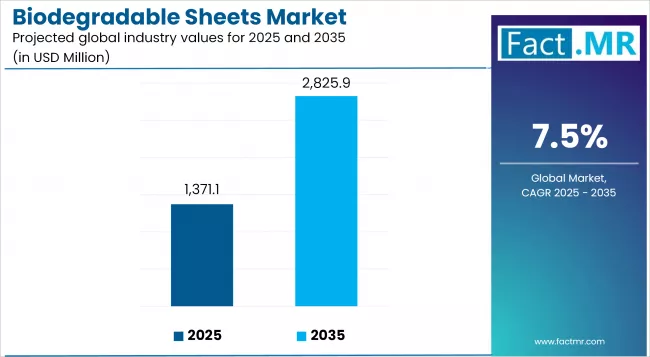
Biodegradable Sheets Market Industry Value Analysis | Source: Fact.MR
The continuous development in the products and long-term supply security coupled with break in cost barriers, and the end-user adoption is guaranteed through strategic investments in biodegradable sheet production in North America, Europe, and Asia Pacific. The developments make biodegradable sheets an important contributor to the growth of the market in the forthcoming decade.
With global retailers and eCommerce systems adopting packaging based on PLA into their distribution channels, it will be more than a sustainability measure that will have a positive effect on their cost and branding prospects. This will make the market continue to grow during the forecast horizon.
Overall, growth trends in the forthcoming years will be fast development of barrier technologies, and increased investment by the global giants like Amcor, BASF, Mondi and Novamont. The rate of demand is expected to be still growing faster as end-users demand certified, high-value sustainable packaging, and brand owners include biodegradable sheets in the mainstream distribution
What are the drivers of the biodegradable sheets market?
The tightening global regulations on single-use plastics, especially in the United States, Germany, China, Japan, and India, which have compelled more countries to adopt policies that require packs to be compostable and recyclable are driving the growth of the biodegradable sheets market. Positive governmental projects along with consumer consciousness of plastic waste management are generating a tipping point in materials like PLA, PBAT, PBS, PHA, and starch blends that meet the goals of the circular economy.
Increased demand due to food and beverage industries is a crucial factor because trays, lids, wraps, and bakery liners move away to compostable options that offer functionality and safety standards. The development of retail and e-commerce landscapes is also a driving factor, as biodegradable e-commerce mailers, garment bags, and cushioning solutions are increasingly being adopted to accomplish the brand sustainability goals and consumer needs to use eco-friendly packaging.
The medical and pharmaceutical sectors are becoming good adopters because they have to have sterile barriers, medical drapes, and hygienic packaging that are not only compliant with the regulatory front but also mindful of the environmentally friendly aspect. The agricultural market, with a demand in Asia Pacific and Europe being boosted by the use of mulch sheets and soil-friendly liners, is supporting the demand growth, as governments promote the use of biodegradable inputs as a part of sustainable farming efforts.
What are the regional trends of the biodegradable sheets market?
Asia Pacific has continued to be the fastest region of growth of biodegradable sheets due to the favorable regulatory environment, huge investment in sustainable packaging and the increased use of e-commerce. China is developing to mass production level of national circular economy strategies with multinational companies and domestic packaging companies incorporating PLA and PBAT sheets into food, retail and e-commerce packaging designs. Japanese waste management laws and government subsidies on compostable packaging give the country an advantage in commercializing biodegradable sheets in foodservice, healthcare and household markets.
South Korea is strengthening its regional stance through cycles of fast innovation of sustainable materials and export packaging. Simultaneously, India is also growing domestic production, as the country has initiatives such as the Make in India movement, and the increase in the EV and e-commerce industries. The growing agricultural demand of the country on biodegradable mulch sheet is growing as well as the fast-growing retailing sector of the country is offering an acceleration to the use of compostable mailers and liners.
The adoption of sustainable and compliant practices in Europe is closely related to single-use plastics directive and the agenda of emission reduction in the EU. Germany and France lead in the adoption of certified biodegradable sheet solutions to food and beverage packaging, healthcare drapes, and retailing purposes. The leadership in the region is also being strengthened by strong government incentives to circular packaging and consumer preference towards alternatives that are environmentally friendly.
The momentum in North America is high and the U.S and Canada is moving at a faster rate to commercially produce biodegradable sheets in foodservice, healthcare, and retail packaging. U.S. market is booming with mega brands incorporating the concept of compostable packaging into mass market with good consumer advocacy towards sustainability. Canada is also investing in keeping up with the industrial composting infrastructure and the modern biopolymer production capacity, which will make sure that in the next decade, it will be able to serve both local and export demand.
What are the challenges and restraining factors of the biodegradable sheets market?
It is expected that high production cost restrict the market growth in the coming year. The manufacturing of PLA, PHA, and PBAT require special infrastructure, feedstock as a fermentation, and complicated polymer modification that increases expenses over conventional petrochemical plastics. Small economies of scale and unpredictability in the supply chains of raw materials are also a source of price instability, limiting its use in cost-sensitive markets.
The processes of certification and approval are also a hindrance because biodegradable sheets are required to pass through stringent compostability, safety, and food-contact tests according to EN 13432, ASTM D6400, and regional regulations.
Lack of uniform composting facilities in the world. Whereas some of these waste management systems have developed in some areas such as Europe and Japan, emerging economies usually do not have industrial composting plants, which limits the end-of-life advantages of biodegradable substances. This disparity tends to erode the consumer confidence and may cause scepticism concerning the real sustainability of such products in the markets where the disposal systems are not developed.
Country-Wise Insights
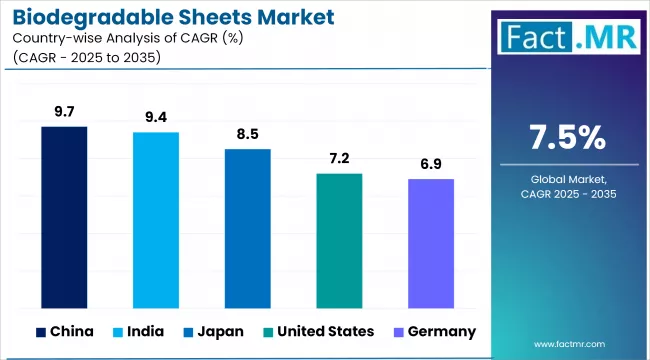
Biodegradable Sheets Market Cagr Analysis By Country | Source: Fact.MR
Advanced composting infrastructure and strict packaging regulations boost market growth in Germany
The market of Germany on biodegradable sheets is reinforced by the fact that the nation has a well-developed waste management and composting system and hence the end-of-life gains of the sheets can be effectively achieved here. Consumers are confident in compostable packaging because it is in accordance with the national sustainability objectives, and the municipalities contribute to the implementation of certified solutions according to the standards of EN 13432. This infrastructure makes it applicable in food and retail and healthcare packaging industry.
Germany is a country with strict rules against using single-use plastic regulations that the EU enforces. The retailers, foodservice, and brand owners have no option of moving towards biodegradable replacement to fulfil the legal and reputational needs. Traditional plastics are being rapidly substituted with certified products like food wraps, bakery liners and trays, and the transition can be accelerated by the strong consumer acceptance of these products.
Increased consumer awareness and readiness to pay to go green packaging solutions is also typical of the German market. As the companies such as BASF and Mondi continue to advance innovation in the high-barrier and printable grade biodegradable sheets, the country is still leading in material development. In the next few years, this infrastructure, regulation, and innovation in Germany will guarantee gradual growth as other European markets can adopt the same.
Sustainability mandates and e-commerce expansion accelerate biodegradable sheets adoption in China
China’s strict packaging laws against the use of single-use plastic to combat plastic pollution, and shift towards the usage of biodegradable materials increased demand for the product.
China market is also characterized by high consumer awareness and willingness to spend in order to go green packaging solutions. The country’s ability to spend more on technologies, infrastructure, regulation and innovation will ensure that there will be gradual growth in the coming years.
It is also anticipated that the next few years will witness an increase in investment in local production capabilities and technology alliances to reduce costs and enhance the capabilities of barriers. It will also influence demand through agricultural adoption in which bio-degradable mulch sheets are marketed to improve the health of the soil.
As regulatory compliance and digital trade continue to grow side by side, the aspect of China as a consumer and manufacturer of the biodegradable sheets is projected to further increase, and the country will emerge as a leading engine of global growth.
Category-Wise Analysis
Extruded Cast Sheets gain traction with versatile applications and cost efficiency
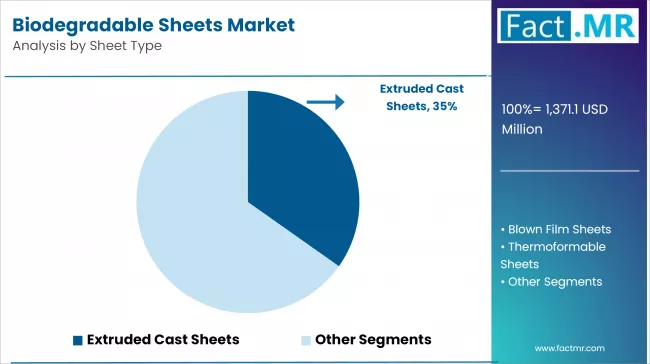
Biodegradable Sheets Market Analysis By Sheet Type | Source: Fact.MR
The biodegradable sheets market is dominated by the extruded cast sheets because of the ease of manufacture and the possibility to balance performance and cost. The procedure enables the manufacturers to attain uniform thickness and optical clearness that enables such sheets to fit many applications such as packaging films, bakery liners and e-commerce wraps. They are scalable thus quicker adoption compared to other types of sheets.
They are compatible with the most popular biopolymers like PLA and PBAT, which allow them to grow faster, and their compostability does not sacrifice mechanical properties. The food and beverage sector is also moving towards extruded cast sheets in lidding and flow-wrap solutions; this is because they meet the regulatory requirements and also sustainability requirements. The retail packaging demand keeps on increasing as people prefer greens.
The expansion of extrusion plants and better feedstock supply chain in the next few years will further lower the cost and will enhance adoption. The fact that printing and surface treatments can be built in direct to the extruded sheets will also make them very appealing as a medium to brand and to apply labels to the product. The extruded cast sheets will continue to lead the world market with the regulatory support and demand of large volumes imposed by the consumer goods sector.
Polylactic Acid (PLA) emerges as a sustainable material of choice
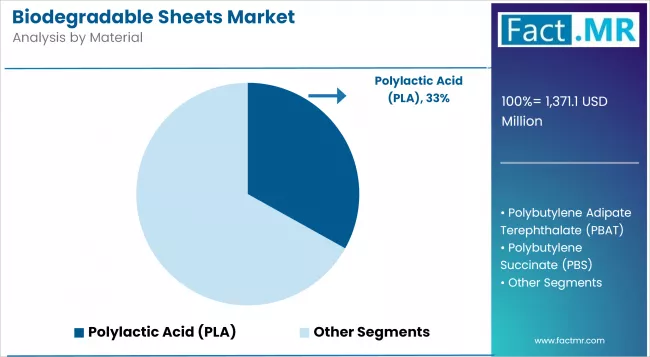
Biodegradable Sheets Market Analysis By Material | Source: Fact.MR
Polylactic acid continues to be the most popular in the biodegradable sheets market due to the popularity of the material because it has a renewable source, can be composted, and it can be used in numerous applications. PLA is derived on corn and sugarcane and fits the objectives of the circular economy and sustainability that is being prioritized by regulators and corporations. This flexibility has seen it used in packaging of food products, as healthcare wrappings and in retailing.
The strengthening of market domination is supported by the fact that most of the major manufacturers like NatureWorks and regional manufacturers are making investment in Asia Pacific. These investments include the increase of supply capacity and better material grades to beat the constraints such as brittle and reduced heat dependency.
The continuation of technological innovations enhancing the performance of the barriers and industrial compostability will help in growing the future. It will be accepted in both developed and emerging markets with a reduction in costs and expansion of infrastructure. As the consumer preference shifts towards the solutions that are renewable in nature and the governments actively discourage the use of petrochemical plastics, PLA will continue to be the segment of materials that will sustain steady demand and revenue growth of the biodegradable sheets.
Competitive Analysis
Key players in the biodegradable sheets market are Amcor PLC, BASF SE, BioSphere Plastic, CloudFilm, Danimer Scientific, GoodNatured Products, Mater-Bi, Mondi Group, NatureWorks LLC, Novamont, PLAMFG, Polymateria Ltd, RTG Films, Tetra Pak International SA, and Zhongnan.
The biodegradable sheets market is very competitive and the rivalry is based on material development, property of a barrier, compostability level, and ability to produce in large quantities. Developments in extrusion technology, surface treatments and functional additives are providing the potential of maintaining product benefits that exceed performance and regulatory requirements.
Major competitors are consolidating by brokering deals with international FMCG brands, retailers, and e-commerce channels, obtaining priority spots in most packaging supply chains. The companies with intellectual property in high-barrier sheet technologies, compostability certifications, and coating processes promoting oxygen and moisture resistance are also considered ahead of others. Incorporation of biodegradable sheets into the e-commerce, agriculture, and healthcare packaging systems is becoming one of the main points of differentiation, an added value is made by solutions specific to sectors.
The concept of competitive positioning is being transformed via strategic alliances between polymer manufactures, converters of packaging materials, and research organizations. Custom solutions are being designed with improved material properties, including food wraps, medical wraps that are sterile and agricultural wraps that are mulch sheets. As sustainability promises grow faster and regulatory frameworks grow stricter, companies with cost efficiency and certified compostability on top of innovation of barrier-grade biodegradable sheets will have the best chance to secure the best global presence.
Recent Development
- At 2025 (Amcor) the company launched its Liquiflex AmPrima mono-material, recycle-ready pouches of bulk foodservice products in Europe. Its innovation promotes increased recycling, optimization of large-scale packaging processes, and demonstrates an interest in sustainable development, becoming a standard in the use of biodegradable sheets and films in the future, in the entire world foodservice industry.
- In the year 2024, Novamont, introduced a project, organizing a European flagship project to showcase new state-of-the-art bio-polymer packaging solutions that decrease their environmental footprint. This will make the company position itself a market leader in sustainable material.
Fact.MR has provided detailed information about the price points of key manufacturers of Biodegradable Sheets Market positioned across regions, sales growth, production capacity, and speculative technological expansion, in the recently published report.
Methodology and Industry Tracking Approach
The 2025 biodegradable sheets market report by Fact.MR is based on insights collected from 1,200 stakeholders across 12 countries, with a minimum of 75 respondents per country. Among the participants, 65% were end users including biopolymer converters, specialty chemical formulators, and FMCG sustainability teams while the remaining 35% included sourcing managers, R&D directors, environmental compliance leads, and bioeconomy consultants.
Data collection was conducted between July 2024 and June 2025, focusing on parameters such as monomer purity, conversion yield, cost per ton, end-use compatibility, feedstock availability, and regulatory alignment. A regionally weighted calibration model ensured balanced representation across North America, Europe, and Asia-Pacific.
The study triangulated over 95 validated sources, including patent databases, sustainability disclosures, process modeling datasets, and annual reports from monomer and biopolymer producers.
Fact.MR applied rigorous analytical tools such as multi-variable regression and scenario modeling to ensure data robustness. With continuous monitoring of the glass adhesives space since 2018, this report offers a comprehensive roadmap for firms seeking competitive advantage, innovation, and sustainable growth within the sector.
Segmentation
Segmentation of Biodegradable Sheets Market
-
By Sheet Type :
- Extruded Cast Sheets
- Blown Film Sheets
- Thermoformable Sheets
- Coated Paperboard Sheets
- Laminated Composites
-
By Material :
- Polylactic Acid (PLA)
- Polybutylene Adipate Terephthalate (PBAT)
- Polybutylene Succinate (PBS)
- Polyhydroxyalkanoates (PHA)
- Cellulose
- Starch Blends
- Bio-PE/Bio-PP Coatings
-
By Thickness :
- ≤50 μm
- 50-150 μm
- >150 μm
-
By Functionality :
- Home-Compostable
- Industrial-Compostable
- Water-Soluble
- High-Barrier (MVTR/O₂)
- Printable/Label-Grade
- Anti-Fog/Anti-Static
-
By Distribution Channel :
- Online
- E-commerce Marketplaces
- Direct-to-Consumer Brand Websites
- Offline
- Supermarkets & Hypermarkets
- Specialty Stores
- Department Stores
- Independent Retailers
- Online
-
By Application :
- Food Wraps
- Trays & Lids
- Produce & Bakery Liners
- E-Commerce Mailers
- Garment Bags
- Agricultural Mulch Sheets
- Lawn & Garden
- Medical Drapes & Sterile Barriers
- Hygiene Products
- Electronics Cushioning
- Tableware Liners
-
By End-user :
- Food & Beverage
- Retail & E-Commerce
- Agriculture & Horticulture
- Healthcare & Pharmaceuticals
- HoReCa & Household
-
By Region :
- North America
- Latin America
- Western Europe
- Eastern Europe
- East Asia
- South Asia & Pacific
- Middle East & Africa
Frequently Asked Questions
What was the Global Biodegradable Sheets Market Size Reported by Fact.MR for 2025?
Who are the Major Players Operating in the Biodegradable Sheets Market?
What is the Estimated Valuation of the Biodegradable Sheets Market in 2035?
What Value CAGR did the Biodegradable Sheets Market Exhibit Over the Last Five Years?
Who worked on this report


Preview the report firsthand - request a free sample
Free SampleGet the brochure for pricing and purchase details
Download PDF