The E-Grocery Compostable Delivery Bags Market is analyzed across its key product, application and end-use segments, with the study covering market dynamics, regional trends and demand outlook, forecast 2026 to 2036.
By Fact.MR Consumer Goods DeskLead analyst:
Ayush RajPublished :
Updated :
11 min read
Fact-checked under the Fact.MR editorial process
E-Grocery Compostable Delivery Bags Market Forecast and Outlook 2026 to 2036
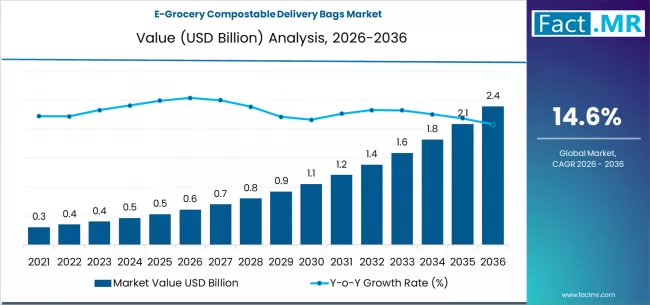
The global market for e-grocery compostable delivery bags is projected to surge from USD 0.61 billion in 2026 to USD 2.39 billion by 2036, accelerating at a substantial 14.6% CAGR. This exceptional growth is supported by the explosive expansion of online grocery shopping and the subsequent critical scrutiny of the massive single-use plastic packaging waste stream it generates.
E Grocery Compostable Delivery Bags Market Market Value Analysis | Source: Fact.MR
Summary of E-Grocery Compostable Delivery Bags Market
Market Snapshot
Global e-grocery compostable delivery bags market revenue stood at USD 0.61billion in 2026 and is forecast to reach USD 2.39billion by 2036.
At a 14.6% CAGR from 2026 to 2036, this market is set to expand ~4.0x in value, adding USD 1.78 billion in absolute opportunity.
Growth is being driven by the rapid expansion of online grocery delivery ecosystems, combined with increasing scrutiny of single-use plastic waste in last-mile delivery.
Compostable delivery bags are emerging as critical sustainability enablers in e-commerce logistics, helping retailers align with environmental regulations and consumer expectations.
Demand and Growth Drivers
Explosive growth in online grocery platforms and last-mile delivery services is driving demand for sustainable packaging alternatives.
Rising regulatory pressure on single-use plastic bans and waste reduction mandates is accelerating adoption of compostable materials.
Increasing consumer preference for eco-friendly packaging and circular economy solutions is reinforcing market expansion.
Retailers are actively transitioning toward sustainable logistics operations, integrating compostable delivery bags into fulfillment systems.
Advancements in bioplastic technologies such as PLA and bio-based films are improving strength, durability, and compostability performance.
Product and Segment View
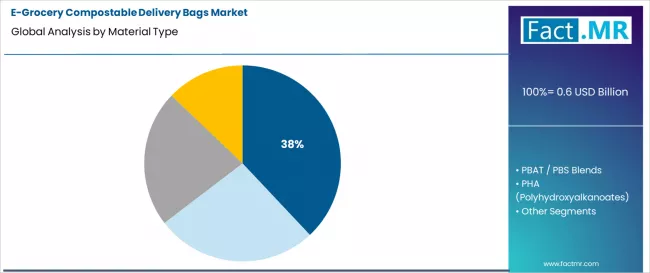
PLA (Polylactic Acid) holds 38% of material segment share in 2026, emerging as the leading segment due to strong compostability and performance characteristics.
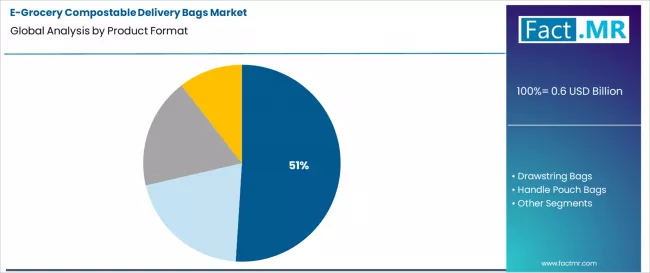
Standard carry-out bags account for 51% of product format share in 2026, positioning them as the dominant segment due to widespread use in grocery delivery.
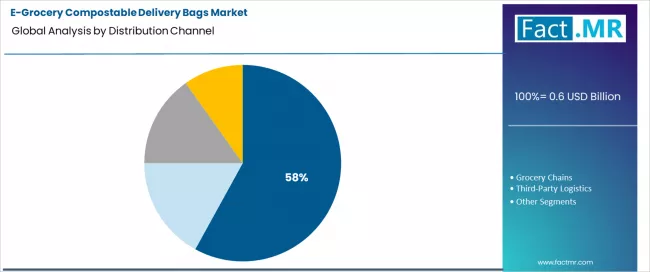
Online retailers hold 58% of distribution channel share in 2026, reflecting their central role in e-grocery ecosystems.
Product innovation is focused on:
Enhanced load-bearing capacity
Moisture resistance for fresh produce
Compostability certifications and standards compliance
Geography and Competitive Outlook
Growth is supported across Asia Pacific, North America, and Europe, aligned with e-commerce expansion and sustainability regulations.
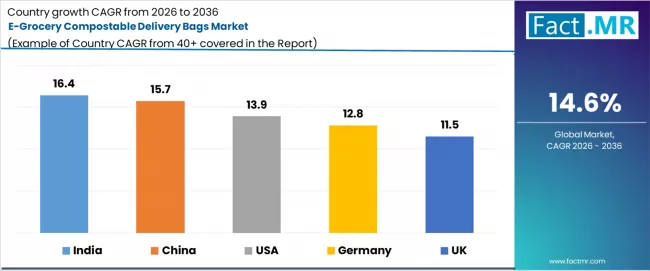
India (16.4% CAGR), China (15.7%), United States (13.9%), Germany (12.8%), and UK (11.5%) are key growth markets.
Market expansion is closely tied to:
E-grocery penetration rates
Plastic reduction policies
Retailer sustainability commitments
Competitive landscape includes companies specializing in bioplastics, sustainable packaging, and retail logistics solutions.
E-Grocery Compostable Delivery Bags Market — At a Glance
Attribute
Details
Market Value 2026
USD 0.61billion
Market Value 2036
USD 2.39billion
Absolute Dollar Opportunity 2026-2036
USD 1.78 billion
Total Growth 2026-2036
300.0%
CAGR 2026-2036
14.6%
Growth Multiple
~4.0x
Key Demand Theme
Increasing adoption of compostable packaging solutions in e-grocery logistics to replace single-use plastics
Leading Segment by Material (2026)
PLA (Polylactic Acid)
Segment Share (2026)
38%
Leading Segment by Product Format (2026)
Standard Carry-Out Bags
Segment Share (2026)
51%
Leading Segment by Distribution Channel (2026)
Online Retailers
Segment Share (2026)
58%
Key Growth Regions
Asia Pacific, North America, Europe
Country CAGRs
India 16.4%, China 15.7%, USA 13.9%, Germany 12.8%, UK 11.5%
Segmentation by Material
PLA, PHA, Starch-Based, Cellulose-Based, Others
Segmentation by Product Format
Standard Carry-Out Bags, Heavy-Duty Bags, Insulated Bags, Others
Segmentation by Distribution Channel
Online Retailers, Direct Supply, Distributors
Segmentation by Region
North America, Latin America, Europe, Asia Pacific, MEA
Source: Fact.MR analysis. Updated Apr 3, 2026
The market represents a strategic pivot where convenience meets circularity, as retailers seek to align their last-mile delivery operations with stringent plastic reduction legislation and heightened consumer environmental expectations. Growth is driven by the imperative for brands to mitigate regulatory risk and protect their reputation, transforming packaging from a logistical afterthought into a core component of customer experience and brand sustainability credentials. India’s leading 16.40% CAGR highlights the potent combination of rapid digital commerce adoption and proactive national bans on single-use plastics, creating an immediate and vast market for compliant solutions. The market’s evolution is characterized by a shift from basic biodegradability to performance-driven materials that ensure durability for heavy, wet, or cold groceries while guaranteeing certified industrial compostability, thereby closing the loop on packaging waste within urban organic waste systems.
Online Retailers, Grocery Chains, Third-Party Logistics, Direct to Consumer
Region
North America, Latin America, Western Europe, Eastern Europe, East Asia, South Asia & Pacific, MEA
Source: Fact.MR analysis. Updated Apr 3, 2026
Segmental Analysis
By Material Type, Which Polymer Offers the Best Balance of Clarity, Printability, and Cost?
E Grocery Compostable Delivery Bags Market Analysis By Material Type | Source: Fact.MR
PLA-based materials lead the segment with a 38% share. Their dominance is attributed to excellent clarity, which allows for product visibility, and superior surface characteristics for high-quality printing of branding and handling instructions. As a drop-in replacement for conventional films on many converting lines, PLA offers a practical pathway for manufacturers to switch production with minimal retooling.
While often blended with flexible polymers like PBAT to improve toughness, the PLA component provides the structural and aesthetic foundation that meets both marketing and functional requirements for e-grocery delivery.
By Product Format, Which Design Dominates Due to Versatility and Manufacturing Economy?
E Grocery Compostable Delivery Bags Market Analysis By Product Format | Source: Fact.MR
Standard carry-out bags hold a commanding 51% share of the product format segment. This simple, t-shirt style bag remains the workhorse of grocery delivery due to its low material usage, efficient manufacturing, and adaptability to a wide range of product sizes and weights.
Its straightforward design allows for reliable performance in automated bagging systems used in fulfillment centers and provides a familiar, easy-to-carry format for consumers, making it the highest-volume, most cost-sensitive category driving bulk demand for compostable films.
By Distribution Channel, Which Entity Faces the Most Direct Consumer and Regulatory Pressure?
E Grocery Compostable Delivery Bags Market Analysis By Distribution Channel | Source: Fact.MR
Online retailers are the primary distribution channel, accounting for 58% of the market. These platforms, including pure-play e-grocery services and omnichannel giants, are at the forefront of the packaging waste critique. The unboxing experience happens directly in the consumer’s home, making packaging choices highly visible.
To protect brand loyalty and comply with evolving extended producer responsibility laws, these retailers are aggressively setting internal deadlines to eliminate conventional plastic, creating concentrated, high-volume demand for certified compostable alternatives.
What are the Drivers, Restraints, and Key Trends of the E-Grocery Compostable Delivery Bags Market?
The primary market driver is the rapid global implementation of legislation banning or taxing lightweight plastic carryout bags, now explicitly extended to include delivery packaging. This regulatory wave creates non-negotiable compliance deadlines.
The competitive landscape of e-grocery is forcing differentiation through sustainability, where offering compostable bags becomes a direct customer acquisition and retention tool. The scalability of e-grocery itself provides the volume necessary to drive down the unit cost of materials through economies of scale and manufacturing innovation.
A significant market restraint is the persistent gap between the performance of compostable films and the extreme demands of grocery delivery, which includes carrying heavy loads, resisting puncture from sharp packaging edges, and maintaining integrity in cold or wet conditions.
Achieving this performance often requires thicker gauges or complex multi-layer structures, eroding the cost and environmental advantages. Widespread consumer confusion over proper disposal and a lack of uniform access to industrial composting facilities can undermine the environmental promise, leading to contamination of recycling streams or bags being sent to landfill.
Analysis of the E-Grocery Compostable Delivery Bags Market by Key Countries
E Grocery Compostable Delivery Bags Market Cagr Analysis By Country | Source: Fact.MR
Country
CAGR (2026-2036)
India
16.40%
China
15.70%
USA
13.90%
Germany
12.80%
UK
11.50%
Source: Fact.MR analysis. Updated Apr 3, 2026
How is India's Rapid E-Grocery Adoption and Stringent Plastic Ban Catalyzing Demand?
India's leading 16.40% CAGR is driven by the explosive growth of its online grocery sector, combined with one of the world's most rigorous bans on single-use plastics. The regulatory environment leaves no room for conventional plastic bags in delivery, forcing immediate and wholesale adoption of alternatives.
The market prioritizes cost-effective, durable solutions that can withstand diverse climatic conditions and are compatible with India’s developing urban organic waste management infrastructure, making it a hub for frugal innovation in compostable packaging.
What is the Impact of China's Scale of Digital Commerce and Circular Economy Policy?
China's 15.70% growth leverages its unparalleled e-commerce scale and top-down circular economy policies that mandate reductions in packaging waste. Major platforms are compelled to meet government-set targets for sustainable packaging ratios.
This creates a high-volume, centralized demand signal that domestic biopolymer producers are scaling to meet. The focus is on creating integrated supply chains from resin production to bag conversion to serve the massive domestic market efficiently.
Why is the USA's Patchwork of State Regulations and Retailer-Led Initiatives a Key Factor?
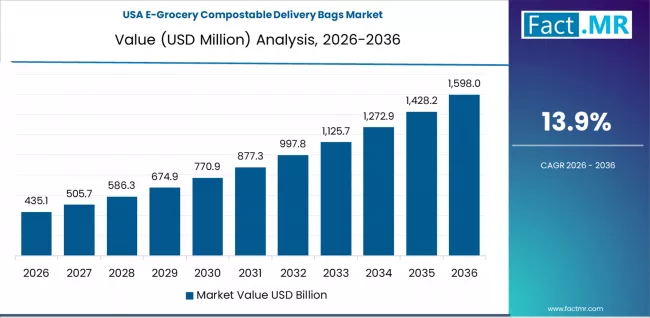
E Grocery Compostable Delivery Bags Market Country Value Analysis | Source: Fact.MR
A mix of state-level plastic bag bans and ambitious corporate sustainability goals from major retailers and e-commerce platforms characterizes the USA’s 13.90% growth. In the absence of a unified federal law, these corporate commitments are the primary market drivers.
Large grocery chains and online retailers are setting their own deadlines to eliminate plastic, creating a competitive race to secure reliable supplies of certified compostable bags and to communicate this switch effectively to consumers.
How is Germany's Strict Packaging Law and Advanced Waste System Shaping the Market?
Germany's 12.80% CAGR operates under the stringent German Packaging Act and a well-established dual system for waste. Compostable bags must not only meet material standards but also be clearly designated and accepted within the country's efficient organic waste collection streams.
The market demands high-certification products with clear labeling and favors suppliers who can demonstrate full compliance with the complex legal and logistical requirements of the German and EU waste hierarchy.
What Role does the UK's Focus on EPR and Consistent Collection Reforms Play?
The UK's 11.50% growth is influenced by its extended producer responsibility reforms and policies aimed at simplifying household waste collection. The push for consistent organic waste collection across municipalities increases the potential utility of compostable bags.
Retailers are seeking solutions that align with these forthcoming systems, favoring bags with certifications recognized by UK waste authorities and that can demonstrably break down in domestic anaerobic digestion facilities.
Competitive Landscape of the E-Grocery Compostable Delivery Bags Market
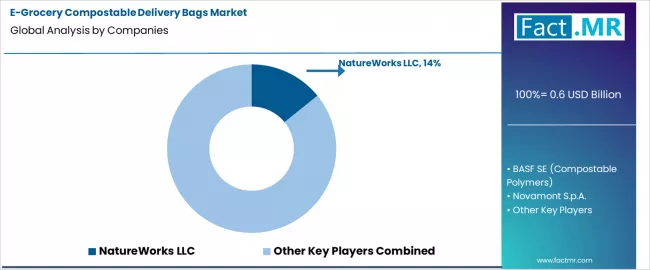
E Grocery Compostable Delivery Bags Market Analysis By Company | Source: Fact.MR
Biopolymer producers competing to supply resins to a vast network of flexible packaging converters define the competitive landscape. Competition centers on proprietary polymer blends that optimize the cost-performance balance for grocery applications, securing certifications from recognized bodies, and providing technical support to converters.
Success depends on forming strategic partnerships with major e-grocery retailers and fulfillment networks, often involving co-development of bag specifications and securing coveted placement on approved vendor lists for large-scale, recurring supply contracts.
Key Players in the E-Grocery Compostable Delivery Bags Market
NatureWorks LLC
BASF SE
Novamont S.p.A.
TotalEnergies Corbion
FKuR Kunststoff GmbH
References
European Bioplastics. 2024. Bioplastics market development update 2024. Berlin, Germany.
Food and Agriculture Organization of the United Nations. 2023. Assessment of agricultural plastics and their sustainability: A call for action. Rome.
Hann, S., & Scholes, R. 2023. The role of compostable packaging in circular economy systems. Journal of Industrial Ecology.
Napper, I. E., & Thompson, R. C. 2024. Plastic waste and environmental policy: A global review. Nature Reviews Earth & Environment.
Rosenboom, J., Langer, R., & Traverso, G. 2023. Bioplastics for a circular economy. Nature Reviews Materials.
United Nations Environment Programme. 2023. Turning off the tap: How the world can end plastic pollution and create a circular economy. Nairobi.
Walker, S., & Rothman, R. 2023. Life cycle assessment of bio-based and fossil-based plastic packaging: A review. Journal of Cleaner Production.
Comparative lifecycle assessment of compostable bags versus reusable systems in last-mile delivery; analysis of bag performance under real-world stress conditions (weight, moisture, temperature); consumer perception and willingness-to-pay studies across different demographics; impact of contamination on composting facility operations and acceptance policies; supply chain and cost analysis for key feedstocks like sugarcane and corn; regulatory landscape analysis and potential for harmonization of compostability standards.
Source: Fact.MR analysis. Updated Apr 3, 2026
Market by Segments
Material Type :
PLA (Polylactic Acid)
PBAT/PBS Blends
PHA (Polyhydroxyalkanoates)
Others
Product Format :
Standard Carry-Out Bags
Drawstring Bags
Handle Pouch Bags
Custom Printed Bags
Distribution Channel :
Online Retailers
Grocery Chains
Third-Party Logistics
Direct to Consumer
Region :
North America
USA
Canada
Latin America
Brazil
Mexico
Argentina
Rest of Latin America
Western Europe
Germany
UK
France
Italy
BENLUX
Spain
Rest of Western Europe
Eastern Europe
Poland
Russia
Czech Republic
Rest of Eastern Europe
East Asia
China
Japan
South Korea
Rest of East Asia
South Asia & Pacific
India
ASEAN
Australia
Rest of South Asia & Pacific
MEA
South Africa
GCC Countries
Turkiye
Rest of MEA
Questions Answered
Frequently Asked Questions
How big is the e-grocery compostable delivery bags market in 2026?
The global e-grocery compostable delivery bags market is estimated to be valued at USD 0.6 billion in 2026.
What will be the size of e-grocery compostable delivery bags market in 2036?
The market size for the e-grocery compostable delivery bags market is projected to reach USD 2.4 billion by 2036.
How much will be the e-grocery compostable delivery bags market growth between 2026 and 2036?
The e-grocery compostable delivery bags market is expected to grow at a 14.6% CAGR between 2026 and 2036.
What are the key product types in the e-grocery compostable delivery bags market?
The key product types in e-grocery compostable delivery bags market are pla (polylactic acid), pbat / pbs blends, pha (polyhydroxyalkanoates) and others.
Which product format segment to contribute significant share in the e-grocery compostable delivery bags market in 2026?
In terms of product format, standard carry-out bags segment to command 51.0% share in the e-grocery compostable delivery bags market in 2026.