- Market Value (2025): USD 1.3 Bn
- Estimated Value (2026): USD 1.4 Bn
- Forecast Value (2036): USD 3.1 Bn
- CAGR (2026-2036): 8.0%
What is the Biodegradable Sulfate-Free Thickeners Market forecast to be worth by 2036?
USD 1.4 billion in 2026 to USD 3.1 billion by 2036 at an 8.0% CAGR.
- The Biodegradable Sulfate-Free Thickeners Market reached USD 1.3 billion in 2025.
- Demand is projected to increase from USD 1.4 billion in 2026 to USD 3.1 billion by 2036.
- The market is forecast to record an 8.0% CAGR from 2026 to 2036 as shampoo brands and mild cleanser formulators replace conventional acrylic rheology systems.
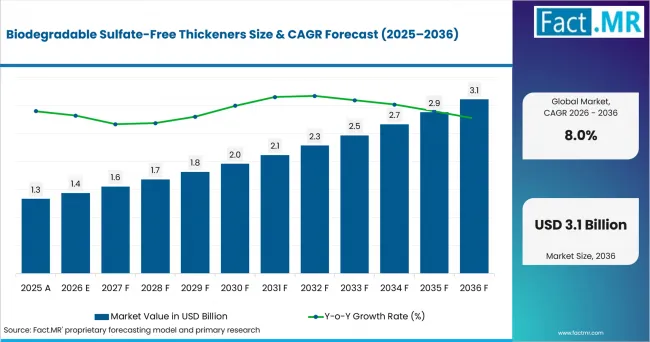
Biodegradable Sulfate Free Thickeners Value Analysis | Source: Fact.MR
What are the defining numbers behind Biodegradable Sulfate-Free Thickeners Market growth?
USD 1.7 billion absolute opportunity by 2036, led by cellulose derivatives, shampoo and low-shear viscosity control.
- Demand Drivers in the Market
- Shampoo formulators need sulfate-free compatible thickeners because low-SLES and SLS-free surfactant systems often lose viscosity during reformulation.
- Facial cleanser brands need mild rheology packages supported by claim documentation for biodegradable and natural-origin positioning.
- Personal care ingredient teams need cold-process or low-energy systems where plant-derived polymers reduce processing friction in liquid cleansers.
- The European Commission published an explanatory guide in April 2025 to support implementation of the REACH restriction on intentionally added microplastics.
- Key Segments Analyzed
- By Thickener Chemistry: Cellulose derivatives are expected to hold 37.0% share in 2026 due to broad compatibility with sulfate-free liquid cleanser bases.
- By Product System: Shampoo is projected to account for 33.0% share in 2026 as hair-care brands reformulate around mild surfactants and rinse feel.
- By Rheology: Low-shear viscosity is anticipated to capture 34.0% share in 2026 since formulators need easy dispensing with enough body on the hand.
- By Claim: Sulfate-free compatible is estimated to represent 31.0% share in 2026 owing to claim-led renovation across shampoo and skin-cleansing formats.
- Analyst Opinion at Fact.MR
- Shambhu Nath Jha, Principal Consultant at Fact.MR, states, “Biodegradable rheology has moved from a label claim into a formulation screen. The next phase is expected to favor thickeners that work in mild surfactant blends and keep texture stable during storage. Suppliers with application data, biodegradability proof and regional technical service are better placed with personal care development teams.”
- Strategic Implications
- Ingredient manufacturers should pair biodegradability data with sulfate-free shampoo and facial cleanser prototypes that show viscosity after storage.
- Formulation labs should test cellulose derivatives, natural gums and starch-based systems early because surfactant changes alter foam and flow behavior.
- Brand owners should connect claim language with ingredient documentation before moving biodegradable thickeners into front-label cleanser claims.
- Distributors should train technical teams on rheology troubleshooting so smaller brands can shorten reformulation cycles while preserving the product brief.
China is projected to record 8.5% CAGR through 2036 driven by cosmetics retail growth and local formulation scale. France is expected to post 8.4% CAGR supported by export-oriented beauty manufacturing. The USA is forecast to hold 8.0% CAGR owing to large health and personal care retail channels. Germany is anticipated to advance at 7.8% CAGR because technical documentation shapes ingredient switching. Japan is estimated to reach 6.9% CAGR as mature cleanser brands use selective reformulation.
How does the Biodegradable Sulfate-Free Thickeners Market break down by segment?
Cellulose derivatives lead Thickener Chemistry at 37.0%; Shampoo leads Product System at 33.0%.
Which Thickener Chemistry leads?
Cellulose derivatives are expected to hold 37.0% share in 2026.
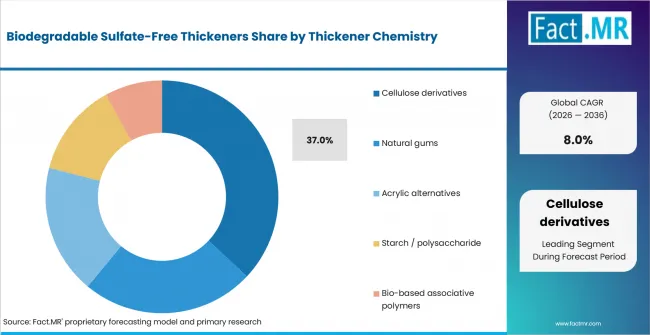
Biodegradable Sulfate Free Thickeners Analysis By Thickener Chemistry | Source: Fact.MR
Cellulose derivatives lead because they give formulators a familiar route to viscosity control in mild cleanser bases. They are useful in sulfate-free shampoo, body wash and hand wash systems where salt response changes after SLS or SLES removal.
BASF markets Verdessence Xanthan as a thickener and stabilizer for surfactant-based personal care formulations, including shampoos, body washes and facial cleansers. BASF states that its Verdessence biopolymer line provides biodegradable and biobased solutions made from renewable feedstocks.
What leads the Product System segment?
Shampoo is projected to account for 33.0% share in 2026.
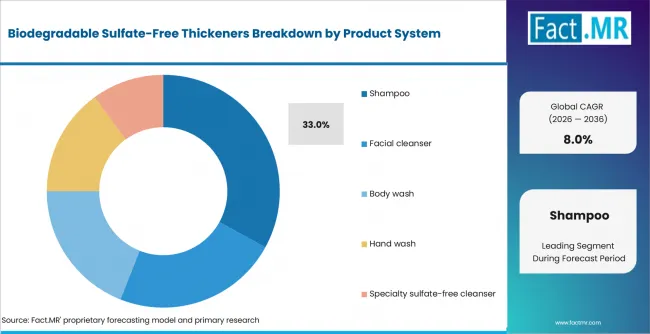
Biodegradable Sulfate Free Thickeners Analysis By Product System | Source: Fact.MR
Shampoo leads because sulfate-free claims are already familiar to hair-care shoppers. Formulators still need body, foam quality and rinse feel after replacing conventional surfactant packages.
FEBEA reported on February 6, 2026 that exports of shampoos and hair preparations from France increased 5.5% in 2025 to EUR 1.5 billion.
How does Rheology shape demand?
Low-shear viscosity is anticipated to capture 34.0% share in 2026.
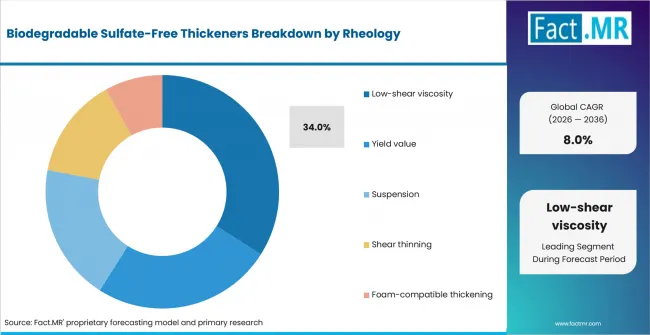
Biodegradable Sulfate Free Thickeners Analysis By Rheology | Source: Fact.MR
Low-shear viscosity leads because cleanser users judge texture before they read the ingredient list. A formula must pour from a bottle and still feel rich during application. Thickeners that provide this balance are easier to approve in shampoo and facial cleanser bases.
Ashland identifies Texturpure SA-2 as a nature-derived texturizer and suspension agent for hair and skin-care cleansers. Ashland states that the ingredient is primarily inherently biodegradable and lists sulfate-free shampoos among its applications.
What supports sulfate-free compatibility within Claim?
Sulfate-free compatible is estimated to represent 31.0% share in 2026.
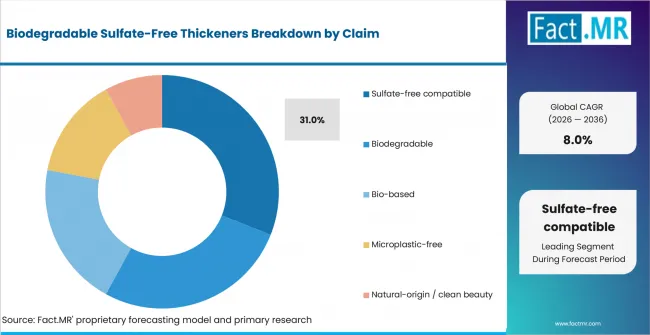
Biodegradable Sulfate Free Thickeners Analysis By Claim | Source: Fact.MR
Sulfate-free compatible claims carry weight because the thickener must work after the surfactant system changes. Mild surfactants such as sodium cocoyl isethionate and sodium lauroyl isethionate can shift foam and viscosity behavior, so compatibility proof is central to supplier selection.
The FDA reported on March 13, 2025 on mandatory cosmetic product facility registration and product listing under MoCRA. Manufacturers and processors generally must register covered facilities, while responsible persons must list each marketed cosmetic product and provide required updates.
What is accelerating Biodegradable Sulfate-Free Thickeners Market adoption, and what is holding it back?
Demand is expected to rise through sulfate-free reformulation and biodegradable claim pressure. Growth is constrained by cost, stability testing and raw-material variability.
Drivers Impact Analysis
| DRIVER | (~) % IMPACT ON CAGR | GEOGRAPHIC RELEVANCE | IMPACT TIMELINE |
|---|---|---|---|
| Sulfate-free cleanser reformulation | +1.7% | Global | Short term (<= 2 years) |
| Biodegradable and microplastic-free claim pressure | +1.3% | North America, Europe | Medium term (2-4 years) |
| Natural-origin rheology development | +1.1% | Europe, East Asia | Medium term (2-4 years) |
| Digital formulation support and sampling | +0.7% | Global | Long term (>= 4 years) |
Opportunity Impact Analysis
| OPPORTUNITY | (~) % IMPACT ON CAGR | GEOGRAPHIC RELEVANCE | IMPACT TIMELINE |
|---|---|---|---|
| Sulfate-free shampoo and facial cleanser renovation | +1.2% | North America, East Asia | Short term (<= 2 years) |
| Foam-compatible thickening in mild surfactant bases | +0.9% | Global | Medium term (2-4 years) |
| Distributor-led formulation support for regional brands | +0.6% | Europe, North America | Medium term (2-4 years) |
Restraints Impact Analysis
| RESTRAINT | (~) % IMPACT ON CAGR | GEOGRAPHIC RELEVANCE | IMPACT TIMELINE |
|---|---|---|---|
| Higher cost than conventional acrylic thickeners | -0.6% | Global | Short term (<= 2 years) |
| Batch-to-batch variation in natural gums | -0.4% | Europe, East Asia | Medium term (2-4 years) |
| Revalidation time for claims and stability | -0.3% | North America, Europe | Medium term (2-4 years) |
Which countries are scaling the Biodegradable Sulfate-Free Thickeners Market through 2036?
- The country comparison spans 1.6 percentage points and forms three practical growth bands across the forecast period.
- China remains 0.1 percentage point above France through cosmetics retail growth and local formulation scale.
- France remains 0.4 percentage point above the USA through export-oriented beauty manufacturing and hair-care category resilience.
- The USA remains 0.2 percentage point above Germany through broad health and personal care retail channels.
- Germany remains 0.9 percentage point above Japan through technical evaluation and beauty care manufacturing depth.
- Japan completes the displayed range through mature cosmetics production and selective reformulation in cleanser systems.
Comparable CAGRs can create different entry conditions due to retail channel scale, claim documentation, formulation testing and local beauty manufacturing depth. Full report coverage includes North America, Latin America, Western Europe, Eastern Europe, East Asia, South Asia & Pacific, Middle East & Africa.
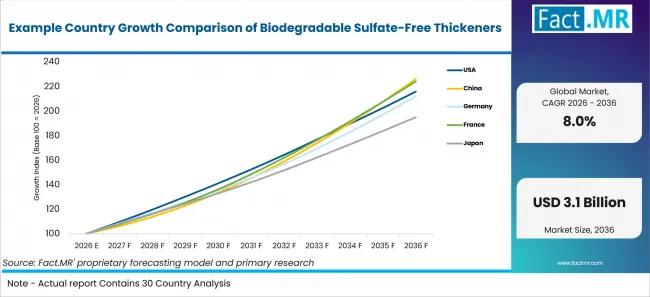
Example Country Growth Comparison Of Biodegradable Sulfate Free Thickeners | Source: Fact.MR
| Country | CAGR (2026-2036) |
|---|---|
| China | 8.5% |
| France | 8.4% |
| United States | 8.0% |
| Germany | 7.8% |
| Japan | 6.9% |
What supports China adoption?
8.5% CAGR, supported by cosmetics retail growth and local formulation scale.
China’s cosmetics channel gives sulfate-free cleanser brands a wide base for texture-led reformulation. The National Bureau of Statistics of China reported in February 2026 that cosmetics retail sales by enterprises above designated size rose 5.1% in 2025. Cellulose derivatives and natural gums are expected to benefit where local formulators need biodegradable thickening systems that keep shampoo and facial cleanser texture stable.
What supports France adoption?
8.4% CAGR, supported by export-oriented beauty manufacturing and hair-care resilience.
FEBEA reported on February 6, 2026 that French cosmetics exports reached EUR 22.4 billion in 2025. Within the total, exports of shampoos and hair preparations increased 5.5% to EUR 1.5 billion, making this one of the cosmetics categories that recorded export growth during the year.
What supports USA adoption?
8.0% CAGR, supported by health and personal care retail scale.
The USA is expected to scale through shampoo, facial cleanser and body wash renovation across large retail channels. The U.S. Census Bureau reported in July 2025 that U.S. Health and Personal Care Stores sales were 8.9% higher year over year in April 2025 on a non-seasonally-adjusted basis. Evonik describes TEGO® Remo 95 MB as a readily biodegradable thickener that efficiently thickens PEG- and sulfate-free surfactant formulations.
What supports Germany adoption?
7.8% CAGR, supported by beauty and home care manufacturing depth.
Germany’s ingredient adoption is expected to reflect technical evaluation before reformulated cleansers reach shelves. IKW projected in December 2025 that German beauty and home care industry sales would increase 2.9% to EUR 35.6 billion in 2025. Suppliers of biodegradable thickeners are expected to gain ground when they support biodegradability data with processing guidance and finished-product stability evidence.
How does Japan perform?
6.9% CAGR, led by mature cosmetics production and careful reformulation.
The Japan Cosmetic Industry Association reported on October 27, 2025, using METI Production Dynamics Statistics, that Japan’s cosmetics shipment value increased 5.5% in 2024 to JPY 1,374.5 billion.
Who leads the Biodegradable Sulfate-Free Thickeners Market?
BASF, Lubrizol, Ashland, Clariant, Evonik and Nouryon are profiled providers.
BASF participates directly through its Verdessence® biopolymer portfolio. Verdessence® Xanthan is positioned as a thickener and stabilizer for surfactant-based formulations, including shampoos, body washes and facial cleansers. BASF describes the Verdessence line as providing biodegradable and biobased solutions made from renewable feedstocks.
Lubrizol has a direct rheology position through Carbopol® BioSense polymer. Lubrizol and Suzano announced its pre-launch in Brazil on March 28, 2025. Lubrizol describes Carbopol BioSense as the first readily biodegradable ingredient in the Carbopol line and notes that Carbopol rheology modifiers are used to enhance viscosity and consistency in applications including shampoos.
Ashland participates through Texturpure™ SA-2, a nature-derived texturizer and suspension agent for hair- and skin-care cleansers. Ashland describes the ingredient as primarily inherently biodegradable and explicitly lists sulfate-free shampoos among its applications.
Clariant offers Aristoflex® Eco T, a biodegradable natural-origin rheology modifier made with Tara gum. Evonik markets TEGO® Remo 95 MB as a natural-based, readily biodegradable thickener for PEG- and sulfate-free surfactant formulations. Nouryon markets Structure® XL starch as a naturally derived and biodegradable rheology modifier for hair- and skin-care applications.
Which companies are the key providers?
Key companies include BASF, Lubrizol, Ashland, Clariant, Evonik and Nouryon.
- BASF
- Lubrizol
- Ashland
- Clariant
- Evonik
- Nouryon
Bibliography
- Ashland. (2026, March 12). Ashland announces strategic partnership with IMCD for the exclusive distribution of personal and home care ingredients in the United States.
- Clariant. (2026, August 17). Aristoflex Eco T.
- Directorate-General for Internal Market, Industry, Entrepreneurship and SMEs. (2025, April 1). Commission helps users to implement the restriction on microplastics under the EU chemical legislation. European Commission.
- Fédération des Entreprises de la Beauté. (2026, February 6). Coup de frein sur les exportations de cosmétiques français en 2025 : le secteur demeure deuxième contributeur à la balance commerciale malgré un repli sur le marché américain.
- Industrieverband Körperpflege- und Waschmittel. (2025, December 3). Market data.
- Lubrizol. (2025, March 28). Lubrizol partners with Suzano for pre-launch of Carbopol® BioSense in Brazil, advancing biodegradable solutions.
- National Bureau of Statistics of China. (2026, February 28). Statistical communiqué of the People's Republic of China on the 2025 national economic and social development.
- U.S. Census Bureau. (2025, July 29). Monthly State Retail Sales for April 2025.
- U.S. Food and Drug Administration. (2025, March 13). FDA provides summary data on the registration and listing of cosmetic product facilities and products.
This Report Answers
- The report explains where biodegradable sulfate-free thickeners are used across thickener chemistry and product system. It also covers rheology and claim position.
- Segment analysis identifies the leading subsegments and the formulation reasons brands prioritize them.
- Country analysis examines the listed markets and the retail, export or manufacturing mechanisms supporting adoption.
- Competitive analysis reviews current providers across natural-based ingredients, rheology polymers and formulation support platforms.
- Application analysis assesses how viscosity, foam feel and claim documentation influence ingredient approval decisions.
What does the Biodegradable Sulfate-Free Thickeners Market cover?
The Biodegradable Sulfate-Free Thickeners Market covers biodegradable thickening ingredients used in sulfate-free personal care cleansers. It includes cellulose derivatives, natural gums, starch or polysaccharide systems and bio-based associative polymers used to control flow, yield value and suspension in shampoo, facial cleanser and body wash formulas.
The assessment covers rinse-off personal care systems that overlap with adjacent categories such as sulfate-free body wash, cosmetic chemicals and carrageenan gum. Demand is assessed across thickener chemistry, product system, rheology and claim positioning.
What is included in the scope?
The scope includes commercial biodegradable thickeners used in sulfate-free cleansing formats. It covers cellulose derivatives, natural gums, acrylic alternatives with improved environmental profiles, starch-based systems and bio-based associative polymers used by personal care formulators.
It includes thickeners used in shampoo, facial cleanser, body wash, hand wash and specialty sulfate-free cleanser systems. Adjacent surfactant shifts are considered where they influence rheology needs, including coverage of sodium cocoyl isethionate and sodium lauroyl isethionate.
What is excluded from the scope?
The scope excludes general surfactants, fragrance ingredients, preservatives, color cosmetics and leave-on skin care ingredients outside a thickening or rheology function. It also excludes conventional synthetic thickeners where the commercial proposition lacks biodegradable or sulfate-free compatibility relevance.
Bulk industrial thickeners for paints, construction, mining and food processing remain outside the market boundary. Food-grade hydrocolloids are covered only when the same chemistry is positioned for personal care cleanser rheology.
How Was the Analysis Built?
The analysis draws on 120+ sources, 35+ company portfolios and 25+ countries.
- Primary Research: Primary research includes discussions with ingredient manufacturers, formulators, distributors, brand owners and subject-matter experts. These conversations examine texture needs, claim requirements, technical validation and factors that influence market acceptance.
- Desk Research: Desk research covers government statistics, regulatory publications, company releases, trade data, technical studies, industry associations, standards and public policy. Every evidence point used in the analysis is documented in the bibliography.
- Market Sizing and Forecasting: Market estimates combine historical performance, cleanser renovation, segment shares, country growth, provider activity, price pressure and barriers to market expansion.
- Data Validation and Update Cycle: Findings are validated by comparing interview feedback with public data, company activity, regulatory changes, formulation trends and industry developments. Updates review launches, partnerships, approvals and shifts in commercial adoption.
What is the report’s scope and coverage?
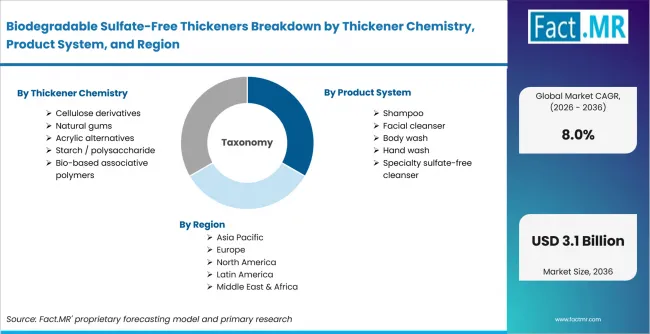
Biodegradable Sulfate Free Thickeners Breakdown By Thickener Chemistry, Product System, And Region | Source: Fact.MR
| Attribute | Details |
|---|---|
| Quantitative Units | USD billion in 2026 to USD billion by 2036 at an CAGR |
| Market Definition | Biodegradable sulfate-free thickeners used to build viscosity, texture, suspension and flow control in sulfate-free personal care cleansers. |
| Thickener Chemistry | Cellulose derivatives; Natural gums; Acrylic alternatives; Starch / polysaccharide; Bio-based associative polymers |
| Product System | Shampoo; Facial cleanser; Body wash; Hand wash; Specialty sulfate-free cleanser |
| Rheology | Low-shear viscosity; Yield value; Suspension; Shear thinning; Foam-compatible thickening |
| Claim | Sulfate-free compatible; Biodegradable; Bio-based; Microplastic-free; Natural-origin / clean beauty |
| Regions Covered | North America; Latin America; Western Europe; Eastern Europe; East Asia; South Asia & Pacific; Middle East & Africa |
| Countries Covered | China; France; United States; Germany; Japan |
| Key Companies Profiled | BASF; Lubrizol; Ashland; Clariant; Evonik; Nouryon |
| Forecast Period | 2026 to 2036 |
| Approach | Hybrid top-down and bottom-up approach using cleanser formulation demand, ingredient qualification, regional beauty production, claim trends and provider portfolio review. |
How is the market segmented?
-
By Thickener Chemistry
- Cellulose derivatives
- Natural gums
- Acrylic alternatives
- Starch / polysaccharide
- Bio-based associative polymers
-
By Product System
- Shampoo
- Facial cleanser
- Body wash
- Hand wash
- Specialty sulfate-free cleanser
-
By Rheology
- Low-shear viscosity
- Yield value
- Suspension
- Shear thinning
- Foam-compatible thickening
-
By Claim
- Sulfate-free compatible
- Biodegradable
- Bio-based
- Microplastic-free
- Natural-origin / clean beauty
-
By Region
- North America
- Latin America
- Western Europe
- Eastern Europe
- East Asia
- South Asia & Pacific
- Middle East & Africa