- Market Value (2025): USD 327.6 Mn
- Estimated Value (2026): USD 380.0 Mn
- Forecast Value (2036): USD 1676.0 Mn
- CAGR (2026-2036): 16.0%
What is the Marine Biodegradable Polymers Market forecast to be worth by 2036?
USD 380.0 million in 2026 to USD 1676.0 million by 2036 at a 16.0% CAGR.
- The marine biodegradable polymers market reached USD 327.6 million in 2025.
- Demand is projected to increase from USD 380.0 million in 2026 to USD 1676.0 million by 2036.
- The market is forecast to record 16.0% CAGR from 2026 to 2036 as aquaculture farms, fishing-gear makers and seafood packaging converters seek proof-led material substitution.
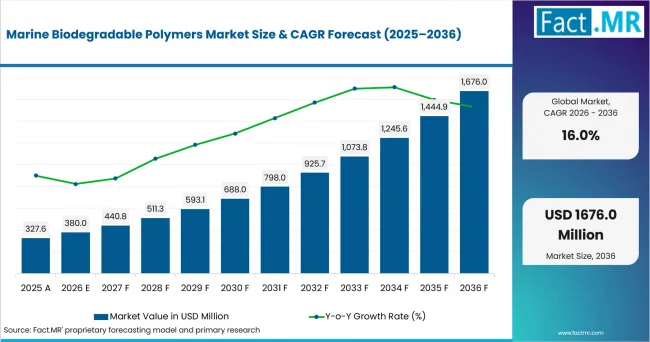
Marine Biodegradable Polymers Market Value Analysis | Source: Fact.MR
What are the defining numbers behind Marine Biodegradable Polymers Market growth?
USD 1,296.0 million absolute opportunity is expected between 2026 and 2036.
- Demand Drivers in the Market
- Aquaculture operators need clips, ties and service parts that resist wet handling while leaving lower persistence if lost in farm environments. FAO reported in June 2026 that aquaculture aquatic-animal production exceeded 100 million tonnes in 2024.
- Fishing-gear producers need monofilaments and multifilaments that combine strength with marine evidence. Gear replacement becomes more selective when retrieval programs and deposit rules put proof of end-of-life behavior into procurement discussions.
- Seafood packaging converters need films that resist moisture during distribution and give brands a credible path away from conventional plastic leakage. Barrier performance remains central because seafood packs face chilled storage, wet surfaces and odor-control requirements.
- Coastal foodservice operators need cups, trays and coated paper formats that can be validated against real disposal routes. Compostable-only claims are not enough when products are likely to contact water or beach environments.
- Key Segments Analyzed
- By Polymer Type: PHA-based polymers are expected to hold 44.0% share in 2026 due to stronger seawater biodegradation positioning and active processing work.
- By Application: Fishing nets-lines are projected to account for 38.0% share in 2026 because leakage risk is visible and gear rules increasingly affect material choices.
- By Product Form: Monofilament is anticipated to capture 43.0% share in 2026 owing to its fit with fishing-line, tie and netting applications.
- By Standard: ASTM marine methods are estimated to represent 37.0% share in 2026 since exporters need recognized test evidence for buyer approval.
- Analyst Opinion at Fact.MR
- Shambhu Nath Jha, Principal Consultant at Fact.MR, states, “The commercial test for marine biodegradable polymers is not the claim. It is whether the material keeps working during wet use and still has credible evidence after leakage. Demand is expected to favor suppliers that combine polymer science, field validation and practical processing support for gear makers and packaging converters.”
- Strategic Implications
- Resin suppliers should separate certified marine grades from general bioplastics supply so buyers do not confuse compostability with seawater performance.
- PHA producers should publish application-level data for abrasion, tensile strength and degradation timing across PHBH bioplastics and other marine-relevant grades.
- Converters should keep trial records by product form because fishing lines, molded clips and coated films do not fail in the same way.
- Brands should connect material claims to likely leakage routes so coastal packaging, fishing gear and aquaculture parts are not evaluated under one generic label.
Germany is projected to record 19.8% CAGR through validated aquaculture materials and North Sea litter scrutiny. The UK is expected to post 19.0% CAGR supported by salmon farming and fishing-gear management. South Korea is forecast to advance at 18.3% CAGR owing to fisheries scale and gear deposit rules. Japan is anticipated to reach 14.1% CAGR with standards work and domestic PHA activity. The USA is estimated to record 13.3% CAGR as aquaculture sales and marine debris programs keep proof requirements visible.
How does the Marine Biodegradable Polymers Market break down by segment?
PHA-based leads Polymer Type at 44.0%; monofilament leads Product Form at 43.0%.
Which Polymer Type dominates?
PHA-based holds 44.0% share in 2026.
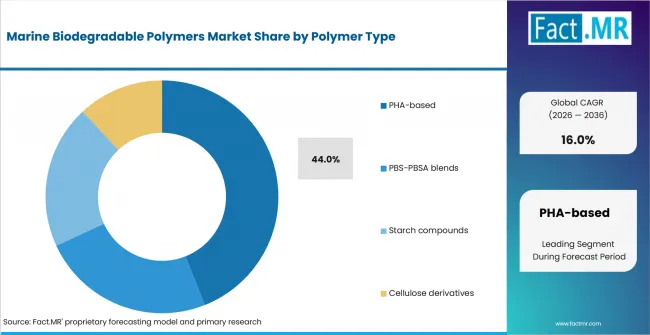
Marine Biodegradable Polymers Market Analysis By Polymer Type | Source: Fact.MR
PHA-based polymers are expected to lead Polymer Type with 44.0% share in 2026 due to their fit with marine biodegradation claims and extrusion work. PBS-PBSA blends are used where flexibility and processability carry more weight. Starch compounds support cost-sensitive films and molded items, while cellulose derivatives fit coatings and film structures. Kaneka states that Green Planet is biodegradable through microorganisms in environments including soil and seawater. This is a manufacturer claim about the material; it does not independently establish buyer behavior.
What leads the Application segment?
Fishing nets-lines hold 38.0% share in 2026.
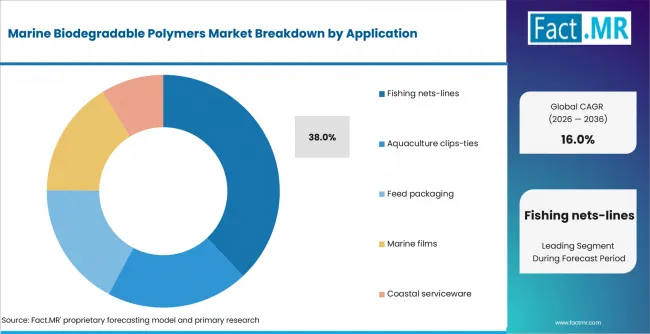
Marine Biodegradable Polymers Market Analysis By Application | Source: Fact.MR
Fishing nets-lines are projected to account for 38.0% share in 2026 because lost gear creates direct exposure in marine environments. Aquaculture clips-ties form the next use case where farms need small parts that survive handling. Feed packaging and marine films remain relevant where leakage is visible near ports or coastal farms. FAO reported in June 2026 that global fisheries and aquaculture production reached record levels in 2024.
How does Product Form shape demand?
Monofilament leads with 43.0% share in 2026.
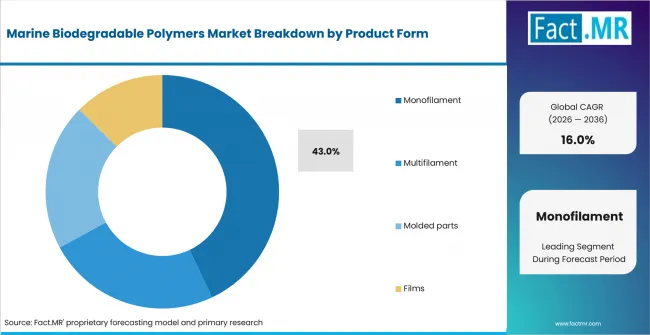
Marine Biodegradable Polymers Market Analysis By Product Form | Source: Fact.MR
Monofilament is anticipated to lead Product Form with 43.0% share in 2026 due to its fit with fishing lines, net components and tie materials. Multifilament supports heavier gear formats where strength is a greater concern. Molded parts are used in clips and small hardware, while films serve packaging and coastal serviceware. Product developers working on biopolymer films need separate validation because film thinning changes degradation and handling behavior.
What supports ASTM marine methods within Standard?
ASTM marine methods hold 37.0% share in 2026.
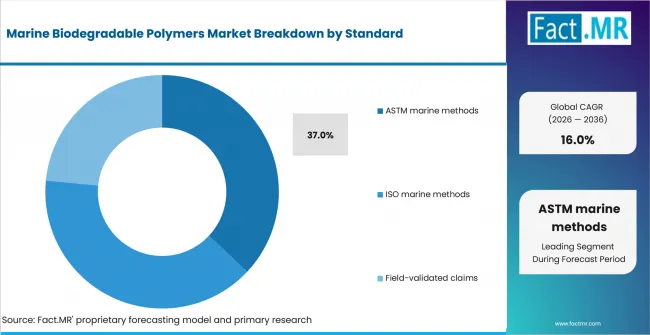
Marine Biodegradable Polymers Market Analysis By Standard | Source: Fact.MR
ASTM marine methods are estimated to represent 37.0% share in 2026 since exporters need a familiar evidence route for buyer review. ISO marine methods support multinational qualification when purchasers want comparable evidence across regions. Field-validated claims remain smaller but commercially useful when tests reflect realistic water exposure. ISO published ISO 16636:2025 in April 2025, specifying field-test methods for determining the disintegration of plastic materials floating in water under natural environmental conditions.
What is accelerating Marine Biodegradable Polymers Market adoption, and what is holding it back?
Aquaculture and gear leakage drive it; proof cost and durability trade-offs restrain it.
Drivers Impact Analysis
| DRIVER | (~) % IMPACT ON CAGR | GEOGRAPHIC RELEVANCE | IMPACT TIMELINE |
|---|---|---|---|
| Fishing gear leakage and aquaculture replacement | +2.1% | Global | Short term (<= 2 years) |
| Water-environment disintegration evidence | +1.6% | Europe, East Asia | Medium term (2-4 years) |
| Barrier coatings for coastal packaging | +1.2% | North America, Europe | Short term (<= 2 years) |
| Serviceware substitution near waterways | +0.9% | Coastal economies | Medium term (2-4 years) |
Source: Fact.MR analysis. Updated Aug 22, 2026
- Fishing gear leakage and aquaculture replacement: Gear makers need polymers that survive wet handling and reduce persistence if nets, lines or clips are lost.
- Barrier coatings for coastal packaging: BASF expanded its certified compostable ecovio portfolio for flexible barrier packaging in April 2026. Biodegradable packaging material formats still need marine claim boundaries.
- Serviceware substitution near waterways: Coastal venues are expected to favor serviceware that withstands wet use and documents end-of-life claims.
Opportunity Impact Analysis
| OPPORTUNITY | (~) % IMPACT ON CAGR | GEOGRAPHIC RELEVANCE | IMPACT TIMELINE |
|---|---|---|---|
| PHA coatings on paper and board | +1.4% | North America, Europe, East Asia | Short term (<= 2 years) |
| Field-tested monofilament and tie materials | +1.1% | East Asia, Europe | Medium term (2-4 years) |
| Aquaculture clips and molded components | +0.9% | Europe, East Asia | Medium term (2-4 years) |
Source: Fact.MR analysis. Updated Aug 22, 2026
- PHA coatings on paper and board: CJ Biomaterials used its October 2025 launch to target coated paper and board food packaging.
- Aquaculture clips and molded components: FAO reported in June 2026 that aquaculture aquatic animal production topped 100 million tonnes in 2024.
Restraints Impact Analysis
| RESTRAINT | (~) % IMPACT ON CAGR | GEOGRAPHIC RELEVANCE | IMPACT TIMELINE |
|---|---|---|---|
| Certification cost by product form | -0.8% | Global | Short term (<= 2 years) |
| Durability versus biodegradation trade-off | -0.7% | Global | Medium term (2-4 years) |
| Confusion between compostability and marine claims | -0.6% | North America, Europe | Short term (<= 2 years) |
Source: Fact.MR analysis. Updated Aug 22, 2026
- Certification cost by product form: A polymer grade does not qualify every finished product, so converters need testing by thickness and part geometry.
- Durability versus biodegradation trade-off: Fishing and aquaculture parts must resist stress during use before end-of-life behavior is assessed.
- Confusion between compostability and marine claims: Buyer reviews are expected to separate compost conditions from seawater or field-disintegration evidence.
Which countries are scaling the Marine Biodegradable Polymers Market through 2036?
Germany 19.8%; UK 19.0%; South Korea 18.3%; Japan 14.1%; USA 13.3%.
- The country spread spans 6.5 percentage points.
- Germany stays 0.8 point above the UK through aquaculture output.
- The UK stays 0.7 point above South Korea through salmon farming.
- South Korea stays 4.2 points above Japan through gear deposit rules.
- Japan stays 0.8 point above the USA through test-method work.
- The USA closes the range as debris programs keep proof visible.
Comparable CAGRs create different entry conditions due to aquaculture scale, gear rules and marine-litter evidence. Full coverage includes North America, Latin America, Western Europe, Eastern Europe, East Asia, South Asia & Pacific, Middle East & Africa.
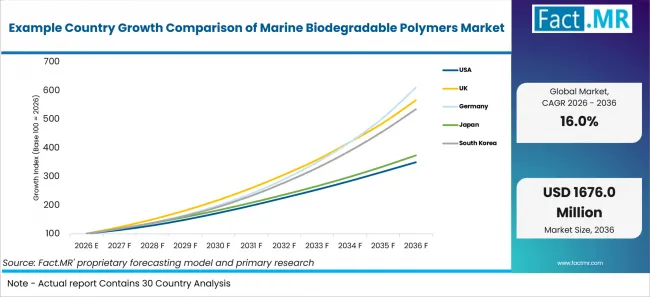
Example Country Growth Comparison Of Marine Biodegradable Polymers Market | Source: Fact.MR
| Country | CAGR (2026-2036) |
|---|---|
| Germany | 19.8% |
| United Kingdom | 19.0% |
| South Korea | 18.3% |
| Japan | 14.1% |
| United States | 13.3% |
Source: Fact.MR analysis. Updated Aug 22, 2026
What is powering Germany adoption?
19.8% CAGR through 2036, driven by aquaculture output and North Sea litter controls.
Germany’s growth is supported by aquaculture activity and stronger attention to marine-plastic leakage. Destatis reported that German aquaculture businesses produced 16,550,263 kg of fish in 2025, while BMEL-Statistik, citing BLE, reported preliminary 2025 per-capita fish consumption of 15.2 kilograms. North Sea operators are expected to require seawater durability and ASTM or ISO evidence before replacing conventional materials.
How is the United Kingdom scaling demand?
19.0% CAGR through 2036, supported by salmon farming and fishing-gear management.
The United Kingdom’s growth reflects its established aquaculture sector and increasing focus on marine litter and fishing-gear management. The Scottish Government reported that Atlantic salmon production reached 192,000 tonnes in 2024, while the Marine Management Organisation reported that the total quantity of landings by UK vessels increased 7.0% year over year in December 2025. Shellfish farms and coastal foodservice users are expected to test marine-degradable clips, ties, lines and films.
What supports South Korea adoption?
18.3% CAGR through 2036, reinforced by fisheries output and gear deposit rules.
South Korea’s growth is supported by large fisheries activity and policy attention to marine equipment and debris. The Ministry of Data and Statistics reported that 2025 fishery production reached 3.935 million tonnes, while the Ministry of Oceans and Fisheries set a policy target for full conversion to eco-friendly buoys by 2024. Local PHA capabilities are expected to support marine product development and clearer material identification.
What underpins Japan’s growth?
14.1% CAGR through 2036, supported by domestic PHA development and test-method work.
Japan’s growth is supported by a sizeable fisheries economy and domestic expertise in biodegradable polymer development. The Fisheries Agency reported that fisheries and aquaculture production value reached JPY 1.6853 trillion in 2023, while NEDO reported in May 2025 that ISO 16636:2025 covered water-environment disintegration field tests. Japanese converters can apply PHA expertise to films and molded parts.
How does the USA perform?
13.3% CAGR through 2036, led by aquaculture sales and coastal debris programs.
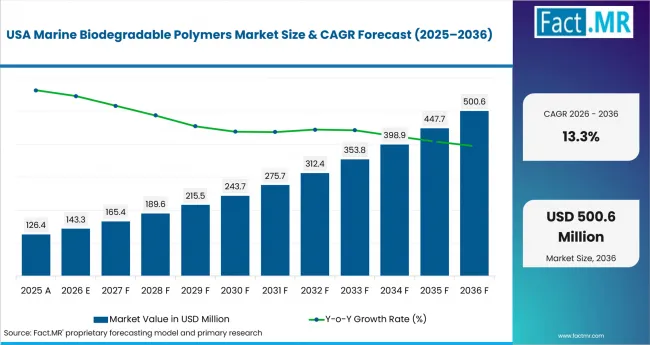
Marine Biodegradable Polymers Market Country Value Analysis | Source: Fact.MR
The USA’s growth reflects substantial fisheries activity, aquaculture sales and long-running marine-debris programs. NOAA Fisheries reported that U.S. commercial landings reached 8.4 billion pounds in 2023, while USDA ERS reported aquaculture sales of USD 1.908 billion in 2023. Coastal programs and public procurement are expected to support demand for materials backed by marine-degradation evidence.
Who leads the Marine Biodegradable Polymers Market?
Kaneka Corporation and CJ Biomaterials lead PHA-based coverage, while RWDC INDUSTRIES, Ningbo TianAn Biologic Material Co., Ltd. and Teknor Apex Company (Danimer Scientific PHA business) support adjacent polymer formats.
Kaneka Corporation is active through Green Planet, a PHA family positioned for biodegradation in soil and seawater. CJ Biomaterials supports PHACT PHA grades and coating compounds that help converters test coated paper, foodservice and flexible packaging formats. Competition in these areas is shaped by polymer evidence, processing support and the ability to document performance across finished product forms.
Which companies are the key providers?
Kaneka Corporation and CJ Biomaterials are key providers. RWDC INDUSTRIES, Ningbo TianAn Biologic Material Co., Ltd. and Teknor Apex Company (Danimer Scientific PHA business) are also profiled.
- Kaneka Corporation
- CJ Biomaterials
- RWDC INDUSTRIES
- Ningbo TianAn Biologic Material Co., Ltd.
- Teknor Apex Company (Danimer Scientific PHA business)
Bibliography
- CJ Biomaterials, Inc. (2025, October 1). CJ Biomaterials launches new PHA platform for extrusion coatings.
- Department of Agriculture, Environment and Rural Affairs. (2025, November). Marine Litter Report 2024.
- Food and Agriculture Organization of the United Nations. (2026, June 16). SOFIA 2026: Global fisheries and aquaculture production reaches new highs.
- German Environment Agency. (2025, July 28). Indicator: Plastic waste in the North Sea.
- Federal Statistical Office (Destatis). (2026, June 5). Aquaculture production businesses and volume produced in 2025 by selected species and Länder.
- International Organization for Standardization. (2025, April). ISO 16636:2025: Plastics—Disintegration field test of plastics under water environmental conditions.
- Kaneka Corporation. (2025, June 10). KANEKA biodegradable polymer Green Planet™ used for artificial turf blades and filler jointly developed for indoor sports with Mizuno.
- Marine Management Organisation. (2026, January 30). Monthly Sea Fisheries Statistics December 2025.
- Ministry of Oceans and Fisheries. (2025, June 20). MOF and KCG to do joint inspection of abandoned fishing gear to crack down on noncompliance with the Fishing Gear Deposit System and illegal dumping.
- NOAA Fisheries. (2026, February 9). Fisheries of the United States Reports.
- Scottish Government. (2025, October 28). Scottish Fish Farm Production Survey 2024.
This Report Answers
- The report explains how marine biodegradable polymers are used across polymer type and application. It also covers product form and standard route.
- Segment analysis identifies PHA-based polymers and monofilament formats as the highest-share categories in 2026.
- Country analysis examines Germany, the United Kingdom, South Korea, Japan and the United States.
- Competitive analysis reviews Kaneka Corporation, CJ Biomaterials, RWDC INDUSTRIES, Ningbo TianAn Biologic Material Co., Ltd. and Teknor Apex Company (Danimer Scientific PHA business).
- Technology assessment reviews PHA-based polymers, PBS-PBSA blends, starch compounds and cellulose derivatives.
- Application assessment covers fishing nets-lines, aquaculture clips-ties, feed packaging, marine films and coastal serviceware.
- Primary interviews, provider checks and official source review support the forecast and evidence base.
What does the Marine Biodegradable Polymers Market cover?
PHA-based, PBS-PBSA, starch and cellulose polymers used in marine-facing applications.
The Marine Biodegradable Polymers Market covers resins and compounds used when buyers need lower-persistence materials for aquatic or coastal leakage routes. The scope includes fishing lines, farm clips, coated formats and marine films used near aquaculture systems and seafood handling.
The assessment differs from general compostable packaging because marine claims require water-exposure evidence and clear boundary control. Adjacent seafood packaging and plant based packaging categories are included only when the product is assessed for marine-adjacent use.
What is included in the scope?
Marine biodegradable polymer materials used in gear, aquaculture, packaging and coastal serviceware.
The scope includes PHA-based polymers, PBS-PBSA blends, starch compounds and cellulose derivatives sold as resins, compounds, coatings or converted forms. It covers fishing nets-lines, aquaculture clips-ties, feed packaging, marine films and coastal serviceware. Related marine waste-derived PCR plastics are adjacent circular material context, not substitutes for biodegradation evidence.
What is excluded from the scope?
Conventional plastics and non-marine compostable products are outside the scope.
The scope excludes conventional polyethylene, polypropylene and nylon products sold without marine biodegradation evidence. It also excludes compostable plastics used only in industrial composting unless the material is separately assessed for water-environment or marine-field performance. Recycled ocean-plastic products are excluded when they are not biodegradable.
How was the analysis built?
120+ sources, 35+ company portfolios, 25+ countries, and more than 20 interviews.
- Primary Research: Interviews include polymer producers, compounders, converters, aquaculture operators, gear suppliers, packaging buyers and certification specialists.
- Desk Research: Desk research covers government statistics, standards documents, regulator pages, company releases and technical material statements.
- Market Sizing and Forecasting: Estimates combine historical values, country CAGRs, application shares, polymer type mix, pricing and adoption barriers.
- Data Validation and Update Cycle: Findings are validated through provider checks, official statistics review and source-date screening.
Segmentation
What is the report’s scope and coverage?
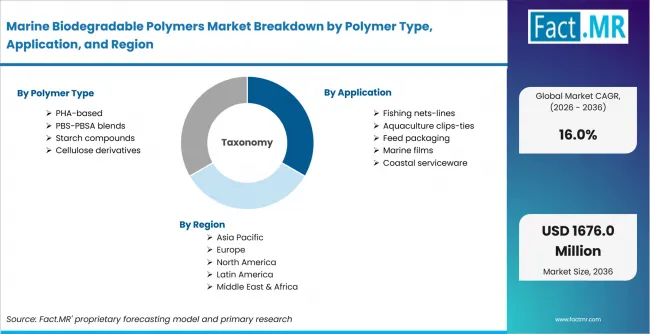
Marine Biodegradable Polymers Market Breakdown By Polymer Type, Application, And Region | Source: Fact.MR
| Attribute | Details |
|---|---|
| Quantitative Units | USD million in 2026 to USD million by 2036 at a CAGR |
| Market Definition | Polymers designed for marine or marine-adjacent applications where seawater or water-environment degradation evidence is central to buyer approval. |
| Polymer Type | PHA-based; PBS-PBSA blends; Starch compounds; Cellulose derivatives |
| Application | Fishing nets-lines; Aquaculture clips-ties; Feed packaging; Marine films; Coastal serviceware |
| Product Form | Monofilament; Multifilament; Molded parts; Films |
| Standard | ASTM marine methods; ISO marine methods; Field-validated claims |
| Regions Covered | North America; Latin America; Western Europe; Eastern Europe; East Asia; South Asia & Pacific; Middle East & Africa |
| Countries Covered | United States; United Kingdom; Germany; Japan; South Korea |
| Key Companies Profiled | Kaneka Corporation; CJ Biomaterials; RWDC INDUSTRIES; Ningbo TianAn Biologic Material Co., Ltd.; Teknor Apex Company (Danimer Scientific PHA business) |
| Forecast Period | 2026 to 2036 |
| Approach | Hybrid top-down and bottom-up approach using polymer type mix, application fit, country adoption, certification evidence, supply activity and provider portfolio review. |
Source: Fact.MR analysis. Updated Aug 22, 2026
How is the market segmented?
-
By Polymer Type
- PHA-based
- PBS-PBSA blends
- Starch compounds
- Cellulose derivatives
-
By Application
- Fishing nets-lines
- Aquaculture clips-ties
- Feed packaging
- Marine films
- Coastal serviceware
-
By Product Form
- Monofilament
- Multifilament
- Molded parts
- Films
-
By Standard
- ASTM marine methods
- ISO marine methods
- Field-validated claims
-
By Region
- North America
- Latin America
- Western Europe
- Eastern Europe
- East Asia
- South Asia & Pacific
- Middle East & Africa
Frequently Asked Questions
How big is the marine biodegradable polymers market in 2026?
What is the CAGR of the marine biodegradable polymers market from 2026 to 2036?
Which polymer type leads the marine biodegradable polymers market?
Which application leads the marine biodegradable polymers market?
Who are the leading companies in the marine biodegradable polymers market?
Who worked on this report


Preview the report firsthand - request a free sample
Free SampleGet the brochure for pricing and purchase details
Download PDF