- Base Value(2025): 1.5 Bn
- Estimated Value(2026): 1.6 Bn
- Forecast Value (2036): 3.3 Bn
- CAGR (2026 - 2036): 7.4%
Biodegradable Spray Tank Line-Cleaning Chemistry Market Forecast and Outlook By FACT.MR
In 2025, the biodegradable spray tank line-cleaning chemistry market was valued at USD 1.5 billion. Based on Fact.MR analysis, demand for biodegradable spray tank line-cleaning chemistries is estimated to grow to USD 1.6 billion in 2026 and USD 3.3 billion by 2036. FACT.MR projects a CAGR of 7.4% during the forecast period.
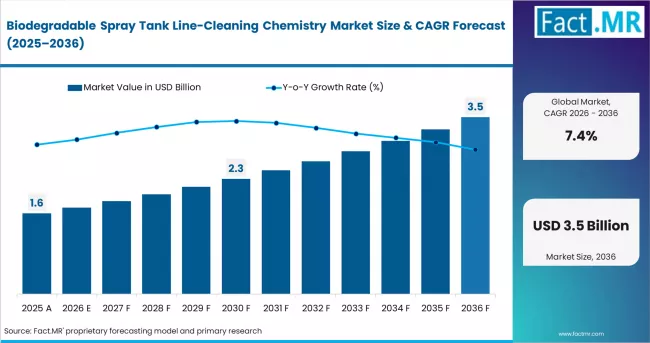
Biodegradable Spray Tank Line Cleaning Chemistry Market Value Analysis | Source: Fact.MR
Summary of Biodegradable Spray Tank Line-Cleaning Chemistry Market
- Market Definition
- The market covers biodegradable alkaline, enzyme-based, and surfactant-based cleaning chemistries for pesticide and chemical residue removal from agricultural spray tanks, boom lines, and food-grade industrial tanks globally.
- Demand Drivers
- India expanded tank cleaning norms in 2024. This increased biodegradable cleaner demand. Procurement is rising among pesticide spray operators.
- EU REACH compliance and German audits are tightening standards. Solvent-based cleaners are declining. Biodegradable alternatives are gaining share.
- Brazil updated agro-export residue standards in 2024. This increased demand for certified cleaners. Export spray operators are key buyers.
- Key Segments Analyzed
- By Product Type: Surfactant-based cleaners lead with 45% share in 2026. Driven by broad residue removal capability.
- By Application: Agriculture spray tanks lead with 50% share. Driven by cross-contamination prevention needs.
- By Formulation: Liquid formulations lead with 53% share. Preferred for easy flushing and compatibility.
- By Geography: India leads at 8.2% CAGR. Driven by spray equipment growth and regulation.
- Analyst Opinion at FACT.MR
- Shambhu Nath Jha, Principal Consultant at Fact.MR, opines, 'Certified biodegradable cleaners are replacing solvent-based products. Compliance approvals are the key differentiator.'
- Strategic Implications
- Invest in EU REACH and EPA approvals. This enables entry into regulated markets.
- Develop crop-specific cleaning protocols. Focus on herbicide and pesticide residue removal.
- Build partnerships with distributors in India and Brazil. This supports programme-based demand.
- Methodology
- Uses producer revenues and spray fleet data. Validated with 2024–2025 benchmarks.
- Includes EPA data, EU REACH reports, and government documentation.
- Forecasts based on equipment growth and adoption trends.Segmental Analysis
| Metric | Value |
|---|---|
| Estimated Value in 2026 | USD 1.6 billion |
| Forecast Value in 2036 | USD 3.3 billion |
| Forecast CAGR (2026 to 2036) | 7.4% |
Source: Fact.MR analysis. Updated Apr 23, 2026
The market is expected to generate USD 1.7 billion in incremental revenue over the forecast period. Growth is steady and structurally supported by expanding agrochemical spray operations and mandatory cross-contamination prevention requirements. Adoption is constrained by price sensitivity among smallholder farmers and the persistence of non-certified solvent-based cleaners in unregulated procurement channels.
Procurement is shifting from generic solvent-based cleaners toward certified biodegradable formulations as agriculture ministry residue regulations and food safety audits tighten requirements. Large agribusiness operators and food-grade industrial tank users prefer documented and traceable cleaning chemistry inputs. Ecolab, BASF, and Solvay are embedding compliance certification into supply agreements. Multi-year input contracts indexed to REACH compliance are replacing spot purchasing across European and North American agricultural chemical distribution networks.
India leads with an estimated CAGR of 8.2% through 2036, supported by rapid agricultural spray equipment expansion and government mandated pesticide residue management. China follows at 7.6%, driven by industrial cleaning demand and large-scale agrochemical usage. Brazil records 7.4%, supported by agro-export compliance requirements and pesticide residue management in export crop spray operations. The United States records 6.8%, anchored by EPA low-VOC and biodegradable chemistry regulatory frameworks. Germany records 6.5%, driven by EU REACH compliance and green chemistry adoption across precision agriculture operations.
Segmental Analysis
Biodegradable Spray Tank Line-Cleaning Chemistry Market Analysis by
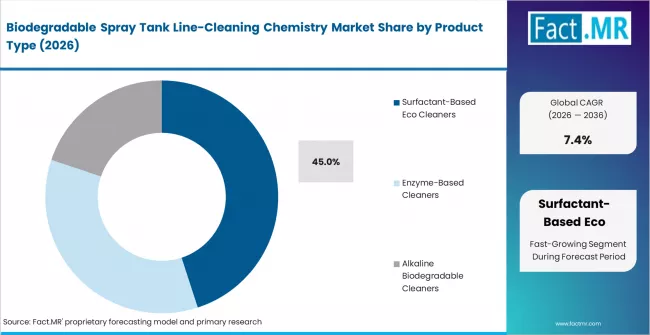
Biodegradable Spray Tank Line Cleaning Chemistry Market Analysis By Product Type | Source: Fact.MR
Based on FACT.MR's biodegradable spray tank line-cleaning chemistry market report, surfactant-based eco cleaners hold 45% share in 2026. They dominate due to broad compatibility. They remove pesticide, herbicide, and fungicide residues. Surfactants emulsify diverse chemistries. This reduces the need for multiple cleaners.
- Ecolab Expansion: Ecolab expanded its product line in 2024. Focus was on agricultural tank cleaning. Products were registered under EPA Design for Environment. Target markets include North America row crops and specialty crops. [1]
- Clariant Launch: Clariant launched an enzyme-based cleaner in 2025. Focus is on herbicide residue removal. Target users include European precision agriculture operators. Products are REACH-compliant. [2]
- Registration Trend: EPA approved 23 new biodegradable cleaners in 2024. Surfactant-based products led approvals. Adoption is rising in spray tank cleaning. [3]
Biodegradable Spray Tank Line-Cleaning Chemistry Market Analysis by Application
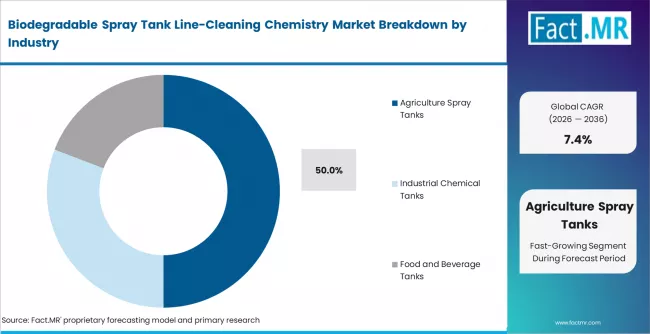
Biodegradable Spray Tank Line Cleaning Chemistry Market Analysis By Application | Source: Fact.MR
Based on FACT.MR's report, agriculture spray tanks hold 50% share in 2026. They represent the largest installed base. Cleaning frequency is high. Residue compliance is critical. Chemical rotation increases contamination risk.
- BASF Programme: BASF expanded tank hygiene programmes in 2024. Focus is on European spray operators. Products comply with EU Regulation 1107/2009. Coverage includes grain and oilseed operations. [4]
- Stepan Development: Stepan Company developed food-grade cleaners in 2025. Focus is on NSF-certified applications. Target industries include dairy and beverages. [5]
- Industry Trend: European Cleaning Products Association reported 19% growth in 2024. Biodegradable cleaners increased across industrial and food-grade tanks. Regulation is the key driver. [6]
Drivers, Restraints, and Opportunities
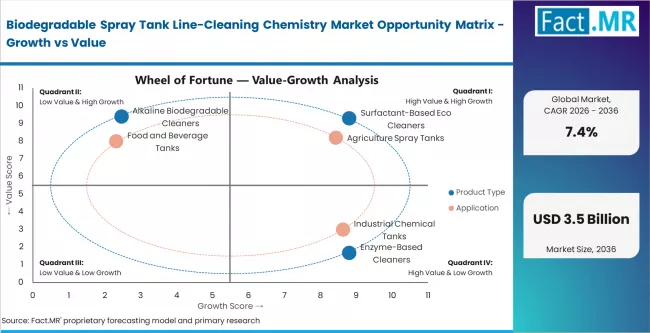
Biodegradable Spray Tank Line Cleaning Chemistry Market Opportunity Matrix Growth Vs Value | Source: Fact.MR
FACT.MR analysts observe steady market growth. Expansion is driven by spray fleet growth. Asia and Latin America lead agriculture demand. North America and Europe drive compliance demand.
The market is shifting toward biodegradable cleaners. Solvent-based products are declining. Certified products command 20–35% price premiums. Non-compliant suppliers face exclusion. Growth is compliance-driven.
- EPA Programme: The EPA updated DfE criteria in 2024. Standards became stricter. Adoption of approved cleaners increased. Ecolab and Stepan Company expanded portfolios.
- India Expansion: Agricultural spray equipment grew 18% in 2024. New guidelines increased compliance requirements. Cleaner demand is rising. Ecolab expanded distribution in India.
- EU REACH Mandate: REACH enforcement increased in 2024. Biodegradability requirements tightened. Solvent cleaners are being replaced. BASF and Solvay expanded compliant products.
Regional Analysis
The biodegradable spray tank line-cleaning chemistry market is assessed across Asia Pacific, North America, Europe, Latin America, and Middle East and Africa, covering 40+ countries with demand shaped by agricultural spray fleet scale, pesticide residue regulation intensity, biodegradable chemistry registration availability, and agro-export compliance requirements. The full report provides market attractiveness analysis by region and country.
.webp "Top Country Growth Comparison Biodegradable Spray Tank Line Cleaning Chemistry Market Cagr (2026 2036)")
Top Country Growth Comparison Biodegradable Spray Tank Line Cleaning Chemistry Market Cagr (2026 2036) | Source: Fact.MR
| Country | CAGR (2026 to 2036) |
|---|---|
| India | 8.2% |
| China | 7.6% |
| Brazil | 7.4% |
| United States | 6.8% |
| Germany | 6.5% |
Source: Fact.MR analysis. Updated Apr 23, 2026
Source: Fact.MR (FACT.MR) analysis, based on proprietary forecasting model and primary research
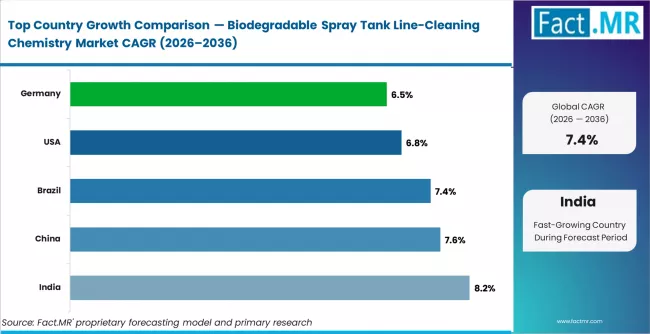
Biodegradable Spray Tank Line Cleaning Chemistry Market Cagr Analysis By Country | Source: Fact.MR
Asia Pacific Biodegradable Spray Tank Line-Cleaning Chemistry Market Analysis
Asia Pacific is the fastest-growing region. India drives compliance-led demand. China drives volume expansion. Procurement models differ across markets. Ecolab and BASF have strong regional presence.
- India: Regulation-driven adoption supports 8.2% CAGR through 2036. It is among the fastest-growing markets. The Agriculture Ministry updated cleaning norms in 2024. Cross-contamination rules were strengthened. Sustainable Agriculture Mission added tank hygiene guidelines. Ecolab expanded partnerships in 2024. Maharashtra and Punjab are key hubs. Growth is policy-driven and programme-led.
- China: Scale-led demand supports 7.6% CAGR through 2036. The Ministry updated spray hygiene standards in 2024. Over 12 million spray units are covered. Food safety rules tightened in key provinces. BASF expanded product availability in 2025. Procurement is linked to state programmes. Growth is driven by scale and regulation.
Fact.MR's analysis of Asia Pacific covers India, China, Japan, South Korea, ASEAN, and Australia and New Zealand. Includes programme data and adoption trends.
Latin America Biodegradable Spray Tank Line-Cleaning Chemistry Market Analysis
Latin America is an export-driven market. Residue compliance is the key driver. Brazil dominates regional demand. Ecolab and Stepan Company operate strong networks.
- Brazil: Export compliance drives 7.4% CAGR through 2036. MAPA updated standards in 2024. Cross-contamination rules were tightened. Spray operators must use certified cleaners. Export auditors updated protocols. Stepan Company expanded distribution in 2025. Growth is export-led and compliance-driven.
Fact.MR covers Brazil, Argentina, Colombia, and Rest of Latin America. Includes export data and adoption benchmarks.
North America Biodegradable Spray Tank Line-Cleaning Chemistry Market Analysis
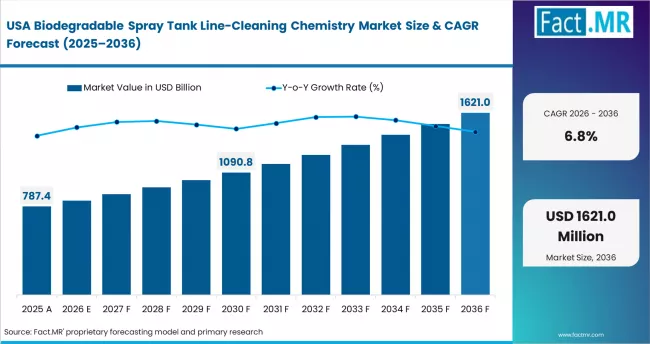
Biodegradable Spray Tank Line Cleaning Chemistry Market Country Value Analysis | Source: Fact.MR
North America is a certification-led market. EPA and food safety rules drive demand. Agricultural and industrial use both contribute. Ecolab and Stepan Company lead through approved products.
- United States: Certification-led growth supports 6.8% CAGR through 2036. EPA approved new products in 2024. Spray tank cleaning is a major category. USDA updated organic guidelines in 2024. Cleaner demand increased among certified operators. Ecolab expanded distribution in 2025. Growth is driven by regulation and certification.
Fact.MR covers the U.S., Canada, and Mexico. Includes EPA and USDA data.
Europe Biodegradable Spray Tank Line-Cleaning Chemistry Market Analysis
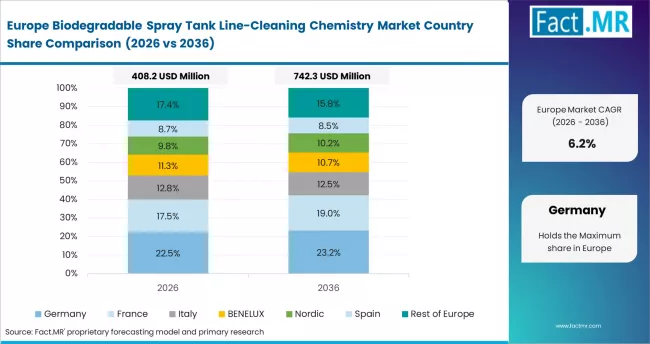
Biodegradable Spray Tank Line Cleaning Chemistry Market Europe Country Market Share Analysis, 2026 & 2036 | Source: Fact.MR
Europe is the regulatory benchmark. REACH and pesticide directives shape demand. Germany leads compliance-driven adoption. BASF, Solvay, and Evonik Industries are key players.
- Germany: Regulation-led demand supports 6.5% CAGR through 2036. The Environment Agency updated REACH guidance in 2024. Biodegradability rules became stricter. Farmers’ Association updated compliance norms. BASF expanded product range in 2025. Growth is compliance-driven and precision-led.
Fact.MR covers Germany, France, the UK, Italy, Spain, Netherlands, and Rest of Europe. Includes REACH data and adoption trends.
Competitive Aligners for Market Players
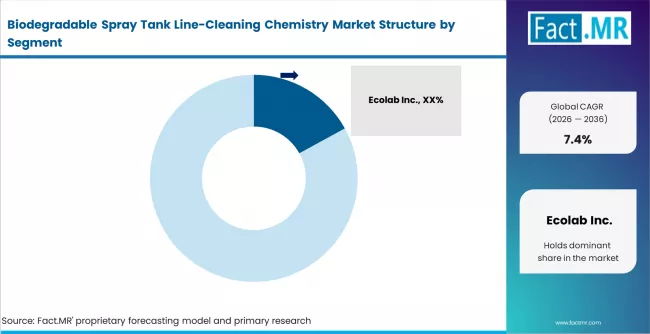
Biodegradable Spray Tank Line Cleaning Chemistry Market Analysis By Company | Source: Fact.MR
Competition in the biodegradable spray tank line-cleaning chemistry market is becoming more structured and compliance-focused. It is no longer just about price or basic cleaning performance. Buyers now look for certified, reliable solutions that meet strict regulatory standards. A small group of global specialty chemical companies dominates the premium segment, while regional players still compete in less regulated, price-sensitive markets. The real differentiator today is certification. Products backed by EPA DfE listing, EU REACH approval, and OECD biodegradability standards are gaining preference across agricultural and food-grade applications.
Large players like Ecolab, BASF, and Solvay have built strong advantages over time. They operate extensive regulatory registration systems and maintain deep distribution networks. Their long-standing relationships with commercial spray operators and cooperatives allow them to stay embedded in procurement cycles.
More importantly, they can adapt and register the same biodegradable formulations across multiple regions. This flexibility, combined with agronomic and technical support, gives them a clear edge over smaller firms that often struggle with compliance costs and limited reach.
At the same time, specialist companies such as Stepan Company, Croda International, Evonik Industries, and Clariant are carving out space in high-value niches. They focus on tailored solutions, such as crop-specific or application-specific cleaning protocols. Buyer behaviour is also evolving. Large operators now prefer integrated cleaning programmes rather than standalone products. This includes documentation, residue control support, and ongoing performance validation. As a result, suppliers that can offer complete, compliant solutions are strengthening their position, while smaller, unregistered players face increasing pressure.
Key Players
- Ecolab Inc.
- BASF SE
- Solvay SA
- Stepan Company
- Croda International Plc
- Evonik Industries AG
- Clariant AG
Bibliography
- [1] Ecolab Inc. (2024). Agricultural Cleaning Product Line Expansion: EPA Design for Environment-Registered Surfactant-Based Biodegradable Cleaners for Pesticide Spray Tank Application Across North American Row Crop and Specialty Crop Operations. ecolab.com/news
- [2] Clariant AG. (2025). Product Launch Announcement: EU REACH-Compliant Enzyme-Based Biodegradable Spray Tank Cleaner for European Precision Agriculture Herbicide Residue Removal in Grain and Oilseed Spray Equipment. clariant.com/en/media
- [3] United States Environmental Protection Agency. (2024). Design for Environment Programme Biodegradable Agricultural Cleaning Chemistry Approvals 2024: Summary of New Product Registrations Including Agricultural Spray Tank and Boom-Line Cleaning Category Data. epa.gov/saferchoice
- [4] BASF SE. (2024). Agricultural Tank Hygiene Programme Expansion: Biodegradable Alkaline and Surfactant-Based Cleaners Registered Under EU Regulation 1107/2009 for Pesticide Spray Tank and Boom-Line Cleaning in Germany, France, and UK Operations. basf.com/global/en/media
- [5] Stepan Company. (2025). Product Development Announcement: NSF-Certified Biodegradable Surfactant-Based Cleaning Formulations for Food and Beverage Industrial Tank Applications Targeting Food-Grade Compliance Procurement in North American Processing Operations. stepan.com/news
- [6] European Cleaning Products Association. (2024). Annual Sector Report 2024: Biodegradable Cleaning Chemistry Registrations for Industrial Chemical and Food-Grade Tank Applications Including EU Chemical Safety Regulation Update Impact on Product Certification Growth. cleanright.eu
This Report Addresses
- Strategic insights across India, China, Brazil, the United States, and Germany. Covers agriculture, industrial, and food-grade tank cleaning demand.
- Market forecast from USD 1.6 billion in 2026 to USD 3.3 billion by 2036. CAGR is 7.4%.
- Opportunity mapping across India spray expansion, China industrial demand, Brazil export compliance, U.S. EPA programmes, and Germany REACH adoption.
- Segment analysis by product type, application, and formulation. Covers global and regional markets.
- Regional outlook across Asia Pacific, Latin America, North America, and Europe. Focus on regulation and compliance trends.
- Competitive analysis of Ecolab, BASF, Solvay, Stepan Company, Croda International, Evonik Industries, and Clariant. Focus on certification and product development.
- Regulatory analysis covering EPA DfE updates, EU REACH enforcement, India pesticide rules, and Brazil MAPA standards.
- Report delivered in PDF, Excel, and presentation formats. Supported by validated data and expert interviews.
Biodegradable Spray Tank Line-Cleaning Chemistry Market Definition
The market covers biodegradable alkaline, enzyme-based, and surfactant-based cleaning chemistries formulated for removing pesticide, herbicide, and chemical residues from agricultural spray tanks, boom lines, and industrial process tanks.
Biodegradable Spray Tank Line-Cleaning Chemistry Market Inclusions
Covers global and regional forecasts from 2026 to 2036 by product type, application, and formulation. Includes alkaline, enzyme, and surfactant-based biodegradable cleaners across liquid, powder, and concentrate formats for agricultural, food-grade, and industrial spray tank applications.
Biodegradable Spray Tank Line-Cleaning Chemistry Market Exclusions
Excludes solvent-based and non-biodegradable tank cleaners. Omits water treatment chemicals and general industrial detergents without tank-line residue removal function. Excludes spray equipment and nozzle hardware.
Biodegradable Spray Tank Line-Cleaning Chemistry Market Research Methodology
- Primary Research
- Interviews with agrochemical spray operators, input procurement managers, industrial cleaning chemistry distributors, and food-grade tank compliance auditors across India, the United States, Germany, Brazil, and China.
- Desk Research
- Uses EPA biodegradable chemistry registration data, EU REACH compliance reports, Ecolab and BASF public filings, FAO pesticide residue management guidelines, and 2024-2025 agricultural input trade statistics.
- Market Sizing and Forecasting
- Hybrid model using biodegradable cleaner producer revenues, spray tank fleet size estimates by region and crop type, average application frequency benchmarks, and compliance-premium pricing data by formulation and certification grade.
- Data Validation and Update Cycle
- Validated using producer revenue disclosures, agricultural input programme procurement volumes, and food-grade tank compliance audit benchmarks. Supported by expert interviews with agronomists and cleaning chemistry procurement specialists.
Segmentation
Scope of Report
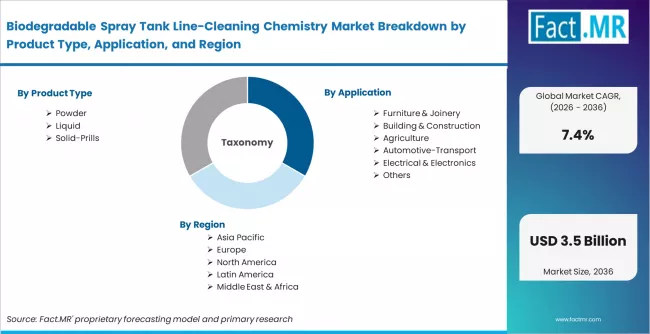
Biodegradable Spray Tank Line Cleaning Chemistry Market Breakdown By Product Type, Application, And Region | Source: Fact.MR
| Attribute | Details |
|---|---|
| Quantitative Units | USD 1.6 billion (2026) to USD 3.3 billion (2036), at a CAGR of 7.4% |
| Market Definition | Biodegradable alkaline, enzyme-based, and surfactant-based cleaning chemistries for pesticide and chemical residue removal from agricultural spray tanks, boom lines, and industrial process tanks, supplied with EPA DfE listing, EU REACH approval, or national biodegradability certification. |
| Product Type Segmentation | Alkaline Biodegradable Cleaners, Enzyme-Based Cleaners, Surfactant-Based Eco Cleaners, Others |
| Application Segmentation | Agriculture Spray Tanks, Industrial Chemical Tanks, Food and Beverage Tanks, Others |
| Formulation Segmentation | Liquid, Powder, Concentrates |
| Application Coverage | Pesticide residue cross-contamination prevention in agricultural spray tank cleaning, herbicide and insecticide residue removal in boom-line flushing, food-grade industrial tank NSF-compliant cleaning, and certified organic spray equipment biodegradable input compliance. |
| Regions Covered | North America, Europe, Asia Pacific, Latin America, Middle East and Africa |
| Countries Covered | USA, Canada, Mexico, Germany, UK, France, Italy, Spain, Netherlands, Nordic, BENELUX, China, Japan, South Korea, India, ASEAN, Australia and New Zealand, Brazil, Argentina, Colombia, Saudi Arabia, GCC, Turkey, South Africa, Rest of MEA |
| Key Companies Profiled | Ecolab Inc., BASF SE, Solvay SA, Stepan Company, Croda International Plc, Evonik Industries AG, Clariant AG |
| Forecast Period | 2026 to 2036 |
| Approach | Hybrid top-down and bottom-up model using biodegradable cleaner producer revenues, agricultural spray fleet size estimates by region and crop type, average application frequency benchmarks, compliance-premium pricing data by formulation and certification grade, and primary interviews with spray operators and cleaning chemistry procurement managers. |
Source: Fact.MR analysis. Updated Apr 23, 2026
Biodegradable Spray Tank Line-Cleaning Chemistry Market By Segment
-
By Product Type:
- Alkaline Biodegradable Cleaners
- Enzyme-Based Cleaners
- Surfactant-Based Eco Cleaners
- Others
-
By Application:
- Agriculture Spray Tanks
- Industrial Chemical Tanks
- Food and Beverage Tanks
- Others
-
By Formulation:
- Liquid
- Powder
- Concentrates
-
By Region:
- North America
- United States
- Canada
- Mexico
- Latin America
- Brazil
- Argentina
- Colombia
- Rest of Latin America
- Western Europe
- Germany
- United Kingdom
- France
- Italy
- Spain
- Netherlands
- Nordic Countries
- BENELUX
- Rest of Western Europe
- Eastern Europe
- Russia
- Poland
- Hungary
- Balkan and Baltic
- Rest of Eastern Europe
- East Asia
- China
- Japan
- South Korea
- South Asia and Pacific
- India
- ASEAN
- Australia and New Zealand
- Rest of South Asia and Pacific
- Middle East and Africa
- Kingdom of Saudi Arabia
- Other GCC Countries
- Turkey
- South Africa
- Rest of Middle East and Africa
- North America
Frequently Asked Questions
How large is the biodegradable spray tank line-cleaning chemistry market in 2025?
What will the market size be in 2026?
What is the projected market size by 2036?
What is the expected CAGR of the biodegradable spray tank line-cleaning chemistry market?
What is the absolute dollar opportunity in this market?
Which product type segment leads the market?
Which application segment holds the largest share?
Which formulation segment is poised to lead?
Which country shows the fastest growth?
What are biodegradable spray tank line-cleaning chemistries used for?
What is driving market growth?
Which region leads market growth?
Who are the key market players?
What challenges does the market face?
Who worked on this report


Preview the report firsthand - request a free sample
Free SampleGet the brochure for pricing and purchase details
Download PDF