Turbine Control Systems Market
Turbine Control Systems Market Size and Share Forecast Outlook 2025 to 2035
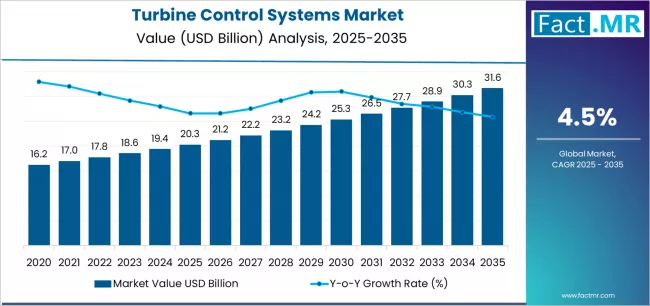
Turbine control systems market is projected to grow from USD 20.3 billion in 2025 to USD 31.6 billion by 2035, at a CAGR of 4.5%. Steam Turbine Control System will dominate with a 44.8% market share, while hardware will lead the component segment with a 65.5% share.
Turbine Control System Market Forecast and Outlook 2025 to 2035
The global turbine control system market is projected to reach about USD 31.64 billion by 2035, rising from USD 20.29 billion in 2025. This reflects a compound annual growth rate of 4.5% across the forecast period. Between 2025 and 2030, the market is expected to grow from USD 20.29 billion to approximately USD 25.01 billion, adding USD 4.72 billion in value.
This period is influenced by the modernization of thermal and combined-cycle plants, where operators replace aging control components with digital platforms that offer structured diagnostic capabilities.
Quick Stats for Turbine Control System Market
- Turbine Control System Market Value (2025): USD 20.29 billion
- Turbine Control System Market Forecast Value (2035): USD 31.64 billion
- Turbine Control System Market Forecast CAGR: 4.5%
- Leading Type in Turbine Control System Market: Steam Turbine Control System
- Key Growth Regions in Turbine Control System Market: Asia Pacific, North America, and Europe
- Top Players in Turbine Control System Market: ABB Ltd., Siemens Energy, General Electric, Schneider Electric, Eaton Corporation, Emerson Electric Co., Honeywell International, Mitsubishi Electric Corporation, Yokogawa Electric Corporation, Voith GmbH & Co. KGaA

Facilities adopt hardware and software packages that integrate programmable logic controllers, distributed control systems, and condition-monitoring tools. As new power plants are commissioned, control systems are incorporated into project planning to support efficiency requirements and compliance with operational standards. Renewable energy installations, particularly wind and hydro facilities, incorporate turbine control units to manage fluctuating output and maintain grid compatibility.
Between 2030 and 2035, the market is projected to rise from USD 25.01 billion to about USD 31.64 billion, adding USD 6.63 billion in value. Growth in this phase reflects wider integration of monitoring systems that combine real-time data collection with standardized asset-management approaches. Operators implement structured maintenance programs that rely on sensors measuring temperature, vibration, pressure, and rotational speed.
Manufacturers refine control algorithms to address variations in load, fuel quality, and environmental conditions. In several regions, newly built gas turbines incorporate control systems designed to support future upgrades, including combustion tuning and emissions-related adjustments. Industrial plants using mechanical-drive turbines also adopt updated control solutions to improve process consistency and equipment reliability.
Between 2020 and 2025, the turbine control system market expanded as power generation facilities focused on extending asset life and managing operating costs. Plants with aging turbines-initiated control system upgrades to maintain stable output and align with regulatory expectations.
Manufacturers supplied systems with improved operator interfaces, enhanced safety functions, and modular components that simplified installation. Renewable energy projects, including utility-scale wind installations, adopted turbine control platforms to monitor blade pitch, generator performance, and structural loads. These developments established a foundation for broader technology adoption across the next decade.
Several operational considerations influence system selection and deployment. Variability in electronic component prices affects production costs and procurement planning. Cybersecurity requirements guide hardware architecture and software update practices, particularly in regions where grid infrastructure is classified as critical. Certification procedures for safety and performance shape commissioning timelines. Power plant operators evaluate compatibility between existing equipment and new control units, assessing requirements for wiring, communication protocols, and interface configurations.
Regional differences in technology infrastructure also influence adoption. Some developing markets face constraints related to data connectivity, specialized maintenance personnel, and access to advanced automation tools. Manufacturers respond by offering product lines suited to different installation scales, including systems designed for basic monitoring and systems built for fully integrated turbine-plant control.
Turbine Control System Market Year-over-Year Forecast 2025 to 2035
Between 2025 and 2030, the turbine control system market is projected to expand from USD 20.29 billion to USD 25.17 billion, resulting in a value increase of USD 4.88 billion, which represents 43.0% of the total forecast growth for the decade. This phase of development will be shaped by rising demand for automation technology platforms and predictive maintenance solutions, product innovation in distributed control system formulations and sensor integration alternatives, as well as expanding integration with power plant digital platforms and asset performance management programs. Companies are establishing competitive positions through investment in control algorithm development technology, high-quality hardware manufacturing capabilities, and strategic market expansion across power generation distribution channels, renewable energy segments, and industrial turbine applications.
From 2030 to 2035, the market is forecast to grow from USD 25.17 billion to USD 31.64 billion, adding another USD 6.47 billion, which constitutes 57.0% of the overall ten-year expansion. This period is expected to be characterized by the expansion of specialized control system derivatives, including targeted artificial intelligence formulations and cloud-based platform integrations tailored for specific operational applications, strategic collaborations between hardware manufacturers and software development companies, and an enhanced focus on cybersecurity enhancement practices and remote monitoring certifications. The growing emphasis on renewable energy integration and evidence-based efficiency optimization will drive demand for advanced control solutions across diverse power generation applications.
Turbine Control System Market Key Takeaways
| Metric | Value |
|---|---|
| Market Value (2025) | USD 20.29 billion |
| Market Forecast Value (2035) | USD 31.64 billion |
| Forecast CAGR (2025-2035) | 4.5% |
Why is the Turbine Control System Market Experiencing Steady Growth?
The turbine control system market grows by enabling power plant operators, energy companies, and industrial facilities to access high-quality automation technologies that support operational efficiency enhancement while meeting energy sector demand for reliable turbine management alternatives. Power generation facilities face mounting pressure to implement proven control technologies with demonstrated performance optimization and safety validation, with distributed control systems typically providing 95-98% operational reliability rates comparable to conventional manual control methods, making these systems essential for competitive operational positioning in power generation and industrial process categories. The energy industry's need for versatile control platforms and equipment compatibility creates demand for diverse system architectures that can provide superior performance monitoring, maintain consistent operations across different turbine configurations, and ensure regulatory compliance without compromising safety standards or operational flexibility.
Government initiatives promoting power generation efficiency and emission reduction programs drive adoption in thermal power plants, renewable energy applications, and combined-cycle facility partnerships, where turbine control system utilization has a direct impact on operational performance outcomes and environmental compliance. The power industry's growing focus on asset digitalization and predictive maintenance capabilities further expands market opportunities, with engineering research demonstrating measurable efficiency improvements in turbine operations, reduced maintenance costs, and enhanced operational safety performance. However, supply chain complexity during component sourcing and the technical requirements for system integration and cybersecurity implementation may limit accessibility among smaller power facilities and developing regions with limited infrastructure for advanced automation technology deployment and technical support systems.
Segmental Analysis
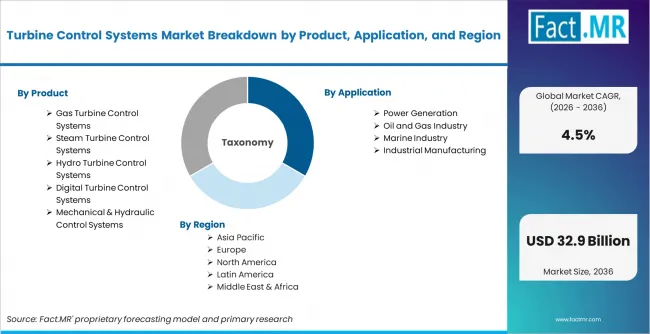
The market is segmented by type, component, and region. By type, the market is divided into steam turbine control system, gas turbine control system, and others. Based on component, the market is categorized into hardware and software. Regionally, the market is divided into Asia Pacific, North America, Europe, Latin America, and Middle East & Africa.
What makes Steam Turbine Control System the Dominant Type Segment in the Turbine Control System Market?

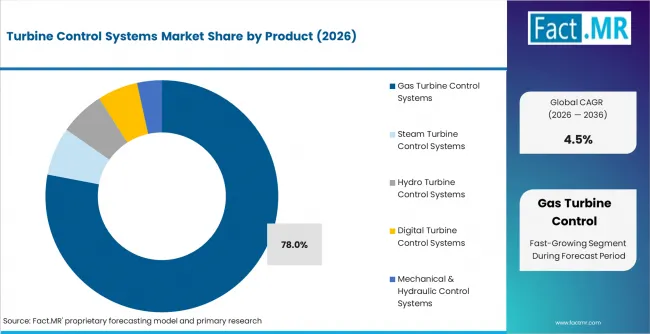
The steam turbine control system segment represents the dominant force in the turbine control system market, capturing approximately 44.8% of total market share in 2025. This established control category encompasses solutions featuring scalable power plant integration compatibility from thermal generation operations, including distributed control architectures and programmable logic controller systems that enable cost-effective deployment and consistent performance standards across all power generation applications.
The steam turbine control system segment's market leadership stems from its superior operational reliability, with products capable of meeting diverse power generation requirements while maintaining high efficiency and operational safety across all turbine environments. Within the steam turbine category, combined-cycle plant control units account for approximately 26.5% share, driven by superior efficiency optimization properties and operational flexibility positioning.
The gas turbine control system segment maintains a substantial 41.2% market share, serving power plants that require advanced control capabilities with comprehensive performance monitoring for peaking power generation and combined-cycle applications. These systems offer high-quality control solutions for power generation and industrial applications while providing sufficient operational capabilities to meet efficiency optimization demands and emission compliance requirements. The others segment accounts for approximately 14.0% of the market, serving wind and hydro turbine automation applications and emerging renewable energy platforms.
Key advantages driving the steam turbine control system segment include:
- Advanced power plant infrastructure with integrated automation systems that reduce operational complexity and ensure consistent turbine performance
- High operational reliability capabilities allowing accurate load control across different operating conditions without significant performance degradation
- Proven platform compatibility, delivering reliable operational outcomes while maintaining cost competitiveness against conventional control alternatives
- Broad regulatory acceptance enabling straightforward system approvals and market entry across multiple jurisdictions
How does the Hardware Segment Lead Component Market Share?

Hardware dominates the component segment with approximately 65.5% market share in 2025, reflecting the critical role of sensors, actuators, and control equipment in supporting global turbine control system deployment and operational reliability worldwide.
The hardware segment's market leadership is reinforced by established control technologies, versatile equipment capabilities, and rising requirements for turbine automation systems in power plants, industrial facilities, and renewable energy installations across developed and emerging markets. Within the hardware segment, sensors and actuators account for approximately 31.4% share, driven by precision control requirements and expanding turbine monitoring infrastructure.
The software segment represents the second-largest component category, capturing 34.5% market share through predictive control algorithms, data analytics platforms, and remote monitoring applications. This segment benefits from growing demand for advanced automation capabilities that meet specific performance optimization standards, cybersecurity requirements, and operational efficiency protocols in competitive energy markets. Software is expected to expand fastest with IoT and artificial intelligence integration driving advanced analytics adoption.
Key market dynamics supporting component growth include:
- Hardware expansion driven by turbine modernization programs and automation technology deployment, requiring standardized control equipment in emerging power markets
- Software modernization trends require high-quality, validated control algorithms for operational accuracy and efficiency optimization
- Integration of predictive maintenance capabilities enabling comprehensive asset management programs and reliability enhancement measures
- Growing emphasis on digital transformation driving demand for comprehensive, multi-component control solutions
What are the Drivers, Restraints, and Key Trends of the Turbine Control System Market?
The market is driven by three concrete demand factors tied to operational efficiency and power generation reliability. First, increasing power generation infrastructure modernization and aging asset replacement creates growing demand for advanced turbine control system alternatives, with global power plant retrofit programs expanding significantly in major electricity-producing countries, requiring comprehensive automation supply infrastructure.
Second, government initiatives promoting renewable energy integration and emission reduction targets drive increased adoption of turbine control systems, with many countries implementing comprehensive efficiency standards for power generation facilities and operational optimization requirements by 2030. Third, technological advancements in distributed control systems and artificial intelligence platforms enable more effective and reliable turbine management products that reduce operational uncertainty while improving efficiency performance capabilities and safety management protocols.
Market restraints include fluctuating raw material costs for electronic components that can deter manufacturers from maintaining competitive pricing strategies, particularly in developing regions where procurement networks for quality-controlled automation hardware remain limited. Regulatory complexity and power system safety approval requirements pose another significant challenge, as turbine control systems demand extensive functional validation and cybersecurity assessment studies, potentially causing increased development costs and market entry delays. Technology infrastructure limitations and skilled workforce availability across different regions create additional market challenges for system accessibility, demanding ongoing investment in technical training programs and support infrastructure development.
Key trends indicate accelerated adoption in Asia Pacific markets, particularly India and China, where rising power generation capacity and infrastructure modernization drive comprehensive turbine control system adoption.
Technology integration trends toward cloud-based control platforms with specific remote monitoring capabilities, predictive maintenance algorithm assessments, and cybersecurity validation protocols enable proactive product development approaches that optimize operational performance and minimize system complexity. The market could face disruption if significant advances in alternative power generation technologies or major changes in energy storage infrastructure reduce reliance on traditional turbine-based power generation alternatives.
Analysis of the Turbine Control System Market by Key Countries

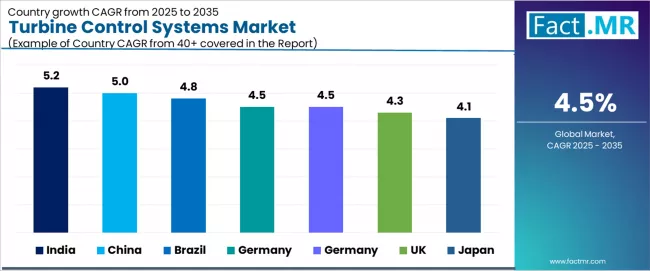
| Country | CAGR (2025-2035) |
|---|---|
| India | 5.2% |
| China | 5.0% |
| Brazil | 4.8% |
| Germany | 4.5% |
| USA | 4.5% |
| UK | 4.3% |
| Japan | 4.1% |
The turbine control system market is expanding steadily, with India leading at a 5.2% CAGR through 2035, driven by retrofitting of coal and hydro plants with modern turbine control systems, power generation capacity expansion, and industrial automation initiatives. China follows at 5.0%, supported by continued renewable power projects, modernization of old turbine assets, and grid infrastructure enhancement programs. Brazil records 4.8%, reflecting expanding hydroelectric projects and turbine upgrade requirements across generation facilities.
Germany posts 4.5%, anchored by strong renewable policy integration and industry automation standards for power generation efficiency. The USA grows at 4.5%, with steady modernization and digitalization of turbine assets across thermal and renewable facilities, expanding power plant automation and control system deployment capabilities, while the UK advances at 4.3%, emphasizing wind turbine control system upgrades and efficiency improvement initiatives, and Japan grows steadily at 4.1%, focusing on advanced turbine control applications in aerospace and gas power sectors through precision automation platforms.
What is India’s Position in the Turbine Control System Market?

India demonstrates the strongest growth potential in the turbine control system market with a CAGR of 5.2% through 2035. The country's leadership position stems from retrofitting of coal and hydro plants with modern turbine control systems, power generation capacity expansion programs, and government infrastructure initiatives enabling mainstream automation technology adoption.
Growth is concentrated in major power generation regions, including thermal power clusters in Gujarat, Maharashtra, Chhattisgarh, and Odisha, where power plant operators and expanding energy companies are implementing turbine control systems for enhanced operational efficiency and emission compliance management.
Distribution channels through equipment procurement networks, engineering procurement construction partnerships, and original equipment manufacturer relationships expand deployment across power generation modernization programs and industrial facility initiatives. The country's growing power sector provides policy support for automation technology development, including distributed control system and predictive maintenance platform adoption.
Key market factors:
- Power generation demand concentrated in thermal power modernization and hydroelectric facility upgrade programs with comprehensive automation initiatives
- Energy infrastructure growth through government funding and private sector power plant development projects
- Comprehensive automation technology ecosystem, including established engineering companies with proven implementation capabilities
- Technology integration featuring advanced control platforms, remote monitoring systems, and predictive maintenance technologies
Why is China expected to emerge as a High Growth Market?
In Beijing, Shanghai, Guangdong, and Jiangsu provinces, the adoption of turbine control systems is accelerating across power generation facilities and renewable energy installations, driven by government innovation incentives and grid infrastructure modernization expansion. The market demonstrates strong growth momentum with a CAGR of 5.0% through 2035, linked to continued renewable power projects, modernization of old turbine assets, and accelerated power sector integration following energy transition priorities.
Chinese power plant operators are implementing turbine control systems and advanced automation platforms to enhance operational efficiency capabilities while meeting growing demand in expanding power generation capacity and national energy security programs. The country's energy development initiatives create persistent demand for control system technologies, while increasing emphasis on emission reduction standards drives adoption of efficiency optimization systems.
Key development areas:
- Power generation and renewable energy categories leading turbine control system adoption with comprehensive automation programs
- Energy infrastructure networks providing integrated control solutions with 85% grid-connected power plant coverage rates
- Technology partnerships between control system suppliers and turbine equipment manufacturers are expanding market reach
- Integration of digital transformation programs and comprehensive operational optimization systems
What is the Outlook for the Turbine Control Systems Market in Brazil?
Brazil's market expansion is driven by diverse power generation demand, including hydroelectric facility modernization in São Paulo and Rio de Janeiro regions, and turbine control system implementation across multiple states. The country demonstrates promising growth potential with a CAGR of 4.8% through 2035, supported by expanding hydroelectric projects, turbine upgrade requirements, and increasing operational efficiency focus among power plant operators.
Brazilian power generation facilities face implementation challenges related to control system availability, requiring local engineering development and support from international automation technology suppliers. However, growing renewable energy integration programs and power sector modernization initiatives create compelling business cases for turbine control system adoption, particularly in hydroelectric facilities where automation technology has a direct impact on generation efficiency.
Market characteristics:
- Power generation and industrial segments showing fastest growth with 12% annual increase in turbine control system implementation
- Regional expansion trends focused on hydroelectric facilities in southeastern and southern states
- Future projections indicate the need for local engineering infrastructure and technical support programs
- Growing emphasis on domestic automation capability and operational excellence programs
How will the Market for Turbine Control Systems Expand in Germany?
The German market leads in advanced turbine control technology innovation based on integration with renewable energy systems and industrial automation standards for enhanced operational performance. The country shows strong potential with a CAGR of 4.5% through 2035, driven by strong renewable policy integration, industry automation commitment to efficiency protocols, and the expansion of specialized control system implementation in major energy regions, including North Rhine-Westphalia, Bavaria, Baden-Württemberg, and Lower Saxony.
German power plant operators are adopting validated turbine control platforms for efficiency optimization and renewable integration, particularly in regions with advanced grid management infrastructure and specialized applications demanding comprehensive performance standards. Technology deployment channels through established equipment distributors and specialty automation suppliers expand coverage across power generation facilities and industrial turbine operations.
Leading market segments:
- Power generation automation in major energy regions implementing comprehensive control optimization
- Utility partnerships with control system providers, achieving 96% operational reliability compliance rates
- Strategic collaborations between research institutions and commercial automation operations are expanding market presence
- Focus on high-performance control formulations and specialized operational efficiency requirements
What is the Forecast for the Turbine Control Systems Market in USA?
In major power generation regions including Texas, California, Florida, and Pennsylvania, power plant operators are implementing comprehensive turbine control system upgrades to modernize existing power generation infrastructure and improve operational efficiency outcomes, with documented case studies showing a 25% improvement in turbine performance through advanced control system deployment.
The market shows strong growth potential with a CAGR of 4.5% through 2035, linked to steady modernization and digitalization of turbine assets, power plant efficiency improvement initiatives, and emerging grid integration requirements in major regions.
American power plant operators are adopting advanced control platforms and validated automation products to enhance operational performance while maintaining safety standards demanded by power system regulations and grid reliability programs. The country's established energy infrastructure creates persistent demand for control system innovation and operational optimization solutions that integrate with existing power plant systems.
Market development factors:
- Power plants and energy companies leading turbine control system adoption across USA
- Energy efficiency programs providing modernization support for turbine automation initiatives
- Strategic partnerships between American automation companies and international control system providers are expanding technical capabilities
- Emphasis on performance validation and operational reliability testing across power generation applications
How will the Turbine Control Systems Market Grow in the UK?
The UK's turbine control system market demonstrates sophisticated operational engagement focused on renewable energy integration concepts and wind turbine automation, with documented adoption of turbine control system protocols, achieving 20% year-over-year growth in wind turbine control installations across power generation and offshore wind facility channels.
The country maintains steady growth momentum with a CAGR of 4.3% through 2035, driven by wind turbine control system upgrades, efficiency improvement initiatives by leading energy companies, and power sector emphasis on renewable integration that aligns with European energy standards applied to control systems.
Major power generation markets, including England, Scotland, and Wales, showcase advanced deployment of turbine control systems where wind facilities integrate seamlessly with existing grid management protocols and comprehensive operational management programs.
Key market characteristics:
- Wind power and conventional generation channels driving turbine control system distribution with emphasis on operational validation and efficiency optimization
- Energy quality partnerships enabling 94% system reliability achievement with comprehensive performance assessment programs
- Technology collaboration between UK companies and international control system providers is expanding market capabilities
- Emphasis on automation innovation and evidence-based efficiency methodologies
How will Growth Unfold for Turbine Control Systems in Japan?

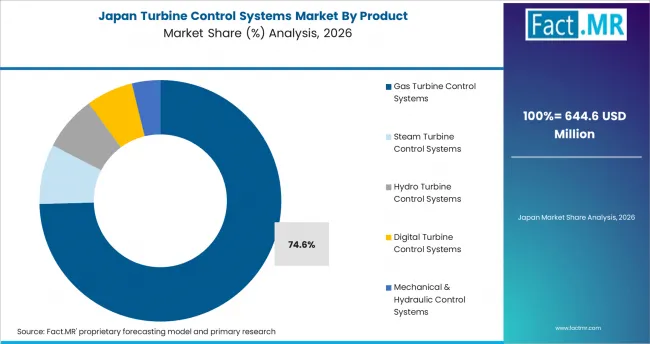
Japan's turbine control system market demonstrates mature and technology-focused landscape, characterized by sophisticated integration of advanced control products with existing power plant operations across energy sectors, industrial facilities, and specialized aerospace applications.
The country shows steady growth momentum with a CAGR of 4.1% through 2035, driven by advanced turbine control applications in aerospace and gas power sectors through precision automation platform development in Tokyo, Osaka, and Nagoya. Japan's emphasis on technological excellence and quality assurance creates requirements for high-performance turbine control system formulations that support comprehensive operational initiatives and regulatory compliance requirements in power generation operations.
The market benefits from strong partnerships between international control system providers and domestic energy companies, creating comprehensive automation ecosystems that prioritize operational accuracy and performance validation programs. Power generation facilities in major industrial regions showcase advanced turbine control system implementations where operators achieve 97% system reliability rates through integrated quality programs.
Key market characteristics:
- Power generation facilities and industrial plants driving high-quality control system requirements with emphasis on operational excellence and safety
- Quality assurance partnerships enabling 95% product compliance with comprehensive validation programs
- Technology collaboration between Japanese companies and international control system providers is expanding market capabilities
- Emphasis on continuous innovation and automation technology optimization methodologies
Europe Market Split by Country

The turbine control system market in Europe is projected to grow from USD 5.01 billion in 2025 to USD 7.82 billion by 2035, registering a CAGR of 4.5% over the forecast period. Germany is expected to maintain its leadership position with a 31.5% market share in 2025, supported by its advanced power generation infrastructure, comprehensive renewable energy networks, and strong industrial automation capabilities across major energy regions.
The UK follows with a 22.8% share in 2025, driven by comprehensive wind turbine control programs in major offshore wind regions implementing advanced automation protocols and grid integration systems. France holds a 19.6% share through the ongoing development of nuclear power plant modernization programs and conventional turbine control networks. Italy commands a 12.4% share, while Spain accounts for 8.9% in 2025.
The rest of Europe region maintains a 4.8% collective share, attributed to increasing turbine control system adoption in Nordic countries and emerging Eastern European power markets implementing advanced automation programs. By 2035, Germany is projected to hold 31.2% share, UK 23.1%, France 19.8%, Italy 12.5%, Spain 9.1%, and Rest of Europe 4.3%, reflecting sustained growth momentum across all major European markets.
Competitive Landscape of the Turbine Control System Market

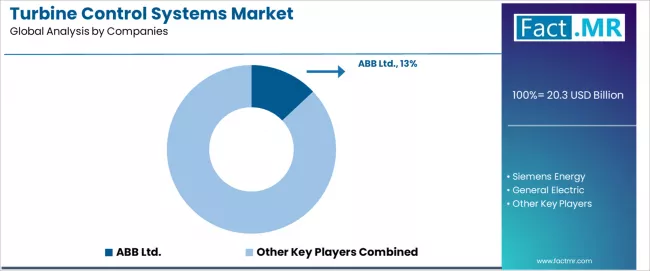
The turbine control system market features approximately 20-25 meaningful players with moderate concentration, where the top three companies control roughly 38-43% of global market share through established automation product portfolios and extensive power generation and industrial relationships. Competition centers on operational reliability, system integration capabilities, and technological innovation rather than price competition alone.
Market leaders include ABB Ltd., Siemens Energy, and General Electric, which maintain competitive advantages through comprehensive control system solution portfolios, global engineering networks, and deep expertise in the power generation automation and industrial control sectors, creating high credibility among power plant operators.
These companies leverage established utility partnerships and ongoing technology development services to defend market positions while expanding into adjacent renewable energy and industrial turbine applications. ABB Ltd. commands approximately 13.8% market share through strategic power generation partnerships and automation platform excellence.
Challengers encompass Schneider Electric and Eaton Corporation, which compete through established electrical equipment portfolios and strong regional presence in key energy markets. Automation specialists, including Emerson Electric Co., Honeywell International, and Mitsubishi Electric Corporation, focus on specific control categories or industry segments, offering differentiated capabilities in distributed control systems, process automation products, and industrial market accessibility.
Regional players and emerging automation technology companies create competitive pressure through innovative control algorithm formulations and rapid deployment capabilities, particularly in high-growth markets including India and China, where local engineering presence provides advantages in power plant operator relationships and regulatory compliance.
Market dynamics favor companies that combine advanced control system development technologies with comprehensive technical support strategies that address the complete operational journey from system design through performance optimization and lifecycle management. Strategic collaborations between hardware manufacturers and software development companies accelerate innovation cycles, while cybersecurity enhancement initiatives enable operational security optimization and system reliability assurance across power generation operations.
Global Turbine Control System Market - Stakeholder Contribution Framework
Turbine control systems represent a critical power generation automation tool that enables power plants, energy companies, and industrial facilities to enhance operational efficiency and equipment reliability without substantial operational disruption, typically providing 95-98% system availability rates comparable to conventional control methods while supporting comprehensive performance optimization.
With the market projected to grow from USD 20.29 billion in 2025 to USD 31.64 billion by 2035 at a 4.5% CAGR, these systems offer compelling advantages - superior operational reliability, enhanced efficiency optimization, and versatile application capabilities - making them essential for thermal power generation operations (established segment), renewable energy facilities (expanding adoption), and diverse industrial applications seeking proven automation control alternatives. Scaling market penetration and system capabilities requires coordinated action across energy policy, industry standards, control system manufacturers, automation technology providers, and research institutions.
How Governments Could Spur Local Production and Adoption?
- Innovation Development Programs: Include control system manufacturing capabilities in national energy security initiatives, providing targeted funding for automation technology production facilities in industrial regions and supporting local engineering companies through innovation grants and development support.
- Tax Policy & R&D Support: Implement accelerated depreciation schedules for turbine control equipment, provide tax incentives for companies investing in advanced automation and digitalization technologies, and establish favorable research accounting standards that encourage domestic production over imported alternatives.
- Regulatory Framework Development: Create streamlined power system safety approval processes across thermal and renewable applications, establish clear performance standards for turbine control systems, and develop international harmonization protocols that facilitate cross-border technology trade.
- Skills Development & Training: Fund vocational programs for control system engineers, automation technology specialists, and cybersecurity professionals. Invest in technology transfer initiatives that bridge academic research with commercial control system development and optimization platforms.
How Industry Bodies Could Support Market Development?
- Quality Standards & Certification: Define standardized performance metrics for turbine control systems across power generation, industrial, and renewable applications, establish universal operational reliability and cybersecurity protocols, and create certification programs for system quality that manufacturers can rely on.
- Market Education & Best Practices: Lead messaging that demonstrates turbine control system advantages, emphasizing proven operational reliability, efficiency optimization benefits, and superior performance capabilities compared to conventional control alternatives.
- Technology Integration Standards: Develop interoperability standards for control system platforms, comprehensive equipment compatibility guidelines, and automation technology frameworks, ensuring consistent quality across different power generation environments and operational requirements.
How Manufacturers and Technology Players Could Strengthen the Ecosystem?
- Advanced Control Development: Develop next-generation automation technologies with enhanced reliability capabilities, improved operational efficiency, and application-specific control features that enhance system performance while improving deployment economics.
- Product Innovation Platforms: Provide comprehensive engineering support that integrates system design, performance validation, cybersecurity assessment, and regulatory compliance modeling, enabling customers to maximize operational adoption and project success rates.
- Distribution & Partnership Networks: Offer flexible collaboration programs for power plants and industrial facilities, including system integration consultation options, customization services, and technical support pathways that keep turbine control applications current with operational demands.
Key Players in the Turbine Control System Market
- ABB Ltd.
- Siemens Energy
- General Electric
- Schneider Electric
- Eaton Corporation
- Emerson Electric Co.
- Honeywell International
- Mitsubishi Electric Corporation
- Yokogawa Electric Corporation
- Voith GmbH & Co. KGaA
Scope of the Report
| Items | Values |
|---|---|
| Quantitative Value (USD Million)s | USD 20.29 Billion |
| Type | Steam Turbine Control System, Gas Turbine Control System, Others |
| Component | Hardware, Software |
| Regions Covered | Asia Pacific, North America, Europe, Latin America, Middle East & Africa |
| Country Covered | India, China, Brazil, USA, Germany, UK, Japan, and 40+ countries |
| Key Companies Profiled | ABB Ltd., Siemens Energy, General Electric, Schneider Electric, Eaton Corporation, Emerson Electric Co., Honeywell International, Mitsubishi Electric Corporation, Yokogawa Electric Corporation, Voith GmbH & Co. KGaA |
| Additional Attributes | Dollar sales by type and component categories, regional adoption trends across Asia Pacific, North America, and Europe, competitive landscape with automation technology providers and engineering companies, system requirements and specifications, integration with power plant operations and industrial control platforms. |
Turbine Control System Market by Segments
-
Type :
- Steam Turbine Control System
- Gas Turbine Control System
- Others
-
Component :
- Hardware
- Software
-
Region :
- Asia Pacific
- China
- Japan
- South Korea
- India
- Australia & New Zealand
- ASEAN
- Rest of Asia Pacific
- North America
- USA
- Canada
- Mexico
- Europe
- Germany
- UK
- France
- Italy
- Spain
- Nordic
- Rest of Europe
- Latin America
- Brazil
- Argentina
- Rest of Latin America
- Middle East & Africa
- Kingdom of Saudi Arabia
- Other GCC Countries
- Turkey
- South Africa
- Rest of Middle East & Africa
- Asia Pacific
Regional Segments Analyzed Include
- North America (U.S., Canada)
- Latin America (Mexico. Brazil)
- Western Europe (Germany, Italy, France, U.K, Spain)
- Eastern Europe (Poland, Russia)
- Asia Pacific (China, India, ASEAN, Australia & New Zealand)
- Japan
- Middle East and Africa (GCC, S. Africa, N. Africa)
Compilation of authentic and first-hand intelligence, insights offered in the report are based on quantitative and qualitative assessment by leading industry experts, and inputs from opinion leaders & industry participants around the value chain. Growth determinants, macroeconomic indicators, and parent market trends have been scrutinized and delivered, coupled with the market attractiveness for each market segment encompassed. Qualitative impact of growth influencers on the market segments across regions has also been mapped by the report.
Table of Content
- Executive Summary
- Global Market Outlook
- Demand to side Trends
- Supply to side Trends
- Technology Roadmap Analysis
- Analysis and Recommendations
- Market Overview
- Market Coverage / Taxonomy
- Market Definition / Scope / Limitations
- Market Background
- Market Dynamics
- Drivers
- Restraints
- Opportunity
- Trends
- Scenario Forecast
- Demand in Optimistic Scenario
- Demand in Likely Scenario
- Demand in Conservative Scenario
- Opportunity Map Analysis
- Product Life Cycle Analysis
- Supply Chain Analysis
- Investment Feasibility Matrix
- Value Chain Analysis
- PESTLE and Porter’s Analysis
- Regulatory Landscape
- Regional Parent Market Outlook
- Production and Consumption Statistics
- Import and Export Statistics
- Market Dynamics
- Global Market Analysis 2020 to 2024 and Forecast, 2025 to 2035
- Historical Market Size Value (USD Million) Analysis, 2020 to 2024
- Current and Future Market Size Value (USD Million) Projections, 2025 to 2035
- Y to o to Y Growth Trend Analysis
- Absolute $ Opportunity Analysis
- Global Market Pricing Analysis 2020 to 2024 and Forecast 2025 to 2035
- Global Market Analysis 2020 to 2024 and Forecast 2025 to 2035, By Type
- Introduction / Key Findings
- Historical Market Size Value (USD Million) Analysis By Type, 2020 to 2024
- Current and Future Market Size Value (USD Million) Analysis and Forecast By Type, 2025 to 2035
- Steam Turbine Control System
- Gas Turbine Control System
- Others
- Y to o to Y Growth Trend Analysis By Type, 2020 to 2024
- Absolute $ Opportunity Analysis By Type, 2025 to 2035
- Global Market Analysis 2020 to 2024 and Forecast 2025 to 2035, By Component
- Introduction / Key Findings
- Historical Market Size Value (USD Million) Analysis By Component, 2020 to 2024
- Current and Future Market Size Value (USD Million) Analysis and Forecast By Component, 2025 to 2035
- Hardware
- Software
- Y to o to Y Growth Trend Analysis By Component, 2020 to 2024
- Absolute $ Opportunity Analysis By Component, 2025 to 2035
- Global Market Analysis 2020 to 2024 and Forecast 2025 to 2035, By Region
- Introduction
- Historical Market Size Value (USD Million) Analysis By Region, 2020 to 2024
- Current Market Size Value (USD Million) Analysis and Forecast By Region, 2025 to 2035
- North America
- Latin America
- Western Europe
- Eastern Europe
- East Asia
- South Asia and Pacific
- Middle East & Africa
- Market Attractiveness Analysis By Region
- North America Market Analysis 2020 to 2024 and Forecast 2025 to 2035, By Country
- Historical Market Size Value (USD Million) Trend Analysis By Market Taxonomy, 2020 to 2024
- Market Size Value (USD Million) Forecast By Market Taxonomy, 2025 to 2035
- By Country
- USA
- Canada
- Mexico
- By Type
- By Component
- By Country
- Market Attractiveness Analysis
- By Country
- By Type
- By Component
- Key Takeaways
- Latin America Market Analysis 2020 to 2024 and Forecast 2025 to 2035, By Country
- Historical Market Size Value (USD Million) Trend Analysis By Market Taxonomy, 2020 to 2024
- Market Size Value (USD Million) Forecast By Market Taxonomy, 2025 to 2035
- By Country
- Brazil
- Chile
- Rest of Latin America
- By Type
- By Component
- By Country
- Market Attractiveness Analysis
- By Country
- By Type
- By Component
- Key Takeaways
- Western Europe Market Analysis 2020 to 2024 and Forecast 2025 to 2035, By Country
- Historical Market Size Value (USD Million) Trend Analysis By Market Taxonomy, 2020 to 2024
- Market Size Value (USD Million) Forecast By Market Taxonomy, 2025 to 2035
- By Country
- Germany
- UK
- Italy
- Spain
- France
- Nordic
- BENELUX
- Rest of Western Europe
- By Type
- By Component
- By Country
- Market Attractiveness Analysis
- By Country
- By Type
- By Component
- Key Takeaways
- Eastern Europe Market Analysis 2020 to 2024 and Forecast 2025 to 2035, By Country
- Historical Market Size Value (USD Million) Trend Analysis By Market Taxonomy, 2020 to 2024
- Market Size Value (USD Million) Forecast By Market Taxonomy, 2025 to 2035
- By Country
- Russia
- Poland
- Hungary
- Balkan & Baltic
- Rest of Eastern Europe
- By Type
- By Component
- By Country
- Market Attractiveness Analysis
- By Country
- By Type
- By Component
- Key Takeaways
- East Asia Market Analysis 2020 to 2024 and Forecast 2025 to 2035, By Country
- Historical Market Size Value (USD Million) Trend Analysis By Market Taxonomy, 2020 to 2024
- Market Size Value (USD Million) Forecast By Market Taxonomy, 2025 to 2035
- By Country
- China
- Japan
- South Korea
- By Type
- By Component
- By Country
- Market Attractiveness Analysis
- By Country
- By Type
- By Component
- Key Takeaways
- South Asia and Pacific Market Analysis 2020 to 2024 and Forecast 2025 to 2035, By Country
- Historical Market Size Value (USD Million) Trend Analysis By Market Taxonomy, 2020 to 2024
- Market Size Value (USD Million) Forecast By Market Taxonomy, 2025 to 2035
- By Country
- India
- ASEAN
- Australia & New Zealand
- Rest of South Asia and Pacific
- By Type
- By Component
- By Country
- Market Attractiveness Analysis
- By Country
- By Type
- By Component
- Key Takeaways
- Middle East & Africa Market Analysis 2020 to 2024 and Forecast 2025 to 2035, By Country
- Historical Market Size Value (USD Million) Trend Analysis By Market Taxonomy, 2020 to 2024
- Market Size Value (USD Million) Forecast By Market Taxonomy, 2025 to 2035
- By Country
- Kingdom of Saudi Arabia
- Other GCC Countries
- Turkiye
- South Africa
- Other African Union
- Rest of Middle East & Africa
- By Type
- By Component
- By Country
- Market Attractiveness Analysis
- By Country
- By Type
- By Component
- Key Takeaways
- Key Countries Market Analysis
- USA
- Pricing Analysis
- Market Share Analysis, 2024
- By Type
- By Component
- Canada
- Pricing Analysis
- Market Share Analysis, 2024
- By Type
- By Component
- Mexico
- Pricing Analysis
- Market Share Analysis, 2024
- By Type
- By Component
- Brazil
- Pricing Analysis
- Market Share Analysis, 2024
- By Type
- By Component
- Chile
- Pricing Analysis
- Market Share Analysis, 2024
- By Type
- By Component
- Germany
- Pricing Analysis
- Market Share Analysis, 2024
- By Type
- By Component
- UK
- Pricing Analysis
- Market Share Analysis, 2024
- By Type
- By Component
- Italy
- Pricing Analysis
- Market Share Analysis, 2024
- By Type
- By Component
- Spain
- Pricing Analysis
- Market Share Analysis, 2024
- By Type
- By Component
- France
- Pricing Analysis
- Market Share Analysis, 2024
- By Type
- By Component
- India
- Pricing Analysis
- Market Share Analysis, 2024
- By Type
- By Component
- ASEAN
- Pricing Analysis
- Market Share Analysis, 2024
- By Type
- By Component
- Australia & New Zealand
- Pricing Analysis
- Market Share Analysis, 2024
- By Type
- By Component
- China
- Pricing Analysis
- Market Share Analysis, 2024
- By Type
- By Component
- Japan
- Pricing Analysis
- Market Share Analysis, 2024
- By Type
- By Component
- South Korea
- Pricing Analysis
- Market Share Analysis, 2024
- By Type
- By Component
- Russia
- Pricing Analysis
- Market Share Analysis, 2024
- By Type
- By Component
- Poland
- Pricing Analysis
- Market Share Analysis, 2024
- By Type
- By Component
- Hungary
- Pricing Analysis
- Market Share Analysis, 2024
- By Type
- By Component
- Kingdom of Saudi Arabia
- Pricing Analysis
- Market Share Analysis, 2024
- By Type
- By Component
- Turkiye
- Pricing Analysis
- Market Share Analysis, 2024
- By Type
- By Component
- South Africa
- Pricing Analysis
- Market Share Analysis, 2024
- By Type
- By Component
- USA
- Market Structure Analysis
- Competition Dashboard
- Competition Benchmarking
- Market Share Analysis of Top Players
- By Regional
- By Type
- By Component
- Competition Analysis
- Competition Deep Dive
- ABB Ltd.
- Overview
- Product Portfolio
- Profitability by Market Segments (Product/Age /Sales Channel/Region)
- Sales Footprint
- Strategy Overview
- Marketing Strategy
- Product Strategy
- Channel Strategy
- Siemens Energy
- General Electric
- Schneider Electric
- Eaton Corporation
- Emerson Electric Co.
- Honeywell International
- Mitsubishi Electric Corporation
- Yokogawa Electric Corporation
- Voith GmbH & Co. KGaA
- ABB Ltd.
- Competition Deep Dive
- Assumptions & Acronyms Used
- Research Methodology
List Of Table
- Table 1: Global Market Value (USD Million) Forecast by Region, 2020 to 2035
- Table 2: Global Market Value (USD Million) Forecast by Type, 2020 to 2035
- Table 3: Global Market Value (USD Million) Forecast by Component, 2020 to 2035
- Table 4: North America Market Value (USD Million) Forecast by Country, 2020 to 2035
- Table 5: North America Market Value (USD Million) Forecast by Type, 2020 to 2035
- Table 6: North America Market Value (USD Million) Forecast by Component, 2020 to 2035
- Table 7: Latin America Market Value (USD Million) Forecast by Country, 2020 to 2035
- Table 8: Latin America Market Value (USD Million) Forecast by Type, 2020 to 2035
- Table 9: Latin America Market Value (USD Million) Forecast by Component, 2020 to 2035
- Table 10: Western Europe Market Value (USD Million) Forecast by Country, 2020 to 2035
- Table 11: Western Europe Market Value (USD Million) Forecast by Type, 2020 to 2035
- Table 12: Western Europe Market Value (USD Million) Forecast by Component, 2020 to 2035
- Table 13: Eastern Europe Market Value (USD Million) Forecast by Country, 2020 to 2035
- Table 14: Eastern Europe Market Value (USD Million) Forecast by Type, 2020 to 2035
- Table 15: Eastern Europe Market Value (USD Million) Forecast by Component, 2020 to 2035
- Table 16: East Asia Market Value (USD Million) Forecast by Country, 2020 to 2035
- Table 17: East Asia Market Value (USD Million) Forecast by Type, 2020 to 2035
- Table 18: East Asia Market Value (USD Million) Forecast by Component, 2020 to 2035
- Table 19: South Asia and Pacific Market Value (USD Million) Forecast by Country, 2020 to 2035
- Table 20: South Asia and Pacific Market Value (USD Million) Forecast by Type, 2020 to 2035
- Table 21: South Asia and Pacific Market Value (USD Million) Forecast by Component, 2020 to 2035
- Table 22: Middle East & Africa Market Value (USD Million) Forecast by Country, 2020 to 2035
- Table 23: Middle East & Africa Market Value (USD Million) Forecast by Type, 2020 to 2035
- Table 24: Middle East & Africa Market Value (USD Million) Forecast by Component, 2020 to 2035
List Of Figures
- Figure 1: Global Market Pricing Analysis
- Figure 2: Global Market Value (USD Million) Forecast 2020 to 2035
- Figure 3: Global Market Value Share and BPS Analysis by Type, 2025 and 2035
- Figure 4: Global Market Y to o to Y Growth Comparison by Type, 2025 to 2035
- Figure 5: Global Market Attractiveness Analysis by Type
- Figure 6: Global Market Value Share and BPS Analysis by Component, 2025 and 2035
- Figure 7: Global Market Y to o to Y Growth Comparison by Component, 2025 to 2035
- Figure 8: Global Market Attractiveness Analysis by Component
- Figure 9: Global Market Value (USD Million) Share and BPS Analysis by Region, 2025 and 2035
- Figure 10: Global Market Y to o to Y Growth Comparison by Region, 2025 to 2035
- Figure 11: Global Market Attractiveness Analysis by Region
- Figure 12: North America Market Incremental Dollar Opportunity, 2025 to 2035
- Figure 13: Latin America Market Incremental Dollar Opportunity, 2025 to 2035
- Figure 14: Western Europe Market Incremental Dollar Opportunity, 2025 to 2035
- Figure 15: Eastern Europe Market Incremental Dollar Opportunity, 2025 to 2035
- Figure 16: East Asia Market Incremental Dollar Opportunity, 2025 to 2035
- Figure 17: South Asia and Pacific Market Incremental Dollar Opportunity, 2025 to 2035
- Figure 18: Middle East & Africa Market Incremental Dollar Opportunity, 2025 to 2035
- Figure 19: North America Market Value Share and BPS Analysis by Country, 2025 and 2035
- Figure 20: North America Market Value Share and BPS Analysis by Type, 2025 and 2035
- Figure 21: North America Market Y to o to Y Growth Comparison by Type, 2025 to 2035
- Figure 22: North America Market Attractiveness Analysis by Type
- Figure 23: North America Market Value Share and BPS Analysis by Component, 2025 and 2035
- Figure 24: North America Market Y to o to Y Growth Comparison by Component, 2025 to 2035
- Figure 25: North America Market Attractiveness Analysis by Component
- Figure 26: Latin America Market Value Share and BPS Analysis by Country, 2025 and 2035
- Figure 27: Latin America Market Value Share and BPS Analysis by Type, 2025 and 2035
- Figure 28: Latin America Market Y to o to Y Growth Comparison by Type, 2025 to 2035
- Figure 29: Latin America Market Attractiveness Analysis by Type
- Figure 30: Latin America Market Value Share and BPS Analysis by Component, 2025 and 2035
- Figure 31: Latin America Market Y to o to Y Growth Comparison by Component, 2025 to 2035
- Figure 32: Latin America Market Attractiveness Analysis by Component
- Figure 33: Western Europe Market Value Share and BPS Analysis by Country, 2025 and 2035
- Figure 34: Western Europe Market Value Share and BPS Analysis by Type, 2025 and 2035
- Figure 35: Western Europe Market Y to o to Y Growth Comparison by Type, 2025 to 2035
- Figure 36: Western Europe Market Attractiveness Analysis by Type
- Figure 37: Western Europe Market Value Share and BPS Analysis by Component, 2025 and 2035
- Figure 38: Western Europe Market Y to o to Y Growth Comparison by Component, 2025 to 2035
- Figure 39: Western Europe Market Attractiveness Analysis by Component
- Figure 40: Eastern Europe Market Value Share and BPS Analysis by Country, 2025 and 2035
- Figure 41: Eastern Europe Market Value Share and BPS Analysis by Type, 2025 and 2035
- Figure 42: Eastern Europe Market Y to o to Y Growth Comparison by Type, 2025 to 2035
- Figure 43: Eastern Europe Market Attractiveness Analysis by Type
- Figure 44: Eastern Europe Market Value Share and BPS Analysis by Component, 2025 and 2035
- Figure 45: Eastern Europe Market Y to o to Y Growth Comparison by Component, 2025 to 2035
- Figure 46: Eastern Europe Market Attractiveness Analysis by Component
- Figure 47: East Asia Market Value Share and BPS Analysis by Country, 2025 and 2035
- Figure 48: East Asia Market Value Share and BPS Analysis by Type, 2025 and 2035
- Figure 49: East Asia Market Y to o to Y Growth Comparison by Type, 2025 to 2035
- Figure 50: East Asia Market Attractiveness Analysis by Type
- Figure 51: East Asia Market Value Share and BPS Analysis by Component, 2025 and 2035
- Figure 52: East Asia Market Y to o to Y Growth Comparison by Component, 2025 to 2035
- Figure 53: East Asia Market Attractiveness Analysis by Component
- Figure 54: South Asia and Pacific Market Value Share and BPS Analysis by Country, 2025 and 2035
- Figure 55: South Asia and Pacific Market Value Share and BPS Analysis by Type, 2025 and 2035
- Figure 56: South Asia and Pacific Market Y to o to Y Growth Comparison by Type, 2025 to 2035
- Figure 57: South Asia and Pacific Market Attractiveness Analysis by Type
- Figure 58: South Asia and Pacific Market Value Share and BPS Analysis by Component, 2025 and 2035
- Figure 59: South Asia and Pacific Market Y to o to Y Growth Comparison by Component, 2025 to 2035
- Figure 60: South Asia and Pacific Market Attractiveness Analysis by Component
- Figure 61: Middle East & Africa Market Value Share and BPS Analysis by Country, 2025 and 2035
- Figure 62: Middle East & Africa Market Value Share and BPS Analysis by Type, 2025 and 2035
- Figure 63: Middle East & Africa Market Y to o to Y Growth Comparison by Type, 2025 to 2035
- Figure 64: Middle East & Africa Market Attractiveness Analysis by Type
- Figure 65: Middle East & Africa Market Value Share and BPS Analysis by Component, 2025 and 2035
- Figure 66: Middle East & Africa Market Y to o to Y Growth Comparison by Component, 2025 to 2035
- Figure 67: Middle East & Africa Market Attractiveness Analysis by Component
- Figure 68: Global Market - Tier Structure Analysis
- Figure 69: Global Market - Company Share Analysis
- FAQs -
How big is the turbine control systems market in 2025?
The global turbine control systems market is estimated to be valued at USD 20.3 billion in 2025.
What will be the size of turbine control systems market in 2035?
The market size for the turbine control systems market is projected to reach USD 31.6 billion by 2035.
How much will be the turbine control systems market growth between 2025 and 2035?
The turbine control systems market is expected to grow at a 4.5% CAGR between 2025 and 2035.
What are the key product types in the turbine control systems market?
The key product types in turbine control systems market are steam turbine control system, gas turbine control system and others.
Which component segment to contribute significant share in the turbine control systems market in 2025?
In terms of component, hardware segment to command 65.5% share in the turbine control systems market in 2025.