- Base Value(2025): 1.54 Bn
- Estimated Value(2025): 1.5 Bn
- Forecast Value (2035): 3.0 Bn
- CAGR (2025 - 2035): 6.8%
Coalescing Agents Market Forecast and Outlook 2025 to 2035
The global coalescing agents market is projected to reach USD 2.98 billion by 2035, recording an absolute increase of USD 1.44 billion over the forecast period. The market is valued at USD 1.54 billion in 2025 and is set to rise at a CAGR of 6.8% during the assessment period.
Demand for coalescing agents is expected to grow by approximately 1.9 times during the same period, supported by increasing demand for water-based coatings and environmentally compliant formulations worldwide, driving requirements for effective film formation additives and increasing investments in low-VOC paint technologies with performance benefits across architectural coatings and industrial applications globally.
Quick Stats for Coalescing Agents Market
- Coalescing Agents Market Value (2025): USD 1.54 billion
- Coalescing Agents Market Forecast Value (2035): USD 2.98 billion
- Coalescing Agents Market Forecast CAGR: 6.8%
- Leading Product in Coalescing Agents Market: Hydrophilic Coalescing Agent (58.7%)
- Key Growth Regions in Coalescing Agents Market: Asia Pacific, North America, and Europe
- Top Players in Coalescing Agents Market: Stepan Company, Runtai New Material Co., Ltd., ADDAPT Chemicals B.V., PATCHAM (FZC), Chemoxy International Ltd., Hallstar, Krishna Antioxidants Pvt. Ltd., Cargill Incorporated, Dow, BASF
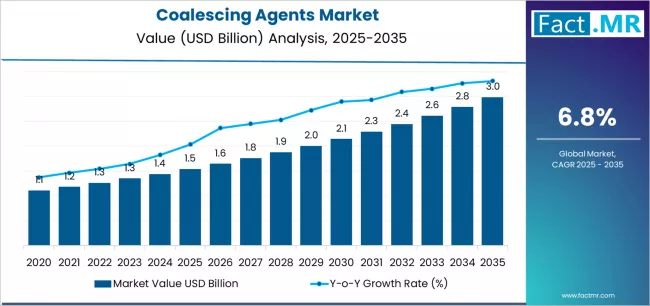
Coalescing Agents Market Market Value Analysis | Source: Fact.MR
Paint and coating manufacturers face mounting pressure to deliver high-quality film formation while meeting stringent environmental regulations and reducing volatile organic compound emissions, with modern coalescing agents providing documented performance benefits including enhanced film integrity, improved low-temperature coalescence, and reduced minimum film formation temperature compared to conventional solvent-based systems alone.
Rising awareness about sustainable coating technologies and expanding construction activities enabling widespread architectural paint adoption create substantial opportunities for additive manufacturers and coating formulators. However, raw material price volatility and regulatory complexity may pose obstacles to consistent market expansion.
The hydrophilic coalescing agents segment dominates market activity, driven by superior compatibility with water-based coating systems and effective film formation characteristics across diverse latex polymer formulations worldwide. Coating formulators increasingly recognize the performance benefits of hydrophilic coalescing agents, with typical additive offerings providing optimal polymer particle fusion and permanent film plasticization at accessible price points through established chemical distribution networks.
The hydrophobic coalescing agents segment demonstrates meaningful presence, supported by specialized applications requiring lower water sensitivity and enhanced moisture resistance in coating formulations. Paints and coatings emerge as the dominant application category, reflecting extensive utilization of coalescing agents in architectural paints, industrial coatings, and decorative finishes.
Regional dynamics show Asia Pacific maintaining market leadership, supported by robust construction activity and expanding manufacturing infrastructure. North America demonstrates steady growth trajectory driven by stringent environmental regulations and water-based coating adoption, while Europe emphasizes eco-friendly formulations and sustainable building practices. China leads country-level growth through massive infrastructure development and in
dustrial coatings demand, followed by India supported by rapid urbanization and construction sector expansion. The competitive landscape features moderate concentration with Stepan Company maintaining market leadership position, while established chemical companies including Dow Inc., BASF SE, and specialty additive manufacturers compete through advanced product formulations and comprehensive technical support programs across diverse coating applications.
Coalescing Agents Market Year-over-Year Forecast 2025 to 2035
Between 2025 and 2029, the coalescing agents market is projected to expand from USD 1.54 billion to USD 1.97 billion, resulting in a value increase of USD 0.43 billion, which represents 29.9% of the total forecast growth for the period. This phase of development will be shaped by rising demand for low-VOC water-based coatings addressing environmental compliance requirements, product innovation in bio-based coalescing agents with renewable feedstock sourcing and improved sustainability profiles, as well as expanding integration with advanced latex polymer systems and zero-VOC coating formulations. Companies are establishing competitive positions through investment in green chemistry partnerships, sustainable manufacturing technologies, and strategic market expansion across architectural coating manufacturers, industrial paint producers, and specialty coating formulators.
From 2029 to 2035, the market is forecast to grow from USD 1.97 billion to USD 2.98 billion, adding another USD 1.01 billion, which constitutes 70.1% of the overall expansion. This period is expected to be characterized by the expansion of specialized additive applications, including ultra-low-VOC coalescing agents and multifunctional additives combining coalescence with other performance benefits tailored for next-generation coating systems, strategic collaborations between additive manufacturers and raw material suppliers, and an enhanced focus on circular economy principles and bio-based feedstock integration. The growing emphasis on sustainable construction materials and rising adoption of green building certification programs will drive demand for environmentally compliant coalescing agent solutions across diverse coating end-uses.
Coalescing Agents Market Key Takeaways
| Metric | Value |
|---|---|
| Market Value (2025) | USD 1.54 billion |
| Market Forecast Value (2035) | USD 2.98 billion |
| Forecast CAGR (2025-2035) | 6.8% |
Source: Fact.MR analysis. Updated Dec 8, 2025
Why is the Coalescing Agents Market Growing?
The coalescing agents market grows by enabling coating manufacturers to formulate high-performance water-based systems and achieve proper film formation while meeting environmental regulations and reducing volatile organic compound emissions without compromising coating quality or application properties.
Paint formulators face mounting pressure to eliminate traditional solvents and meet increasingly stringent air quality standards while maintaining film integrity and application performance, with modern coalescing agents typically providing critical functionality including temporary plasticization for polymer particle fusion, minimum film formation temperature reduction for cold weather application, and efficient evaporation profiles for optimal film development compared to conventional coalescent systems alone, making effective coalescing additives essential for successful water-based coating formulation.
The coatings industry's transition toward sustainable technologies creates demand for coalescing agent solutions that can enable environmental compliance, support performance requirements, and facilitate water-based system adoption without compromising coating durability or aesthetic properties.
Coating formulator adoption and environmental regulations drive utilization of coalescing agents in architectural paint manufacturing, industrial coating production, and specialty coating formulation facilities, where additive performance directly impacts product quality and regulatory compliance.
The increasing construction activity globally, with expanding residential and commercial building projects requiring substantial paint volumes, creates expanding coating production driving coalescing agent consumption. Rising awareness about indoor air quality and volatile organic compound reduction enables regulatory frameworks supporting water-based coating adoption and coalescing agent utilization.
Performance limitations at extreme conditions and formulation complexity may restrict application scope and require specialized technical support among diverse coating manufacturers with varying formulation capabilities.
Segmental Analysis
The market is segmented by product, application, and region. By product, the market is divided into hydrophilic coalescing agent and hydrophobic coalescing agent. Based on application, the market is categorized into paints & coatings, adhesive & sealants, personal care ingredients, inks, and others. Regionally, the market is divided into Asia Pacific, North America, Europe, Latin America, and Middle East & Africa.
By Product, Which Segment Accounts for the Dominant Market Share?
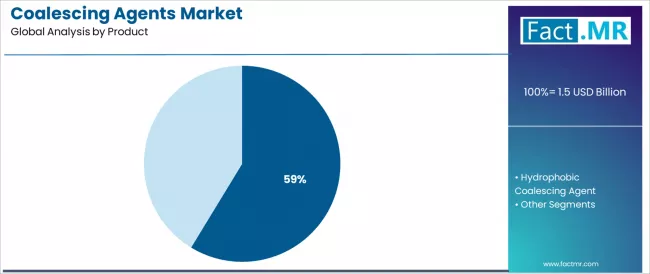
Coalescing Agents Market Analysis By Product | Source: Fact.MR
The hydrophilic coalescing agents segment represents the dominant force in the coalescing agents market, capturing 58.7% of the total market share in 2025. This established product category encompasses solutions featuring water-miscible characteristics and excellent compatibility with latex systems, including advanced formulations combining glycol ether chemistry, optimal evaporation profiles, and effective polymer particle fusion capabilities that enable superior film formation performance and environmental compliance across architectural paints, industrial coatings, and adhesive applications worldwide.
The hydrophilic coalescing agents segment's market leadership stems from its comprehensive compatibility with water-based systems, with solutions capable of addressing fundamental coating formulation needs including minimum film formation temperature reduction, temporary plasticization during film formation, and complete evaporation leaving no permanent plasticizer while maintaining excellent performance across diverse polymer types and coating applications.
Within the hydrophilic coalescing agents category, glycol ether-based products demonstrate dominant market utilization, driven by established performance characteristics and broad regulatory acceptance. These coalescing agents provide essential functionality for acrylic, vinyl acrylic, and styrene acrylic latex systems requiring effective coalescence and film integrity.
The hydrophobic coalescing agents segment maintains substantial market share at 41.3%, serving coating formulators requiring specialized performance characteristics including reduced water sensitivity, enhanced moisture resistance, and slower evaporation profiles for specific application requirements. These agents offer distinct advantages for exterior coatings and high-humidity environments.
Key performance advantages driving the hydrophilic coalescing agents segment include:
- Superior water compatibility mechanisms enabling seamless integration with latex polymer systems and water-based coating formulations
- Optimal evaporation characteristics allowing controlled film formation followed by complete removal without permanent plasticization effects
- Broad polymer compatibility supporting diverse latex chemistries including acrylics, vinyl acrylics, and styrene acrylics across coating applications
- Regulatory acceptance advantages meeting environmental standards and volatile organic compound regulations across major markets
By Application, Which Segment Accounts for the Largest Market Share?
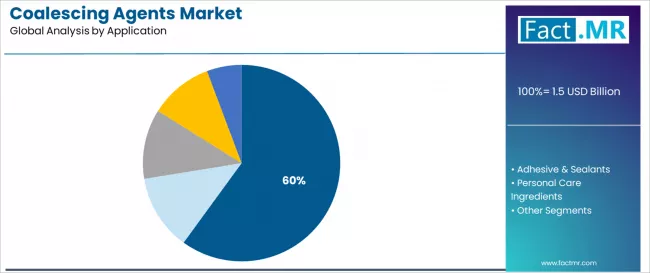
Coalescing Agents Market Analysis By Application | Source: Fact.MR
Paints and coatings dominate the coalescing agents application landscape with approximately 60.0% market share in 2025, reflecting the critical role of film formation additives in supporting water-based coating performance and quality characteristics. The paints and coatings segment's market leadership is reinforced by massive architectural paint production volumes, industrial coating manufacturing requirements, and decorative finish formulation needs driving consistent coalescing agent consumption.
Within this segment, architectural paints represent the dominant application, driven by residential and commercial construction activities requiring interior and exterior paint systems. These coatings benefit from coalescing agents enabling proper film formation, improved application properties, and enhanced durability characteristics.
The adhesive and sealants segment represents an important application category with 25.0% market share, demonstrating presence through specialized requirements for polymer particle fusion in latex-based adhesive formulations and sealant systems. This segment benefits from construction and automotive manufacturing driving adhesive consumption.
Personal care ingredients maintain meaningful presence at 10.0% through cosmetic and personal care formulations utilizing coalescing agents for film formation in hair care products and cosmetic applications. Inks represent 3.0% through printing ink formulations, while others account for 2.0% serving niche coating and polymer applications.
Key market dynamics supporting application segmentation include:
- Paints and coatings dominance driven by construction activity and architectural paint consumption volumes
- Adhesive and sealants growth trends requiring effective latex particle coalescence in bonding applications
- Integration of multifunctional additives enabling combined coalescence with other performance benefits
- Growing emphasis on ultra-low-VOC formulations driving demand for efficient coalescing agents
What Drives Hydrophobic Coalescing Agents Adoption?
Hydrophobic coalescing agents emerge as a significant product segment in the coalescing agents market with approximately 41.3% market share in 2025, reflecting specialized performance requirements for moisture-resistant coatings and slower evaporation profiles in specific formulation contexts. The hydrophobic coalescing agents segment demonstrates consistent demand driven by exterior coating applications, high-humidity environments, and formulations requiring extended open time.
The segment's market strength stems from distinct performance characteristics including reduced water sensitivity supporting exterior durability, slower evaporation enabling extended workability, and enhanced film properties in moisture-prone applications. Hydrophobic coalescing agents provide critical functionality for coating systems requiring moisture resistance during film formation and application.
Within hydrophobic coalescing agent applications, exterior architectural coatings demonstrate meaningful utilization through requirements for weather resistance and moisture tolerance. Industrial coatings maintain presence through specialized performance needs in protective coating systems.
Key segment characteristics include:
- Moisture resistance advantages providing superior performance in high-humidity environments and exterior applications
- Extended evaporation profiles enabling longer open time and improved application workability
- Specialized performance benefits addressing unique coating requirements beyond standard hydrophilic agent capabilities
- Formulation flexibility supporting customized coalescence characteristics for specific end-use demands
What Characterizes Adhesive and Sealants Utilization?
Adhesive and sealants represent an important application segment in the coalescing agents market with approximately 25.0% market share in 2025, reflecting essential requirements for polymer particle fusion in latex-based bonding systems and sealant formulations. The adhesive and sealants segment demonstrates steady demand driven by construction industry consumption, automotive manufacturing requirements, and packaging adhesive applications.
Within adhesive and sealants applications, construction adhesives demonstrate significant coalescing agent utilization through latex-based tile adhesives, flooring adhesives, and construction sealants requiring proper film formation. Automotive adhesives maintain presence through interior assembly and trim bonding applications, while packaging adhesives serve paper and flexible packaging lamination.
The segment benefits from coalescing agents enabling optimal bond strength development, proper polymer particle fusion, and adequate open time for application and substrate positioning. Adhesive formulations require careful balance of coalescence rate with bonding performance.
Key application dynamics include:
- Construction adhesive dominance driving consumption through building material installation and assembly
- Automotive manufacturing requirements supporting specialized adhesive formulations for component bonding
- Packaging industry applications utilizing latex adhesives for paper and flexible substrate lamination
- Performance optimization addressing bond strength development and application workability requirements
What are the Drivers, Restraints, and Key Trends of the Coalescing Agents Market?
The market is driven by three concrete demand factors tied to sustainable coating evolution. First, increasing environmental regulations limiting volatile organic compound emissions create expanding requirements for water-based coating systems, with coalescing agents representing critical enablers of successful low-VOC formulations, necessitating widespread coating industry adoption and formulation optimization. Second, growing construction activity and infrastructure development drive architectural paint consumption, with residential and commercial building projects requiring substantial coating volumes supporting consistent coalescing agent demand by 2030. Third, advancing coating technologies and performance requirements enable sophisticated formulation approaches incorporating multifunctional additives that optimize film formation while delivering additional coating benefits beyond basic coalescence functionality.
Market restraints include raw material price volatility and supply chain disruptions that can challenge cost predictability and margin stability, particularly for petrochemical-derived coalescing agents where feedstock costs fluctuate with crude oil prices and derivative market dynamics. Performance limitations under extreme conditions pose another significant obstacle, as coalescing agents must function effectively across temperature ranges, humidity conditions, and substrate variations, potentially requiring formulation adjustments or specialized product grades addressing specific application scenarios. Regulatory complexity and regional variation create additional barriers for global product standardization, demanding comprehensive compliance management and market-specific formulation approaches addressing diverse environmental regulations and safety requirements.
Key trends indicate accelerated bio-based coalescing agent development in developed markets, particularly North America and Europe, where coating manufacturers demonstrate increasing emphasis on renewable feedstock sourcing, reduced carbon footprint, and sustainable chemistry principles. Green building certification requirements trends toward comprehensive environmental performance including coating volatile organic compound content, renewable material incorporation, and lifecycle sustainability driving specification of advanced coalescing agent solutions. However, the market thesis could face disruption if significant advances in self-coalescing latex polymers or breakthrough film formation technologies substantially reduce external coalescing agent requirements in water-based coating formulations.
Analysis of the Coalescing Agents Market by Key Countries
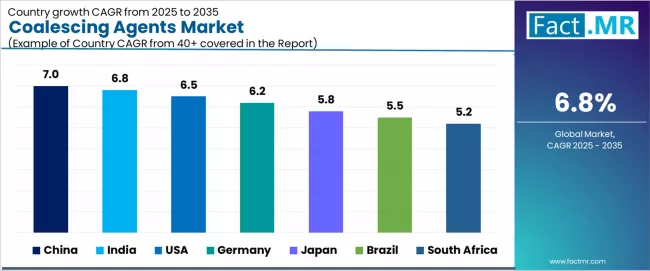
Coalescing Agents Market Cagr Analysis By Country | Source: Fact.MR
| Country | CAGR (2025 to 2035) |
|---|---|
| China | 7.0% |
| India | 6.8% |
| USA | 6.5% |
| Germany | 6.2% |
| Japan | 5.8% |
| Brazil | 5.5% |
| South Africa | 5.2% |
Source: Fact.MR analysis. Updated Dec 8, 2025
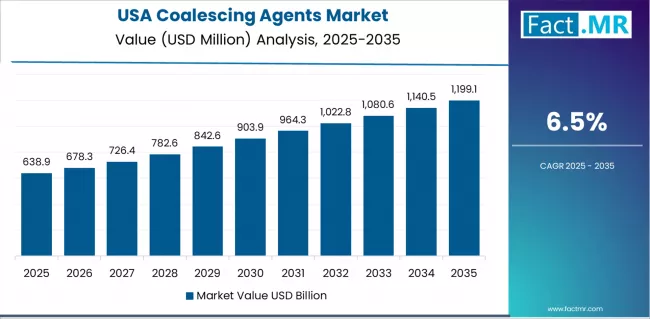
The global coalescing agents market is expanding steadily, with China leading at a 7.0% CAGR through 2035, driven by infrastructure boom, industrial coatings demand, and massive construction activity supporting paint consumption. India follows at 6.8%, supported by rapid urbanization, infrastructure development projects, and expanding construction sector. USA records 6.5%, reflecting shift to water-based coatings, stringent environmental regulations, and architectural paint market maturity.
Germany advances at 6.2%, leveraging eco-friendly coating adoption, automotive industry requirements, and construction sector growth. Japan posts 5.8%, focusing on advanced coating technologies and industrial application innovation, while Brazil grows steadily at 5.5%, anchored by industrial sector expansion and paint market development. South Africa demonstrates 5.2% growth, driven by construction industry recovery and eco-friendly formulation adoption.
How is China Leading Global Market Expansion?
China demonstrates the strongest growth potential in the coalescing agents market with a CAGR of 7.0% through 2035. The country's leadership position stems from massive infrastructure construction programs, rapid urbanization driving residential development, and extensive industrial manufacturing requiring protective and decorative coatings.
Growth is concentrated in major industrial centers and urban development zones, including Guangdong, Jiangsu, Zhejiang, Shandong, and Shanghai, where paint and coating manufacturers operate large-scale production facilities supporting domestic construction and export markets.
Distribution channels through chemical distributors, coating manufacturer direct procurement, and specialty additive suppliers expand coalescing agent accessibility across coating production facilities. The country's position as global manufacturing hub provides strong momentum for industrial coatings consumption, including comprehensive growth across architectural paints and specialty coating applications.
Key market factors:
- Infrastructure investment driving massive construction activity and architectural paint consumption volumes
- Industrial manufacturing concentration requiring protective coatings for equipment, facilities, and manufactured products
- Environmental regulation evolution implementing volatile organic compound controls and water-based coating requirements
- Domestic chemical industry capabilities supporting coalescing agent production and technical service development
Why is India Emerging as a High-Growth Market?
In major industrial and urban centers including Maharashtra, Gujarat, Tamil Nadu, Karnataka, and Delhi NCR, coalescing agent consumption is accelerating across paint manufacturing facilities and coating production operations, driven by rapid urbanization and infrastructure development initiatives.
The market demonstrates strong growth momentum with a CAGR of 6.8% through 2035, linked to construction sector expansion and increasing paint industry sophistication. Indian coating manufacturers are adopting water-based technologies and incorporating coalescing agents to meet performance requirements while addressing environmental considerations. The country's expanding middle class creates ongoing demand for residential construction and renovation driving architectural paint consumption and coalescing agent utilization.
Key development areas:
- Urbanization acceleration driving residential and commercial construction requiring substantial paint volumes
- Infrastructure projects including roads, airports, and public facilities demanding protective coating systems
- Paint industry modernization implementing water-based technologies and performance additive utilization
- Environmental awareness growth supporting regulatory development and sustainable coating adoption
What drives USA’s Market Maturity?

Coalescing Agents Market Europe Country Market Share Analysis, 2025 & 2035 | Source: Fact.MR
USA’s market expansion is driven by stringent environmental regulations mandating volatile organic compound reduction, established water-based coating dominance in architectural applications, and continuous innovation in sustainable coating technologies. The country demonstrates steady growth potential with a CAGR of 6.5% through 2035, supported by mature paint industry infrastructure and sophisticated formulation capabilities.
American coating manufacturers face implementation opportunities related to ultra-low-VOC formulations, bio-based coalescing agent adoption, and green building certification requirements. However, established regulatory framework and environmental consciousness create stable baseline demand for coalescing agents, particularly in architectural coatings where water-based systems represent standard technology and performance additive optimization drives continuous formulation improvement.
Market characteristics:
- Environmental regulations leadership establishing stringent volatile organic compound limits and driving water-based coating adoption
- Architectural paint dominance with water-based systems comprising majority of residential and commercial coating applications
- Green building emphasis supporting LEED certification and sustainable material specification including low-VOC coatings
- Technical innovation focus driving bio-based coalescing agent development and multifunctional additive formulation
How does Germany Demonstrate Environmental Leadership?
The market in Germany leads in eco-friendly coating adoption based on comprehensive environmental standards and established sustainable building practices across construction sector. The country shows meaningful potential with a CAGR of 6.2% through 2035, driven by automotive coating requirements and stringent environmental compliance frameworks in major industrial regions.
German coating manufacturers are implementing water-based technologies and utilizing advanced coalescing agents to meet performance standards while achieving environmental objectives. The country's automotive industry creates ongoing demand for industrial coatings incorporating effective coalescence for production line application and quality requirements.
Leading market segments:
- Automotive coatings utilization supporting water-based paint systems in vehicle manufacturing and refinishing
- Architectural coatings emphasis addressing sustainable building requirements and indoor air quality standards
- Industrial coatings development incorporating environmental compliance with performance optimization
- Technical expertise concentration supporting advanced formulation development and additive innovation
What positions Japan for Technology Leadership?

Coalescing Agents Market Japan Market Share Analysis By Product | Source: Fact.MR
In major industrial centers including Tokyo, Osaka, Nagoya, and Fukuoka, coating manufacturers are implementing advanced coalescing agent technologies in water-based coating systems, driven by environmental regulations and quality requirements. The market shows steady growth potential with a CAGR of 5.8% through 2035, linked to sophisticated coating technologies and industrial application innovation.
Japanese coating producers are developing high-performance formulations utilizing optimized coalescing agent systems for automotive, industrial, and specialty coating applications. The country's focus on technology advancement creates ongoing opportunities for innovative coalescing agent development.
Market characteristics:
- Advanced coating technologies emphasizing performance optimization and environmental compliance integration
- Automotive industry requirements supporting high-quality coating systems for manufacturing excellence
- Industrial applications diversity spanning electronics, machinery, and equipment coating needs
- Quality standards emphasis ensuring consistent coating performance and durability characteristics
How does Brazil Show Industrial Development?
In major industrial states including São Paulo, Rio de Janeiro, Minas Gerais, and Rio Grande do Sul, coalescing agent consumption is expanding across paint manufacturing and industrial coating production, driven by industrial sector growth and construction market development. The market demonstrates solid growth potential with a CAGR of 5.5% through 2035, linked to urbanization patterns and infrastructure investment programs.
Brazilian coating manufacturers are adopting water-based technologies and implementing coalescing agents to improve product performance and address environmental considerations. The country's expanding construction sector creates ongoing demand for architectural paints supporting residential and commercial development.
Key development areas:
- Industrial expansion supporting manufacturing facility construction and protective coating requirements
- Construction market growth driving architectural paint consumption for residential and commercial buildings
- Paint industry development implementing modern formulation technologies and performance additives
- Environmental awareness increasing supporting regulatory framework evolution and sustainable coating adoption
What characterizes South Africa's Market Development?
In major economic centers including Gauteng, Western Cape, and KwaZulu-Natal, coalescing agent adoption is expanding through paint manufacturing facilities serving construction and industrial markets, driven by construction sector recovery and infrastructure development initiatives. The market demonstrates meaningful growth potential with a CAGR of 5.2% through 2035, linked to urbanization and economic development supporting building activity.
South African coating manufacturers are implementing water-based formulations and utilizing coalescing agents to meet performance requirements while addressing environmental considerations. The country's construction industry creates ongoing opportunities for architectural paint consumption.
Key development areas:
- Construction sector recovery supporting residential and commercial building activity
- Infrastructure development programs requiring protective and architectural coating systems
- Eco-friendly formulation adoption addressing environmental awareness and regulatory evolution
- Paint industry modernization implementing contemporary formulation technologies and additive utilization
Europe Market Split by Country
Coalescing Agents Market Country Value Analysis | Source: Fact.MR
The coalescing agents market in Europe is projected to grow from USD 0.277 billion in 2025 to USD 0.536 billion by 2035, registering a CAGR of 6.8% over the forecast period. Germany is expected to maintain its leadership position with a 34.2% market share in 2025, adjusting to 33.8% by 2035, supported by its extensive automotive industry, comprehensive environmental regulations, and established coating manufacturing infrastructure serving major European markets.
France follows with a 21.8% share in 2025, projected to reach 22.3% by 2035, driven by architectural coating consumption and industrial manufacturing requirements. UK holds a 18.1% share in 2025, expected to maintain 18.5% by 2035 through construction sector activity and environmental compliance emphasis. Italy commands a 14.7% share, while Spain accounts for 8.2% in 2025.
The rest of Europe region is anticipated to gain momentum, expanding its collective share from 3.0% to 3.2% by 2035, attributed to increasing water-based coating adoption in Nordic countries and emerging construction markets implementing environmental standards.
Competitive Landscape of the Coalescing Agents Market
Coalescing Agents Market Analysis By Company | Source: Fact.MR
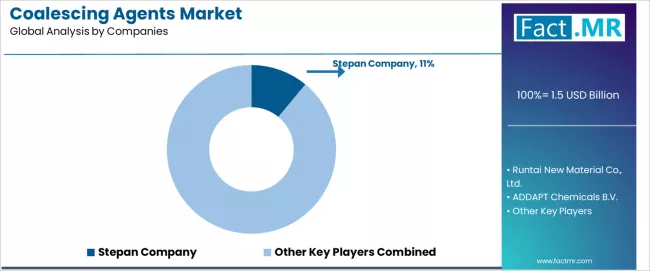
The coalescing agents market features approximately 12-15 meaningful players with moderate concentration, where the top three companies control roughly 32-40% of global market share through established product portfolios, comprehensive technical service capabilities, and extensive distribution networks across coating industry customers. Competition centers on product performance optimization, technical support quality, and application expertise rather than price competition alone.
Market leaders include Stepan Company, Dow Inc., and BASF SE, which maintain competitive advantages through comprehensive coalescing agent portfolios, advanced chemical synthesis capabilities, and deep expertise in coating formulation science, creating high customer confidence among paint manufacturers seeking reliable additive performance and technical support. These companies leverage ongoing research and development investments and strategic coating industry partnerships to defend market positions while expanding into bio-based coalescing agents and sustainable chemistry solutions.
Challengers encompass established specialty chemical companies including Runtai New Material Co., Ltd., ADDAPT Chemicals B.V., and PATCHAM (FZC), which compete through regional market strengths and specialized product offerings serving specific coating segments through customized formulations, local technical service, or cost-competitive positioning. Specialty additive manufacturers, including Chemoxy International Ltd., Hallstar, and Krishna Antioxidants Pvt. Ltd., focus on niche markets or innovative technologies, offering differentiated capabilities in bio-based products, multifunctional additives, or regional manufacturing advantages.
Integrated chemical companies and regional producers create competitive pressure through backward integration and local market presence, particularly in high-growth markets including China and India, where domestic chemical industry development provides opportunities for cost-competitive coalescing agent production and technical service supporting local coating manufacturers.
Market dynamics favor companies that combine proven product performance with comprehensive technical support addressing complete formulation optimization from laboratory development through production scale-up. Strategic emphasis on sustainable chemistry, bio-based feedstock development, and multifunctional additive innovation enables differentiation in increasingly sophisticated coalescing agents markets across established and emerging coating industry segments.
Global Coalescing Agents Market - Stakeholder Contribution Framework
Coalescing agents represent a critical coating additive category that enables manufacturers to formulate high-performance water-based systems and achieve proper film formation while meeting environmental regulations and reducing volatile organic compound emissions without compromising coating quality, typically providing essential functionality including temporary polymer plasticization, minimum film formation temperature reduction, and complete evaporation profiles compared to conventional solvent systems alone while ensuring optimal film integrity and environmental compliance.
With the market projected to grow from USD 1.54 billion in 2025 to USD 2.98 billion by 2035 at a 6.8% CAGR, these solutions offer compelling advantages for water-based coating applications, sustainable formulation development, and diverse end-use industries seeking environmental compliance. Scaling market adoption and sustainable innovation requires coordinated action across environmental policy, chemical standards, additive manufacturers, coating producers, and green chemistry initiatives.
How Could Governments Spur Local Development and Adoption?
- Environmental Regulation Development: Implement comprehensive volatile organic compound limits supporting water-based coating adoption, provide clear guidelines for coalescing agent classification and volatile organic compound accounting, and establish enforcement mechanisms ensuring environmental compliance.
- Sustainable Chemistry Support: Include bio-based coalescing agents in renewable chemistry programs, provide research funding for sustainable additive development, and offer tax incentives for renewable feedstock utilization.
- Green Building Programs: Integrate low-VOC coating requirements in building codes and green certification programs, support specification of environmentally compliant coating systems, and provide education on sustainable coating selection.
- Research & Innovation Funding: Support academic research on coalescing agent mechanisms and formulation optimization, fund development of next-generation bio-based additives, and establish testing facilities for coating performance validation.
- Industry Development Support: Provide technical assistance for coating manufacturers transitioning to water-based systems, support workforce training on advanced formulation technologies, and facilitate technology transfer from research to commercial applications.
How Could Industry Bodies Support Market Development?
- Technical Standards Development: Define performance testing protocols for coalescing agents across coating applications, establish quality specifications ensuring consistent additive performance, and create guidelines for volatile organic compound calculation and environmental compliance.
- Education & Training: Develop formulation training programs for coating technologists, establish best practices for coalescing agent selection and optimization, and create technical resources supporting water-based coating development.
- Sustainability Frameworks: Lead initiatives promoting sustainable coating technologies, establish criteria for bio-based additive recognition, and create lifecycle assessment methodologies for coating environmental impact.
- Market Development: Support promotional campaigns demonstrating water-based coating performance and environmental benefits, facilitate knowledge sharing on formulation techniques, and create platforms connecting additive suppliers with coating manufacturers.
How Could Manufacturers and Technology Players Strengthen the Ecosystem?
- Product Innovation: Develop next-generation coalescing agents with enhanced performance characteristics, create bio-based alternatives utilizing renewable feedstocks, and formulate multifunctional additives combining coalescence with additional coating benefits.
- Technical Service Excellence: Provide comprehensive formulation support from laboratory development through production scale-up, offer troubleshooting assistance for coating performance optimization, and deliver application expertise supporting successful water-based system implementation.
- Sustainable Manufacturing: Implement green chemistry principles in coalescing agent production, reduce manufacturing environmental footprint through process optimization, and establish transparent sustainability reporting demonstrating environmental commitment.
- Collaboration & Partnerships: Build relationships with latex polymer suppliers ensuring coalescing agent compatibility, establish partnerships with coating manufacturers supporting formulation optimization, and engage in research collaborations advancing coating science.
How Could Coating Manufacturers Navigate Formulation Optimization?
- Additive Selection Strategy: Evaluate coalescing agent options based on polymer compatibility, performance requirements, and environmental constraints, conduct comparative testing establishing optimal additive selection, and implement quality specifications ensuring consistent coating performance.
- Formulation Development: Optimize coalescing agent concentration balancing film formation with environmental compliance, develop coating systems meeting performance targets while minimizing volatile organic compound content, and validate formulations across application conditions and substrate types.
- Performance Testing: Conduct comprehensive coating evaluation including film formation quality, application properties, and durability characteristics, implement quality control procedures ensuring consistent production, and establish performance benchmarks supporting continuous improvement.
- Technical Capability Building: Invest in formulation expertise understanding water-based coating science, develop testing capabilities supporting coating optimization, and maintain relationships with additive suppliers accessing technical support and product innovations.
How Could Investors and Financial Enablers Unlock Value?
- Technology Innovation Investment: Back companies developing breakthrough coalescing agent technologies including novel bio-based products and multifunctional additives, support research programs advancing coating science, and finance pilot facilities demonstrating commercial viability.
- Manufacturing Capacity Financing: Provide capital for coalescing agent production facilities in strategic markets, support capacity expansion addressing growing water-based coating demand, and finance sustainable manufacturing infrastructure implementing green chemistry principles.
- Market Development Support: Fund coating industry initiatives promoting water-based technology adoption, support education programs building formulation expertise, and back distribution networks connecting additive suppliers with coating manufacturers globally.
- Sustainable Chemistry Investment: Support bio-based feedstock development creating renewable coalescing agent sources, finance lifecycle assessment programs demonstrating environmental benefits, and back certification programs validating sustainable chemistry claims.
Key Players in the Coalescing Agents Market
- Stepan Company
- Runtai New Material Co., Ltd.
- ADDAPT Chemicals B.V.
- Patcham (FZC)
- Chemoxy International Ltd. (a Novacap company, now Seqens)
- Hallstar Company
- Krishna Antioxidants Pvt. Ltd.
- Cargill, Incorporated
- Dow Inc.
- BASF SE
Segmentation
Scope of the Report
| Items | Values |
|---|---|
| Quantitative Units | USD 1.54 Billion |
| Product | Hydrophilic Coalescing Agent, Hydrophobic Coalescing Agent |
| Application | Paints & Coatings, Adhesive & Sealants, Personal Care Ingredients, Inks, Others |
| Regions Covered | Asia Pacific, Europe, North America, Latin America, Middle East & Africa |
| Country Covered | China, India, USA, Germany, Japan, Brazil, South Africa, and 40+ countries |
| Key Companies Profiled | Stepan Company, Runtai New Material Co., Ltd., ADDAPT Chemicals B.V., PATCHAM (FZC), Chemoxy International Ltd., Hallstar, Krishna Antioxidants Pvt. Ltd., Cargill Incorporated, Dow, BASF |
| Additional Attributes | Dollar sales by product and application categories, regional consumption trends across Asia Pacific, North America, and Europe, competitive landscape with chemical manufacturers and specialty additive producers, coalescing agent specification requirements and performance standards, integration with latex polymer systems and water-based coating formulations, innovations in bio-based chemistry and sustainable feedstock utilization, and development of specialized applications with multifunctional additive capabilities and environmental compliance optimization. |
Source: Fact.MR analysis. Updated Dec 8, 2025
Coalescing Agents Market by Segments
-
Product :
- Hydrophilic Coalescing Agent
- Hydrophobic Coalescing Agent
-
Application :
- Paints & Coatings
- Adhesive & Sealants
- Personal Care Ingredients
- Inks
- Others
-
Region :
- Asia Pacific
- China
- Japan
- South Korea
- India
- Australia
- Thailand
- Rest of Asia Pacific
- Europe
- Germany
- UK
- France
- Italy
- Spain
- Denmark
- Sweden
- Norway
- Rest of Europe
- North America
- USA
- Canada
- Mexico
- Latin America
- Brazil
- Argentina
- Rest of Latin America
- Middle East & Africa
- South Africa
- Saudi Arabia
- UAE
- Kuwait
- Rest of Middle East & Africa
- Asia Pacific
Frequently Asked Questions
How big is the coalescing agents market in 2025?
What will be the size of coalescing agents market in 2035?
How much will be the coalescing agents market growth between 2025 and 2035?
What are the key product types in the coalescing agents market?
Which application segment to contribute significant share in the coalescing agents market in 2025?
Who worked on this report


Preview the report firsthand - request a free sample
Free SampleGet the brochure for pricing and purchase details
Download PDF