- Base Value(2025): 13.8 Bn
- Estimated Value(2026): 14.5 Bn
- Forecast Value (2036): 25.2 Bn
- CAGR (2026 - 2036): 5.7%
Mattifying Agents Market Forecast and Outlook 2026 to 2036
The mattifying agents market stood at USD 13.8 billion in 2025. Fact.MR estimates it will reach USD 14.5 billion in 2026 and expand to USD 25.2 billion by 2036. The market is projected to grow at a CAGR of 5.7% over the forecast period, supported by rising demand for multifunctional skincare and oil-control formulations.
The market is expected to generate an absolute dollar opportunity of USD 11.4 billion between 2026 and 2036. This growth trajectory is structurally supported by the convergence of rising adult acne prevalence, the skinification of cosmetics, and shifting consumer preferences toward hybrid products that both mattify and moisturise without compromising skin barrier function.
Dr. Noopur Jain, chief consultant dermatologist and founder, Skinzest says “Dermatologists see a clear rise in adult acne and oil-related concerns among urban consumers, and oil-control formulations are increasingly part of effective clinical skincare regimens,”
Country growth reflects adult acne demographics, urban humidity exposure, and local regulatory environments. China leads at 7.9% CAGR, supported by rising awareness of sebum management among Gen Z urban consumers. India follows at 7.5% driven by tropical climate conditions and expanding D2C skincare platforms. Germany registers 6.9% growth underpinned by EU cosmetics ingredient compliance investment. Brazil records 6.0% from expanding mass-market skincare penetration, while the United States posts 5.9% amid robust MoCRA-driven product reformulation cycles.
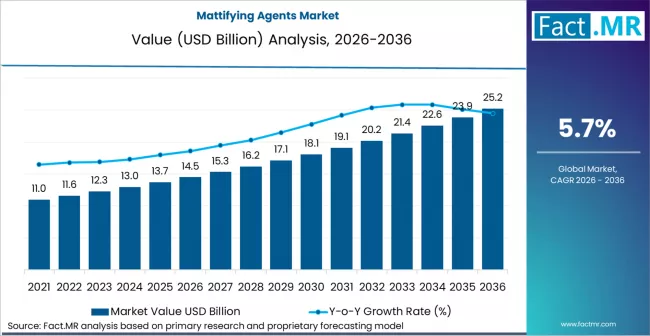
Mattifying Agents Market Market Value Analysis | Source: Fact.MR
| Metric | Value |
|---|---|
| Estimated Value in 2026 | USD 14.5 billion |
| Forecast Value in 2036 | USD 25.2 billion |
| Forecast CAGR (2026 to 2036) | 5.7% |
Market Definition
The mattifying agents market covers cosmetic ingredients and finished products designed to reduce sebum-induced shine on skin. It includes silica microspheres, kaolin clay, zinc oxide, and bio-derived seboregulators. It also covers creams, lotions, gels, and powders formulated for oil control. The core function is sebum absorption and light diffusion. End uses span mass cosmetics, prestige skincare, and dermatology-oriented products for oily, combination, and acne-prone skin.
Market Inclusions
The report provides global and regional revenue forecasts from 2026 to 2036. It is segmented by product form, skin type, distribution channel, and end user. Ingredient demand for silica, kaolin, zinc oxide, and bio-actives is analysed alongside finished formulations. Channels include online retail, specialty beauty stores, pharmacies, and supermarkets. Country coverage includes China, India, Germany, Brazil, and the United States.
Market Exclusions
The scope excludes cosmetic powders without oil-control intent. It omits sunscreen products unless they carry verified mattifying claims. Colour cosmetics such as foundations and concealers with incidental mattifying ingredients are not included. Industrial talc and silica outside personal care are excluded. The focus remains on purpose-formulated mattifying systems and enabling actives.
Research Methodology
- Primary Research: Interviews were conducted with formulation chemists, marketing heads, procurement managers, and specialty beauty buyers across North America, Europe, and Asia Pacific. These discussions validated pricing trends and ingredient adoption.
- Desk Research: Sources included FDA publications under MoCRA, EU Cosmetics Regulation updates, company annual reports, investor presentations, and product launch databases.
- Market Sizing and Forecasting: A hybrid approach was used. Top-down estimates assessed addressable demand by skin type and geography. Bottom-up inputs included average selling prices, replacement cycles, and first-purchase growth from distributor interviews.
- Data Validation and Update Cycle: Outputs were cross-checked against company earnings, regulatory filings, and retail sales data. Forecasts are reviewed annually to reflect regulatory and ingredient-level shifts.
Summary
- Market Definition
- Mattifying agents are specialised personal care systems designed to absorb excess sebum and reduce shine. They include functional ingredients such as silica, kaolin, and zinc oxide, as well as creams, gels, lotions, and powders formulated for oily and acne-prone skin.
- Demand Drivers
- Rising adult acne prevalence is expanding the addressable oily-skin population. Dermatologist recommendations and social media education are accelerating adoption.
- Hybrid moisturizing-mattifying innovation is creating premium pricing tiers above basic powders. Bio-active seboregulators support barrier-friendly positioning.
- Growth of D2C skincare platforms in India, China, and Southeast Asia is driving first-time adoption in humid urban markets where oil control is a key concern.
- Key Segments Analyzed
- By Form: Mattifying Creams hold 36.5% share, driven by demand for dual hydration and oil control benefits. Lotions, gels, and powders follow.
- By Skin Type: Oily Skin accounts for 48.3% of demand and is the fastest-growing segment. Combination, acne-prone, and sensitive skin segments follow.
- By Distribution Channel: Online Retail is the fastest-growing channel, supported by D2C brands and algorithm-driven discovery. Supermarkets, specialty stores, and pharmacies remain core channels.
- By End User: Women represent the largest segment. Men and unisex categories are growing faster as male grooming expands.
- By Geography: Asia Pacific leads in volume growth due to humid climates and urbanisation. Europe leads in premium ingredient innovation under strict compliance rules.
- Analyst Opinion at FACT.MR
- Shambhu Nath Jha, Principal Consultant at FACT.MR, opines, “CXOs will find this report critical for understanding how value is moving from legacy silica powders to bio-derived seboregulators and hybrid systems. Regulatory compliance under MoCRA and EU microplastic restrictions is raising entry barriers and strengthening scale advantages through 2036.”
- Strategic Implications
- Ingredient suppliers should accelerate bio-derived seboregulator launches to replace synthetic micro plastic-linked materials under EU timelines.
- Finished-product brands must strengthen MoCRA-compliant safety substantiation to maintain U.S. market access.
- Distributors in India and China should partner with D2C-focused mattifying brands targeting humid climate oily-skin consumers with high repeat purchase rates.
- Methodology
- Market sizing combined ingredient demand by skin type and geography with finished-product pricing data across forms and channels. Validation came from brand disclosures and distributor interviews.
- Adoption trends were benchmarked against product launches from L’Oréal, Beiersdorf, Shiseido, Croda International, Foxtale, and major ingredient suppliers.
- Regional forecasts incorporated acne prevalence data, humidity indices, regulatory timelines, and urban expansion statistics.
Segmental Analysis
Mattifying Agents Market Analysis by Form
Mattifying Agents Market Analysis By Form | Source: Fact.MR
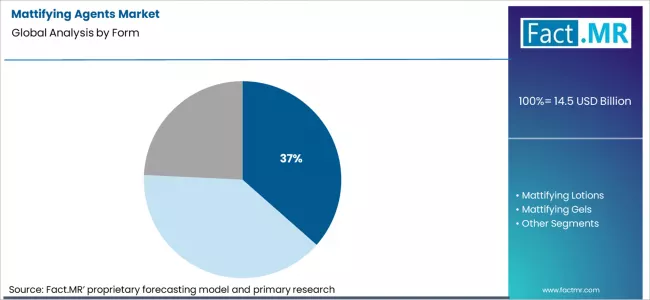
Based on FACT.MR's mattifying agents market report, mattifying creams are estimated to hold 36.5% share in 2026. Creams dominate because they combine oil control with hydration, addressing the dryness associated with powder-only solutions. This format allows integration of absorbent minerals, bio-actives, and humectants such as hyaluronic acid, enabling multifunctional products positioned at higher price tiers.
- L'Oréal Effaclar Reformulation: In early 2025, L'Oréal reformulated La Roche-Posay Effaclar Duo following a coordinated recall, reinforcing investment in compliant acne and oil-control creams under MoCRA oversight. [5]
- Croda Beauty Actives Seboregulation Portfolio: In 2025, Croda launched Zenakine, a biotech-derived neuroactive ingredient developed with the University of Manchester and SkinBiotherapeutics. This reflects ongoing expansion of clinical-grade seboregulating actives for premium skincare. [6]
- Hybrid Moisturising-Mattifying Market Trend: The global moisturiser market reached USD 11.3 billion in 2024, growing at 5.4% CAGR, with face moisturisers accounting for 65.7% share. Hybrid hydration and oil-control creams sit at the centre of this convergence trend. [7]
Mattifying Agents Market Analysis by Skin Type
Mattifying Agents Market Analysis By Skin Type | Source: Fact.MR
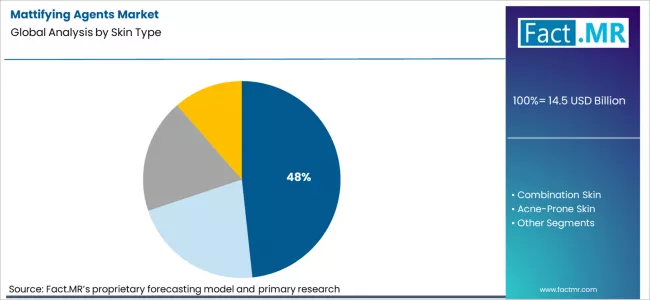
Based on FACT.MR's mattifying agents market report, the oily skin segment is projected to hold 48.3% share in 2026. Excess sebum production is the primary driver of purchase decisions. Adult acne prevalence, pollution-linked sebaceous activity, and ingredient-aware Gen Z consumers sustain concentrated skin care demand in this segment.
- Foxtale Series C Funding for D2C Oily Skin Expansion: In January 2025, Mumbai-based Foxtale raised USD 30 million in Series C funding with participation from KOSÉ Corporation. The brand focuses on oily and acne-prone skin for tropical climates and more than doubled revenue in FY25. [8]
- L'Oréal La Roche-Posay Spotscan+Coach for Acne-Prone Oily Skin: In May 2025 at Viva Technology, L'Oréal launched Spotscan+Coach, an AI-powered acne coaching app linked to Effaclar oil-control products. The digital model drives repeat engagement among oily-skin consumers. [1]
- Imerys Natural Mineral Mattifying Ingredient Demand: Imerys supplies kaolin and perlite grades engineered for oil absorption. The company reports rising demand for natural mineral alternatives as European brands reformulate under microplastic restrictions. [4]
Drivers, Restraints, and Opportunities
Fact.MR estimates the mattifying agents market reached USD 13.8 billion in 2025, supported by persistently high oily-skin prevalence in tropical and urban populations. Oil-control has moved from a niche acne solution to a routine skincare step. In the U.S., pharmacy-led clinical skincare provides steady replacement demand. At the same time, dermatologist-backed routines in Asia Pacific and India are driving first-time purchases in markets where adult acne is a leading concern.
The market is splitting into two clear tiers. Commodity mineral powders such as kaolin and talc face pricing pressure from private labels and raw material commoditization. In contrast, biotech-driven seboregulators command premium pricing. Suppliers such as Croda Beauty Actives are expanding clinically supported portfolios that justify higher margins.
- Rising Oily Skin Incidence and Adult Acne Awareness: Oily and combination skin remain the most common global skin types. Adult acne affects around 15% of adult women and rising numbers of men. The American Academy of Dermatology reports growing consultation volumes among 25 to 40 year olds, reinforcing sustained demand for sebum-control formulations. [2]
- MoCRA Compliance Pressure as a Market Consolidator: The Modernization of Cosmetics Regulation Act introduced mandatory facility registration by July 2024 and adverse event reporting from December 2023, with GMP rules expected by December 2025. These requirements raise compliance costs and favour established producers with regulatory infrastructure, consolidating market share among well-capitalised brands. [3]
- EU Microplastic Restrictions and Ingredient Substitution Demand: The European Chemicals Agency restriction on intentionally added microplastics, phased from October 2023, is forcing reformulation of products using synthetic silica microspheres and nylon powders. This shift is increasing demand for natural minerals and bio-derived seboregulators from suppliers such as Imerys and Croda. [4]
Regional Analysis
The mattifying agents market is analysed across North America, Latin America, Europe, East Asia, South Asia, Oceania and Middle East & Africa across 40+ countries. The full report also offers market attractiveness analysis based on regional trends.
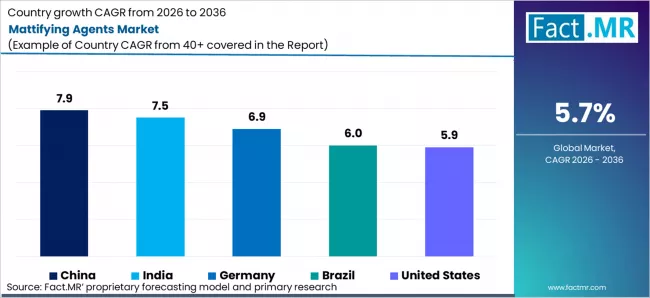
Mattifying Agents Market Cagr Analysis By Country | Source: Fact.MR
| Country | CAGR (2026-2036) |
|---|---|
| China | 7.9% |
| India | 7.5% |
| Germany | 6.9% |
| Brazil | 6.0% |
| United States | 5.9% |
Source: Fact.MR (FACT.MR) analysis, based on proprietary forecasting model and primary research
Asia Pacific Mattifying Agents Market Analysis
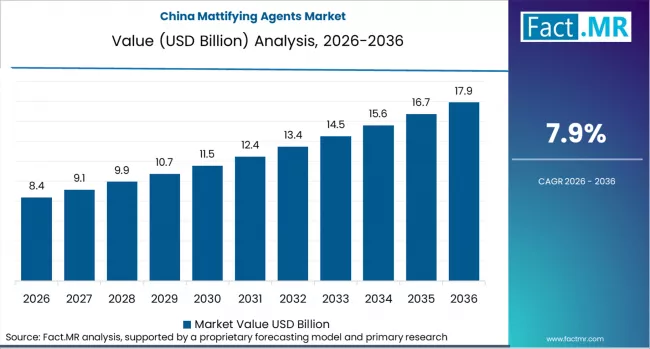
Mattifying Agents Market Country Value Analysis | Source: Fact.MR
Asia Pacific is the fastest-growing region, driven by humid climates that intensify sebum production and by rapid D2C skincare expansion. Young urban consumers are increasingly ingredient-aware, and both global brands and local disruptors compete through social commerce and dermatologist-backed positioning.
- China: Demand in China is projected to rise at 7.9% CAGR through 2036. Growth is centred in tier-1 and tier-2 cities where pollution and dense urban living amplify oily skin concerns. Platforms such as Tmall and Douyin enable large-scale ingredient-led discovery. International brands including L'Oréal and Shiseido compete with domestic science-driven labels, supported by Guochao-led local R&D investment.
- India: Demand in India is projected to rise at 7.5% CAGR through 2036. High heat and humidity sustain structural oil-control demand. Foxtale raised USD 30 million in January 2025 and grew 150% in FY25 by targeting acne-prone consumers. KOSÉ’s partnership signals rising global investment in India’s oily-skin segment.
FACT.MR's Asia Pacific analysis covers China, India, Japan, South Korea, Australia and New Zealand, ASEAN, and Rest of Asia Pacific. Readers can also find regional trends, regulations, and market growth based on different segments and countries in Asia Pacific.
Europe Mattifying Agents Market Analysis
Europe acts as the regulatory benchmark. EU Cosmetics Regulation and micro plastic restrictions are accelerating reformulation toward mineral and bio-derived actives.
- Germany: Demand in Germany is projected to rise at 6.9% CAGR through 2036. Beiersdorf continues innovation through NIVEA and Eucerin, while pharmacy channels anchor dermatologist-led oil-control sales. Reformulation spending is rising under EU compliance timelines.
FACT.MR's European analysis covers Germany, France, the United Kingdom, Norway, Spain, the Netherlands, Nordics, and Rest of Europe. Readers can also find regional trends, regulations, and market growth based on different segments and countries in Europe.
North America Mattifying Agents Market Analysis
North America is shaped by regulatory compliance under MoCRA. Pharmacy-led clinical brands dominate oily-skin care.
- United States: Demand in the United States is projected to rise at 5.9% CAGR through 2036. MoCRA facility registration and adverse-event reporting are restructuring market access. L'Oréal’s 2025 Effaclar reformulation reflects heightened compliance scrutiny. State-level ingredient bans are further driving microplastic-free reformulation.
FACT.MR's North American analysis covers the United States, Canada, and Mexico. Readers can also find regional trends, regulations, and market growth based on different segments and countries in North America.
Competitive Aligners for Market Players
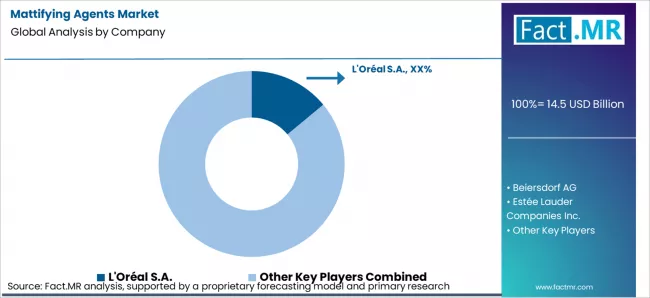
Mattifying Agents Market Analysis By Company | Source: Fact.MR
The global mattifying agents market is moderately concentrated at the brand level and fragmented at the ingredient level. L'Oréal leads across mass and prestige segments through La Roche-Posay, Garnier, and L'Oréal Paris, which hold strong positions in oily and acne-prone skincare. Beiersdorf, Shiseido, Estée Lauder, Unilever, and Kenvue maintain broad international reach and pharmacy relationships. At the ingredient tier, Croda International and Imerys compete for reformulation mandates as brands respond to EU microplastic rules and U.S. MoCRA compliance cycles.
Structural advantage in this market comes from clinical validation and distribution depth. L'Oréal integrates digital diagnostics with product development, including its Cell BioPrint device introduced at CES 2025 and the Spotscan+Coach acne app launched in May 2025. These tools strengthen consumer trust before purchase. Croda Beauty Actives supports brands with biotech-based seboregulation ingredients, offering differentiation beyond mineral absorbents.
Pharmacy buyers increasingly require documented safety, GMP alignment, and adverse event reporting compliance under MoCRA. Established players secure preferred access to CVS and Walgreens shelves. D2C brands such as Foxtale compete by building credibility through strong repeat purchase and consumer data rather than pharmacy-led endorsement.
Recent Developments
- In January 2025, D2C skincare brand Foxtale raised USD 30 million in Series C funding from KOSÉ Corporation, Panthera Growth Partners, Z47, and Kae Capital, with proceeds directed at R&D expansion and Indian market penetration for oily and acne-prone skin formulations. [8]
- In May 2025, L'Oréal launched La Roche-Posay Spotscan+Coach, an AI-powered acne management app developed with dermatologists, targeting the clinical oily and acne-prone skin consumer and integrating directly with the brand's Effaclar and B5 mattifying skincare lines.
Key Players
- L'Oréal S.A.
- Beiersdorf AG
- Estée Lauder Companies Inc.
- Shiseido Company, Limited
- Unilever PLC
- Johnson & Johnson (Kenvue)
- Croda International Plc
- Foxtale Consumer Private Limited
- Debut Biotech Inc.
- ISDIN
- Imerys S.A.
- KOSÉ Corporation
Bibliography
- [1] L'Oréal Groupe. (May 2025). L'Oréal Unleashes Science, Technology and Creativity at Viva Technology 2025.
- [2] American Academy of Dermatology Association. (2024). Adult Acne Epidemiology and Consultation Volume Data. AAD Annual Meeting and Clinical Practice Data.
- [3] U.S. Food and Drug Administration. (2024). Modernization of Cosmetics Regulation Act of 2022 (MoCRA):
- [4] Imerys S.A. (September 2024). ImerCare Mineral Solutions for Skin Care: Mattifying, Exfoliation, and Oil Absorption Technical Bulletin.
- [5] L'Oréal Groupe. (March 2025). Statement on La Roche-Posay Effaclar Duo Reformulation and FDA Coordination. L'Oréal Investor Relations.
- [6] Croda International Plc. (September 2025). Croda Launches Zenakine Neuroactive Ingredient in Partnership with University of Manchester and SkinBiotherapeutics Plc.
This Report Addresses
- Market intelligence to enable structured strategic decision making across mature and emerging resin economies
- Market size estimation and 10-year revenue forecasts from 2026 to 2036, supported by validated capacity and trade benchmarks
- Growth opportunity mapping across powder, liquid, and solid forms with emphasis on active ingredient transitions
- Segment and regional revenue forecasts covering building and construction, furniture and joinery, agriculture, automotive, and electrical applications
- Competition strategy assessment including integration models, cost survivability positioning, and compliance capability benchmarking
- Product reformulation and emission compliance tracking including the shift from talc/silica to microbiome-friendly and bio-fermented actives
- Regulatory impact analysis covering formaldehyde emission mandates, indoor air quality thresholds, and export driven specification upgrades
- Market report delivery in PDF, Excel, PPT, and interactive dashboard formats for executive and operational use
Scope of Report
| Items | Values |
|---|---|
| Quantitative Units | USD 14.5 billion (2026) to USD 25.2 billion (2036), at a CAGR of 5.7% |
| Market Definition | Mattifying agents are purpose-engineered personal care systems—including functional ingredients such as silica microspheres, kaolin, zinc oxide, and bio-derived seboregulators, and finished formulations in cream, lotion, gel, and powder formats—designed to absorb excess sebum, diffuse surface light, and regulate oil production across oily, combination, and acne-prone skin types in both consumer and professional applications. |
| Form Segmentation | Mattifying Creams (36.5%), Mattifying Lotions, Mattifying Gels, Mattifying Powders |
| Skin Type Segmentation | Oily Skin (48.3%), Combination Skin, Acne-Prone Skin, Sensitive Skin |
| Distribution Channel Segmentation | Supermarkets & Hypermarkets, Online Retail, Specialty Beauty Stores, Pharmacies & Drug Stores |
| End User Segmentation | Women, Men, Unisex Consumers |
| Application Coverage | Daily facial skincare for oily and combination skin types, pharmacy dermocosmetic oil-control systems, prestige hybrid moisturising-mattifying products, acne-prone skin management formulations, men's grooming facial oil-control, and mass-market colour cosmetics with primary mattifying function |
| Regions Covered | Asia Pacific, Europe, North America, Latin America, Middle East and Africa |
| Countries Covered | China, Japan, South Korea, Australia and New Zealand, India, ASEAN, Rest of Asia Pacific, Norway, Germany, United Kingdom, France, Spain, Netherlands, Nordics, Rest of Europe, United States, Canada, Mexico, Brazil, Chile, Ecuador, Rest of Latin America, Kingdom of Saudi Arabia, United Arab Emirates, South Africa, Turkey, Rest of Middle East and Africa |
| Key Companies Profiled | L'Oréal S.A., Beiersdorf AG, Estée Lauder Companies Inc., Shiseido Company Limited, Unilever PLC, Johnson & Johnson (Kenvue), Croda International Plc, Foxtale Consumer, Debut Biotech Inc., ISDIN, Imerys S.A., KOSÉ Corporation |
| Forecast Period | 2026 to 2036 |
| Approach | A hybrid top-down and bottom-up modelling approach was applied. Top-down inputs included oily and combination skin type incidence by region and addressable product category scope. Bottom-up inputs incorporated average unit prices by product form and distribution channel tier, category penetration growth rates, and new consumer adoption assumptions from primary interviews with brand managers, formulators, and specialty retail buyers. |
Mattifying Agents Market by Segment
-
By Form :
- Mattifying Creams
- Mattifying Lotions
- Mattifying Gels
- Mattifying Powders
-
By Skin Type :
- Oily Skin
- Combination Skin
- Acne-Prone Skin
- Sensitive Skin
-
By Distribution Channel :
- Supermarkets & Hypermarkets
- Online Retail
- Specialty Beauty Stores
- Pharmacies & Drug Stores
-
By End User :
- Women
- Men
- Unisex Consumers
-
By Region :
- North America
- United States
- Canada
- Mexico
- Europe
- Germany
- United Kingdom
- France
- Norway
- Spain
- Netherlands
- Nordics
- Rest of Europe
- Asia Pacific
- China
- Japan
- South Korea
- India
- Australia and New Zealand
- ASEAN
- Rest of Asia Pacific
- Latin America
- Brazil
- Chile
- Ecuador
- Rest of Latin America
- Middle East and Africa
- Kingdom of Saudi Arabia
- United Arab Emirates
- South Africa
- North America