- Market Value (2025): USD 864.0 Mn
- Estimated Value (2026): USD 943.4 Mn
- Forecast Value (2036): USD 2272.5 Mn
- CAGR (2026-2036): 9.2%
What is the Biological Polymer Film Market forecast to be worth by 2036?
USD 943.4 million in 2026 to USD 2272.5 million by 2036, at a 9.2% CAGR.
- According to Fact.MR analysis, the biological polymer film market reached USD 864.0 million in 2025.
- Sales are projected to rise from USD 943.4 million in 2026 to USD 2272.5 million by 2036.
- The market is forecast to record a 9.2% CAGR during 2026 to 2036 as packaging converters qualify biological film grades for commercial use.
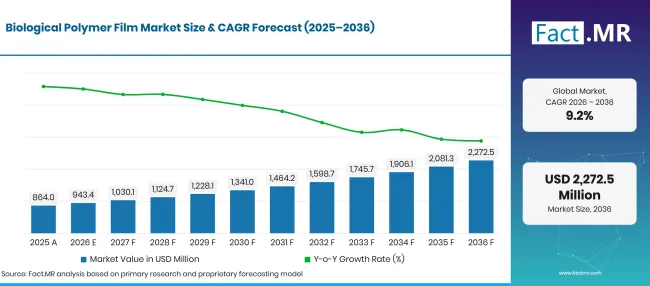
Biological Polymer Film Market Forecast Global | Source: Fact.MR
| Year | Basis | Market Value (USD million) |
|---|---|---|
| 2025 | Actual | 864.0 |
| 2026 | Estimate | 943.4 |
| 2036 | Forecast | 2,272.5 |
| CAGR 2026 to 2036 | Forecast period | 9.2% |
Source: Fact.MR analysis. Updated Oct 22, 2026
What are the defining numbers behind Biological Polymer Film Market growth?
the USD 1329.1 million absolute opportunity between 2026 and 2036 is associated with film applications led by polysaccharides and packaging.
- Demand Drivers in the Market
- Food packaging producers assess thin films for moisture control and reliable product protection. Trials must confirm that the film seals properly under each converter’s actual operating conditions.
- Brand packaging teams review material origin and disposal options before changing film specifications. Eurostat reported 35.3 kg of plastic packaging waste per person in the EU in 2023, in an October 2025 release [1]. Packaging policy is encouraging closer evaluation of how well alternative films perform in practice.
- Agricultural film makers look for grades that match crop schedules and provide verified soil biodegradation when the film is meant to stay in the field. BASF identified its ecovio M 2351 grade for soil-biodegradable agricultural mulch film in February 2025 [2]. These applications need evidence based on real field conditions.
- Healthcare and biomedical developers focus on clean processing and suitability for the intended clinical use. Film choice depends on the material’s contact properties and required testing.
- Key Segments Analyzed
- By Material Type: Polysaccharides are projected to hold 42.3% share in 2026, supported by film-forming ingredients used in edible coatings and packaging research.
- By Application: Packaging is estimated to account for 54.2% share in 2026, reflecting purchases of suitable food wrapping and protective-film formats.
- By End-User: Food & Beverage is forecast to represent 55.0% share in 2026, because film performance is closely tied to product protection and handling.
- Analyst Opinion at Fact.MR
- Shambhu Nath Jha, Principal Consultant at Fact.MR, states, “Packaging engineers review moisture barriers and sealing performance before approving a new material. A hypothetical survey could examine how often converters reject a film after line-speed testing and how certification requirements affect the price premium they will accept.”
- Strategic Implications
- Film producers should share tensile-strength results and moisture-barrier tests suited to each application. Consistent test records help packaging teams compare different material grades.
- Food manufacturers should check line performance and sealing consistency before making major material changes. Industry analysis of bioplastics for packaging supports this evaluation.
- Agricultural distributors should clearly separate industrial compostability claims from soil-biodegradation requirements in product guidance.
Germany is projected to post 9.9% CAGR through 2036, supported by packaging specification changes. Brazil follows at 9.0% as producers assess alternatives for selected packaging uses. The USA records 8.2%, reflecting a broad food packaging customer base. The UK stands at 7.3% as packaging rules tighten. Japan reaches 6.5%, with technical performance shaping material approval.
How does the Biological Polymer Film Market break down by segment?
Polysaccharides 42.3%; Packaging 54.2%; Food & Beverage 55.0% in 2026.
Which Material Type dominates?
Polysaccharides holds 42.3% share in 2026.
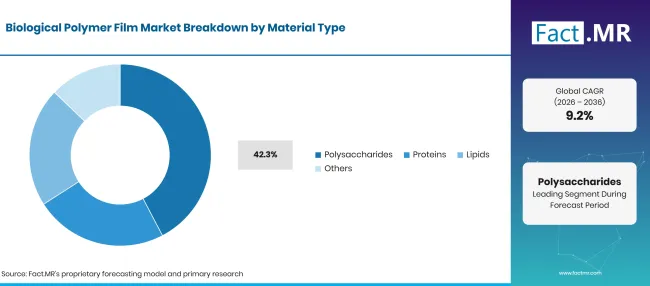
Biological Polymer Film Market Breakdown Material Type | Source: Fact.MR
| Material Type | Share (2026) |
|---|---|
| Polysaccharides (Leading segment) | 42.3% |
| Other segments combined | 57.7% |
| Total | 100.0% |
Source: Fact.MR analysis. Updated Oct 22, 2026
polysaccharide films attract teams considering film-forming cellulose or starch structures for suitable packaging uses. Their processing behavior depends on the selected polymer and finished-film construction. Proteins and lipids serve other targeted protective functions, so buyers compare performance for the actual product rather than treating all natural materials alike.
What leads the Application segment?
Packaging accounts for 54.2% share in 2026.
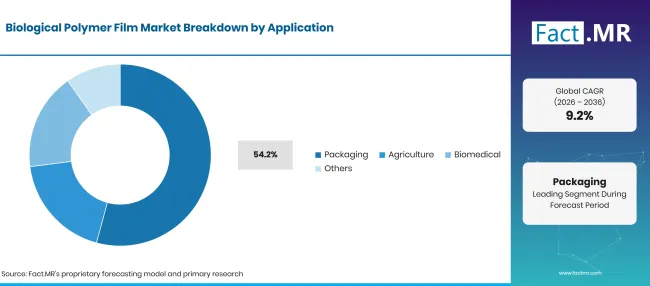
Biological Polymer Film Market Breakdown Application | Source: Fact.MR
| Application | Share (2026) |
|---|---|
| Packaging (Leading segment) | 54.2% |
| Other segments combined | 45.8% |
| Total | 100.0% |
Source: Fact.MR analysis. Updated Oct 22, 2026
packaging accounts for repeat film purchases because food converters need predictable production and stable product protection. Materials selected for agriculture face separate requirements, including performance across a crop cycle. Biomedical films require testing specific to their intended use.
How does End-User purchasing shape sales?
Food & Beverage leads with 55.0% share in 2026.
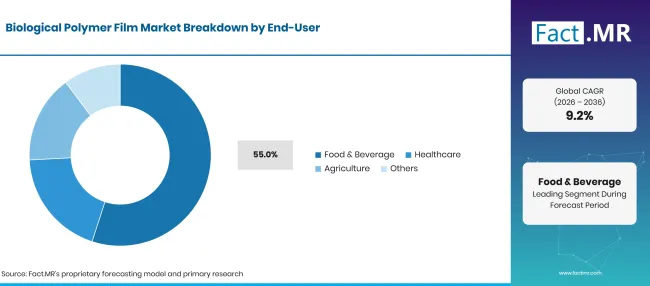
Biological Polymer Film Market Breakdown End User | Source: Fact.MR
| End-User | Share (2026) |
|---|---|
| Food & Beverage (Leading segment) | 55.0% |
| Other segments combined | 45.0% |
| Total | 100.0% |
Source: Fact.MR analysis. Updated Oct 22, 2026
food and beverage companies assess biological films against the freshness and pack integrity requirements of each product. Their technical teams examine sealing performance and consistency before approving regular orders. Healthcare applications require distinct product assessments, while agricultural users focus on conditions in the field.
What is accelerating Biological Polymer Film Market adoption, and what is holding it back?
Food packaging specifications and verified material performance support adoption; moisture sensitivity and conversion costs slow wider use.
Drivers Impact Analysis
| DRIVER | (~) % IMPACT ON CAGR | GEOGRAPHIC RELEVANCE | IMPACT TIMELINE |
|---|---|---|---|
| Packaging qualification | +1.0% | Global | Medium term (2–4 years) |
| Verified disposal claims | +0.8% | Europe | Medium term (2–4 years) |
| Agricultural film uses | +0.7% | Europe, Brazil | Long term (>= 4 years) |
| Food contact testing | +0.5% | Global | Short term (<= 2 years) |
| Film process improvements | +0.4% | Global | Long term (>= 4 years) |
Source: Fact.MR analysis. Updated Oct 22, 2026
Opportunity Impact Analysis
| OPPORTUNITY | (~) % IMPACT ON CAGR | GEOGRAPHIC RELEVANCE | IMPACT TIMELINE |
|---|---|---|---|
| Coated paper combinations | +0.8% | Europe | Medium term (2–4 years) |
| Custom food wraps | +0.6% | Global | Short term (<= 2 years) |
| Soil-biodegradable field film | +0.5% | Brazil, Europe | Long term (>= 4 years) |
| Biomedical niche uses | +0.4% | USA, Japan | Long term (>= 4 years) |
Source: Fact.MR analysis. Updated Oct 22, 2026
Restraints Impact Analysis
| RESTRAINT | (~) % IMPACT ON CAGR | GEOGRAPHIC RELEVANCE | IMPACT TIMELINE |
|---|---|---|---|
| Moisture barrier limits | -0.8% | Global | Short term (<= 2 years) |
| Processing changeover costs | -0.6% | Global | Medium term (2–4 years) |
| Feedstock variability | -0.5% | Global | Medium term (2–4 years) |
| End-of-life confusion | -0.4% | Europe, Americas | Long term (>= 4 years) |
Source: Fact.MR analysis. Updated Oct 22, 2026
Which countries are scaling the Biological Polymer Film Market through 2036?
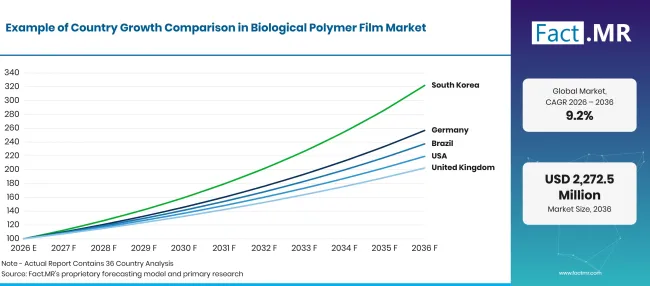
Biological Polymer Film Market Growth Index | Source: Fact.MR
| Country | CAGR (2026–2036) |
|---|---|
| Germany | 9.9% |
| Brazil | 9.0% |
| United States | 8.2% |
| United Kingdom | 7.3% |
| Japan | 6.5% |
Source: Fact.MR analysis. Updated Oct 22, 2026
Why is Germany expanding biological polymer film adoption?
9.9% CAGR, linked to material documentation and demanding packaging conversion trials.
Germany’s food packaging converters assess biological films against finished-pack sealing and barrier requirements before changing production lines. The Federal Statistical Office published its packaging collection dataset in March 2025 for the 2023 reporting year [4].
How is Brazil developing biological polymer film sales?
9.0% CAGR, influenced by agricultural applications and packaging policy.
Brazil’s crop production creates a practical setting for testing films designed for agricultural uses, while food packagers review material protection under local distribution conditions. In May 2025, the Ministry of Development, Industry, Trade and Services announced a circular economy plan containing 71 actions [5].
What supports the United States biological polymer film outlook?
8.2% CAGR, shaped by food packaging trials and material qualification.
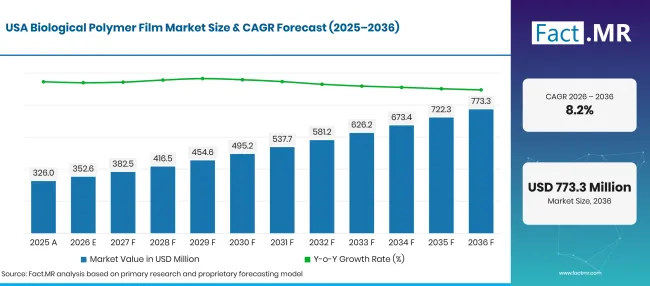
Biological Polymer Film Market Forecast Usa | Source: Fact.MR
U.S. food packaging producers evaluate new films against line speed and food-contact requirements before moving from pilot trials to repeat orders. Packaging operations may consider protein or polysaccharide layers for targeted barrier functions. Biomedical film applications involve separate specifications, so material developers need documentation designed for each intended use.
How is the United Kingdom assessing biological polymer films?
7.3% CAGR, tied to packaging records and careful material selection.
UK food packaging manufacturers compare finished-film performance with existing recycling and reporting arrangements. In September 2026, the Department for Environment, Food & Rural Affairs provisionally estimated that 57.3% of UK plastic packaging waste was recycled in 2025 [3].
Why is Japan maintaining biological polymer film development?
6.5% CAGR, influenced by precision manufacturing and film quality checks.
Japanese film converters generally place close attention on thickness uniformity and seal quality in packaging operations. Specialized biological films can enter selected food uses after their barrier properties are checked against the required shelf life. Healthcare developers assess biomedical films under separate product requirements, and consistent material quality is central to repeat testing.
Who leads the Biological Polymer Film Market?
NatureWorks LLC offers Ingeo PLA materials relevant to film development, while BASF SE supplies ecovio grades including materials intended for agricultural film uses. Novamont S.p.A. is active in biodegradable polymer systems. Competitive selection depends on the film grade and the performance checks required by each converter.
Novamont S.p.A., Futerro SA and Biome Bioplastics Limited are linked to bio-based polymer materials. Plantic Technologies Limited has starch-based barrier packaging heritage. A supplier’s presence in bioplastics alone should not be taken as proof of direct sales in each biological film segment.
Which companies are the key providers?
Key companies include NatureWorks LLC; BASF SE; Novamont S.p.A.; Biome Bioplastics Limited; Futerro SA; Plantic Technologies Limited; and FKuR Kunststoff GmbH.
- NatureWorks LLC
- BASF SE
- Novamont S.p.A.
- Biome Bioplastics Limited
- Futerro SA
- Plantic Technologies Limited
- FKuR Kunststoff GmbH
How is the market segmented?
-
By Material Type
- Polysaccharides
- Proteins
- Lipids
- Others
-
By Application
- Packaging
- Agriculture
- Biomedical
- Others
-
By End-User
- Food & Beverage
- Healthcare
- Agriculture
- Others
-
By Region
- North America
- Latin America
- Western Europe
- Eastern Europe
- East Asia
- South Asia & Pacific
- Middle East & Africa
Bibliography
- [1] Eurostat. (2025, October 22). Plastic packaging waste in the EU: 35.3 kg per person.
- [2] BASF. (2025, February 4). For the cultivation of greenhouse fruit and vegetables: Plant clips made of certified industrial compostable biopolymer.
- [3] Department for Environment, Food & Rural Affairs. (2026, September 23). UK statistics on waste.
- [4] Statistisches Bundesamt (Destatis). (2025, March 17). Abfallentsorgung 2023: Art und Menge der im Berichtsjahr 2023 gesammelten/zurückgenommenen Verpackungen.
- [5] Ministério do Desenvolvimento, Indústria, Comércio e Serviços. (2025, May 8). Plano Nacional de Economia Circular.
- [6] Presidência da República do Brasil. (2025, October 21). Decreto nº 12.688, de 21 de outubro de 2025: Regulamenta o art. 32, § 1º, e o art. 33, § 1º, da Lei nº 12.305, de 2 de agosto de 2010, e institui o sistema de logística reversa de embalagens de plástico.
This Report Answers
- The report examines how polysaccharide, protein and lipid film materials meet different production requirements.
- Application analysis explains the buying conditions in packaging and selected agricultural films.
- Country comparisons cover Germany, Brazil, the United States, the United Kingdom and Japan.
- Competitive analysis separates polymer production from film conversion and finished-film supply.
- Risk analysis explains material qualification barriers and the need for clear disposal claims.
What does the Biological Polymer Film Market cover?
The market covers thin films made using biological polymer materials when sold for relevant packaging, agricultural, biomedical or other applications. These materials differ by their chemical structure and by the property the finished film needs to provide. Biological origin does not automatically establish biodegradation or compostability. For wider material context, see bioplastics materials in a related application.
What is included in the scope?
Packaging applications include relevant food wrapping and coating films with a biological polymer component. Agricultural applications include suitable field films while biomedical applications cover qualified specialty products. Related categories help explain film material choices, including biopolymer films and compostable PHA film packaging where material behavior and end use differ. Related field applications appear in agricultural film analysis in a related application.
What is excluded from the scope?
The scope excludes conventional petrochemical films without the defined biological polymer basis. Polymer resin sales are distinguished from finished film sales to limit double counting. Recycling equipment and waste collection services are not included as biological polymer film sales. Water-soluble films are considered only when they meet the relevant biological polymer definition.
How Was the Analysis Built?
The analysis draws on 120+ sources, 35+ company portfolios, 25+ countries, and more than 20 industry interviews.
- Primary Research: Primary research includes discussions with manufacturers, service providers, technology developers, distributors, end users, and subject-matter experts. These conversations examine purchasing priorities, product adoption, operational challenges, approval requirements, competitive positioning, and the factors that influence wider market acceptance.
- Desk Research: Desk research covers government statistics, regulatory publications, company filings, trade data, technical studies, industry associations, standards, public policy, and other authoritative sources. Every source used in the analysis is documented in the bibliography.
- Market Sizing and Forecasting: Market estimates combine historical performance, demand indicators, pricing and volume trends, segment shares, company participation, country-level growth, adoption patterns, investment activity, and barriers to market expansion.
- Data Validation and Update Cycle: Findings are validated by comparing primary interviews with public data, company activity, regulatory changes, trade patterns, and industry developments. Regular updates review new product launches, capacity changes, partnerships, approvals, and shifts in commercial adoption.
Segmentation
What is the report’s scope and coverage?
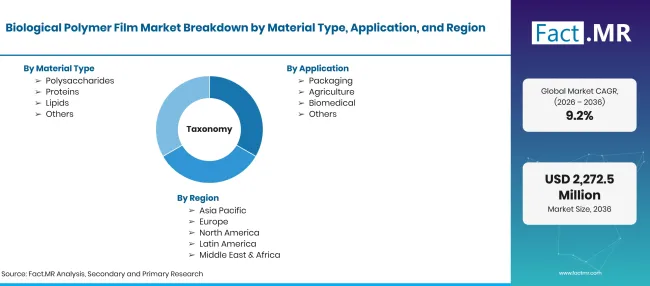
Biological Polymer Film Market Taxonomy | Source: Fact.MR
| Attribute | Details |
|---|---|
| Quantitative Units | USD million in 2026 to USD million by 2036 at CAGR |
| Market Definition | Thin films formed from biological polymer materials for packaging, agricultural, biomedical and related uses. |
| Material Type | Polysaccharides; Proteins; Lipids; Others |
| Application | Packaging; Agriculture; Biomedical; Others |
| End-User | Food & Beverage; Healthcare; Agriculture; Others |
| Regions Covered | North America; Latin America; Western Europe; Eastern Europe; East Asia; South Asia & Pacific; Middle East & Africa |
| Countries Covered | Germany; Brazil; United States; United Kingdom; Japan |
| Companies Profiled | NatureWorks LLC; BASF SE; Novamont S.p.A.; Biome Bioplastics Limited; Futerro SA; Plantic Technologies Limited; and FKuR Kunststoff GmbH |
| Forecast Period | 2026 to 2036 |
| Approach | Application performance, packaging context, supplier portfolios and official public information |
Source: Fact.MR analysis. Updated Oct 22, 2026
Frequently Asked Questions
How big is the biological polymer film market in 2026?
What is the CAGR from 2026 to 2036?
Which material type leads?
Which application leads?
Who are the main companies in the biological polymer film market?
Who worked on this report


Preview the report firsthand - request a free sample
Free SampleGet the brochure for pricing and purchase details
Download PDF