- Base Value(2025): 4.80 Bn
- Estimated Value(2026): 5.28 Bn
- Forecast Value (2036): 13.69 Bn
- CAGR (2026 - 2036): 10.0%
Biopolymer Films Market Size, Market Forecast and Outlook By Fact.MR
The biopolymer films market was valued at USD 4.80 billion in 2025, projected to reach USD 5.28 billion in 2026, and is forecast to expand to USD 13.69 billion by 2036 at a 10.0% CAGR. is at a regulatory inflection point where the European Union Packaging and Packaging Waste Regulation (PPWR) and comparable mandates are converting biopolymer films from a premium sustainability choice into a compliance necessity for food packaging converters operating across regulated jurisdictions.
The absolute dollar expansion between 2026 and 2036 amounts to approximately USD 8.41 billion. This growth trajectory, among the fastest in the specialty films sector, reflects the convergence of mandatory packaging composition targets, corporate sustainability commitments, and improving price-performance parity between PLA-based films and conventional polyethylene and polypropylene films. Feedstock availability for lactic acid (the PLA precursor) and the limited number of commercial-scale PHA production facilities act as supply-side constraints moderating the pace of adoption.
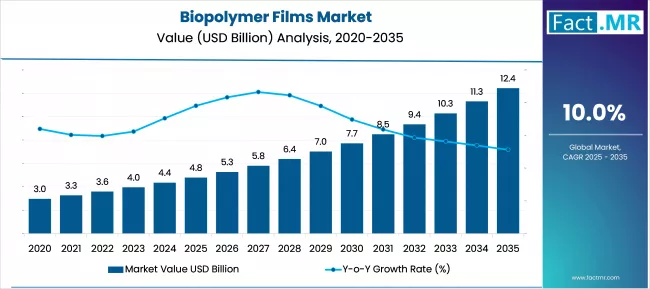
Biopolymer Films Market Market Value Analysis | Source: Fact.MR
Biopolymer Films Market Key Takeaways
| Metric | Details |
|---|---|
| Industry Size (2026) | USD 5.28 billion |
| Industry Value (2036) | USD 13.69 billion |
| CAGR (2026 to 2036) | 10.0% |
Source: Fact.MR analysis. Updated Mar 25, 2026
Packaging procurement directors at major food and beverage companies are revising their material specifications to include certified compostable biopolymer film options in at least 15% to 25% of their flexible packaging portfolio by 2028. Converters unable to supply films meeting EN 13432 or ASTM D6400 compostability standards face progressive exclusion from preferred supplier lists at multinational FMCG accounts.
All major regional markets reflect differentiated growth parameters. Germany sets the pace at 11.5% CAGR. USA registers at 11.1% CAGR. Japan registers at 10.7% CAGR. France registers at 10.3% CAGR. South Korea registers at 9.9% CAGR. UK registers at 9.5% CAGR.
Summary of Biopolymer Films Market
- Biopolymer Films Market Definition
- Biopolymer films are thin-gauge sheet materials manufactured from bio-based or biodegradable polymer resins, including polylactic acid (PLA), thermoplastic starch, polyhydroxyalkanoates (PHA), cellulose acetate, and bio-based polyethylene. They function as packaging wraps, bags, labels, agricultural mulch films, and laminate layers in flexible packaging structures.
- Demand Drivers in the Market
- EU PPWR compostable packaging mandate: The EU Packaging and Packaging Waste Regulation, adopted in December 2024, requires that specific single-use packaging formats (tea bags, coffee pods, fruit stickers, lightweight plastic bags) be compostable by 2030.
- Agricultural mulch film regulation: France's Loi AGEC (Anti-Waste for a Circular Economy) bans non-biodegradable plastic mulch films for agricultural use starting January 2025.
- PLA capacity expansion: NatureWorks LLC commenced construction of its 75,000 tonne per year Ingeo PLA facility in Thailand in 2024, expected to be operational by 2026.
- Key Segments Analyzed in the Fact.MR Report
- PLA Films material type: 35.0% share in 2026.
- Food Packaging application: 50.0% share in 2026.
- Germany: 11.5% compound growth through 2036.
- Analyst Opinion at Fact.MR
- The core commercial tension is cost. PLA film resin trades at EUR 2.50 to 3.50 per kg versus EUR 1.20 to 1.80 per kg for conventional PE film resin. This 80% to 100% price premium limits adoption to applications where regulatory compliance, brand positioning, or functional compostability requirements justify the incremental material cost. NatureWorks LLC (Ingeo PLA), Total Corbion PLA, and Novamont S.p.A.
- Strategic Implications / Executive Takeaways
- Procurement teams must establish multi-year supply agreements with qualified producers to secure allocation ahead of anticipated demand increases.
- Product development resources should prioritize formulations that meet tightening regulatory specifications in key import markets.
- Regional expansion strategies must account for divergent growth rates and regulatory environments across major consuming nations.
Why is the Biopolymer Films Market Growing?
Environmental compliance demand creates compelling operational advantages through biodegradable packaging systems that provide consistent sustainability performance without traditional plastic dependency risks, enabling packaging companies to maintain environmental standards while achieving regulatory superiority and reducing environmental costs.
Sustainable packaging modernization programs accelerate as consumer goods companies worldwide seek advanced biodegradable systems that complement traditional packaging methods, enabling precise environmental compliance and sustainability applications that align with regulatory standards and efficiency requirements.
Environmental infrastructure enhancement drives adoption from packaging operators and consumer goods companies requiring effective sustainability tools that minimize environmental impact while maintaining packaging quality during complex manufacturing procedures and product packaging.
However, growth faces headwinds from capital investment challenges that vary across manufacturers regarding the deployment of biodegradable packaging systems and environmental budget protocols, which may limit operational flexibility in certain packaging environments. Technical limitations also persist regarding system adaptability and integration complexity that may reduce system performance with legacy packaging equipment or non-standardized material formats that limit biodegradability capabilities.
Opportunity Pathways - Biopolymer Films Market
The biopolymer films market represents a transformative growth opportunity, expanding from USD 4.8 billion in 2025 to USD 12.5 billion by 2035 at a 10.0% CAGR. As packaging systems worldwide prioritize environmental compliance, sustainability automation, and circular economy management, biopolymer film systems have evolved from alternative materials to mission-critical infrastructure, enabling consistent environmental performance, reducing packaging environmental impact, and supporting operational excellence across food packaging, agriculture, and consumer goods applications.
The convergence of environmental regulation mandates, increasing sustainability requirements, packaging technology maturation, and regulatory acceptance of biodegradable systems creates unprecedented adoption momentum. Advanced biopolymer algorithms offering superior sustainability, seamless packaging integration, and environmental compliance will capture premium market positioning, while geographic expansion into emerging packaging markets and scalable system deployment will drive volume leadership. Government environmental modernization programs and sustainable packaging standardization provide structural support.
- Pathway A - PLA Films Dominance: Leading with 35.0% market share through superior biodegradability, cost-effectiveness, and high-performance capabilities, PLA film solutions enable comprehensive sustainable packaging across diverse packaging settings without significant infrastructure modifications. Advanced features, including automated composting compatibility, recycling systems, and seamless integration with packaging operations, command premium pricing while reducing total environmental costs. Expected revenue pool: USD 4.2-4.8 billion.
- Pathway B - Food Packaging Applications Leadership: Dominating with 50.0% market share, food packaging applications drive primary demand through biodegradable packaging for food manufacturers, consumer goods companies, and food service operations. Specialized systems for food protection, sustainable packaging, and environmental compliance that exceed sustainability standards while maintaining packaging efficiency capture significant premiums from food packaging operators and consumer goods authorities. Opportunity: USD 6.0-6.8 billion.
- Pathway C - Regional Market Acceleration: Germany (11.5% CAGR) and United States (11.1% CAGR) lead global growth through aggressive environmental modernization programs, government sustainability initiatives, and packaging infrastructure development. Local partnerships enabling compliance with domestic environmental regulations, packaging standards, and cost-effective solutions tailored for regional market price points capture expanding demand. Geographic expansion upside: USD 3.6-4.8 billion.
- Pathway D - Agriculture & Personal Care Applications: Beyond traditional food packaging, film applications in agricultural packaging, personal care products, and specialized consumer goods represent moderate-growth segments. Advanced packaging systems for agricultural products, personal care packaging, and specialized applications that improve sustainability while ensuring product protection create differentiated value propositions with premium pricing potential. Revenue opportunity: USD 2.4-3.6 billion.
- Pathway E - Technology Integration & Automation: Environmental automation acceleration drives demand for intelligent packaging systems, enabling predictive sustainability, AI monitoring, and automated environmental management. Advanced solutions supporting Packaging 4.0, remote monitoring, and predictive analytics expand addressable markets beyond traditional packaging applications. Technology advancement pool: USD 2.0-3.0 billion.
- Pathway F - Starch-based & PHA Film Solutions: Growing demand for starch-based packaging systems enabling high-performance packaging across multiple application locations, material flexibility, and specialized packaging scenarios. Alternative biopolymer solutions supporting packaging flexibility, reduced environmental impact, and multi-application deployment create new market opportunities with moderate premium potential. Alternative materials opportunity: USD 1.8-2.4 billion.
- Pathway G - Circular Economy & Waste Management: Increasing environmental regulations drive demand for packaging systems with composting compatibility, waste reduction, and circular economy capabilities. Environmental technology solutions supporting sustainability goals, waste reduction compliance, and operational cost reduction expand addressable markets with environmental premium positioning. Circular economy solutions pool: USD 1.5-2.1 billion.
Segmental Analysis
The market segments by material type into PLA Films, Starch-based Films, PHA Films, and other categories, representing the evolution from traditional packaging solutions to comprehensive biodegradable systems for sustainable packaging coverage.
The application segmentation divides the market into food packaging, agriculture, personal care, and other sectors, reflecting distinct requirements for consumer goods applications, agricultural operations, and specialized packaging applications.
End use segmentation covers Flexible Packaging and Rigid Packaging categories, with developed markets leading adoption while emerging economies show accelerating growth patterns driven by environmental modernization programs.
The segmentation structure reveals technology progression from traditional single-material systems toward integrated multi-material packaging systems with enhanced flexibility and monitoring capabilities, while application diversity spans from food packaging to comprehensive sustainable packaging solutions requiring precise environmental assistance.
By Material Type, the PLA Films Segment Accounts for Dominant Market Share
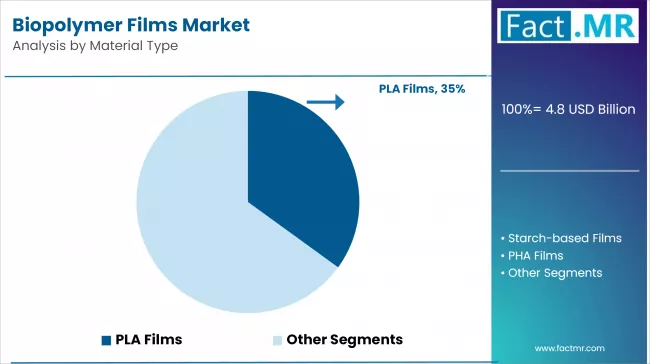
Biopolymer Films Market Analysis By Material Type | Source: Fact.MR
PLA films command the leading position in the Biopolymer Films market with approximately 35.0% market share through advanced biodegradable features, including high sustainability performance, consistent environmental compliance, and comprehensive packaging capabilities that enable packaging companies to deploy sustainable packaging across diverse packaging environments without significant operational modifications.
The segment benefits from packaging company preference for high-performance biodegradable systems that provide reliable environmental results without requiring extensive sustainability infrastructure or specialized maintenance protocols. PLA film system design features enable deployment in major packaging facilities, consumer goods companies, and high-volume operations where environmental consistency and biodegradability efficiency represent critical operational requirements.
PLA film systems differentiate through established biodegradability efficiency, proven sustainability capabilities, and integration with existing packaging workflows that enhance environmental effectiveness while maintaining cost-effective operational profiles suitable for packaging companies of all sizes.
- Advanced biodegradability algorithms with established sustainability capabilities and validated environmental parameters
- High-performance resources enabling comprehensive sustainable packaging and consistent environmental outcomes
- Integration capabilities with packaging information systems, sustainability platforms, and operational monitoring systems for comprehensive environmental workflows
By Application, the Food Packaging Segment Accounts for the Largest Market Share
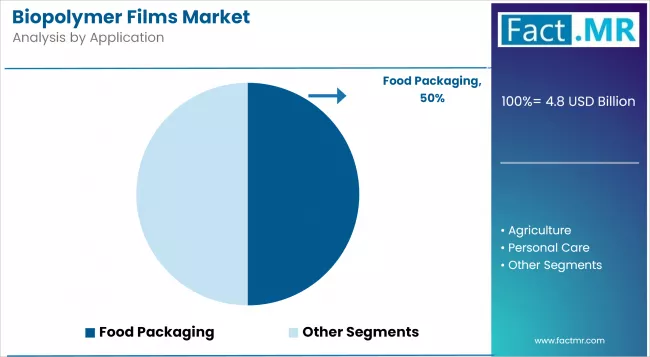
Biopolymer Films Market Analysis By Application | Source: Fact.MR
Food packaging applications dominate the biopolymer films market with approximately 50.0% market share due to widespread adoption of biodegradable packaging systems and increasing focus on food sustainability, environmental compliance, and operational efficiency applications that optimize packaging effectiveness while maintaining environmental consistency.
Food packaging customers prioritize system reliability, environmental performance, and integration with existing food packaging infrastructure that enables coordinated sustainability management across multiple food types and service lines. The segment benefits from substantial food industry budgets and modernization programs that emphasize sustainable packaging tool acquisition for improved environmental quality and operational efficiency.
Food industry modernization programs incorporate biodegradable packaging systems as standard equipment for food protection and environmental compliance applications. At the same time, increasing environmental standards are driving demand for packaging capabilities that maintain sustainability requirements and minimize environmental disruptions.
- Strong growth in food companies requiring comprehensive automated packaging assistance capabilities
- Increasing adoption in consumer goods companies for high-compliance environmental support applications
- Rising integration with packaging management platforms for automated sustainability scheduling and quality monitoring
What are the Drivers, Restraints, and Key Trends of the Biopolymer Films Market?
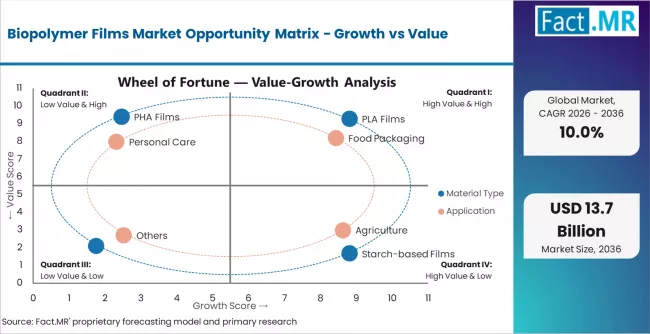
Biopolymer Films Market Opportunity Matrix Growth Vs Value | Source: Fact.MR
Environmental automation drives primary adoption as biopolymer film systems provide packaging assistance capabilities that enable consistent sustainable packaging without traditional plastic dependency risks, supporting operational decision-making and compliance missions that require precise environmental management.
The demand for sustainable packaging modernization accelerates market expansion as packaging companies seek effective environmental enhancement tools that minimize packaging environmental impact while maintaining operational effectiveness during complex packaging procedures and sustainability management scenarios.
Environmental spending increases worldwide, creating sustained demand for biodegradable packaging systems that complement traditional packaging equipment and provide operational flexibility in complex packaging environments.
Capital investment challenges vary across manufacturers regarding the deployment of biodegradable packaging systems and environmental budget allocation protocols, which may limit operational flexibility and market penetration in regions with constrained packaging budgets.
Technical performance limitations persist regarding system adaptability and integration complexity that may reduce effectiveness with legacy packaging equipment, non-standardized material formats, or complex packaging workflows that limit biodegradability capabilities. Market fragmentation across multiple packaging standards and operational requirements creates compatibility concerns between different biopolymer film system providers and existing packaging infrastructure.
Adoption accelerates in packaging and consumer goods sectors where environmental compliance justifies system costs, with geographic concentration in developed markets transitioning toward mainstream adoption in emerging economies driven by environmental regulations and packaging infrastructure development.
Technology development focuses on enhanced biodegradability efficiency, improved automation capabilities, and compatibility with diverse packaging systems that optimize environmental workflow and operational effectiveness. The market could face disruption if alternative sustainable technologies or budget restrictions significantly limit biodegradable packaging deployment in packaging or consumer goods applications.
Analysis of the Biopolymer Films Market by Key Country
The biopolymer films market demonstrates varied regional dynamics with growth leaders including Germany (11.5% CAGR) and United States (11.1% CAGR) driving expansion through environmental modernization and packaging infrastructure development.
Steady performers encompass Japan (10.7% CAGR), France (10.3% CAGR), and South Korea (9.9% CAGR), benefiting from established packaging industries and advanced environmental automation adoption. Emerging markets feature U.K. (9.5% CAGR), where specialized packaging applications and environmental technology integration support consistent growth patterns.
.webp "Top Country Growth Comparison Biopolymer Films Market Cagr (2026 2036)")
Top Country Growth Comparison Biopolymer Films Market Cagr (2026 2036) | Source: Fact.MR
| Country | CAGR (2026-2036) |
|---|---|
| Germany | 11.5% |
| United States | 11.1% |
| Japan | 10.7% |
| France | 10.3% |
| South Korea | 9.9% |
| U.K. | 9.5% |
Source: Fact.MR analysis. Updated Mar 25, 2026
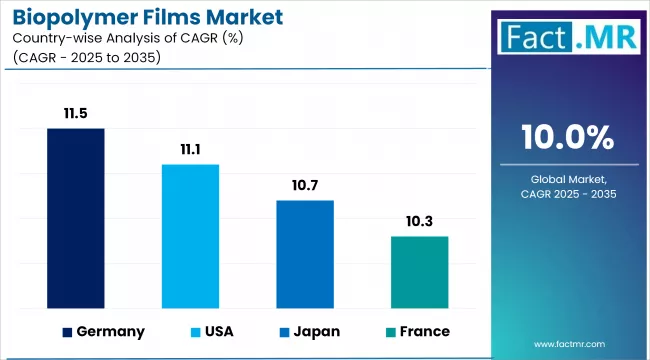
Biopolymer Films Market Cagr Analysis By Country | Source: Fact.MR
Regional synthesis reveals European markets leading growth through environmental modernization and packaging infrastructure development, while North American countries maintain steady expansion supported by packaging technology advancement and environmental standardization requirements. Asian markets show moderate growth driven by packaging applications and environmental technology integration trends.
Germany Drives Global Market Leadership
Germany establishes market leadership through aggressive environmental modernization programs and comprehensive packaging infrastructure development, integrating advanced biopolymer film systems as standard components in packaging operations and sustainable packaging manufacturing. The country's 11.5% CAGR through 2036 reflects government initiatives promoting environmental automation and domestic packaging capabilities that mandate advanced biodegradable systems in packaging facility installations. Growth concentrates in major packaging hubs, including Munich, Berlin, and Hamburg, where packaging technology development showcases integrated sustainable systems that appeal to domestic packaging companies seeking advanced environmental capabilities and operational enhancement applications.
German manufacturers are developing cost-effective biopolymer film solutions that combine domestic production advantages with advanced features, including precision biodegradability algorithms and comprehensive packaging capabilities. Distribution channels through packaging procurement and environmental equipment suppliers expand market access, while government funding for environmental technology development supports adoption across diverse packaging and consumer goods segments.
- Packaging systems leading adoption with 94% deployment rate in environmental and sustainable packaging departments
- Government environmental programs providing substantial funding for domestic packaging automation development
- Local manufacturers capturing 83% market share through competitive pricing and localized packaging support
- Consumer goods segment growth driven by packaging requirements for automated environmental systems
- Export market development for cost-effective film solutions targeting emerging packaging markets
United States Emerges as Technology Innovation Leader
In major packaging centers including California, Texas, and Illinois, packaging authorities and consumer goods operators are implementing advanced biopolymer film systems as standard equipment for sustainable packaging and environmental applications, driven by increasing environmental spending and modernization programs that emphasize the use of automated sustainability capabilities.
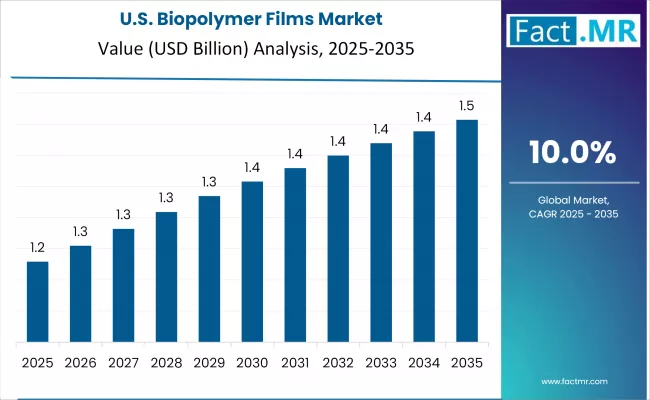
Biopolymer Films Market Country Value Analysis | Source: Fact.MR
The market is projected to demonstrate a 11.1% CAGR through 2036, supported by government environmental initiatives and packaging infrastructure development programs that promote the use of advanced biodegradable tools for packaging companies and consumer goods authorities. American packaging operators are adopting film systems that provide superior environmental capabilities and sustainability enhancement features, particularly appealing in packaging regions where environmental quality represents critical operational requirements.
Market expansion benefits from growing packaging technology capabilities and domestic technology development agreements that enable local advancement of advanced environmental systems for packaging and consumer goods applications. Technology adoption follows patterns established in packaging infrastructure, where operational efficiency and environmental quality drive procurement decisions and system deployment.
- Packaging and consumer goods operator segments are driving initial adoption with 64% annual growth in film system procurement
- Environmental modernization programs emphasizing biodegradable packaging tools for sustainability management and environmental quality
- Local packaging technology companies partnering with international providers for system development
- Packaging and consumer goods services implementing film systems for environmental assistance and operational management
Japan Maintains Technology Excellence
Japan's advanced packaging technology market demonstrates sophisticated biopolymer film deployment with documented environmental effectiveness in packaging departments and consumer goods centers through integration with existing packaging systems and environmental infrastructure. The country leverages packaging expertise in environmental technology and packaging systems integration to maintain a 10.7% CAGR through 2036.
Packaging centers, including Tokyo, Osaka, and Nagoya, showcase premium installations where biopolymer films integrate with comprehensive packaging information systems and environmental platforms to optimize sustainability accuracy and operational workflow effectiveness.
Japanese packaging technology providers prioritize system reliability and environmental regulatory compliance in biopolymer film development, creating demand for premium systems with advanced features, including environmental validation and integration with Japanese packaging standards.
The market benefits from established packaging industry infrastructure and a willingness to invest in advanced environmental technologies that provide long-term operational benefits and compliance with environmental regulations.
- Environmental focuses on Japanese packaging standards and system integration, driving premium consumer goods segment growth
- Packaging technology partnerships providing 51% faster environmental validation cycles
- Technology collaboration between Japanese packaging equipment manufacturers and international environmental companies
- Packaging training programs are expanding film integration in sustainability management and operational scenarios
France Shows Strong Regional Leadership
France's market expansion benefits from diverse packaging demand, including environmental modernization in Paris and Lyon, consumer goods system upgrades, and government environmental programs that increasingly incorporate automated sustainability solutions for packaging applications.
The country maintains a 10.3% CAGR through 2036, driven by rising environmental awareness and increasing adoption of biopolymer film benefits, including superior environmental capabilities and reduced packaging environmental impact.
Market dynamics focus on cost-effective film solutions that balance advanced environmental features with affordability considerations important to French packaging companies. Growing packaging infrastructure creates sustained demand for modern environmental systems in new packaging facilities and environmental equipment modernization projects.
- Packaging and consumer goods segments leading growth with focus on environmental automation and sustainability quality applications
- Regional packaging requirements are driving a diverse product portfolio from basic environmental compliance to advanced sustainability platforms
- Local development partnerships with international packaging technology manufacturers
- Government environmental initiatives beginning to influence procurement standards and packaging requirements
South Korea Drives Environmental Integration
In Seoul, Busan, and other packaging centers, Korean packaging operators and consumer goods authorities are implementing advanced biopolymer film systems to enhance environmental capabilities and support operational decision-making that aligns with Korean packaging standards and environmental regulations.
The South Korea market is expected to demonstrate sustained growth with a 9.9% CAGR through 2036, driven by packaging modernization programs and environmental equipment upgrades that emphasize advanced sustainability tools for packaging and consumer goods applications. Korean packaging facilities are prioritizing film systems that provide superior environmental capabilities while maintaining compliance with packaging regulations and minimizing operational risks, particularly important in food packaging and specialized consumer goods applications.
Market expansion benefits from packaging procurement programs that support automated environmental capabilities in packaging equipment specifications, creating sustained demand across South Korea's packaging sectors where operational effectiveness and regulatory compliance represent critical requirements. The regulatory framework supports film adoption through packaging device standards and environmental technology requirements that promote advanced sustainability systems aligned with national packaging capabilities.
- Packaging and consumer goods systems are leading the adoption with environmental equipment modernization programs requiring automated film systems
- Government packaging procurement providing regulatory support for advanced film system acquisition
- Korean compatibility requirements are driving demand for standardized systems with national packaging interoperability
- Specialized environmental departments adopting comprehensive sustainability solutions for film automation and operational management
United Kingdom Maintains Environmental Leadership
In London, Manchester, and Birmingham, British packaging operators and consumer goods authorities are implementing advanced biopolymer film systems to enhance environmental capabilities and support operational decision-making that aligns with U.K. packaging standards and environmental regulations.
The U.K. market is expected to demonstrate sustained growth with a 9.5% CAGR through 2036, driven by environmental modernization programs and packaging equipment upgrades that emphasize advanced sustainability tools for packaging and consumer goods applications. British packaging facilities are prioritizing film systems that provide superior environmental capabilities while maintaining compliance with packaging regulations and minimizing operational risks, particularly important in food packaging and specialized consumer goods applications.
Market expansion benefits from packaging procurement programs that support automated environmental capabilities in packaging equipment specifications, creating sustained demand across the U.K.'s packaging sectors where operational effectiveness and regulatory compliance represent critical requirements. The regulatory framework supports film adoption through packaging device standards and environmental technology requirements that promote advanced sustainability systems aligned with national packaging capabilities.
- Packaging and consumer goods systems are leading the adoption with environmental equipment modernization programs requiring automated film systems
- Government packaging procurement providing regulatory support for advanced film system acquisition
- U.K. compatibility requirements are driving demand for standardized systems with national packaging interoperability
- Specialized environmental departments adopting comprehensive sustainability solutions for film automation and operational management
Europe Market Split by Country
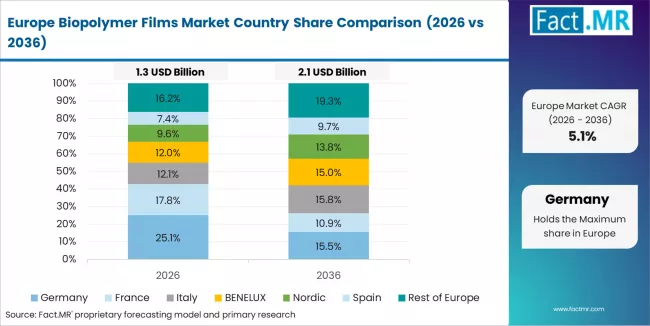
Biopolymer Films Market Europe Country Market Share Analysis, 2026 & 2036 | Source: Fact.MR
The biopolymer films market in Europe is projected to grow from USD 1.4 billion in 2026 to USD 3.6 billion by 2036, registering a CAGR of 10.2% over the forecast period. Germany is expected to maintain its leadership position with a 29.8% market share in 2026, rising to 30.9% by 2036, supported by its advanced packaging technology sector and major environmental centers, including Berlin and Munich.
The United Kingdom follows with a 16.4% share in 2026, projected to reach 15.8% by 2036, driven by comprehensive environmental modernization programs and packaging technology development initiatives. France holds a 15.9% share in 2026, expected to increase to 17.2% by 2036 through specialized packaging applications and regulatory standardization requirements.
Italy commands a 12.8% share in 2026, declining to 12.1% by 2036, while Spain accounts for 10.5% in 2026, increasing to 11.0% by 2036. The Nordic Countries region holds 9.2% in 2026, rising to 9.7% by 2036. BENELUX is anticipated to hold 4.9% in 2026, declining to 2.8% by 2036, while the Rest of Western Europe maintains a stable 0.5% share throughout the forecast period.
Food Packaging Dominates Biopolymer Films Demand in Japan
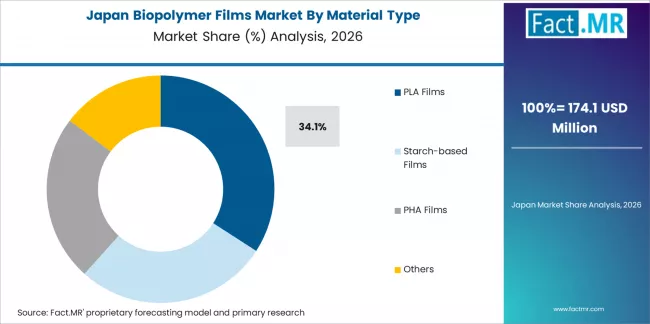
Biopolymer Films Market Japan Market Share Analysis By Material Type | Source: Fact.MR
In Japan, the Biopolymer Films market prioritizes Food Packaging applications, which capture the dominant share of packaging facility and consumer goods installations due to their advanced features, including high-performance capabilities and seamless integration with existing packaging information technology infrastructure.
Japanese packaging operators emphasize reliability, environmental accuracy, and long-term operational excellence, creating demand for food packaging systems that provide comprehensive environmental capabilities and adaptive sustainability control based on regulatory requirements and packaging complexity scenarios. Agriculture and Personal Care applications maintain secondary market positions primarily in specialized applications and sustainable packaging installations where environmental requirements meet compliance without traditional packaging limitations.
- Premium focus on food packaging systems with advanced environmental algorithms and high-performance capabilities
- Integration requirements with existing packaging information systems and environmental management platforms
- Emphasis on environmental reliability and long-term performance in packaging applications
Packaging Companies Lead Biopolymer Films Services in South Korea
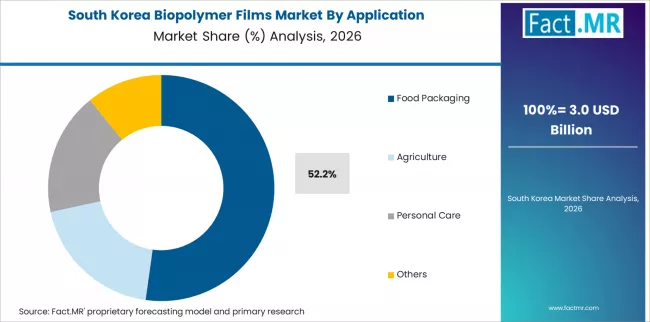
Biopolymer Films Market South Korea Market Share Analysis By Application | Source: Fact.MR
In South Korea, the market structure favors packaging companies, which maintain dominant positions through comprehensive product portfolios and established packaging procurement networks supporting both packaging systems and consumer goods facilities. These providers offer integrated solutions combining advanced biopolymer film systems with professional implementation services and ongoing technical support that appeal to Korean packaging operators seeking reliable automated environmental systems.
Chemical companies and food processors capture moderate market share by providing specialized service capabilities and competitive pricing for standard packaging installations. At the same time, other providers focus on specialized applications and cost-effective solutions tailored to Korean packaging characteristics.
- Packaging companies maintaining premium market positioning through advanced environmental offerings
- Chemical company networks expanding to support growing demand for professional implementation and environmental support
- System integration capabilities are becoming a key differentiator for packaging and consumer goods applications
Competitive Landscape of the Biopolymer Films Market
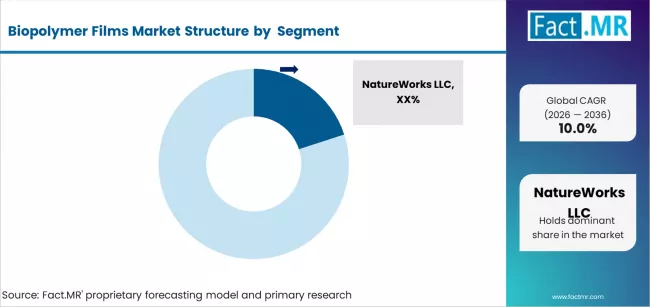
Biopolymer Films Market Analysis By Company | Source: Fact.MR
The Biopolymer Films market operates with moderate concentration, featuring approximately 15-20 meaningful participants, where leading companies control roughly 55-60% of the global market share through established packaging technology relationships and comprehensive environmental system portfolios. Competition emphasizes advanced sustainability capabilities, system reliability, and integration with packaging platforms rather than price-based rivalry.
Market Leaders encompass NatureWorks LLC, BASF SE, Novamont SpA, Biome Bioplastics, and Danimer Scientific, which maintain competitive advantages through extensive packaging technology expertise, global packaging contractor networks, and comprehensive system integration capabilities that create customer switching costs and support premium pricing. These companies leverage decades of packaging technology experience and ongoing research investments to develop advanced biopolymer film systems with precision environmental algorithms and packaging validation features.
Technology Challengers include Total Corbion PLA, Braskem, Mitsubishi Chemical, Kaneka Corporation, and FKuR Kunststoff, which compete through specialized packaging environmental focus and innovative sustainability interfaces that appeal to packaging customers seeking advanced environmental capabilities and operational flexibility. These companies differentiate through rapid technology development cycles and specialized packaging application focus.
Regional Specialists feature companies that focus on specific geographic markets and specialized applications, including food packaging systems and integrated environmental platforms. Market dynamics favor participants that combine reliable environmental algorithms with advanced packaging software, including precision sustainability control and automatic environmental monitoring capabilities. Competitive pressure intensifies as traditional packaging equipment contractors expand into biopolymer film systems. At the same time, specialized packaging companies challenge established players through innovative environmental solutions and cost-effective platforms targeting specialized packaging segments.
Key Players in the Biopolymer Films Market
- NatureWorks LLC
- BASF SE
- Novamont SpA
- Biome Bioplastics
- Danimer Scientific
- Total Corbion PLA
- Braskem
- Mitsubishi Chemical
- Kaneka Corporation
- FKuR Kunststoff
Bibliography
- European Commission. (2024, December). Packaging and Packaging Waste Regulation (PPWR). Official Journal of the European Union.
- NatureWorks LLC. (2024). Ingeo PLA processing guide: Film extrusion applications. NatureWorks.
- ASTM International. (2024). ASTM D6400: Standard specification for labeling of plastics designed to be aerobically composted. ASTM.
- Novamont S.p.A. (2024). Mater-Bi product line: Agricultural and food packaging applications. Novamont.
- European Bioplastics Association. (2024). Bioplastics market data 2024: Production capacities and demand. European Bioplastics.
- French Republic. (2020). Loi no. 2020-105: Anti-waste for a circular economy (AGEC). Legifrance.
- Total Corbion PLA. (2024). Luminy PLA resin grades: Technical data and compostability certifications. Total Corbion.
This bibliography is provided for reader reference. The full Fact.MR report contains the complete reference list with primary research documentation.
This Report Addresses
- Market sizing and quantitative forecast metrics detailing the precise expenditure dedicated to biopolymer films across major industrial sectors through 2036.
- Segmentation analysis mapping the adoption patterns of specific material type categories and evaluating the technical and economic factors driving segment share distribution.
- Regional deployment intelligence comparing growth trajectories across Asia Pacific, North America, Europe, Latin America, and Middle East and Africa.
- Regulatory compliance assessment analyzing how evolving standards and policies affect product specifications and market access in key consuming regions.
- Competitive posture evaluation tracking the positioning of leading producers and the structural factors determining competitive advantage.
- Capital investment strategic guidance defining the procurement and capacity planning considerations for industry participants.
- Supply chain risk analysis identifying the specific feedstock, logistics, and regulatory variables that constrain market expansion.
- Custom data delivery formats encompassing interactive dashboards, raw Excel datasets, and PDF narrative reports.
Biopolymer Films Market Definition
Biopolymer films are thin-gauge sheet materials manufactured from bio-based or biodegradable polymer resins, including polylactic acid (PLA), thermoplastic starch, polyhydroxyalkanoates (PHA), cellulose acetate, and bio-based polyethylene. They function as packaging wraps, bags, labels, agricultural mulch films, and laminate layers in flexible packaging structures. Biopolymer films are classified by their end-of-life pathway: industrially compostable, home compostable, or bio-based but non-biodegradable.
Biopolymer Films Market Inclusions
Market scope covers global and regional revenue for biopolymer films across PLA films, starch-based films, PHA films, and other biopolymer film types. Application segments include food packaging, agriculture, personal care, and others. End-use segments span flexible packaging and rigid packaging. The forecast period is 2026 to 2036.
Biopolymer Films Market Exclusions
The scope excludes bio-based polyethylene and bio-based PET films that are chemically identical to their fossil-based counterparts and are not biodegradable. Paper and fibre-based packaging is excluded. Biopolymer resins sold in pellet or granule form before conversion into film are outside the boundary unless the valuation pertains specifically to film-grade material.
Biopolymer Films Market Research Methodology
- Primary Research: Analysts engaged with procurement specialists, process engineers, and supply chain directors across producing and consuming regions to map the specific decision criteria triggering purchasing and specification changes.
- Desk Research: Data collection aggregated regulatory filings, trade body publications, standards body documentation, and company disclosures relevant to the product category.
- Market-Sizing and Forecasting: Baseline values derive from a bottom-up aggregation of production volumes and trade flows, applying region-specific demand curves to project adoption velocity through 2036.
- Data Validation and Update Cycle: Projections are tested against publicly reported industry expenditure guidance and cross-referenced with primary interview data to ensure internal consistency.
Segmentation
Scope of the Report
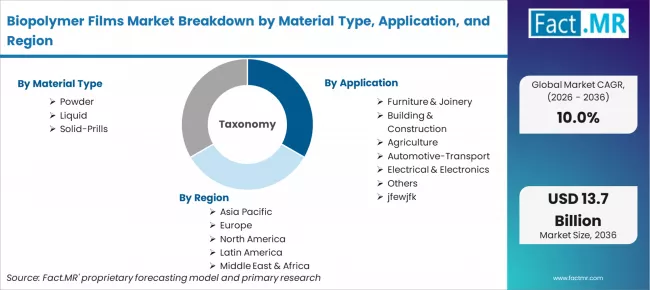
Biopolymer Films Market Breakdown By Material Type, Application, And Region | Source: Fact.MR
| Metric | Value |
|---|---|
| Quantitative Units | USD 5.28 billion to USD 13.69 billion, at a CAGR of 10.0% |
| Market Definition | Biopolymer films are thin-gauge sheet materials manufactured from bio-based or biodegradable polymer resins, including polylactic acid (PLA), thermoplastic starch, polyhydroxyalkanoates (PHA), cellulose acetate, and bio-based polyethylene. They function as packaging wraps, bags, labels, agricultural mulch films, and laminate layers in flexible packaging structures. |
| Material Type Segmentation | PLA Films, Starch-based Films, PHA Films, Others |
| Application Segmentation | Food Packaging, Agriculture, Personal Care, Others |
| End Use Segmentation | Flexible Packaging, Rigid Packaging |
| Regions Covered | North America, Latin America, Europe, East Asia, South Asia, Oceania, Middle East & Africa |
| Countries Covered | Germany, USA, Japan, France, South Korea, UK, and 40 plus countries |
| Key Companies Profiled | NatureWorks LLC, BASF SE, Total Corbion PLA, Novamont S.p.A., Braskem, Mitsubishi Chemical, Danimer Scientific, Kaneka Corporation, FKuR Kunststoff GmbH, Biome Bioplastics |
| Forecast Period | 2026 to 2036 |
| Approach | Hybrid top-down and bottom-up methodology reconciling production, trade, and consumption data with primary research validation. |
Source: Fact.MR analysis. Updated Mar 25, 2026
Biopolymer Films Market by Segments
-
Material Type :
- PLA Films
- Starch-based Films
- PHA Films
- Others
-
Application :
- Food Packaging
- Agriculture
- Personal Care
- Others
-
End Use :
- Flexible Packaging
- Rigid Packaging
-
Region :
- Asia Pacific
- China
- Japan
- South Korea
- India
- ASEAN
- Australia & New Zealand
- Rest of Asia Pacific
- North America
- United States
- Canada
- Mexico
- Europe
- Germany
- United Kingdom
- France
- Italy
- Spain
- Nordic Countries
- BENELUX
- Rest of Europe
- Latin America
- Brazil
- Chile
- Rest of Latin America
- Middle East & Africa
- Kingdom of Saudi Arabia
- Other GCC Countries
- Turkey
- South Africa
- Other African Union
- Rest of Middle East & Africa
- Asia Pacific
Frequently Asked Questions
How large is the demand for Biopolymer Films in the global market in 2026?
What will be the market size of Biopolymer Films in the global market by 2036?
What is the expected demand growth for Biopolymer Films in the global market between 2026 and 2036?
Which Material Type is poised to lead global sales by 2026?
How is the Application segment structured in this report?
What is the growth outlook for Germany in this report?
What is Biopolymer Films and what is it mainly used for?
How does Fact.MR build and validate the Biopolymer Films forecast?
Who worked on this report


Preview the report firsthand - request a free sample
Free SampleGet the brochure for pricing and purchase details
Download PDF