- Forecast Value (2036): 782 Mn
- CAGR (2036): 5.0%
Bottom Discharge Valve Market Forecast and Outlook 2026 to 2036
Global demand is projected to advance from USD 480 million in 2026 to approximately USD 782 million by 2036, progressing at a CAGR of 5.0%.
Key Takeaways from the Bottom Discharge Valve Market
- Bottom Discharge Valve Market Value (2026): USD 480 million
- Bottom Discharge Valve Market Forecast Value (2036): USD 782 million
- Bottom Discharge Valve Market Forecast CAGR (2026-2036): 5.0%
- Leading Application: Pharmaceutical Manufacturing (28%)
- Key Market Participants: De Dietrich Process Systems, GEMÜ, GEA, Spirax Sarco, Crane, IMI, Bürkert, Alfa Laval, Valmet, Flowserve
- Key Growth Regions: North America, Europe, Asia Pacific, Latin America, Middle East
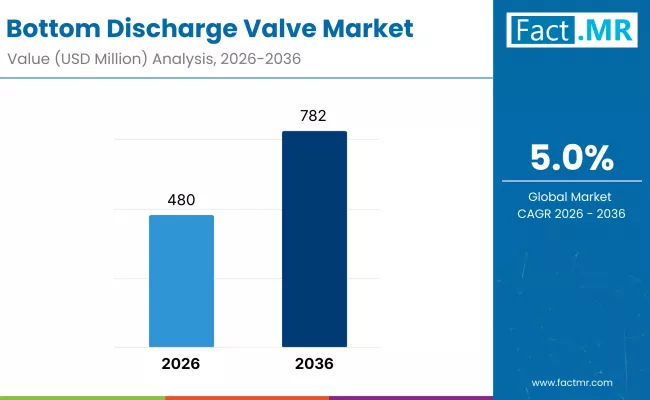
Bottom Discharge Valve Market By Industry | Source: Fact.MR
This trajectory reflects rising pharmaceutical manufacturing capacity, increased regulatory emphasis on process hygiene, and normalization of dead-space-free valve technologies across chemical processing industries. Bottom discharge valve solutions address fundamental operational needs by targeting contamination prevention challenges, material waste reduction, and clean-in-place compatibility through optimized flow path designs.
As noted by Robert Anderson, Senior Process Systems Engineer at PharmaFlow Technologies, the pharmaceutical and fine chemical industries are experiencing a fundamental shift toward valves that eliminate dead legs and minimize product carryover. Modern flush bottom designs have evolved from basic tank drainage to precision-engineered components ensuring complete discharge while meeting stringent hygienic standards including surface finishes below 0.4 micrometers roughness average and validated clean-in-place performance. Companies successfully integrating advanced sealing technologies, automated actuation systems, and material innovations will capture disproportionate market share in the coming years. By combining metallurgical expertise, Industry 4.0 connectivity, and regulatory compliance capabilities, leading manufacturers align with contemporary process manufacturing culture. This momentum is reinforced by strong growth in ultrapure applications, reflecting industry demand for contamination control, batch integrity, and validated cleaning protocols.
Bottom Discharge Valve Market
| Metric | Value |
|---|---|
| Estimated Value in (2026) | USD 480 million |
| Forecast Value in (2036) | USD 782 million |
| Forecast CAGR (2026 to 2036) | 5.0 % |
Source: Fact.MR analysis. Updated Feb 6, 2026
Category
| Category | Segments |
|---|---|
| Application | Pharmaceutical Manufacturing, Fine & Specialty Chemicals, Food Processing, Petrochemicals, Battery Materials |
| Valve Type | Flush Bottom Valves, Tank Bottom Ball Valves, Tank Bottom Diaphragm Valves, Other |
| Material | Stainless Steel, Alloy/High-Ni, PTFE/PFA Lined, Other |
| Region | North America; Europe; Asia Pacific; Latin America; Middle East & Africa |
Source: Fact.MR analysis. Updated Feb 6, 2026
Segmental Analysis
How is pharmaceutical manufacturing becoming the leading application in the bottom discharge valve market?
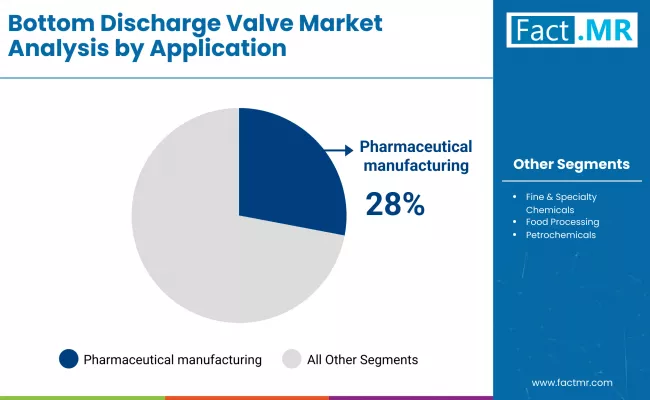
Bottom Discharge Valve Market By Application | Source: Fact.MR
Pharmaceutical manufacturing accounts for 28% of the bottom discharge valve market because it demands the highest standards of cleanliness and control. Drug manufacturers must prevent contamination while meeting strict regulatory requirements during active pharmaceutical ingredient production. Hygienic bottom discharge valves allow complete emptying of vessels. This protects batch integrity and supports reliable cleaning validation. Flush bottom designs eliminate dead space and use mirror-polished internal surfaces to prevent product buildup. These features improve yield and reduce residue risks. The valves also work across different vessel types and sterilization methods. As a result, pharmaceutical companies can achieve visible quality improvements without redesigning their processes.
Why do flush bottom valves dominate valve type preferences?
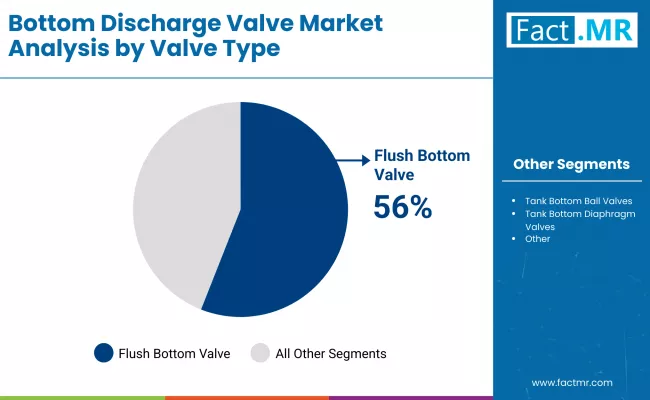
Bottom Discharge Valve Market By Valve Type | Source: Fact.MR
Flush bottom valves hold 56% market share because they are designed to eliminate dead legs. Their smooth flow paths and optimized seat designs allow materials to discharge completely. Process studies show that these valves reduce product holdup and improve cleaning efficiency. They also simplify compliance with hygiene regulations. Advances in elastomer sealing and precision machining have solved earlier reliability concerns. Modern flush bottom valves now deliver leak-tight performance even in demanding environments. This makes them the preferred choice for hygienic and high-value applications.
Bottom Discharge Valve Market-Drivers, Restraints & Trends
- Drivers: Regulatory pressure is the strongest driver. Authorities require validated cleaning and minimal material retention. Guidance from the U.S. FDA has pushed manufacturers toward dead-space-free valve designs. Growth in battery materials is another driver. Production of lithium and nickel compounds requires corrosion-resistant discharge solutions. Bottom discharge valves meet these needs in expanding electric vehicle supply chains.
- Restraints: Some limitations remain. Highly viscous materials may require specialized discharge mechanisms beyond standard valves.Cost is also a barrier. Hygienic valve systems require higher upfront investment. Maintenance can be more complex, especially for facilities using older equipment. These factors slow adoption among smaller processors.
- Trend 1: Smart valve integration Valves are becoming smarter. Sensors, IO-Link connectivity, and predictive maintenance tools are being integrated into discharge systems. These features enable real-time monitoring and automated safety compliance. They also support Industry 4.0 manufacturing strategies.
- Trend 2: Modular clean-in-place systems New valve designs include built-in cleaning features such as spray balls and self-draining geometries. These systems reduce chemical and water use during cleaning. European plants report up to 30% lower cleaning agent consumption while maintaining hygiene standards. This aligns performance with sustainability goals.
Bottom Discharge Valve Market Analysis by Key Country
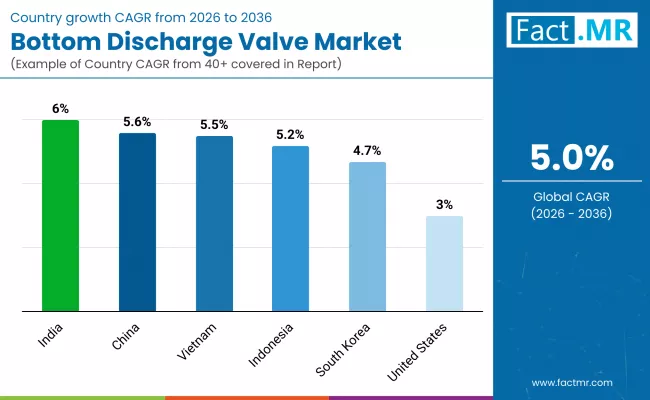
Bottom Discharge Valve Market By Country | Source: Fact.MR
| Country | CAGR (2026-2036) |
|---|---|
| India | 6.0% |
| China | 5.6% |
| Vietnam | 5.5% |
| Indonesia | 5.2% |
| South Korea | 4.7% |
| United States | 3.0% |
Source: Fact.MR analysis. Updated Feb 6, 2026
What factors position India to lead global growth in bottom discharge valve adoption?
India is the fastest-growing market, expanding at 6.0% CAGR. Growth is driven by Production Linked Incentive (PLI) 2.0 schemes focused on active pharmaceutical ingredient manufacturing through 2026. New plants are being built to meet global quality standards. These facilities specify hygienic bottom discharge valves made from 316L stainless steel. Mirror-polished internal surfaces with ultra-low roughness help meet strict contamination control rules. Foreign investment is also rising. New greenfield projects are increasing demand for export-grade valves. National policy emphasis on pharmaceutical self-reliance continues to support long-term adoption.
How does industrial tank farm standardization influence China’s market expansion?
China’s market grows at 5.6% CAGR, supported by enforcement of GB 43352-2023 standards. These rules require tank farms to minimize hazardous liquid residue. Operators are shifting to flush bottom valve designs that eliminate sediment buildup. This improves safety and discharge efficiency. Adoption is strongest in petrochemical and specialty chemical zones, supported by national safety campaigns across industrial clusters.
What role does manufacturing reshoring play in Vietnam’s market development?
Vietnam expands at 5.5% CAGR, driven by “China Plus One” manufacturing strategies. Chemical and food processors are relocating operations to avoid tariffs and diversify supply chains. New factories require standardized industrial valves for edible oil refining, paints, and coatings. Import data shows rising demand for high-performance discharge valves. Government incentives for value-added manufacturing further support growth in southern industrial zones.
How does nickel processing expansion influence Indonesia’s market trajectory?
Indonesia grows at 5.2% CAGR, supported by mandates for domestic nickel refining. These rules aim to strengthen electric vehicle battery supply chains. Hydrometallurgical processes require acid-resistant bottom discharge valves. Demand is rising for Hastelloy and PTFE-lined designs. Investments in local refining capacity are driving adoption of advanced valve technologies built for corrosive environments.
How do semiconductor investments influence South Korea’s market development?
South Korea’s bottom discharge valve market expands at 4.7% CAGR, closely tied to heavy investment in advanced semiconductor manufacturing. Major chipmakers are pushing beyond three-nanometer process nodes, which significantly raises purity and contamination-control requirements across fabrication facilities. New fabs rely on ultra-pure water systems and highly controlled chemical delivery networks. Bottom discharge valves play a critical role in these systems by ensuring complete draining of process chemicals without residue. Even trace contamination can affect chip yields, making valve precision essential rather than optional. Manufacturers therefore demand valves with mirror-polished internal surfaces, low particle generation, and materials compatible with aggressive cleaning chemicals. The emphasis is not only on performance, but also on long-term reliability and consistency.
How does process safety regulation influence United States market expansion?
The United States market grows at 3.0% CAGR, shaped largely by stricter process safety regulations rather than capacity expansion alone. Updated Underwriters Laboratories (UL) safety standards, effective from 2026, require real-time monitoring of valve position in hazardous chemical environments. These regulations have changed purchasing priorities. Chemical processors are moving away from manual valves toward automated pneumatic systems equipped with position sensors and digital feedback. Real-time confirmation of valve status improves safety, reduces human error, and supports compliance audits. Facilities handling flammable or toxic materials now view smart discharge valves as risk-mitigation tools. Integrated monitoring also supports predictive maintenance, reducing unplanned shutdowns.
Competitive Landscape of the Bottom Discharge Valve Market
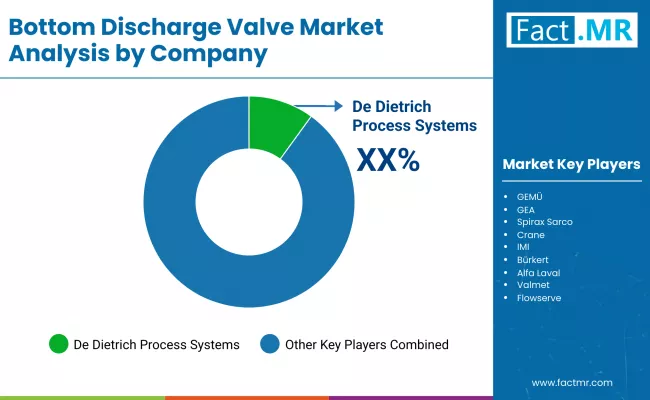
Bottom Discharge Valve Market By Company | Source: Fact.MR
The bottom discharge valve market shows moderate concentration. It includes a mix of global process equipment leaders and regional valve manufacturers. Competition has intensified in recent years due to tighter regulations and expanding pharmaceutical production capacity. These trends are increasing demand for hygienic and high-performance valve solutions.
Manufacturers are differentiating through technology and service depth. Proprietary sealing designs, a wide range of materials, and built-in automation features are becoming key advantages. Many suppliers now align products with Industry 4.0 requirements, including sensor integration and digital monitoring.
De Dietrich Process Systems holds a strong position in pharmaceutical and fine chemical markets. Its glass-lined and specialty alloy valves deliver corrosion resistance and hygienic performance. GEMÜ focuses on precision manufacturing. Modular valve platforms allow customers to customize actuation and control systems for different processes. GEA targets food and beverage producers. Its discharge valves integrate clean-in-place functionality and meet sanitary certification standards. Spirax Sarco positions bottom discharge valves as part of broader process optimization solutions.
Competition is no longer limited to hardware. Application engineering, validation support, and lifecycle services now play a major role. These value-added offerings increase switching costs and encourage long-term partnerships. Process manufacturers increasingly seek complete solutions that balance performance, compliance, and total cost of ownership.
Recent Development
- In February 2025, Emerson introduced the Type 84 Pressure Relief Valve, specifically engineered for high-pressure gas tanks (hydrogen storage and refueling). It features Arlon® 3000XT thermoplastic seating to prevent embrittlement and leaks, a major development for the burgeoning H2 economy.
- In September 2025, Richter was nominated for the PRIMUS Award 2025 for its turnkey NKL/NKS valves. These use a PFA-L (PFA-lined) and FDA-compliant design, targeting global pharmaceutical corporations that require high-purity, corrosive-resistant bottom discharge solutions.
Key Players in Bottom Discharge Valve Market
- De Dietrich Process Systems
- GEMÜ
- GEA
- Spirax Sarco
- Crane
- IMI
- Bürkert
- Alfa Laval
- Valmet
- Flowserve
Bibliography
- Emerson. 2026. Series XV03/05 pneumatic valves with UL-certified safety accessories for hazardous zone applications. Official company press releases and technical product documentation.
- GEMÜ. 2026. Modular flush bottom valves with integrated clean-in-place capabilities. Corporate product announcements and European Union compliance certifications.
- Underwriters Laboratories. 2026. Process safety update for valve position monitoring in hazardous zones. UL standards documentation and industry implementation guidelines.
- Government of China. 2023. GB 43352-2023 national standards for industrial tank farm hazardous liquid residue minimization. State Administration for Market Regulation official publications.
- Government of India. 2026. Production Linked Incentive 2.0 pharmaceutical subsidies for API manufacturing. Ministry of Chemicals and Fertilizers policy documentation.
- European Union. 2026. Packaging and Packaging Waste Regulation circular discharge protocols. Official EU regulatory framework and implementation deadlines.
- VDMA. 2026. Industry 4.0 ready modular discharge valves for chemical plant modernization. German Mechanical Engineering Industry Association economic surveys and technology reports.
- Samsung Electronics. 2026. Semiconductor fabrication facility expansion and beyond-3nm process development. Corporate capital expenditure announcements and technology roadmaps.
Segmentation
Scope of Report
| Items | Values |
|---|---|
| Quantitative Units (2026) | USD 480 Million |
| Application | Pharmaceutical Manufacturing, Fine & Specialty Chemicals, Food Processing, Petrochemicals, Battery Materials |
| Valve Type | Flush Bottom Valves, Tank Bottom Ball Valves, Tank Bottom Diaphragm Valves, Other |
| Material | Stainless Steel, Alloy/High-Ni, PTFE/PFA Lined, Other |
| Regions Covered | North America, Europe, Asia Pacific, Latin America, Middle East & Africa |
| Countries Covered | U.S., Canada, Germany, Italy, UK, France, Japan, Australia, and other countries |
| Key Companies Profiled | De Dietrich Process Systems, GEMÜ, GEA, Spirax Sarco, Crane, IMI, Bürkert, Alfa Laval, Valmet, Flowserve |
| Additional Attributes | Dollar revenue in the bottom discharge valve market is segmented by application (pharmaceutical manufacturing, fine & specialty chemicals, food processing, petrochemicals, battery materials), valve type (flush bottom valves, tank bottom ball valves, tank bottom diaphragm valves, other), material (stainless steel, alloy/high-Ni, PTFE/PFA lined, other), and region. |
Source: Fact.MR analysis. Updated Feb 6, 2026
Bottom Discharge Valve Market by Segments
-
Application :
- Pharmaceutical Manufacturing
- Fine & Specialty Chemicals
- Food Processing
- Petrochemicals
- Battery Materials
-
Valve Type :
- Flush Bottom Valves
- Tank Bottom Ball Valves
- Tank Bottom Diaphragm Valves
- Other
-
Material :
- Stainless Steel
- Alloy/High-Ni
- PTFE/PFA Lined
- Other
-
Region :
- Asia Pacific
- China
- India
- Japan
- South Korea
- Vietnam
- Indonesia
- Rest of Asia Pacific
- North America
- United States
- Canada
- Mexico
- Europe
- Germany
- France
- UK
- Italy
- Spain
- Rest of Europe
- Latin America
- Brazil
- Mexico
- Argentina
- Rest of Latin America
- Asia Pacific
Frequently Asked Questions
How big is the global bottom discharge valve market in 2026?
What will be the size of the bottom discharge valve market in 2036?
How fast will the bottom discharge valve market grow between 2026 and 2036?
Which application dominates the bottom discharge valve market?
Which valve type holds the largest share in bottom discharge valves?
Who worked on this report


Preview the report firsthand - request a free sample
Free SampleGet the brochure for pricing and purchase details
Download PDF