- Base Value(2025): 39.25 Bn
- Estimated Value(2025): 39.3 Bn
- Forecast Value (2035): 240.9 Bn
- CAGR (2025 - 2035): 19.9%
Lithium Chemicals Market Forecast and Outlook 2025 to 2035
The global lithium chemicals market is projected to reach USD 240.9 billion by 2035, recording an absolute increase of USD 201.65 billion over the forecast period. The market is valued at USD 39.25 billion in 2025 and is set to rise at a CAGR of 19.9% during the assessment period.
The overall market size is expected to grow by approximately 6.1 times during the same period, supported by explosive electric vehicle battery demand and expanding energy storage system deployment across renewable energy integration worldwide, driving demand for battery-grade lithium compounds and increasing investments in upstream mining operations with advanced extraction technologies across lithium carbonate, lithium hydroxide, and specialty chemical production applications globally.
Quick Stats for Lithium Chemicals Market
- Lithium Chemicals Market Value (2025): USD 39.25 billion
- Lithium Chemicals Market Forecast Value (2035): USD 240.9 billion
- Lithium Chemicals Market Forecast CAGR: 19.9%
- Leading Product in Lithium Chemicals Market: Carbonate (60.7%)
- Key Growth Regions in Lithium Chemicals Market: Asia Pacific, North America, and Europe
- Top Players in Lithium Chemicals Market: Albemarle Corporation, SQM S.A., Ganfeng Lithium Co., Ltd., Arcadium Lithium, Pilbara Minerals Limited, Talison Lithium Pty Ltd, Lithium Americas Corp., Critical Elements Lithium Corporation, SICHUAN BRIVO LITHIUM MATERIALS CO., LTD., Infinitylithium
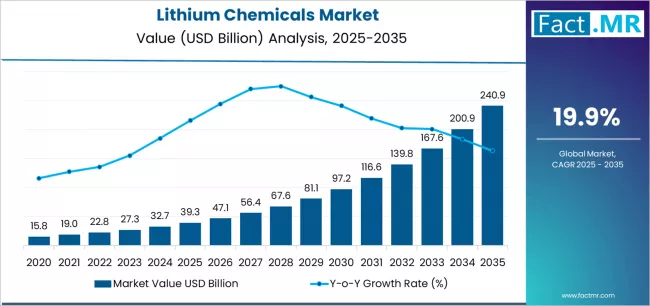
Lithium Chemicals Market Market Value Analysis | Source: Fact.MR
Battery manufacturers face mounting pressure to secure reliable lithium supply while meeting stringent quality specifications and reducing costs, with modern lithium chemical products providing documented performance benefits including high purity levels, consistent particle size distribution, and superior electrochemical properties compared to technical-grade materials alone.
Rising deployment of gigafactories and expanding direct lithium extraction technologies enabling sustainable production create substantial opportunities for mining companies and chemical processors. However, price volatility and supply chain concentration in specific geographic regions may pose obstacles to supply security and long-term contracting strategies.
The carbonate product segment dominates market activity, driven by established use in cathode material production and cost-effective processing delivering reliable battery-grade lithium across diverse cell chemistry applications worldwide. Battery manufacturers increasingly recognize the performance advantages of lithium carbonate, with typical specifications providing suitable purity and particle characteristics at competitive pricing through conventional processing methods.
The automotive end-use segment demonstrates the strongest market presence, supported by massive electric vehicle adoption and comprehensive battery manufacturing capacity requiring high-volume lithium compound consumption. Carbonate emerges as the dominant product category, reflecting widespread adoption of lithium carbonate in LFP cathode production and established processing infrastructure supporting battery manufacturing. China represents the fastest-growing market, driven by world-leading electric vehicle production and extensive battery manufacturing capacity supporting comprehensive lithium chemical consumption.
Regional dynamics show Asia Pacific maintaining market leadership, supported by concentrated battery cell production and electric vehicle manufacturing driving lithium chemical demand across producing nations. USA demonstrates robust expansion potential driven by domestic lithium supply chain development and battery manufacturing investments requiring secure material sourcing, while Germany emphasizes EU Green Deal objectives and local battery factory establishment. Japan leads technology development through advanced battery R&D and automotive sector integration, followed by South Korea supported by strong battery production ecosystem.
The competitive landscape features moderate concentration with Albemarle Corporation maintaining market leadership position at a 17.0% market share, while established players including SQM S.A., Ganfeng Lithium Co., Ltd., Arcadium Lithium, and Pilbara Minerals Limited compete through integrated mining-to-chemicals operations and comprehensive supply agreements across diverse battery manufacturing applications.
Lithium Chemicals Market Year-over-Year Forecast 2025 to 2035
Between 2025 and 2029, the lithium chemicals market is projected to expand from USD 39.25 billion to USD 80.2 billion, resulting in a value increase of USD 40.95 billion, which represents 20.3% of the total forecast growth for the period. This phase of development will be shaped by accelerating electric vehicle production and battery gigafactory ramp-up across major automotive markets, product innovation in high-purity lithium hydroxide for high-nickel cathodes and advanced processing technologies with reduced environmental footprint, as well as expanding hard rock mining operations and brine extraction facility development across Australia, South America, and North America. Companies are establishing competitive positions through investment in mining capacity expansion, processing technology optimization, and strategic offtake agreements across battery manufacturers, cathode material producers, and automotive OEMs.
From 2029 to 2035, the market is forecast to grow from USD 80.2 billion to USD 240.9 billion, adding another USD 160.7 billion, which constitutes 79.7% of the overall expansion. This period is expected to be characterized by the expansion of specialized applications, including ultra-high-purity lithium compounds for solid-state batteries and pharmaceutical-grade lithium for medical applications tailored for specific quality requirements, strategic collaborations between mining companies and battery manufacturers, and an enhanced focus on direct lithium extraction from geothermal brines and oil field waters. The growing emphasis on supply chain localization and rising adoption of lithium recycling from end-of-life batteries will drive demand for diversified lithium sources with reduced environmental impact, enhanced security of supply, and circular economy integration across battery manufacturing, energy storage, and specialty chemical sectors.
Lithium Chemicals Market Key Takeaways
| Metric | Value |
|---|---|
| Market Value (2025) | USD 39.25 billion |
| Market Forecast Value (2035) | USD 240.9 billion |
| Forecast CAGR (2025-2035) | 19.9% |
Source: Fact.MR analysis. Updated Dec 3, 2025
Why is the Lithium Chemicals Market Growing?
The lithium chemicals market grows by enabling battery manufacturers and cathode material producers to manufacture lithium-ion cells and support electric vehicle production while meeting stringent purity specifications and ensuring consistent supply without excessive dependence on single-source suppliers and geographically concentrated production regions. Battery producers face mounting pressure to secure long-term lithium supply and optimize cathode performance while managing cost volatility, with battery-grade lithium compounds typically providing essential material characteristics including 99.5%+ purity, controlled particle morphology, and minimal impurity levels compared to technical-grade alternatives alone, making high-quality lithium chemicals essential for comprehensive battery manufacturing. The automotive industry's transition toward electrification and massive battery capacity requirements create demand for specialized lithium products that can provide consistent quality, reliable delivery, and competitive pricing without compromising electrochemical performance or manufacturing yields.
Battery gigafactory expansion and supply security requirements drive adoption in cathode material production, battery cell manufacturing, and energy storage applications, where lithium quality has direct impact on cell performance and cycle life. The explosive growth of electric vehicle adoption and grid-scale energy storage deployment, affecting automotive markets and utility sectors globally, creates expanding lithium consumption supporting battery production requirements. Rising awareness about supply chain resilience and geographic diversification enables informed sourcing strategies and adoption of multiple lithium supply sources. However, extraction technology limitations and environmental permitting challenges may limit production scaling among certain projects with specific geological conditions or regulatory constraints.
Segmental Analysis
The market is segmented by product, end-use, and region. By product, the market is divided into carbonate, hydroxide, chloride, and others. Based on end-use, the market is categorized into automotive, consumer electrical, industrial, and other end use. Regionally, the market is divided into Asia Pacific, Europe, North America, Latin America, and Middle East & Africa.
By Product, Which Segment Accounts for the Dominant Market Share?
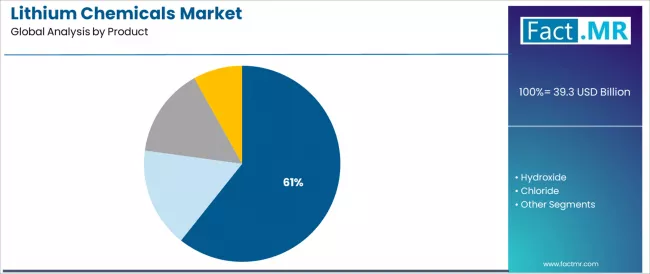
Lithium Chemicals Market Analysis By Product | Source: Fact.MR
Carbonate represents the dominant force in the lithium chemicals market, capturing 60.7% of total market share in 2025. This established lithium compound category encompasses solutions featuring lithium carbonate with battery-grade specifications and technical-grade variants, including advanced high-purity formulations achieving 99.5%+ Li2CO3 content that enable reliable cathode material production across LFP (lithium iron phosphate) battery chemistry and established NMC formulations requiring carbonate-based precursor materials worldwide.
The carbonate segment's market leadership stems from its cost-effective production economics, with solutions capable of meeting battery specifications through conventional processing from spodumene concentrate or brine sources while maintaining competitive pricing and widespread commercial availability across global lithium supply chains.
The hydroxide segment maintains substantial market share at 22.4%, serving high-nickel cathode production and advanced battery chemistries requiring lithium hydroxide monohydrate for optimal electrochemical performance across premium electric vehicles and long-range applications. These solutions offer superior performance for demanding chemistry requirements while providing sufficient justification for premium pricing through enhanced energy density capabilities.
The hydroxide segment demonstrates the fastest growth potential, driven by automotive industry shift toward high-nickel NMC and NCA cathodes maximizing vehicle range. Within the product category, chloride at 10.3% demonstrates specialized applications in metallurgy, air conditioning, and pharmaceutical synthesis, while others including metallic lithium, lithium bromide, and specialty compounds maintain 6.6% presence through niche industrial and medical applications.
Key production advantages driving the carbonate segment include:
- Cost-effective processing with established conversion technologies enabling efficient production from spodumene concentrate and brine sources without excessive capital requirements or processing complexity
- Broad application compatibility enabling use across diverse cathode chemistries including LFP and lower-nickel NMC formulations without extensive specification modifications
- Established supply infrastructure providing reliable availability and multiple sourcing options through Australian hard rock operations and South American brine facilities
- Processing flexibility allowing production from multiple feedstock sources including mineral concentrates, brines, and recycled battery materials supporting supply diversification
By End-use, Which Segment Accounts for the Largest Market Share?
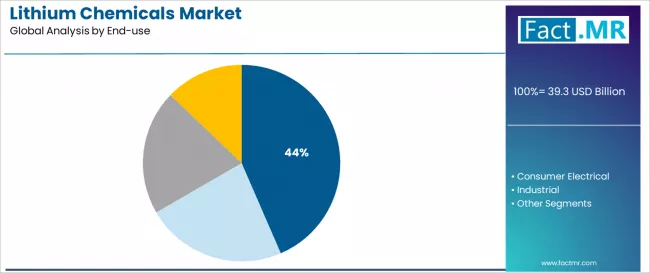
Lithium Chemicals Market Analysis By End Use | Source: Fact.MR
Automotive dominates the lithium chemicals end-use landscape with a 43.5% market share in 2025, reflecting the overwhelming demand from electric vehicle battery production and comprehensive automotive industry electrification driving primary lithium consumption worldwide.
The automotive segment's market leadership is reinforced by massive battery production volumes, expanding EV model availability, and regulatory pressure for zero-emission vehicles driving systematic battery material procurement.
Within this segment, passenger electric vehicles represent the primary consumption category, driven by mainstream EV adoption and comprehensive model launches across major automotive brands. This sub-segment benefits from declining battery costs enabling mass-market vehicle pricing and expanding consumer acceptance of electric powertrains.
The consumer electrical segment represents an important category at 28.7% market share with established presence, demonstrating steady demand through portable electronics, power tools, and consumer devices requiring lithium-ion battery power sources. This segment benefits from continuous product replacement cycles and expanding wireless device proliferation.
The industrial segment maintains significant presence at 21.2% through energy storage systems, specialty batteries, and industrial equipment applications, while other end use at 6.6% addresses pharmaceutical, lubricating grease, and specialty chemical applications.
Key market dynamics supporting end-use segment growth include:
- Automotive expansion driven by electric vehicle production growth and battery capacity increases, requiring massive lithium chemical volumes for gigafactory supply
- Consumer electrical category maintaining steady baseline demand through smartphone, laptop, and power tool battery production
- Integration of grid-scale energy storage enabling utility-scale battery deployment and renewable energy integration
- Growing emphasis on battery size increases and energy density improvements driving lithium content per vehicle growth
What are the Drivers, Restraints, and Key Trends of the Lithium Chemicals Market?
The market is driven by three concrete demand factors tied to electrification outcomes. First, explosive electric vehicle adoption and battery manufacturing capacity expansion create unprecedented lithium demand, with automotive battery production representing the dominant consumption driver requiring secure long-term supply in gigafactory operations, necessitating massive mining capacity additions. Second, declining battery costs and improving vehicle economics drive mainstream EV adoption and systematic electrification, with lithium chemical prices demonstrating volatility but overall supply growth supporting battery cost reduction trajectories enabling mass-market vehicle affordability through manufacturing scale by 2030. Third, expanding energy storage deployment and grid modernization enable renewable energy integration that drives lithium consumption while supporting decarbonization objectives and utility-scale battery installations.
Market restraints include mining development timelines and capital intensity that can challenge supply responsiveness and demand-supply balance, particularly for new lithium projects where permitting processes prove lengthy and production ramp-up requires multi-year development periods before reaching nameplate capacity. Environmental concerns and water usage controversies pose another significant obstacle, as lithium extraction from brines requires substantial water resources in arid regions while hard rock mining generates significant waste materials, potentially affecting project approval and social license to operate. Geographic concentration and geopolitical risks create additional challenges for supply security, with lithium production heavily concentrated in Australia, Chile, and China creating single-point-of-failure vulnerabilities and strategic material dependencies.
Key trends indicate accelerated direct lithium extraction technology adoption in developed markets, particularly North America, where innovative extraction methods from geothermal brines, oil field waters, and unconventional sources offer reduced environmental impact, faster production timelines, and domestic supply development compared to conventional brine evaporation or hard rock mining. Supply chain localization trends toward regional battery material production with integrated mining-to-cathode operations enable supply security and reduced transportation footprint supporting automotive industry reshoring initiatives. However, the market thesis could face disruption if significant advances in alternative battery chemistries including sodium-ion or major breakthroughs in lithium-free energy storage reduce lithium intensity per kWh or eliminate lithium requirements entirely.
Analysis of the Lithium Chemicals Market by Key Countries
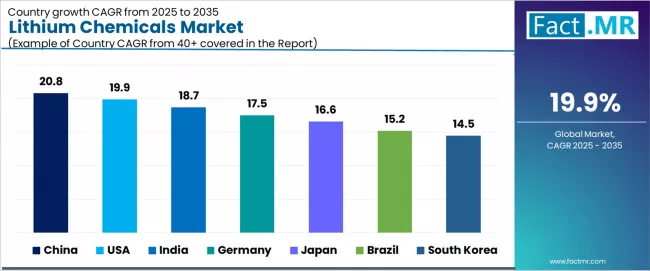
Lithium Chemicals Market Cagr Analysis By Country | Source: Fact.MR
| Country | CAGR (2025 to 2035) |
|---|---|
| China | 20.8% |
| USA | 19.9% |
| India | 18.7% |
| Germany | 17.5% |
| Japan | 16.6% |
| Brazil | 15.2% |
| South Korea | 14.5% |
Source: Fact.MR analysis. Updated Dec 3, 2025
The global lithium chemicals market is expanding explosively, with China leading at a 20.8% CAGR through 2035, driven by massive EV battery manufacturing investments and comprehensive supply chain integration supporting world-leading battery production capacity. USA follows at 19.9%, supported by domestic lithium supply chain expansion and Inflation Reduction Act incentives promoting localized production. India records 18.7%, reflecting fast EV growth and grid storage programs supporting comprehensive electrification initiatives.
Germany advances at 17.5%, leveraging EU Green Deal and local battery factories driving automotive industry transformation. Japan posts 16.6%, focusing on advanced battery R&D and automotive sector integration supporting technology leadership, while Brazil grows robustly at 15.2%, emphasizing increasing lithium mining and exports. South Korea demonstrates 14.5% growth, anchored by strong battery production ecosystem.
How is China Leading Global Market Expansion?
China demonstrates the strongest growth potential in the lithium chemicals market with a CAGR of 20.8% through 2035. The country's leadership position stems from world-leading battery manufacturing capacity, extensive electric vehicle production volumes, and comprehensive lithium processing infrastructure driving domestic consumption and export-oriented battery production.
Growth is concentrated in major battery production regions and lithium processing hubs, including Jiangxi, Sichuan, Qinghai, and Jiangsu, where integrated operations convert lithium raw materials into battery-grade chemicals supporting gigafactory supply beyond basic chemical processing.
Supply channels through domestic lithium processors, integrated mining-to-battery companies, and comprehensive trading networks expand material availability across cathode manufacturers and cell producers. The country's vertically integrated lithium supply chain from African and Australian mineral imports through domestic processing to battery production provides strong momentum for consumption growth, including comprehensive dominance of global lithium chemical processing capacity and battery manufacturing.
Key market factors:
- Battery manufacturing concentrated in industrial zones with extensive gigafactory capacity consuming massive lithium chemical volumes
- Lithium processing leadership through domestic refining capacity converting imported concentrates and domestic brine resources
- Comprehensive electric vehicle production, including BYD, CATL-supplied OEMs, and emerging manufacturers with proven market dominance
- Vertical integration from lithium trading and processing through cathode material production and battery cell manufacturing
Why is USA Emerging as a Supply Chain Development Leader?
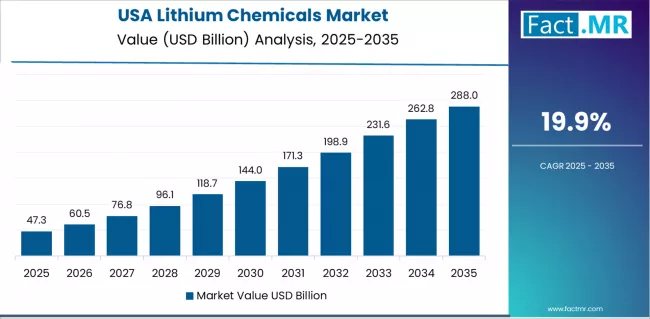
Lithium Chemicals Market Country Value Analysis | Source: Fact.MR
In major lithium project regions including Nevada, North Carolina, Arkansas, and California, the development of domestic lithium production is accelerating across mining projects, driven by Inflation Reduction Act requirements and automotive industry commitments to localized supply chains. The market demonstrates explosive growth momentum with a CAGR of 19.9% through 2035, linked to domestic lithium supply chain expansion and comprehensive federal support for critical mineral production.
American projects are implementing diverse extraction technologies including hard rock mining, brine processing, and direct lithium extraction to establish domestic production while meeting requirements for clean energy supply chain development. The country's expanding battery manufacturing capacity and automotive electrification create ongoing demand for domestic lithium chemicals, while strategic emphasis on supply chain resilience drives comprehensive upstream development from mining through chemical processing.
Key development areas:
- Lithium project development including Nevada lithium clay deposits, North Carolina spodumene mining, and Arkansas brine operations
- Battery manufacturing expansion through gigafactory construction and automotive OEM investments requiring domestic lithium supply
- Technology development enabling direct lithium extraction and innovative processing reducing environmental impact
- Government support programs including Inflation Reduction Act domestic content requirements and Defense Production Act invocation
What Drives India Market Electrification Growth?
India market expansion is driven by aggressive electric vehicle adoption targets, including comprehensive two-wheeler and three-wheeler electrification requiring battery manufacturing capacity development. The country demonstrates substantial growth potential with a CAGR of 18.7% through 2035, supported by fast EV growth and grid storage programs promoting domestic battery production and lithium chemical demand.
Indian initiatives face implementation challenges related to import dependence and domestic processing capacity limitations, necessitating strategic partnerships and technology investments. However, massive vehicle market and government electrification mandates create favorable conditions for battery material consumption growth, particularly among facilities pursuing production-linked incentives where domestic manufacturing drives lithium chemical procurement and processing capability development.
Market characteristics:
- Electric vehicle adoption acceleration through two-wheeler and three-wheeler segments with substantial market volumes
- Battery manufacturing investment including domestic gigafactory announcements and foreign partnership facilities
- Future projections indicate continued import dependence with gradual domestic processing capacity development
- Growing emphasis on lithium exploration and potential domestic mining addressing supply security objectives
How does Germany Demonstrate Green Transition Leadership?
The market for lithium chemicals in Germany leads in automotive electrification based on comprehensive manufacturer commitments and battery gigafactory investments supporting European lithium demand. The country shows strong potential with a CAGR of 17.5% through 2035, driven by EU Green Deal objectives and local battery factories requiring reliable lithium supply in major automotive regions.
German automotive manufacturers are implementing comprehensive electrification strategies through platform development and battery procurement for supply security, particularly in premium vehicle segments requiring high-performance battery systems. Supply channels through European lithium projects, international sourcing agreements, and strategic partnerships expand material availability across battery manufacturing operations and automotive production facilities.
Leading market segments:
- Automotive battery production in major manufacturing centers implementing high-nickel cathode chemistries requiring lithium hydroxide
- Battery manufacturing facilities achieving operational status through automotive OEM joint ventures and dedicated cell producers
- Strategic collaborations between German automotive companies and lithium producers expanding long-term supply agreements
- Focus on European lithium project development including Portuguese mining and German processing facilities addressing supply localization
What Positions Japan for Technology Excellence Leadership?
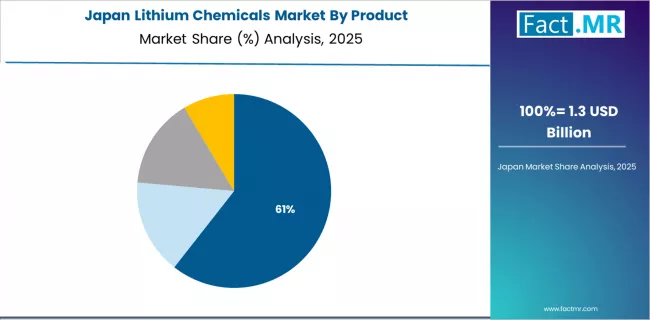
Lithium Chemicals Market Japan Market Share Analysis By Product | Source: Fact.MR
Japan's lithium chemicals market demonstrates sophisticated technology focus emphasizing advanced battery development and automotive integration, with documented leadership in solid-state battery research and high-performance cathode materials achieving breakthrough energy density in development programs.
The country maintains solid growth momentum with a CAGR of 16.6% through 2035, driven by advanced battery R&D and automotive sector integration emphasizing quality-focused material specifications that support premium vehicle applications. Major battery and automotive operations showcase advanced material requirements where high-purity lithium chemicals integrate systematically with precision manufacturing and comprehensive quality assurance protocols.
Market development factors:
- Automotive manufacturers and battery companies leading advanced chemistry development with emphasis on solid-state commercialization
- High-purity material specifications supporting premium battery production and advanced cathode formulations
- Strategic sourcing relationships establishing long-term supply agreements with Australian and South American lithium producers
- Emphasis on supply chain management and quality assurance addressing automotive industry standards and performance requirements
How does Brazil Show Mining Development Leadership?
Brazil's lithium chemicals market demonstrates emerging production capabilities focused on hard rock mining development and export-oriented lithium compound production, with documented project advancement achieving substantial resource delineation in pegmatite deposits across Minas Gerais and other mineral-rich regions. The country maintains solid growth momentum with a CAGR of 15.2% through 2035, driven by increasing lithium mining and exports supporting global supply chain diversification beyond Australian and Chilean dominance.
Brazilian mining projects are implementing comprehensive development programs capable of producing spodumene concentrate and potentially integrated lithium chemicals to serve international battery manufacturers while establishing domestic processing capabilities. The country's extensive mineral resources and established mining sector create ongoing opportunities for lithium production, while strategic emphasis on value-added processing drives comprehensive project development from exploration through chemical production.
Key market characteristics:
- Lithium mining development including advanced exploration projects and feasibility studies for hard rock deposits
- Export orientation targeting international lithium chemical processors and battery material supply chains
- Mining sector expertise supporting rapid project development and established regulatory frameworks
- Strategic positioning as alternative lithium source addressing supply chain diversification objectives for global battery manufacturers
What characterizes South Korea's Battery Production Integration?
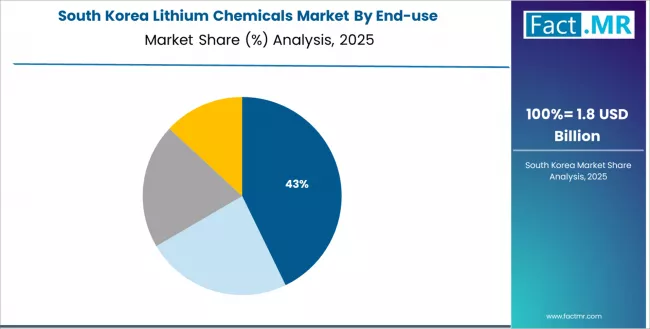
Lithium Chemicals Market South Korea Market Share Analysis By End Use | Source: Fact.MR
South Korea's lithium chemicals market demonstrates concentrated consumption focused on leading battery manufacturers and automotive supply chain integration, with documented procurement strategies achieving comprehensive long-term supply agreements across diverse lithium sources supporting global gigafactory operations.
The country maintains solid growth momentum with a CAGR of 14.5% through 2035, driven by strong battery production ecosystem including LG Energy Solution, Samsung SDI, and SK On requiring reliable lithium chemical supply for global automotive partnerships.
South Korean battery operations showcase sophisticated material procurement where international sourcing and quality specifications integrate systematically with automated manufacturing and global customer requirements demanding consistent supply reliability.
Key development areas:
- Battery manufacturers leading global lithium chemical procurement with emphasis on long-term offtake agreements
- Quality specifications requiring high-purity materials and consistent particle characteristics for automated production
- International sourcing strategies diversifying supply across Australian mining, South American production, and emerging sources
- Vertical integration initiatives including minority investments in lithium mining projects and processing facilities
Europe Market Split by Country
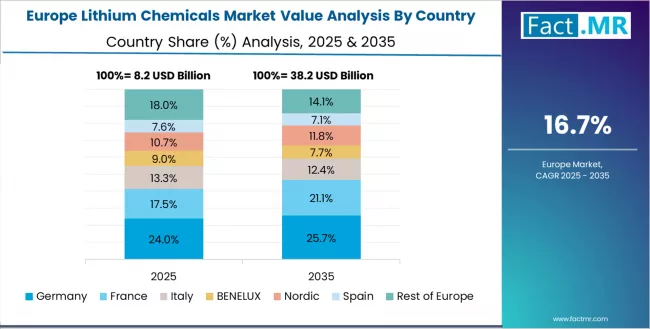
Lithium Chemicals Market Europe Country Market Share Analysis, 2025 & 2035 | Source: Fact.MR
The lithium chemicals market in Europe is projected to grow from USD 7.8 billion in 2025 to USD 46.3 billion by 2035, registering a CAGR of 19.5% over the forecast period. Germany is expected to maintain its leadership position with a 34.2% market share in 2025, adjusting to 35.6% by 2035, supported by its extensive automotive manufacturing base, comprehensive battery gigafactory investments, and strategic lithium procurement serving major European electric vehicle production.
France follows with a 18.9% share in 2025, projected to reach 18.3% by 2035, driven by automotive industry electrification and battery manufacturing initiatives in major industrial regions implementing comprehensive supply chain development. UK holds a 15.7% share in 2025, expected to maintain 15.4% by 2035 through ongoing automotive sector transformation and battery facility development.
Italy commands a 12.8% share, while Spain accounts for 10.2% in 2025. The rest of Europe region is anticipated to gain momentum, expanding its collective share from 8.2% to 9.4% by 2035, attributed to increasing lithium consumption in Nordic battery manufacturing and emerging Eastern European automotive production facilities implementing electric vehicle integration.
Competitive Landscape of the Lithium Chemicals Market
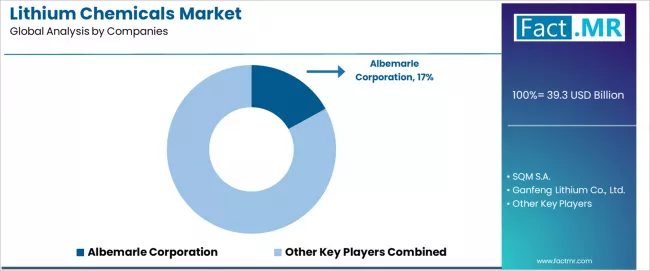
Lithium Chemicals Market Analysis By Company | Source: Fact.MR
The lithium chemicals market features approximately 15-25 meaningful players with moderate concentration, where the top three companies control roughly 40-50% of global market share through integrated mining operations, processing capabilities, and long-term supply agreements. Competition centers on production capacity, resource quality, and customer relationships rather than product differentiation alone.
Market leaders include Albemarle Corporation maintaining a 17.0% market share, SQM S.A., and Ganfeng Lithium Co., Ltd., which maintain competitive advantages through vertically integrated operations spanning mining through chemical production, diverse asset portfolios across hard rock and brine resources, and comprehensive offtake agreements with global battery manufacturers, creating stable long-term revenue streams among lithium producers serving automotive supply chains. These companies leverage operational scale and technical expertise to defend market positions while expanding production capacity through brownfield expansions and greenfield project development.
Challengers encompass established lithium producers including Arcadium Lithium (formed through Allkem-Livent merger), Pilbara Minerals Limited, and Talison Lithium Pty Ltd, which compete through high-quality spodumene production and strategic partnerships supporting battery material supply chains.
Emerging producers, including Lithium Americas Corp., Critical Elements Lithium Corporation, and regional players including SICHUAN BRIVO LITHIUM MATERIALS CO., LTD. and Infinitylithium, focus on project development and regional market supply, offering differentiated capabilities in direct lithium extraction, high-grade deposits, and specialized processing technologies.
Emerging technology developers and junior mining companies create competitive pressure through innovative extraction methods and new resource development, particularly in regions including North America and Europe, where domestic production incentives and supply chain localization provide advantages for local projects.
Market dynamics favor companies that combine resource quality with processing efficiency that addresses diverse customer requirements from cathode material producers through battery manufacturers and automotive OEMs. Strategic emphasis on sustainability credentials, supply chain transparency, and recycling integration enables differentiation in increasingly ESG-focused and security-conscious lithium chemicals market segments across battery manufacturing, energy storage, and specialty chemical applications.
Global Lithium Chemicals Market - Stakeholder Contribution Framework
Lithium chemicals represent a critical energy transition material that enables battery manufacturers and cathode material producers to manufacture lithium-ion cells and support electric vehicle production while meeting stringent purity specifications and ensuring consistent supply without excessive dependence on single-source suppliers and geographically concentrated production regions, typically providing essential material characteristics including 99.5%+ purity, controlled particle morphology, and minimal impurity levels compared to technical-grade alternatives alone while ensuring improved battery performance and comprehensive supply security outcomes.
With the market projected to grow from USD 39.25 billion in 2025 to USD 240.9 billion by 2035 at a 19.9% CAGR, these products offer compelling advantages for automotive applications, carbonate products, and diverse battery chemistries seeking reliable lithium supply. Scaling market development and sustainable growth requires coordinated action across mining development, processing technology, chemical producers, battery manufacturers, and recycling infrastructure.
How Could Governments Spur Local Development and Adoption?
- Mining Development Programs: Include lithium in critical mineral strategies, providing targeted support for exploration activities and mine development and supporting environmental assessment streamlining through regulatory efficiency initiatives.
- Processing Capacity Investment: Implement favorable tax treatment for lithium refining facilities, provide incentives for companies developing domestic chemical processing and value-added production, and establish loan guarantees supporting capital-intensive project financing.
- Supply Chain Security Initiatives: Fund strategic lithium reserves and buffer stocks, invest in domestic supply chain development from mining through battery materials, and establish offtake agreements supporting domestic project viability.
- Environmental & Social Standards: Create clear regulatory frameworks for sustainable lithium extraction, establish water management requirements and waste disposal protocols, and develop community engagement guidelines ensuring social license to operate.
- Research & Innovation Support: Establish public-private partnerships for extraction technology development, support direct lithium extraction commercialization and innovative processing methods, and create pathways for recycling technology advancement and circular economy integration.
How Could Industry Bodies Support Market Development?
- Technical Standards & Specifications: Define standardized quality grades for lithium chemicals across battery applications, establish testing protocols and purity benchmarks, and create material specifications that manufacturers can reference.
- Market Education & Transparency: Lead initiatives demonstrating lithium supply chain dynamics, emphasizing responsible sourcing, sustainability credentials, and supply-demand fundamentals supporting informed investment decisions.
- Sustainability Guidelines: Develop frameworks for environmental impact assessment, water management best practices, and social responsibility standards, ensuring responsible development across exploration and production activities.
- Professional Development: Run technical programs for mining engineers, processing specialists, and quality managers on optimizing lithium extraction, chemical processing, and quality assurance approaches in diverse geological settings.
How Could Mining Companies and Chemical Producers Strengthen the Ecosystem?
- Production Capacity Development: Develop comprehensive mining operations with efficient extraction technologies, establish processing facilities with consistent quality output, and implement automation supporting cost-competitive production and reliable supply.
- Quality Assurance Programs: Provide battery-grade material specifications, comprehensive testing documentation, and consistent quality delivery that enable customer confidence and long-term supply relationships.
- Sustainability Initiatives: Offer responsible mining practices, water recycling systems, and carbon footprint reduction programs supporting environmental objectives and social license to operate.
- Customer Partnership Development: Build collaborative relationships with battery manufacturers, establish long-term offtake agreements, and provide technical support enabling optimal material utilization and application performance.
How Could Battery Manufacturers and Automotive Companies Navigate the Market?
- Supply Security Strategies: Develop comprehensive sourcing protocols incorporating geographic diversification, multiple supplier relationships, and strategic investments, with particular focus on long-term offtake agreements and minority equity positions for supply assurance.
- Quality Specification Management: Establish rigorous material requirements addressing purity, particle size, and impurity limits through systematic supplier qualification and ongoing quality monitoring programs.
- Vertical Integration Initiatives: Implement strategic investments in upstream lithium projects, consider backward integration into chemical processing, and develop recycling capabilities supporting circular supply chains.
- Technology Collaboration: Create joint development programs addressing battery chemistry optimization, material utilization efficiency, and recycling technology advancement supporting sustainable supply chain development.
How Could Investors and Financial Enablers Unlock Value?
- Mining Project Financing: Provide project capital for established producers like Albemarle Corporation, SQM S.A., and emerging developers to fund mine construction, processing facilities, and infrastructure supporting production growth.
- Technology Development Investment: Back companies developing direct lithium extraction, innovative processing technologies, and recycling solutions that enhance efficiency and reduce environmental impact.
- Supply Chain Integration Funding: Finance vertical integration strategies combining mining with processing or battery manufacturing, creating comprehensive value chains with enhanced competitive positioning.
- Exploration & Development Support: Enable junior mining companies and exploration programs identifying new lithium resources, supporting resource diversification and future supply development addressing long-term demand growth.
Key Players in the Lithium Chemicals Market
- Albemarle Corporation
- SQM S.A.
- Ganfeng Lithium Co., Ltd.
- Arcadium Lithium
- Pilbara Minerals Limited
- Talison Lithium Pty Ltd
- Lithium Americas Corp.
- Critical Elements Lithium Corporation
- SICHUAN BRIVO LITHIUM MATERIALS CO., LTD.
- Infinitylithium
Segmentation
Scope of the Report
| Items | Values |
|---|---|
| Quantitative Units | USD 39.25 Billion |
| Product | Carbonate, Hydroxide, Chloride, Others |
| End-use | Automotive, Consumer Electrical, Industrial, Other End Use |
| Regions Covered | Asia Pacific, Europe, North America, Latin America, Middle East & Africa |
| Country Covered | China, USA, India, Germany, Japan, Brazil, South Korea, and 40+ countries |
| Key Companies Profiled | Albemarle Corporation, SQM S.A., Ganfeng Lithium Co., Ltd., Arcadium Lithium, Pilbara Minerals Limited, Talison Lithium Pty Ltd, Lithium Americas Corp., Critical Elements Lithium Corporation, SICHUAN BRIVO LITHIUM MATERIALS CO., LTD., Infinitylithium |
| Additional Attributes | Dollar sales by product and end-use categories, regional production trends across Asia Pacific, Europe, and North America, competitive landscape with mining companies and chemical processors, product specifications and purity requirements, integration with battery manufacturing and cathode material production, innovations in extraction technologies and sustainable processing methods, and development of circular economy solutions with recycling capabilities and second-life applications. |
Source: Fact.MR analysis. Updated Dec 3, 2025
Lithium Chemicals Market by Segments
-
Product :
- Carbonate
- Hydroxide
- Chloride
- Others
-
End-use :
- Automotive
- Consumer Electrical
- Industrial
- Other End Use
-
Region :
- Asia Pacific
- China
- Japan
- South Korea
- India
- Australia
- Thailand
- Rest of Asia Pacific
- Europe
- Germany
- UK
- France
- Italy
- Spain
- Denmark
- Sweden
- Norway
- Rest of Europe
- North America
- USA
- Canada
- Mexico
- Latin America
- Brazil
- Argentina
- Rest of Latin America
- Middle East & Africa
- South Africa
- Saudi Arabia
- UAE
- Kuwait
- Rest of Middle East & Africa
- Asia Pacific
Frequently Asked Questions
How big is the lithium chemicals market in 2025?
What will be the size of lithium chemicals market in 2035?
How much will be the lithium chemicals market growth between 2025 and 2035?
What are the key product types in the lithium chemicals market?
Which end-use segment to contribute significant share in the lithium chemicals market in 2025?
Who worked on this report


Preview the report firsthand - request a free sample
Free SampleGet the brochure for pricing and purchase details
Download PDF