- Base Value(2026): 18.5 Bn
- Estimated Value(2026): 18.5 Bn
- Forecast Value (2036): 25.6 Bn
- CAGR (2026 - 2036): 3.3%
Brake Discs and Rotors Market Forecast and Outlook 2026 to 2036
In 2025, the brake discs and rotors market was valued at approximately USD 17.9 billion. Based on Fact.MR analysis, demand for brake discs and rotors is estimated to reach USD 18.5 billion in 2026 and expand to USD 25.6 billion by 2036, registering a CAGR of 3.3% during the forecast period. Growth is linked to sustained global vehicle parc expansion, regulatory enforcement of braking system standards, and recurring replacement demand across passenger and commercial vehicle fleets.
The market adds close to USD 7.7 billion in value over the forecast period, reflecting steady compounding driven by replacement demand rather than rapid unit volume expansion. Early growth is supported by rising aftermarket turnover in Asia Pacific and Latin America, while mid-term performance aligns with OEM sourcing stability and material shifts toward high carbon and coated rotors. In later years, electrified vehicle penetration moderate’s friction brake usage, extending replacement intervals but supporting higher realised value per unit through specification driven rotor designs.
India records the fastest growth at 4.6% CAGR supported by vehicle ownership growth and expanding service networks. Indonesia follows at 4.4% driven by domestic assembly and aftermarket activity, while China grows at 4.1% linked to fleet expansion and inspection compliance. Mexico posts 3.9% aligned with export oriented vehicle production. Mature markets such as the United States at 2.1% and Germany at 1.7% remain replacement led, constrained by longer service intervals, stable vehicle populations, and strict homologation frameworks.
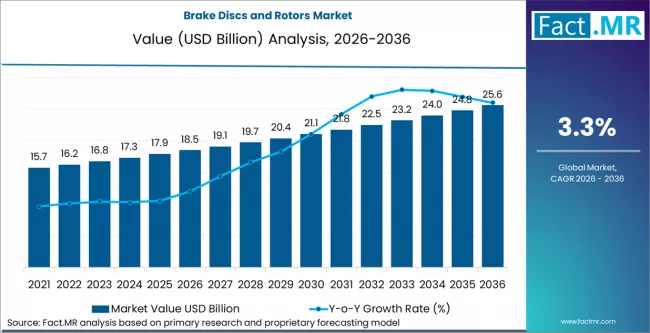
Brake Discs And Rotors Market Market Value Analysis | Source: Fact.MR
Summary of Brake Discs and Rotors Market
Market Definition
- The brake discs and rotors market comprises metal braking components used in disc brake systems to convert kinetic energy into heat through friction, manufactured to meet mandatory safety and performance requirements under UNECE Regulation No. 13 and UNECE Regulation No. 90.
Demand Drivers
- Mandatory braking system compliance under UNECE and national vehicle type approval regulations requires validated disc and rotor performance across passenger and commercial vehicles.
- A growing global vehicle parc sustains recurring replacement demand, as discs and rotors are wear components replaced based on mileage, inspection outcomes, and safety regulations.
- Expansion of aftermarket service networks in Asia Pacific and Latin America increases availability and turnover of replacement brake discs and rotors in aging vehicle fleets.
Key Segments Analyzed
- Product type: Vented brake discs lead with about 53% share due to superior heat dissipation required for mixed driving conditions and regulatory thermal performance validation.
- Material: Cast iron dominates with roughly 59% share because of stable friction behavior, thermal conductivity, and compatibility with high volume OEM manufacturing processes. [1]
- Geography: Asia Pacific represents the fastest growing region, led by India, Indonesia, and China, where fleet expansion and inspection compliance drive sustained replacement demand.
Analyst Opinion at Fact.MR
- Shambhu Nath Jha, Principal Consultant at Fact.MR, opines, ‘CXOs will find that brake discs and rotors demand is structurally anchored in vehicle parc growth and regulatory braking compliance, with long term value shaped more by replacement cycles and material validation than short term vehicle production volatility.’
Strategic Implications / Executive Takeaways
- Align product development with UNECE R13 and R90 performance requirements to secure OEM and regulated aftermarket approvals.
- Focus on high carbon and coated rotor variants to offset longer service intervals in hybrid and electric vehicles through higher per unit realization.
- Strengthen aftermarket distribution and installer relationships in high growth regions to capture replacement driven demand from expanding vehicle fleets.
Methodology
- Market sizing is based on vehicle production volumes, registered vehicle parc data, and average brake disc replacement cycles validated against national transport statistics and UN Comtrade trade flows.
- Technical assumptions reference UNECE braking regulations and ISO brake component standards governing material performance and dimensional tolerances.
- Findings are validated through primary interviews with OEM suppliers, aftermarket distributors, and automotive engineers, and cross checked against regulatory and customs data.
Brake Discs and Rotors Market Definition
The brake discs and rotors market covers metal components used in disc brake systems to slow or stop vehicles through friction. When brake pads clamp onto a rotating disc or rotor, kinetic energy converts into heat, which reduces wheel speed. These components are manufactured mainly from cast iron, steel, or composite materials and are designed to meet safety and performance requirements defined in UNECE Regulation No. 13 for braking systems [2]. Brake discs and rotors are sold to vehicle manufacturers and aftermarket suppliers for use in passenger cars, commercial vehicles, and two wheelers.
Brake Discs and Rotors Market Inclusions
The report covers global and regional market size estimates in volume and value terms with a forecast period from 2026 to 2036. Segmentation includes product type such as solid and ventilated discs, material categories referenced in ISO brake component standards [3], application by vehicle type including passenger and commercial vehicles, and end use covering original equipment and replacement demand. The scope also includes regional demand patterns, pricing benchmarks, and international trade flows reported through UN Comtrade.
Brake Discs and Rotors Market Exclusions
The scope excludes brake pads, calipers, drums, hydraulic fluids, and electronic braking components such as ABS modules. Complete brake assemblies sold as integrated systems are not included. Motorsport specific brake discs, carbon carbon racing rotors, and prototype braking components without road homologation are excluded. Downstream services such as installation, maintenance, and repair labor are outside the scope, along with laboratory testing programs and experimental friction materials.
Brake Discs and Rotors Market Research Methodology
- Primary Research: Primary research involved interviews with brake disc manufacturers, automotive OEM suppliers, aftermarket distributors, vehicle service operators, and automotive engineers.
- Desk Research: Desk research used vehicle production statistics from national transport authorities, braking system regulations from UNECE, ISO brake component standards, customs trade data from UN Comtrade, and company annual reports and technical product disclosures filed with securities regulators.
- Market Sizing and Forecasting: Market sizing applied a hybrid top down and bottom up model using vehicle production volumes, average disc replacement cycles, and component fitment rates by vehicle category.
Data Validation and Update Cycle
Outputs were cross checked against automotive registration data, trade statistics, OEM supply disclosures, and regulatory documentation, with updates applied when verified public data sources issue revisions.
Segmental Analysis
Brake Discs and Rotors Market Analysis by Product Type
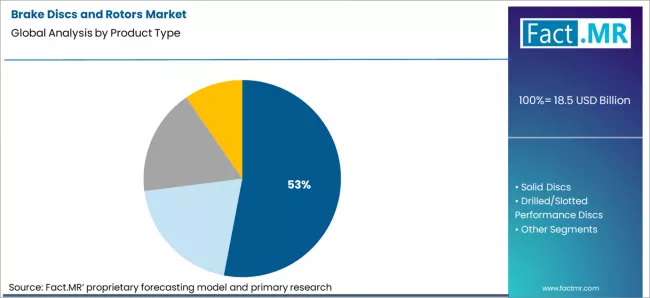
Brake Discs And Rotors Market Analysis By Product Type | Source: Fact.MR
Based on Fact.MR analysis, consumption of vented brake discs is estimated to hold 53% share in 2025. Fact.MR analysts note that vented discs are preferred because internal air channels improve heat dissipation during repeated braking cycles, which reduces fade under high thermal loads. As per Fact.MR, this design addresses buyer requirements for thermal control and consistent braking performance in passenger vehicles and light commercial vehicles operating under mixed driving conditions.
- OEM specification: Bosch documents the use of vented brake discs in original equipment braking systems to manage heat buildup and extend service life under normal and severe driving conditions.
- Product engineering: Brembo publishes technical descriptions showing vented disc designs used across standard and performance vehicle platforms to improve cooling efficiency.
- Design guidance: Fact.MR analysts reference Society of Automotive Engineers technical papers that describe vented disc geometry as a primary method for managing brake system thermal loads.
Brake Discs and Rotors Market Analysis by Material
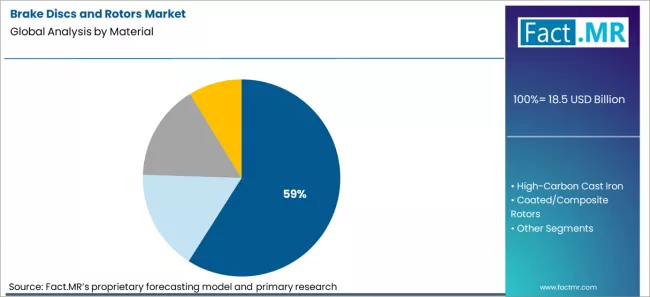
Brake Discs And Rotors Market Analysis By Material | Source: Fact.MR
Based on Fact.MR analysis, consumption of cast iron brake discs and rotors is estimated to hold 59% share in 2025. Fact.MR opines that cast iron leads due to its stable friction characteristics, thermal conductivity, and cost efficiency in high-volume vehicle production. As per Fact.MR, this material addresses manufacturer requirements for predictable braking behavior and compatibility with established machining and foundry processes.
- Material Specification: Tenneco identifies grey cast iron as a standard material for brake rotors due to its damping capacity and wear behavior in OEM applications.
- Manufacturing Practice: American Foundry Society technical publications describe the widespread use of cast iron in automotive brake components because of process stability and material availability.
- Performance Reference: Fact.MR analysts reference vehicle testing data and engineering literature that document consistent friction coefficients of cast iron rotors across typical operating temperature ranges.
Brake Discs and Rotors Market Drivers, Restraints, And Opportunities
Fact.MR analysis indicates that the brake discs and rotors market exists as a core safety component segment of the global automotive aftermarket and original equipment supply chain, driven by vehicle production volumes and mileage-based replacement demand. As per Fact.MR assessment, brake discs and rotors provide friction surface and heat dissipation for disc braking systems, an arrangement specified in automotive safety regulations and vehicle type-approval standards such as UNECE Regulation No. 90, which sets braking performance requirements for passenger cars and commercial vehicles. Fact.MR analysts observe that current market size is shaped by global fleet growth, ageing vehicle populations, and mandated safety test requirements that include rotor performance under dynamic braking conditions.
Fact.MR is of the opinion that the market is undergoing a gradual transition in application demand as electrification, advanced materials, and lightweighting influence component design and replacement cycles. Based on Fact.MR assessment, internal combustion engine vehicle (ICEV) populations continue to drive baseline demand because of established maintenance patterns, but growth in hybrid and electric vehicles (HEVs/EVs) is shifting demand toward rotors integrated with regenerative brake systems and higher heat tolerance materials. Electrified powertrains reduce friction braking use under normal driving conditions, which can extend service life of discs and rotors; this dynamic results in higher unit value niche replacements and longer replacement intervals, meaning total shipment volume gains are moderate even where premium value segments grow. Fact.MR analysis suggests this uneven mix of application shifts defines near-term market dynamics.
- Regulated Brake Performance Standards: Fact.MR analysts note that compliance with vehicle braking component performance standards such as UNECE Regulation No. 90 influences material selection, dimensional tolerances, and test acceptance criteria for brake discs and rotors used in OEM and aftermarket applications [4].
- Electrification Impact On Replacement Cycles: Based on Fact.MR assessment, increased adoption of hybrid and electric vehicles alters brake usage patterns because regenerative braking reduces reliance on friction braking, leading to longer service life for discs and rotors in certain vehicle segments.
- Asia Pacific Automotive Production Growth: Fact.MR opines that expanding automotive manufacturing in China, India, and Southeast Asia supports regional production and aftermarket stocking of brake discs and rotors, aligning with domestic fleet expansion and export oriented OEM capacity.
Regional Analysis
Based on regional assessment, the brake discs and rotors sector is analyzed across North America, Latin America, Europe, East Asia, South Asia, and other emerging automotive manufacturing regions, spanning more than 40 countries. Regional performance varies according to vehicle production volumes, replacement demand in the aftermarket, and regulatory standards related to braking performance and safety. The report also presents a comparative market attractiveness evaluation grounded in region-specific demand trends.
Brake Discs and Rotors Market CAGR Analysis by Country (2026-2036)
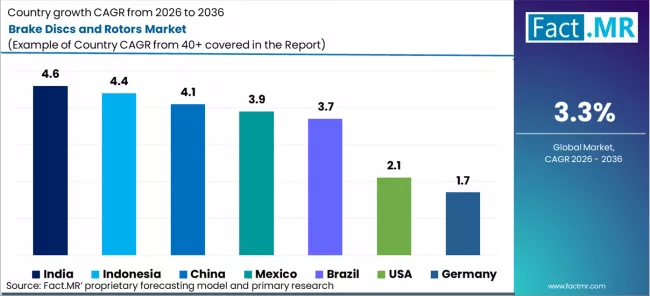
Brake Discs And Rotors Market Cagr Analysis By Country | Source: Fact.MR
| Country | CAGR |
|---|---|
| India | 4.6% |
| Indonesia | 4.4% |
| China | 4.1% |
| Mexico | 3.9% |
| Brazil | 3.7% |
| United States | 2.1% |
| Germany | 1.7% |
| Japan | 1.3% |
Source: Fact.MR analysis. Updated Feb 17, 2026
Source: Fact.MR analysis, based on proprietary forecasting models and primary research.
Asia Pacific Brake Discs and Rotors Market Analysis
Asia Pacific functions as a production- and regulation-aligned automotive components region for brake discs and rotors, supported by high vehicle assembly volumes and mandatory braking performance standards. Demand follows national automotive safety regulations, homologation norms, and OEM sourcing requirements. Usage spans passenger vehicles, commercial vehicles, and two-wheelers, with specifications enforced through vehicle type approval systems and public transport fleet procurement.
- India: Demand for brake discs and rotors in India is projected to rise at 4.6% CAGR through 2036. Application is governed by Automotive Industry Standards under AIS norms updated in 2021 and reinforced through OEM sourcing for BS-VI compliant vehicles produced during 2022-2023, as per Fact.MR.
- Indonesia: Demand for brake discs and rotors in Indonesia is projected to rise at 4.4% CAGR through 2036. Use is regulated under vehicle safety standards issued by the Ministry of Transportation in 2020 and reinforced through domestic vehicle production programs reported during 2022, according to Fact.MR.
- China: Demand for brake discs and rotors in China is projected to rise at 4.1% CAGR through 2036. Application follows braking performance requirements under GB automotive standards revised in 2021 and reinforced through passenger vehicle production and inspection systems applied nationwide, as per Fact.MR.
Fact.MR’s analysis of the brake discs and rotors market in Asia Pacific consists of country-wise assessment that includes India, Indonesia, and China. Readers can find vehicle safety standards, production references, and component specification frameworks.
Latin America Brake Discs and Rotors Market Analysis
Latin America operates as an OEM- and replacement-driven market for brake discs and rotors, with demand tied to vehicle assembly activity and national road safety compliance. Adoption is governed by homologation rules, inspection regimes, and fleet renewal programs rather than discretionary aftermarket selection.
- Mexico: Demand for brake discs and rotors in Mexico is projected to rise at 3.9% CAGR through 2036. Usage follows NOM automotive safety standards enforced during vehicle manufacturing and reinforced through export-oriented OEM production for North America in 2022, according to Fact.MR.
- Brazil: Demand for brake discs and rotors in Brazil is projected to rise at 3.7% CAGR through 2036. Application is governed by CONTRAN braking regulations and reinforced through domestic vehicle production and inspection requirements applied during 2021-2022, as per Fact.MR.
Fact.MR’s analysis of the brake discs and rotors market in Latin America consists of country-wise assessment that includes Mexico and Brazil. Readers can find homologation rules, inspection frameworks, and production-linked demand references.
North America Brake Discs and Rotors Market Analysis
North America functions as a standards-led automotive components market where brake discs and rotors are governed by federal safety regulations, OEM specifications, and public fleet procurement rules. Demand is shaped by replacement cycles and compliance-driven component sourcing.
- United States: Demand for brake discs and rotors in the United States is projected to rise at 2.1% CAGR through 2036. Application is governed by FMVSS braking standards and reinforced through OEM production and public fleet replacement programs implemented during 2021-2022, as per Fact.MR.
Fact.MR’s analysis of the brake discs and rotors market in North America consists of country-wise assessment that includes the United States. Readers can find federal safety standards and vehicle production references.
Europe Brake Discs and Rotors Market Analysis
Europe operates as a regulation-led automotive components market where brake discs and rotors are specified under harmonized vehicle safety and type approval frameworks. Adoption is driven by compliance with braking performance, emissions-related wear limits, and inspection regimes.
- Germany: Demand for brake discs and rotors in Germany is projected to rise at 1.7% CAGR through 2036. Use follows EU type approval regulations and braking system standards applied in passenger vehicle production and inspection cycles during 2021-2022, according to Fact.MR.
- Japan: Demand for brake discs and rotors in Japan is projected to rise at 1.3% CAGR through 2036. Application is governed by Road Transport Vehicle Act braking requirements and reinforced through domestic vehicle certification systems applied during 2021-2022, as per Fact.MR.
Fact.MR’s analysis of the brake discs and rotors market in Europe consists of country-wise assessment that includes Germany and Japan. Readers can find regulatory frameworks, inspection regimes, and component compliance references.
Competitive Landscape of Brake Discs and Rotors Market
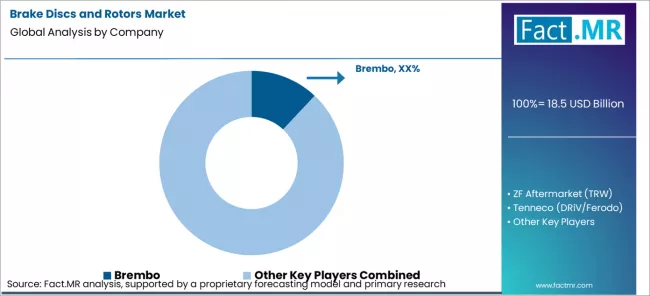
Brake Discs And Rotors Market Analysis By Company | Source: Fact.MR
As per Fact.MR analysis, the 2026 brake discs and rotors market is driven by validated safety performance and material reliability. Brembo and ZF Aftermarket (TRW) provide high-performance disc assemblies that maintain consistent braking under varying loads, increasing adoption in premium and performance vehicles. Tenneco (DRiV/Ferodo) and Nisshinbo focus on friction stability and thermal resilience, improving trust among professional installers and safety inspectors. Aisin and Akebono offer rotor architectures with documented NVH performance, reducing warranty claims and enhancing consumer satisfaction. Bosch and Hitachi Astemo ensure multi-region compliance and control system readiness, supporting OEM and aftermarket uptake. ADVICS and EBC Brakes use specialized materials and coatings to improve wear resistance, sustaining demand in niche segments. Validated performance, regulatory adherence, and OEM alignment reinforce positions and create enduring competitive moats beyond price competition.
Recent Industry Developments
- Launch of Mass-Market "Brake-by-Wire" Systems (Bosch): In late 2025, Robert Bosch GmbH successfully completed a 3,300 km public road test of its new hydraulic brake-by-wire system. This technology eliminates the mechanical link between the pedal and the rotor, allowing for "customizable" pedal feel and significantly reducing weight. Bosch confirmed the official market launch for Fall 2025/Early 2026, with orders already secured from multiple global OEMs.
- Strategic Expansion into High-Performance Electronics (Brembo): In early 2026, Brembo finalized the integration of Öhlins Racing (acquired in 2025 for $405 million) and announced a new strategic partnership with JAC Group. The goal is to move beyond hardware (discs/rotors) into "intelligent" braking solutions that combine Brembo’s SENSIFY™ software with advanced suspension and sensor data.
Key Players in Brake Discs and Rotors Market
- Brembo
- ZF Aftermarket (TRW)
- Tenneco (DRiV/Ferodo)
- Nisshinbo
- Aisin
- Akebono
- Bosch
- Hitachi Astemo
- ADVICS
- EBC Brakes
Bibliography
- [1] International Organization for Standardization. (2019). Road vehicles - Braking systems - Performance and test methods for brake components. ISO.
- [2] United Nations Economic Commission for Europe. (2015). UNECE Regulation No. 13: Uniform provisions concerning the approval of vehicles of categories M, N and O with regard to braking. UNECE.
- [3] International Organization for Standardization. (2020). Road vehicles - Disc brake systems - Terminology and general requirements. ISO.
- [4] United Nations Economic Commission for Europe. (2011). UNECE Regulation No. 90: Uniform provisions concerning the approval of replacement brake linings, discs and drums. UNECE.
- [5] Robert Bosch GmbH. (2025). Bosch completes public road testing of hydraulic brake-by-wire system. Bosch Media Service.
- [6] Brembo S.p.A. (2026). Brembo strengthens intelligent braking strategy through integration of Öhlins Racing and new OEM partnerships. Brembo Group.
Segmentation
Scope of the Report
| Metric | Value |
|---|---|
| Quantitative Units | USD 18.5 billion (2026) to USD 25.6 billion (2036), CAGR 3.3% |
| Market Definition | The brake discs and rotors market covers metal components used in disc brake systems that convert kinetic energy into heat through friction. Products are designed to meet safety and performance requirements under UNECE Regulation No. 13 and UNECE Regulation No. 90. Components are manufactured mainly from cast iron, high carbon alloys, and coated composites and are used in passenger cars, SUVs, light commercial vehicles, and medium & heavy commercial vehicles. |
| Product Type Segmentation | Vented Discs, Solid Discs, Drilled/Slotted Performance Discs, Drum Rotors/Other |
| Material Segmentation | Cast Iron, High-Carbon Cast Iron, Coated/Composite Rotors, Other |
| Vehicle Type Segmentation | Passenger Cars, SUVs/Crossovers, Light Commercial Vehicles, Medium & Heavy Commercial Vehicles |
| Sales Channel Segmentation | Aftermarket, OEM Fitment, Fleet Service, Other |
| Regions Covered | Asia Pacific, Europe, North America, Latin America, Middle East & Africa |
| Countries Covered | India, Indonesia, China, Mexico, Brazil, United States, Germany, Japan |
| Key Companies Profiled | Brembo, ZF Aftermarket (TRW), Tenneco (DRiV/Ferodo), Nisshinbo, Aisin, Akebono, Bosch, Hitachi Astemo, ADVICS, EBC Brakes |
| Forecast Period | 2026 to 2036 |
| Approach | Hybrid top-down and bottom-up modeling using vehicle parc, OEM production, and average replacement cycles. Desk research utilized UNECE braking regulations, ISO brake component standards, UN Comtrade trade data, and public transport statistics. Primary interviews were conducted with OEM suppliers, aftermarket distributors, and automotive engineers. |
Source: Fact.MR analysis. Updated Feb 17, 2026
Brake Discs and Rotors Market Analysis by Segments
-
By Product Type :
- Vented Discs
- Solid Discs
- Drilled/Slotted Performance Discs
- Drum Rotors/Other
-
By Material :
- Cast Iron
- High-Carbon Cast Iron
- Coated/Composite Rotors
- Other
-
By Vehicle Type :
- Passenger Cars
- SUVs/Crossovers
- Light Commercial Vehicles
- Medium & Heavy Commercial Vehicles
-
By Sales Channel :
- Aftermarket
- OEM Fitment
- Fleet Service
- Other
-
Region :
- Asia Pacific
- India
- China
- Japan
- South Korea
- Indonesia
- Australia & New Zealand
- ASEAN
- Rest of Asia Pacific
- Europe
- Germany
- Italy
- France
- United Kingdom
- Spain
- Benelux
- Nordics
- Central & Eastern Europe
- Rest of Europe
- North America
- United States
- Canada
- Mexico
- Latin America
- Brazil
- Argentina
- Chile
- Rest of Latin America
- Middle East & Africa
- Kingdom of Saudi Arabia
- United Arab Emirates
- South Africa
- Turkey
- Rest of Middle East & Africa
- Asia Pacific
Frequently Asked Questions
How large is the brake discs and rotors market in 2026?
What is the projected market size by 2036?
What CAGR is expected from 2026 to 2036?
How much value will the market add over the forecast window?
What structurally governs demand in this market?
Is growth mainly driven by vehicle production cycles or replacement demand?
Which product type leads the market by share?
Why do vented discs dominate mixed-use vehicles?
Which material dominates brake discs and rotors demand?
What material shift is shaping mid-period value growth?
How do hybrids and EVs affect long-term rotor replacement demand?
Which country records the fastest growth?
What is Indonesia’s projected CAGR?
What is China’s projected CAGR?
What is Mexico’s projected CAGR and what drives it?
What is Brazil’s projected CAGR?
How does the United States market grow relative to Asia?
What is Germany’s projected CAGR?
What is Japan’s projected CAGR?
What should suppliers prioritize to protect pricing and approvals?
Who worked on this report


Preview the report firsthand - request a free sample
Free SampleGet the brochure for pricing and purchase details
Download PDF