- Base Value(2025): 5.2 Bn
- Estimated Value(2026): 5.5 Bn
- Forecast Value (2036): 10.0 Bn
- CAGR (2026 - 2036): 6.0%
Electric Brake Actuator Systems for Passenger Vehicles Market Forecast and Outlook by Fact.MR
- The electric brake actuator systems market was valued at USD 5.2 billion in 2025.
- According to Fact.MR, demand is projected to reach USD 5.5 billion in 2026 and expand to USD 10.0 billion by 2036, reflecting a CAGR of 6.0% during the forecast period.
- The market is expected to create an absolute opportunity of USD 4.4 billion between 2026 and 2036, supported by the shift toward software-controlled braking systems and electrified vehicle platforms.
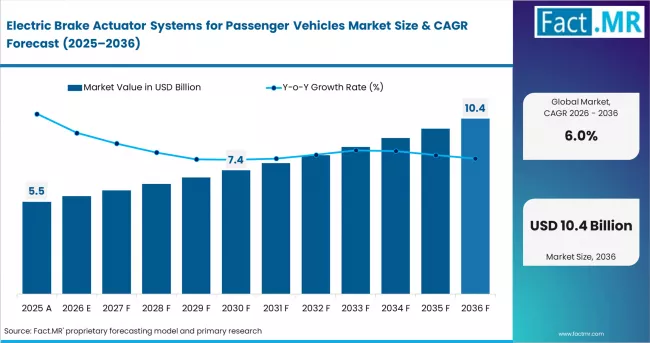
Electric Brake Actuator Systems For Passenger Vehicles Market Value Analysis | Source: Fact.MR
| Metric | Value |
|---|---|
| Estimated Value in 2026 | USD 5.5 billion |
| Forecast Value in 2036 | USD 10.0 billion |
| Forecast CAGR (2026 to 2036) | 6.0% |
Source: Fact.MR analysis. Updated May 11, 2026
Summary of the Electric Brake Actuator Systems for Passenger Vehicles Market
- Market Definition
- The electric brake actuator systems market includes electrically controlled actuation hardware that generates or coordinates braking response in passenger vehicles.
- Demand Drivers
- Passenger-car platforms need better integration between friction braking and regenerative braking.
- OEMs are moving toward brake architectures that support software-led chassis control and freer interior packaging.
- Premium and electric passenger vehicles are increasing the addressable base for brake-by-wire and integrated brake actuation.
- Key Segments Analyzed
- By Actuator Type: Electrohydraulic brake actuators are expected to account for 36.0% share in 2026, supported by their role as the first major bridge from conventional hydraulics to full by-wire braking.
- By Vehicle Propulsion: Battery electric passenger cars are projected to hold 34.0% share in 2026 because regenerative blending increases the value of electronically coordinated braking.
- By Brake Architecture: Brake-by-wire systems are expected to capture 33.0% share in 2026 as pedal decoupling and integrated motion control move closer to series deployment.
- By Geography: China leads growth with a 7.0% CAGR through 2036, supported by passenger EV scale and growing adoption of advanced brake control systems.
- Analyst Opinion at Fact.MR
- Shambhu Nath Jha, Senior Analyst at Fact.MR, states that the strongest shift in this market is that electric brake actuation is no longer a premium engineering experiment. It is becoming a practical control layer for regenerative blending, chassis software, and future automation. Once pedal feel, packaging freedom, and brake-force coordination become software issues, the actuator becomes a strategic vehicle-architecture component.”
- Strategic Implications
- Suppliers that combine fault-tolerant actuation with smooth brake blending will be better placed in next-generation passenger-car platforms.
- OEMs need brake-actuator vendors that support vehicle-level motion-control integration rather than isolated braking hardware supply.
- Aftermarket participants gain more from exact fitment and validated service procedures than from low-cost generic substitution.
- Methodology
- Market sizing used passenger-vehicle production, EV mix, and brake-by-wire penetration as baseline anchors.
- Analysis incorporated supplier positioning around hydraulic and hybrid by-wire actuation.
- Forecasts were checked against recent commercialization signals and current supplier brake-technology roadmaps.
Growth remains firm because electric brake actuation is no longer assessed only on pressure generation or brake boost capability. Buyers increasingly evaluate how effectively these systems support brake blending, motion control software, packaging flexibility, and readiness for future autonomous vehicle architectures. As vehicles integrate regenerative braking and advanced control systems, actuator performance is becoming more closely tied to total vehicle dynamics. Bosch states that its brake-by-wire systems enable shorter pedal travel and new pedal concepts, reflecting changes in cabin design and control architecture. Continental also notes that brake-by-wire technology helps maintain consistent pedal feel even when regenerative braking performs much of the deceleration in electric vehicles. [1]
China is projected to remain the fastest-growing country, with a CAGR of 7.0% over the study period, followed by Germany at 6.6% and the United States at 6.3%. Japan is expected to expand at 5.9%, South Korea at 5.8%. Fact.MR views this spread as a reflection of differences in EV adoption, premium braking content, and the speed at which passenger-car platforms migrate toward brake-by-wire and integrated motion-control architectures. The underlying technology direction described by Bosch, ZF, Continental, and Brembo supports this transition path.
Segmental Analysis
Electric Brake Actuator Systems for Passenger Vehicles Market Analysis by Actuator Type
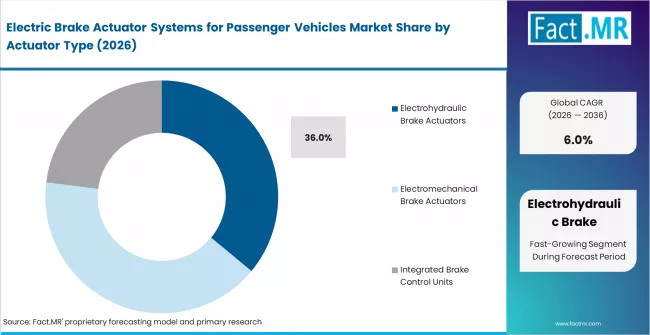
Electric Brake Actuator Systems For Passenger Vehicles Market Analysis By Actuator Type | Source: Fact.MR
Electrohydraulic brake actuators are expected to hold 36.0% share in 2026. Their lead comes from the fact that they provide a more manageable transition path from conventional hydraulic braking toward fully by-wire architectures. Bosch’s current solution uses two independent hydraulic brake actuators, and Continental’s MK C2 roadmap still builds from extensive electrohydraulic actuation experience while opening the path toward full brake-by-wire. That gives electrohydraulic formats a strong structural advantage because they preserve familiar hydraulic force generation while moving control logic into electrical and software layers.
- Transition value: Electrohydraulic actuation helps OEMs move toward by-wire control without abandoning proven hydraulic braking behavior.
- Integration support: It works well with regenerative braking coordination and existing ESC-related logic.
- Risk moderation: OEMs can capture packaging and control gains while keeping a more familiar physical braking foundation.
Electric Brake Actuator Systems for Passenger Vehicles Market Analysis by Vehicle Propulsion
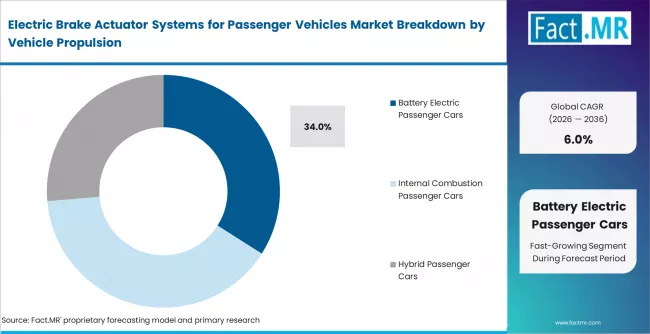
Electric Brake Actuator Systems For Passenger Vehicles Market Analysis By Vehicle Propulsion | Source: Fact.MR
Battery electric passenger cars continue to lead demand for electric brake actuator systems due to their need to coordinate regenerative and friction braking seamlessly. Consistent pedal response is critical in these vehicles, even when braking force is being managed through multiple systems. Battery electric passenger cars are projected to account for 34.0% share in 2026. This requirement increases the value of electronically controlled brake actuation compared with simpler hydraulic layouts.
- Regen blending: BEVs need precise coordination between electric deceleration and friction braking.
- Pedal consistency: Electronic actuation helps keep pedal feel stable even when brake torque sources vary.
- Architecture freedom: EV platforms benefit more from firewall and packaging flexibility created by by-wire systems.
Electric Brake Actuator Systems for Passenger Vehicles Market Analysis by Brake Architecture
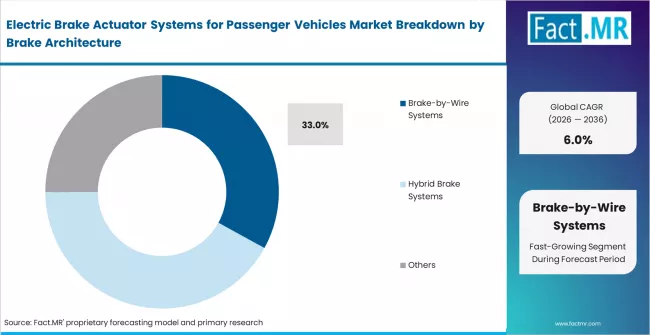
Electric Brake Actuator Systems For Passenger Vehicles Market Analysis By Brake Architecture | Source: Fact.MR
Brake-by-wire systems are expected to capture 33.0% share in 2026, as the replacement of direct mechanical linkage with electrical signal transmission and electronically managed actuation. Bosch, ZF, and Continental each describe this transition clearly, though from different system angles. Brake-by-wire gains strength because it supports shorter pedal travel, more flexible interior design, and deeper integration with motion-control software.
- Pedal decoupling: Brake-by-wire lets OEMs separate pedal feel management from direct hydraulic transmission.
- Software compatibility: It fits better with integrated motion control and automated driving support.
- Commercial readiness: Recent supplier launches and awards indicate that the category is moving into larger-scale vehicle programs
Electric Brake Actuator Systems for Passenger Vehicles Market Drivers, Restraints, and Opportunities
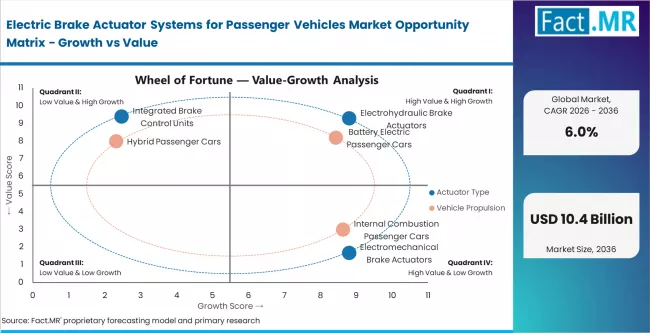
Electric Brake Actuator Systems For Passenger Vehicles Market Opportunity Matrix Growth Vs Value | Source: Fact.MR
The strongest market driver is the growing need to coordinate friction braking with regenerative braking and software-led chassis control. Braking systems are no longer limited to stopping performance. They now play a role in energy recovery, vehicle stability, and motion management, especially in electrified platforms. Continental links brake-by-wire technology directly to maintaining consistent braking behavior during regenerative deceleration in electric vehicles. Bosch and ZF Friedrichshafen also position by-wire systems around new vehicle packaging concepts and electronically managed actuation. This creates a clear incentive for passenger car OEMs to adopt electric brake actuators as braking becomes part of broader vehicle control architecture.
The main restraint is the high validation burden associated with safety-critical systems. Electric brake actuators must demonstrate fault tolerance, predictable pedal feel, and safe braking performance across a wide range of driving and environmental conditions. Validation requirements are significantly more demanding than those for standard vehicle electronics because braking performance directly affects occupant safety.
Supplier focus on redundant actuators, hybrid backup architectures, and improved fault management indicates growing engineering confidence in these systems. At the same time, it highlights why adoption progresses at a measured pace. Extensive testing, certification, and integration work are required before large-scale deployment, particularly in mainstream vehicle segments where reliability expectations are high.
Opportunities in the Electric Brake Actuator Systems for Passenger Vehicles Market
- Brake-by-wire rollout: Passenger platforms moving toward decoupled pedals and software-led braking create room for larger-scale actuation demand. Bosch’s road-launch timing and ZF’s new business support this opportunity. [3]
- Hybrid architecture adoption: Mixed systems with electro-mechanical rear braking and traditional front braking provide a pragmatic bridge for OEMs. ZF explicitly describes this hybrid concept in recent business announcements.
- Premium passenger-car differentiation: Intelligent systems such as Brembo Sensify create opportunity where pedal feel, control precision, and digital braking response become part of vehicle differentiation.
Regional Analysis
Based on the regional analysis, the Electric Brake Actuator Systems for Passenger Vehicles Market is segmented into East Asia, Europe, North America, South Asia and Pacific, Latin America, and Middle East and Africa across 40 plus countries.
.webp "Top Country Growth Comparison Electric Brake Actuator Systems For Passenger Vehicles Market Cagr (2026 2036)")
Top Country Growth Comparison Electric Brake Actuator Systems For Passenger Vehicles Market Cagr (2026 2036) | Source: Fact.MR
| Country | CAGR (2026 to 2036) |
|---|---|
| China | 7.0% |
| Germany | 6.6% |
| United States | 6.3% |
| Japan | 5.9% |
| South Korea | 5.8% |
Source: Fact.MR analysis. Updated May 11, 2026
Source: Fact.MR analysis, based on proprietary forecasting model and primary research
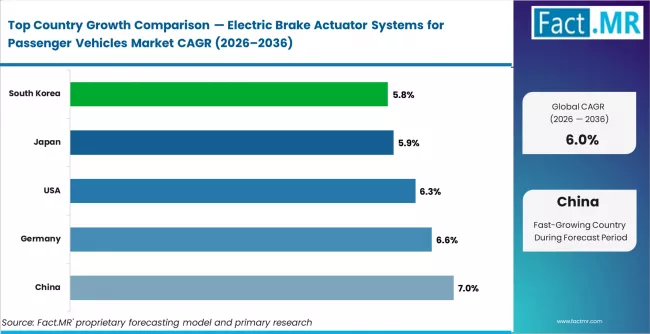
Electric Brake Actuator Systems For Passenger Vehicles Market Cagr Analysis By Country | Source: Fact.MR
East Asia Electric Brake Actuator Systems for Passenger Vehicles Market Analysis
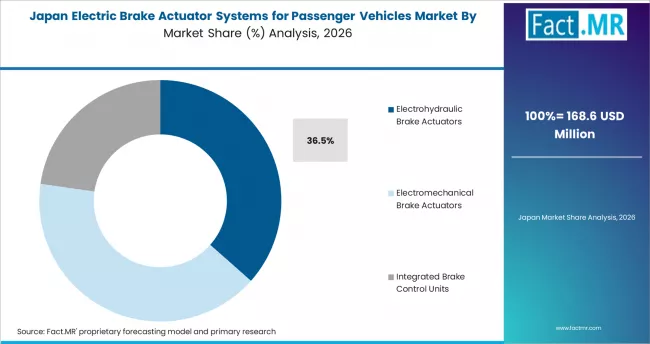
Electric Brake Actuator Systems For Passenger Vehicles Market Japan Market Share Analysis By Actuator Type | Source: Fact.MR
East Asia remains the strongest production and adoption base for this market. The region combines high passenger-EV output with strong interest in architecture modernization and rapid supplier commercialization. Bosch has said European and Asian automakers have already placed orders for its hydraulic brake-by-wire system, which reinforces the region’s early deployment relevance. East Asia also benefits from dense passenger-car manufacturing and broad willingness to absorb advanced chassis electronics in newer platforms.
- China: China leads regional growth through its strong passenger EV production base and rapid migration toward electronics-rich vehicle architectures. Demand for electric brake actuator systems is projected to grow at a 7.0% CAGR. Strong EV scale creates favorable conditions for regenerative-braking-compatible actuation systems, while local OEMs continue to adopt advanced control technologies across mainstream and premium models.
- Japan: Japan reflects a steadier growth profile, with demand projected at a 5.9% CAGR through 2036. The market is mature and places strong emphasis on reliability, brake feel consistency, and carefully managed rollout of new braking technologies. High engineering standards and established OEM processes continue to support gradual adoption.
- South Korea: South Korea is expected to expand at a 5.8% CAGR, supported by electronics-rich passenger vehicle platforms and quicker integration of advanced chassis-control concepts. Strong automotive technology capabilities and competitive EV programs continue to reinforce demand.
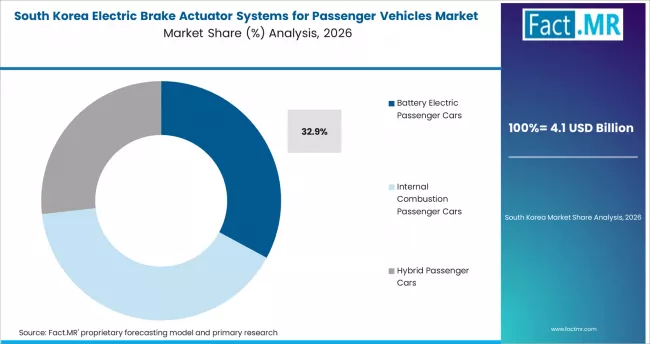
Electric Brake Actuator Systems For Passenger Vehicles Market South Korea Market Share Analysis By Vehicle Propulsion | Source: Fact.MR
Fact.MR’s report also covers ASEAN, Australia and New Zealand, and other South Asia and Pacific passenger-vehicle markets. These countries matter where EV adoption broadens and where imported or localized by-wire-ready braking platforms gain share.
North America Electric Brake Actuator Systems for Passenger Vehicles Market Analysis
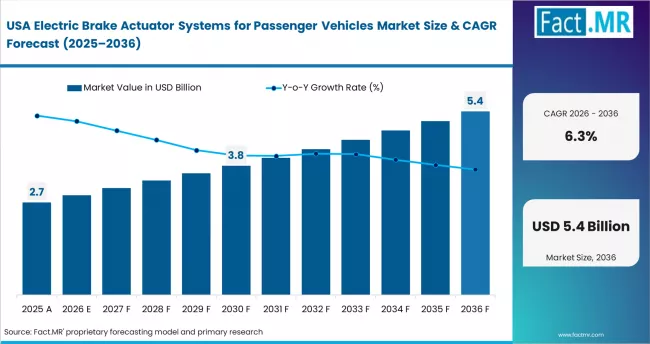
Electric Brake Actuator Systems For Passenger Vehicles Market Country Value Analysis | Source: Fact.MR
North America is shaped by growing EV penetration, larger passenger-vehicle platforms, and rising demand for software-defined vehicle features. Electric brake actuation matters here because OEMs are increasingly interested in flexible packaging, integrated chassis control, and regenerative braking coordination. ZF’s and Bosch’s current by-wire positioning fits this regional shift closely. [4]
- United States: Demand for electric brake actuator systems in the United States is projected to rise at a 6.3% CAGR through 2036. Growth is supported by expanding EV programs and passenger vehicle architectures that can absorb advanced braking controls. OEM interest in integrated chassis systems and software-enabled performance is creating sustained opportunities for suppliers.
Fact.MR’s report also includes Canada and the broader North American passenger-vehicle supply ecosystem. Additional value comes from premium content, EV growth, and broader interest in by-wire chassis architectures.
Europe Electric Brake Actuator Systems for Passenger Vehicles Market Analysis
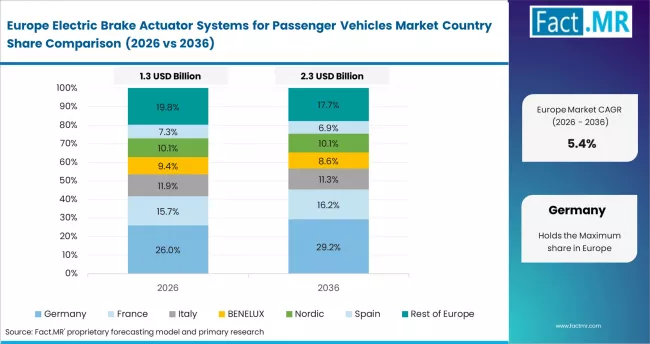
Electric Brake Actuator Systems For Passenger Vehicles Market Europe Country Market Share Analysis, 2026 & 2036 | Source: Fact.MR
Europe remains a high-discipline market rather than the largest-volume growth center. Passenger-car OEMs in the region place strong weight on brake feel, regenerative efficiency, and fault-tolerant chassis technology. Bosch’s reported orders from European automakers, Continental’s brake-by-wire development history, ZF’s new business, and Brembo’s Sensify production timing all underscore Europe’s importance as a commercialization and engineering center for electric brake actuation.
- Germany: Germany is projected to grow at a 6.6% CAGR over the assessment period. The country’s importance comes from premium passenger vehicle engineering, deep supplier networks, and faster adoption of software-intensive chassis systems. Demand is reinforced by OEM focus on electrification and high-performance braking technologies.
Fact.MR’s report also covers France, Italy, the United Kingdom, Spain, and the rest of Europe. These markets add commercial depth through electrification, premium braking demand, and continued focus on advanced passenger-car chassis technology.
Competitive Aligners for Market Players
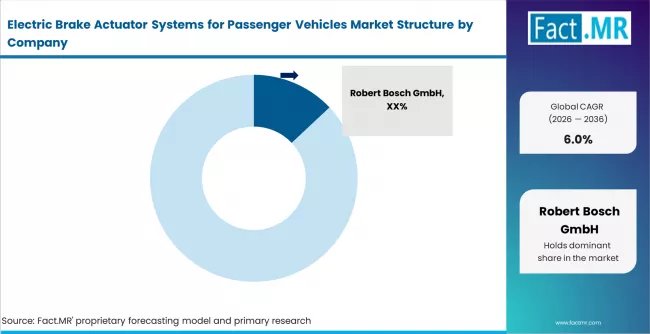
Electric Brake Actuator Systems For Passenger Vehicles Market Analysis By Company | Source: Fact.MR
The strongest market driver is the growing need to coordinate friction braking with regenerative braking and software-led chassis control. Braking systems are no longer limited to stopping performance. They now play a role in energy recovery, vehicle stability, and motion management, especially in electrified platforms. Continental links brake-by-wire technology directly to maintaining consistent braking behavior during regenerative deceleration in electric vehicles. Bosch and ZF Friedrichshafen also position by-wire systems around new vehicle packaging concepts and electronically managed actuation. This creates a clear incentive for passenger car OEMs to adopt electric brake actuators as braking becomes part of broader vehicle control architecture.
The main restraint is the high validation burden associated with safety-critical systems. Electric brake actuators must demonstrate fault tolerance, predictable pedal feel, and safe braking performance across a wide range of driving and environmental conditions. Validation requirements are significantly more demanding than those for standard vehicle electronics because braking performance directly affects occupant safety. Supplier focus on redundant actuators, hybrid backup architectures, and improved fault management indicates growing engineering confidence in these systems. At the same time, it highlights why adoption progresses at a measured pace. Extensive testing, certification, and integration work are required before large-scale deployment, particularly in mainstream vehicle segments where reliability expectations are high.
Key Players in Electric Brake Actuator Systems for Passenger Vehicles Market
- Robert Bosch GmbH
- ZF Friedrichshafen AG
- Continental AG
- Brembo N.V.
- Aisin Corporation
- Hitachi Astemo, Ltd.
- ADVICS Co., Ltd.
- Mando Corporation
- Hyundai Mobis
- Knorr-Bremse AG
- HL Mando
- Nissin Kogyo / Hitachi Astemo group
Bibliography
- [1] Bosch Mobility. Brake-by-wire. Official product page describing two independent hydraulic brake actuators, short pedal travel, and new pedal concepts.
- [2] Brembo. Sitemap / Sensify references. Official site navigation showing Sensify as Brembo’s answer to brake-by-wire evolution.
- [3] Bosch. Reinventing braking. Article stating first orders are in and market launch was planned for fall 2025, with a forecast of over 5.5 million vehicles by 2030.
- [4] ZF. By-Wire Technology. Official technology page describing replacement of mechanical and hydraulic systems with electronic control.
- [5] Brembo. 2023 report / Sensify. Published material indicating production launch timing in 2025 for Sensify.
This Report Addresses
- Strategic demand outlook for electric brake actuator systems across passenger-vehicle braking architectures.
- Market forecast from USD 5.58 billion in 2026 to USD 10.04 billion by 2036.
- The growing role of brake-by-wire, integrated brake control, and electrohydraulic actuation in passenger cars.
- The effect of regenerative braking and software-led chassis control on electric brake actuation demand.
- OEM versus aftermarket demand patterns in a validation-sensitive passenger-vehicle safety category.
- Regional differences in EV adoption, premium braking content, and by-wire commercialization.
- Competitive positioning of suppliers active in passenger-car brake-by-wire and integrated brake actuation.
- Segment analysis by actuator type, propulsion, brake architecture, sales channel, and geography.
Electric Brake Actuator Systems for Passenger Vehicles Market Definition
The market covers electrically controlled brake actuation systems used in passenger vehicles to generate, modulate, or coordinate braking force through electrohydraulic or electromechanical means. This includes brake-by-wire actuators, integrated brake control units, rear electric brake modules, and associated actuation hardware embedded in passenger-car braking architectures.
Electric Brake Actuator Systems for Passenger Vehicles Market Inclusions
The market includes hydraulic brake-by-wire actuators, integrated brake control modules, electro-mechanical rear brake systems, scalable brake-by-wire system generations, and intelligent braking platforms for passenger vehicles.
Electric Brake Actuator Systems for Passenger Vehicles Market Exclusions
The market excludes conventional vacuum boosters without electric actuation logic, standard hydraulic brake hardware where actuation value cannot be isolated, friction materials, non-passenger-vehicle brake systems, and motorsport-only brake-by-wire applications. The focus remains on passenger-vehicle electric brake actuation systems that change how braking force is generated or coordinated at the actuation level. Brembo’s Formula 1 by-wire references are therefore adjacent rather than core to the passenger-vehicle market defined here. [2]
Electric Brake Actuator Systems for Passenger Vehicles Market Research Methodology
- Primary Research
- Interviews with brake-system engineers, chassis-control architects, passenger-vehicle platform teams, brake-actuator integration specialists, and aftermarket braking-service distributors.
- Desk Research
- Review of official brake-by-wire product pages, company technology roadmaps, brake-system press releases, and current passenger-car braking materials from Bosch, ZF, Continental, and Brembo.
- Market-Sizing and Forecasting
- Fact.MR used a blended model based on ssengerpa-vehicle production, EV and hybrid mix, brake-by-wire penetration, regenerative-braking integration, and premium braking-content intensity.
- Data Validation and Update Cycle
- Forecasts were cross-checked through supplier commercialization signals, current production-launch timing, and public positioning around by-wire and integrated brake control for passenger vehicles.
Segmentation
Scope of the Report
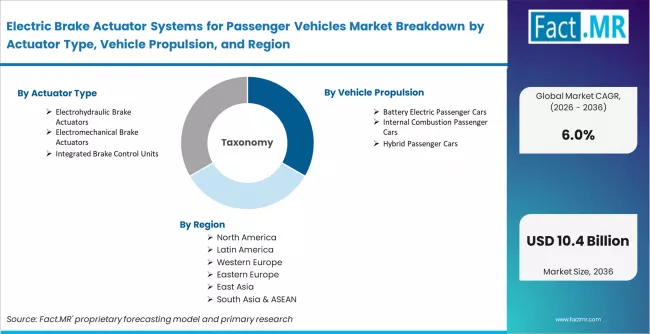
Electric Brake Actuator Systems For Passenger Vehicles Market Breakdown By Actuator Type, Vehicle Propulsion, And Region | Source: Fact.MR
| Attribute | Details |
|---|---|
| Quantitative Units | USD 5.5 billion in 2026 to USD 10.0 billion in 2036, at a CAGR of 6.0% |
| Market Definition | Passenger-vehicle electric brake actuator systems that generate or coordinate braking response through electrohydraulic, electromechanical, and by-wire actuation architectures. |
| Actuator Type Segmentation | Electrohydraulic Brake Actuators, Electromechanical Brake Actuators, Integrated Brake Control Units, Rear-Axle Electric Brake Modules, Others |
| Vehicle Propulsion Segmentation | Internal Combustion Passenger Cars, Hybrid Passenger Cars, Battery Electric Passenger Cars, Plug-in Hybrid Passenger Cars |
| Brake Architecture Segmentation | Conventional Electro-Boosted Systems, Brake-by-Wire Systems, Hybrid Brake Systems, Others |
| Sales Channel Segmentation | OEM, Aftermarket |
| Regions Covered | East Asia, Europe, North America, South Asia and Pacific, Latin America, Middle East and Africa |
| Countries Covered | China, Germany, United States, Japan, South Korea, India, Mexico, and 40+ countries |
| Key Companies Profiled | Bosch, ZF, Continental, Brembo, Aisin, Hitachi Astemo, ADVICS, Mando, Hyundai Mobis, Knorr-Bremse and others |
| Forecast Period | 2026 to 2036 |
| Approach | Fact.MR combined primary interviews with braking and chassis stakeholders, desk research across official supplier materials, and a forecast model anchored in passenger-vehicle production, EV mix, and by-wire penetration. |
Source: Fact.MR analysis. Updated May 11, 2026
Electric Brake Actuator Systems for Passenger Vehicles Market by Segments
-
By Actuator Type:
- Electrohydraulic Brake Actuators
- Electromechanical Brake Actuators
- Integrated Brake Control Units
- Rear-Axle Electric Brake Modules
- Others
-
By Vehicle Propulsion:
- Internal Combustion Passenger Cars
- Hybrid Passenger Cars
- Battery Electric Passenger Cars
- Plug-in Hybrid Passenger Cars
-
By Brake Architecture:
- Conventional Electro-Boosted Systems
- Brake-by-Wire Systems
- Hybrid Brake Systems
- Others
-
By Sales Channel:
- OEM
- Aftermarket
-
By Region:
- North America
- United States
- Canada
- Mexico
- Latin America
- Brazil
- Argentina
- Rest of Latin America
- Europe
- Germany
- France
- United Kingdom
- Italy
- Spain
- Rest of Europe
- East Asia
- China
- Japan
- South Korea
- South Asia and Pacific
- India
- ASEAN
- Australia and New Zealand
- Rest of South Asia and Pacific
- Middle East and Africa
- GCC Countries
- South Africa
- Turkey
- Rest of Middle East and Africa
- North America
Frequently Asked Questions
What is the estimated size of the electric brake actuator systems market in 2026?
How large is the market expected to become by 2036?
What is the forecast CAGR for 2026 to 2036?
Which actuator type leads the market?
Which propulsion type dominates demand?
Why does the OEM channel dominate?
Why are electric brake actuators important here?
What is the strongest demand driver?
What is the key restraint?
Which country is growing fastest?
Why is China ahead?
How does Germany compare?
Why does the United States rank strongly?
How do EVs affect this market?
Is this a fragmented supplier market?
What do OEM buyers prioritize?
Why do hybrid by-wire systems matter in this segment?
Is the aftermarket attractive?
Which companies are most visible in this market?
What is the broader outlook through 2036?
Who worked on this report


Preview the report firsthand - request a free sample
Free SampleGet the brochure for pricing and purchase details
Download PDF