- Base Value(2026): 4.2 Bn
- Estimated Value(2026): 4.2 Bn
- Forecast Value (2036): 5.7 Bn
- CAGR (2026 - 2036): 3.1%
Brake Hoses and Brake Pipes Market Forecast and Outlook 2026 to 2036
In 2025, the brake hoses and brake pipes market was valued at approximately USD 4.1 billion. Based on Fact.MR analysis, demand for brake hoses and brake pipes is estimated to reach USD 4.2 billion in 2026 and expand to USD 5.7 billion by 2036, registering a CAGR of 3.1% during the forecast period. Growth is linked to steady global vehicle parc expansion, mandatory hydraulic braking standards, and recurring replacement demand tied to ageing brake fluid lines and pressure fatigue exposure.
The market adds close to USD 1.6 billion in value over the decade, reflecting rolling compounding rather than step change expansion. Early period growth is supported by aftermarket replacement cycles in Asia Pacific and Latin America, where vehicle fleets age under high thermal and humidity exposure. Mid cycle momentum aligns with OEM production stability and wider adoption of corrosion resistant coated steel pipes. In later years, electrified vehicle penetration lengthens replacement intervals, moderating volume growth while supporting higher realised value through reinforced hose designs and premium compliance driven specifications.
India records the fastest growth at 4.2% CAGR supported by vehicle ownership growth and expanding service networks. China follows at 3.8% driven by large fleet size and inspection enforcement, while Mexico grows at 3.6% linked to export oriented vehicle assembly. Brazil posts 3.5% tied to domestic fleet renewal. Mature markets such as the United States at 2.0% and Germany at 1.5% remain replacement led, constrained by longer service intervals, stable vehicle populations, and stringent homologation frameworks.
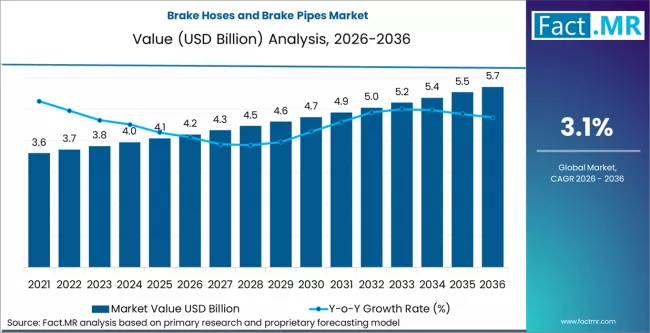
Brake Hoses And Brake Pipes Market Market Value Analysis | Source: Fact.MR
Brake Hoses and Brake Pipes Market Definition
The brake hoses and brake pipes market covers fluid carrying components that transmit hydraulic pressure from the master cylinder to braking units in vehicles. Brake hoses are flexible lines used near moving suspension and steering parts, while brake pipes are rigid metal lines routed along the vehicle chassis. Together, they ensure controlled transfer of brake fluid during braking. Design and performance requirements for these components are defined under ISO 4038 and FMVSS 106 brake hose standards issued by ISO and the US Department of Transportation [1]. These products are supplied to vehicle manufacturers and aftermarket service channels.
Brake Hoses and Brake Pipes Market Inclusions
The report covers global and regional market size estimates in volume and value terms with a forecast period from 2026 to 2036. Segmentation includes product type such as rubber brake hoses and steel or copper alloy brake pipes referenced in FMVSS 106 [2], application by vehicle category including passenger and commercial vehicles, and end use covering original equipment and replacement demand. The scope also includes regional demand patterns, pricing benchmarks, and international trade flows reported through UN Comtrade.
Brake Hoses and Brake Pipes Market Exclusions
The scope excludes brake discs, pads, calipers, master cylinders, and electronic braking systems such as ABS and ESC modules. Complete hydraulic assemblies sold as integrated braking systems are not included. Motorsport specific hoses, prototype lines without road certification, and custom racing components are excluded. Downstream services such as installation, maintenance labor, and vehicle servicing contracts are outside the scope, along with laboratory testing programs and experimental fluid transfer materials.
Brake Hoses and Brake Pipes Market Research Methodology
- Primary Research: Primary research involved interviews with brake hose and pipe manufacturers, automotive OEM suppliers, aftermarket distributors, vehicle service operators, and quality engineers.
- Desk Research: Desk research used braking system regulations from the US National Highway Traffic Safety Administration, ISO brake hose standards, vehicle production data from national transport authorities, customs trade statistics from UN Comtrade, and company annual reports and technical product disclosures filed with securities regulators.
- Market Sizing and Forecasting: Market sizing applied a hybrid top down and bottom up model using vehicle production volumes, hydraulic line fitment rates, and average replacement cycles by vehicle category.
Data Validation and Update Cycle
Outputs were cross checked against vehicle registration data, trade statistics, OEM supply disclosures, and regulatory documentation, with updates applied when verified public data sources issue revisions.
Summary of brake hoses and brake pipes market
Market Definition
- The brake hoses and brake pipes market comprises flexible and rigid hydraulic lines that transmit brake fluid pressure from the master cylinder to wheel braking units, manufactured to meet safety and durability requirements defined under FMVSS 106 and ISO brake hose standards.
Demand Drivers
- Mandatory compliance with hydraulic braking system regulations such as FMVSS 106 and UNECE braking provisions drives baseline demand for certified brake hoses and pipes across OEM and replacement channels [3].
- Growth in the global vehicle parc sustains recurring replacement demand, as brake hoses and pipes are subject to ageing, pressure cycling fatigue, and corrosion exposure over service life.
- Expansion of aftermarket service networks in Asia Pacific and Latin America accelerates replacement cycles for rubber hoses and coated steel pipes in ageing passenger and commercial vehicle fleets.
Key Segments Analyzed
- Product type: Rubber brake hoses lead with about 44% share due to their flexibility requirements near suspension and steering components and compatibility with conventional hydraulic brake architectures.
- Material and coating: Zinc or aluminium coated steel brake pipes dominate with roughly 46% share, combining high burst strength with corrosion resistance under road salt and moisture exposure.
- Geography: Asia Pacific is the fastest growing region, led by India and China, where vehicle ownership growth and inspection enforcement support steady replacement demand.
Analyst Opinion at Fact.MR
- Shambh Nath Jha, Principal Consultant at Fact.MR, opines, ‘CXOs will find that brake hoses and brake pipes demand is structurally anchored in hydraulic braking compliance, with long term value shaped by replacement intervals, pressure fatigue limits, and material certification rather than discretionary vehicle upgrades.’
Strategic Implications / Executive Takeaways
- Prioritize compliance with FMVSS 106, ISO brake hose standards, and UNECE braking provisions to secure OEM fitment and regulated aftermarket acceptance [4].
- Expand portfolios of reinforced and corrosion resistant hose and pipe variants to offset longer service intervals in hybrid and electric vehicles through higher unit value realization.
- Strengthen aftermarket distribution and installer education in high growth regions to capture replacement driven demand tied to ageing hydraulic brake lines.
Methodology
- Market sizing is based on vehicle production volumes, hydraulic line fitment rates, and average replacement cycles validated against national vehicle registration data and UN Comtrade trade flows.
- Technical assumptions reference FMVSS 106, ISO brake hose standards, and UNECE braking system regulations governing pressure resistance and durability.
- Findings are validated through primary interviews with brake hose and pipe manufacturers, OEM suppliers, aftermarket distributors, and automotive engineers, and cross checked against regulatory documentation.
Segmental Analysis
Brake Hoses and Brake Pipes Market Analysis by Product Type
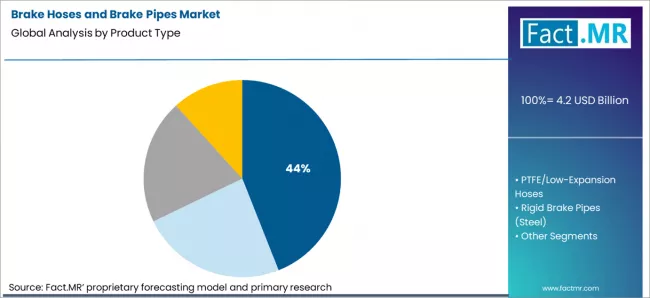
Brake Hoses And Brake Pipes Market Analysis By Product Type | Source: Fact.MR
Based on Fact.MR analysis, consumption of rubber brake hoses is estimated to account for 44.0% share of the global brake hoses and brake pipes market. Fact.MR analysts note that rubber brake hoses remain widely used because they provide the flexibility required between the vehicle body and moving suspension components while maintaining hydraulic pressure stability. As per Fact.MR, this product type addresses OEM and aftermarket needs related to vibration absorption, routing ease, and compatibility with established hydraulic braking architectures across passenger and light commercial vehicles.
- OEM usage: Continental supplies rubber brake hoses for passenger cars and light commercial vehicles, citing flexibility and pressure resistance as core functional requirements in its braking system documentation.
- Product standards: Society of Automotive Engineers SAE J1401 defines performance and testing requirements for rubber brake hoses used in hydraulic brake systems.
- Service replacement: Fact.MR analysts reference vehicle maintenance guidance that identifies periodic replacement of rubber brake hoses due to ageing and environmental exposure.
Brake Hoses and Brake Pipes Market Analysis by Material and Coating
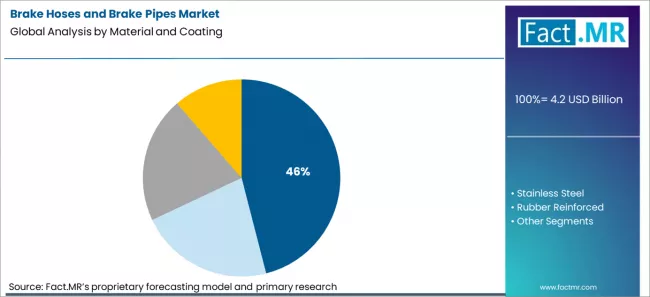
Brake Hoses And Brake Pipes Market Analysis By Material And Coating | Source: Fact.MR
Based on Fact.MR analysis, consumption of zinc or aluminium coated steel brake pipes is estimated to hold 46.0% share of the global market. Fact.MR opines that coated steel pipes dominate because they combine high burst strength with corrosion resistance under road salt and moisture exposure. As per Fact.MR, this material choice addresses manufacturer requirements for long service life, compliance with durability regulations, and compatibility with automated tube forming, bending, and flaring processes used in high-volume vehicle production.
- Material specification: Bundy Tube produces zinc and aluminium coated steel brake pipes for OEM applications, citing corrosion protection and dimensional consistency.
- Corrosion testing: International Organization for Standardization ISO corrosion testing standards guide evaluation of coated steel tubes used in automotive brake systems.
[5] - Regulatory context: Fact.MR analysts reference vehicle type approval durability requirements that drive the use of coated steel brake pipes.
Brake Hoses and Brake Pipes Market Drivers, Restraints, And Opportunities
Fact.MR analysis indicates that the brake hoses and brake pipes market exists as an essential safety-critical component segment within global automotive brake systems, driven by both original equipment manufacturing and aftermarket replacement requirements. As per Fact.MR assessment, flexible brake hoses and rigid brake pipes transmit hydraulic pressure from master cylinders to wheel brakes in disc and drum brake assembly’s performance characteristics specified in automotive regulatory requirements such as UNECE Regulation No. 13-H, which provides uniform provisions for braking equipment and systems on vehicles, including hoses and pipes. Fact.MR analysts observe that demand at present is anchored in global vehicle parc expansion and routine maintenance cycles, which require periodic replacement of brake hoses and pipes to maintain system integrity under pressure and temperature cycles.
Fact.MR is of the opinion that current market dynamics reflect transitions in material technology and application requirements as vehicles evolve toward higher performance, electrification, and enhanced safety test criteria. Based on Fact.MR assessment, conventional rubber brake hoses face competition from reinforced and composite materials that offer higher burst resistance, reduced expansion under pressure, and longer service intervals specified in test standards such as ISO 3996 for pneumatic brake components. At the same time, growth in hybrid and electric vehicles alters brake usage patterns because regenerative braking reduces reliance on hydraulic brake actuation under normal driving conditions, leading to longer service life for some brake hydraulic components even as premium value segments develop. Fact.MR analysis suggests this mix of evolving requirements and longer replacement intervals will shape moderate volume growth while elevating unit value among higher-performance brake hose and pipe variants.
- Regulatory braking system standards: Fact.MR analysts note that compliance with braking equipment provisions in UNECE Regulation No. 13-H influences design, testing, and replacement specifications for brake hoses and brake pipes across OEM and aftermarket sectors.
- Material innovation drivers: Based on Fact.MR assessment, development of reinforced and composite brake hoses that demonstrate improved resistance to pressure cycling and environmental degradation supports premium segments where performance documentation is specified.
- Asia Pacific automotive growth: Fact.MR opines that expanding automotive manufacturing and fleet size in China, India, and Southeast Asia supports regional demand for brake hoses and brake pipes driven by replacement cycles, light vehicle production, and aftermarket stocking needs.
Regional Analysis
Based on regional assessment, the brake hoses and brake pipes sector is analyzed across North America, Latin America, Europe, East Asia, South Asia, and key automotive manufacturing regions, spanning more than 40 countries. Regional performance varies according to vehicle production volumes, regulatory requirements for braking systems, and replacement demand within the automotive aftermarket. The report also presents a comparative market attractiveness evaluation grounded in region-specific demand trends.
Brake Hoses and Brake Pipes Market CAGR Analysis by Country (2026-2036)
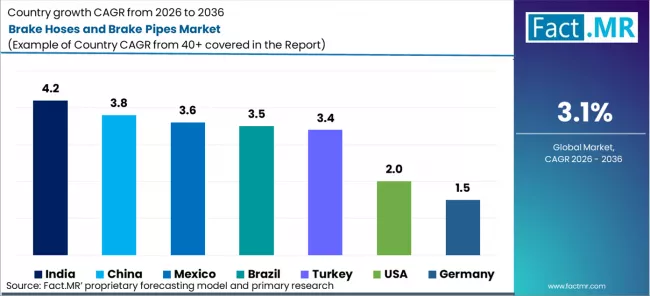
Brake Hoses And Brake Pipes Market Cagr Analysis By Country | Source: Fact.MR
| Country | CAGR |
|---|---|
| India | 4.2% |
| China | 3.8% |
| Mexico | 3.6% |
| Brazil | 3.5% |
| Turkey | 3.4% |
| United States | 2.0% |
| Germany | 1.5% |
| Japan | 1.2% |
Source: Fact.MR analysis. Updated Feb 17, 2026
Source: Fact.MR analysis, based on proprietary forecasting models and primary research.
Asia Pacific Brake Hoses and Brake Pipes Market Analysis
Asia Pacific operates as a high-volume automotive manufacturing region for brake hoses and brake pipes, supported by large passenger vehicle, two-wheeler, and commercial vehicle production bases. Demand is governed by national vehicle safety regulations, hydraulic braking system standards, and OEM sourcing requirements. Component usage is enforced through vehicle type approval systems, periodic inspection regimes, and mandatory compliance with braking performance norms across domestic and export-oriented vehicle production.
- India: Demand for brake hoses and brake pipes in India is projected to rise at 4.2% CAGR through 2036. Application is governed by Automotive Industry Standards aligned with CMVR requirements updated during 2021 and reinforced through OEM sourcing for BS-VI compliant vehicle production during 2022-2023, as per Fact.MR.
- China: Demand for brake hoses and brake pipes in China is projected to rise at 3.8% CAGR through 2036. Use follows hydraulic braking system requirements under GB automotive standards revised in 2021 and enforced through nationwide vehicle inspection and type approval systems, according to Fact.MR.
Fact.MR’s analysis of the brake hoses and brake pipes market in Asia Pacific consists of country-wise assessment that includes India and China. Readers can find safety standards references, certification frameworks, and production-linked demand documentation.
Latin America Brake Hoses and Brake Pipes Market Analysis
Latin America functions as an OEM- and compliance-driven automotive components region where brake hoses and brake pipes demand is linked to vehicle assembly activity and regulatory conformity. Adoption is shaped by national homologation rules, safety inspection programs, and export requirements for vehicles supplied to North American and regional markets. Public fleet renewal policies and domestic production standards guide component specifications.
- Mexico: Demand for brake hoses and brake pipes in Mexico is projected to rise at 3.6% CAGR through 2036. Application follows NOM automotive safety standards enforced during vehicle manufacturing and reinforced through export-oriented OEM production serving North American markets during 2022, according to Fact.MR.
- Brazil: Demand for brake hoses and brake pipes in Brazil is projected to rise at 3.5% CAGR through 2036. Use is governed by CONTRAN braking system regulations and reinforced through domestic vehicle production and inspection regimes applied during 2021-2022, as per Fact.MR.
Fact.MR’s analysis of the brake hoses and brake pipes market in Latin America consists of country-wise assessment that includes Mexico and Brazil. Readers can find homologation rules, inspection systems, and production-based demand references.
Middle East Brake Hoses and Brake Pipes Market Analysis
The Middle East operates as an import-led automotive components market for brake hoses and brake pipes, with demand governed by vehicle safety compliance and inspection frameworks. Usage is tied to fleet maintenance standards, vehicle import homologation, and alignment with international braking system regulations. Regulatory approval and conformity assessment play a central role in component adoption across passenger and commercial vehicle fleets.
- Turkey: Demand for brake hoses and brake pipes in Turkey is projected to rise at 3.4% CAGR through 2036. Application is governed by EU-aligned vehicle type approval regulations adopted nationally and reinforced through domestic vehicle assembly and inspection systems during 2021-2022, according to Fact.MR.
Fact.MR’s analysis of the brake hoses and brake pipes market in the Middle East consists of country-wise assessment that includes Turkey. Readers can find vehicle approval frameworks and compliance documentation.
North America Brake Hoses and Brake Pipes Market Analysis
North America functions as a standards-led automotive components market where brake hoses and brake pipes are governed by federal safety regulations and OEM specifications. Demand is shaped by compliance with hydraulic braking system performance requirements, periodic inspection programs, and public fleet maintenance policies. Replacement cycles and regulatory conformity influence demand more strongly than new vehicle production volumes.
- United States: Demand for brake hoses and brake pipes in the United States is projected to rise at 2.0% CAGR through 2036. Application is governed by FMVSS hydraulic brake system requirements and reinforced through OEM production and public fleet replacement programs implemented during 2021-2022, as per Fact.MR.
Fact.MR’s analysis of the brake hoses and brake pipes market in North America consists of country-wise assessment that includes the United States. Readers can find federal safety standards and vehicle compliance references.
Europe Brake Hoses and Brake Pipes Market Analysis
Europe operates as a regulation-led automotive components market for brake hoses and brake pipes, with adoption governed by harmonized vehicle safety and type approval frameworks. Component usage is defined through braking system performance standards, periodic inspection rules, and conformity assessments enforced across member states. Regulatory alignment rather than production scale primarily determines regional demand patterns.
- Germany: Demand for brake hoses and brake pipes in Germany is projected to rise at 1.5% CAGR through 2036. Use follows EU type approval regulations and braking system standards applied in vehicle manufacturing and periodic inspection cycles during 2021-2022, according to Fact.MR.
- Japan: Demand for brake hoses and brake pipes in Japan is projected to rise at 1.2% CAGR through 2036. Application is governed by Road Transport Vehicle Act braking system requirements and enforced through domestic vehicle certification processes applied during 2021-2022, as per Fact.MR.
Fact.MR’s analysis of the brake hoses and brake pipes market in Europe consists of country-wise assessment that includes Germany and Japan. Readers can find regulatory frameworks, inspection regimes, and component compliance references.
Competitive Landscape of Brake Hoses and Brake Pipes Market
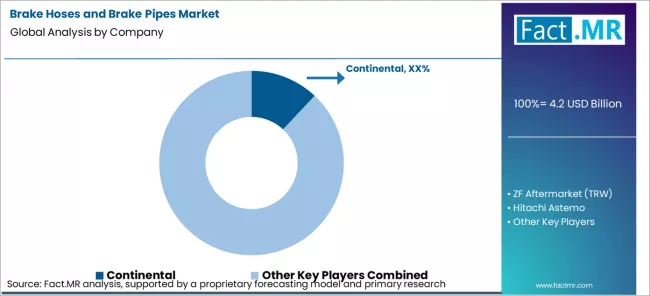
Brake Hoses And Brake Pipes Market Analysis By Company | Source: Fact.MR
As per Fact.MR analysis, the 2026 brake hoses and brake pipes market is defined by validated hydraulic performance, durability, and regulatory compliance. Continental and ZF Aftermarket (TRW) provide high-pressure brake lines with proven burst and fatigue resistance, which increases adoption in OEM and aftermarket programs. Hitachi Astemo and Aisin focus on corrosion protection and consistent flow characteristics, which improves system reliability and reduces warranty claims. Nichirin and Sumitomo Riko emphasise multi-region compliance and long-term material stability, which strengthens trust among global vehicle manufacturers. Gates and Cohline provide flexible, reinforced hoses with validated heat and abrasion resistance, which enhances operational lifespan in heavy-duty and passenger vehicles. Parker Hannifin and Trelleborg offer customized hydraulic solutions for specialized applications, which sustains adoption in niche segments. Across the market, validated performance, material reliability, and adherence to automotive standards reinforce positions and establish enduring competitive moats beyond pricing or isolated part claims.
Recent Industry Developments
- Continental (ContiTech) Strategic Portfolio Expansion: In late 2025 and early 2026, Continental’s ContiTech division significantly expanded its aftermarket portfolio, adding over 1,000 new parts including high-performance hydraulic bushings and steering components. The company is specifically targeting the European EV fleet with a new line of corrosion-resistant brake pipes and hoses designed to handle the higher weight and unique thermal profiles of electric drivetrains. [6]
- Trelleborg’s Sustainability Pivot (Fossil-Free Steel): In February 2025, Trelleborg reached a landmark agreement with steel manufacturer SSAB for the delivery of fossil-free steel. By early 2026, this partnership has entered its implementation phase, with Trelleborg integrating this "green steel" into its brake shim and pipe fitting production. This move is designed to offer automotive OEMs components with a significantly lower carbon footprint to meet 2030 sustainability targets. [7]
Key Players in Brake Hoses and Brake Pipes Market
- Continental
- ZF Aftermarket (TRW)
- Hitachi Astemo
- Aisin
- Nichirin
- Sumitomo Riko
- Gates
- Cohline
- Parker Hannifin
- Trelleborg
Bibliography
- [1] International Organization for Standardization. (2019). ISO 4038: Road vehicles - Brake hoses - Specification. ISO.
- [2] U.S. Department of Transportation, National Highway Traffic Safety Administration. (2023). Federal Motor Vehicle Safety Standard No. 106: Brake hoses. NHTSA.
- [3] U.S. Department of Transportation, National Highway Traffic Safety Administration. (2023). Brake system safety standards and compliance guidance. NHTSA.
- [4] United Nations Economic Commission for Europe. (2018). UNECE Regulation No. 13-H: Uniform provisions concerning the approval of passenger cars with regard to braking. UNECE.
- [5] International Organization for Standardization. (2017). ISO 9227: Corrosion tests in artificial atmospheres - Salt spray tests. ISO.
- [6] Continental AG. (2025). ContiTech expands aftermarket portfolio for electric and conventional vehicles. Continental Group.
- [7] Trelleborg AB. (2025). Sustainable automotive components using fossil-free steel. Trelleborg Group.
Segmentation
Scope of the Report
| Metric | Value |
|---|---|
| Quantitative Units | USD 4.2 billion (2026) to USD 5.7 billion (2036), CAGR 3.1% |
| Market Definition | The brake hoses and brake pipes market covers flexible and rigid hydraulic lines that transmit brake fluid pressure from the master cylinder to wheel braking units. Rubber hoses are used near moving suspension and steering components, while rigid steel pipes are routed along the chassis. Design and performance requirements follow ISO 4038 and FMVSS 106 standards. Products are supplied to OEMs, aftermarket distributors, and fleet service providers for passenger cars, SUVs, light commercial, and medium & heavy commercial vehicles. |
| Product Type Segmentation | Rubber Brake Hoses, PTFE/Low-Expansion Hoses, Rigid Brake Pipes (Steel), Other |
| Material/Coating Segmentation | Steel (Zn/Al coated), Stainless Steel, Rubber Reinforced, Other |
| Vehicle Type Segmentation | Passenger Cars, SUVs/Crossovers, Light Commercial Vehicles, Medium & Heavy Commercial Vehicles |
| Sales Channel Segmentation | Aftermarket, OEM Fitment, Fleet/Service, Other |
| Regions Covered | Asia Pacific, Europe, North America, Latin America, Middle East & Africa |
| Countries Covered | India, China, Mexico, Brazil, Turkey, United States, Germany, Japan |
| Key Companies Profiled | Continental, ZF Aftermarket (TRW), Hitachi Astemo, Aisin, Nichirin, Sumitomo Riko, Gates, Cohline, Parker Hannifin, Trelleborg |
| Forecast Period | 2026 to 2036 |
| Approach | Hybrid top-down and bottom-up modeling using vehicle production, hydraulic line fitment rates, and average replacement cycles. Desk research utilized FMVSS 106 and ISO 4038 standards, UNECE braking regulations, UN Comtrade trade data, and OEM production statistics. Primary interviews included brake hose and pipe manufacturers, aftermarket distributors, OEM suppliers, and automotive engineers. |
Source: Fact.MR analysis. Updated Feb 17, 2026
Brake Hoses and Brake Pipes Market Analysis by Segments
-
By Product Type :
- Rubber Brake Hoses
- PTFE/Low-Expansion Hoses
- Rigid Brake Pipes (Steel)
- Other
-
By Material/Coating :
- Steel (Zn/Al coated)
- Stainless Steel
- Rubber Reinforced
- Other
-
By Vehicle Type :
- Passenger Cars
- SUVs/Crossovers
- Light Commercial Vehicles
- Medium & Heavy Commercial Vehicles
-
By Sales Channel :
- Aftermarket
- OEM Fitment
- Fleet/Service
- Other
-
Region :
- Asia Pacific
- India
- China
- Japan
- South Korea
- Indonesia
- Australia & New Zealand
- ASEAN
- Rest of Asia Pacific
- Europe
- Germany
- Italy
- France
- United Kingdom
- Spain
- Benelux
- Nordics
- Central & Eastern Europe
- Rest of Europe
- North America
- United States
- Canada
- Mexico
- Latin America
- Brazil
- Argentina
- Chile
- Rest of Latin America
- Middle East & Africa
- Kingdom of Saudi Arabia
- United Arab Emirates
- South Africa
- Turkey
- Rest of Middle East & Africa
- Asia Pacific
Frequently Asked Questions
How large is the brake hoses and brake pipes market in 2026?
What is the projected market size by 2036?
What CAGR is projected for 2026 to 2036?
How much value will the market add over the decade?
What fundamentally drives demand for brake hoses and pipes?
Is market growth driven more by new vehicle builds or replacement cycles?
Which product type leads the market by share?
Why do rubber brake hoses remain widely used despite premium alternatives?
Which material or coating dominates brake pipe demand?
What is the main advantage of coated steel pipes in real-world service?
How does electrification affect replacement intervals for hoses and pipes?
Which country is expected to grow the fastest?
What is China’s projected CAGR and what supports it?
What is Mexico’s projected CAGR?
What is Brazil’s projected CAGR?
What is Turkey’s projected CAGR?
How does the United States market compare to emerging regions?
What is Germany’s projected CAGR?
What is Japan’s projected CAGR?
What should suppliers prioritize to protect approvals and pricing?
Who worked on this report


Preview the report firsthand - request a free sample
Free SampleGet the brochure for pricing and purchase details
Download PDF