- Base Value(2026): 6.2 Bn
- Estimated Value(2026): 6.2 Bn
- Forecast Value (2036): 7.4 Bn
- CAGR (2026 - 2036): 1.8%
Vacuum Brake Booster Market Forecast Outlook 2026 to 2036
The vacuum brake booster market is likely to be valued at USD 6.2 billion in 2026 and is projected to reach USD 7.4 billion by 2036, expanding at a 1.8% compound annual growth rate (CAGR).
Key Takeaways from Vacuum Brake Booster Market
- Vacuum Brake Booster Market Value (2026): USD 6.2 billion
- Vacuum Brake Booster Market Forecast Value (2036): USD 7.4 billion
- Vacuum Brake Booster Market Forecast CAGR (2026-2036): 1.8%
- Leading Segment in Vacuum Brake Booster Market: ICE Powertrain (76%)
- Key Growth Region in Vacuum Brake Booster Market: Asia Pacific
- Key Players in Vacuum Brake Booster Market: Continental AG, Robert Bosch GmbH (Bosch), ZF Friedrichshafen AG (ZF), Hitachi Astemo Ltd., Denso Corporation, Aisin Corporation, Mando Corporation, ADVICS Co., Ltd., Nissin Kogyo Co., Ltd., Brembo S.p.A.
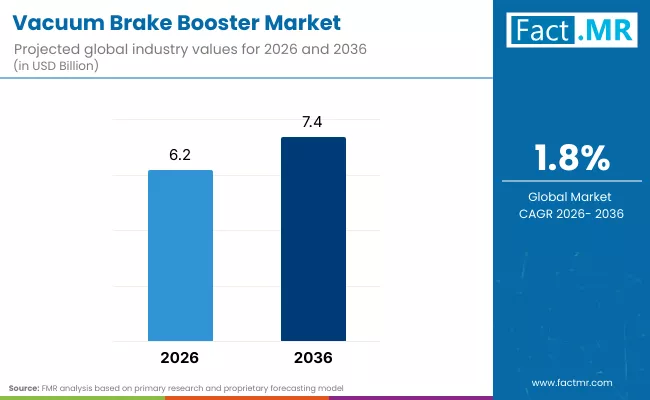
Vacuum Brake Booster Market Industry | Source: Fact.MR
Highlighting the pivot from traditional hardware to software-integrated systems, Dr. Stefan Hartung, Chairman of the Bosch Board of Management, stated: "Without sophisticated hardware, even the smartest car won't move a single millimeter. Our aim is to continue playing a key role in shaping the industry in the age of software-driven mobility by offering tailored, intelligent solutions."
Growth quality is dictated by volume stability in mass-market regions rather than technological disruption. End-use dependency remains anchored to traditional powertrain architectures where engine-derived vacuum is readily available, acting as a natural hedge against the rapid software-centric shifts seen in premium EV platforms. Market resilience is maintained through the low-cost reliability of these units, which remain the baseline for global vehicle production.
Vacuum Brake Booster Market
| Metric | Value |
|---|---|
| Estimated Value in (2026E) | USD 6.2 billion |
| Forecast Value in (2036F) | USD 7.4 billion |
| Forecast CAGR (2026 to 2036) | 1.8% |
Source: Fact.MR analysis. Updated Feb 4, 2026
Category
| Category | Segments |
|---|---|
| Sales Channel | First Fit (OEM); Aftermarket |
| Vehicle Type | Passenger Cars; LCV; HCV |
| Booster Type | Single Diaphragm; Tandem; Other |
| Powertrain | ICE; HEV; BEV |
| Diameter | <8 inch; 8-9 inch; >9 inch |
| Region | North America; Europe; Asia Pacific; Latin America; Middle East & Africa |
Source: Fact.MR analysis. Updated Feb 4, 2026
Segmental Analysis
What is Driving the Dominance of ICE Powertrain in the Vacuum Brake Booster Market?
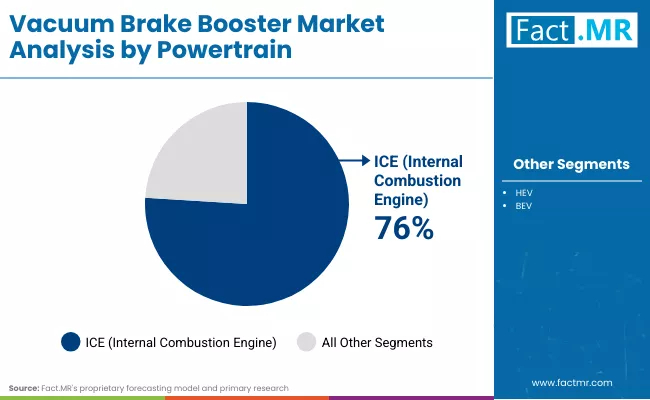
Vacuum Brake Booster Market Powertrain | Source: Fact.MR
The ICE (Internal Combustion Engine) powertrain holds 76% of the market share in 2026. This dominance is driven by the continued reliance on vacuum brake boosters in traditional gasoline and diesel vehicles. Vacuum brake boosters are critical for providing the necessary braking power, especially in high-performance ICE vehicles, and they remain the standard in many mass-market vehicles due to their proven reliability and cost-effectiveness. While HEVs and BEVs are gaining ground, the ICE powertrain continues to be the largest segment, making vacuum brake boosters a key component for the majority of the vehicle fleet.
What is the Role of Vehicle Type in the Vacuum Brake Booster Market?
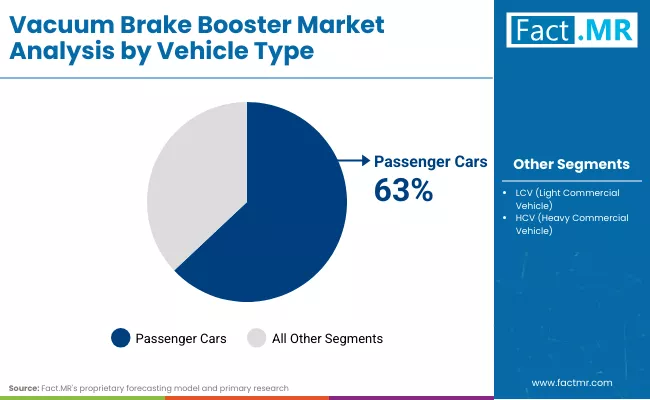
Vacuum Brake Booster Market Vehicle Type | Source: Fact.MR
Passenger Cars lead the vacuum brake booster market, capturing 63% of the share in 2026. This is primarily due to the high volume of vehicles produced in the passenger car segment, where vacuum brake boosters are standard, especially in ICE models. LCVs and HCVs represent a smaller portion of the market, but they are important for heavy-duty applications where robust braking performance is required. The trend in these vehicle types is toward improving braking efficiency while maintaining the cost-effectiveness of traditional vacuum systems.
Vacuum Brake Booster Market — Drivers, Restraints & Trends
| Country | Drivers | Restraints | Trends |
|---|---|---|---|
| USA | High production of passenger cars and light trucks with internal combustion engines keeps demand for vacuum brake boosters strong. | Shift to EVs with integrated electric booster systems may reduce long‑term demand. | Enhanced vacuum boosters paired with ABS and stability systems for safety optimization. |
| China | Large vehicle output across passenger and commercial segments drives demand for traditional vacuum boosters. | Rapid EV adoption could reduce long‑term requirement for vacuum‑based systems. | Localization of booster production to meet growing OEM volumes. |
| India | Rising passenger vehicle sales and ongoing ICE vehicle prevalence sustain market demand. | Price sensitivity and lower penetration in entry models can restrain uptake of advanced designs. | Aftermarket demand as older vehicles require replacement parts. |
| Germany | Strict safety standards and high OEM quality expectations support advanced vacuum brake booster use. | Electrification focus and brake‑by‑wire technologies may reduce future volumes. | Lightweight designs to support fuel‑efficiency and emissions targets. |
| Japan | Strong OEM emphasis on reliability and brake performance sustains vacuum booster adoption in ICE models. | Slow growth in traditional engine vehicles limits incremental demand. | Compact, highly efficient booster designs integrated with safety systems. |
| South Korea | Solid automotive production with continued use of conventional brake boosters in many internal combustion vehicles. | EV shift and alternative brake boosters (electronic) may restrain long‑term growth. | Increased use of electronically assisted vacuum boosters for improved performance. |
| Mexico | Growing vehicle assembly for export markets with traditional engine platforms supports demand. | Price constraints limit adoption of premium booster technologies. | Aftermarket replacement growth as fleet ages. |
Source: Fact.MR analysis. Updated Feb 4, 2026
Analysis of the Vacuum Brake Booster Market by Key Country
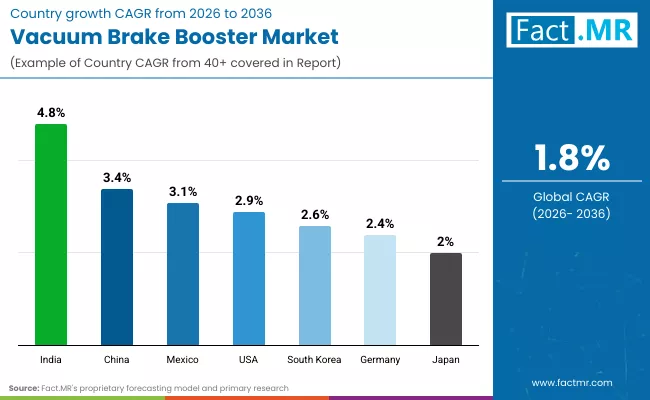
Vacuum Brake Booster Market Country | Source: Fact.MR
| Country | CAGR (Forecast Period) |
|---|---|
| USA | 2.9% |
| China | 3.4% |
| India | 4.8% |
| Germany | 2.4% |
| Japan | 2.0% |
| South Korea | 2.6% |
| Mexico | 3.1% |
Source: Fact.MR analysis. Updated Feb 4, 2026
What Factors Drive the 2.9% Growth in the United States Vacuum Brake Booster Market?
The USA vacuum brake booster market is growing at 2.9%, largely driven by the increasing demand for hybrid and electric vehicles (EVs), which require high-efficiency braking systems to meet the NHTSA's 2026 vehicle safety mandates. The shift towards electric powertrains and increased emphasis on safety systems, such as automatic emergency braking and lane-keeping assistance, has spurred demand for advanced vacuum brake boosters. Additionally, the market is supported by the growing popularity of SUVs and light trucks, which benefit from the increased braking power provided by vacuum boosters, especially in emergency situations. Moreover, the aftermarket segment remains strong as more legacy vehicles continue to be maintained with vacuum-based braking systems.
Why is the China Vacuum Brake Booster Market Projected to Expand at a 3.4% Rate?
The China vacuum brake booster market is projected to grow at 3.4%, driven by the rapid adoption of New Energy Vehicles (NEVs). The Chinese government’s push for NEVs has created strong demand for vacuum brake boosters, as these vehicles require advanced braking systems that offer both performance and efficiency. The market is also benefiting from the growing automotive manufacturing base in China, with local suppliers like Wanxiang and BYD leading the way in vacuum booster technology for their EVs. Additionally, China's expanding road infrastructure and increasing focus on vehicle safety are prompting automakers to implement advanced brake booster systems in passenger cars and commercial vehicles.
How Does the 4.8% Growth Reflect the India Vacuum Brake Booster Market Expansion?
India’s 4.8% growth in the vacuum brake booster market is fueled by the rapid expansion of the automotive sector and the increased premiumization of vehicles. The production of SUVs and commercial vehicles in India has surged, requiring more advanced braking systems for better performance and safety. The Production Linked Incentive (PLI) Scheme is also supporting the localization of vacuum brake boosters, driving the market's growth as global suppliers like Bosch and ZF establish manufacturing facilities in India. Moreover, the enforcement of BS6 Phase 2 norms and the rise in consumer preference for safety features are propelling the demand for braking systems in mid- and high-end vehicle segments.
What Factors Support the 2.4% Growth for the Germany Vacuum Brake Booster Market?
In Germany, the 2.4% growth in the vacuum brake booster market is attributed to the strict Euro 7 emission regulations and the shift towards electrification in the automotive sector. While electrified powertrains typically use electronic brake boosters, there remains a steady demand for vacuum brake boosters in internal combustion engine (ICE) vehicles. German premium brands, including BMW, Mercedes-Benz, and Audi, continue to use vacuum brake boosters in their high-performance vehicles. Additionally, the global push for advanced safety systems, including emergency braking assistance, ensures that vacuum brake boosters remain an integral part of vehicle safety technologies.
How Does Japan Achieve 2.0% Growth in the Vacuum Brake Booster Market?
Japan’s 2.0% growth in the vacuum brake booster market is influenced by the increased adoption of hybrid and electric vehicles, particularly among Japanese automakers like Toyota and Honda. As these automakers prioritize fuel efficiency and lower emissions, vacuum brake boosters continue to play an essential role in ICE and hybrid vehicles. The aging population in Japan also drives the need for advanced braking systems in vehicles, particularly for older drivers who prioritize safety and ease of operation. Additionally, government regulations around vehicle safety and emission standards support the continued relevance of vacuum brake boosters in Japan’s automotive market.
Why Does South Korea Exhibit a 2.6% Growth in Vacuum Brake Boosters?
South Korea’s 2.6% growth in the vacuum brake booster market is driven by the K-Mobility strategy, which encourages innovation in braking systems to meet the demands of electric and hybrid vehicles. South Korea’s Hyundai Mobis and Kia are actively working on developing vacuum brake boosters that are lightweight and optimized for electric vehicle integration. Additionally, the market is benefiting from R&D investments aimed at improving braking performance while reducing weight, fuel consumption, and emissions. With the continued adoption of advanced safety systems like Lane-Keeping Assist (LKA) and Automated Emergency Braking (AEB), vacuum brake boosters remain essential in maintaining the stability and safety of South Korean vehicles.
How is the Mexico Vacuum Brake Booster Market Maintaining a 3.1% Rate?
Mexico’s 3.1% growth in the vacuum brake booster market is tied to the USMCA and the regional value content (RVC) requirements for components sold in the North American market. The increasing nearshoring trend in the automotive industry, with companies relocating vacuum brake booster production to Mexico, has driven the growth. Mexico is becoming a key hub for the production of safety-critical components for North American OEMs, particularly pickup trucks and SUVs, which are dominant in the region. As electric vehicle production continues to grow in Mexico, the demand for vacuum brake boosters is expected to remain stable, especially in hybrid and ICE vehicle applications.
How Are Participants Competing in the Vacuum Brake Booster Market?
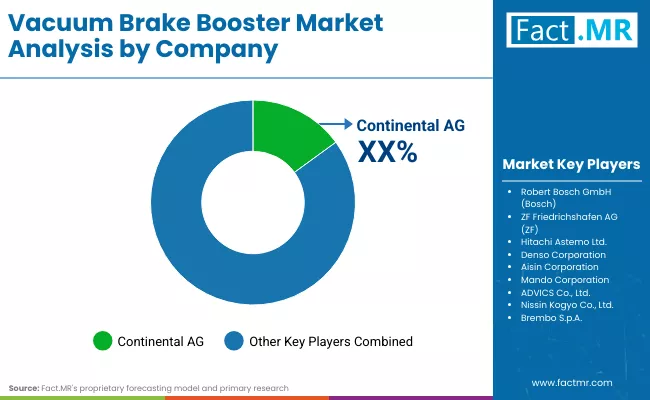
Vacuum Brake Booster Market Company | Source: Fact.MR
The vacuum brake booster market is shaped by key players such as Continental, Bosch, and ZF Friedrichshafen, who lead with innovations in braking performance and safety. Bosch and ZF focus on high-efficiency brake boosters, reducing weight and enhancing brake responsiveness in both traditional and electric vehicles (EVs). Hitachi Astemo and Denso prioritize advanced sensor integration, optimizing braking control and system reliability. Aisin and Mando continue to develop affordable, durable solutions, aiming for mass-market adoption. Brembo and Nissin Kogyo cater to premium and performance vehicles, ensuring precise braking force control and maximizing safety.
Recent Industry Developments
- Patent - Vacuum Brake Booster with Integrated Control Valve (Published Aug 8, 2023): A vacuum brake booster (VBB) assembly with an integrated control valve system was published, which improves braking response and vacuum management by integrating a novel valve control mechanism inside the booster housing.
- Patent - Brake Booster with Electronic Assist & Vacuum Reserve (Published Jan 9, 2024): A patent titled Brake booster assembly with electronic assist and vacuum reserve chamber was published, showing innovation where a vacuum booster integrates an auxiliary vacuum reservoir and electric assist function to maintain consistent assist under low-vacuum conditions (e.g., turbocharged or EV applications).
- OEM Electronic Vacuum Booster Adoption (2025 Production Plans): Bosch publicly highlighted its next-generation electronic Vacuum Brake Booster (e-Brake Booster) featuring improved vacuum regulation and integration with stability control ECUs for hybrid/electric vehicles - representing a verified supplier product advancement in vacuum brake boost technology.
Key Players of the Vacuum Brake Booster Market
- Continental AG
- Robert Bosch GmbH (Bosch)
- ZF Friedrichshafen AG (ZF)
- Hitachi Astemo Ltd.
- Denso Corporation
- Aisin Corporation
- Mando Corporation
- ADVICS Co., Ltd.
- Nissin Kogyo Co., Ltd.
- Brembo S.p.A.
Bibliographies
- National Highway Traffic Safety Administration. (2023). Federal Motor Vehicle Safety Standards (FMVSS 105 & 135): Hydraulic and power brake systems. U.S. Department of Transportation.
- United Nations Economic Commission for Europe (UNECE). (2024). UN Regulation No. 13 and 13-H - Braking systems and power-assisted braking requirements. UNECE Transport Division.
- Society of Automotive Engineers (SAE). (2024). Brake assist and vacuum booster performance requirements in passenger vehicles. SAE Technical Paper Series.
- International Organization for Standardization. (2023). ISO 26262: Road vehicles - Functional safety of electrical and electronic systems. ISO.
- Institute of Electrical and Electronics Engineers (IEEE). (2024). Brake pedal force optimization and booster control in modern braking systems. IEEE Xplore Digital Library.
Segmentation
Scope of the Report
| Items | Values |
|---|---|
| Quantitative Units (2026) | USD Billion |
| Sales Channel | First Fit (OEM), Aftermarket |
| Vehicle Type | Passenger Cars, LCV, HCV |
| Booster Type | Single Diaphragm, Tandem, Other |
| Powertrain | ICE, HEV, BEV |
| Diameter | <8 inch, 8-9 inch, >9 inch |
| Regions Covered | North America, Europe, Asia Pacific, Latin America, Middle East & Africa |
| Countries Covered | United States, Canada, Mexico, Germany, United Kingdom, France, Japan, South Korea, China, India, Brazil, and other countries |
| Key Companies Profiled | Continental AG, Robert Bosch GmbH (Bosch), ZF Friedrichshafen AG (ZF), Hitachi Astemo Ltd., Denso Corporation, Aisin Corporation, Mando Corporation, ADVICS Co., Ltd., Nissin Kogyo Co., Ltd., Brembo S.p.A. |
| Additional Attributes | Dollar revenue by sales channel, vehicle type, booster type, powertrain, diameter, and region; regional demand trends, competitive landscape, technological advancements in vacuum brake boosters, operational performance optimization initiatives, and product development strategies |
Source: Fact.MR analysis. Updated Feb 4, 2026
Vacuum Brake Booster Market Key Segments
-
Sales Channel :
- First Fit (OEM)
- Aftermarket
-
Vehicle Type :
- Passenger Cars
- LCV (Light Commercial Vehicle)
- HCV (Heavy Commercial Vehicle)
-
Booster Type :
- Single Diaphragm
- Tandem
- Other
-
Powertrain :
- ICE
- HEV
- BEV
-
Diameter :
- <8 inch
- 8-9 inch
- 9 inch
-
Region :
- North America
- USA
- Canada
- Mexico
- Europe
- Germany
- UK
- France
- Italy
- Spain
- Nordic Countries
- BENELUX
- Rest of Europe
- Asia Pacific
- China
- Japan
- South Korea
- India
- Australia
- Rest of Asia Pacific
- Latin America
- Brazil
- Argentina
- Rest of Latin America
- Middle East and Africa
- Kingdom of Saudi Arabia
- United Arab Emirates
- South Africa
- Rest of Middle East and Africa
- Other Regions
- Oceania
- Central Asia
- Other Markets
- North America
Frequently Asked Questions
What is the projected market size for vacuum brake boosters in 2026?
What value is expected for vacuum brake boosters in 2036?
At what rate will the vacuum brake booster market progress from 2026 to 2036?
Which powertrain type dominates demand and what share does it hold?
Which region is expected to experience the fastest growth and what rate is it projected at?
Who are the major players in the vacuum brake booster market?
Who worked on this report


Preview the report firsthand - request a free sample
Free SampleGet the brochure for pricing and purchase details
Download PDF