- Market Value (2025): USD 498.6 Bn
- Estimated Value (2026): USD 526.5 Bn
- Forecast Value (2036): USD 905.5 Bn
- CAGR (2026-2036): 5.6%
What is the Branded Apparel Market forecast to be worth by 2036?
USD 526.5 billion in 2026 to USD 905.5 billion by 2036 at a 5.6% CAGR.
- As per Fact.MR analysis, the branded apparel market was valued at USD 498.6 billion in 2025.
- Demand will grow from USD 526.5 billion in 2026 to USD 905.5 billion by 2036.
- The forecast records a 5.6% CAGR from 2026 to 2036 as growers seek more controlled mineral nutrition.
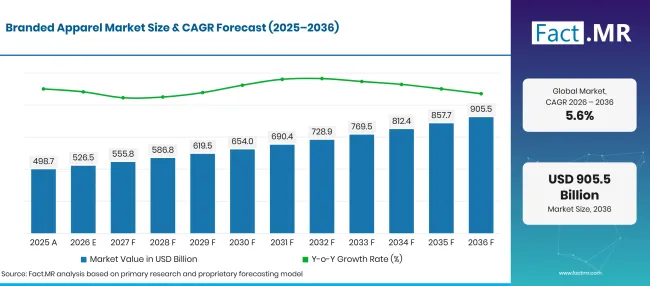
Factmr Branded Apparel Market Forecast Global | Source: Fact.MR
| Year | Basis | Market Value (USD billion) |
|---|---|---|
| 2025 | Actual | 498.6 |
| 2026 | Estimate | 526.5 |
| 2036 | Forecast | 905.5 |
| CAGR 2026 to 2036 | Forecast period | 5.6% |
Source: Fact.MR analysis. Updated Oct 14, 2026
What are the defining numbers behind Branded Apparel Market growth?
USD 379.0 billion absolute opportunity between 2026 and 2036.
- Demand Drivers in the Market
- Global apparel brands focus on product quality and a distinct brand identity as consumer preferences evolve. The United Nations Environment Programme (UNEP) reported in its 2025 Annual Report, published in 2026, that the textile industry accounts for approximately 2%–8% of global greenhouse gas emissions [1]. This environmental impact increases the relevance of sustainable materials and responsible production practices for apparel manufacturers and brands.
- Apparel manufacturers and retailers adjust collections and inventory to meet changing consumer demand. The World Trade Organization (WTO) published its Global Trade Outlook and Statistics Update in October 2025, providing updated forecasts for global merchandise trade in 2025 and 2026 [6]. These trade outlooks provide context for apparel businesses managing international sourcing and distribution, although they do not measure branded apparel sales specifically.
- Brazilian apparel retailers adapt their product assortments and sales strategies to changing consumer demand. For instance, on August 13, 2025, the Brazilian Institute of Geography and Statistics (IBGE) reported that retail sales of fabrics, clothing, and footwear increased by 5.5% in the first half of 2025 compared with the same period in 2024 [2]. This growth highlights the importance of monitoring retail demand when planning collections and managing inventory in Brazil.
- Key Segments Analyzed
- By Product Type: Casual Wear will account for 38.4% of the Branded Apparel Market in 2026, reflecting strong consumer demand for comfortable, versatile clothing suitable for everyday use.
- By Sales Channel: Online Stores will represent for 34.6% of the market in 2026, supported by the convenience of digital shopping, broader product availability, and growing e-commerce adoption.
- By End-User: Women will hold for 41.3% of the market in 2026, reflecting demand across casualwear, formalwear, sportswear, and fashion-oriented apparel categories.
- By Material: Cotton leads with 36.5% of the market in 2026, reflecting its widespread use in apparel due to its breathability, comfort, and versatility.
- Analyst Opinion at Fact.MR
- Shambhu Nath Jha, Principal Consultant at Fact.MR, states, “Branded apparel is likely to attract consumer interest where brand identity, comfort, and style influence purchasing decisions. Consumers still need to consider product quality, pricing, and intended use before choosing apparel from a particular brand. Casual wear is likely to drive branded apparel demand as consumers prioritize comfort, style, and versatility. Brands that combine quality materials, strong digital channels, and evolving fashion trends are well positioned for growth.”
- Strategic Implications
- Apparel brands can strengthen consumer confidence by clearly communicating product quality and sizing. They can also provide details about fabric composition and care instructions on labels and online product listings.
- Retailers can help consumers make informed purchasing decisions by providing clear information about fit and durability. They can also highlight design and pricing to improve customer satisfaction.
- Fashion designers can develop collections that align with market demand by monitoring changing consumer preferences and seasonal trends. They can also consider evolving lifestyle needs when designing new products.
- Apparel manufacturers can manage costs while meeting consumer expectations by balancing material quality with production efficiency. They can also focus on sustainable sourcing to produce durable and responsibly made clothing.
Germany is set to record a 6.4% CAGR through 2033. Brazil is set to post 5.9%, followed by the USA at 5.3%. The UK is estimated to advance at 4.8%, while Japan is forecast at 4.2%. Evolving fashion preferences and shopping behaviors create different growth opportunities across branded apparel markets.
How does the Branded Apparel Market break down by segment?
Fact.MR finds that Casual Wear leads Product Type at 38.4%; Online Stores leads Sales Channel at 34.6%; Women leads End-User at 41.3%; Cotton leads Material at 36.5% in the Branded Apparel Market.
Which Product Type dominates?
Casual Wear is set to hold 38.4% share in 2026.
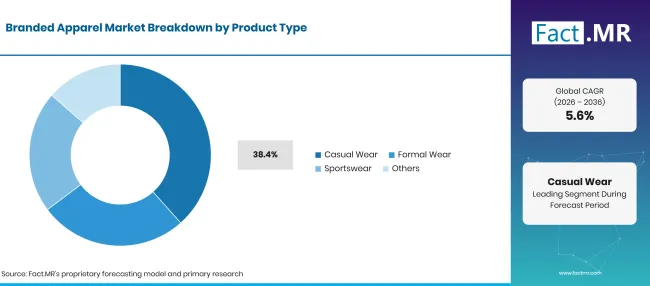
Factmr Branded Apparel Market Breakdown Product Type | Source: Fact.MR
| Product Type | Share (2026) |
|---|---|
| Casual Wear (Leading segment) | 38.4% |
| Other segments combined | 61.6%* |
| Total | 100.0% |
Source: Fact.MR analysis. Updated Oct 14, 2026
Casual wear holds a strong position in the branded apparel market because consumers prefer comfortable and versatile clothing for everyday use. Branded casual clothing appeals to a broad customer base through varied designs and accessible price points. Formalwear and sportswear serve distinct occasions and lifestyle needs which influence purchasing patterns across the market.
What leads the Sales Channel segment?
Online Stores is set to represent 34.6% share in 2026.
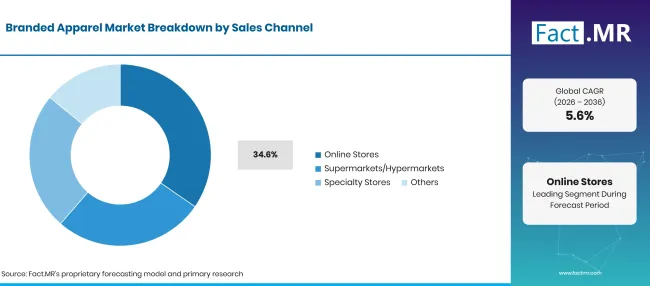
Factmr Branded Apparel Market Breakdown Sales Channel | Source: Fact.MR
| Sales Channel | Share (2026) |
|---|---|
| Online Stores (Leading segment) | 34.6% |
| Other segments combined | 65.4%* |
| Total | 100.0% |
Source: Fact.MR analysis. Updated Oct 14, 2026
Online stores hold a strong position in the branded apparel market by offering convenient shopping and a wide range of products. They also allow consumers to compare prices easily before making a purchase. Digital platforms allow apparel brands to reach wider audiences through brand websites and online marketplaces. Physical retail stores and other sales channels continue to serve consumers who prefer in-person product evaluation, immediate purchases, and personalized shopping experiences.
How does End-User shape demand?
Women is likely to account for 41.3 % share in 2026.
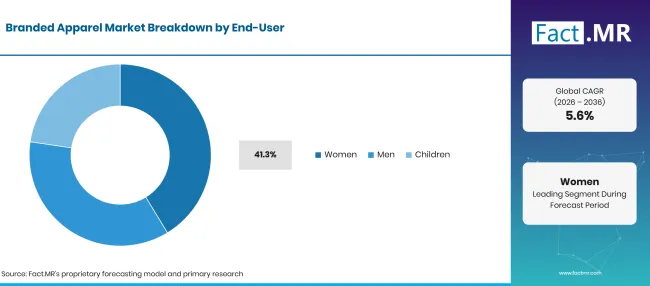
Factmr Branded Apparel Market Breakdown End User | Source: Fact.MR
| End-User | Share (2026) |
|---|---|
| Women (Leading segment) | 41.3% |
| Other segments combined | 58.7%* |
| Total | 100.0% |
Source: Fact.MR analysis. Updated Oct 14, 2026
Women segment leads with a significant share in the branded apparel market in 2026 because of varied clothing needs across everyday fashion and special occasions. For instance, in April 2026, India's Ministry of Textiles released its Market for Textiles and Clothing: National Household Survey 2024, reporting that women accounted for 55.5% of textile purchases, compared with 44.5% for men [3]. The above data highlights women's purchasing preferences in apparel demand, although the statistic covers textile purchases broadly rather than branded apparel alone.
What leads the Material segment?
Cotton is likely to account for 36.5% share in 2026.
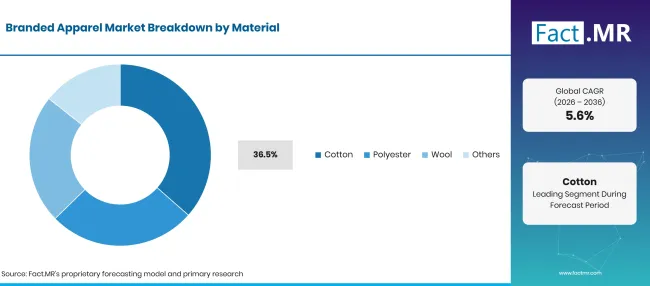
Factmr Branded Apparel Market Breakdown Material | Source: Fact.MR
| Material | Share (2026) |
|---|---|
| Cotton (Leading segment) | 36.5% |
| Other segments combined | 63.5%* |
| Total | 100.0% |
Source: Fact.MR analysis. Updated Oct 14, 2026
Cotton holds a dominant position in the branded apparel market because of its softness and comfort for everyday wear. Its breathable nature also makes it suitable for casualwear and other clothing categories. Synthetic fabrics such as polyester are widely used in apparel production due to their durability and flexibility. These materials also help improve moisture control and support active lifestyles.
What is accelerating Branded Apparel Market adoption, and what is holding it back?
Growing brand awareness and online shopping boost demand, but high prices and intense competition limit growth.
Drivers Impact Analysis
| DRIVER | (~) % IMPACT ON CAGR | GEOGRAPHIC RELEVANCE | IMPACT TIMELINE |
|---|---|---|---|
| Growing consumer preference for branded casual wear | +1.0% | Global | Medium term (2–4 years) |
| Expansion of online apparel retail and e-commerce | +0.9% | Global | Short term (≤ 2 years) |
| Rising demand for women's branded apparel | +0.7% | Americas, Europe, Asia-Pacific | Medium term (2–4 years) |
| Brand differentiation and digital marketing | +0.5% | Global | Short term (≤ 2 years) |
| Demand for sustainable materials and cotton-based clothing | +0.4% | Europe, Americas, Asia-Pacific | Long term (≥ 4 years) |
Source: Fact.MR analysis. Updated Oct 14, 2026
Opportunity Impact Analysis
| OPPORTUNITY | (~) % IMPACT ON CAGR | GEOGRAPHIC RELEVANCE | IMPACT TIMELINE |
|---|---|---|---|
| Expansion into emerging branded apparel markets | +0.8% | Asia-Pacific, Latin America | Medium term (2–4 years) |
| Personalized apparel and direct-to-consumer channels | +0.6% | North America, Europe, Asia-Pacific | Medium term (2–4 years) |
| Growth of online marketplaces and digital brand stores | +0.5% | Global | Short term (≤ 2 years) |
| Sustainable cotton sourcing and circular fashion initiatives | +0.4% | Europe, North America, Asia-Pacific | Long term (≥ 4 years) |
Source: Fact.MR analysis. Updated Oct 14, 2026
Restraints Impact Analysis
| RESTRAINT | (~) % IMPACT ON CAGR | GEOGRAPHIC RELEVANCE | IMPACT TIMELINE |
|---|---|---|---|
| High prices of premium branded apparel | -0.8% | Global | Short term (<= 2 years) |
| Intense competition from low-cost and unbranded clothing | -0.6% | Global | Medium term (2–4 years) |
| Counterfeit products and brand imitation | -0.5% | Asia-Pacific, Latin America | Short term (≤ 2 years) |
| Rising material, manufacturing, and supply-chain costs | -0.4% | Global | Medium term (2–4 years |
Source: Fact.MR analysis. Updated Oct 14, 2026
Which countries are scaling the Branded Apparel Market through 2036?
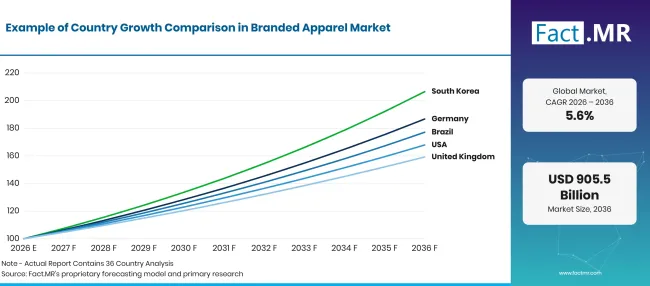
Factmr Branded Apparel Market Growth Index | Source: Fact.MR
| Country | CAGR (2026-2036) |
|---|---|
| Germany | 6.4% |
| Brazil | 5.9% |
| USA | 5.3% |
| UK | 4.8% |
| Japan | 4.2% |
Source: Fact.MR analysis. Updated Oct 14, 2026
What supports Germany's branded apparel market growth?
6.4% CAGR, supported by rising demand for premium clothing and everyday casualwear.
Germany's developed retail sector and established consumer market create opportunities for branded clothing across different categories such as casualwear and sportswear as well as formalwear. Consumers consider product quality, brand reputation, and durability when purchasing apparel. Online retail and omnichannel shopping also help brands reach consumers and expand their market presence.
How is Brazil developing its branded apparel market?
5.9% CAGR, driven by domestic fashion demand, expanding digital retail, and diverse consumer preferences.
Brazil's large consumer base offers growth opportunities for both domestic and international apparel brands. Demand for casual clothing and women's apparel as well as sportswear supports market expansion. According to Brazil's Institute of Geography and Statistics (IBGE), retail sales of fabrics, clothing, and footwear increased by 5.5% in the first half of 2025 compared with the same period in 2024 [4]. Brands can build demand by aligning product design, pricing, and distribution with local consumer preferences.
What supports United States branded apparel market growth?
The market is projected to grow at a 5.3% CAGR due to strong demand and rising online apparel sales.
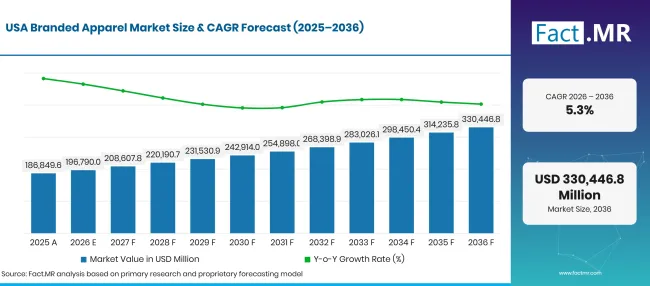
Factmr Branded Apparel Market Forecast Usa | Source: Fact.MR
The United States offers opportunities across casualwear, sportswear, denim, and premium clothing, with consumers purchasing apparel through both physical stores and digital platforms. The U.S. Census Bureau's quarterly retail e-commerce statistics provide an official measure of the expanding online retail environment, which supports brands seeking to improve digital reach and direct-to-consumer sales. Branded apparel companies can strengthen their market position by introducing new products and improving customer loyalty. They can also attract more customers by offering convenient shopping experiences.
How is the United Kingdom developing its branded apparel market?
4.8% CAGR, shaped by established fashion retail, online shopping, and demand for versatile clothing.
The UK apparel market caters to consumers seeking casual clothing and formal outfits as well as sportswear and premium fashion. The Office for National Statistics (ONS), in its January 23, 2026 retail sales release, reported that Great Britain's total retail sales volumes increased by 1.3% in 2025 compared with 2024 [5]. This broader retail trend provides context for apparel brands as they adjust their product offerings and pricing. They also adapt their digital sales strategies to meet changing consumer demand.
Who leads the Branded Apparel Market?
Fact.MR profiles major branded apparel companies including Nike, Adidas, Inditex, H&M Group, Fast Retailing, PVH Corp. and Levi Strauss & Co. These businesses compete across sportswear and casual fashion as well as premium clothing and denim.
Nike and Adidas are major players in branded sportswear and performance apparel. Inditex operates fashion brands such as Zara, while H&M Group competes in accessible fashion and everyday clothing. Fast Retailing, through Uniqlo, focuses on casualwear and functional apparel. Other significant competitors include PVH Corp., which owns Calvin Klein and Tommy Hilfiger, and Levi Strauss & Co., known for denim and casualwear.
Brand recognition and competitive pricing influence market performance alongside product quality and distribution reach. Apparel manufacturers need efficient sourcing and reliable production. Retailers need responsive inventory management and effective omnichannel strategies. Brands also need to adapt to changing fashion preferences while maintaining customer loyalty and differentiating their products in a competitive market.
Which companies are the key providers?
Key companies includes Nike, Inc., Adidas AG, Inditex S.A., H&M Group, Fast Retailing Co., Ltd., PVH Corp., Levi Strauss & Co.
- Nike, Inc.
- Adidas AG
- Inditex S.A.
- H&M Group
- Fast Retailing Co., Ltd.
- PVH Corp.
- Levi Strauss & Co.
Bibliography
- [1] United Nations Environment Programme. (2025). Minimizing fashion’s environmental footprint. https://www.unep.org/annualreport/2025/stories/minimizing-fashions-environmental-footprint
- [2] Fast Retailing Co., Ltd. (2025). Integrated report 2025.
- [3] H & M Hennes & Mauritz AB. (2026). Annual and sustainability report 2025.
- [4] Instituto Brasileiro de Geografia e Estatística. (2025, August 13). Retail sales hit -0.1% in June. https://agenciadenoticias.ibge.gov.br/en/agencia-press-room/2185-news-agency/releases-en/44227-retail-sales-hit-0-1-in-june
- [5] Industria de Diseño Textil, S.A. (2026). Annual report 2025.
- [6] Levi Strauss & Co. (2026). 2025 annual report.
- [7] National Statistics Office. (2026, January 23). Retail sales, Great Britain: December 2025. Office for National Statistics. https://www.ons.gov.uk/businessindustryandtrade/retailindustry/bulletins/retailsales/december2025
- [8] NIKE, Inc. (2025). Form 10-K: Annual report for the fiscal year ended May 31, 2025. U.S. Securities and Exchange Commission.
- [9] PVH Corp. (2026). Company filings. U.S. Securities and Exchange Commission.
- [10] United Nations Environment Programme. (2025). Minimizing fashion’s environmental footprint.
- https://www.unep.org/annualreport/2025/stories/minimizing-fashions-environmental-footprint
- [11] U.S. Census Bureau. (n.d.). Quarterly retail e-commerce sales. https://www.census.gov/retail/ecommerce.html
- [12] World Trade Organization. (2025, October). Global trade outlook and statistics update: October 2025. https://www.wto.org/english/rese/publicationse/gtos1025_e.htm
This Report Answers
- The report describes how branded apparel is sold across the listed product types and consumer segments.
- Segment analysis compares the specified product categories and their 2026 shares.
- Country analysis discusses Germany, Brazil, USA, UK, and Japan alongside official retail statistics.
- The competitive overview profiles Nike, Adidas, Inditex, H&M Group, Fast Retailing, PVH Corp., and Levi Strauss & Co.
- Sales channel analysis distinguishes online stores from specialty stores, department stores, brand-owned retail stores, and other distribution channels.
What does the Branded Apparel Market cover?
The market covers clothing products sold under established brand names. It tracks demand across casual wear, formal wear, sportswear, and other apparel categories. Product coverage follows the specified product types, while sales channel analysis separates online stores from physical retail and other distribution channels. Apparel purchasing decisions depend on brand recognition, product quality, design, pricing, material composition, and consumer preferences.
What is included in the scope?
Included products comprise branded clothing sold through online stores, specialty stores, department stores, brand-owned retail stores, and other specified channels.
The market covers apparel purchased by women, men, and children, with material segmentation encompassing cotton, synthetic fibers, blended fabrics, and other materials. The analysis also considers casual wear and other identified apparel categories across the specified geographic markets.
What is excluded from the scope?
The analysis excludes unbranded clothing without an established brand identity.
It also excludes footwear and fashion accessories such as handbags and jewellery unless they fall within the defined apparel category. Textile raw materials and manufacturing machinery are not included. Retail technology services are also excluded to ensure consistency in branded apparel market sizing.
How Was the Analysis Built?
The analysis draws on 120+ sources, 35+ company portfolios, 25+ countries, and more than 20 industry interviews.
- Primary Research: Primary research involves discussions with apparel manufacturers and brand owners as well as retailers and industry experts. These discussions explore consumer preferences and pricing strategies. They also examine product development and distribution methods along with market competition and factors affecting consumer choices.
- Desk Research: Desk research uses government statistics and company annual reports along with retail data and industry publications. It also includes consumer studies and sustainability reports. All sources used in the analysis are listed in the bibliography.
- Market Sizing and Forecasting: Market estimates consider past retail performance and consumer demand. They also account for pricing trends and segment shares as well as country-level growth and online sales. Purchasing habits and barriers to market expansion are also examined.
- Data Validation and Update Cycle: Findings are validated using company reports and official retail statistics. The analysis also considers trade data and consumer trends. Regular updates track product launches and store expansions along with e-commerce growth and changes in buying habits.
Segmentation
What is the report’s scope and coverage?
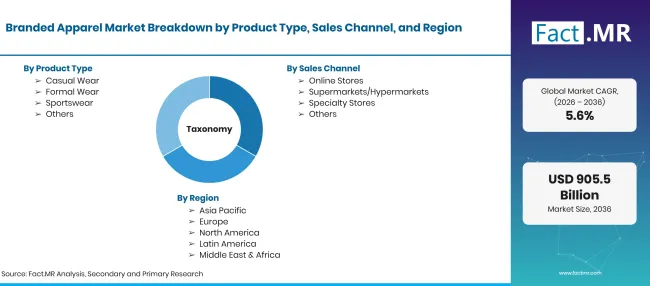
Factmr Branded Apparel Market Taxonomy | Source: Fact.MR
| Attribute | Details |
|---|---|
| Quantitative Units | USD billion |
| Market Definition | Branded apparel includes clothing sold under established brand names, formalwear, sportswear, encompassing casualwear, and other apparel categories differentiated by brand design, identity, quality, and consumer recognition. |
| Product Type | Casual Wear; Formal Wear; Sportswear; Other Apparel Types |
| Sales Channel | Online Stores; Supermarkets/Hypermarkets; Specialty Stores; Others |
| End-User | Women; Men; Children |
| Material | Cotton; Synthetic Fibers; Blended Fabrics; Other Materials |
| Regions Covered | North America; Latin America; Western Europe; Eastern Europe; East Asia; South Asia & Pacific; Middle East & Africa |
| Countries Covered | Germany; Brazil; USA; UK; Japan |
| Companies Profiled | Nike, Inc.; Adidas AG; Inditex S.A.; H&M Group; Fast Retailing Co., Ltd.; PVH Corp.; Levi Strauss & Co. |
| Forecast Period | 2026 to 2036 |
| Approach | Market segmentation and scenario-based analysis supported by company reports, official retail statistics, industry publications, and consumer market data. |
Source: Fact.MR analysis. Updated Oct 14, 2026
How is the market segmented?
-
By Product Type:
- Casual Wear
- Formal Wear
- Sportswear
- Others
-
By Sales Channel:
- Online Stores
- Supermarkets/Hypermarkets
- Specialty Stores
- Others
-
By End-User:
- Women
- Men
- Children
-
By Material:
- Cotton
- Polyester
- Wool
- Others
-
By Region:
- North America
- Latin America
- Western Europe
- Eastern Europe
- East Asia
- South Asia & Pacific
- Middle East & Africa
Frequently Asked Questions
How big is the Branded Apparel Market in 2026?
What is the CAGR from 2026 to 2036?
Which product type has the largest stated share?
Which material has the largest stated share?
Which companies are covered?
Who worked on this report


Preview the report firsthand - request a free sample
Free SampleGet the brochure for pricing and purchase details
Download PDF