- Market Value (2025): USD 43.2 Bn
- Estimated Value (2026): USD 44.8 Bn
- Forecast Value (2036): USD 65.2 Bn
- CAGR (2026-2036): 3.8%
What is the Bread Flour Market forecast to be worth by 2036?
USD 43.2 billion in 2025; USD 44.8 billion in 2026 to USD 65.2 billion by 2036 at a 3.8% CAGR.
- As per Fact.MR analysis, the Bread Flour Market was valued at USD 43.2 billion in 2025.
- Demand will increase from USD 44.8 billion in 2026 to USD 65.2 billion by 2036.
- Fact.MR estimates a 3.8% CAGR from 2026 to 2036 as commercial bakeries and household customers continue buying flour for everyday bread production.
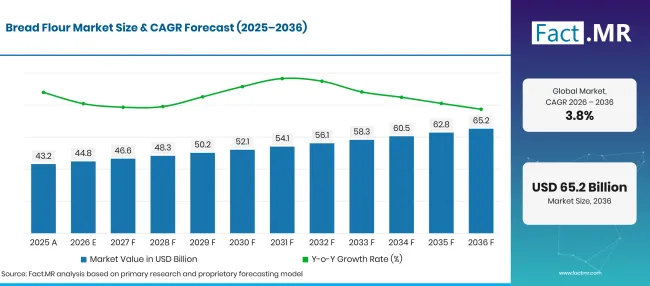
Factmr Bread Flour Market Forecast Global | Source: Fact.MR
| Year | Basis | Market Value (USD billion) |
|---|---|---|
| 2025 | Actual | 43.2 |
| 2026 | Estimate | 44.8 |
| 2036 | Forecast | 65.2 |
| CAGR 2026 to 2036 | Forecast period | 3.8% |
Source: Fact.MR analysis. Updated Oct 13, 2026
What are the defining numbers behind Bread Flour Market growth?
USD 20.4 billion absolute opportunity by 2036, led by white flour, bakery applications and supermarket retail.
- Demand Drivers in the Market
- Commercial bakeries buy flour regularly because bread quality depends on consistent protein content and dough performance.
- The UK Department for Environment, Food & Rural Affairs reported 5.526 million tonnes of wheat for flour milling, including bioethanol and starch uses, in 2025 [1].
- Flour mills combine domestic and imported wheat to achieve the texture required for packaged bread products.
- Key Segments Analyzed
- By Product Type: White Flour holds 42.3% share in 2026 as its fine texture and consistent dough performance suit everyday bread production.
- By Application: Bakery accounts for 48.2% share in 2026 because professional bread making requires steady flour deliveries and repeatable baking results.
- By Sales Channel: Supermarkets/Hypermarkets captures 48.7% share in 2026 as customers can compare familiar packaged flour grades during routine grocery visits.
- Analyst Opinion at Fact.MR
- Shambhu Nath Jha, Principal Consultant at Fact.MR, states, “Consistency is a key factor when bakeries choose a regular flour supplier, as changes in dough quality can affect daily production. Household buyers make different choices, often comparing flour type, pack size, and shelf price before purchasing.”
- Strategic Implications
- Millers can organize bread flour grades based on consistent dough performance and clearly explain the most suitable baking use for each product.
- Industrial bakers need to check flour performance across multiple production runs before choosing a new supplier.
- Retailers can stock standard white flour alongside whole wheat and multigrain varieties while keeping pack sizes easy for shoppers to compare.
- Wheat traders need to monitor crop quality and milling performance as closely as overall harvest volumes when discussing future flour supply.
The United States will lead at 4.9% CAGR, supported by commercial bakery demand, recurring flour purchases, and established milling activity. Japan will follow at 4.5%, where detailed bakery specifications and consistent flour quality will support sales. The United Kingdom will record 4.1% as commercial bakeries continue to rely on stable milling grades and dependable supply. Germany will reach 3.7%, supported by varied bread formats and an established wheat-milling base. Brazil will advance at 2.8%, where domestic wheat availability, and bakery requirements will shape flour purchasing.
How does the Bread Flour Market break down by segment?
White Flour leads Product Type at 42.3%; Bakery leads Application at 48.2%; Supermarkets/Hypermarkets lead Sales Channel at 48.7%.
Which Product Type dominates?
White Flour is forecast to hold a 42.3% share in 2026.
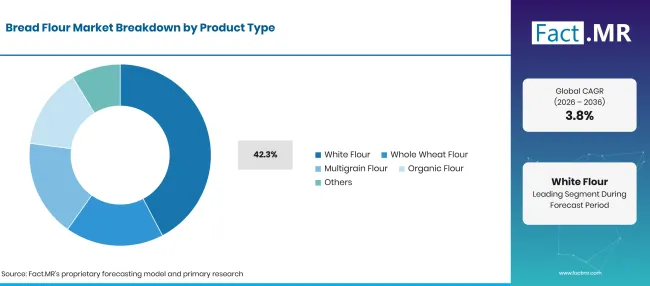
Factmr Bread Flour Market Breakdown Product Type | Source: Fact.MR
| Product Type | Share (2026) |
|---|---|
| White Flour (Leading segment) | 42.3% |
| Other segments combined | 57.7%* |
| Total | 100.0% |
Source: Fact.MR analysis. Updated Oct 13, 2026
White flour remains the most common choice for many bakeries because it delivers consistent dough quality for everyday bread products. Bakers choose different protein levels based on the type of bread they make, so one flour grade does not suit every recipe. Whole wheat flour contains the bran and germ, giving bread a different taste and texture. Multigrain flour is used in recipes that combine wheat with other grains, while organic flour appeals to shoppers looking for certified production methods.
What leads the Application segment?
Fact.MR forecasts that bakery will account for a 48.2% share in 2026.
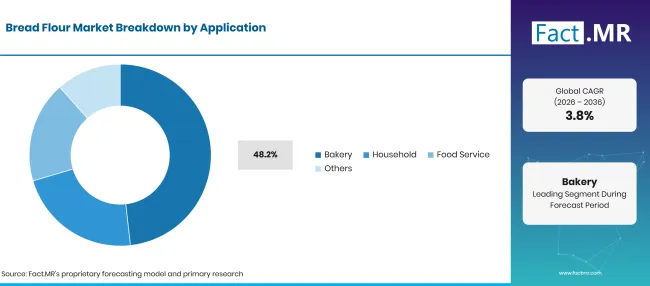
Factmr Bread Flour Market Breakdown Application | Source: Fact.MR
| Application | Share (2026) |
|---|---|
| Bakery (Leading segment) | 48.2% |
| Other segments combined | 51.8%* |
| Total | 100.0% |
Source: Fact.MR analysis. Updated Oct 13, 2026
Bakeries buy bread flour regularly and expect the same dough quality from every delivery. A change in flour can affect mixing time, water absorption, and proofing results. Harvest volume plays a role in raw material supply, but millers still need wheat that meets the quality requirements of bread producers.
How do Sales Channels shape flour purchases?
Fact.MR expects supermarkets/Hypermarkets to hold a 48.7% share in 2026.
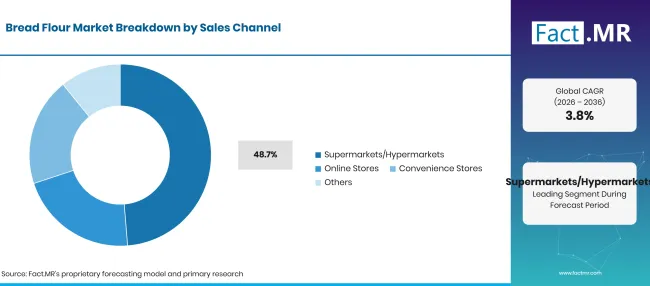
Factmr Bread Flour Market Breakdown Sales Channel | Source: Fact.MR
| Sales Channel | Share (2026) |
|---|---|
| Supermarkets/Hypermarkets (Leading segment) | 48.7% |
| Other segments combined | 51.3%* |
| Total | 100.0% |
Source: Fact.MR analysis. Updated Oct 13, 2026
Supermarkets and hypermarkets allow shoppers to compare different flour types and pack sizes during their regular grocery trips. Online stores are convenient for repeat purchases and specialty flours, especially when certain products are not easily available in local shops.
What is accelerating Bread Flour Market adoption, and what is holding it back?
Repeat purchases from bakeries support bread flour sales, while differences in wheat quality and changes in cost influence flour buying decisions.
Drivers Impact Analysis
| DRIVER | (~) % IMPACT ON CAGR | GEOGRAPHIC RELEVANCE | IMPACT TIMELINE |
|---|---|---|---|
| Repeated flour use in commercial bread production | +1.0% | Global | Long term |
| Consistent grades for industrial bakery lines | +0.8% | North America, Europe | Medium term |
| Retail purchases for home baking | +0.6% | Global | Medium term |
| Broader flour choice for whole wheat bread | +0.5% | Global | Long term |
| More efficient grain sourcing and blending | +0.4% | Global | Medium term |
Source: Fact.MR analysis. Updated Oct 13, 2026
Opportunity Impact Analysis
| OPPORTUNITY | (~) % IMPACT ON CAGR | GEOGRAPHIC RELEVANCE | IMPACT TIMELINE |
|---|---|---|---|
| Flour grades for industrial bread lines | +0.7% | North America, Western Europe | Medium term |
| Small packs for household bakers | +0.5% | Global | Short term |
| Specialty multigrain formulations | +0.4% | Global | Medium term |
| Closer mill-to-bakery planning | +0.3% | Global | Long term |
Source: Fact.MR analysis. Updated Oct 13, 2026
Restraints Impact Analysis
| RESTRAINT | (~) % IMPACT ON CAGR | GEOGRAPHIC RELEVANCE | IMPACT TIMELINE |
|---|---|---|---|
| Wheat harvest and grade variation | -0.7% | Global | Short term |
| Energy and transport expenses | -0.5% | Global | Medium term |
| Price competition on standard flour | -0.4% | Global | Medium term |
| Storage and shelf-life limits | -0.3% | Global | Short term |
Source: Fact.MR analysis. Updated Oct 13, 2026
Which countries are scaling the Bread Flour Market through 2036?
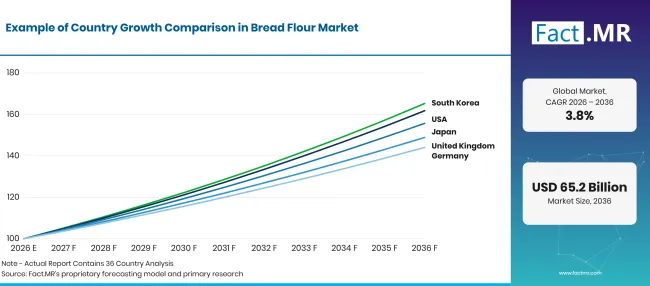
Factmr Bread Flour Market Growth Index | Source: Fact.MR
| Country | CAGR (2026–2036) |
|---|---|
| United States | 4.9% |
| Japan | 4.5% |
| United Kingdom | 4.1% |
| Germany | 3.7% |
| Brazil | 2.8% |
Source: Fact.MR analysis. Updated Oct 13, 2026
How is the United States developing bread flour sales?
4.9% CAGR, supported by commercial baking and established flour milling.
U.S. flour mills supply commercial bakeries that depend on consistent dough performance across regular production runs. The U.S. Department of Agriculture Economic Research Service estimated 960 million bushels of wheat for food use in 2025/26 [5]. Consistent flour quality, repeat purchases from bakeries, and easy availability in supermarkets help maintain bread flour sales.
What supports bread flour purchases in Japan?
4.5% CAGR, supported by detailed bakery specifications and consistent flour quality.
Japanese bakeries choose flour based on dough performance, loaf softness, and the texture of the final product. The Ministry of Agriculture, Forestry and Fisheries reported 1.031 million tonnes of wheat harvested in 2025 [2]. Mills use available wheat supplies and specialized flour grades to meet the needs of bakeries that require consistent handling and baking results.
What is shaping bread flour sales in the United Kingdom?
4.1% CAGR, shaped by milling throughput and dependable wheat sourcing.
UK commercial bakeries rely on flour that delivers consistent results during mixing, proofing, and baking. The Department for Environment, Food & Rural Affairs reported 11.958 million tonnes of wheat harvested in 2025 [3]. Domestic wheat production provides millers with a strong supply base for bakery flour blends, while retail packs remain popular for home bread making.
How does Germany support bread flour production?
3.7% CAGR, supported by varied bread formats and an established wheat-milling base.
German bakeries use different flour grades to make a wide variety of breads and support different fermentation methods. The Federal Statistical Office reported 22.6 million tonnes of winter wheat harvested in 2025 [4]. Strong local grain supplies give mills more flexibility when producing white flour, whole wheat flour, and other bread flour blends for both commercial bakeries and household consumers.
What affects bread flour purchasing in Brazil?
2.8% CAGR, shaped by domestic wheat supply and mill sourcing decisions.
Brazilian mills adjust their wheat sourcing to maintain consistent flour quality as crop availability and grain sources change. Bakeries value flour that performs reliably in daily production, while household sales depend on affordable pack sizes and consistent product quality.
Who leads the Bread Flour Market?
Bread flour competition includes suppliers serving commercial bakeries as well as brands selling directly to home bakers. Archer Daniels Midland Company, Ardent Mills, and Bay State Milling operate in grain processing and flour milling. King Arthur Baking and Bob’s Red Mill supply baking flour to retail customers. Consistent product quality and competitive pricing influence buying decisions across both markets.
General Mills participates through its flour brands and established retail network, while Cargill supplies grain and ingredients to food manufacturers. Conagra Brands and Hain Celestial are primarily focused on packaged foods and are not part of the core flour-milling supplier group. Flour producers compete by delivering consistent flour quality and the right grades for different baking applications
Which companies are the key providers?
Key companies include Archer-Daniels-Midland Company (ADM); General Mills, Inc.; King Arthur Baking Company, Inc.; Bob’s Red Mill Natural Foods Inc.; Bay State Milling Company; Ardent Mills, LLC; and Cargill Incorporated.
- Archer Daniels Midland Company
- General Mills Inc.
- King Arthur Baking Company Inc.
- Bob’s Red Mill Natural Foods Inc.
- Bay State Milling Company
- Ardent Mills LLC
- Cargill Incorporated
Bibliography
- [1] Department for Environment, Food & Rural Affairs. (2026, July 9). Agriculture in the United Kingdom 2025: Chapter 7, Crops.
- [2] Ministry of Agriculture, Forestry and Fisheries. (2026).[FY2025 White Paper on Food, Agriculture and Rural Areas].
- [3] Department for Environment, Food & Rural Affairs. (2026, October 8). Cereal and oilseed production in the United Kingdom 2025.
- [4] Statistisches Bundesamt (Destatis). (n.d.). 2025 grain and potato harvest: 45 million tons of grain and 14 million tons of potatoes.
- [5] U.S. Department of Agriculture, Economic Research Service. (2026, May 14). Wheat Outlook: May 2026.
- [6] Statistisches Bundesamt (Destatis). (n.d.). Agricultural stocks as at 31 December 2025.
- [7] ADM. (2026). Flours & specialty grains. ADM.
- [8] King Arthur Baking Company. (2024, June 14). Sir Lancelot hi-gluten flour: Product information sheet.
This Report Answers
- The report assesses bread flour spending by product type, application and sales channel.
- Segment analysis explains how white flour, commercial bakeries and supermarket retail shape product purchases.
- Country analysis reviews differences in wheat supply, breadmaking needs and flour buying.
- Competitive analysis examines milling specialists and retail flour brands active in relevant product categories.
- Supply-chain analysis looks at wheat selection, milling grades, flour handling and delivery.
What does the Bread Flour Market cover?
The Bread Flour Market covers flour made and sold for bread production across commercial bakeries, food service and household use. Bread mix products offer background on prepared bakery blends without changing the flour-only market boundary.
What is included in the scope?
The scope includes white, whole wheat, multigrain and organic bread flour purchased as finished milling products. Functional bakery ingredients are discussed only when they help explain bakery purchasing needs.
What is excluded from the scope?
Unfilled wheat grain, finished bread and bakery mixes sold as prepared compound ingredients are excluded from bread flour revenue. Baked foods and cereals sit downstream of the flour supplied to bakeries.
How Was the Analysis Built?
The analysis draws on 120+ sources, 35+ company portfolios, 25+ countries, and more than 20 industry interviews.
- Primary Research: Primary research includes discussions with manufacturers, service providers, technology developers, distributors, end users, and subject-matter experts. These conversations examine purchasing priorities, product adoption, operational challenges, approval requirements, competitive positioning, and the factors that influence wider market acceptance.
- Desk Research: Desk research covers government statistics, regulatory publications, company filings, trade data, technical studies, industry associations, standards, public policy, and other authoritative sources. Every source used in the analysis is documented in the bibliography.
- Market Sizing and Forecasting: Market estimates combine historical performance, demand indicators, pricing and volume trends, segment shares, company participation, country-level growth, adoption patterns, investment activity, and barriers to market expansion.
- Data Validation and Update Cycle: Findings are validated by comparing primary interviews with public data, company activity, regulatory changes, trade patterns, and industry developments. Regular updates review new product launches, capacity changes, partnerships, approvals, and shifts in commercial adoption.
Segmentation
What is the report’s scope and coverage?
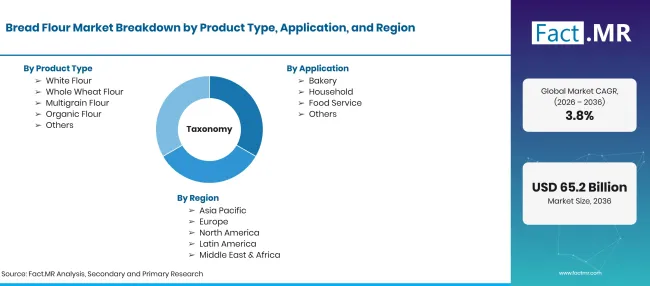
Factmr Bread Flour Market Taxonomy | Source: Fact.MR
| Attribute | Details |
|---|---|
| Quantitative units | USD billion in 2026 to USD billion by 2036 at a CAGR |
| Market definition | Bread flour sold for bakery production, home bread baking and food service uses. |
| Product Type | White Flour; Whole Wheat Flour; Multigrain Flour; Organic Flour; Others |
| Application | Bakery; Household; Food Service; Others |
| Sales Channel | Supermarkets/Hypermarkets; Online Stores; Convenience Stores; Others |
| Regions covered | North America; Latin America; Western Europe; Eastern Europe; East Asia; South Asia & Pacific; Middle East & Africa |
| Countries covered | United States; Japan; United Kingdom; Germany; Brazil |
| Forecast period | 2026 to 2036 |
| Approach | Analysis of bread flour product mix, wheat milling, bakery uses, retail channels and country-level conditions |
Source: Fact.MR analysis. Updated Oct 13, 2026
How is the market segmented?
-
By Product Type
- White Flour
- Whole Wheat Flour
- Multigrain Flour
- Organic Flour
- Others
-
By Application
- Bakery
- Household
- Food Service
- Others
-
By Sales Channel
- Supermarkets/Hypermarkets
- Online Stores
- Convenience Stores
- Others
-
By Region
- North America
- Latin America
- Western Europe
- Eastern Europe
- East Asia
- South Asia & Pacific
- Middle East & Africa
Frequently Asked Questions
How big is the bread flour market in 2026?
What is the CAGR of the bread flour market from 2026 to 2036?
Which product type leads the bread flour market?
Which sales channel leads the bread flour market?
Which companies supply bread flour?
Who worked on this report


Preview the report firsthand - request a free sample
Free SampleGet the brochure for pricing and purchase details
Download PDF