- Market Value (2025): USD 716.9 Mn
- Estimated Value (2026): USD 755.4 Mn
- Forecast Value (2036): USD 1275.8 Mn
- CAGR (2026-2036): 5.4%
What is the Business Jet Simulators Market forecast to be worth by 2036?
USD 755.4 million in 2026 to USD 1275.8 million by 2036, at a 5.4% CAGR.
- The business jet simulators market was valued at USD 716.9 million in 2025.
- According to Fact.MR analysis, revenue is forecast to grow from USD 755.4 million in 2026 to USD 1275.8 million by 2036 as operators maintain recurrent training and introduce new aircraft types.
- The 5.4% CAGR over 2026 to 2036 reflects demand for aircraft-specific full-flight devices, pilot training and ongoing simulator support.
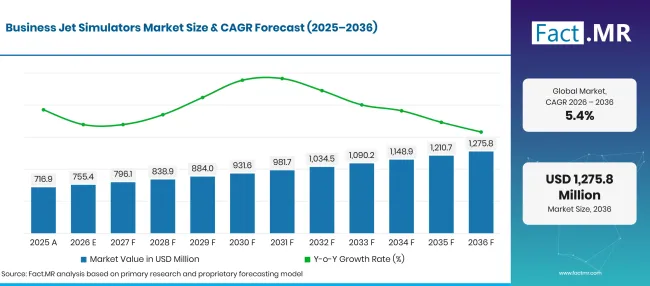
Business Jet Simulators Market Forecast Global | Source: Fact.MR
| Year | Basis | Market Value (USD million) |
|---|---|---|
| 2025 | Actual | 716.9 |
| 2026 | Estimate | 755.4 |
| 2036 | Forecast | 1275.8 |
| CAGR 2026 to 2036 | Forecast period | 5.4% |
Source: Fact.MR analysis. Updated Nov 10, 2026
What are the defining numbers behind Business Jet Simulators Market growth?
USD 520.4 million in additional market value by 2036, centered on full-flight and pilot-training applications.
- Demand Drivers in the Market
- New business jet deliveries create training requirements for additional aircraft types. The General Aviation Manufacturers Association counted 854 business jet shipments in 2025, compared with 764 in 2024 [1].
- Flight departments reserve simulator sessions to rehearse abnormal procedures without exposing aircraft or passengers to training risk. Full-flight devices allow repeated cockpit scenarios while instructors assess decisions and crew coordination.
- Operators moving to new aircraft types need additional simulator sessions. The Federal Aviation Administration reported that global business jet deliveries increased by 4.1% in 2024 in its fiscal 2025–2045 aerospace forecast [2].
- Operators purchasing recurring training consider course availability alongside the device itself. A simulator with limited instructor coverage offers less value during a time-sensitive renewal period.
- Cockpit changes require updates to visual displays and aircraft system simulations. Providers that can incorporate manufacturer changes into training devices have a clearer route to repeat contracts.
- Key Segments Analyzed
- By Type: Full Flight Simulators account for 62.3% of 2026 sales, reflecting the value of qualified training that reproduces the relevant aircraft and cockpit environment.
- By Application: Pilot Training contributes 54.8% in 2026 because operators need initial and recurrent courses for flight crews.
- By Platform: Commercial Aviation represents 59.9% in 2026 within the report’s classification of business and charter-aviation training.
- By Component: Hardware leads with 59.5% in 2026, reflecting investment in cockpits, displays and motion equipment.
- Analyst Opinion at Fact.MR
- Shambhu Nath Jha, Principal Consultant at Fact.MR, states, “Simulator providers compete on the aircraft types they can support, the qualification of their devices and the availability of instructors. Operators also need course dates that fit their schedules. Training centers that keep systems updated and minimize interruptions are better placed to retain recurrent customers.”
- Strategic Implications
- Simulator builders can secure aircraft data and technical support early enough to keep training devices aligned with cockpit revisions.
- Training center operators need to match simulator purchases with aircraft types that are already represented in their service area.
- Flight departments benefit from comparing course schedules and regulator acceptance before entering annual training agreements.
- Hardware and software suppliers can design updates that minimize simulator downtime and simplify ongoing system maintenance.
Brazil is forecast to record a 7.0% CAGR through 2036 as business aviation training access develops. Germany follows at 6.2%, supported by European operating and qualification requirements. Japan is projected at 5.5% alongside demand for aircraft-specific pilot preparation. The USA is forecast at 4.6%, reflecting an established training network. The UK is projected at 3.8% as providers focus on recurrent courses and device utilization.
How does the Business Jet Simulators Market break down by segment?
Full Flight Simulators account for 62.3%; Pilot Training for 54.8%; Commercial Aviation for 59.9%; Hardware for 59.5%.
Which Type dominates?
Full Flight Simulators represent 62.3% of the 2026 market.
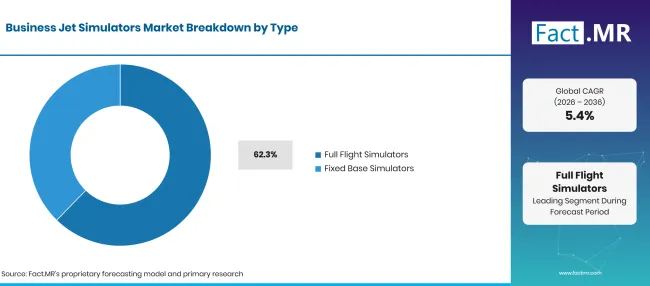
Business Jet Simulators Market Breakdown Type 1 | Source: Fact.MR
| Type | Share (2026) |
|---|---|
| Full Flight Simulators (Leading segment) | 62.3% |
| Other segments combined | 37.7% |
| Total | 100.0% |
Source: Fact.MR analysis. Updated Nov 10, 2026
Full-flight simulators reproduce an aircraft cockpit within a moving training device and are central to many approved pilot courses. Operators value a setting where crews can practice emergencies without flying the aircraft. Device qualification increases the burden on manufacturers because the flight model must perform consistently with the approved aircraft. Fixed-base simulators offer a different purchase decision when motion is unnecessary for the training objective.
What leads the Application segment?
Pilot Training makes up 54.8% of the 2026 market.
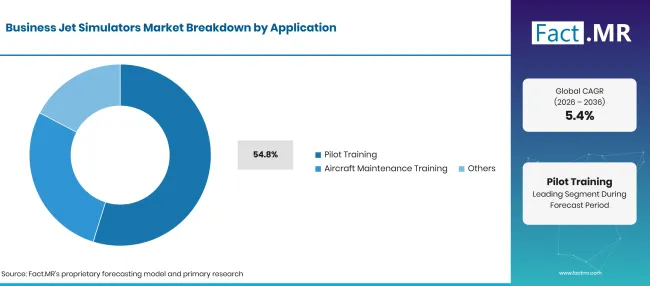
Business Jet Simulators Market Breakdown Application | Source: Fact.MR
| Application | Share (2026) |
|---|---|
| Pilot Training (Leading segment) | 54.8% |
| Other segments combined | 45.2% |
| Total | 100.0% |
Source: Fact.MR analysis. Updated Nov 10, 2026
Pilot training accounts for more simulator spending than maintenance-oriented instruction in the stated market split. Flight departments need scheduled sessions for initial qualifications and recurrent checks. Training buyers need an aircraft-matched course that fits the crew roster. Maintenance training follows a separate learning need. It concentrates on system behavior and fault identification without requiring the full motion environment used for some pilot sessions.
How does Platform shape simulator use?
Commercial Aviation leads with 59.9% of 2026 demand.
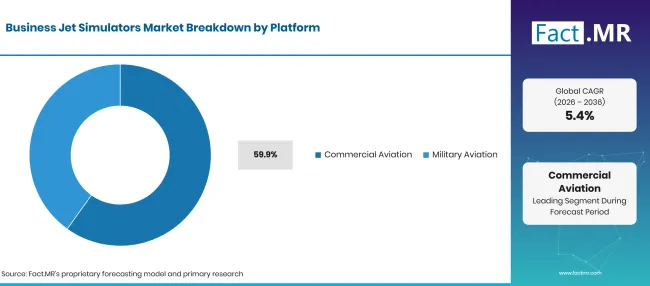
Business Jet Simulators Market Breakdown Platform | Source: Fact.MR
| Platform | Share (2026) |
|---|---|
| Commercial Aviation (Leading segment) | 59.9% |
| Other segments combined | 40.1% |
| Total | 100.0% |
Source: Fact.MR analysis. Updated Nov 10, 2026
The commercial platform category covers business and charter aviation simulator applications in this market classification. Charter operators must keep crews ready for differing trip schedules while corporate flight departments place weight on aircraft familiarity. Military aviation covers business-jet-derived aircraft used in specialized missions and training programs. Its contract process differs from civilian course purchases.
Which Component takes the higher share?
Hardware represents 59.5% of the 2026 market.
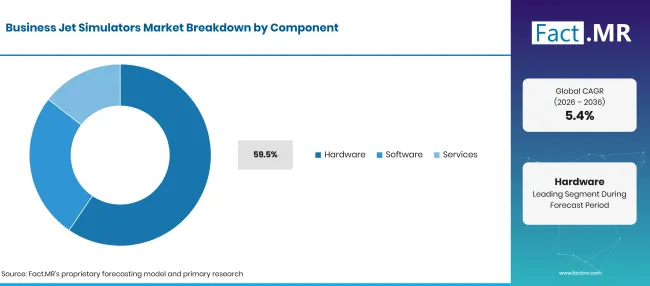
Business Jet Simulators Market Breakdown Component | Source: Fact.MR
| Component | Share (2026) |
|---|---|
| Hardware (Leading segment) | 59.5% |
| Other segments combined | 40.5% |
| Total | 100.0% |
Source: Fact.MR analysis. Updated Nov 10, 2026
Hardware purchases cover the physical cockpit and the systems needed to reproduce aircraft response. This initial equipment cost can dominate a full simulator installation. Software remains essential because the aircraft model must keep pace with changes in avionics and operational procedures. Services include maintenance and technical support that allow a training center to keep booking sessions.
What is accelerating Business Jet Simulators Market adoption, and what is holding it back?
Aircraft-specific training supports purchases, while qualification costs, instructor availability and the capacity of existing training centers influence installation decisions.
Drivers Impact Analysis
| DRIVER | CAGR IMPACT (%) | GEOGRAPHIC RELEVANCE | IMPACT TIMELINE |
|---|---|---|---|
| Recurrent pilot training requirements | +1.1% | North America; Europe | Short term (≤ 2 years) |
| Business jet model introductions | +0.9% | Global | Medium term (2–4 years) |
| Aircraft-type-specific course needs | +0.7% | North America; East Asia | Medium term (2–4 years) |
| Training capacity and scheduling | +0.5% | Global | Short term (≤ 2 years) |
| Maintenance and systems instruction | +0.3% | Global | Long term (≥ 4 years) |
Source: Fact.MR analysis. Updated Nov 10, 2026
Opportunity Impact Analysis
| OPPORTUNITY | CAGR IMPACT (%) | GEOGRAPHIC RELEVANCE | IMPACT TIMELINE |
|---|---|---|---|
| New aircraft model coverage | +0.7% | Global | Medium term (2–4 years) |
| Brazilian and Asian training access | +0.6% | Latin America; East Asia | Long term (≥ 4 years) |
| Cockpit software revisions | +0.5% | Global | Medium term (2–4 years) |
| Simulator service contracts | +0.3% | North America; Europe | Short term (≤ 2 years) |
Source: Fact.MR analysis. Updated Nov 10, 2026
Restraints Impact Analysis
| RESTRAINT | CAGR IMPACT (%) | GEOGRAPHIC RELEVANCE | IMPACT TIMELINE |
|---|---|---|---|
| Device qualification and validation expense | -0.7% | Global | Medium term (2–4 years) |
| High capital cost of full-flight devices | -0.6% | Global | Short term (≤ 2 years) |
| Aircraft type concentration | -0.4% | Smaller national fleets | Long term (≥ 4 years) |
| Specialist instructor availability | -0.3% | Global | Medium term (2–4 years) |
Source: Fact.MR analysis. Updated Nov 10, 2026
Which countries are scaling the Business Jet Simulators Market through 2036?
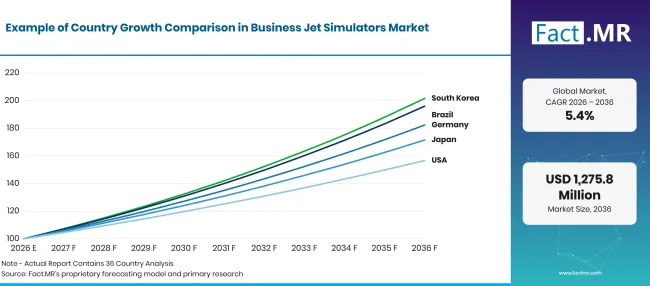
Business Jet Simulators Market Growth Index | Source: Fact.MR
| Country | CAGR (2026 to 2036) |
|---|---|
| Brazil | 7.0% |
| Germany | 6.2% |
| Japan | 5.5% |
| USA | 4.6% |
| UK | 3.8% |
Source: Fact.MR analysis. Updated Nov 10, 2026
What supports Brazil’s simulator demand?
7.0% CAGR, shaped by local business aviation access.
Brazil offers opportunities for aircraft-specific pilot training near private and charter operations. Its National Civil Aviation Agency reviewed 22,128 registered aircraft for 2024 in a 2025 activity publication [5]. Training centers can use relationships with aircraft distributors to identify the models that justify dedicated equipment. Investment still depends on steady bookings and available instructors.
What shapes Germany’s training market?
6.2% CAGR, linked to European aviation oversight.
Germany’s simulator outlook reflects the needs of European business aviation crews who train under recognized qualification arrangements. German aviation operators place weight on aircraft-type familiarity and recurrent course availability. European Union Aviation Safety Agency rules give operators a common framework when assessing approved training devices [3].
How does Japan’s business jet segment develop?
5.5% CAGR, reflecting model-specific training needs.
Japan’s business jet training needs are shaped by aircraft imported from international manufacturers and used on cross-border trips. The Ministry of Land, Infrastructure, Transport and Tourism reported 23,650 business jet movements in 2025 [6]. Pilots need aircraft-specific refresher courses that reflect flight deck procedures and the airports they serve.
What keeps US simulator utilization high?
4.6% CAGR, supported by an established operating base.
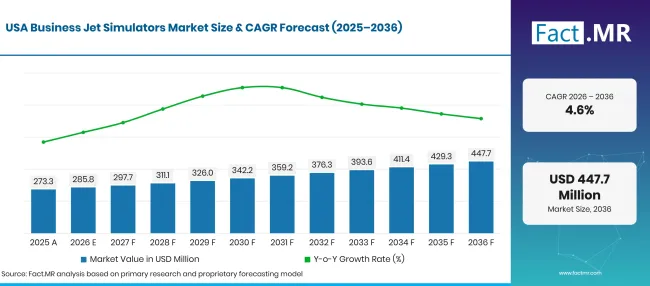
Business Jet Simulators Market Forecast Usa | Source: Fact.MR
The United States has an established network of business jet operators and specialist training providers. The Federal Aviation Administration recorded 5,134,988 business jet operations during 2024 in its July 2025 report [4]. New Citation variants create opportunities for corresponding simulator training, while older aircraft continue to need instruction on previous cockpit generations.
How is the UK training market positioned?
3.8% CAGR, centered on recurrent qualification.
The United Kingdom’s simulator market is closely connected with London-area business aviation operations and recurrent training needs. The Civil Aviation Authority reported 28,244 aero-business movements at London Luton in its 2025 airport statistics, released in March 2026 [8]. Approval recognition remains important when operators choose a training provider, and simulator software updates help training centers keep aircraft procedures current.
Who leads the Business Jet Simulators Market?
Business jet simulator competition depends on aircraft coverage and training-center access. CAE supplies simulation technology and business aviation courses across several jet families. Its fiscal 2025 corporate material describes consolidation of SIMCOM and the extension of a training agreement with Flexjet [7].
FlightSafety International combines a network of training locations with model-specific device approvals. TRU Simulation + Training and Frasca International serve the simulation equipment business. AXIS Flight Simulation GmbH works in simulator engineering. Operators compare qualification acceptance, maintenance response and available training dates when choosing between these approaches.
Which companies are the key providers?
Key companies include CAE Inc., FlightSafety International, TRU Simulation + Training, Frasca International, SIMCOM Aviation Training, and AXIS Flight Simulation GmbH.
- CAE Inc.
- FlightSafety International
- TRU Simulation + Training
- Frasca International
- SIMCOM Aviation Training
- AXIS Flight Simulation GmbH
Bibliography
- [1] Federal Aviation Administration. (2025). FAA Aerospace Forecast, Fiscal Years 2025–2045.
- [2] Federal Aviation Administration. (2025, June). FAA Aerospace Forecast, Fiscal Years 2025–2045.
- [3] European Union Aviation Safety Agency. (2025, August 26). Annual Safety Review 2025.
- [4] Federal Aviation Administration. (2025, July). Business Jet Report: July 2025 Issue.
- [5] Agência Nacional de Aviação Civil. (2025, April 24). Relatório de Gestão e Atividades 2024.
- [6] Ministry of Land, Infrastructure, Transport and Tourism. (2026). Business jet aircraft movements in Japan.
- [7] CAE Inc. (2025). Notice of Annual and Special Meeting of Shareholders and Management Proxy Circular, Fiscal 2025.
- [8] UK Civil Aviation Authority. (2026, March 23). Annual airport data 2025: Table 3.1 Aircraft Movements.
This Report Answers
- The analysis compares full-flight and fixed-base devices across business jet training uses.
- Application coverage distinguishes pilot qualification from aircraft maintenance instruction.
- The report evaluates commercial and military uses of business-jet-platform simulation.
- Country analysis considers the operating context in Brazil, Germany, Japan, USA and UK.
- Supplier analysis reviews simulator manufacturing and aircraft-specific training services.
What does the Business Jet Simulators Market cover?
Business jet simulators recreate aircraft flight deck controls and operating responses for training purposes. Revenue coverage includes suitable physical devices and supporting software or services sold for business jet applications. The boundary includes pilot and maintenance training for commercial and specialized military uses of business-jet platforms.
What is included in the scope?
Full-flight simulators and fixed-base simulators built or configured for business jet models are included.
Relevant hardware, simulator software and support services are counted. Training applications cover pilot instruction and aircraft maintenance familiarization where the simulator is intended for business jet use.
What is excluded from the scope?
Airline transport simulators dedicated only to large passenger aircraft fall outside this market.
Helicopter-only devices and flight entertainment products are excluded. General aviation piston trainers without a business jet application are also excluded from the revenue definition.
How Was the Analysis Built?
The analysis draws on 120+ sources, 35+ company portfolios, 25+ countries, and more than 20 industry interviews.
- Primary Research: Primary research includes discussions with manufacturers, service providers, technology developers, distributors, end users, and subject-matter experts. These conversations examine purchasing priorities, product adoption, operational challenges, approval requirements, competitive positioning, and the factors that influence wider market acceptance.
- Desk Research: Desk research covers government statistics, regulatory publications, company filings, trade data, technical studies, industry associations, standards, public policy, and other authoritative sources. Every source used in the analysis is documented in the bibliography.
- Market Sizing and Forecasting: Market estimates combine historical performance, demand indicators, pricing and volume trends, segment shares, company participation, country-level growth, adoption patterns, investment activity, and barriers to market expansion.
- Data Validation and Update Cycle: Findings are validated by comparing primary interviews with public data, company activity, regulatory changes, trade patterns, and industry developments. Regular updates review new product launches, capacity changes, partnerships, approvals, and shifts in commercial adoption.
Segmentation
What is the report’s scope and coverage?
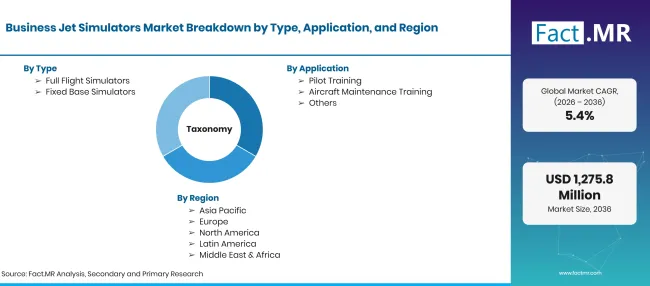
Business Jet Simulators Market Taxonomy | Source: Fact.MR
| Attribute | Details |
|---|---|
| Quantitative Units | USD million |
| Market Definition | Simulation devices and related training systems configured for business jet operations, pilot instruction and aircraft-system familiarization. |
| Type | Full Flight Simulators; Fixed Base Simulators |
| Application | Pilot Training; Aircraft Maintenance Training; Others |
| Platform | Commercial Aviation; Military Aviation |
| Component | Hardware; Software; Services |
| Regions Covered | North America; Latin America; Western Europe; Eastern Europe; East Asia; South Asia & Pacific; Middle East & Africa |
| Countries Covered | Brazil; Germany; Japan; USA; UK |
| Companies Profiled | CAE Inc., FlightSafety International, TRU Simulation + Training, Frasca International, SIMCOM Aviation Training, and AXIS Flight Simulation GmbH |
| Forecast Period | 2026 to 2036 |
| Approach | Aircraft-type training needs, simulator installations, recurrent utilization and supplier service portfolios |
Source: Fact.MR analysis. Updated Nov 10, 2026
How is the market segmented?
-
By Type
- Full Flight Simulators
- Fixed Base Simulators
-
By Application
- Pilot Training
- Aircraft Maintenance Training
- Others
-
By Platform
- Commercial Aviation
- Military Aviation
-
By Component
- Hardware
- Software
- Services
-
By Region
- North America
- Latin America
- Western Europe
- Eastern Europe
- East Asia
- South Asia & Pacific
- Middle East & Africa
Frequently Asked Questions
How big is the Business Jet Simulators Market in 2026?
What is the CAGR of the Business Jet Simulators Market from 2026 to 2036?
Which type leads the Business Jet Simulators Market?
Which application leads the Business Jet Simulators Market?
Who are the leading companies in the Business Jet Simulators Market?
Who worked on this report


Preview the report firsthand - request a free sample
Free SampleGet the brochure for pricing and purchase details
Download PDF