Business Email Market (2026 - 2036)

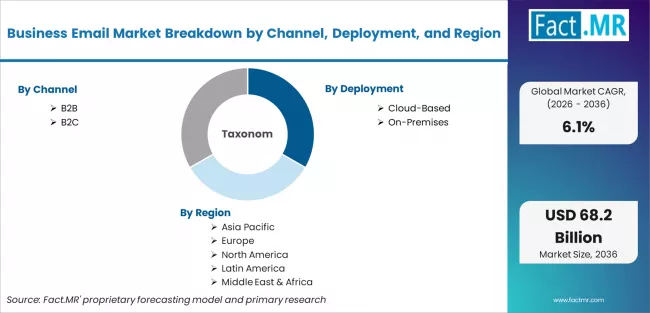
Business Email Market is segmented by Channel (Business-to-Business and Business-to-Customer), Deployment (Cloud-Based and On-Premises), and Region. Forecast for 2026 to 2036.

Core Findings

    Business Email Market Forecast and Outlook By Fact.MR

    In 2025, the business email market was valued at USD 35.6 billion. Based on Fact.MR analysis, demand for business email services is estimated to grow to USD 37.7 billion in 2026 and USD 68.2 billion by 2036. FACT.MR projects a CAGR of 6.1% during the forecast period.

    The market is expected to generate USD 30.5 billion in incremental revenue during the forecast period, reflecting steady rather than transformational expansion. Growth is driven by enterprise migration to cloud email platforms. AI-powered security and productivity features are increasing premium subscription revenue. SMB adoption of cloud email is rising across Asia Pacific and Latin America. Migration cycles in North America and Western Europe are reaching maturity. Freemium business email tiers are creating pricing pressure. Regulated industries continue to face high costs for layered email security solutions.

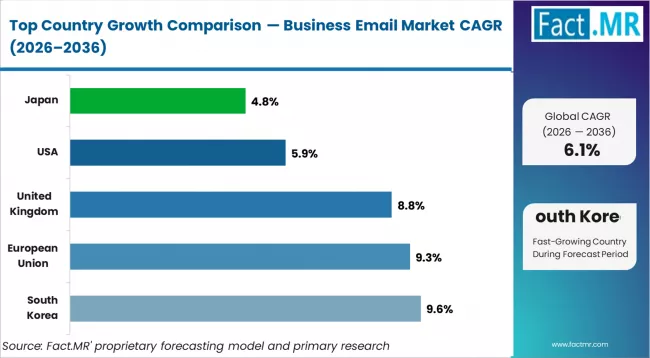
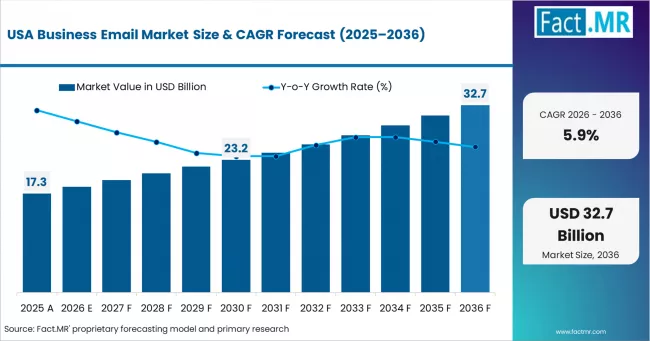
    South Korea's rapid digital workplace adoption leads country-level growth at 9.6% CAGR, while the European Union at 9.3% is shaped by GDPR cloud data residency compliance demand. Japan at 4.8% and the USA at 5.9% represent mature markets generating AI-upgrade and compliance-reformulation demand rather than seat-volume growth, with structural constraints from high existing cloud email penetration and legacy infrastructure inertia in regulated sectors.
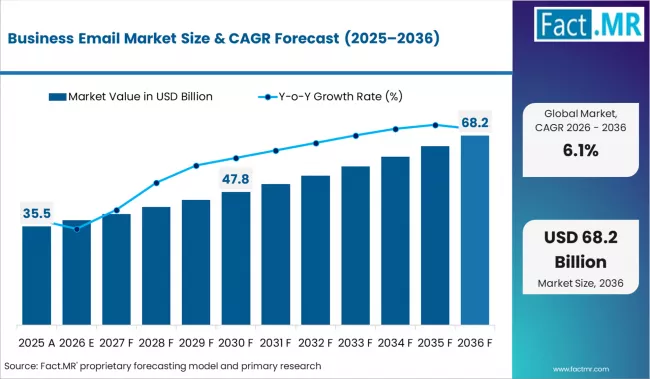
    Business Email Market Market Value Analysis

    Metric Value
    Estimated Value in 2026 USD 37.7 billion
    Forecast Value in 2036 USD 68.2 billion
    Forecast CAGR (2026 to 2036) 6.1%

    Business Email Market Definition

    The business email market includes hosted, cloud-based, and on-premises email platforms used by enterprises, SMBs, and government organizations. Solutions include platforms such as Microsoft 365 and Google Workspace, encrypted enterprise email, hosted custom-domain email, and email security or archiving tools.

    Market Inclusions

    Global and regional forecasts from 2026-2036 by channel and deployment model. Includes B2B enterprise email platforms, B2C transactional email services, hosted cloud email, and on-premises server deployments across major regions.

    Market Exclusions

    Excludes personal consumer webmail accounts. Excludes standalone email security gateways without platform licensing. Excludes marketing automation tools, messaging apps without email integration, and email server hardware.

    Research Methodology

    • Primary Research: Interviews with IT procurement leaders, cloud email resellers, CIOs, compliance managers, and SMB consultants. Coverage across North America, Europe, and Asia Pacific.
    • Desk Research: Sources include reports from Microsoft and Alphabet Inc. Also includes GDPR enforcement decisions, South Korea MSIT cloud policies, and Japan Digital Agency migration guidelines.
    • Market Sizing and Forecasting: Hybrid top-down and bottom-up approach. Based on enterprise and SMB email seat counts, subscription pricing tiers, AI feature adoption, and vendor revenue.
    • Data Validation and Update Cycle: Forecasts validated using revenue disclosures from Microsoft, Alphabet Inc., Proton AG, Zoho Corporation, and Tutanota. Supported by IT spending surveys and reseller interviews.

    Summary of Business Email Market

    • Market Definition
      • The market includes licensed cloud and on-premises email platforms used for business communication, compliance archiving, and AI-enabled productivity.
    • Demand Drivers
      • South Korea’s cloud-first digital transformation policy is accelerating migration to business cloud email platforms.
      • Enforcement of General Data Protection Regulation is increasing demand for secure and sovereign email platforms.
      • AI-driven phishing detection and security tools are raising enterprise spending on advanced email protection.
    • Key Segments Analyzed
      • By Channel: B2B holds about 70% share in 2026 due to enterprise and SMB subscription licensing.
      • By Deployment: Cloud deployment holds about 65% share as organisations migrate from legacy systems.
      • By Geography: South Korea leads growth with about 9.6% CAGR through 2036.
    • Analyst Opinion at FACT.MR
      • Shambhu Nath Jha notes that AI security features and GDPR compliance are key drivers shaping vendor selection and premium pricing.
    • Strategic Implications
      • Providers should invest in AI-driven phishing detection and DMARC enforcement tools.
      • Vendors should expand EU data residency and GDPR-compliant infrastructure.
      • Resellers should focus on cloud migration services in South Korea and Europe.
    • Methodology
      • Market sizing uses enterprise and SMB email seat data and subscription pricing benchmarks.
      • Regulatory data from GDPR, South Korea MSIT policies, and Japan Digital Agency guidance supported analysis.
      • Forecasts integrate cloud migration trends, AI security adoption, and interviews with IT procurement experts.

    Segmental Analysis

    Business Email Market Analysis by Channel
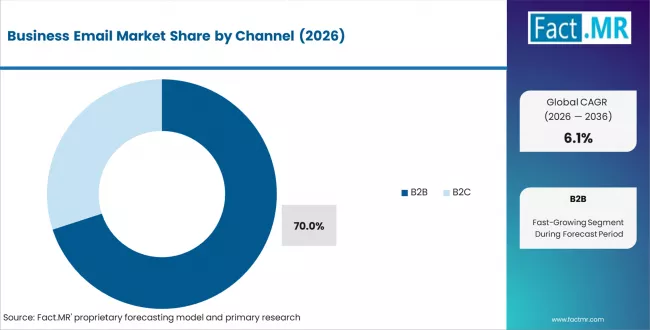
    Business Email Market Analysis By Channel

    FACT.MR estimates the B2B channel will hold about 70% share in 2026. Enterprise subscription licensing remains the dominant revenue model. Platforms such as Microsoft 365 and Google Workspace generate recurring revenue tied to employee seat counts.

    • Google Workspace AI Expansion: Google integrated Gemini AI into all Workspace Business and Enterprise plans in January 2025. The update introduced AI email drafting, summarization, and smart replies for all B2B subscribers. [4]
    • Proton Mail for Business Expansion: Proton AG expanded Proton Mail for Business in 2024 with custom domains, enterprise security controls, and EU data residency features. The company reported over 100 million paid accounts across its ecosystem in 2024. [5]
    • B2B Email Security Spend Growth: The FBI Internet Crime Report recorded USD 2.9 billion in BEC losses in 2023. This is driving enterprises to upgrade to advanced security tiers such as Microsoft Defender for Office 365 Plan 2 and Google Workspace Enterprise Plus. [3]

    Business Email Market Analysis by Deployment
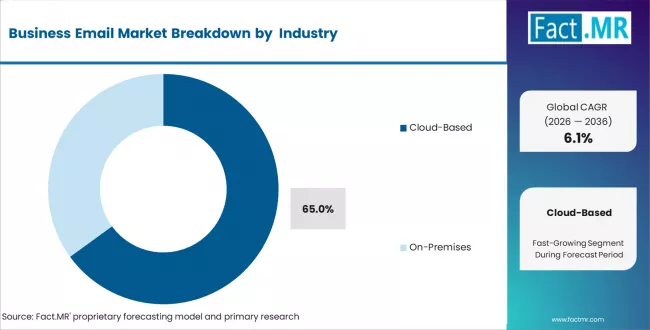
    Business Email Market Analysis By Deployment

    FACT.MR estimates cloud deployment will reach about 65% share in 2026. Growth reflects ongoing migration from on-premises systems to SaaS email platforms. SMB adoption is also rising in Asia Pacific and Latin America.

    • Microsoft Outlook AI Redesign: In October 2025, Microsoft announced an AI-native redesign of Outlook led by VP Gaurav Sareen. The redesign focuses on integrating advanced AI productivity features into cloud email platforms. [6]
    • Tutanota Encrypted Cloud Deployment: Tutanota expanded its encrypted cloud email platform in 2024 to support enterprise custom domains and end-to-end encrypted communication for regulated SMB users. [7]
    • On-Premises Migration Decline: Microsoft ended mainstream support for Exchange Server 2016 and 2019 in October 2025. This support deadline accelerated migration of legacy on-premises deployments to Microsoft 365 cloud email services. [8]

    Drivers, Restraints, and Opportunities
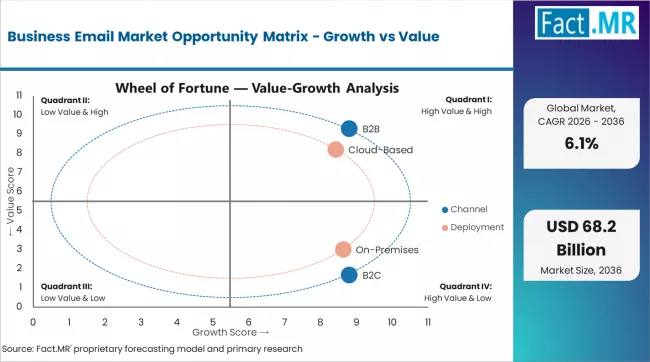
    Business Email Market Opportunity Matrix Growth Vs Value

    Email remains the primary channel for B2B and B2C communication. Organizations rely on it for contracts, compliance records, and customer communication. Platforms such as Microsoft 365 and Google Workspace dominate enterprise seat licensing and generate recurring subscription revenue.

    Seat volumes are stable in mature markets, while revenue growth comes from AI security upgrades, encrypted deployments, and SMB cloud adoption in Asia Pacific and Latin America. Rising business email compromise (BEC) attacks are pushing companies toward premium security tiers.

    • EU GDPR Data Residency Compliance: The General Data Protection Regulation requires personal data to be processed within compliant jurisdictions. Regulators such as Germany’s BfDI, France’s CNIL, and Ireland’s DPC enforce the rule. Microsoft’s EU Data Boundary programme ensures Microsoft 365 email data for EU customers remains within the EU, supporting regional market growth of about 9.3% CAGR. [1]
    • South Korea Cloud Mandate: South Korea expanded its cloud-first procurement policy in 2024 under the Digital Government plan. Public agencies must adopt certified cloud services including business email. Companies such as Samsung Electronics and LG Corporation expanded Microsoft 365 and Google Workspace AI seat deployment, supporting 9.6% CAGR growth. [2]
    • AI Business Email Compromise Defence: Microsoft launched Security Copilot integration with Defender for Office 365 in October 2024. The system enables AI-based phishing detection and automated incident response. Rising BEC attacks continue to drive enterprise upgrades to premium email security plans. [3]

    Regional Analysis

    The business email market is analysed across North America, Europe, Asia Pacific, Latin America, and Middle East and Africa, covering 40+ country-level demand profiles shaped by enterprise cloud migration maturity, data privacy regulatory frameworks, government digital transformation mandates, and SMB cloud email adoption rates. The full report offers market attractiveness analysis based on seat growth, AI security premium adoption, and data sovereignty compliance benchmarks.

    Top Country Growth Comparison Business Email Market Cagr (2026 2036)

    Country CAGR (2026 to 2036)
    South Korea 9.6%
    European Union 9.3%
    United Kingdom 8.8%
    USA 5.9%
    Japan 4.8%

    Source: Fact.MR (FACT.MR) analysis, based on proprietary forecasting model and primary research
    Business Email Market Cagr Analysis By Country

    Asia Pacific Business Email Market Analysis
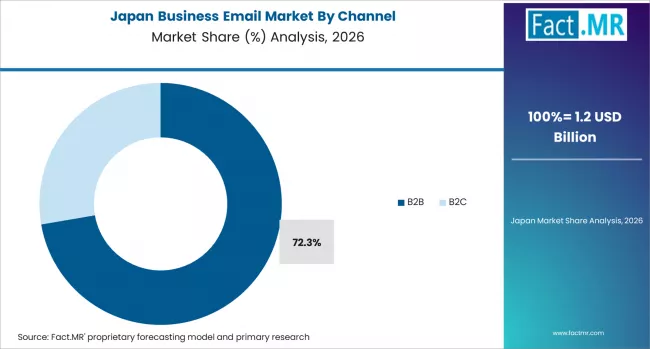
    Business Email Market Japan Market Share Analysis By Channel

    Asia Pacific is the fastest-growing region for business email adoption. Growth is supported by government cloud policies, enterprise digital transformation, and SMB cloud adoption. Platforms such as Microsoft 365 and Google Workspace dominate enterprise deployments. Regional platforms including Kakao for Business and Line Works support domestic enterprise communication needs.

    • South Korea: Cloud business email expansion in South Korea is forecast at 9.6% CAGR through 2036. The government’s cloud-first policy requires public agencies to adopt certified digital services including business email platforms. Enterprises such as Samsung Electronics expanded Microsoft 365 Copilot deployments across global operations. SK Group also accelerated Google Workspace adoption across its affiliates. Kakao for Business introduced AI email drafting tools to compete with global platforms in domestic enterprise accounts.
    • Japan: Adoption of enterprise business email solutions in Japan is expected to grow at 4.8% CAGR through 2036. The Digital Agency of Japan requires ministries to migrate email systems to approved cloud platforms by FY2025. Japan Post Holdings completed migration of about 50,000 employees to Google Workspace in 2024. Companies such as Hitachi Ltd. and Toyota Motor Corporation continue expanding Microsoft 365 enterprise deployments.

    FACT.MR’s Asia Pacific coverage includes Japan, South Korea, China, India, ASEAN, Australia and New Zealand, and Rest of Asia Pacific. The report includes enterprise seat benchmarks, government cloud policy timelines, and AI security adoption trends.

    Europe Business Email Market Analysis
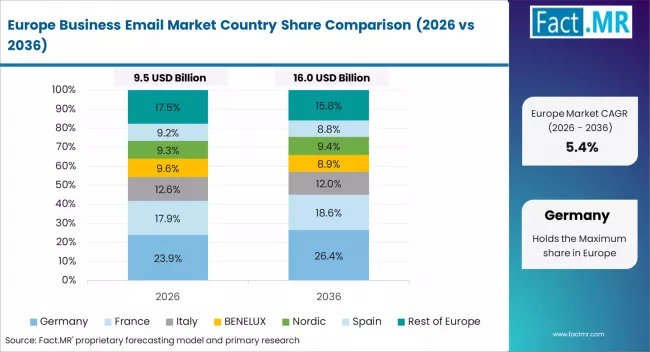
    Business Email Market Europe Country Market Share Analysis, 2026 & 2036

    Europe acts as the regulatory benchmark for business email data privacy and sovereignty compliance. Enforcement of the General Data Protection Regulation strongly influences vendor selection across enterprises. Providers such as Microsoft 365, Google Workspace, and Proton Mail compete through data residency guarantees and encryption features.

    • European Union: Enterprise email platform usage across the EU is projected to increase at 9.3% CAGR through 2036. The European Data Protection Board reinforced cloud service procurement rules requiring EU-based data processing agreements. Microsoft implemented its EU Data Boundary initiative to ensure Microsoft 365 data remains within Europe. The European Commission deployed Microsoft 365 for around 32,000 staff, providing a large institutional reference. Proton AG reported strong enterprise growth among legal and healthcare sectors.
    • United Kingdom: Secure enterprise email adoption in the UK is forecast at 8.8% CAGR through 2036. The National Cyber Security Centre updated guidance endorsing Microsoft 365 and Google Workspace for government use. The HM Revenue and Customs migrated about 65,000 staff to Microsoft 365 in 2024. Providers such as Fastmail and Hushmail are gaining traction in regulated sectors requiring encrypted communication.

    FACT.MR’s Europe coverage includes Germany, France, the United Kingdom, Italy, Spain, Nordic countries, BENELUX, Eastern Europe, and Russia. The report includes GDPR compliance benchmarks, enterprise adoption statistics, and regional forecasts.

    North America Business Email Market Analysis
    Business Email Market Country Value Analysis

    North America generates the largest revenue share for business email platforms. High cloud penetration and enterprise adoption support strong subscription revenue. Microsoft 365 and Google Workspace dominate deployments across enterprises and SMBs.

    • USA: Business email platform revenue in the United States is projected to grow at 5.9% CAGR through 2036. The market has the largest installed base of Microsoft 365 and Google Workspace enterprise users. Microsoft introduced Security Copilot integration with Defender for Office 365 in 2024 to address rising phishing and BEC threats. The Federal Trade Commission also reviewed cloud productivity platform competition in 2024, encouraging enterprises to evaluate alternatives such as Zoho Mail and Fastmail. Google integrated Gemini AI features into Workspace Business and Enterprise plans in 2025 to strengthen enterprise retention.

    FACT.MR’s North America coverage includes the United States, Canada, and Mexico. The report includes enterprise seat adoption data, AI security subscription benchmarks, and country-level forecasts by channel and deployment model.

    Competitive Aligners for Market Players
    Business Email Market Analysis By Company

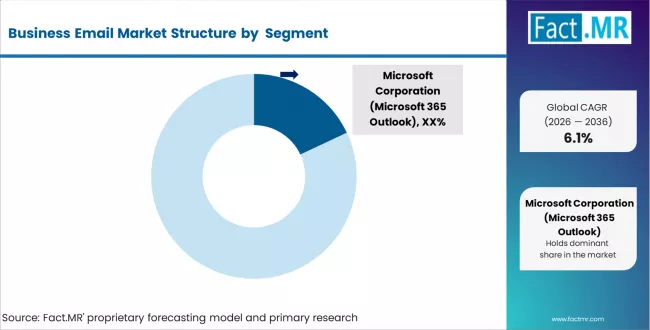
    The global business email market is dominated by a few major players, especially at the enterprise cloud level. Microsoft (Microsoft 365) and Google (Google Workspace) together control roughly 60-70% of enterprise business email revenue based on per-seat licensing. Since most core email features are now standardized across platforms, competition has shifted toward areas such as AI-driven productivity tools, security capabilities, compliance with data sovereignty regulations, and pricing of subscription plans.

    Both companies are also using AI as a major revenue driver. Microsoft offers Microsoft 365 Copilot at about $30 per user per month, while Google is integrating advanced Gemini AI features into premium Workspace plans. These AI tools are expected to play a major role in revenue growth over the next decade.

    Microsoft benefits from its tightly integrated ecosystem, including Outlook, Teams, SharePoint, Word, and Excel, which creates strong switching costs for enterprises already relying on multiple Microsoft tools. Compliance credentials such as FedRAMP authorization and the EU Data Boundary also strengthen its position in regulated sectors.

    Google’s advantage lies in competitive pricing, strong collaboration tools like Meet and Drive, and Gemini’s multimodal AI capabilities. Meanwhile, Proton and Zoho serve niche markets focused on privacy, data sovereignty, and affordable solutions for SMBs and regulated industries.

    Key Players

    • Microsoft Corporation (Microsoft 365 Outlook)
    • Google LLC (Google Workspace Gmail)
    • Apple Inc. (Apple Mail)
    • Zoho Corporation Pvt. Ltd. (Zoho Mail)
    • Proton AG (Proton Mail)
    • FastMail Pty Ltd
    • United Internet AG (GMX Mail, Mail.com)
    • Hushmail Communications Ltd.
    • Tuta Mail (formerly Tutanota)

    Scope of Report

    Business Email Market Breakdown By Channel, Deployment, And Region

    Attribute Details
    Quantitative Units USD 37.7 billion (2026) to USD 68.2 billion (2036), at a CAGR of 6.1%
    Market Definition Cloud-based and on-premises electronic mail platforms for enterprise and SMB B2B and B2C business communication, compliance archiving, and AI-integrated email security and productivity services.
    Channel Segmentation B2B, B2C
    Deployment Segmentation Cloud-Based, On-Premises
    Application Coverage Enterprise internal communication, regulatory compliance archiving, AI-integrated email security, encrypted B2B correspondence, government digital workplace, SMB hosted email, and transactional B2C email.
    Regions Covered North America, Europe, Asia Pacific, Latin America, Middle East and Africa
    Countries Covered USA, Canada, Mexico, UK, Germany, France, Italy, Spain, Nordic, BENELUX, Eastern Europe, Japan, South Korea, China, India, ASEAN, Australia and New Zealand, Brazil, Rest of Latin America, GCC, South Africa, Rest of MEA
    Key Companies Profiled Microsoft (Outlook), Google (Gmail), Apple Mail, Zoho Mail, Proton Mail, FastMail, GMX Mail, Hushmail, Mail.com, Tuta Mail
    Forecast Period 2026 to 2036
    Approach Hybrid top-down and bottom-up model using enterprise and SMB seat counts by region, average subscription pricing by channel and AI security tier, deployment split analysis, and primary interviews with IT procurement directors.

    Business Email Market by Segments

    • By Channel :

      • Business-to-Business (B2B)
      • Business-to-Customer (B2C)
    • By Deployment :

      • Cloud-Based
      • On-Premises
    • By Region :

      • North America
        • United States
        • Canada
        • Mexico
      • Latin America
        • Brazil
        • Mexico
        • Argentina
        • Chile
        • Rest of Latin America
      • Western Europe
        • Germany
        • United Kingdom
        • France
        • Italy
        • Spain
        • Nordic Countries
        • BENELUX
        • Rest of Western Europe
      • Eastern Europe
        • Russia
        • Poland
        • Hungary
        • Balkan and Baltic
        • Rest of Eastern Europe
      • East Asia
        • China
        • Japan
        • South Korea
      • South Asia and Pacific
        • India
        • ASEAN
        • Australia and New Zealand
        • Rest of South Asia and Pacific
      • Middle East and Africa
        • Kingdom of Saudi Arabia
        • Other GCC Countries
        • Turkey
        • South Africa
        • Rest of Middle East and Africa

    Bibliography

    • [1] Ministry of Science and ICT, Republic of Korea. (2024). Digital Government Implementation Plan Update: Cloud-First Procurement Policy Expansion for All Public Agencies Including Business Email Platforms Under Cloud Security Assurance Programme Certification Requirements. 2024.
    • [2] Federal Bureau of Investigation. (2024). Internet Crime Report 2023: Business Email Compromise Losses USD 2.9 Billion Highest-Loss Cybercrime Category and Microsoft Security Copilot Integration with Defender for Office 365 AI-Powered BEC Detection Announcement. October 2024.
    • [3] Google LLC. (2025). Google Workspace Updates: Gemini AI Features Including Email Drafting Summarisation and Smart Compose Integrated into All Business and Enterprise Subscription Plans Without Separate Add-On from January 15 2025. January 2025.
    • [4] Proton AG. (2024). Company Update: Proton Paying Subscriber Base Surpasses 100 Million Accounts Across Proton Mail Proton VPN and Proton Drive, Enterprise Business Email Growth in European Healthcare Legal and Financial Sectors. December 2024.
    • [5] Microsoft Corporation / The Verge. (2025). Internal Memo: Gaurav Sareen Corporate VP Global Experiences and Platform Vision for AI-Native Fundamental Redesign of Microsoft Outlook Cloud Business Email Platform. October 2025.
    • [6] Tuta Mail (formerly Tutanota). (2024). Product Update: Zero-Knowledge Encrypted Cloud Business Email Infrastructure Expansion for European Enterprise SMB Custom Domain Deployment with End-to-End Encryption and GDPR-Compliant EU Jurisdiction Data Storage. 2024.
    • [7] Microsoft Corporation. (2025). Exchange Server Lifecycle Policy: Exchange Server 2016 End of Mainstream Support October 14 2025 Migration Guidance to Microsoft 365 Cloud-Based Business Email for On-Premises Enterprise Customers. 2025.

    This Report Addresses

    • Strategic intelligence on GDPR cloud email data residency in the EU, South Korea cloud-first government mandates, UK NCSC security guidance, Japan Digital Agency migration frameworks, and FBI BEC threat trends shaping enterprise email procurement through 2036.
    • Market forecast projecting growth from USD 37.7 billion in 2026 to USD 68.2 billion by 2036 at a 6.1% CAGR, segmented by channel, deployment model, and region.
    • Growth opportunity analysis across South Korea government cloud email mandates, EU GDPR-certified platforms, UK NCSC-aligned enterprise migrations, AI-driven BEC security in the USA, and Japan public sector email modernisation.
    • Country CAGR outlook highlighting South Korea (9.6%), EU (9.3%), UK (8.8%), USA (5.9%), and Japan (4.8%), supported by enterprise seat data, AI security adoption benchmarks, and regulatory timelines.
    • Competitive landscape analysis covering Microsoft, Google, Proton AG, Zoho, FastMail, Hushmail, Tuta Mail, and GMX Mail, focusing on AI roadmaps, data sovereignty strategies, and compliance certifications.
    • Technology tracking including AI-native BEC detection, Security Copilot incident response, Gemini email summarisation, encrypted email architectures, DMARC enforcement, and Exchange Server cloud migration.
    • Regulatory coverage of GDPR email processing rules, EU AI Act impacts, South Korea PIPA frameworks, Japan Digital Agency standards, US FTC platform oversight, and UK NCSC cloud security principles.
    • Report deliverables include PDF report, Excel datasets, PowerPoint summary, and dashboards using data from Microsoft and Alphabet reports, GDPR authorities, government programmes, and expert interviews.

    Table of Content

    1. Executive Summary
      • Global Market Outlook
      • Demand to side Trends
      • Supply to side Trends
      • Technology Roadmap Analysis
      • Analysis and Recommendations
    2. Market Overview
      • Market Coverage / Taxonomy
      • Market Definition / Scope / Limitations
    3. Research Methodology
      • Chapter Orientation
      • Analytical Lens and Working Hypotheses
        • Market Structure, Signals, and Trend Drivers
        • Benchmarking and Cross-market Comparability
        • Market Sizing, Forecasting, and Opportunity Mapping
      • Research Design and Evidence Framework
        • Desk Research Programme (Secondary Evidence)
          • Company Annual and Sustainability Reports
          • Peer-reviewed Journals and Academic Literature
          • Corporate Websites, Product Literature, and Technical Notes
          • Earnings Decks and Investor Briefings
          • Statutory Filings and Regulatory Disclosures
          • Technical White Papers and Standards Notes
          • Trade Journals, Industry Magazines, and Analyst Briefs
          • Conference Proceedings, Webinars, and Seminar Materials
          • Government Statistics Portals and Public Data Releases
          • Press Releases and Reputable Media Coverage
          • Specialist Newsletters and Curated Briefings
          • Sector Databases and Reference Repositories
          • Fact.MR Internal Proprietary Databases and Historical Market Datasets
          • Subscription Datasets and Paid Sources
          • Social Channels, Communities, and Digital Listening Inputs
          • Additional Desk Sources
        • Expert Input and Fieldwork (Primary Evidence)
          • Primary Modes
            • Qualitative Interviews and Expert Elicitation
            • Quantitative Surveys and Structured Data Capture
            • Blended Approach
          • Why Primary Evidence is Used
          • Field Techniques
            • Interviews
            • Surveys
            • Focus Groups
            • Observational and In-context Research
            • Social and Community Interactions
          • Stakeholder Universe Engaged
            • C-suite Leaders
            • Board Members
            • Presidents and Vice Presidents
            • R&D and Innovation Heads
            • Technical Specialists
            • Domain Subject-matter Experts
            • Scientists
            • Physicians and Other Healthcare Professionals
          • Governance, Ethics, and Data Stewardship
            • Research Ethics
            • Data Integrity and Handling
        • Tooling, Models, and Reference Databases
      • Data Engineering and Model Build
        • Data Acquisition and Ingestion
        • Cleaning, Normalisation, and Verification
        • Synthesis, Triangulation, and Analysis
      • Quality Assurance and Audit Trail
    4. Market Background
      • Market Dynamics
        • Drivers
        • Restraints
        • Opportunity
        • Trends
      • Scenario Forecast
        • Demand in Optimistic Scenario
        • Demand in Likely Scenario
        • Demand in Conservative Scenario
      • Opportunity Map Analysis
      • Product Life Cycle Analysis
      • Supply Chain Analysis
      • Investment Feasibility Matrix
      • Value Chain Analysis
      • PESTLE and Porter’s Analysis
      • Regulatory Landscape
      • Regional Parent Market Outlook
      • Production and Consumption Statistics
      • Import and Export Statistics
    5. Global Market Analysis 2021 to 2025 and Forecast, 2026 to 2036
      • Historical Market Size Value (USD Million) Analysis, 2021 to 2025
      • Current and Future Market Size Value (USD Million) Projections, 2026 to 2036
        • Y to o to Y Growth Trend Analysis
        • Absolute $ Opportunity Analysis
    6. Global Market Pricing Analysis 2021 to 2025 and Forecast 2026 to 2036
    7. Global Market Analysis 2021 to 2025 and Forecast 2026 to 2036, By Channel
      • Introduction / Key Findings
      • Historical Market Size Value (USD Million) Analysis By Channel, 2021 to 2025
      • Current and Future Market Size Value (USD Million) Analysis and Forecast By Channel, 2026 to 2036
        • B2B
        • B2C
      • Y to o to Y Growth Trend Analysis By Channel, 2021 to 2025
      • Absolute $ Opportunity Analysis By Channel, 2026 to 2036
    8. Global Market Analysis 2021 to 2025 and Forecast 2026 to 2036, By Deployment
      • Introduction / Key Findings
      • Historical Market Size Value (USD Million) Analysis By Deployment, 2021 to 2025
      • Current and Future Market Size Value (USD Million) Analysis and Forecast By Deployment, 2026 to 2036
        • Cloud-Based
        • On-Premises
      • Y to o to Y Growth Trend Analysis By Deployment, 2021 to 2025
      • Absolute $ Opportunity Analysis By Deployment, 2026 to 2036
    9. Global Market Analysis 2021 to 2025 and Forecast 2026 to 2036, By Region
      • Introduction
      • Historical Market Size Value (USD Million) Analysis By Region, 2021 to 2025
      • Current Market Size Value (USD Million) Analysis and Forecast By Region, 2026 to 2036
        • North America
        • Latin America
        • Western Europe
        • Eastern Europe
        • East Asia
        • South Asia and Pacific
        • Middle East & Africa
      • Market Attractiveness Analysis By Region
    10. North America Market Analysis 2021 to 2025 and Forecast 2026 to 2036, By Country
      • Historical Market Size Value (USD Million) Trend Analysis By Market Taxonomy, 2021 to 2025
      • Market Size Value (USD Million) Forecast By Market Taxonomy, 2026 to 2036
        • By Country
          • USA
          • Canada
          • Mexico
        • By Channel
        • By Deployment
      • Market Attractiveness Analysis
        • By Country
        • By Channel
        • By Deployment
      • Key Takeaways
    11. Latin America Market Analysis 2021 to 2025 and Forecast 2026 to 2036, By Country
      • Historical Market Size Value (USD Million) Trend Analysis By Market Taxonomy, 2021 to 2025
      • Market Size Value (USD Million) Forecast By Market Taxonomy, 2026 to 2036
        • By Country
          • Brazil
          • Chile
          • Rest of Latin America
        • By Channel
        • By Deployment
      • Market Attractiveness Analysis
        • By Country
        • By Channel
        • By Deployment
      • Key Takeaways
    12. Western Europe Market Analysis 2021 to 2025 and Forecast 2026 to 2036, By Country
      • Historical Market Size Value (USD Million) Trend Analysis By Market Taxonomy, 2021 to 2025
      • Market Size Value (USD Million) Forecast By Market Taxonomy, 2026 to 2036
        • By Country
          • Germany
          • UK
          • Italy
          • Spain
          • France
          • Nordic
          • BENELUX
          • Rest of Western Europe
        • By Channel
        • By Deployment
      • Market Attractiveness Analysis
        • By Country
        • By Channel
        • By Deployment
      • Key Takeaways
    13. Eastern Europe Market Analysis 2021 to 2025 and Forecast 2026 to 2036, By Country
      • Historical Market Size Value (USD Million) Trend Analysis By Market Taxonomy, 2021 to 2025
      • Market Size Value (USD Million) Forecast By Market Taxonomy, 2026 to 2036
        • By Country
          • Russia
          • Poland
          • Hungary
          • Balkan & Baltic
          • Rest of Eastern Europe
        • By Channel
        • By Deployment
      • Market Attractiveness Analysis
        • By Country
        • By Channel
        • By Deployment
      • Key Takeaways
    14. East Asia Market Analysis 2021 to 2025 and Forecast 2026 to 2036, By Country
      • Historical Market Size Value (USD Million) Trend Analysis By Market Taxonomy, 2021 to 2025
      • Market Size Value (USD Million) Forecast By Market Taxonomy, 2026 to 2036
        • By Country
          • China
          • Japan
          • South Korea
        • By Channel
        • By Deployment
      • Market Attractiveness Analysis
        • By Country
        • By Channel
        • By Deployment
      • Key Takeaways
    15. South Asia and Pacific Market Analysis 2021 to 2025 and Forecast 2026 to 2036, By Country
      • Historical Market Size Value (USD Million) Trend Analysis By Market Taxonomy, 2021 to 2025
      • Market Size Value (USD Million) Forecast By Market Taxonomy, 2026 to 2036
        • By Country
          • India
          • ASEAN
          • Australia & New Zealand
          • Rest of South Asia and Pacific
        • By Channel
        • By Deployment
      • Market Attractiveness Analysis
        • By Country
        • By Channel
        • By Deployment
      • Key Takeaways
    16. Middle East & Africa Market Analysis 2021 to 2025 and Forecast 2026 to 2036, By Country
      • Historical Market Size Value (USD Million) Trend Analysis By Market Taxonomy, 2021 to 2025
      • Market Size Value (USD Million) Forecast By Market Taxonomy, 2026 to 2036
        • By Country
          • Kingdom of Saudi Arabia
          • Other GCC Countries
          • Turkiye
          • South Africa
          • Other African Union
          • Rest of Middle East & Africa
        • By Channel
        • By Deployment
      • Market Attractiveness Analysis
        • By Country
        • By Channel
        • By Deployment
      • Key Takeaways
    17. Key Countries Market Analysis
      • USA
        • Pricing Analysis
        • Market Share Analysis, 2025
          • By Channel
          • By Deployment
      • Canada
        • Pricing Analysis
        • Market Share Analysis, 2025
          • By Channel
          • By Deployment
      • Mexico
        • Pricing Analysis
        • Market Share Analysis, 2025
          • By Channel
          • By Deployment
      • Brazil
        • Pricing Analysis
        • Market Share Analysis, 2025
          • By Channel
          • By Deployment
      • Chile
        • Pricing Analysis
        • Market Share Analysis, 2025
          • By Channel
          • By Deployment
      • Germany
        • Pricing Analysis
        • Market Share Analysis, 2025
          • By Channel
          • By Deployment
      • UK
        • Pricing Analysis
        • Market Share Analysis, 2025
          • By Channel
          • By Deployment
      • Italy
        • Pricing Analysis
        • Market Share Analysis, 2025
          • By Channel
          • By Deployment
      • Spain
        • Pricing Analysis
        • Market Share Analysis, 2025
          • By Channel
          • By Deployment
      • France
        • Pricing Analysis
        • Market Share Analysis, 2025
          • By Channel
          • By Deployment
      • India
        • Pricing Analysis
        • Market Share Analysis, 2025
          • By Channel
          • By Deployment
      • ASEAN
        • Pricing Analysis
        • Market Share Analysis, 2025
          • By Channel
          • By Deployment
      • Australia & New Zealand
        • Pricing Analysis
        • Market Share Analysis, 2025
          • By Channel
          • By Deployment
      • China
        • Pricing Analysis
        • Market Share Analysis, 2025
          • By Channel
          • By Deployment
      • Japan
        • Pricing Analysis
        • Market Share Analysis, 2025
          • By Channel
          • By Deployment
      • South Korea
        • Pricing Analysis
        • Market Share Analysis, 2025
          • By Channel
          • By Deployment
      • Russia
        • Pricing Analysis
        • Market Share Analysis, 2025
          • By Channel
          • By Deployment
      • Poland
        • Pricing Analysis
        • Market Share Analysis, 2025
          • By Channel
          • By Deployment
      • Hungary
        • Pricing Analysis
        • Market Share Analysis, 2025
          • By Channel
          • By Deployment
      • Kingdom of Saudi Arabia
        • Pricing Analysis
        • Market Share Analysis, 2025
          • By Channel
          • By Deployment
      • Turkiye
        • Pricing Analysis
        • Market Share Analysis, 2025
          • By Channel
          • By Deployment
      • South Africa
        • Pricing Analysis
        • Market Share Analysis, 2025
          • By Channel
          • By Deployment
    18. Market Structure Analysis
      • Competition Dashboard
      • Competition Benchmarking
      • Market Share Analysis of Top Players
        • By Regional
        • By Channel
        • By Deployment
    19. Competition Analysis
      • Competition Deep Dive
        • Microsoft Corporation (Microsoft 365 Outlook)
          • Overview
          • Product Portfolio
          • Profitability by Market Segments (Product/Age /Sales Channel/Region)
          • Sales Footprint
          • Strategy Overview
            • Marketing Strategy
            • Product Strategy
            • Channel Strategy
        • Google LLC (Google Workspace Gmail)
        • Apple Inc. (Apple Mail)
        • Zoho Corporation Pvt. Ltd. (Zoho Mail)
        • Proton AG (Proton Mail)
        • FastMail Pty Ltd
        • Value (USD Million)ed Internet AG (GMX Mail, Mail.com)
    20. Assumptions & Acronyms Used

    List Of Table

    • Table 1: Global Market Value (USD Million) Forecast by Region, 2021 to 2036
    • Table 2: Global Market Value (USD Million) Forecast by Channel, 2021 to 2036
    • Table 3: Global Market Value (USD Million) Forecast by Deployment, 2021 to 2036
    • Table 4: North America Market Value (USD Million) Forecast by Country, 2021 to 2036
    • Table 5: North America Market Value (USD Million) Forecast by Channel, 2021 to 2036
    • Table 6: North America Market Value (USD Million) Forecast by Deployment, 2021 to 2036
    • Table 7: Latin America Market Value (USD Million) Forecast by Country, 2021 to 2036
    • Table 8: Latin America Market Value (USD Million) Forecast by Channel, 2021 to 2036
    • Table 9: Latin America Market Value (USD Million) Forecast by Deployment, 2021 to 2036
    • Table 10: Western Europe Market Value (USD Million) Forecast by Country, 2021 to 2036
    • Table 11: Western Europe Market Value (USD Million) Forecast by Channel, 2021 to 2036
    • Table 12: Western Europe Market Value (USD Million) Forecast by Deployment, 2021 to 2036
    • Table 13: Eastern Europe Market Value (USD Million) Forecast by Country, 2021 to 2036
    • Table 14: Eastern Europe Market Value (USD Million) Forecast by Channel, 2021 to 2036
    • Table 15: Eastern Europe Market Value (USD Million) Forecast by Deployment, 2021 to 2036
    • Table 16: East Asia Market Value (USD Million) Forecast by Country, 2021 to 2036
    • Table 17: East Asia Market Value (USD Million) Forecast by Channel, 2021 to 2036
    • Table 18: East Asia Market Value (USD Million) Forecast by Deployment, 2021 to 2036
    • Table 19: South Asia and Pacific Market Value (USD Million) Forecast by Country, 2021 to 2036
    • Table 20: South Asia and Pacific Market Value (USD Million) Forecast by Channel, 2021 to 2036
    • Table 21: South Asia and Pacific Market Value (USD Million) Forecast by Deployment, 2021 to 2036
    • Table 22: Middle East & Africa Market Value (USD Million) Forecast by Country, 2021 to 2036
    • Table 23: Middle East & Africa Market Value (USD Million) Forecast by Channel, 2021 to 2036
    • Table 24: Middle East & Africa Market Value (USD Million) Forecast by Deployment, 2021 to 2036

    List Of Figures

    • Figure 1: Global Market Pricing Analysis
    • Figure 2: Global Market Value (USD Million) Forecast 2021 to 2036
    • Figure 3: Global Market Value Share and BPS Analysis by Channel, 2026 and 2036
    • Figure 4: Global Market Y-o-Y Growth Comparison by Channel, 2026 to 2036
    • Figure 5: Global Market Attractiveness Analysis by Channel
    • Figure 6: Global Market Value Share and BPS Analysis by Deployment, 2026 and 2036
    • Figure 7: Global Market Y-o-Y Growth Comparison by Deployment, 2026 to 2036
    • Figure 8: Global Market Attractiveness Analysis by Deployment
    • Figure 9: Global Market Value (USD Million) Share and BPS Analysis by Region, 2026 and 2036
    • Figure 10: Global Market Y-o-Y Growth Comparison by Region, 2026 to 2036
    • Figure 11: Global Market Attractiveness Analysis by Region
    • Figure 12: North America Market Incremental Dollar Opportunity, 2026 to 2036
    • Figure 13: Latin America Market Incremental Dollar Opportunity, 2026 to 2036
    • Figure 14: Western Europe Market Incremental Dollar Opportunity, 2026 to 2036
    • Figure 15: Eastern Europe Market Incremental Dollar Opportunity, 2026 to 2036
    • Figure 16: East Asia Market Incremental Dollar Opportunity, 2026 to 2036
    • Figure 17: South Asia and Pacific Market Incremental Dollar Opportunity, 2026 to 2036
    • Figure 18: Middle East & Africa Market Incremental Dollar Opportunity, 2026 to 2036
    • Figure 19: North America Market Value Share and BPS Analysis by Country, 2026 and 2036
    • Figure 20: North America Market Value Share and BPS Analysis by Channel, 2026 and 2036
    • Figure 21: North America Market Y-o-Y Growth Comparison by Channel, 2026 to 2036
    • Figure 22: North America Market Attractiveness Analysis by Channel
    • Figure 23: North America Market Value Share and BPS Analysis by Deployment, 2026 and 2036
    • Figure 24: North America Market Y-o-Y Growth Comparison by Deployment, 2026 to 2036
    • Figure 25: North America Market Attractiveness Analysis by Deployment
    • Figure 26: Latin America Market Value Share and BPS Analysis by Country, 2026 and 2036
    • Figure 27: Latin America Market Value Share and BPS Analysis by Channel, 2026 and 2036
    • Figure 28: Latin America Market Y-o-Y Growth Comparison by Channel, 2026 to 2036
    • Figure 29: Latin America Market Attractiveness Analysis by Channel
    • Figure 30: Latin America Market Value Share and BPS Analysis by Deployment, 2026 and 2036
    • Figure 31: Latin America Market Y-o-Y Growth Comparison by Deployment, 2026 to 2036
    • Figure 32: Latin America Market Attractiveness Analysis by Deployment
    • Figure 33: Western Europe Market Value Share and BPS Analysis by Country, 2026 and 2036
    • Figure 34: Western Europe Market Value Share and BPS Analysis by Channel, 2026 and 2036
    • Figure 35: Western Europe Market Y-o-Y Growth Comparison by Channel, 2026 to 2036
    • Figure 36: Western Europe Market Attractiveness Analysis by Channel
    • Figure 37: Western Europe Market Value Share and BPS Analysis by Deployment, 2026 and 2036
    • Figure 38: Western Europe Market Y-o-Y Growth Comparison by Deployment, 2026 to 2036
    • Figure 39: Western Europe Market Attractiveness Analysis by Deployment
    • Figure 40: Eastern Europe Market Value Share and BPS Analysis by Country, 2026 and 2036
    • Figure 41: Eastern Europe Market Value Share and BPS Analysis by Channel, 2026 and 2036
    • Figure 42: Eastern Europe Market Y-o-Y Growth Comparison by Channel, 2026 to 2036
    • Figure 43: Eastern Europe Market Attractiveness Analysis by Channel
    • Figure 44: Eastern Europe Market Value Share and BPS Analysis by Deployment, 2026 and 2036
    • Figure 45: Eastern Europe Market Y-o-Y Growth Comparison by Deployment, 2026 to 2036
    • Figure 46: Eastern Europe Market Attractiveness Analysis by Deployment
    • Figure 47: East Asia Market Value Share and BPS Analysis by Country, 2026 and 2036
    • Figure 48: East Asia Market Value Share and BPS Analysis by Channel, 2026 and 2036
    • Figure 49: East Asia Market Y-o-Y Growth Comparison by Channel, 2026 to 2036
    • Figure 50: East Asia Market Attractiveness Analysis by Channel
    • Figure 51: East Asia Market Value Share and BPS Analysis by Deployment, 2026 and 2036
    • Figure 52: East Asia Market Y-o-Y Growth Comparison by Deployment, 2026 to 2036
    • Figure 53: East Asia Market Attractiveness Analysis by Deployment
    • Figure 54: South Asia and Pacific Market Value Share and BPS Analysis by Country, 2026 and 2036
    • Figure 55: South Asia and Pacific Market Value Share and BPS Analysis by Channel, 2026 and 2036
    • Figure 56: South Asia and Pacific Market Y-o-Y Growth Comparison by Channel, 2026 to 2036
    • Figure 57: South Asia and Pacific Market Attractiveness Analysis by Channel
    • Figure 58: South Asia and Pacific Market Value Share and BPS Analysis by Deployment, 2026 and 2036
    • Figure 59: South Asia and Pacific Market Y-o-Y Growth Comparison by Deployment, 2026 to 2036
    • Figure 60: South Asia and Pacific Market Attractiveness Analysis by Deployment
    • Figure 61: Middle East & Africa Market Value Share and BPS Analysis by Country, 2026 and 2036
    • Figure 62: Middle East & Africa Market Value Share and BPS Analysis by Channel, 2026 and 2036
    • Figure 63: Middle East & Africa Market Y-o-Y Growth Comparison by Channel, 2026 to 2036
    • Figure 64: Middle East & Africa Market Attractiveness Analysis by Channel
    • Figure 65: Middle East & Africa Market Value Share and BPS Analysis by Deployment, 2026 and 2036
    • Figure 66: Middle East & Africa Market Y-o-Y Growth Comparison by Deployment, 2026 to 2036
    • Figure 67: Middle East & Africa Market Attractiveness Analysis by Deployment
    • Figure 68: Global Market - Tier Structure Analysis
    • Figure 69: Global Market - Company Share Analysis

    - FAQs -

    How large is the business email market in 2025?

    The global business email market was valued at USD 35.6 billion in 2025.

    What will the market size be in 2026?

    Based on Fact.MR analysis, the business email market is estimated to grow to USD 37.7 billion in 2026.

    What is the projected market size by 2036?

    The market is projected to reach USD 68.2 billion by 2036, generating USD 30.5 billion in absolute revenue opportunity over the forecast period from 2026 to 2036.

    What is the expected CAGR?

    The forecast CAGR from 2026 to 2036 is 6.1%.

    Which channel segment leads the business email market?

    B2B channel holds approximately 70% share in 2026.

    Which deployment model dominates?

    Cloud-based deployment holds approximately 65% share in 2026.

    Which country shows the fastest growth?

    South Korea leads at 9.6% CAGR through 2036.

    What is driving growth in the business email market?

    Growth is mainly driven by cloud adoption, AI-powered productivity tools, cybersecurity upgrades, and regulatory compliance requirements.

    Which companies dominate the enterprise business email market?

    Microsoft and Google lead the market, while Proton, Zoho, and privacy-focused providers serve specialized segments.

    Why are enterprises upgrading their business email platforms?

    Organizations are upgrading to gain stronger security, AI productivity features, and better compliance with data protection regulations.

    How is AI influencing business email platforms?

    AI is enabling automated email summarisation, threat detection, incident response, and productivity assistance for enterprise users.

    What role does cybersecurity play in this market?

    Cybersecurity is critical as businesses deploy AI-driven protection against phishing, business email compromise (BEC), and data breaches.

    Why is data residency important for enterprise email?

    Data residency ensures that sensitive corporate communications are stored and processed within specific jurisdictions to meet regulatory requirements.

    Business Email Market