- Base Value(2026): 3.4 Bn
- Estimated Value(2026): 3.4 Bn
- Forecast Value (2036): 5.2 Bn
- CAGR (2026 - 2036): 4.3%
Capacitor Films Market Forecast and Outlook 2026 to 2036
The global capacitor films market is valued at USD 3.4 billion in 2026 and is set to reach USD 5.2 billion by 2036, recording an absolute increase of USD 1.8 billion over the forecast period. This translates into a total growth of 52.9%, with the market forecast to expand at a compound annual growth rate (CAGR) of 4.3% between 2026 and 2036.
Quick Stats for Capacitor Films Market
- Capacitor Films Market Value (2026): USD 3.4 billion
- Capacitor Films Market Forecast Value (2036): USD 5.2 billion
- Capacitor Films Market Forecast CAGR: 4.3%
- Leading Film Type in Capacitor Films Market: Polypropylene (54.2%)
- Key Growth Regions in Capacitor Films Market: North America, Europe, Asia Pacific
- Key Players in Capacitor Films Market: Toray Industries Inc., JPFL Films Ltd., Cosmo Films Ltd., Mitsubishi Chemical Corporation, Steiner GmbH
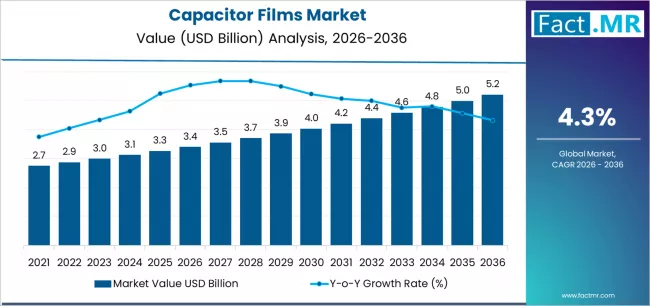
Capacitor Films Market Market Value Analysis | Source: Fact.MR
The capacitor films market is expected to grow by approximately 1.5X during the same period, supported by increasing demand for energy-efficient electronic components across automotive applications, consumer electronics manufacturing, and industrial automation systems, growing adoption of electric vehicle powertrains requiring high-performance dielectric materials, and rising requirements for advanced power management solutions across renewable energy infrastructure, telecommunications networks, and industrial machinery applications.
The polypropylene segment is set to register 54.2% of the capacitor films market in 2026. Polypropylene films enable electronics manufacturers to achieve superior dielectric performance with exceptional thermal stability and low dissipation characteristics across demanding operating conditions, providing enhanced reliability for automotive inverters, industrial motor drives, and power conversion applications. These materials deliver performance characteristics that allow component designers to achieve optimal electrical efficiency and prevent system failures during high-frequency operations while maintaining consistent dielectric properties over extended operational cycles.
Consumer electronics applications are projected to register 36.8% of the capacitor films market in 2026. Capacitor films in consumer electronics enable enhanced power management, electromagnetic interference suppression, and signal processing capabilities that are essential for smartphones, laptops, gaming systems, and audio equipment. These materials provide the dielectric properties necessary for miniaturized electronic systems to operate reliably in compact form factors while maintaining consistent electrical performance and energy efficiency characteristics.
The market encompasses various film materials, application categories, and specialized processing technologies tailored for specific electronic applications. Modern capacitor films incorporate advanced polymer chemistry, metallization techniques, and enhanced dielectric formulations that can operate effectively across diverse voltage requirements while maintaining consistent electrical performance over extended temperature ranges. The integration of nanotechnology innovations, self-healing capabilities, and multi-layer construction methods has further strengthened the value proposition of these dielectric materials among electronics manufacturers seeking component reliability and performance optimization.
Between 2026 and 2030, the capacitor films market is projected to expand from USD 3.4 billion to USD 4.2 billion, resulting in a value increase of USD 0.8 billion, which represents 44.4% of the total forecast growth for the decade. This phase of development will be shaped by increasing electric vehicle adoption worldwide, rising demand for renewable energy storage systems, and growing availability of advanced dielectric technologies across automotive electronics, power inverters, and energy conversion applications.
Between 2030 and 2036, the market is forecast to grow from USD 4.2 billion to USD 5.2 billion, adding another USD 1.0 billion, which constitutes 55.6% of the overall ten-year expansion. This period is expected to be characterized by the advancement of high-temperature dielectric materials, the development of ultra-thin film technologies, and the expansion of electric mobility infrastructure across diverse automotive applications. The growing emphasis on energy efficiency standards and advanced power electronics capabilities will drive demand for innovative capacitor film varieties with enhanced dielectric strength, improved thermal resistance, and superior frequency response characteristics.
Capacitor Films Market Key Takeaways
| Metric | Value |
|---|---|
| Estimated Value in (2026E) | USD 3.4 billion |
| Forecast Value in (2036F) | USD 5.2 billion |
| Forecast CAGR (2026 to 2036) | 4.3% |
Source: Fact.MR analysis. Updated Dec 12, 2025
Why is the Capacitor Films Market Growing?
Market expansion is being supported by the increasing global emphasis on energy efficiency standards and the corresponding shift toward advanced dielectric materials that can provide superior electrical performance while meeting user requirements for enhanced component reliability and cost-effective power management solutions. Modern electronics manufacturers are increasingly focused on incorporating film materials that can enhance electrical efficiency while satisfying demands for consistent, precisely controlled dielectric properties and optimized thermal management. Capacitor films' proven ability to deliver electrical excellence, thermal benefits, and diverse application possibilities makes them essential components for performance-focused manufacturers and efficiency-focused design professionals.
The growing focus on electric vehicle development and renewable energy infrastructure is driving demand for high-performance dielectric materials that can support distinctive electrical outcomes and comprehensive power management across automotive powertrains, energy storage installations, and premium industrial systems. User preference for film solutions that combine functional excellence with thermal intelligence is creating opportunities for innovative implementations in both traditional and emerging electronic applications. The rising influence of power electronics technologies and advanced energy conversion systems is also contributing to increased adoption of intelligent dielectric solutions that can provide authentic performance benefits and reliable electrical characteristics.
At the regulatory level, the US Department of Energy's Advanced Manufacturing initiatives provide funding support for materials technology implementations, with specific allocations for dielectric material systems already established. In turn, Environmental Protection Agency reports note high rates of energy efficiency adoption and electronic component optimization, which is evidence of a mature, performance-driven implementation process. Meanwhile, state-level legislation like California's Clean Energy standards and federal Electric Vehicle Infrastructure protocols make energy efficiency and component performance obligations explicit for automotive manufacturers and electronics producers.
Segmental Analysis
The market is segmented by film material, application sector, end-use industry, voltage rating, and region. By film material, the market is divided into polypropylene, polyester, polyethylene terephthalate, polyphenylene sulfide, polyimide, and other film configurations. Based on application sector, the market is categorized into consumer electronics, automotive electronics, industrial applications, power systems, and others.
By end-use industry, the market includes electronics manufacturing, automotive, energy and utilities, telecommunications, and other industry categories. By voltage rating, the market encompasses low voltage applications, medium voltage applications, high voltage applications, and other voltage platforms. Regionally, the market is divided into North America, Europe, Asia Pacific, Latin America, MEA, and other regions.
By Film Material, Which Segment Holds the Dominant Market Share?
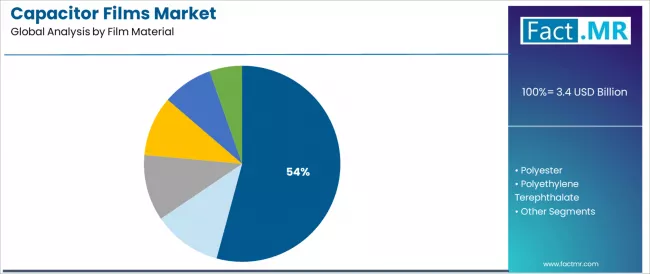
Capacitor Films Market Analysis By Film Material | Source: Fact.MR
Polypropylene films are projected to account for 54.2% of the capacitor films market in 2026, reaffirming its position as the leading film material. Electronics engineers and component designers increasingly utilize polypropylene films for their superior dielectric characteristics, established thermal standards, and essential functionality in diverse power management applications across multiple industrial sectors.
Polypropylene's proven performance characteristics and established reliability directly address user requirements for comprehensive electrical efficiency and optimal dielectric precision in electronic and power applications. This material segment forms the foundation of modern capacitor performance patterns, as it represents the film material with the greatest application versatility and established compatibility across multiple electronic systems.
- Industrial investments in advanced materials technology and performance optimization continue to strengthen adoption among efficiency-focused users.
- With electronics manufacturers prioritizing component reliability and electrical consistency, polypropylene films align with both performance objectives and efficiency requirements, making them the central component of comprehensive power management strategies.
By Application Sector, Which Segment Registers the Highest Share?

Capacitor Films Market Analysis By Application Sector | Source: Fact.MR
Consumer electronics are projected to represent 36.8% of all capacitor film applications in 2026, underscoring their critical role as the primary application sector for performance-focused users seeking superior electrical benefits and enhanced efficiency credentials.
Consumer electronics users and component designers prefer consumer electronics applications for their established performance requirements, proven electrical demand, and ability to maintain exceptional dielectric performance while supporting versatile power management during diverse electronic activities.
Positioned as essential applications for efficiency-focused electronics managers, consumer electronics offerings provide both electrical excellence and performance optimization advantages. The segment is supported by continuous improvement in materials technology and the widespread availability of established dielectric standards that enable performance assurance and premium positioning at the component level.
- Consumer electronics users are optimizing material selections to support application-specific requirements and comprehensive efficiency strategies.
- As materials technology continues to advance and manufacturers seek efficient dielectric methods, consumer electronics applications will continue to drive market growth while supporting electrical performance and optimization strategies.
What are the Drivers, Restraints, and Key Trends of the Capacitor Films Market?
The capacitor films market is advancing rapidly due to increasing energy efficiency adoption and growing need for advanced dielectric materials that emphasize superior electrical performance across industrial segments and electronic applications.
The market faces challenges, including competition from alternative dielectric technologies, raw material price fluctuations, and technical performance factors affecting adoption rates. Innovation in materials enhancement and advanced processing systems continues to influence market development and expansion patterns.
Expansion of High-Temperature Materials and Automotive Integration Applications
The growing adoption of capacitor films with high-temperature resistance and automotive integration capabilities is enabling users to develop power strategies that provide distinctive electrical benefits while commanding intelligent performance and enhanced efficiency characteristics.
High-temperature materials applications provide superior thermal consistency while allowing more advanced performance optimization features across various automotive categories. Users are increasingly recognizing the electrical advantages of automotive positioning for comprehensive power management outcomes and technology-integrated electronic processes.
Integration of Advanced Metallization Technology and Performance-Based Systems
Modern capacitor film manufacturers are incorporating advanced metallization processing, precision thickness monitoring capabilities, and intelligent quality systems to enhance dielectric precision, improve electrical efficiency effectiveness, and meet industrial demands for connected materials solutions.
These systems improve electrical effectiveness while enabling new applications, including automated quality programs and predictive performance protocols. Advanced technology integration also allows users to support efficiency optimization positioning and electrical management beyond traditional dielectric requirements.
Analysis of the Capacitor Films Market by Key Countries
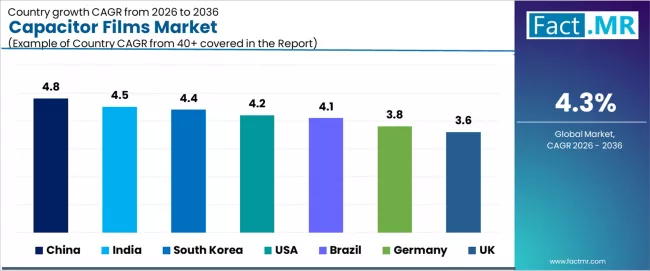
Capacitor Films Market Cagr Analysis By Country | Source: Fact.MR
| Country | CAGR (2026-2036) |
|---|---|
| China | 4.8% |
| India | 4.5% |
| Germany | 3.8% |
| Brazil | 4.1% |
| USA | 4.2% |
| UK | 3.6% |
| South Korea | 4.4% |
Source: Fact.MR analysis. Updated Dec 12, 2025
The capacitor films market is experiencing robust growth globally, with China leading at a 4.8% CAGR through 2036, driven by the expanding electronics manufacturing sector, growing automotive electrification requirements, and increasing adoption of advanced dielectric materials. The USA follows at 4.2%, supported by rising electric vehicle investment, expanding renewable energy programs, and growing acceptance of high-performance materials technologies. India shows growth at 4.5%, emphasizing established electronics manufacturing standards and comprehensive industrial development.
South Korea records 4.4%, focusing on technology advancement and electronics manufacturing growth. Brazil demonstrates 4.1% growth, prioritizing advanced materials technologies and industrial optimization. Germany shows growth at 3.8%, emphasizing established materials industry standards and comprehensive manufacturing development. The UK demonstrates 3.6% growth, prioritizing advanced materials technologies and manufacturing optimization.
Why does China Lead Global Market Growth?
Demand for capacitor films in China is projected to exhibit exceptional growth with a CAGR of 4.8% through 2036, driven by the country's rapidly expanding electronics manufacturing sector, favorable government policies toward industrial modernization, and initiatives promoting advanced materials technologies across major manufacturing regions.
China's position as a global electronics hub and increasing focus on electric vehicle systems are creating substantial demand for high-quality capacitor films in both domestic and export markets. Major electronics manufacturers and materials distributors are establishing comprehensive production capabilities to serve growing demand and emerging technology opportunities.
- Established manufacturing culture and expanding technology consciousness are driving demand for capacitor films across electronics facilities, automotive developments, and comprehensive materials systems throughout Chinese industrial markets.
- Strong infrastructure development and materials adoption initiatives are supporting the rapid adoption of premium capacitor films among performance-focused manufacturers seeking to meet evolving efficiency standards and electrical requirements.
Why does USA Demonstrate Strong Market Potential?
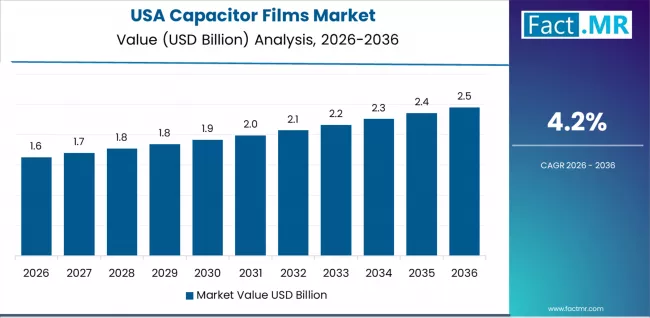
Capacitor Films Market Country Value Analysis | Source: Fact.MR
The capacitor films market in the USA is expanding at a CAGR of 4.2%, supported by rising electric vehicle investment, growing efficiency consciousness, and expanding technology distributor capabilities.
The country's developing automotive infrastructure and increasing investment in materials technologies are driving demand for capacitor films across both traditional and modern electronic applications. International materials companies and domestic distributors are establishing comprehensive operational networks to address growing market demand for high-performance dielectric devices and efficient power solutions.
- Rising automotive development and expanding manufacturing capabilities are creating opportunities for capacitor film adoption across electric vehicle projects, modern electronics developments, and distributor companies throughout major American technology regions.
- Growing energy efficiency awareness initiatives and materials technology advancement are driving the adoption of specialized film products and services among industrial users seeking to enhance their electrical performance and meet increasing efficiency reliability demand.
Why does India Demonstrate Considerable Expansion?
The capacitor films market in India is projected to grow at a CAGR of 4.5% through 2036, supported by the country's expanding electronics manufacturing standards, established government regulations, and leadership in technology implementation.
India's advanced infrastructure development standards and strong support for innovative materials systems are creating steady demand for both traditional and advanced capacitor film varieties. Leading materials manufacturers and specialty distributors are establishing comprehensive operational strategies to serve both domestic markets and growing regional opportunities.
- Advanced manufacturing capabilities and established technology-focused markets are driving demand for premium capacitor films across electronics facilities, industrial operations, and comprehensive technology companies seeking superior performance profiles and materials innovation.
- Strong industrial culture and regulatory development are supporting the adoption of innovative materials technology among users prioritizing electrical reliability and performance precision in electronic applications.
What is the Outlook for the Capacitor Films Market in South Korea?
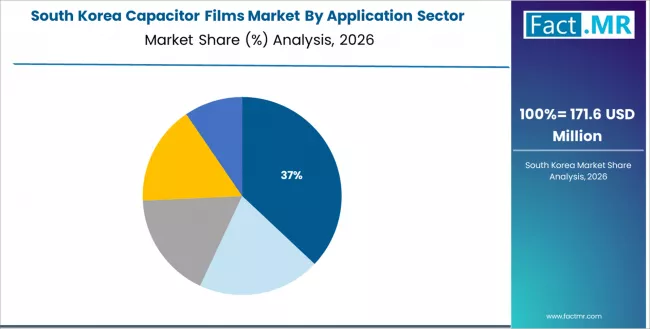
Capacitor Films Market South Korea Market Share Analysis By Application Sector | Source: Fact.MR
The capacitor films market in South Korea is projected to grow at a CAGR of 4.4% through 2036, driven by the country's emphasis on technology development, electronics manufacturing modernization growth, and growing materials distributor capabilities.
South Korean industrial users and electronics facilities consistently seek efficiency-focused materials systems that enhance electrical performance and support modernization excellence for both traditional and modern electronic applications. The country's position as an Asian technology leader continues to drive innovation in specialized materials applications and electrical performance standards.
- Expanding technology culture and growing electronics markets are driving demand for commercial capacitor films across industrial consumers, electronics providers, and efficiency-focused distributors seeking superior electrical control and distinctive performance profiles.
- Increasing focus on manufacturing efficiency and industrial modernization systems is supporting the adoption of specialty capacitor film varieties among users and distributors seeking authentic South Korean technology-focused products in regional markets with established electronics expertise.
What Factors underpin USA’s Capacitor Films Market Growth?
The capacitor films market in the USA is projected to grow at a CAGR of 4.2% through 2036, supported by the country's emphasis on materials technology advancement, electrical optimization, and advanced electronic system integration requiring efficient dielectric solutions.
American industrial users and performance-focused facilities prioritize electrical reliability and materials precision, making specialized capacitor films essential components for both traditional and modern power applications. The country's comprehensive materials technology leadership and advancing electrical patterns support continued market expansion.
- Advanced materials technology capabilities and growing precision electrical management are driving demand for capacitor films across specialty applications, modern electronics formats, and technology-integrated power programs serving domestic markets with increasing performance requirements.
- Strong focus on electrical optimization and performance excellence is encouraging users and distributors to adopt materials solutions that support efficiency objectives and meet American quality standards for electronic applications.
How does Brazil Show Steady Growth?
The capacitor films market in Brazil is projected to grow at a CAGR of 4.1% through 2036, supported by established manufacturing standards, expanding industrial markets, and emphasis on materials efficiency across automotive and electronics sectors.
Brazilian industrial users and materials professionals prioritize quality performance and electrical consistency, creating steady demand for premium dielectric solutions. The country's comprehensive market development and established manufacturing performance practices support continued advancement in specialized applications.
- Established industrial markets and expanding manufacturing industry are driving demand for quality capacitor films across automotive operations, electronics facilities, and professional materials companies throughout Brazilian technology regions.
- Strong emphasis on quality standards and electrical efficiency is supporting the adoption of premium film varieties among users seeking proven performance and established materials credentials in industrial applications.
Why does Germany Show Strong Growth?
The capacitor films market in Germany is projected to grow at a CAGR of 3.8% through 2036, supported by the country's emphasis on precision manufacturing, materials excellence, and advanced technology integration requiring efficient dielectric solutions.
German industrial users and performance-focused facilities prioritize technical performance and materials precision, making specialized capacitor films essential components for both traditional and modern electrical applications. The country's comprehensive materials leadership and advancing precision patterns support continued market expansion.
- Advanced precision materials technology capabilities and growing technical electrical applications are driving demand for capacitor films across specialty manufacturing applications, modern precision formats, and technology-integrated power programs serving domestic markets with increasing quality requirements.
- Strong focus on technical precision and materials excellence is encouraging users and distributors to adopt dielectric solutions that support efficiency objectives and meet German precision standards for electronic applications.
How does the Capacitor Films Market in the UK Maintain Growth?
The capacitor films market in the UK is projected to grow at a CAGR of 3.6% through 2036, supported by established materials industry standards, mature industrial markets, and emphasis on electrical efficiency across electronics and automotive sectors.
British industrial users and materials professionals prioritize quality performance and electrical consistency, creating demand for premium dielectric solutions. The country's comprehensive market maturity and established manufacturing performance practices support continued development in specialized applications.
- Established industrial markets and mature materials industry are driving demand for quality capacitor films across electronics operations, automotive facilities, and professional materials companies throughout British technology regions.
- Strong emphasis on quality standards and electrical efficiency is supporting the adoption of premium film varieties among users seeking proven performance and established materials credentials in industrial applications.
Europe Market Split by Country
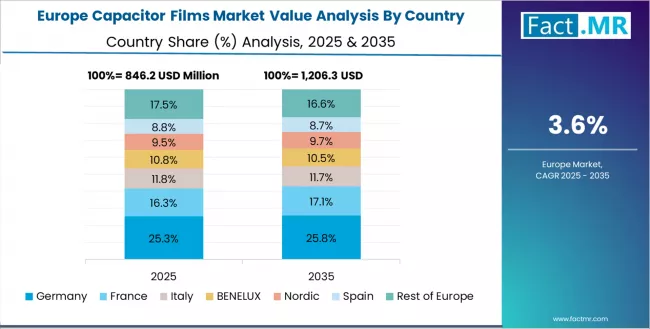
Capacitor Films Market Europe Country Market Share Analysis, 2025 & 2035 | Source: Fact.MR
The Europe capacitor films market is projected to grow from USD 0.9 billion in 2026 to USD 1.3 billion by 2036, recording a CAGR of 3.7% over the forecast period. Germany leads the region with a 41.2% share in 2026, moderating slightly to 40.8% by 2036, supported by its strong materials industry traditions and demand for premium, precision-manufactured film solutions.
UK follows with 19.6% in 2026, easing to 19.3% by 2036, driven by a mature electronics market and emphasis on electrical efficiency and quality performance. France accounts for 16.8% in 2026, rising to 17.1% by 2036, reflecting steady adoption of advanced materials technologies and manufacturing optimization.
Italy holds 9.1% in 2026, expanding to 9.4% by 2036 as industrial modernization and specialty materials applications grow. Spain contributes 5.7% in 2026, growing to 5.9% by 2036, supported by expanding automotive development and materials performance awareness modernization. The Nordic countries rise from 4.2% in 2026 to 4.3% by 2036 on the back of strong technology consciousness and advanced manufacturing methodologies. BENELUX remains at 3.4% share across both 2026 and 2036, reflecting mature, efficiency-focused industrial markets.
Competitive Landscape of the Capacitor Films Market
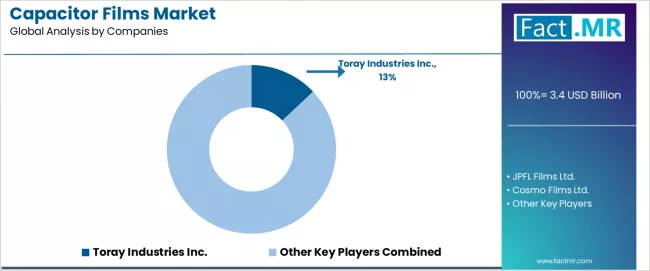
Capacitor Films Market Analysis By Company | Source: Fact.MR
The capacitor films market is characterized by competition among established materials technology companies, specialized film manufacturers, and integrated dielectric solution providers. Companies are investing in advanced materials technologies, specialized production platforms, product innovation capabilities, and comprehensive distribution networks to deliver consistent, high-quality, and reliable capacitor films. Innovation in polymer chemistry, metallization processes, and performance-focused product development is central to strengthening market position and customer satisfaction.
Toray Industries Inc. leads the market with a 13% share with a strong focus on polymer innovation and comprehensive film solutions, offering industrial and automotive systems with emphasis on performance excellence and materials heritage. JPFL Films Ltd. provides integrated materials automation with a focus on electronics market applications and precision manufacturing networks.
Cosmo Films Ltd. delivers comprehensive materials technology solutions with a focus on commercial positioning and electrical efficiency. Mitsubishi Chemical Corporation specializes in comprehensive polymer technologies with an emphasis on dielectric applications. Steiner GmbH focuses on comprehensive specialty films with advanced design and premium positioning capabilities.
Key Players in the Capacitor Films Market
- Toray Industries Inc.
- JPFL Films Ltd.
- Cosmo Films Ltd.
- Mitsubishi Chemical Corporation
- Steiner GmbH
- Bollore Group
- DuPont Teijin Films
- Treofan Group
- SKC Co., Ltd.
- Henkel AG & Co. KGaA
- 3M Company
- Gunze Limited
- Terichem Tervakoski
- Berry Global Inc.
Segmentation
Scope of the Report
| Items | Values |
|---|---|
| Quantitative Units (2026) | USD 3.4 Billion |
| Film Material | Polypropylene, Polyester, Polyethylene Terephthalate, Polyphenylene Sulfide, Polyimide, Other Film Configurations |
| Application Sector | Consumer Electronics, Automotive Electronics, Industrial Applications, Power Systems, Others |
| End-Use Industry | Electronics Manufacturing, Automotive, Energy and Utilities, Telecommunications, Others |
| Voltage Rating | Low Voltage Applications, Medium Voltage Applications, High Voltage Applications, Other Voltage Platforms |
| Regions Covered | North America, Europe, Asia Pacific, Latin America, MEA, Other Regions |
| Countries Covered | China, India, Germany, Brazil, USA, UK, South Korea, and 40+ countries |
| Key Companies Profiled | Toray Industries Inc., JPFL Films Ltd., Cosmo Films Ltd., Mitsubishi Chemical Corporation, Steiner GmbH, and other leading capacitor film companies |
| Additional Attributes | Dollar sales by film material, application sector, end-use industry, voltage rating, and region; regional demand trends, competitive landscape, technological advancements in materials engineering, electrical performance optimization initiatives, dielectric enhancement programs, and premium product development strategies |
Source: Fact.MR analysis. Updated Dec 12, 2025
Capacitor Films Market by Segments
-
Film Material :
- Polypropylene
- Polyester
- Polyethylene Terephthalate
- Polyphenylene Sulfide
- Polyimide
- Other Film Configurations
-
Application Sector :
- Consumer Electronics
- Automotive Electronics
- Industrial Applications
- Power Systems
- Others
-
End-Use Industry :
- Electronics Manufacturing
- Automotive
- Energy and Utilities
- Telecommunications
- Others
-
Voltage Rating :
- Low Voltage Applications
- Medium Voltage Applications
- High Voltage Applications
- Other Voltage Platforms
-
Region :
-
North America
- USA
- Canada
- Mexico
-
Europe
- Germany
- UK
- France
- Italy
- Spain
- Nordic Countries
- BENELUX
- Rest of Europe
-
Asia Pacific
- China
- India
- Japan
- South Korea
- Australia
- Rest of Asia Pacific
-
Latin America
- Brazil
- Argentina
- Rest of Latin America
-
MEA
- Saudi Arabia
- UAE
- South Africa
- Rest of MEA
-
Frequently Asked Questions
How big is the capacitor films market in 2026?
What will be the size of capacitor films market in 2036?
How much will be the capacitor films market growth between 2026 and 2036?
What are the key product types in the capacitor films market?
Which application sector segment to contribute significant share in the capacitor films market in 2026?
Who worked on this report


Preview the report firsthand - request a free sample
Free SampleGet the brochure for pricing and purchase details
Download PDF