Rain Event Resilient Fertilizer Timing Toolkit Market

Rain Event Resilient Fertilizer Timing Toolkit Market Size and Share Forecast Outlook 2026 to 2036

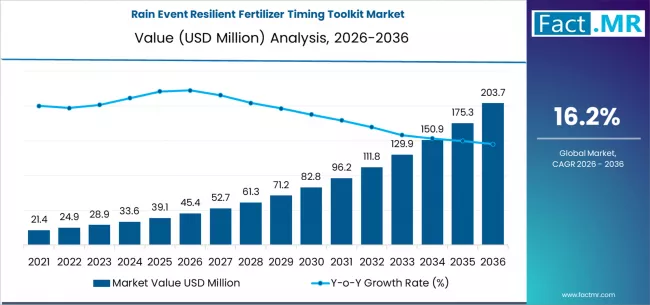
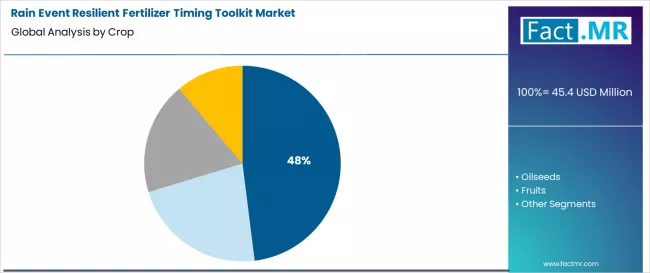
Rain event resilient fertilizer timing toolkit market is projected to grow from USD 45.4 million in 2026 to USD 203.7 million by 2036, at a CAGR of 16.2%. Cereals will dominate with a 48.0% market share, while granular will lead the form segment with a 40.2% share.

Rain Event Resilient Fertilizer Timing Toolkit Market Forecast and Outlook 2026 to 2036

The global market for rain event resilient fertilizer timing toolkits is projected to expand significantly, growing from USD 45.40 million in 2026 to USD 203.74 million by 2036, advancing at a CAGR of 16.2%.

Key Takeaways from the Rain Event Resilient Fertilizer Timing Toolkit Market

  • Market Value for 2026: USD 45.40 Million
  • Market Value for 2036: USD 203.74 Million
  • Forecast CAGR (2026-2036): 16.2%
  • Leading Crop Type Segment (2026): Cereals (48%)
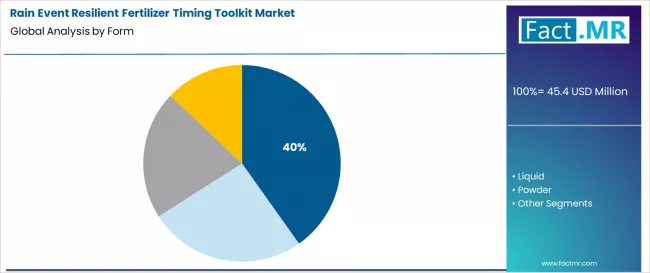
  • Leading Form Segment (2026): Granular (40%)
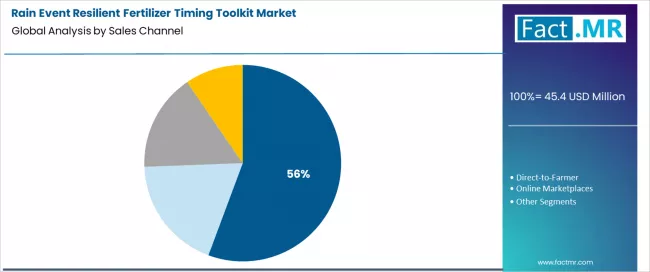
  • Leading Sales Channel Segment (2026): Ag-Retailers (56%)
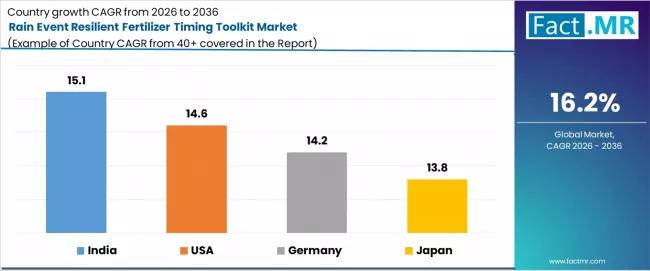
  • Key Growth Countries: India (15.1% CAGR), USA (14.6% CAGR), Germany (14.2% CAGR), Japan (13.8% CAGR)
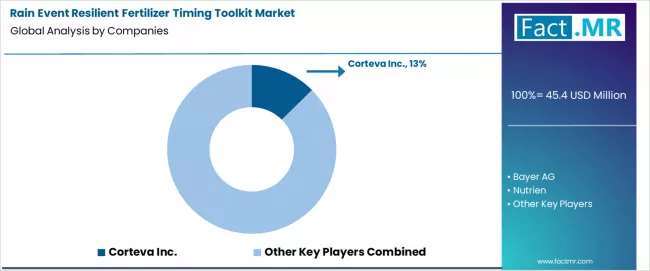
  • Key Players in the Market: Corteva Inc., Bayer AG, Nutrien, Syngenta AG, Yara International ASA, Trimble Inc.

Rain Event Resilient Fertilizer Timing Toolkit Market Market Value Analysis

This market represents the critical fusion of agronomic strategy and meteorological intelligence, providing farmers with data-driven systems to optimize fertilizer application windows around increasingly unpredictable rainfall patterns. These toolkits integrate hyper-local weather forecasting, soil moisture sensors, and decision-support algorithms to recommend application schedules that maximize nutrient uptake and minimize losses from leaching and runoff.

Growth is propelled by the escalating volatility of precipitation events due to climate change, which disrupts traditional fertilization calendars and heightens economic and environmental risks. The financial and regulatory costs of nutrient loss are driving demand for precise management solutions. These toolkits move nutrient management from a calendar-based activity to a dynamic, condition-responsive practice, transforming weather data from a threat into a strategic planning asset to enhance fertilizer use efficiency and protect water quality.

The market’s evolution focuses on enhancing predictive accuracy and user-friendly integration into farm workflows. Success hinges on the reliability of short-term weather models, the robustness of agronomic algorithms that balance crop need with environmental risk, and the delivery of clear, actionable recommendations that farmers can implement with confidence, thereby securing both yield goals and environmental compliance in an uncertain climate.

Metric

Metric Value
Market Value (2026) USD 45.40 Million
Market Forecast Value (2036) USD 203.74 Million
Forecast CAGR (2026-2036) 16.2%

Category

Category Segments
Crop Type Cereals, Oilseeds, Fruits, Vegetables
Form Granular, Liquid, Powder, Suspension
Sales Channel Ag-Retailers, Direct-to-Farmer, Online Marketplaces, Cooperatives
Region North America, Latin America, Western Europe, Eastern Europe, East Asia, South Asia & Pacific, MEA

Segmental Analysis

By Crop Type, Which Systems Are Most Vulnerable to Timing?

Rain Event Resilient Fertilizer Timing Toolkit Market Analysis By Crop

Cereals lead with a 48% share. The extensive acreage of corn, wheat, and rice, coupled with their defined, time-sensitive nutrient demand peaks, makes them highly susceptible to financial loss from poorly timed rain.

A major rainfall event immediately after a surface application can lead to significant nitrogen loss. Timing toolkits provide critical decision support for these high-stakes, large-scale operations, where optimizing a narrow application window has substantial economic and environmental impact.

By Form, Which is Most Compatible with Dynamic Scheduling?

Rain Event Resilient Fertilizer Timing Toolkit Market Analysis By Form

Granular form holds a 40% share, favored for its logistical flexibility in response to weather windows. Granular fertilizers, especially controlled-release varieties, can be staged for application and spread quickly when the toolkit indicates a suitable dry period.

Their physical stability allows for storage and handling under variable schedules, making them more adaptable to last-minute timing changes dictated by incoming weather than some liquid systems requiring immediate use after mixing.

By Sales Channel, Where is Local Weather Intelligence Integrated?

Rain Event Resilient Fertilizer Timing Toolkit Market Analysis By Sales Channel

Ag-retailers are the primary channel, capturing 56% of the market. The effective use of timing toolkits requires interpreting broad forecasts in the context of local microclimates and field conditions.

Retailer agronomists provide this essential localized expertise, helping farmers translate toolkit alerts into practical action plans. Their role in bundling these digital services with fertilizer sales creates a cohesive risk-management package for the grower.

What are the Drivers, Restraints, and Key Trends of the Rain Event Resilient Fertilizer Timing Toolkit Market?

The core driver is the increasing frequency and intensity of extreme rainfall events, which elevate the risk of nutrient loss and degrade fertilizer investment returns. Tightening regulations on nutrient runoff compel farmers to adopt practices that minimize environmental impact, with precise timing being a foremost strategy. The growing availability of high-resolution, farm-level weather data and the proliferation of soil sensor networks provide the necessary infrastructure for these toolkits to operate effectively.

A significant restraint is the inherent uncertainty in weather forecasting, especially beyond a 72-hour window, which can limit planning horizons. Farmer skepticism regarding forecast accuracy and the operational challenge of mobilizing equipment on short notice can hinder adoption. The subscription or service cost for advanced toolkits may also be a barrier for smaller operations, despite the potential savings in nutrient loss prevention.

Key trends include the deep integration with farm management software, allowing toolkits to automatically adjust planned field operations in a master schedule. The use of machine learning is improving forecast interpretation by analyzing historical yield and loss data alongside weather patterns. There is also a trend toward service-based models where payment is tied to documented nutrient loss reduction or efficiency gains, aligning vendor success with farmer outcomes.

Analysis of the Rain Event Resilient Fertilizer Timing Toolkit Market by Key Countries

Rain Event Resilient Fertilizer Timing Toolkit Market Cagr Analysis By Country

Country CAGR (2026-2036)
India 15.1%
USA 14.6%
Germany 14.2%
Japan 13.8%

How is India's Monsoon-Dependent Agriculture a Key Growth Factor?

India’s leading CAGR of 15.1% is driven by the overwhelming dependence of its vast agricultural sector on the monsoon's timing and distribution. The economic impact of pre-or post-monsoon fertilizer application is immense.

Digital tools that provide localized rainfall predictions are becoming indispensable for millions of farmers seeking to time urea and other nutrient applications effectively, minimizing waste and maximizing crop response during the erratic monsoon season.

What is the Impact of the USA's Large-Scale Farming and Precision Tech Adoption?

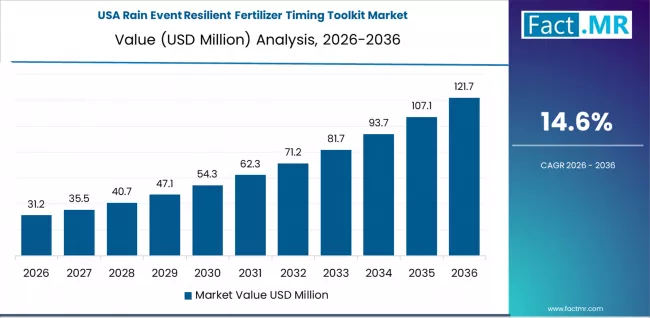
Rain Event Resilient Fertilizer Timing Toolkit Market Country Value Analysis

The scale of its cropping systems and high adoption of precision agriculture technology fuel the USA’s 14.6% growth. Farmers in the Midwest and Plains face increasing spring rainfall volatility.

The economic scale of their operations justifies investment in advanced decision-support toolkits to protect costly fertilizer inputs. Integration of these toolkits with existing high-tech machinery and farm management platforms facilitates seamless adoption.

Why is Germany's Engineering and Regulatory Focus Influential?

Germany’s 14.2% CAGR reflects its precision engineering culture and strict nutrient management regulations. German farmers are required to achieve high nutrient use efficiency.

Timing toolkits that leverage precise weather data and soil models are seen as essential instruments for meeting these regulatory benchmarks while maintaining productivity, fitting into the country's methodical, technology-driven approach to agriculture.

How is Japan's Limited Land and Need for Efficiency Shaping the Market?

Japan’s 13.8% growth stems from the need for extreme input efficiency on its limited arable land. Japanese agriculture is highly sensitive to typhoon seasons and intense rainfall events.

The high value of its horticultural and rice production justifies sophisticated management tools. Timing toolkits are valued for minimizing losses and ensuring precise nutrient delivery in a condensed and intense farming environment, where mistakes are costly.

Competitive Landscape of the Rain Event Resilient Fertilizer Timing Toolkit Market

Rain Event Resilient Fertilizer Timing Toolkit Market Analysis By Company

The competitive landscape involves agriscience corporations, precision agriculture specialists, and weather technology companies. Competition centers on the accuracy and granularity of weather prediction models, the sophistication of agronomic algorithms that convert weather data into fertilizer advice, and the usability of the digital interface.

Strategic partnerships are critical, often linking weather data providers with fertilizer companies and equipment manufacturers to create integrated solutions. Establishing trust through proven track records of preventing loss and increasing efficiency is the ultimate competitive advantage.

Key Players in the Rain Event Resilient Fertilizer Timing Toolkit Market

  • Corteva Inc.
  • Bayer AG
  • Nutrien
  • Syngenta AG
  • Yara International ASA
  • Trimble Inc.

Scope of Report

Items Values
Quantitative Units USD Million
Crop Type Cereals, Oilseeds, Fruits, Vegetables
Form Granular, Liquid, Powder, Suspension
Sales Channel Ag-Retailers, Direct-to-Farmer, Online Marketplaces, Cooperatives
Key Countries USA, Germany, Japan, India
Key Companies Corteva Inc., Bayer AG, Nutrien, Syngenta AG, Yara International ASA, Trimble Inc.
Additional Analysis Analysis of weather prediction accuracy and its impact on toolkit reliability; agronomic modeling of nutrient loss under different rainfall scenarios; ROI analysis for farmers adopting dynamic timing; integration capabilities with irrigation and spraying equipment; review of insurance products linked to weather-resilient practices.

Market by Segments

  • Crop Type :

    • Cereals
    • Oilseeds
    • Fruits
    • Vegetables
  • Form :

    • Granular
    • Liquid
    • Powder
    • Suspension
  • Sales Channel :

    • Ag-Retailers
    • Direct-to-Farmer
    • Online Marketplaces
    • Cooperatives
  • Region :

    • North America

      • USA
      • Canada
    • Latin America

      • Brazil
      • Mexico
      • Argentina
      • Rest of Latin America
    • Western Europe

      • Germany
      • UK
      • France
      • Spain
      • Italy
      • BENELUX
      • Rest of Western Europe
    • Eastern Europe

      • Russia
      • Poland
      • Czech Republic
      • Rest of Eastern Europe
    • East Asia

      • China
      • Japan
      • South Korea
      • Rest of East Asia
    • South Asia & Pacific

      • India
      • ASEAN
      • Australia
      • Rest of South Asia & Pacific
    • MEA

      • Saudi Arabia
      • UAE
      • Turkiye
      • Rest of MEA

Table of Content

  1. Executive Summary
    • Global Market Outlook
    • Demand to side Trends
    • Supply to side Trends
    • Technology Roadmap Analysis
    • Analysis and Recommendations
  2. Market Overview
    • Market Coverage / Taxonomy
    • Market Definition / Scope / Limitations
  3. Market Background
    • Market Dynamics
      • Drivers
      • Restraints
      • Opportunity
      • Trends
    • Scenario Forecast
      • Demand in Optimistic Scenario
      • Demand in Likely Scenario
      • Demand in Conservative Scenario
    • Opportunity Map Analysis
    • Product Life Cycle Analysis
    • Supply Chain Analysis
    • Investment Feasibility Matrix
    • Value Chain Analysis
    • PESTLE and Porter’s Analysis
    • Regulatory Landscape
    • Regional Parent Market Outlook
    • Production and Consumption Statistics
    • Import and Export Statistics
  4. Global Market Analysis 2021 to 2025 and Forecast, 2026 to 2036
    • Historical Market Size Value (USD Million) Analysis, 2021 to 2025
    • Current and Future Market Size Value (USD Million) Projections, 2026 to 2036
      • Y to o to Y Growth Trend Analysis
      • Absolute $ Opportunity Analysis
  5. Global Market Pricing Analysis 2021 to 2025 and Forecast 2026 to 2036
  6. Global Market Analysis 2021 to 2025 and Forecast 2026 to 2036, By Crop
    • Introduction / Key Findings
    • Historical Market Size Value (USD Million) Analysis By Crop, 2021 to 2025
    • Current and Future Market Size Value (USD Million) Analysis and Forecast By Crop, 2026 to 2036
      • Cereals
      • Oilseeds
      • Fruits
      • Vegetables
    • Y to o to Y Growth Trend Analysis By Crop, 2021 to 2025
    • Absolute $ Opportunity Analysis By Crop, 2026 to 2036
  7. Global Market Analysis 2021 to 2025 and Forecast 2026 to 2036, By Form
    • Introduction / Key Findings
    • Historical Market Size Value (USD Million) Analysis By Form, 2021 to 2025
    • Current and Future Market Size Value (USD Million) Analysis and Forecast By Form, 2026 to 2036
      • Granular
      • Liquid
      • Powder
      • Suspension
    • Y to o to Y Growth Trend Analysis By Form, 2021 to 2025
    • Absolute $ Opportunity Analysis By Form, 2026 to 2036
  8. Global Market Analysis 2021 to 2025 and Forecast 2026 to 2036, By Sales Channel
    • Introduction / Key Findings
    • Historical Market Size Value (USD Million) Analysis By Sales Channel, 2021 to 2025
    • Current and Future Market Size Value (USD Million) Analysis and Forecast By Sales Channel, 2026 to 2036
      • Ag-Retailers
      • Direct-to-Farmer
      • Online Marketplaces
      • Cooperatives
    • Y to o to Y Growth Trend Analysis By Sales Channel, 2021 to 2025
    • Absolute $ Opportunity Analysis By Sales Channel, 2026 to 2036
  9. Global Market Analysis 2021 to 2025 and Forecast 2026 to 2036, By Region
    • Introduction
    • Historical Market Size Value (USD Million) Analysis By Region, 2021 to 2025
    • Current Market Size Value (USD Million) Analysis and Forecast By Region, 2026 to 2036
      • North America
      • Latin America
      • Western Europe
      • Eastern Europe
      • East Asia
      • South Asia and Pacific
      • Middle East & Africa
    • Market Attractiveness Analysis By Region
  10. North America Market Analysis 2021 to 2025 and Forecast 2026 to 2036, By Country
    • Historical Market Size Value (USD Million) Trend Analysis By Market Taxonomy, 2021 to 2025
    • Market Size Value (USD Million) Forecast By Market Taxonomy, 2026 to 2036
      • By Country
        • USA
        • Canada
        • Mexico
      • By Crop
      • By Form
      • By Sales Channel
    • Market Attractiveness Analysis
      • By Country
      • By Crop
      • By Form
      • By Sales Channel
    • Key Takeaways
  11. Latin America Market Analysis 2021 to 2025 and Forecast 2026 to 2036, By Country
    • Historical Market Size Value (USD Million) Trend Analysis By Market Taxonomy, 2021 to 2025
    • Market Size Value (USD Million) Forecast By Market Taxonomy, 2026 to 2036
      • By Country
        • Brazil
        • Chile
        • Rest of Latin America
      • By Crop
      • By Form
      • By Sales Channel
    • Market Attractiveness Analysis
      • By Country
      • By Crop
      • By Form
      • By Sales Channel
    • Key Takeaways
  12. Western Europe Market Analysis 2021 to 2025 and Forecast 2026 to 2036, By Country
    • Historical Market Size Value (USD Million) Trend Analysis By Market Taxonomy, 2021 to 2025
    • Market Size Value (USD Million) Forecast By Market Taxonomy, 2026 to 2036
      • By Country
        • Germany
        • UK
        • Italy
        • Spain
        • France
        • Nordic
        • BENELUX
        • Rest of Western Europe
      • By Crop
      • By Form
      • By Sales Channel
    • Market Attractiveness Analysis
      • By Country
      • By Crop
      • By Form
      • By Sales Channel
    • Key Takeaways
  13. Eastern Europe Market Analysis 2021 to 2025 and Forecast 2026 to 2036, By Country
    • Historical Market Size Value (USD Million) Trend Analysis By Market Taxonomy, 2021 to 2025
    • Market Size Value (USD Million) Forecast By Market Taxonomy, 2026 to 2036
      • By Country
        • Russia
        • Poland
        • Hungary
        • Balkan & Baltic
        • Rest of Eastern Europe
      • By Crop
      • By Form
      • By Sales Channel
    • Market Attractiveness Analysis
      • By Country
      • By Crop
      • By Form
      • By Sales Channel
    • Key Takeaways
  14. East Asia Market Analysis 2021 to 2025 and Forecast 2026 to 2036, By Country
    • Historical Market Size Value (USD Million) Trend Analysis By Market Taxonomy, 2021 to 2025
    • Market Size Value (USD Million) Forecast By Market Taxonomy, 2026 to 2036
      • By Country
        • China
        • Japan
        • South Korea
      • By Crop
      • By Form
      • By Sales Channel
    • Market Attractiveness Analysis
      • By Country
      • By Crop
      • By Form
      • By Sales Channel
    • Key Takeaways
  15. South Asia and Pacific Market Analysis 2021 to 2025 and Forecast 2026 to 2036, By Country
    • Historical Market Size Value (USD Million) Trend Analysis By Market Taxonomy, 2021 to 2025
    • Market Size Value (USD Million) Forecast By Market Taxonomy, 2026 to 2036
      • By Country
        • India
        • ASEAN
        • Australia & New Zealand
        • Rest of South Asia and Pacific
      • By Crop
      • By Form
      • By Sales Channel
    • Market Attractiveness Analysis
      • By Country
      • By Crop
      • By Form
      • By Sales Channel
    • Key Takeaways
  16. Middle East & Africa Market Analysis 2021 to 2025 and Forecast 2026 to 2036, By Country
    • Historical Market Size Value (USD Million) Trend Analysis By Market Taxonomy, 2021 to 2025
    • Market Size Value (USD Million) Forecast By Market Taxonomy, 2026 to 2036
      • By Country
        • Kingdom of Saudi Arabia
        • Other GCC Countries
        • Turkiye
        • South Africa
        • Other African Union
        • Rest of Middle East & Africa
      • By Crop
      • By Form
      • By Sales Channel
    • Market Attractiveness Analysis
      • By Country
      • By Crop
      • By Form
      • By Sales Channel
    • Key Takeaways
  17. Key Countries Market Analysis
    • USA
      • Pricing Analysis
      • Market Share Analysis, 2025
        • By Crop
        • By Form
        • By Sales Channel
    • Canada
      • Pricing Analysis
      • Market Share Analysis, 2025
        • By Crop
        • By Form
        • By Sales Channel
    • Mexico
      • Pricing Analysis
      • Market Share Analysis, 2025
        • By Crop
        • By Form
        • By Sales Channel
    • Brazil
      • Pricing Analysis
      • Market Share Analysis, 2025
        • By Crop
        • By Form
        • By Sales Channel
    • Chile
      • Pricing Analysis
      • Market Share Analysis, 2025
        • By Crop
        • By Form
        • By Sales Channel
    • Germany
      • Pricing Analysis
      • Market Share Analysis, 2025
        • By Crop
        • By Form
        • By Sales Channel
    • UK
      • Pricing Analysis
      • Market Share Analysis, 2025
        • By Crop
        • By Form
        • By Sales Channel
    • Italy
      • Pricing Analysis
      • Market Share Analysis, 2025
        • By Crop
        • By Form
        • By Sales Channel
    • Spain
      • Pricing Analysis
      • Market Share Analysis, 2025
        • By Crop
        • By Form
        • By Sales Channel
    • France
      • Pricing Analysis
      • Market Share Analysis, 2025
        • By Crop
        • By Form
        • By Sales Channel
    • India
      • Pricing Analysis
      • Market Share Analysis, 2025
        • By Crop
        • By Form
        • By Sales Channel
    • ASEAN
      • Pricing Analysis
      • Market Share Analysis, 2025
        • By Crop
        • By Form
        • By Sales Channel
    • Australia & New Zealand
      • Pricing Analysis
      • Market Share Analysis, 2025
        • By Crop
        • By Form
        • By Sales Channel
    • China
      • Pricing Analysis
      • Market Share Analysis, 2025
        • By Crop
        • By Form
        • By Sales Channel
    • Japan
      • Pricing Analysis
      • Market Share Analysis, 2025
        • By Crop
        • By Form
        • By Sales Channel
    • South Korea
      • Pricing Analysis
      • Market Share Analysis, 2025
        • By Crop
        • By Form
        • By Sales Channel
    • Russia
      • Pricing Analysis
      • Market Share Analysis, 2025
        • By Crop
        • By Form
        • By Sales Channel
    • Poland
      • Pricing Analysis
      • Market Share Analysis, 2025
        • By Crop
        • By Form
        • By Sales Channel
    • Hungary
      • Pricing Analysis
      • Market Share Analysis, 2025
        • By Crop
        • By Form
        • By Sales Channel
    • Kingdom of Saudi Arabia
      • Pricing Analysis
      • Market Share Analysis, 2025
        • By Crop
        • By Form
        • By Sales Channel
    • Turkiye
      • Pricing Analysis
      • Market Share Analysis, 2025
        • By Crop
        • By Form
        • By Sales Channel
    • South Africa
      • Pricing Analysis
      • Market Share Analysis, 2025
        • By Crop
        • By Form
        • By Sales Channel
  18. Market Structure Analysis
    • Competition Dashboard
    • Competition Benchmarking
    • Market Share Analysis of Top Players
      • By Regional
      • By Crop
      • By Form
      • By Sales Channel
  19. Competition Analysis
    • Competition Deep Dive
      • Corteva Inc.
        • Overview
        • Product Portfolio
        • Profitability by Market Segments (Product/Age /Sales Channel/Region)
        • Sales Footprint
        • Strategy Overview
          • Marketing Strategy
          • Product Strategy
          • Channel Strategy
      • Bayer AG
      • Nutrien
      • Syngenta AG
      • Yara International ASA
      • Trimble Inc.
  20. Assumptions & Acronyms Used
  21. Research Methodology

List Of Table

  • Table 1: Global Market Value (USD Million) Forecast by Region, 2021 to 2036
  • Table 2: Global Market Value (USD Million) Forecast by Crop, 2021 to 2036
  • Table 3: Global Market Value (USD Million) Forecast by Form, 2021 to 2036
  • Table 4: Global Market Value (USD Million) Forecast by Sales Channel, 2021 to 2036
  • Table 5: North America Market Value (USD Million) Forecast by Country, 2021 to 2036
  • Table 6: North America Market Value (USD Million) Forecast by Crop, 2021 to 2036
  • Table 7: North America Market Value (USD Million) Forecast by Form, 2021 to 2036
  • Table 8: North America Market Value (USD Million) Forecast by Sales Channel, 2021 to 2036
  • Table 9: Latin America Market Value (USD Million) Forecast by Country, 2021 to 2036
  • Table 10: Latin America Market Value (USD Million) Forecast by Crop, 2021 to 2036
  • Table 11: Latin America Market Value (USD Million) Forecast by Form, 2021 to 2036
  • Table 12: Latin America Market Value (USD Million) Forecast by Sales Channel, 2021 to 2036
  • Table 13: Western Europe Market Value (USD Million) Forecast by Country, 2021 to 2036
  • Table 14: Western Europe Market Value (USD Million) Forecast by Crop, 2021 to 2036
  • Table 15: Western Europe Market Value (USD Million) Forecast by Form, 2021 to 2036
  • Table 16: Western Europe Market Value (USD Million) Forecast by Sales Channel, 2021 to 2036
  • Table 17: Eastern Europe Market Value (USD Million) Forecast by Country, 2021 to 2036
  • Table 18: Eastern Europe Market Value (USD Million) Forecast by Crop, 2021 to 2036
  • Table 19: Eastern Europe Market Value (USD Million) Forecast by Form, 2021 to 2036
  • Table 20: Eastern Europe Market Value (USD Million) Forecast by Sales Channel, 2021 to 2036
  • Table 21: East Asia Market Value (USD Million) Forecast by Country, 2021 to 2036
  • Table 22: East Asia Market Value (USD Million) Forecast by Crop, 2021 to 2036
  • Table 23: East Asia Market Value (USD Million) Forecast by Form, 2021 to 2036
  • Table 24: East Asia Market Value (USD Million) Forecast by Sales Channel, 2021 to 2036
  • Table 25: South Asia and Pacific Market Value (USD Million) Forecast by Country, 2021 to 2036
  • Table 26: South Asia and Pacific Market Value (USD Million) Forecast by Crop, 2021 to 2036
  • Table 27: South Asia and Pacific Market Value (USD Million) Forecast by Form, 2021 to 2036
  • Table 28: South Asia and Pacific Market Value (USD Million) Forecast by Sales Channel, 2021 to 2036
  • Table 29: Middle East & Africa Market Value (USD Million) Forecast by Country, 2021 to 2036
  • Table 30: Middle East & Africa Market Value (USD Million) Forecast by Crop, 2021 to 2036
  • Table 31: Middle East & Africa Market Value (USD Million) Forecast by Form, 2021 to 2036
  • Table 32: Middle East & Africa Market Value (USD Million) Forecast by Sales Channel, 2021 to 2036

List Of Figures

  • Figure 1: Global Market Pricing Analysis
  • Figure 2: Global Market Value (USD Million) Forecast 2021 to 2036
  • Figure 3: Global Market Value Share and BPS Analysis by Crop, 2026 and 2036
  • Figure 4: Global Market Y to o to Y Growth Comparison by Crop, 2026 to 2036
  • Figure 5: Global Market Attractiveness Analysis by Crop
  • Figure 6: Global Market Value Share and BPS Analysis by Form, 2026 and 2036
  • Figure 7: Global Market Y to o to Y Growth Comparison by Form, 2026 to 2036
  • Figure 8: Global Market Attractiveness Analysis by Form
  • Figure 9: Global Market Value Share and BPS Analysis by Sales Channel, 2026 and 2036
  • Figure 10: Global Market Y to o to Y Growth Comparison by Sales Channel, 2026 to 2036
  • Figure 11: Global Market Attractiveness Analysis by Sales Channel
  • Figure 12: Global Market Value (USD Million) Share and BPS Analysis by Region, 2026 and 2036
  • Figure 13: Global Market Y to o to Y Growth Comparison by Region, 2026 to 2036
  • Figure 14: Global Market Attractiveness Analysis by Region
  • Figure 15: North America Market Incremental Dollar Opportunity, 2026 to 2036
  • Figure 16: Latin America Market Incremental Dollar Opportunity, 2026 to 2036
  • Figure 17: Western Europe Market Incremental Dollar Opportunity, 2026 to 2036
  • Figure 18: Eastern Europe Market Incremental Dollar Opportunity, 2026 to 2036
  • Figure 19: East Asia Market Incremental Dollar Opportunity, 2026 to 2036
  • Figure 20: South Asia and Pacific Market Incremental Dollar Opportunity, 2026 to 2036
  • Figure 21: Middle East & Africa Market Incremental Dollar Opportunity, 2026 to 2036
  • Figure 22: North America Market Value Share and BPS Analysis by Country, 2026 and 2036
  • Figure 23: North America Market Value Share and BPS Analysis by Crop, 2026 and 2036
  • Figure 24: North America Market Y to o to Y Growth Comparison by Crop, 2026 to 2036
  • Figure 25: North America Market Attractiveness Analysis by Crop
  • Figure 26: North America Market Value Share and BPS Analysis by Form, 2026 and 2036
  • Figure 27: North America Market Y to o to Y Growth Comparison by Form, 2026 to 2036
  • Figure 28: North America Market Attractiveness Analysis by Form
  • Figure 29: North America Market Value Share and BPS Analysis by Sales Channel, 2026 and 2036
  • Figure 30: North America Market Y to o to Y Growth Comparison by Sales Channel, 2026 to 2036
  • Figure 31: North America Market Attractiveness Analysis by Sales Channel
  • Figure 32: Latin America Market Value Share and BPS Analysis by Country, 2026 and 2036
  • Figure 33: Latin America Market Value Share and BPS Analysis by Crop, 2026 and 2036
  • Figure 34: Latin America Market Y to o to Y Growth Comparison by Crop, 2026 to 2036
  • Figure 35: Latin America Market Attractiveness Analysis by Crop
  • Figure 36: Latin America Market Value Share and BPS Analysis by Form, 2026 and 2036
  • Figure 37: Latin America Market Y to o to Y Growth Comparison by Form, 2026 to 2036
  • Figure 38: Latin America Market Attractiveness Analysis by Form
  • Figure 39: Latin America Market Value Share and BPS Analysis by Sales Channel, 2026 and 2036
  • Figure 40: Latin America Market Y to o to Y Growth Comparison by Sales Channel, 2026 to 2036
  • Figure 41: Latin America Market Attractiveness Analysis by Sales Channel
  • Figure 42: Western Europe Market Value Share and BPS Analysis by Country, 2026 and 2036
  • Figure 43: Western Europe Market Value Share and BPS Analysis by Crop, 2026 and 2036
  • Figure 44: Western Europe Market Y to o to Y Growth Comparison by Crop, 2026 to 2036
  • Figure 45: Western Europe Market Attractiveness Analysis by Crop
  • Figure 46: Western Europe Market Value Share and BPS Analysis by Form, 2026 and 2036
  • Figure 47: Western Europe Market Y to o to Y Growth Comparison by Form, 2026 to 2036
  • Figure 48: Western Europe Market Attractiveness Analysis by Form
  • Figure 49: Western Europe Market Value Share and BPS Analysis by Sales Channel, 2026 and 2036
  • Figure 50: Western Europe Market Y to o to Y Growth Comparison by Sales Channel, 2026 to 2036
  • Figure 51: Western Europe Market Attractiveness Analysis by Sales Channel
  • Figure 52: Eastern Europe Market Value Share and BPS Analysis by Country, 2026 and 2036
  • Figure 53: Eastern Europe Market Value Share and BPS Analysis by Crop, 2026 and 2036
  • Figure 54: Eastern Europe Market Y to o to Y Growth Comparison by Crop, 2026 to 2036
  • Figure 55: Eastern Europe Market Attractiveness Analysis by Crop
  • Figure 56: Eastern Europe Market Value Share and BPS Analysis by Form, 2026 and 2036
  • Figure 57: Eastern Europe Market Y to o to Y Growth Comparison by Form, 2026 to 2036
  • Figure 58: Eastern Europe Market Attractiveness Analysis by Form
  • Figure 59: Eastern Europe Market Value Share and BPS Analysis by Sales Channel, 2026 and 2036
  • Figure 60: Eastern Europe Market Y to o to Y Growth Comparison by Sales Channel, 2026 to 2036
  • Figure 61: Eastern Europe Market Attractiveness Analysis by Sales Channel
  • Figure 62: East Asia Market Value Share and BPS Analysis by Country, 2026 and 2036
  • Figure 63: East Asia Market Value Share and BPS Analysis by Crop, 2026 and 2036
  • Figure 64: East Asia Market Y to o to Y Growth Comparison by Crop, 2026 to 2036
  • Figure 65: East Asia Market Attractiveness Analysis by Crop
  • Figure 66: East Asia Market Value Share and BPS Analysis by Form, 2026 and 2036
  • Figure 67: East Asia Market Y to o to Y Growth Comparison by Form, 2026 to 2036
  • Figure 68: East Asia Market Attractiveness Analysis by Form
  • Figure 69: East Asia Market Value Share and BPS Analysis by Sales Channel, 2026 and 2036
  • Figure 70: East Asia Market Y to o to Y Growth Comparison by Sales Channel, 2026 to 2036
  • Figure 71: East Asia Market Attractiveness Analysis by Sales Channel
  • Figure 72: South Asia and Pacific Market Value Share and BPS Analysis by Country, 2026 and 2036
  • Figure 73: South Asia and Pacific Market Value Share and BPS Analysis by Crop, 2026 and 2036
  • Figure 74: South Asia and Pacific Market Y to o to Y Growth Comparison by Crop, 2026 to 2036
  • Figure 75: South Asia and Pacific Market Attractiveness Analysis by Crop
  • Figure 76: South Asia and Pacific Market Value Share and BPS Analysis by Form, 2026 and 2036
  • Figure 77: South Asia and Pacific Market Y to o to Y Growth Comparison by Form, 2026 to 2036
  • Figure 78: South Asia and Pacific Market Attractiveness Analysis by Form
  • Figure 79: South Asia and Pacific Market Value Share and BPS Analysis by Sales Channel, 2026 and 2036
  • Figure 80: South Asia and Pacific Market Y to o to Y Growth Comparison by Sales Channel, 2026 to 2036
  • Figure 81: South Asia and Pacific Market Attractiveness Analysis by Sales Channel
  • Figure 82: Middle East & Africa Market Value Share and BPS Analysis by Country, 2026 and 2036
  • Figure 83: Middle East & Africa Market Value Share and BPS Analysis by Crop, 2026 and 2036
  • Figure 84: Middle East & Africa Market Y to o to Y Growth Comparison by Crop, 2026 to 2036
  • Figure 85: Middle East & Africa Market Attractiveness Analysis by Crop
  • Figure 86: Middle East & Africa Market Value Share and BPS Analysis by Form, 2026 and 2036
  • Figure 87: Middle East & Africa Market Y to o to Y Growth Comparison by Form, 2026 to 2036
  • Figure 88: Middle East & Africa Market Attractiveness Analysis by Form
  • Figure 89: Middle East & Africa Market Value Share and BPS Analysis by Sales Channel, 2026 and 2036
  • Figure 90: Middle East & Africa Market Y to o to Y Growth Comparison by Sales Channel, 2026 to 2036
  • Figure 91: Middle East & Africa Market Attractiveness Analysis by Sales Channel
  • Figure 92: Global Market - Tier Structure Analysis
  • Figure 93: Global Market - Company Share Analysis

- FAQs -

How big is the rain event resilient fertilizer timing toolkit market in 2026?

The global rain event resilient fertilizer timing toolkit market is estimated to be valued at USD 45.4 million in 2026.

What will be the size of rain event resilient fertilizer timing toolkit market in 2036?

The market size for the rain event resilient fertilizer timing toolkit market is projected to reach USD 203.7 million by 2036.

How much will be the rain event resilient fertilizer timing toolkit market growth between 2026 and 2036?

The rain event resilient fertilizer timing toolkit market is expected to grow at a 16.2% CAGR between 2026 and 2036.

What are the key product types in the rain event resilient fertilizer timing toolkit market?

The key product types in rain event resilient fertilizer timing toolkit market are cereals, oilseeds, fruits and vegetables.

Which form segment to contribute significant share in the rain event resilient fertilizer timing toolkit market in 2026?

In terms of form, granular segment to command 40.2% share in the rain event resilient fertilizer timing toolkit market in 2026.
Rain Event Resilient Fertilizer Timing Toolkit Market