- Market Value (2025): USD 545.8 Mn
- Estimated Value (2026): USD 614.0 Mn
- Forecast Value (2036): USD 1993.9 Mn
- CAGR (2026-2036): 12.5%
What is the Carob Pulp Fibers Market forecast to be worth by 2036?
USD 614.0 million in 2026 to USD 1,993.9 million by 2036 at a 12.5% CAGR.
- The Carob Pulp Fibers Market was valued at USD 545.8 million in 2025.
- Demand is projected to increase from USD 614.0 million in 2026 to USD 1,993.9 million by 2036.
- The market is forecast to record 12.5% CAGR from 2026 to 2036 as formulators evaluate carob pulp fiber for fiber enrichment and texture-related applications.
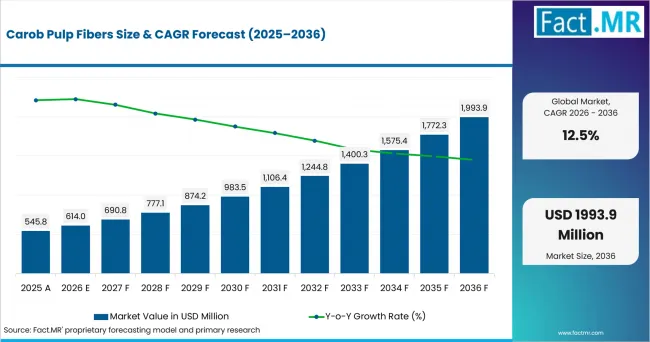
Carob Pulp Fibers Value Analysis | Source: Fact.MR
What are the defining numbers behind Carob Pulp Fibers Market growth?
An absolute opportunity of USD 1,379.9 million is expected between 2026 and 2036.
- Demand Drivers in the Market
- Functional food brands need fruit-derived fiber systems that support fiber-forward positioning. The U.S. Food and Drug Administration lists 28 g as the Daily Value for dietary fiber; whether a processed carob-derived fraction may be declared as dietary fiber depends on whether it meets applicable regulatory definitions.
- Supplement formulators need powders that mix cleanly into sachets and capsules. Pulp fiber gives them a plant-origin option where bulk density and serving size shape product design.
- Bakery developers need fiber ingredients that can contribute body in reformulated products. Roasted carob pulp powder can contribute cocoa-like color and aroma in bakery and snack formulations; these sensory properties should not be generalized to every purified carob pulp-fiber ingredient.
- Pet nutrition is a potential application for carob-derived ingredients, but satiety, stool-quality and digestive claims for carob pulp fiber should be supported by product-specific feeding, digestibility and palatability data.
- Ingredient distributors need reliable milling and documentation before adding a new fruit fiber to customer portfolios. Moisture, mesh size and origin records are central to repeat orders.
- Key Segments Analyzed
- By Carob Fraction: Pulp fiber is expected to hold 36.0% share in 2026 because it gives formulators the clearest link to fruit-derived dietary fiber.
- By Function: Prebiotic support is projected to account for 31.0% share in 2026.
- By Application: Functional foods are anticipated to capture 29.0% share in 2026 due to use in bars, cereals and bakery products.
- By Processing: Dry milling is estimated to represent 33.0% share in 2026 owing to simpler handling and lower solvent reliance.
- Analyst Opinion at Fact.MR
- Shambhu Nath Jha, Principal Consultant at Fact.MR, states, “Carob pulp fiber is drawing attention because it connects fiber enrichment with fruit-origin storytelling. The market is projected to expand as brands look for ingredients that support texture and digestive-positioned labels. Suppliers should combine clean milling, particle-size control and application guidance for food and pet nutrition teams.”
- Strategic Implications
- Ingredient suppliers should publish mesh size, moisture and fiber data so formulators compare lots before pilot trials.
- Food brands should match carob pulp fiber with chocolate, cereal and nut profiles where its natural color supports the finished product.
- China-facing teams should prepare label files early. On March 27, 2025, China's National Health Commission and State Administration for Market Regulation jointly issued 50 new national food-safety standards and nine amendments, including GB 7718-2025 on prepackaged food labeling and GB 28050-2025 on nutrition labeling.
- Pet nutrition producers should validate palatability, digestibility and stool-quality outcomes in formulation-specific testing before making performance claims for carob pulp fiber.
China is expected to record 13.6% CAGR through 2036 driven by packaged-food retail and pet nutrition trials. The USA is projected to post 13.1% CAGR as food spending supports reformulation. Germany is anticipated to reach 12.9% CAGR due to prepared meals. Japan is estimated to advance at 12.0% CAGR owing to health-food formats. France is forecast to hold 11.6% CAGR as Mediterranean ingredient familiarity supports clean labels.
How does the Carob Pulp Fibers Market break down by segment?
Pulp fiber leads Carob Fraction at 36.0% share in 2026; Dry milling leads Processing at 33.0% share.
Which Carob Fraction dominates?
Pulp fiber is expected to hold 36.0% share in 2026.
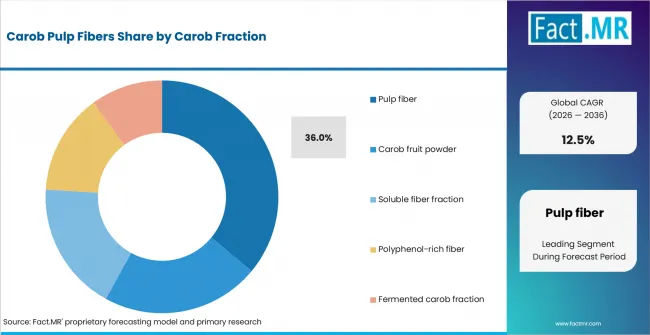
Carob Pulp Fibers Analysis By Carob Fraction | Source: Fact.MR
Carob fruit powder can retain natural sugars, color and fiber. More highly processed soluble, polyphenol-rich and fermented fractions require product-specific validation because their composition and functionality depend on the processing route.
What leads the Function segment?
Prebiotic support is projected to account for 31.0% share in 2026.
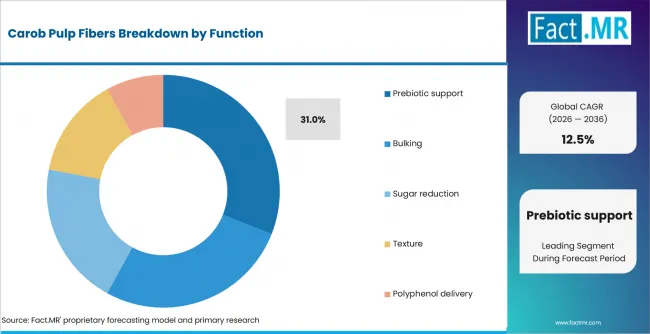
Carob Pulp Fibers Analysis By Function | Source: Fact.MR
A 2025 in-vitro fecal-fermentation study found that carob-flour dietary fiber altered microbiota composition, while its fermentation profile differed from inulin. USDA FAS reported in May 2025 that China’s high-end and functional pet food products were expected to grow by 6% to 8% in 2025; this statistic describes the broader pet-food market rather than demand specifically for carob pulp fiber. Bulking and sugar-reduction applications remain relevant formulation areas.
How does Application shape demand?
Functional foods are anticipated to capture 29.0% share in 2026.
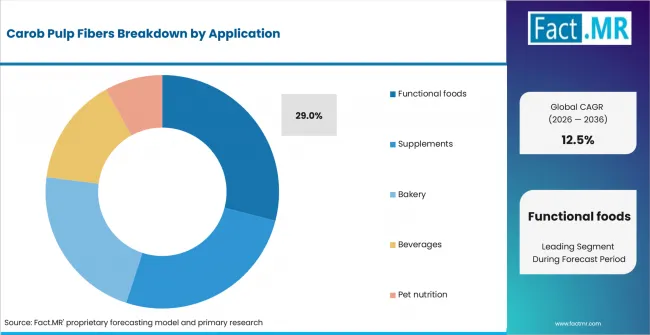
Carob Pulp Fibers Analysis By Application | Source: Fact.MR
Supplements can use carob-derived powders where serving size and flowability are suitable. Bakery applications can benefit when natural carob color and flavor fit the product concept, while beverage and pet-nutrition uses require formulation-specific particle-size, dispersion and palatability testing.
What supports Processing choices?
Dry milling is estimated to represent 33.0% share in 2026.
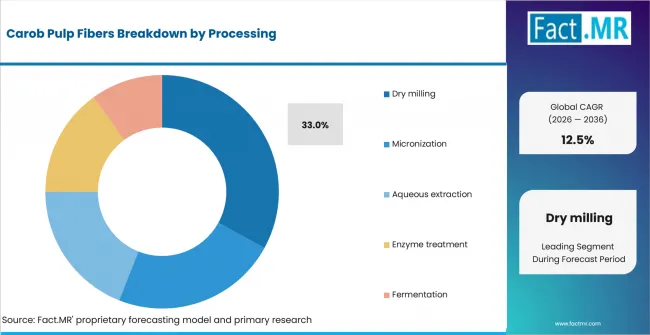
Carob Pulp Fibers Analysis By Processing | Source: Fact.MR
Carob pulp can be deseeded, ground and sieved to produce flour or powder, while carob fiber can also be produced through extraction that removes much of the soluble carbohydrate. Research also documents enzymatic treatment as a route for modifying the soluble-fiber fraction.
What is accelerating Carob Pulp Fibers Market adoption, and what is holding it back?
Fiber-enriched reformulation drives it; raw-material consistency restrains it.
Drivers Impact Analysis
| DRIVER | (~) % IMPACT ON CAGR | GEOGRAPHIC RELEVANCE | IMPACT TIMELINE |
|---|---|---|---|
| Fiber-enriched reformulation in functional foods | +1.9% | North America, Europe, East Asia | Short term (<= 2 years) |
| Fruit-origin digestive-fiber positioning | +1.5% | Global | Medium term (2-4 years) |
| Pet nutrition fiber use | +1.2% | China, USA, Japan | Medium term (2-4 years) |
| Dry-powder processing fit | +0.8% | Europe, North America | Long term (>= 4 years) |
Opportunity Impact Analysis
| OPPORTUNITY | (~) % IMPACT ON CAGR | GEOGRAPHIC RELEVANCE | IMPACT TIMELINE |
|---|---|---|---|
| Clean-label bakery and snack formulations | +1.4% | USA, Germany, France | Short term (<= 2 years) |
| Powdered supplements and stick packs | +1.1% | North America, East Asia | Medium term (2-4 years) |
| Carob side-stream valorization | +0.9% | Mediterranean Europe, North Africa | Long term (>= 4 years) |
Restraints Impact Analysis
| RESTRAINT | (~) % IMPACT ON CAGR | GEOGRAPHIC RELEVANCE | IMPACT TIMELINE |
|---|---|---|---|
| Flavor and color variability | -0.6% | Global | Short term (<= 2 years) |
| Documentation depth for fiber claims | -0.4% | USA, Europe, China | Medium term (2-4 years) |
| Fine-powder handling limits | -0.3% | Global | Long term (>= 4 years) |
Which countries are scaling the Carob Pulp Fibers Market through 2036?
- The country comparison spans 2.0 percentage points across the forecast period.
- China remains 0.5 percentage point above the USA through packaged-food retail growth and pet nutrition demand.
- The USA remains 0.2 percentage point above Germany as food spending supports fiber-label reformulation.
- Germany remains 0.9 percentage point above Japan through prepared-meal manufacturing and bakery applications.
- Japan remains 0.4 percentage point above France as processed foods support health-oriented fiber trials.
- France closes the displayed range through agri-food exports and Mediterranean ingredient familiarity.
Comparable CAGRs create different entry conditions due to food spending, retail channels, pet nutrition, prepared meals and health-food claim systems. Full report coverage includes North America, Latin America, Western Europe, Eastern Europe, East Asia, South Asia & Pacific, Middle East & Africa.
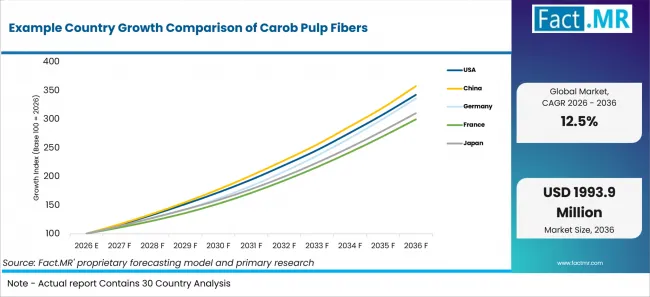
Example Country Growth Comparison Of Carob Pulp Fibers | Source: Fact.MR
| Country | CAGR |
|---|---|
| China | 13.6% |
| United States | 13.1% |
| Germany | 12.9% |
| Japan | 12.0% |
| France | 11.6% |
What supports China adoption?
13.6% CAGR, supported by packaged-food retail and pet nutrition demand.
China has a large packaged-food retail base where fruit-derived fibers can be evaluated in snacks and nutrition products. The National Bureau of Statistics of China reported in February 2026 that retail sales of grain, oil and food by enterprises above designated size increased 9.3% in 2025. China at a 13.6% CAGR through 2036 as domestic formulators evaluate carob pulp fiber for fiber-enrichment and digestive-wellness positioning.
How is the USA scaling demand?
13.1% CAGR, backed by food spending and fiber-label awareness.
The USA has a broad food manufacturing base and a familiar Nutrition Facts label system. USDA ERS reported on June 11, 2026 that inflation-adjusted U.S. food spending by consumers, businesses and government entities reached USD 2.51 trillion in 2025, expressed in 2025 dollars. The USA at a 13.1% CAGR through 2036 as formulators evaluate carob pulp fiber in bars and supplement powders.
What supports Germany’s growth?
12.9% CAGR, driven by prepared meals and bakery applications.
Germany offers a practical route through prepared foods that use fiber and texture systems. Destatis reported on January 14, 2026 that Germany produced 1.7 million tonnes of prepared meals in 2024. Germany at a 12.9% CAGR through 2036, with convenience foods and bakery applications providing relevant formulation settings.
How does Japan perform?
12.0% CAGR, led by food processing capacity and health-food positioning.
Japan offers a large processed-food base for evaluating fiber-rich carob ingredients. USDA FAS reported on April 1, 2026 that Japan's food-processing sector contracted 3% in 2025 to USD 174 billion, while health foods, frozen foods and shelf-stable products recorded growth. Japan at a 12.0% CAGR through 2036 as health-oriented and shelf-stable products create trial opportunities.
What underpins France’s growth?
11.6% CAGR, supported by agri-food exports and Mediterranean ingredient sourcing.
France provides a route through agri-food and natural-ingredient channels. INSEE reported on May 29, 2026 that France's agri-food exports totaled EUR 65.3 billion in 2025, based on provisional 2025 data. France at an 11.6% CAGR through 2036 as bakery and nutrition brands evaluate fruit-based fibers.
Who leads the Carob Pulp Fibers Market?
Publicly documented participants with direct carob-pulp, carob-powder or carob-fiber activity include Boublenza, Pedro Perez Martinez/Beflesh, ILCAR, Terra Carob Industry and Bagnarese.
ILCAR offers CHOCAR®, a carob powder produced through dehydration and super-micronization of Sicilian organic carob pulp. Terra Carob Industry lists carob pulp and carob flour among its processed products, including single- and double-roasted carob flour. Bagnarese markets a natural carob extract/fiber and documents grinding, decantation and filtration, and drying in its production process.
For a market scope focused specifically on carob pulp, powder, flour and fiber ingredients, these companies provide more direct product evidence than suppliers documented only for seed-derived locust bean gum.
Which companies are the key providers?
Key profiled participants are Boublenza, Pedro Perez Martinez/Beflesh, ILCAR, Terra Carob Industry and Bagnarese, based on publicly documented carob-pulp, carob-powder or carob-fiber activity.
- Boublenza (CARUMA)
- Pedro Perez Martinez / Beflesh
- ILCAR
- Terra Carob Industry
- Bagnarese
Bibliography
- U.S. Department of Agriculture, Foreign Agricultural Service. (2025, May 16). China: Pet Food Market Update 2025 (GAIN Report No. CH2025-0109).
- National Bureau of Statistics of China. (2026, February 28). Statistical communiqué of the People’s Republic of China on the 2025 national economic and social development.
- Zeballos, E., & Sinclair, W. (2026, June 11). Total U.S. food spending reached $2.51 trillion in 2025. U.S. Department of Agriculture, Economic Research Service.
- Statistisches Bundesamt. (2026, January 14). Produktion von Fertiggerichten binnen fünf Jahren mengenmäßig um 25,6 % gestiegen.
- Aoki, S. (2026, April 1). Food processing ingredients annual (GAIN Report No. JA2026-0012). U.S. Department of Agriculture, Foreign Agricultural Service.
- Institut national de la statistique et des études économiques. (2026, May 29). Commerce extérieur de produits agroalimentaires : Données annuelles de 2000 à 2025.
- Arioglu-Tuncil, S., Deemer, D., Lindemann, S. R., & Tunçil, Y. E. (2025). Coconut (Cocos nucifera L.) and carob (Ceratonia siliqua L.) flours dietary fibers differentially impact fecal microbiota composition and metabolic outputs in vitro. Food Science & Nutrition, 13(1), e4724.
- Garau, C., Umaña, M., Llompart, M., Velázquez, I., Gálvez, I., & Simal, S. (2025). Potential of carob pulp powder: Influence of cultivar on nutritional composition, antioxidant activity, and functional properties. Molecules, 30(13), 2715.
This Report Answers
- The report explains where carob pulp fibers are used across carob fraction and function. Coverage extends to application and processing route.
- Segment analysis identifies pulp fiber and prebiotic support as central subsegments shaping the forecast; the prebiotic label is a market-segmentation category rather than proof of a universal physiological effect.
- Country analysis examines China, the USA, Germany, Japan and France across food retail, prepared foods and health-oriented products.
- Competitive analysis reviews Boublenza, Pedro Perez Martinez/Beflesh, ILCAR, Terra Carob Industry and Bagnarese based on publicly documented carob-pulp, powder or fiber activity.
- Application analysis assesses how functional foods, supplements, bakery, beverages and pet nutrition influence ingredient approval.
- Processing analysis evaluates dry milling, micronization, aqueous extraction, enzyme treatment and fermentation for commercial use.
What does the Carob Pulp Fibers Market cover?
Pulp fiber, carob fruit powder, soluble fiber fraction and polyphenol-rich fiber used for fiber enrichment.
The Carob Pulp Fibers Market covers fruit-derived fiber ingredients recovered from carob pulp and prepared for use in food, supplements and pet nutrition. It includes dry-milled and micronized powders, soluble fractions and fermented fractions used to support texture or digestive-positioned labels.
The assessment differs from the broader carob ingredient category by focusing on pulp-derived fibers. Carob seed gum sold only as a hydrocolloid, roasted carob flavor powder and finished foods containing carob flavor are outside this scope unless the product is sold as a fiber ingredient.
What is included in the scope?
Carob pulp fiber ingredients used in functional foods, supplements, bakery, beverages and pet nutrition.
The scope includes pulp fiber, carob fruit powder and soluble fiber fraction used by functional food and supplement brands. Related coverage of dietary fiber ingredients and prebiotic fiber applications frames adjacent buyer needs. Coverage of fiber-enhanced foods and functional bakery ingredients show where carob pulp fiber competes for formulation budgets.
Coverage includes the prebiotic support segment, along with bulking, sugar reduction, texture and polyphenol delivery. Coverage includes processing routes where dry milling, micronization, aqueous extraction, enzyme treatment or fermentation are used to produce a commercial ingredient.
What is excluded from the scope?
Carob seed gum and finished carob-flavored foods are outside the scope.
The scope excludes locust bean gum when sold only as a seed-derived thickener. The scope excludes roasted carob powders sold for flavor, cocoa-style substitutes and finished foods that contain carob only as an ingredient claim. Broad dietary fiber blends are covered only when carob pulp fiber is a named commercial input.
How Was the Analysis Built?
The analysis draws on 120+ sources, 35+ company portfolios, 25+ countries and more than 20 industry interviews.
- Primary Research: Primary research includes discussions with ingredient suppliers, food formulators, supplement brands, bakery producers, pet nutrition teams and distributors. These conversations examine approval steps, sensory limits, particle-size needs, claim support and repeat-order conditions.
- Desk Research: Desk research covers government statistics, regulatory publications, company announcements, ingredient portfolios, product pages, technical notes and public policy sources.
- Market Sizing and Forecasting: Market estimates combine historical ingredient use, application mix, processing route fit, country-level growth, fiber-label relevance, formulation barriers and provider portfolio checks.
- Data Validation and Update Cycle: Findings are checked against official statistics, company activity, portfolio mapping and interview feedback. Regular updates review ingredient launches, supply-chain changes and regulatory updates.
What is the report’s scope and coverage?
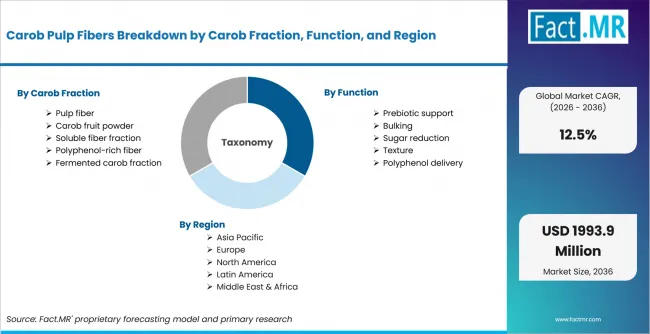
Carob Pulp Fibers Breakdown By Carob Fraction, Function, And Region | Source: Fact.MR
| Attribute | Details |
|---|---|
| Quantitative Units | USD million |
| Market Definition | Fruit-derived ingredients recovered from carob pulp and used for fiber enrichment, digestive-fiber positioning, bulking, sugar reduction, texture and polyphenol delivery. |
| Carob Fraction | Pulp fiber; Carob fruit powder; Soluble fiber fraction; Polyphenol-rich fiber; Fermented carob fraction |
| Function | Prebiotic support; Bulking; Sugar reduction; Texture; Polyphenol delivery |
| Application | Functional foods; Supplements; Bakery; Beverages; Pet nutrition |
| Processing | Dry milling; Micronization; Aqueous extraction; Enzyme treatment; Fermentation |
| Regions Covered | North America; Latin America; Western Europe; Eastern Europe; East Asia; South Asia & Pacific; Middle East & Africa |
| Countries Covered | United States; China; Germany; France; Japan |
| Key Companies Profiled | Boublenza (CARUMA); Pedro Perez Martinez / Beflesh; ILCAR; Terra Carob Industry; Bagnarese |
| Forecast Period | 2026 to 2036 |
| Approach | Hybrid top-down and bottom-up approach using food formulation demand, fiber use cases, application mix, processing routes, country adoption and provider portfolio review. |
How is the market segmented?
-
By Carob Fraction
- Pulp fiber
- Carob fruit powder
- Soluble fiber fraction
- Polyphenol-rich fiber
- Fermented carob fraction
-
By Function
- Prebiotic support
- Bulking
- Sugar reduction
- Texture
- Polyphenol delivery
-
By Application
- Functional foods
- Supplements
- Bakery
- Beverages
- Pet nutrition
-
By Processing
- Dry milling
- Micronization
- Aqueous extraction
- Enzyme treatment
- Fermentation
-
By Region
- North America
- Latin America
- Western Europe
- Eastern Europe
- East Asia
- South Asia & Pacific
- Middle East & Africa