- Market Value (2025): USD 2.98 Bn
- Estimated Value (2026): USD 3.07 Bn
- Forecast Value (2036): USD 4.16 Bn
- CAGR (2026-2036): 3.1%
What is the CATV Equipment and Antennas Market forecast to be worth by 2036?
USD 3.07 billion in 2026 to USD 4.16 billion by 2036 at a 3.1% CAGR.
- According to Fact.MR analysis, the CATV equipment and antennas market reached USD 2.98 billion in 2025.
- Demand is projected to increase from USD 3.07 billion in 2026 to USD 4.16 billion by 2036.
- The market is forecast to record a 3.1% CAGR from 2026 to 2036 as cable providers modernize access networks and households continue using fixed broadband and television services.
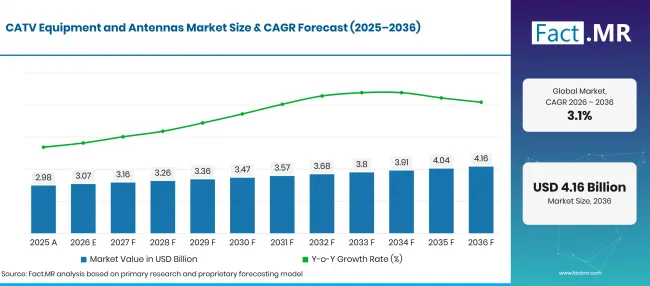
Catv Equipment And Antennas Market Forecast Global | Source: Fact.MR
| Year | Basis | Market value (USD million) |
|---|---|---|
| 2025 | Actual | 2.98 |
| 2026 | Estimate | 3.07 |
| 2036 | Forecast | 3.1% |
| CAGR, 2026 to 2036 | 5.6% | |
What are the defining numbers behind CATV Equipment and Antennas Market growth?
According to Fact.MR analysis, an absolute opportunity of USD 1.1 billion is projected between 2026 and 2036.
- Demand Drivers in the Market
- Headends and network nodes require upgrades as fixed broadband services handle more data. In August 2026, the Federal Communications Commission reported that the number of Americans without access to 100/20 Mbps fixed terrestrial broadband fell by about 23% between June 2024 and June 2025 [1].
- Stable home connections depend on suitable antennas, splitters, and coaxial equipment, especially in areas with many homes close together. Cable quality and proper connections also play an important role in keeping network performance steady.
- Large CATV networks require regular repairs, creating ongoing demand for replacement connectors, cables, and other basic parts. Regional distributors help by keeping these products available locally when technicians need matching parts during service visits.
- Key Segments Analyzed
- By Product Type: As per Fact.MR analysis, Transmission Equipment is estimated to hold 32.4% share in 2026.
- By Application: Residential is forecast to represent 68.3% share in 2026. The segment benefits from the large installed base of household TV and fixed broadband connections.
- By Distribution Channel: Based on Fact.MR analysis, Offline Stores are expected to capture 72.1% share in 2026.
- Analyst Opinion at Fact.MR
- Shambhu Nath Jha, Principal Consultant at Fact.MR, states, “Cable providers are now using coaxial and fiber networks together as they gradually upgrade their systems. Many are increasing the data capacity of existing coaxial lines while bringing fiber closer to homes and businesses. This creates opportunities for suppliers that provide reliable network hardware, equipment that works with newer DOCSIS systems, and practical support for installation and maintenance.”
- Strategic Implications
- CATV equipment works best when it fits both existing HFC networks and newer network designs. This gives cable providers more freedom to upgrade in stages without replacing large amounts of equipment at the same time.
- Distributors benefit from keeping commonly used coaxial cables, connectors, and antennas in stock along with newer network equipment. Local supply matters because repair work often requires parts quickly.
- Home installers get more reliable results when antennas and other network parts are properly matched. Correct parts and clean connections reduce signal loss and help maintain stable service across both older and upgraded sections of the cable network.
Germany leads the five countries with a 4.0% CAGR through 2036, as HFC networks continue to serve fixed broadband users while fiber coverage grows. The United States follows at 3.6%, supported by its large cable broadband network. The United Kingdom records 3.1% as gigabit services reach more areas, while Japan grows at 2.6% with cable television networks still widely installed. Brazil reaches 2.2% as broadband access becomes available to more users.
How does the CATV Equipment and Antennas Market break down by segment?
Transmission Equipment leads Product Type at 32.4%; Residential leads Application at 68.3%; Offline Stores lead Distribution Channel at 72.1%.
Which Product Type dominates?
Transmission Equipment is forecast to hold 32.4% share in 2026.
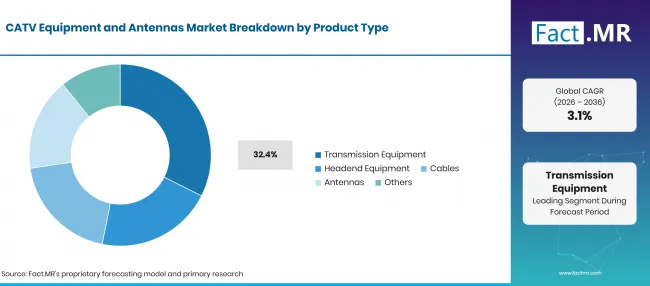
Factmr Catv Equipment And Antennas Market Breakdown Product Type | Source: Fact.MR
CATV Equipment and Antennas Market Breakdown by Product Type
| Product Type | Share (2026) |
| Transmission Equipment (Leading segment) | 32.4% |
| Other segments combined | 67.6%* |
| Total | 100.0% |
Transmission equipment is forecast to lead because it carries TV and broadband signals from headends to optical nodes and local coaxial networks. Headend equipment manages these services, while cables and antennas connect different parts of the network to homes and other end users. In July 2025, Harmonic reported 14 Gbps downstream DOCSIS 4.0 performance during a joint CableLabs test event [2].
What leads the Application segment?
Residential is forecast to account for 68.3% share in 2026.
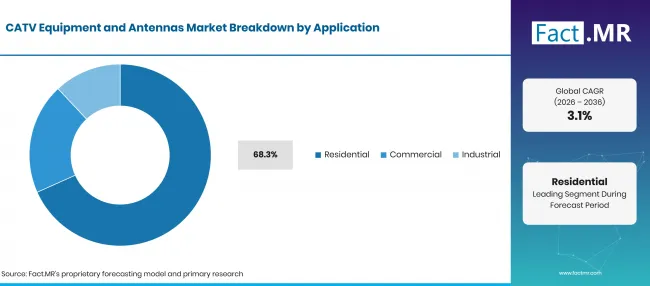
Catv Equipment And Antennas Market Breakdown Application | Source: Fact.MR
Dehydrated Beans Market Breakdown by Product Type Product type Share (2026) Black Beans (Leading segment) 28.3% Other segments combined 71.7%* Total 100.0%
CATV Equipment and Antennas Market Breakdown by Application
| Application | Share (2026) |
| Residential (Leading segment) | 68.3% |
| Other segments combined | 31.7%* |
| Total | 100.0% |
Homes account for most CATV equipment use because cable networks first served household television and later expanded into broadband services. Changes in home connections create regular demand for coaxial cables, connectors, and splitters. Hotels and other managed properties also use this equipment, but on a smaller scale.
How does Distribution Channel shape demand?
Offline Stores are expected to capture 72.1% share in 2026.
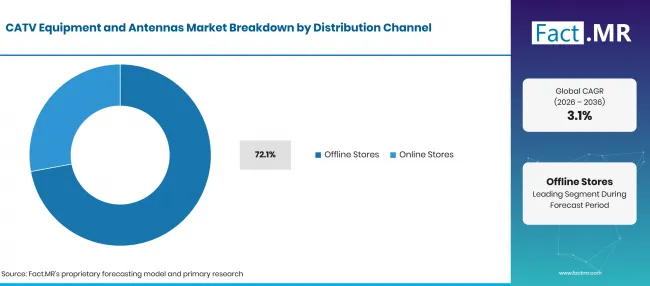
Factmr Catv Equipment And Antennas Market Breakdown Distribution Channel | Source: Fact.MR
CATV Equipment and Antennas Market Breakdown by Application
| Distribution Channel | Share (2026) |
|---|---|
| Offline Stores (Leading Segment) | 72.1% |
| Online Stores | 27.9% |
| Total | 100.0% |
Store-based sales are expected to lead because installation and repair work often requires the correct connector or replacement part without delay. Specialist distributors keep these parts available locally for technicians working in the field. Online stores are more useful for standard antennas and shorter cable lengths.
What is accelerating CATV Equipment and Antennas Market adoption, and what is holding it back?
Upgrades to existing networks continue to support demand, especially in areas where HFC systems remain widely used. At the same time, wider fiber coverage and growing use of streaming services are gradually reducing reliance on traditional CATV systems.
Drivers Impact Analysis
| DRIVER | (~) % IMPACT ON CAGR | GEOGRAPHIC RELEVANCE | IMPACT TIMELINE |
|---|---|---|---|
| DOCSIS and access-network upgrades | +0.8% | North America, Europe | Medium term (2-4 years) |
| High fixed-broadband data use | +0.7% | Global | Long term (>= 4 years) |
| Large installed HFC network base | +0.6% | North America, Europe, Japan | Medium term (2-4 years) |
| Residential replacement and repair demand | +0.5% | Global | Short term (<= 2 years) |
| Selective fiber-deep upgrades around coax plant | +0.4% | Europe, North America | Long term (>= 4 years) |
Opportunity Impact Analysis
| OPPORTUNITY | (~) % IMPACT ON CAGR | GEOGRAPHIC RELEVANCE | IMPACT TIMELINE |
|---|---|---|---|
| DOCSIS 4.0 transmission equipment | +0.7% | North America, Western Europe | Medium term (2-4 years) |
| Distributed access architectures | +0.6% | North America, Europe | Medium term (2-4 years) |
| MDU broadband upgrades | +0.5% | Europe, Asia | Short term (<= 2 years) |
| Integrated fiber and cable portfolios | +0.4% | Global | Long term (>= 4 years) |
Restraints Impact Analysis
| RESTRAINT | (~) % IMPACT ON CAGR | GEOGRAPHIC RELEVANCE | IMPACT TIMELINE |
|---|---|---|---|
| FTTH replacement of coax access | -0.7% | Europe, East Asia | Long term (>= 4 years) |
| Decline in traditional pay-TV subscriptions | -0.5% | Latin America, North America | Medium term (2-4 years) |
| Price pressure on passive components | -0.4% | Global | Short term (<= 2 years) |
| Long life of installed cable hardware | -0.3% | Global | Medium term (2-4 years) |
Which countries are scaling the CATV Equipment and Antennas Market through 2036?
- Germany is forecast to keep the highest listed CAGR at 4.0%, supported by HFC broadband use while operators expand fiber in selected areas.
- The United States is projected to follow at 3.6% as large cable broadband networks continue competing on fixed-network speed and capacity.
- The United Kingdom is expected to record 3.1% where gigabit-capable coverage combines full-fiber and DOCSIS-based cable infrastructure.
- Japan is forecast to post 2.6% reflecting an established cable television base and continued household use of fixed connectivity.
- Brazil is forecast to reach 2.2% supported by a large fixed-broadband base and ongoing demand for access-network hardware.
Comparable CAGRs still create different market conditions because cable-network age, fiber rollout and household broadband use vary by country. Full report coverage includes North America, Latin America, Western Europe, Eastern Europe, East Asia, South Asia & Pacific, Middle East & Africa.
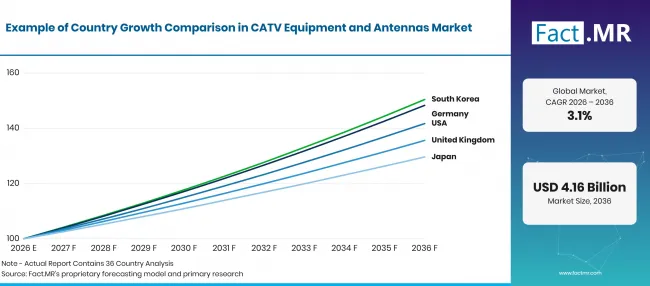
Catv Equipment And Antennas Market Growth Index | Source: Fact.MR
| Country | CAGR (2026-2036) |
|---|---|
| Germany | 4.0% |
| United States | 3.6% |
| United Kingdom | 3.1% |
| Japan | 2.6% |
| Brazil | 2.2% |
What supports Germany adoption?
4.0% CAGR, supported by HFC broadband use and staged fiber rollout.
Germany continues to use HFC networks along with DSL and fiber for fixed internet services. In June 2026, the Bundesnetzagentur reported that connections providing speeds of at least 100 Mbps increased from 21.5 million in 2024 to 23.6 million in 2025 [4]. This wider use of high-speed connections keeps network upgrades important as the country gradually expands its fiber coverage.
How is the United States scaling demand?
3.6% CAGR, shaped by large cable broadband networks and continued speed upgrades.
The U.S. has a large number of households using fixed broadband services, creating a broad base for network connections and upgrades. According to the U.S. Census Bureau, 101,582,619 households had cable, fiber-optic, or DSL broadband subscriptions in the 2024 ACS [5]. This large user base creates regular demand for network maintenance and replacement parts.
What supports the United Kingdom outlook?
3.1% CAGR, led by gigabit coverage across cable and full-fiber networks.
UK broadband providers are expanding gigabit services through both full-fiber and cable networks, with upgrades taking place across different areas. In May 2025, Ofcom reported that 25.9 million homes, or 86% of UK homes, had access to gigabit-capable broadband as of January 2025 [6]. DOCSIS-based systems remain part of this coverage and create ongoing demand for compatible parts as providers improve their networks.
How is Japan developing demand?
2.6% CAGR, driven by household internet use and an established cable television base.
Japan has a well-established base of household internet users and cable television services, particularly in urban areas. The Statistical Handbook of Japan 2025 reported that 85.6% of individuals aged 6 and over had used the Internet in the past year as of August 2024 [7]. This high level of internet use reflects the country’s broad network base, while CATV products continue to serve cable systems that remain active.
What underpins Brazil growth?
2.2% CAGR, backed by fixed-broadband expansion and continuing access-network upgrades.
Brazil has a large fixed broadband network that serves users across major cities and regional areas. In July 2026, Anatel reported 55.4 million fixed broadband connections in the second quarter of 2026 [8]. As providers extend their networks and maintain existing connections, installers continue to use replacement parts and other components for regular upgrades and repair work.
Who leads the CATV Equipment and Antennas Market?
Competition mainly comes from companies supplying broadband access systems, signal transmission products, and network connections.
In September 2025, Harmonic announced that neu-medianet selected its cOS platform to introduce XGS-PON services while continuing DOCSIS services on its existing network [9]. Suppliers that work across both cable and fiber systems are better placed to serve providers as they upgrade existing networks and gradually add newer technology
Which companies are the key providers?
Key companies include Amphenol Corporation; Belden Inc.; Corning Incorporated; Harmonic Inc.; Vecima Networks; and Huawei Technologies.
- Amphenol Corporation
- Belden Inc.
- Corning Incorporated
- Harmonic Inc.
- Vecima Networks
- Huawei Technologies
Bibliography
- [1] Federal Communications Commission. (2026, August 14). 2026 Section 706 Report (FCC 26-55).
- [2] Harmonic Inc. (2025, July 8). Harmonic Sets DOCSIS 4.0 Record with 14 Gbps Downstream Speed at CableLabs Interoperability Event.
- [4] Bundesnetzagentur. (2026, June 5). Telecoms Annual Report 2025.
- [5] U.S. Census Bureau. (2025, September 11). Internet Subscriptions in Household (2024 American Community Survey 1-Year Estimates, Table B28011).
- [6] Ofcom. (2025, May 8). Connected Nations update: Spring 2025.
- [7] Statistics Bureau of Japan. (2025, September). Statistical Handbook of Japan 2025.
- [8] Agência Nacional de Telecomunicações. (2026, July 15). Anatel divulga Relatório de Monitoramento da Competição do segundo trimestre de 2026.
- [9] Harmonic Inc. (2025, September 23). neu-medianet Fast-Tracks Fiber Broadband Rollout with Harmonic.
This Report Answers
- The report explains how CATV equipment and antennas are sold by product type, application and distribution channel across cable and hybrid fiber coax networks.
- Segment analysis identifies the leading subsegment in each listed dimension and explains the operating reason behind its 2026 share.
- Country analysis compares Germany, the United States, the United Kingdom, Japan and Brazil through fixed-broadband coverage, cable-network use and television-service trends.
- Competitive analysis reviews active providers serving cable access, RF transmission, interconnect, broadband network and antenna requirements.
- Technology analysis considers how DOCSIS upgrades and fiber-deep designs affect coaxial and transmission equipment.
What does the CATV Equipment and Antennas Market cover?
The market covers equipment used inside cable television and HFC broadband networks. Transmission platforms, headend systems, coaxial cable and antennas are included when they receive or distribute cable-network signals. The scope connects with carrier infrastructure in telecom applications where hardware supports network delivery. It also overlaps with microwave transmission equipment in RF transmission and antenna functions.
What is included in the scope?
The scope includes new and replacement equipment used by cable providers, installers and business properties.
It covers DOCSIS-oriented network hardware, coaxial signal distribution and compatible antennas. Technical context is supported by the radio frequency test equipment market for field signal checks. Component context also connects with the RF filters market where signal selection and interference control shape RF performance.
What is excluded from the scope?
The scope excludes television sets, streaming subscriptions and mobile handsets.
Pure fiber equipment falls outside the boundary when it has no defined cable-network role. Wider network context can be compared with the resilient networks market where network continuity and communications hardware are evaluated together.
How Was the Analysis Built?
The analysis draws on 120+ sources, 35+ company portfolios, 25+ countries, and more than 20 industry interviews.
- Primary Research: Primary research includes discussions with manufacturers, service providers, technology developers, distributors, end users, and subject-matter experts. These conversations examine purchasing priorities, product adoption, operational challenges, approval requirements, competitive positioning, and the factors that influence wider market acceptance.
- Desk Research: Desk research covers government statistics, regulatory publications, company filings, trade data, technical studies, industry associations, standards, public policy, and other authoritative sources. Every source used in the analysis is documented in the bibliography.
- Market Sizing and Forecasting: Market estimates combine historical performance, demand indicators, pricing and volume trends, segment shares, company participation, country-level growth, adoption patterns, investment activity, and barriers to market expansion.
- Data Validation and Update Cycle: Findings are validated by comparing primary interviews with public data, company activity, regulatory changes, trade patterns, and industry developments. Regular updates review new product launches, capacity changes, partnerships, approvals, and shifts in commercial adoption.
What is the report’s scope and coverage?
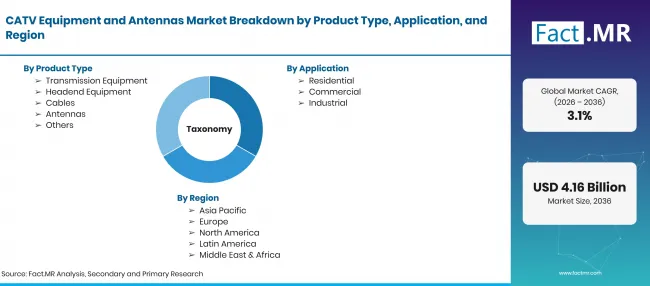
Factmr Catv Equipment And Antennas Market Taxonomy | Source: Fact.MR
| Attribute | Details |
|---|---|
| Quantitative Units | USD billion |
| Market Definition | Equipment and antennas used to receive, process, transmit and distribute cable television and broadband signals across CATV and hybrid fiber coax networks. The scope includes transmission equipment, headend equipment, coaxial cables, antennas and related field hardware. |
| Product Type | Transmission Equipment; Headend Equipment; Cables; Antennas; Others |
| Application | Residential; Commercial; Industrial |
| Distribution Channel | Offline Stores; Online Stores |
| Regions Covered | North America; Latin America; Western Europe; Eastern Europe; East Asia; South Asia & Pacific; Middle East & Africa |
| Countries Covered | Germany; United States; United Kingdom; Japan; Brazil |
| Key Companies Profiled | Amphenol Corporation; Belden Inc.; Corning Incorporated; Harmonic Inc.; Vecima Networks; Huawei Technologies |
| Forecast Period | 2026 to 2036 |
| Approach | Hybrid top-down and bottom-up approach using broadband-network installed base, cable upgrade cycles, product mix, country growth, official connectivity statistics and manufacturer portfolio review. |
How is the market segmented?
-
By Product Type:
- Transmission Equipment
- Headend Equipment
- Cables
- Antennas
- Others
-
By Application:
- Residential
- Commercial
- Industrial
-
By Distribution Channel:
- Offline Stores
- Online Stores
-
By Region:
- North America
- Latin America
- Western Europe
- Eastern Europe
- East Asia
- South Asia & Pacific
- Middle East & Africa