Resilient Networks Market Size, Share, Growth and Forecast (2026 - 2036)

The Resilient Networks Market is segmented by Network Type, Component, Connectivity Technology, Resilience Capability, End Use Industry and Region. Forecast for 2026 to 2036

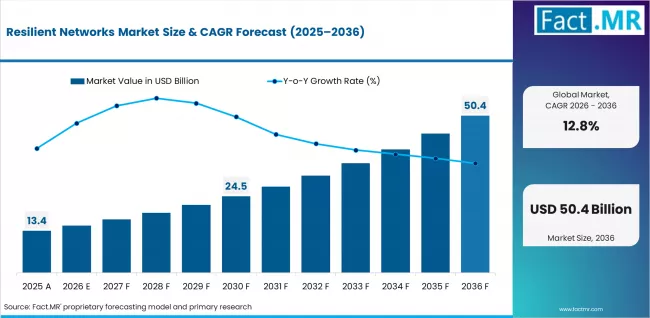
According to Fact.MR estimates, the resilient networks market stood at USD 13.4 billion in 2025. The market is projected to reach USD 15.1 billion in 2026 and climb to USD 50.4 billion by 2036, progressing at a CAGR of 12.8%. SD-WAN & Intelligent WAN is anticipated to account for nearly 31% share of the network type segment, while Hardware is expected to remain the leading component with around 42% share, driven by rising investments in critical communication infrastructure, increasing demand for AI-driven self-healing and cyber-resilient networks, rapid expansion of private 5G and cloud connectivity, and growing adoption of secure, high-availability networking solutions across telecom, defense, industrial, healthcare, and data center sectors.

Resilient Networks Market Overview, Growth Outlook, and Forecast by Fact.MR

  • Global resilient networks market revenue stood at USD 13.4 Bn in 2025 and is forecast to reach USD 50.4 Bn by 2036.
  • At a 12.8% CAGR from 2026 to 2036, this market is set to expand ~ 3.3 x in value, adding USD 35.3 Bn in absolute opportunity.
Resilient Networks Market  Value Analysis

Summary of the Resilient Networks Market

  • Demand and Growth Drivers
    • Increasing reliance on uninterrupted digital connectivity and mission-critical communications is driving demand for resilient networking infrastructure.
    • Rising cyberattacks, network disruptions, and data security concerns are accelerating adoption of self-healing and disaster recovery network solutions.
    • Growing deployment of cloud computing, edge networks, and distributed IT infrastructure is supporting demand for intelligent WAN and SD-WAN solutions.
    • Expansion of industrial automation, smart utilities, and connected transportation systems is increasing need for resilient and low-latency communication networks.
    • Increasing government investments in defense communication systems and critical infrastructure modernization are supporting market expansion.
    • Advancements in AI-driven network monitoring, automation, and predictive maintenance technologies are improving network resilience and operational efficiency.
  • Product and Segment View
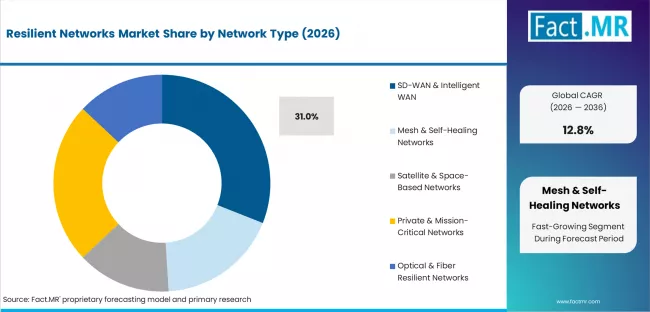
    • SD-WAN & intelligent WAN solutions hold 31% share of network type segment, driven by increasing demand for secure and scalable enterprise connectivity.
    • Private & mission-critical networks account for 24% share, supported by rising adoption across defense, industrial, and public safety applications.
    • Mesh & self-healing networks represent 18% share, reflecting increasing demand for uninterrupted communication capabilities.
    • Satellite & space-based networks contribute 14% share, while optical & fiber resilient networks account for 13%.
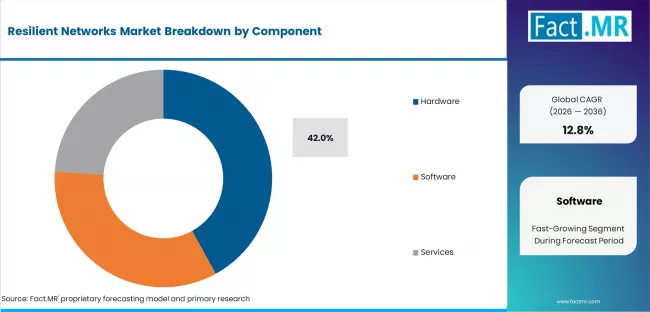
    • Hardware dominates component segment with 42% share, supported by growing deployment of networking infrastructure equipment.
    • Software accounts for 34% share, driven by increasing use of AI-enabled network management and cybersecurity platforms.
    • Services contribute 24% share, reflecting rising demand for integration, monitoring, and managed network services.
  • Geography and Competitive Outlook
    • North America and Europe represent key markets supported by strong digital infrastructure and cybersecurity investments.
    • China, India, and South Korea are emerging as high-growth markets due to increasing deployment of 5G, cloud infrastructure, and mission-critical communication networks.
    • Key companies active in this market include Cisco Systems Inc., Nokia Corporation, Huawei Technologies Co. Ltd., Juniper Networks Inc., and Ericsson AB.
  • Analyst Opinion
    • Shambhu Nath Jha, Principal Consultant at Fact.MR, says, “The Resilient Networks Market is no longer defined solely by traditional telecom redundancy infrastructure. Growth is increasingly driven by AI-powered self-healing networks, rising demand for cyber-resilient and mission-critical connectivity, and the shift toward cloud-native, automated, and low-latency network architectures that enhance operational continuity across telecom, defense, industrial, healthcare, and data center environments

Resilient Networks Market— At a Glance

Attribute Details
Market Value 2025 USD 13.4 billion
Market Value 2036 USD 50.4 billion
Absolute Dollar Opportunity USD 35.3 billion
CAGR 12.8%
Growth Multiple 3.3x
Key Demand Theme Increasing demand for secure, high-availability, and self-healing communication infrastructure
Leading Network Type SD-WAN & Intelligent WAN
Segment Share 31%
Leading Component Hardware
Segment Share 42%
Leading Deployment Mode On-Premises
Segment Share 38%
Leading Connectivity Technology Wired Connectivity
Segment Share 41%
Leading Resilience Capability Cyber Resilient Networks
Segment Share 33%
Leading End-use Industry Telecommunications
Segment Share 23%
Key Growth Regions North America, Europe, Asia Pacific
Key Companies Cisco, Nokia, Huawei, Juniper Networks, Ericsson
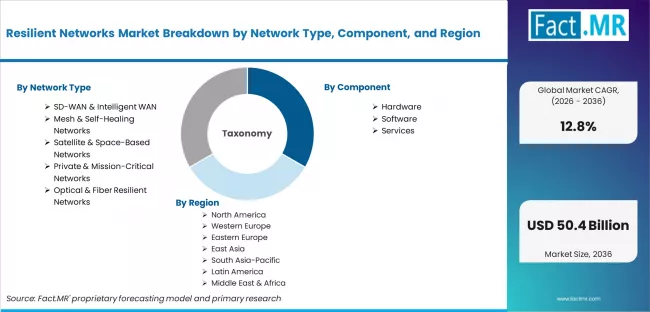
Segmentation by Network Type SD-WAN & Intelligent WAN, Mesh & Self-Healing Networks, Satellite & Space-Based Networks, Private & Mission-Critical Networks, Optical & Fiber Resilient Networks
Segmentation by Component Hardware, Software, Services
Segmentation by Deployment Mode On-Premises, Cloud-Based, Hybrid Deployment
Segmentation by Connectivity Technology Wired Connectivity, Wireless Connectivity, Satellite Connectivity
Segmentation by Resilience Capability Disaster Recovery Networks, Cyber Resilient Networks, Self-Healing Networks, Energy-Resilient Networks
Segmentation by End-use Industry Telecommunications, Government & Defense, Energy & Utilities, Transportation & Logistics, Healthcare, Manufacturing & Industrial, BFSI, IT & Data Centers
Segmentation by Region North America, Latin America, Europe, East Asia, South Asia & Pacific, Middle East & Africa

Key Growth Drivers, Constraints, and Opportunities
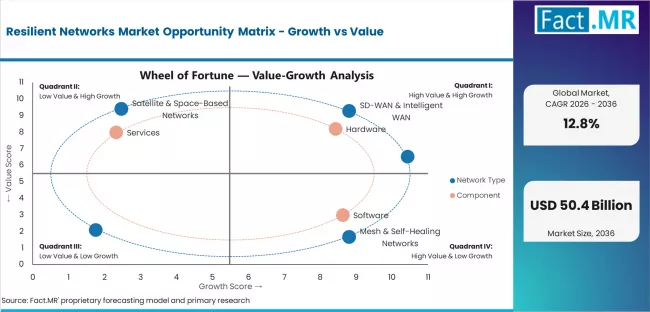
Resilient Networks Market Opportunity Matrix Growth Vs Value

Key Factors Driving Growth

  • Dollar investments in digital infrastructure modernization will grow, as will the need for continuous, secure connections between enterprises and critical infrastructure sectors, driving an increase in resilient networking solutions.
  • The deployment of AI-driven self-healing and mission-critical networking technologies are likely to be necessitated by cybersecurity threats, cloud adoption, and operational continuity.
  • The emergence of AI-driven automation, private 5G, edge computing, cloud-native networking and network orchestration platforms will help to drive the deployment of resilient networks.
Growth Driver Demand Impact Time Horizon Key Impact Area Fact.MR Insight
Rising investments in digital infrastructure modernization and critical communication systems High Short-Mid Term Telecom & enterprise networking Increasing focus on operational continuity and secure connectivity is driving demand for resilient networking solutions
Growing cybersecurity threats and demand for uninterrupted connectivity High Short-Mid Term Cyber-resilient infrastructure Enterprises are rapidly adopting secure and self-healing network architectures to reduce downtime and cyber risks
Expansion of cloud computing, edge infrastructure, and private 5G networks High Short-Mid Term Cloud & wireless networking Rising deployment of distributed digital infrastructure is accelerating adoption of resilient network technologies
Advancements in AI-driven network automation and self-healing technologies Medium-High Mid-Long Term Intelligent network management AI-powered analytics, automation, and predictive maintenance are improving network resilience and operational efficiency

Key Market Constraints

  • The cost of infrastructure upgrades, integration, and implementation will still be a barrier to implementing resilient networking solutions.
  • Large-scale adoption will be limited by complex network management needs, interoperability issues and cyber security compliance.
  • Digital infrastructure will be in short supply, awareness of autonomous networking technologies will be low, and budgets will be limited, and these factors will make it difficult to gain momentum in developing economies.

Key Opportunity Areas

  • Solution providers can expect to see strong growth opportunities in the development of AI-powered systems for self-healing, zero trust, and automated network orchestration.
  • Growth will be fueled by the increasing demand of telecom operators, defense sector, hyperscale data centers, industrial facilities, healthcare providers, etc.
  • Market potential will be bolstered by the increasing penetration of private 5G, edge computing, multi-cloud connectivity and software-defined networking technologies.

Segment-wise Analysis of the Resilient Networks Market

  • By the year 2026, SD-WAN & Intelligent WAN account for a 31% market share of the network type segment due to increasing enterprise demand for secure multi-cloud connectivity, rising adoption of software-defined networking, and growing need for high-performance, resilient communication infrastructure across distributed business operations.
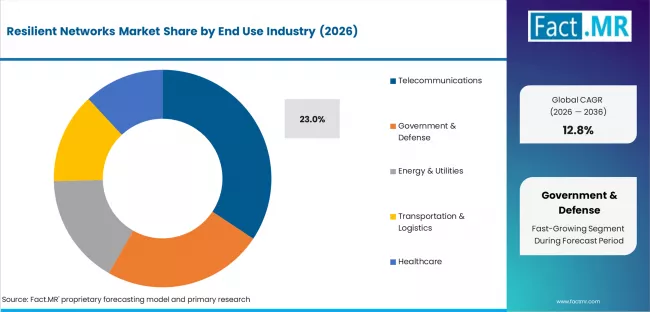
  • Telecommunications represent a 23% market share of the end use industry segment by 2026, driven by rapid 5G expansion, increasing investments in network modernization, and growing deployment of AI-driven self-healing and mission-critical communication infrastructure to ensure uninterrupted connectivity and operational continuity

The segmentation of the Resilient Networks Market includes network type, component, deployment mode, connectivity technology, resilience capability, end use industry, and region.

Which Network Type Dominates the Resilient Networks Market?
Resilient Networks Market Analysis By Network Type

Secure multi-cloud connectivity, centralized network management, and optimized traffic routing across a distributed enterprise environment are fueling SD-WAN & Intelligent WAN's 31% market share. The growth of demand for secure communication infrastructure in defense, industrial, and emergency response applications drives the private & mission-critical networks segment, at 24%. Mesh & self-healing networks account for a share of 18%, making them networks that recover from faults on their own and keep connected.

Which Component Dominates the Resilient Networks Market?
Resilient Networks Market Analysis By Component

Hardware has a market share of 42% due to large investments in routers, switches, wireless infrastructure, optical transport systems and cybersecurity appliances. The growth in software adoption of AI-based network orchestration, self-healing, and cloud-native network platforms drives 34% of the share of software. Services account for 24% as enterprises are increasingly turning to managed networking, consulting, integration, and maintenance services for support in their deployment of resilient infrastructure.

Which Deployment Mode Dominates the Resilient Networks Market?
Resilient Networks Market Analysis By Deployment Mode

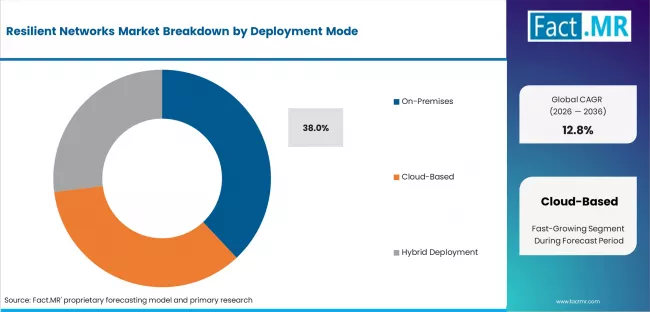
The on-premises segment captures 38% market share as enterprises and government organizations seek to have more control, security and compliance over their mission critical networking infrastructure. Cloud-Based is 35% due to growing penetration of scalable and flexible cloud-native networking solutions. Adopting Hybrid Deployment is a key strategy for organizations looking to leverage on-premises infrastructure alongside multi-cloud and edge deployment strategies for network flexibility and operational resilience, accounting for 27%.

Which Connectivity Technology Dominates the Resilient Networks Market?
Resilient Networks Market Analysis By Connectivity Technology

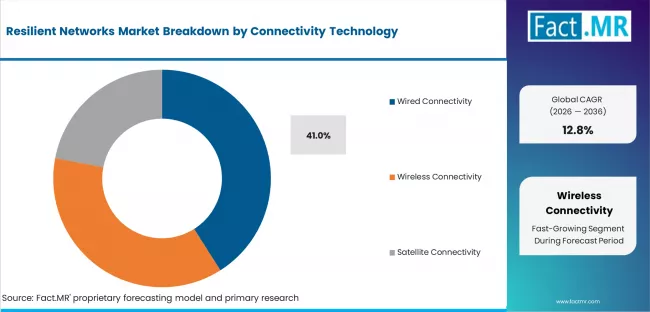
Wired Connectivity makes up 41% of the market as it delivers the best reliability, bandwidth capacity and low latency for enterprise and telecom infrastructure. Expanding wireless industry adoption of 5G, mobility needs, and growing deployment of wireless industrial and enterprise network are driving growth in the Wireless Connectivity industry. Wireless Connectivity industry is growing due to rising wireless 5G adoption, mobility needs, and increasing deployment of wireless industrial and enterprise networks. Satellite Connectivity is expected to gain steady market traction due to the need for robust communication solutions in remote, defense, maritime, and disaster recovery applications, accounting for 22% of the market.

Which End Use Industry Dominates the Resilient Networks Market?
Resilient Networks Market Analysis By End Use Industry

Telecommunications is expected to hold 23% share in 2026 owning to the continued efforts for the deployment of 5G, network upgrades and maintaining communication infrastructure. The Government & Defense segment's share rose to 16%, due to the growing demand for secure and mission-critical communication systems. Manufacturing & Industrial accounts for 14% as industrial IoT and smart factory networking has been growing in adoption.

Regional Outlook Across Key Markets

The market analysis covers key global regions, including South Asia and Pacific, Middle East & Africa, North America, Latin America, Western Europe, and Eastern Europe. It is segmented geographically, with specific market dynamics for each region. The full report provides a detailed market attractiveness analysis.

Top Country Growth Comparison Resilient Networks Market Cagr (2026 2036)

CAGR Table

Country CAGR (%)
Germany 11.4%
U.K. 11.8%
U.S. 12.2%
Japan 12.7%
S. Korea 13.5%
China 14.1%
India 15.3%

Source: Fact.MR (FMR) analysis, based on proprietary forecasting model and primary research.
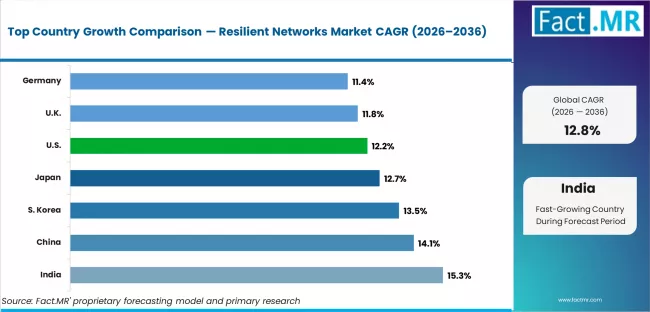
Resilient Networks Market Cagr Analysis By Country

North America

North America represents “the global innovation hub for AI-driven resilient networking infrastructure” due to strong investments in cloud networking, cybersecurity, and hyperscale data centers. Major companies including Cisco, Palo Alto Networks, and Arista Networks dominate the regional competitive landscape through AI-powered networking, secure access infrastructure, and cloud-native resilience solutions. The region benefits from rapid enterprise digital transformation, large-scale 5G deployment, and high adoption of self-healing networking technologies.

  • USA.: Demand for resilient networking solutions in the U.S. is projected to rise at 12.2% CAGR through 2036. Growth is driven by rapid AI infrastructure expansion, hyperscale cloud investment, and increasing enterprise demand for secure and automated networking systems.

Western Europe
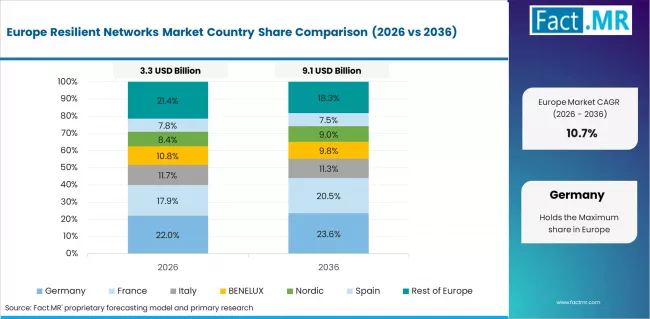
Resilient Networks Market Europe Country Market Share Analysis, 2026 & 2036

Western Europe functions as “the cybersecurity and industrial networking transformation center” for resilient networking technologies. Companies such as Nokia, Ericsson, and Juniper Networks maintain strong positions through secure telecom infrastructure, private wireless networking, and industrial connectivity solutions. Regional growth is supported by increasing cybersecurity regulations, smart manufacturing investments, and widespread deployment of cloud-native and mission-critical communication systems.

  • Germany: Demand for resilient networking solutions in Germany is projected to rise at 11.4% CAGR through 2036. Germany’s growth is primarily supported by Industry 4.0 expansion, industrial automation, and secure enterprise networking investments. German manufacturers are increasingly deploying private 5G and edge networking infrastructure to support connected factory operations and autonomous manufacturing systems.

East Asia

East Asia serves as “the large-scale telecom infrastructure expansion powerhouse” for the resilient networks market. Major regional participants including Huawei Technologies, ZTE, and NEC Corporation are strengthening their competitive positions through advanced telecom networking, private 5G infrastructure, and AI-enabled automation platforms. The region benefits from aggressive 5G rollout, smart city deployment, and government-backed digital infrastructure initiatives.

  • China: Demand for resilient networking solutions in China is projected to rise at 14.1% CAGR through 2036. China is witnessing strong growth due to extensive 5G deployment, hyperscale data center expansion, and large-scale smart infrastructure projects. Telecom operators and state-backed technology providers are investing heavily in AI-driven networking automation and cloud connectivity systems. The country’s rapid adoption of industrial IoT and smart manufacturing infrastructure is also accelerating deployment of private wireless and resilient networking platforms.

South Asia & Pacific

South Asia & Pacific represents “the fastest-emerging digital connectivity expansion region” for resilient networking infrastructure. Key companies including Cisco, Nokia, and Huawei Technologies are actively strengthening regional presence through telecom modernization, cloud networking, and enterprise connectivity projects. Strong government-backed digital transformation initiatives and rapid broadband expansion are supporting long-term resilient network deployment across telecom, enterprise, and public infrastructure sectors.

  • India: Demand for resilient networking solutions in India is projected to rise at 15.3% CAGR through 2036. India is emerging as one of the fastest-growing resilient networking markets due to aggressive 5G rollout, broadband expansion, and government-led digital infrastructure initiatives. In January 2025, the Department of Telecommunications launched National Broadband Mission 2.0 targeting fiber connectivity expansion and 95% network uptime across villages by 2030 [1]. In December 2025, the Indian government confirmed that 5G services had reached 99.9% of districts with over 508,000 5G BTS installations nationwide [2]. Growing enterprise interest in private 5G, cloud networking, and AI-driven telecom infrastructure is further supporting resilient network adoption across industrial and public sectors.

Fact.MR’s analysis of the global resilient networks market provides region-wise and country-wise assessment across North America, Western Europe, East Asia, South Asia & Pacific, Eastern Europe, Latin America, and Middle East & Africa. Readers can access detailed insights on AI-driven networking adoption, private 5G deployment, cyber resilience strategies, telecom modernization, cloud connectivity expansion, industrial digitalization trends, and mission-critical communication infrastructure investments shaping long-term market growth.

Competitive Benchmarking and Company Positioning

Leading Companies Shaping the Resilient Networks Market
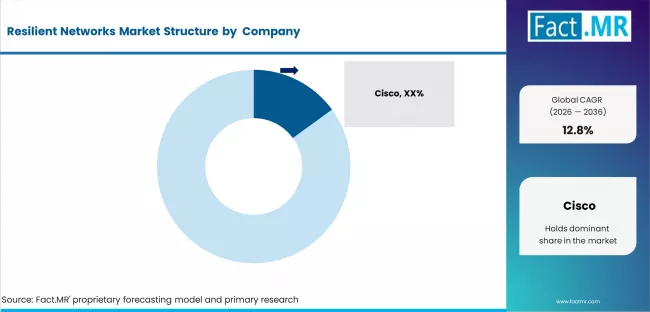
Resilient Networks Market Analysis By Company

The moderately concentrated resilient networks market is dominated by the leading players, such as Cisco, Huawei Technologies Co., Ltd., Nokia, Ericsson, and Hewlett Packard Enterprise Development LP, which account for almost 45–55% of the market. Competition is not only about pricing, but also about capabilities of the AI-powered automation, cyber resilience, cloud-native networking and telecom infrastructure. The large vendors gain from integrated product ecosystems, long-term telecom contracts and solid cyber security portfolios, and the opposite side, the buyers, decrease supplier dependency by way of multi-vendor deployments and hybrid networking approaches. Prices should moderate while demand for secure, self-healing, mission-critical networking infrastructure will be held in enterprise and telecom markets.

Key Players of the Resilient Networks Market

  • Cisco
  • Huawei Technologies Co., Ltd.
  • Nokia
  • Ericsson
  • Hewlett Packard Enterprise Development LP
  • Arista Networks, Inc.
  • Fortinet
  • Palo Alto Networks
  • Broadcom
  • Check Point Software Technologies Ltd.

Recent Industry Developments

  • Cisco launches AI-ready secure enterprise network architecture (November 2025): Cisco introduced new AI-powered networking and cloud-managed infrastructure solutions to simplify secure enterprise, branch, and campus network operations for resilient connectivity environments. (Cisco Newsroom) [3]
  • Nokia expands industrial private wireless and edge networking capabilities (September 2025): Nokia strengthened its industrial digitalization portfolio through enhanced private wireless and edge networking solutions supporting AI-driven resilient connectivity across industrial and critical infrastructure applications. (Nokia Newsroom) [4]
  • Palo Alto Networks collaborates with U.K. Ministry of Justice to strengthen digital resilience (July 2025): Palo Alto Networks partnered with the U.K. Ministry of Justice to enhance secure network transformation using Prisma SASE and Cortex XSIAM platforms for resilient digital services infrastructure. (Palo Alto Networks Press Release) [5]

Sources and Research References

  • [1] Department of Telecommunications, Government of India, “National Broadband Mission 2.0 Launched to Accelerate Digital Connectivity,” January 2025
  • [2] Press Information Bureau, Government of India, “5G Services Reach 99.9% of Districts Across India,” December 2025
  • [3] Cisco, “Cisco Supercharges its Secure Enterprise Network Architecture for the AI Era,” November 2025
  • [4] Nokia, “Nokia Study Reveals Surge of ROI and AI-Enabled Use Cases with On-Premise Edge and Private Wireless,” September 2025
  • [5] Palo Alto Networks, “Palo Alto Networks Collaborates With UK’s Ministry of Justice To Boost the Security and Resilience of Digital Services,” July 2025

Resilient Networks Market Definition

Resilient networks are an advanced combination of communication and connectivity solutions that help keep networks operational when facing cyber-attacks, hardware problems, natural disasters, or traffic overloads. These networks are made up of hardware, software, automation, cybersecurity, and cloud technologies which all work together for high availability, quick recovery and secure data transmission. Resilient networks have proliferated throughout the telecommunications industry, defense facilities, industrial plants, healthcare systems, transportation networks, and data centers where constant connectivity and operational continuity are essential for business continuity and for mission-critical applications.

Resilient Networks Market Inclusions

The market size analysis of resilient networks is provided at a global and regional level in the report, covering North America, Europe, Asia Pacific, Latin America and Middle East & Africa. It offers segmentation based on network type, component, deployment mode, connectivity technology, resilience capability and end use industry. The study also examines pricing trends, technology adoption, competitive benchmarking, infrastructure investment, regulatory trends, and demand analysis trends in the telecom, industrial, defense, and enterprise networking markets.

Resilient Networks Market Exclusions

The report does not include conventional consumer internet services, standalone telecom billing software, generic IT support services or non-resilient legacy networking equipment without redundancy or hard-to-break cyber-resilience features. It also excludes consumer electronics, smartphones, personal Wi-Fi routers, and pure cloud storage services, unless they are built into resilient network infrastructure. It is a scope that is limited to enterprise class, mission critical, self-healing, secure and high-availability networking technologies and the software and service ecosystems surrounding these technologies.

Resilient Networks Market Research Methodology

  • Primary Research
    • Fact.MR held interviews with several telecom operators, network infrastructure vendors, cyber security experts, cloud networking vendors, system integrators and enterprise IT decision makers. Executive, product management, and technology consultant insights were leveraged to understand the trend in demand, deployment priorities, and competitive movements.
  • Desk Research
    • Secondary research comprised investor presentations, company annual reports, telecom regulatory publications, white papers, industry journals, government digital infrastructure initiatives and technology association databases. Additional information from public sources from the cloud, networking and cybersecurity sectors was also compiled.
  • Market-Sizing and Forecasting
    • The market was estimated with a hybrid approach that integrated top down and bottom up approach. Market forecasts were created by benchmarking revenue for the top network infrastructure vendors, the SD-WAN sector, private 5G, cyber security and cloud networking products, followed by regional adoption heatmap and enterprise spending analysis.
  • Data Validation and Update Cycle
    • All estimates in the market have been triangulated between primary interviews, company disclosure and macro-economic indicators. Forecast models are updated on a regular basis to incorporate changes in enterprise networking and cybersecurity patterns, regulatory changes, infrastructure investments, and technology change.

Scope of Analysis

Resilient Networks Market Breakdown By Network Type, Component, And Region

Parameter Details
Quantitative Units USD 15.1 billion in 2025 to USD 50.4 billion in 2036, at a CAGR of 12.8%
Market Definition The resilient networks market comprises secure, self-healing communication infrastructures and networking solutions designed to ensure uninterrupted connectivity, cyber resilience, automated recovery, and operational continuity across telecom, enterprise, industrial, and critical infrastructure environments.
Regions Covered North America, Latin America, Europe, East Asia, South Asia and Pacific, MiddleEastand Africa
Countries Covered USA, Canada, UK, Germany, China, India, 30 plus countries
Key Companies Cisco, Huawei Technologies Co., Ltd., Nokia, Ericsson, Hewlett Packard Enterprise Development LP, Arista Networks, Inc., Fortinet, Palo Alto Networks, Broadcom, Check Point Software Technologies Ltd.
Forecast Period 2026 to 2036
Approach Hybrid demand-side and top-downmethodologybuilt on country-level application demand, product benchmarking, pricing analysis, shipment validation, and primary interviews across manufacturers, distributors, retailers, and end users

Resilient Networks Market Segmentation

  • Resilient Networks Market by Network Type:

    • SD-WAN & Intelligent WAN
      • Cloud-managed SD-WAN
      • Hybrid WAN
      • Secure Access Service Edge (SASE)-enabled WAN
      • Multi-cloud connectivity WAN
    • Mesh & Self-Healing Networks
      • Wireless mesh networks
      • Tactical mesh communication systems
      • Industrial mesh networking
      • Autonomous self-healing enterprise networks
    • Satellite & Space-Based Networks
      • LEO satellite resilient networks
      • GEO/MEO satellite communication systems
      • Hybrid satellite-terrestrial networks
      • Disaster recovery satellite backhaul
    • Private & Mission-Critical Networks
      • Private LTE networks
      • Private 5G networks
      • Tactical military communication networks
      • Emergency response communication networks
    • Optical & Fiber Resilient Networks
      • Redundant optical transport networks
      • Ring-based fiber architectures
      • Elastic optical networking
      • Carrier-grade backbone resilience systems
  • Resilient Networks Market by Component:

    • Hardware
      • Routing & Switching Equipment
      • Wireless Infrastructure
      • Security Infrastructure
      • Power & Backup Systems
    • Software
      • Network Management Software
      • AI & Automation Software
      • Security & Cyber Resilience Software
      • Virtualization & Cloud Software
    • Services
      • Professional Services
      • Managed Services
      • Support & Maintenance
  • Resilient Networks Market by Deployment Mode:

    • On-Premises
    • Cloud-Based
    • Hybrid Deployment
  • Resilient Networks Market by Connectivity Technology:

    • Wired Connectivity
    • Wireless Connectivity
    • Satellite Connectivity
  • Resilient Networks Market by Resilience Capability:

    • Disaster Recovery Networks
    • Cyber Resilient Networks
    • Self-Healing Networks
    • Energy-Resilient Networks
  • Resilient Networks Market by End Use Industry:

    • Telecommunications
      • Carrier Networks
      • Enterprise Telecom
    • Government & Defense
      • Defense Communication
      • Public Safety & Homeland Security
    • Energy & Utilities
      • Power Utilities
      • Oil & Gas
    • Transportation & Logistics
      • Aviation Networks
      • Rail & Metro Networks
    • Maritime & Ports
      • Healthcare
      • Hospital Networks
    • Healthcare Data Connectivity
      • Manufacturing & Industrial
      • Industrial Automation
    • Process Industries
      • BFSI
      • Banking Networks
    • Capital Markets
      • IT & Data Centers
      • Cloud & Hyperscale Data Centers
    • Enterprise IT
  • Resilient Networks Market by Region:

    • North America
      • USA
      • Canada
      • Mexico
    • Latin America
      • Brazil
      • Chile
      • Rest of LATAM
    • East Asia
      • China
      • Japan
      • South Korea
    • Western Europe
      • Germany
      • Italy
      • France
      • U.K.
      • Spain
      • BENELUX
      • Nordic
      • Rest of W. Europe
    • Eastern Europe
      • Russia
      • Hungary
      • Poland
      • Balkan & Baltics
      • Rest of E. Europe
    • South Asia & Pacific
      • India
      • ASEAN
      • ANZ
      • Rest of SAP
    • Middle East and Africa
      • Kingdom of Saudi Arabia
      • United Arab Emirates
      • South Africa
      • Rest of Middle East and Africa

- Frequently Asked Questions -

How large is the demand for Resilient Networks in the global market in 2026?

Demand for Resilient Networks in the global market is estimated to be valued at USD 15.1 billion in 2026.

What will be the market size of Resilient Networks in the global market by 2036?

The market size for Resilient Networks is projected to reach USD 50.4 billion by 2036.

What is the expected demand growth for Resilient Networks in the global market between 2026 and 2036?

Demand for Resilient Networks in the global market is expected to grow at a CAGR of 12.8% between 2026 and 2036, driven by rising cybersecurity requirements, cloud adoption, and increasing dependence on uninterrupted digital connectivity.

Which network type is expected to dominate the market?

SD-WAN & Intelligent WAN solutions are expected to dominate the market, accounting for 31% of the market share in 2026, due to their ability to enhance network reliability, flexibility, and traffic optimization across distributed enterprise environments.

How significant is the growth outlook for China in this market?

China is expected to grow at a CAGR of 14.1%, reflecting strong investments in data infrastructure, 5G deployment, and cybersecurity enhancement initiatives.

What is the growth outlook for the United States in the Resilient Networks market?

The United States is expected to grow at a CAGR of 12.2%, influenced by rising cybersecurity spending and adoption of cloud-native networking architectures.

Which company is identified as a leading player in the Resilient Networks market?

Cisco is recognized as a leading player in this market, offering advanced SD-WAN, intelligent routing, and cybersecurity-integrated networking solutions.

Table of Content

  1. Resilient Networks Market – Executive Summary
  2. Market Overview
    • Market Definition & Introduction
    • Market Taxonomy & Research Scope
  3. Global Resilient Networks Market Demand (in Value or Size in US$ Bn) Analysis 2021-2025 and Forecast, 2026–2036
    • Historical Market Value (US$ Bn) Analysis, 2021-2025
    • Current and Future Market Value (US$ Bn) Projections, 2026–2036
      • Y-o-Y Growth Trend Analysis
      • Absolute $ Opportunity Analysis
  4. Market Background and Foundational Data Points
    • Enterprise investments in network modernization
    • SD-WAN and intelligent WAN adoption growth
    • Expansion of private 5G infrastructure deployments
    • Rising cloud and multi-cloud connectivity demand
    • Growth of hyperscale and edge data centers
    • Increasing cybersecurity and zero-trust investments
    • Adoption of AI-driven self-healing networks
    • Telecom spending on resilient 5G infrastructure
    • Industrial IoT and smart factory connectivity demand
    • Disaster recovery and business continuity investments
    • Hybrid cloud and edge networking deployment growth
    • Government-led digital infrastructure modernization initiatives
    • Start-up Ecosystem Analysis, 2021-2025
    • Resilient Networks Market Opportunity Assessment
      • Total Available Market (US$ Bn)
      • Serviceable Addressable Market (US$ Bn)
      • Serviceable Obtainable Market (US$ Bn)
    • Porter’s Five Forces and PESTEL Analysis
    • Investment Feasibility Analysis
    • Macro-Economic Factors & Forecast Factors - Relevance & Impact
    • Market Dynamics
      • Drivers
      • Restraints
      • Opportunity Analysis
    • Key Regulations & Certifications
  5. Resilient Networks Market Analysis 2021-2025 and Forecast 2026–2036, By Network Type
    • Introduction / Key Findings
    • Historical Market Size (US$ Bn) Trend Analysis By Network Type, 2021-2025
    • Current and Future Market Size (US$ Bn) Analysis and Forecast By Network Type, 2026-2036
      • SD-WAN & Intelligent WAN
        • Cloud-managed SD-WAN
        • Hybrid WAN
        • Secure Access Service Edge (SASE)-enabled WAN
        • Multi-cloud connectivity WAN
      • Mesh & Self-Healing Networks
        • Wireless mesh networks
        • Tactical mesh communication systems
        • Industrial mesh networking
        • Autonomous self-healing enterprise networks
      • Satellite & Space-Based Networks
        • LEO satellite resilient networks
        • GEO/MEO satellite communication systems
        • Hybrid satellite-terrestrial networks
        • Disaster recovery satellite backhaul
      • Private & Mission-Critical Networks
        • Private LTE networks
        • Private 5G networks
        • Tactical military communication networks
        • Emergency response communication networks
      • Optical & Fiber Resilient Networks
        • Redundant optical transport networks
        • Ring-based fiber architectures
        • Elastic optical networking
        • Carrier-grade backbone resilience systems
    • Market Attractiveness Analysis By Network Type
  6. Resilient Networks Market Analysis 2021-2025 and Forecast 2026–2036, By Component
    • Introduction / Key Findings
    • Historical Market Size (US$ Bn) Trend Analysis By Component, 2021-2025
    • Current and Future Market Size (US$ Bn) Analysis and Forecast By Component, 2026-2036
      • Hardware
        • Routing & Switching Equipment
        • Wireless Infrastructure
        • Security Infrastructure
        • Power & Backup Systems
      • Software
        • Network Management Software
        • AI & Automation Software
        • Security & Cyber Resilience Software
        • Virtualization & Cloud Software
      • Services
        • Professional Services
        • Managed Services
        • Support & Maintenance
    • Market Attractiveness Analysis By Component
  7. Resilient Networks Market Analysis 2021-2025 and Forecast 2026–2036, By Deployment Mode
    • Introduction / Key Findings
    • Historical Market Size (US$ Bn) Trend Analysis By Deployment Mode, 2021-2025
    • Current and Future Market Size (US$ Bn) Analysis and Forecast By Deployment Mode, 2026-2036
      • On-Premises
      • Cloud-Based
      • Hybrid Deployment
    • Market Attractiveness Analysis By Deployment Mode
  8. Resilient Networks Market Analysis 2021-2025 and Forecast 2026–2036, By Connectivity Technology
    • Introduction / Key Findings
    • Historical Market Size (US$ Bn) Trend Analysis By Connectivity Technology, 2021-2025
    • Current and Future Market Size (US$ Bn) Analysis and Forecast By Connectivity Technology, 2026-2036
      • Wired Connectivity
      • Wireless Connectivity
      • Satellite Connectivity
    • Market Attractiveness Analysis By Connectivity Technology
  9. Resilient Networks Market Analysis 2021-2025 and Forecast 2026–2036, By Resilience Capability
    • Introduction / Key Findings
    • Historical Market Size (US$ Bn) Trend Analysis By Resilience Capability, 2021-2025
    • Current and Future Market Size (US$ Bn) Analysis and Forecast By Resilience Capability, 2026-2036
      • Disaster Recovery Networks
      • Cyber Resilient Networks
      • Self-Healing Networks
      • Energy-Resilient Networks
    • Market Attractiveness Analysis By Resilience Capability
  10. Resilient Networks Market Analysis 2021-2025 and Forecast 2026–2036, By End Use Industry
    • Introduction / Key Findings
    • Historical Market Size (US$ Bn) Trend Analysis by End Use Industry, 2021-2025
    • Current and Future Market Size (US$ Bn) Analysis and Forecast by End Use Industry, 2026-2036
      • Telecommunications
        • Carrier Networks
        • Enterprise Telecom
      • Government & Defense
        • Defense Communication
        • Public Safety & Homeland Security
      • Energy & Utilities
        • Power Utilities
        • Oil & Gas
      • Transportation & Logistics
        • Aviation Networks
        • Rail & Metro Networks
        • Maritime & Ports
      • Healthcare
        • Hospital Networks
        • Healthcare Data Connectivity
      • Manufacturing & Industrial
        • Industrial Automation
        • Process Industries
      • BFSI
        • Banking Networks
        • Capital Markets
      • IT & Data Centers
        • Cloud & Hyperscale Data Centers
        • Enterprise IT
    • Market Attractiveness Analysis by End Use Industry
  11. Resilient Networks Market Analysis 2021-2025 and Forecast 2026–2036, By End-User Type
    • Introduction / Key Findings
    • Historical Market Size (US$ Bn) Trend Analysis by End-User Type, 2021-2025
    • Current and Future Market Size (US$ Bn) Analysis and Forecast by End-User Type, 2026-2036
      • Mobile Network Operators (MNOs)
      • Telecom Infrastructure OEMs
      • Neutral-host / Tower companies
      • Hyperscale edge data center operators
      • Government & defense telecom networks
    • Market Attractiveness Analysis by End-User Type
  12. Global Resilient Networks Market Analysis and Forecast, by Region
    • Introduction / Key Findings
    • Historical Market Size (US$ Bn) Trend Analysis by Region, 2021-2025
    • Current and Future Market Size (US$ Bn) Analysis and Forecast by Region, 2026-2036
      • North America
      • Latin America
      • Western Europe
      • Eastern Europe
      • East Asia
      • South Asia & Pacific
      • Middle East & Africa
    • Market Attractiveness Analysis by Region
  13. North America Resilient Networks Market Analysis and Forecast
    • Introduction / Key Findings
    • Historical Market Size (US$ Bn) Trend Analysis by Market Taxonomy, 2021-2025
    • Current and Future Market Size (US$ Bn) Analysis & Forecast by Market Taxonomy, 2026-2036
    • By Country
      • United States
      • Canada
      • Mexico
    • By Taxonomy
    • Market Attractiveness Analysis By Country & Taxonomy
    • Market Trends
    • Key Market Participants – Intensity Mapping
    • Drivers and Restraints - Impact Analysis
  14. Latin America Resilient Networks Market Analysis and Forecast
    • Introduction / Key Findings
    • Historical Market Size (US$ Bn) Trend Analysis by Market Taxonomy, 2021-2025
    • Current and Future Market Size (US$ Bn) Analysis & Forecast by Market Taxonomy, 2026-2036
    • By Country
      • Brazil
      • Chile
      • Rest of LATAM
    • By Taxonomy
    • Market Attractiveness Analysis By Country & Taxonomy
    • Market Trends
    • Key Market Participants – Intensity Mapping
    • Drivers and Restraints - Impact Analysis
  15. Western Europe Resilient Networks Market Analysis and Forecast
    • Introduction / Key Findings
    • Historical Market Size (US$ Bn) Trend Analysis by Market Taxonomy, 2021-2025
    • Current and Future Market Size (US$ Bn) Analysis & Forecast by Market Taxonomy, 2026-2036
    • By Country
      • Germany
      • Italy
      • France
      • United Kingdom
      • Spain
      • BENELUX
      • Nordics
      • Rest of Western Europe
    • By Taxonomy
    • Market Attractiveness Analysis By Country & Taxonomy
    • Market Trends
    • Key Market Participants – Intensity Mapping
    • Drivers and Restraints - Impact Analysis
  16. Eastern Europe Resilient Networks Market Analysis and Forecast
    • Introduction / Key Findings
    • Historical Market Size (US$ Bn) Trend Analysis by Market Taxonomy, 2021-2025
    • Current and Future Market Size (US$ Bn) Analysis & Forecast by Market Taxonomy, 2026-2036
    • By Country
      • Russia
      • Hungary
      • Poland
      • Balkan & Baltics
      • Rest of Eastern Europe
    • By Taxonomy
    • Market Attractiveness Analysis By Country & Taxonomy
    • Market Trends
    • Key Market Participants – Intensity Mapping
    • Drivers and Restraints - Impact Analysis
  17. East Asia Resilient Networks Market Analysis and Forecast
    • Introduction / Key Findings
    • Historical Market Size (US$ Bn) Trend Analysis by Market Taxonomy, 2021-2025
    • Current and Future Market Size (US$ Bn) Analysis & Forecast by Market Taxonomy, 2026-2036
    • By Country
      • China
      • Japan
      • South Korea
    • By Taxonomy
    • Market Attractiveness Analysis By Country & Taxonomy
    • Market Trends
    • Key Market Participants – Intensity Mapping
    • Drivers and Restraints - Impact Analysis
  18. South Asia & Pacific Resilient Networks Market Analysis and Forecast
    • Introduction / Key Findings
    • Historical Market Size (US$ Bn) Trend Analysis by Market Taxonomy, 2021-2025
    • Current and Future Market Size (US$ Bn) Analysis & Forecast by Market Taxonomy, 2026-2036
    • By Country
      • India
      • ASEAN
      • Australia & New Zealand
      • Rest of South Asia & Pacific
    • By Taxonomy
    • Market Attractiveness Analysis By Country & Taxonomy
    • Market Trends
    • Key Market Participants – Intensity Mapping
    • Drivers and Restraints - Impact Analysis
  19. Middle East & Africa Resilient Networks Market Analysis and Forecast
    • Introduction / Key Findings
    • Historical Market Size (US$ Bn) Trend Analysis by Market Taxonomy, 2021-2025
    • Current and Future Market Size (US$ Bn) Analysis & Forecast by Market Taxonomy, 2026-2036
    • By Country
      • Kingdom of Saudi Arabia
      • Other GCC Countries
      • Turkiye
      • South Africa
      • Other African Union
    • By Taxonomy
    • Market Attractiveness Analysis By Country & Taxonomy
    • Market Trends
    • Key Market Participants – Intensity Mapping
    • Drivers and Restraints - Impact Analysis
  20. Country-level Resilient Networks Market Analysis and Forecast
    • Introduction
    • Market Value Proportion Analysis, By Key Countries
    • Global Vs. Country Growth Comparison
      • United States Resilient Networks Market Analysis
        • Market Size (US$ Bn) Analysis by Market Taxonomy, 2021–2036
        • By Network Type
        • By Component
        • By Deployment Mode
        • By Connectivity Technology
        • By Resilience Capability
        • By End Use Industry
        • Canada Resilient Networks Market Analysis
        • Mexico Resilient Networks Market Analysis
        • Brazil Resilient Networks Market Analysis
        • Chile Resilient Networks Market Analysis
        • Germany Resilient Networks Market Analysis
        • France Resilient Networks Market Analysis
        • Italy Resilient Networks Market Analysis
        • Spain Resilient Networks Market Analysis
        • United Kingdom Resilient Networks Market Analysis
        • BENELUX Resilient Networks Market Analysis
        • Nordics Resilient Networks Market Analysis
        • Poland Resilient Networks Market Analysis
        • Russia Resilient Networks Market Analysis
        • Hungary Resilient Networks Market Analysis
        • Balkan & Baltics Resilient Networks Market Analysis
        • China Resilient Networks Market Analysis
        • Japan Resilient Networks Market Analysis
        • South Korea Resilient Networks Market Analysis
        • India Resilient Networks Market Analysis
        • ASEAN Resilient Networks Market Analysis
        • ANZ Resilient Networks Market Analysis
        • KSA Resilient Networks Market Analysis
        • Other GCC Countries Resilient Networks Market Analysis
        • South Africa Resilient Networks Market Analysis
        • Turkiye Resilient Networks Market Analysis
    • Resilient Networks Market Structure Analysis
      • Market Analysis by Tier of Companies
      • Market Concentration
      • Market Share Analysis of Top Players
      • Market Space for New Brands and Dollar Opportunity
      • Market Presence Analysis
        • Regional Footprint of Players
        • Product Footprint by Players
  21. Mobile Optical Pluggable Competition Analysis
    • Competition Dashboard
    • Pricing Analysis by Competition
    • Competition Benchmarking
    • Competition Deep Dive
      • Cisco
        • Overview
        • Product Portfolio
        • Sales Footprint
        • Key Developments
        • SWOT Analysis
        • Strategy Overview
        • Key Financials
      • Huawei Technologies Co., Ltd.
      • Nokia
      • Ericsson
      • Hewlett Packard Enterprise Development LP
      • Arista Networks, Inc.
      • Fortinet
      • Palo Alto Networks
      • Broadcom
      • Check Point Software Technologies Ltd.
      • Other Prominent Players
  22. Primary insights
  23. Assumptions & Acronyms Used
  24. Research Methodology & Data Sources

List Of Table

  • Table 1: Global Market Value (USD Bn) Forecast by Region, 2021 to 2036
  • Table 2: Global Market Value (USD Bn) Forecast by Network Type, 2021 to 2036
  • Table 3: Global Market Value (USD Bn) Forecast by Component, 2021 to 2036
  • Table 4: Global Market Value (USD Bn) Forecast by Deployment Mode, 2021 to 2036
  • Table 5: Global Market Value (USD Bn) Forecast by Connectivity Technology, 2021 to 2036
  • Table 6: Global Market Value (USD Bn) Forecast by Resilience Capability, 2021 to 2036
  • Table 7: Global Market Value (USD Bn) Forecast by End Use Industry, 2021 to 2036
  • Table 8: North America Market Value (USD Bn) Forecast by Country, 2021 to 2036
  • Table 9: North America Market Value (USD Bn) Forecast by Network Type, 2021 to 2036
  • Table 10: North America Market Value (USD Bn) Forecast by Component, 2021 to 2036
  • Table 11: North America Market Value (USD Bn) Forecast by Deployment Mode, 2021 to 2036
  • Table 12: North America Market Value (USD Bn) Forecast by Connectivity Technology, 2021 to 2036
  • Table 13: North America Market Value (USD Bn) Forecast by Resilience Capability, 2021 to 2036
  • Table 14: North America Market Value (USD Bn) Forecast by End Use Industry, 2021 to 2036
  • Table 15: Latin America Market Value (USD Bn) Forecast by Country, 2021 to 2036
  • Table 16: Latin America Market Value (USD Bn) Forecast by Network Type, 2021 to 2036
  • Table 17: Latin America Market Value (USD Bn) Forecast by Component, 2021 to 2036
  • Table 18: Latin America Market Value (USD Bn) Forecast by Deployment Mode, 2021 to 2036
  • Table 19: Latin America Market Value (USD Bn) Forecast by Connectivity Technology, 2021 to 2036
  • Table 20: Latin America Market Value (USD Bn) Forecast by Resilience Capability, 2021 to 2036
  • Table 21: Latin America Market Value (USD Bn) Forecast by End Use Industry, 2021 to 2036
  • Table 22: Western Europe Market Value (USD Bn) Forecast by Country, 2021 to 2036
  • Table 23: Western Europe Market Value (USD Bn) Forecast by Network Type, 2021 to 2036
  • Table 24: Western Europe Market Value (USD Bn) Forecast by Component, 2021 to 2036
  • Table 25: Western Europe Market Value (USD Bn) Forecast by Deployment Mode, 2021 to 2036
  • Table 26: Western Europe Market Value (USD Bn) Forecast by Connectivity Technology, 2021 to 2036
  • Table 27: Western Europe Market Value (USD Bn) Forecast by Resilience Capability, 2021 to 2036
  • Table 28: Western Europe Market Value (USD Bn) Forecast by End Use Industry, 2021 to 2036
  • Table 29: Eastern Europe Market Value (USD Bn) Forecast by Country, 2021 to 2036
  • Table 30: Eastern Europe Market Value (USD Bn) Forecast by Network Type, 2021 to 2036
  • Table 31: Eastern Europe Market Value (USD Bn) Forecast by Component, 2021 to 2036
  • Table 32: Eastern Europe Market Value (USD Bn) Forecast by Deployment Mode, 2021 to 2036
  • Table 33: Eastern Europe Market Value (USD Bn) Forecast by Connectivity Technology, 2021 to 2036
  • Table 34: Eastern Europe Market Value (USD Bn) Forecast by Resilience Capability, 2021 to 2036
  • Table 35: Eastern Europe Market Value (USD Bn) Forecast by End Use Industry, 2021 to 2036
  • Table 36: East Asia Market Value (USD Bn) Forecast by Country, 2021 to 2036
  • Table 37: East Asia Market Value (USD Bn) Forecast by Network Type, 2021 to 2036
  • Table 38: East Asia Market Value (USD Bn) Forecast by Component, 2021 to 2036
  • Table 39: East Asia Market Value (USD Bn) Forecast by Deployment Mode, 2021 to 2036
  • Table 40: East Asia Market Value (USD Bn) Forecast by Connectivity Technology, 2021 to 2036
  • Table 41: East Asia Market Value (USD Bn) Forecast by Resilience Capability, 2021 to 2036
  • Table 42: East Asia Market Value (USD Bn) Forecast by End Use Industry, 2021 to 2036
  • Table 43: South Asia and Pacific Market Value (USD Bn) Forecast by Country, 2021 to 2036
  • Table 44: South Asia and Pacific Market Value (USD Bn) Forecast by Network Type, 2021 to 2036
  • Table 45: South Asia and Pacific Market Value (USD Bn) Forecast by Component, 2021 to 2036
  • Table 46: South Asia and Pacific Market Value (USD Bn) Forecast by Deployment Mode, 2021 to 2036
  • Table 47: South Asia and Pacific Market Value (USD Bn) Forecast by Connectivity Technology, 2021 to 2036
  • Table 48: South Asia and Pacific Market Value (USD Bn) Forecast by Resilience Capability, 2021 to 2036
  • Table 49: South Asia and Pacific Market Value (USD Bn) Forecast by End Use Industry, 2021 to 2036
  • Table 50: Middle East & Africa Market Value (USD Bn) Forecast by Country, 2021 to 2036
  • Table 51: Middle East & Africa Market Value (USD Bn) Forecast by Network Type, 2021 to 2036
  • Table 52: Middle East & Africa Market Value (USD Bn) Forecast by Component, 2021 to 2036
  • Table 53: Middle East & Africa Market Value (USD Bn) Forecast by Deployment Mode, 2021 to 2036
  • Table 54: Middle East & Africa Market Value (USD Bn) Forecast by Connectivity Technology, 2021 to 2036
  • Table 55: Middle East & Africa Market Value (USD Bn) Forecast by Resilience Capability, 2021 to 2036
  • Table 56: Middle East & Africa Market Value (USD Bn) Forecast by End Use Industry, 2021 to 2036

List Of Figures

  • Figure 1: Global Market Pricing Analysis
  • Figure 2: Global Market Value (USD Bn) Forecast 2021 to 2036
  • Figure 3: Global Market Value Share and BPS Analysis by Network Type, 2026 and 2036
  • Figure 4: Global Market Y-o-Y Growth Comparison by Network Type, 2026 to 2036
  • Figure 5: Global Market Attractiveness Analysis by Network Type
  • Figure 6: Global Market Value Share and BPS Analysis by Component, 2026 and 2036
  • Figure 7: Global Market Y-o-Y Growth Comparison by Component, 2026 to 2036
  • Figure 8: Global Market Attractiveness Analysis by Component
  • Figure 9: Global Market Value Share and BPS Analysis by Deployment Mode, 2026 and 2036
  • Figure 10: Global Market Y-o-Y Growth Comparison by Deployment Mode, 2026 to 2036
  • Figure 11: Global Market Attractiveness Analysis by Deployment Mode
  • Figure 12: Global Market Value Share and BPS Analysis by Connectivity Technology, 2026 and 2036
  • Figure 13: Global Market Y-o-Y Growth Comparison by Connectivity Technology, 2026 to 2036
  • Figure 14: Global Market Attractiveness Analysis by Connectivity Technology
  • Figure 15: Global Market Value Share and BPS Analysis by Resilience Capability, 2026 and 2036
  • Figure 16: Global Market Y-o-Y Growth Comparison by Resilience Capability, 2026 to 2036
  • Figure 17: Global Market Attractiveness Analysis by Resilience Capability
  • Figure 18: Global Market Value Share and BPS Analysis by End Use Industry, 2026 and 2036
  • Figure 19: Global Market Y-o-Y Growth Comparison by End Use Industry, 2026 to 2036
  • Figure 20: Global Market Attractiveness Analysis by End Use Industry
  • Figure 21: Global Market Value (USD Bn) Share and BPS Analysis by Region, 2026 and 2036
  • Figure 22: Global Market Y-o-Y Growth Comparison by Region, 2026 to 2036
  • Figure 23: Global Market Attractiveness Analysis by Region
  • Figure 24: North America Market Incremental $ Opportunity, 2026 to 2036
  • Figure 25: Latin America Market Incremental $ Opportunity, 2026 to 2036
  • Figure 26: Western Europe Market Incremental $ Opportunity, 2026 to 2036
  • Figure 27: Eastern Europe Market Incremental $ Opportunity, 2026 to 2036
  • Figure 28: East Asia Market Incremental $ Opportunity, 2026 to 2036
  • Figure 29: South Asia and Pacific Market Incremental $ Opportunity, 2026 to 2036
  • Figure 30: Middle East & Africa Market Incremental $ Opportunity, 2026 to 2036
  • Figure 31: North America Market Value Share and BPS Analysis by Country, 2026 and 2036
  • Figure 32: North America Market Value Share and BPS Analysis by Network Type, 2026 and 2036
  • Figure 33: North America Market Y-o-Y Growth Comparison by Network Type, 2026 to 2036
  • Figure 34: North America Market Attractiveness Analysis by Network Type
  • Figure 35: North America Market Value Share and BPS Analysis by Component, 2026 and 2036
  • Figure 36: North America Market Y-o-Y Growth Comparison by Component, 2026 to 2036
  • Figure 37: North America Market Attractiveness Analysis by Component
  • Figure 38: North America Market Value Share and BPS Analysis by Deployment Mode, 2026 and 2036
  • Figure 39: North America Market Y-o-Y Growth Comparison by Deployment Mode, 2026 to 2036
  • Figure 40: North America Market Attractiveness Analysis by Deployment Mode
  • Figure 41: North America Market Value Share and BPS Analysis by Connectivity Technology, 2026 and 2036
  • Figure 42: North America Market Y-o-Y Growth Comparison by Connectivity Technology, 2026 to 2036
  • Figure 43: North America Market Attractiveness Analysis by Connectivity Technology
  • Figure 44: North America Market Value Share and BPS Analysis by Resilience Capability, 2026 and 2036
  • Figure 45: North America Market Y-o-Y Growth Comparison by Resilience Capability, 2026 to 2036
  • Figure 46: North America Market Attractiveness Analysis by Resilience Capability
  • Figure 47: North America Market Value Share and BPS Analysis by End Use Industry, 2026 and 2036
  • Figure 48: North America Market Y-o-Y Growth Comparison by End Use Industry, 2026 to 2036
  • Figure 49: North America Market Attractiveness Analysis by End Use Industry
  • Figure 50: Latin America Market Value Share and BPS Analysis by Country, 2026 and 2036
  • Figure 51: Latin America Market Value Share and BPS Analysis by Network Type, 2026 and 2036
  • Figure 52: Latin America Market Y-o-Y Growth Comparison by Network Type, 2026 to 2036
  • Figure 53: Latin America Market Attractiveness Analysis by Network Type
  • Figure 54: Latin America Market Value Share and BPS Analysis by Component, 2026 and 2036
  • Figure 55: Latin America Market Y-o-Y Growth Comparison by Component, 2026 to 2036
  • Figure 56: Latin America Market Attractiveness Analysis by Component
  • Figure 57: Latin America Market Value Share and BPS Analysis by Deployment Mode, 2026 and 2036
  • Figure 58: Latin America Market Y-o-Y Growth Comparison by Deployment Mode, 2026 to 2036
  • Figure 59: Latin America Market Attractiveness Analysis by Deployment Mode
  • Figure 60: Latin America Market Value Share and BPS Analysis by Connectivity Technology, 2026 and 2036
  • Figure 61: Latin America Market Y-o-Y Growth Comparison by Connectivity Technology, 2026 to 2036
  • Figure 62: Latin America Market Attractiveness Analysis by Connectivity Technology
  • Figure 63: Latin America Market Value Share and BPS Analysis by Resilience Capability, 2026 and 2036
  • Figure 64: Latin America Market Y-o-Y Growth Comparison by Resilience Capability, 2026 to 2036
  • Figure 65: Latin America Market Attractiveness Analysis by Resilience Capability
  • Figure 66: Latin America Market Value Share and BPS Analysis by End Use Industry, 2026 and 2036
  • Figure 67: Latin America Market Y-o-Y Growth Comparison by End Use Industry, 2026 to 2036
  • Figure 68: Latin America Market Attractiveness Analysis by End Use Industry
  • Figure 69: Western Europe Market Value Share and BPS Analysis by Country, 2026 and 2036
  • Figure 70: Western Europe Market Value Share and BPS Analysis by Network Type, 2026 and 2036
  • Figure 71: Western Europe Market Y-o-Y Growth Comparison by Network Type, 2026 to 2036
  • Figure 72: Western Europe Market Attractiveness Analysis by Network Type
  • Figure 73: Western Europe Market Value Share and BPS Analysis by Component, 2026 and 2036
  • Figure 74: Western Europe Market Y-o-Y Growth Comparison by Component, 2026 to 2036
  • Figure 75: Western Europe Market Attractiveness Analysis by Component
  • Figure 76: Western Europe Market Value Share and BPS Analysis by Deployment Mode, 2026 and 2036
  • Figure 77: Western Europe Market Y-o-Y Growth Comparison by Deployment Mode, 2026 to 2036
  • Figure 78: Western Europe Market Attractiveness Analysis by Deployment Mode
  • Figure 79: Western Europe Market Value Share and BPS Analysis by Connectivity Technology, 2026 and 2036
  • Figure 80: Western Europe Market Y-o-Y Growth Comparison by Connectivity Technology, 2026 to 2036
  • Figure 81: Western Europe Market Attractiveness Analysis by Connectivity Technology
  • Figure 82: Western Europe Market Value Share and BPS Analysis by Resilience Capability, 2026 and 2036
  • Figure 83: Western Europe Market Y-o-Y Growth Comparison by Resilience Capability, 2026 to 2036
  • Figure 84: Western Europe Market Attractiveness Analysis by Resilience Capability
  • Figure 85: Western Europe Market Value Share and BPS Analysis by End Use Industry, 2026 and 2036
  • Figure 86: Western Europe Market Y-o-Y Growth Comparison by End Use Industry, 2026 to 2036
  • Figure 87: Western Europe Market Attractiveness Analysis by End Use Industry
  • Figure 88: Eastern Europe Market Value Share and BPS Analysis by Country, 2026 and 2036
  • Figure 89: Eastern Europe Market Value Share and BPS Analysis by Network Type, 2026 and 2036
  • Figure 90: Eastern Europe Market Y-o-Y Growth Comparison by Network Type, 2026 to 2036
  • Figure 91: Eastern Europe Market Attractiveness Analysis by Network Type
  • Figure 92: Eastern Europe Market Value Share and BPS Analysis by Component, 2026 and 2036
  • Figure 93: Eastern Europe Market Y-o-Y Growth Comparison by Component, 2026 to 2036
  • Figure 94: Eastern Europe Market Attractiveness Analysis by Component
  • Figure 95: Eastern Europe Market Value Share and BPS Analysis by Deployment Mode, 2026 and 2036
  • Figure 96: Eastern Europe Market Y-o-Y Growth Comparison by Deployment Mode, 2026 to 2036
  • Figure 97: Eastern Europe Market Attractiveness Analysis by Deployment Mode
  • Figure 98: Eastern Europe Market Value Share and BPS Analysis by Connectivity Technology, 2026 and 2036
  • Figure 99: Eastern Europe Market Y-o-Y Growth Comparison by Connectivity Technology, 2026 to 2036
  • Figure 100: Eastern Europe Market Attractiveness Analysis by Connectivity Technology
  • Figure 101: Eastern Europe Market Value Share and BPS Analysis by Resilience Capability, 2026 and 2036
  • Figure 102: Eastern Europe Market Y-o-Y Growth Comparison by Resilience Capability, 2026 to 2036
  • Figure 103: Eastern Europe Market Attractiveness Analysis by Resilience Capability
  • Figure 104: Eastern Europe Market Value Share and BPS Analysis by End Use Industry, 2026 and 2036
  • Figure 105: Eastern Europe Market Y-o-Y Growth Comparison by End Use Industry, 2026 to 2036
  • Figure 106: Eastern Europe Market Attractiveness Analysis by End Use Industry
  • Figure 107: East Asia Market Value Share and BPS Analysis by Country, 2026 and 2036
  • Figure 108: East Asia Market Value Share and BPS Analysis by Network Type, 2026 and 2036
  • Figure 109: East Asia Market Y-o-Y Growth Comparison by Network Type, 2026 to 2036
  • Figure 110: East Asia Market Attractiveness Analysis by Network Type
  • Figure 111: East Asia Market Value Share and BPS Analysis by Component, 2026 and 2036
  • Figure 112: East Asia Market Y-o-Y Growth Comparison by Component, 2026 to 2036
  • Figure 113: East Asia Market Attractiveness Analysis by Component
  • Figure 114: East Asia Market Value Share and BPS Analysis by Deployment Mode, 2026 and 2036
  • Figure 115: East Asia Market Y-o-Y Growth Comparison by Deployment Mode, 2026 to 2036
  • Figure 116: East Asia Market Attractiveness Analysis by Deployment Mode
  • Figure 117: East Asia Market Value Share and BPS Analysis by Connectivity Technology, 2026 and 2036
  • Figure 118: East Asia Market Y-o-Y Growth Comparison by Connectivity Technology, 2026 to 2036
  • Figure 119: East Asia Market Attractiveness Analysis by Connectivity Technology
  • Figure 120: East Asia Market Value Share and BPS Analysis by Resilience Capability, 2026 and 2036
  • Figure 121: East Asia Market Y-o-Y Growth Comparison by Resilience Capability, 2026 to 2036
  • Figure 122: East Asia Market Attractiveness Analysis by Resilience Capability
  • Figure 123: East Asia Market Value Share and BPS Analysis by End Use Industry, 2026 and 2036
  • Figure 124: East Asia Market Y-o-Y Growth Comparison by End Use Industry, 2026 to 2036
  • Figure 125: East Asia Market Attractiveness Analysis by End Use Industry
  • Figure 126: South Asia and Pacific Market Value Share and BPS Analysis by Country, 2026 and 2036
  • Figure 127: South Asia and Pacific Market Value Share and BPS Analysis by Network Type, 2026 and 2036
  • Figure 128: South Asia and Pacific Market Y-o-Y Growth Comparison by Network Type, 2026 to 2036
  • Figure 129: South Asia and Pacific Market Attractiveness Analysis by Network Type
  • Figure 130: South Asia and Pacific Market Value Share and BPS Analysis by Component, 2026 and 2036
  • Figure 131: South Asia and Pacific Market Y-o-Y Growth Comparison by Component, 2026 to 2036
  • Figure 132: South Asia and Pacific Market Attractiveness Analysis by Component
  • Figure 133: South Asia and Pacific Market Value Share and BPS Analysis by Deployment Mode, 2026 and 2036
  • Figure 134: South Asia and Pacific Market Y-o-Y Growth Comparison by Deployment Mode, 2026 to 2036
  • Figure 135: South Asia and Pacific Market Attractiveness Analysis by Deployment Mode
  • Figure 136: South Asia and Pacific Market Value Share and BPS Analysis by Connectivity Technology, 2026 and 2036
  • Figure 137: South Asia and Pacific Market Y-o-Y Growth Comparison by Connectivity Technology, 2026 to 2036
  • Figure 138: South Asia and Pacific Market Attractiveness Analysis by Connectivity Technology
  • Figure 139: South Asia and Pacific Market Value Share and BPS Analysis by Resilience Capability, 2026 and 2036
  • Figure 140: South Asia and Pacific Market Y-o-Y Growth Comparison by Resilience Capability, 2026 to 2036
  • Figure 141: South Asia and Pacific Market Attractiveness Analysis by Resilience Capability
  • Figure 142: South Asia and Pacific Market Value Share and BPS Analysis by End Use Industry, 2026 and 2036
  • Figure 143: South Asia and Pacific Market Y-o-Y Growth Comparison by End Use Industry, 2026 to 2036
  • Figure 144: South Asia and Pacific Market Attractiveness Analysis by End Use Industry
  • Figure 145: Middle East & Africa Market Value Share and BPS Analysis by Country, 2026 and 2036
  • Figure 146: Middle East & Africa Market Value Share and BPS Analysis by Network Type, 2026 and 2036
  • Figure 147: Middle East & Africa Market Y-o-Y Growth Comparison by Network Type, 2026 to 2036
  • Figure 148: Middle East & Africa Market Attractiveness Analysis by Network Type
  • Figure 149: Middle East & Africa Market Value Share and BPS Analysis by Component, 2026 and 2036
  • Figure 150: Middle East & Africa Market Y-o-Y Growth Comparison by Component, 2026 to 2036
  • Figure 151: Middle East & Africa Market Attractiveness Analysis by Component
  • Figure 152: Middle East & Africa Market Value Share and BPS Analysis by Deployment Mode, 2026 and 2036
  • Figure 153: Middle East & Africa Market Y-o-Y Growth Comparison by Deployment Mode, 2026 to 2036
  • Figure 154: Middle East & Africa Market Attractiveness Analysis by Deployment Mode
  • Figure 155: Middle East & Africa Market Value Share and BPS Analysis by Connectivity Technology, 2026 and 2036
  • Figure 156: Middle East & Africa Market Y-o-Y Growth Comparison by Connectivity Technology, 2026 to 2036
  • Figure 157: Middle East & Africa Market Attractiveness Analysis by Connectivity Technology
  • Figure 158: Middle East & Africa Market Value Share and BPS Analysis by Resilience Capability, 2026 and 2036
  • Figure 159: Middle East & Africa Market Y-o-Y Growth Comparison by Resilience Capability, 2026 to 2036
  • Figure 160: Middle East & Africa Market Attractiveness Analysis by Resilience Capability
  • Figure 161: Middle East & Africa Market Value Share and BPS Analysis by End Use Industry, 2026 and 2036
  • Figure 162: Middle East & Africa Market Y-o-Y Growth Comparison by End Use Industry, 2026 to 2036
  • Figure 163: Middle East & Africa Market Attractiveness Analysis by End Use Industry
  • Figure 164: Global Market – Tier Structure Analysis
  • Figure 165: Global Market – Company Share Analysis

Resilient Networks Market