Chemical Enhanced Oil Recovery Market Size, Share, Growth and Forecast (2026 - 2036)
The Chemical Enhanced Oil Recovery Market is segmented by Origin (Petro-based, Bio-based, and Water-based), Application (Onshore and Offshore), Type (Water-soluble Polymers, Surfactants, Polymer Gels, Biopolymers, and Alkaline Chemicals), Technique (Polymer Flooding, Surfactant-Polymer Flooding, Alkali-Surfactant-Polymer Flooding, Alkali-Co-Solvent-Polymer Flooding, and Low Tension Gas Flooding), and Reservoir Type (Sandstone, Carbonate, and Shale & Tight Reservoirs) and Region. Forecast for 2026 to 2036.
FACT.MR is of the opinion that the chemical enhanced oil recovery market is approaching a chemistry-led inflection point. Conventional polymer flooding continues to anchor overall volumes. However, operator economics are increasingly shifting toward integrated alkali-surfactant-polymer formulations. These systems are gaining traction in mature sandstone reservoirs where higher chemical costs are justified by improved recovery efficiency and stronger incremental returns.
Chemical Enhanced Oil Recovery Market Forecast and Outlook By Fact.MR
- In 2025, the chemical enhanced oil recovery market was valued at USD 0.8 billion.
- Based on Fact.MR analysis, demand for chemical EOR is estimated to grow to USD 0.9 billion in 2026 and USD 1.6 billion by 2036.
- FACT.MR projects a CAGR of 5.8% during the forecast period.
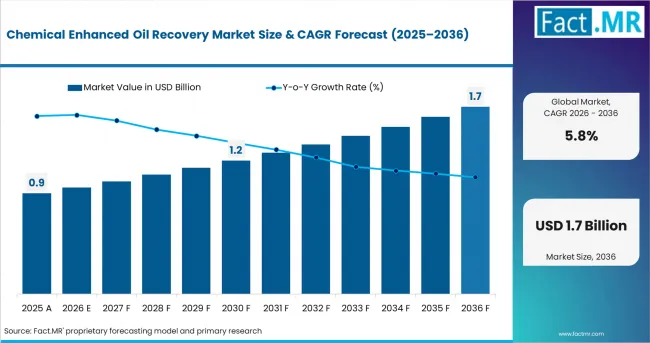
| Metric | Value |
|---|---|
| Estimated Value in 2026 | USD 0.9 billion |
| Forecast Value in 2036 | USD 1.6 billion |
| Forecast CAGR (2026 to 2036) | 5.8% |
Summary of Chemical Enhanced Oil Recovery Market
- Market Definition
- The market covers petro-based, bio-based, and water-based chemical agents injected into onshore and offshore reservoirs for enhanced recovery through polymer flooding, surfactant-polymer, and ASP techniques across sandstone, carbonate, and shale reservoir types globally.
- Demand Drivers
- Ageing global oil fields are experiencing natural production decline. Operators require chemical EOR to maintain offtake rates from reservoirs past primary and secondary recovery phases. NOCs in China, the Middle East, and North America are committing multi-year CEOR program budgets.
- Crude oil prices sustaining above USD 70 per barrel through 2024–2025 have improved project economics for chemical EOR. Higher margins reduce the cost-per-barrel threshold for polymer and ASP flooding programs in mature field development plans.
- National energy security mandates in China, Saudi Arabia, and the United States are accelerating domestic EOR investment. Government-backed field development programs are funding chemical flood pilots across Daqing, Abqaiq, and Permian Basin assets.
- Key Segments Analyzed
- By Origin: Petro-based chemicals hold approximately 65% share in 2026. Dominant due to established field performance, cost efficiency, and widespread compatibility with existing injection infrastructure across onshore EOR operations.
- By Application: Onshore applications hold approximately 70% share in 2026. Majority of mature oilfield EOR deployments are land-based, with lower operational complexity and established infrastructure for chemical injection programs.
- By Type: Water-soluble polymers hold approximately 45% share in 2026. Core chemical used in mobility control and flooding efficiency improvement across the widest range of reservoir conditions and operator program scales.
- By Technique: Polymer flooding holds approximately 55% share in 2026. Most widely deployed CEOR technique globally due to proven recovery rates, lower formulation cost, and extensive SPE-documented field performance data.
- By Reservoir Type: Sandstone reservoirs hold approximately 50% share in 2026. Favorable porosity and wettability characteristics make sandstone the primary target for chemical flooding program design and field-scale implementation.
- Analyst Opinion at FACT.MR
- Shambhu Nath Jha, Principal Consultant at Fact.MR, opines, ‘CXOs will encounter a market where polymer flooding continues to dominate volumes, while ASP and ACP technologies are gradually gaining early-stage adoption. The core growth narrative is anchored in mature field recovery economics rather than new exploration activity.’
- Strategic Implications
- Develop integrated ASP and ACP chemical packages targeting mature sandstone operator programs where incremental recovery economics justify higher chemical input costs versus conventional polymer flooding.
- Invest in bio-based polymer and surfactant R&D to address operator sustainability requirements. Bio-based alternatives are gaining procurement evaluation weight in NOC and IOC EOR program tender processes.
- Build service capability around chemical injection system integration. Operators increasingly prefer turnkey CEOR solutions combining chemical supply, injection equipment, and reservoir monitoring rather than standalone chemical procurement.
- Methodology
- Market sizing based on chemical agent volumes deployed per EOR program and average cost per barrel of incremental oil produced. Validated with 2024–2025 operator capex disclosures and oilfield chemical shipment data.
- Supported by DOE EOR program databases, SPE technical paper repositories, and CNPC and Aramco field development plan disclosures from 2024–2025.
- Forecasts incorporate crude price sensitivity analysis, mature field decline rate benchmarks, and expert inputs from reservoir engineers and EOR chemical procurement executives at major field operators.
The market is projected to generate approximately USD 0.7 billion in incremental revenue over the forecast period. Growth is closely tied to mature field recovery economics rather than new exploration cycles. Rising global oil demand and ageing reservoir infrastructure are sustaining long-term CEOR investments. Operators are increasingly focused on maximizing output from existing assets. However, crude price volatility and high chemical formulation costs continue to limit adoption in marginal fields.
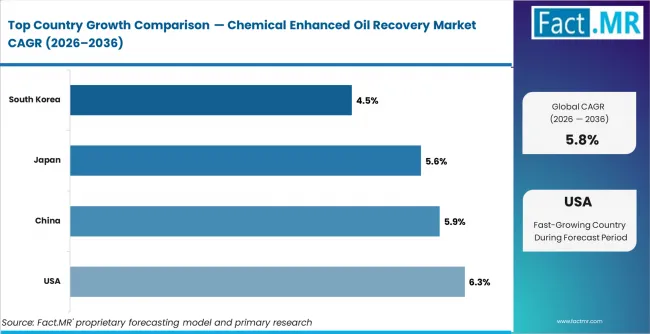
China leads growth with a CAGR of 5.9% through 2036. Large-scale CEOR programs in Daqing and Shengli fields are driving demand. PetroChina and Sinopec remain key operators advancing polymer and ASP flooding projects. The United States follows with a CAGR of 6.3%. Growth is supported by EOR trials across the Permian Basin and Gulf Coast. Federal backing and research funding are accelerating technology deployment and pilot programs. Japan shows steady expansion at a CAGR of 5.6%. Investment is supported by offshore feasibility programs led by JOGMEC. Focus remains on improving recovery rates in mature offshore assets. South Korea records a CAGR of 4.5%. Growth is linked to integration with domestic petrochemical production. Locally produced polymers are supporting CEOR deployment strategies in selected projects.
Segmental Analysis
Chemical Enhanced Oil Recovery Market Analysis by Origin
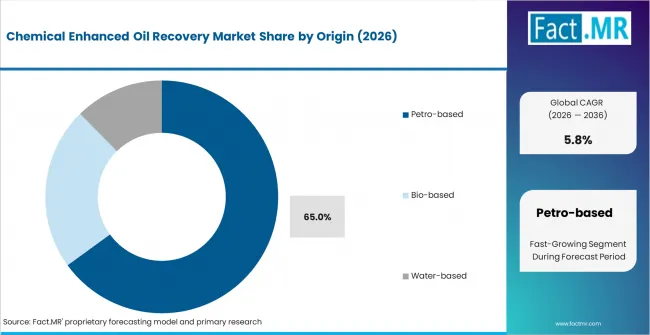
Based on FACT.MR's chemical enhanced oil recovery market report, consumption of petro-based chemicals is estimated to hold 65% share in 2026. This origin segment dominates due to proven field performance, established cost-efficiency benchmarks, and full compatibility with existing reservoir injection infrastructure across global EOR programs.
- Shell CEOR Program: Shell plc confirmed continued polymer flood chemical procurement for its Oman PDO mature field operations in 2024, maintaining petro-based polyacrylamide as the primary injection chemical across its flagship Middle Eastern EOR assets [5].
- Bio-based Polymer Development: Schlumberger's chemical division announced field trials of bio-derived xanthan and scleroglucan biopolymers in 2025 targeting carbonate reservoir operations where thermal stability of petro-based polymers is a performance constraint [6].
- Water-based Formulation Trend: Operator adoption of water-based alkaline chemical pre-flushes prior to ASP injection expanded in Daqing field operations through 2024, reducing interfacial tension ahead of polymer flooding and improving overall oil cut from mature well patterns [4].
Chemical Enhanced Oil Recovery Market Analysis by Application
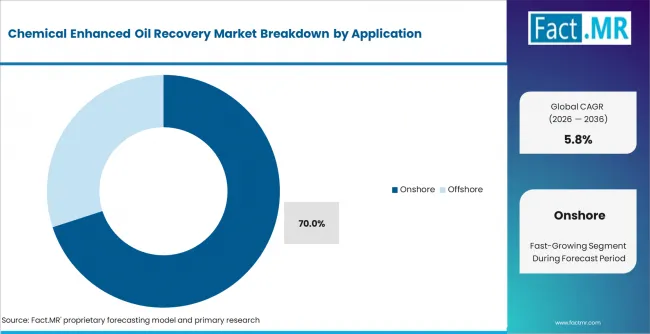
Based on FACT.MR's chemical enhanced oil recovery market report, onshore applications hold approximately 70% share in 2026. The majority of mature oilfield CEOR deployments are land-based, with established chemical injection infrastructure, lower logistical complexity, and extensive SPE-documented program performance data supporting procurement decisions.
- Occidental Onshore Program: Occidental Petroleum expanded its chemical EOR program footprint in the Permian Basin in 2024, applying polymer and surfactant formulations to mature waterflood patterns where natural decline rates had reduced unit production economics [7].
- Offshore Pilot Expansion: Baker Hughes supported a deepwater polymer flood feasibility study for a Brazilian pre-salt operator in early 2025, evaluating water-soluble polymer stability under high-temperature and high-salinity offshore reservoir conditions [8].
- Onshore Infrastructure Advantage: Land-based CEOR operations benefit from fixed-facility chemical mixing and injection stations, reducing per-barrel chemical cost relative to offshore platforms where chemical storage, handling, and injection face space and weight constraints.
Chemical Enhanced Oil Recovery Market Analysis by Type
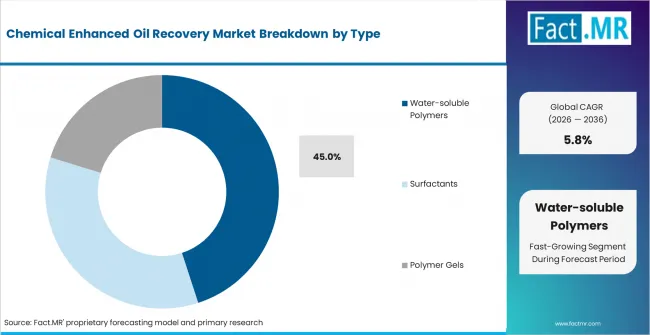
Based on FACT.MR's chemical enhanced oil recovery market report, water-soluble polymers hold approximately 45% share in 2026. These chemicals are the core mobility control agent in polymer flooding, the most widely deployed CEOR technique. Their performance across diverse reservoir conditions and cost-effectiveness at commercial injection volumes underpin volume leadership.
- Halliburton Polymer Supply: Halliburton expanded polyacrylamide production capacity in 2024 to support growing CEOR chemical supply demand from Middle Eastern and Asian national oil company field programs, citing multi-year framework supply agreements with major NOCs [9].
- Surfactant Technology Launch: Core Laboratories introduced an updated surfactant screening platform in 2025 targeting operators designing ASP flood formulations for heterogeneous carbonate reservoirs, offering improved surfactant-reservoir compatibility assessment under reservoir temperature conditions [10].
- Biopolymer Adoption Growth: CNPC's research institute published SPE-documented results in 2024 showing improved high-temperature polymer flood performance using scleroglucan biopolymers in Daqing deep reservoir layers, supporting bio-based polymer uptake in technically demanding Chinese field programs [4].
Chemical Enhanced Oil Recovery Market Analysis by Technique
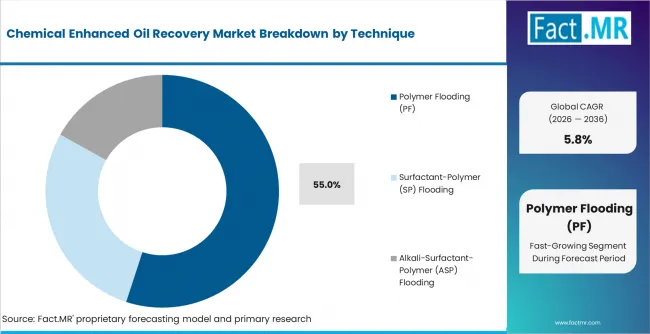
Based on FACT.MR's chemical enhanced oil recovery market report, polymer flooding holds approximately 55% share in 2026. It is the most widely deployed CEOR technique globally due to cost-effectiveness, proven recovery performance, and the broadest base of SPE-documented commercial field results across sandstone and moderate-heterogeneity carbonate reservoirs.
- ASP Flood Expansion: Sinopec completed a commercial-scale ASP flood phase at the Daqing Xingshugang formation in 2024, reporting a 15-percentage-point incremental oil recovery improvement versus baseline waterflood, validating multi-chemical technique economics at full field scale [4].
- ACP Technique Development: Chevron conducted a low-salinity co-solvent polymer flood pilot in California's San Joaquin Valley in 2025, evaluating ACP formulation performance in heavy oil sandstone formations where conventional polymer viscosity is insufficient at reservoir conditions [11].
- LTG Flood Feasibility: Shell and BP jointly evaluated low-tension gas flooding applicability in North Sea carbonate fields in 2024, examining combined gas-chemical injection for residual oil mobilisation in fractured reservoir environments where pure polymer flooding is ineffective [5].
Chemical Enhanced Oil Recovery Market Analysis by Reservoir Type
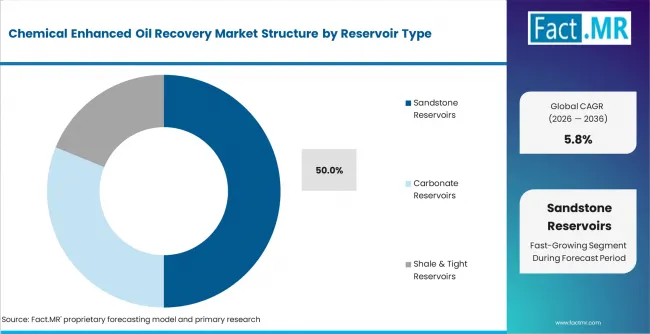
Based on FACT.MR's chemical enhanced oil recovery market report, sandstone reservoirs hold approximately 50% share in 2026. Favourable porosity, permeability, and wettability characteristics make sandstone the preferred target for chemical flooding program design, with the broadest available field performance documentation across global CEOR programs.
- Sandstone Field Dominance: PetroChina's Daqing field, the world's largest CEOR operation, is a sandstone reservoir hosting over 40 years of polymer flood and ASP flood commercial operations, accounting for a substantial share of global CEOR chemical consumption volumes [4].
- Carbonate Program Development: Saudi Aramco announced expanded carbonate EOR feasibility studies at its Ghawar field in 2025, evaluating alkaline and surfactant formulations designed to overcome wettability challenges that limit conventional polymer flood efficiency in carbonate rock systems [12].
- Shale Reservoir Evaluation: ConocoPhillips and Core Laboratories co-published SPE research in 2024 examining polymer and surfactant applicability in tight oil and shale formations, identifying nano-surfactant formulations as a potential chemical EOR pathway for unconventional reservoir targets [7].
Drivers, Restraints, and Opportunities
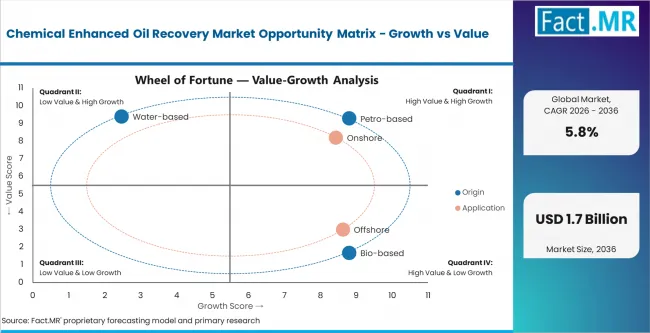
FACT.MR analysts observe that the chemical EOR market has expanded steadily in response to the need to sustain output from declining mature fields. National oil companies and independent operators continue to maintain baseline CEOR spending across crude price cycles.
Conventional water flooding is approaching its physical limits across a growing number of legacy reservoirs. Chemical EOR is moving from pilot to commercial scale in fields with proven recovery economics. ASP and ACP formulations are gradually replacing standalone polymer programs in reservoirs with complex wettability and heterogeneity.
- Mature Field Production Pressure: A large share of global crude output comes from fields older than 20 years. Decline rates are accelerating across conventional reservoirs. This is sustaining long-term demand for recovery enhancement solutions. Chemical EOR remains the most scalable method for improving sandstone reservoir recovery [2].
- U.S. DOE CEOR Program Support: The U.S. Department of Energy expanded funding for EOR technologies in 2024. Over USD 12 million was allocated to polymer and surfactant flood validation projects. Activity is concentrated in the Permian and Gulf Coast basins. Federal support is reducing pilot risk and accelerating commercial adoption [3].
- Asia Pacific Field Development Intensity: Large-scale CEOR investments continue across China. PetroChina and Sinopec expanded programs at Daqing and Shengli fields during 2024–2025. National production targets are sustaining long-term CEOR demand. This is reinforcing China’s position as the largest chemical EOR market globally.
Regional Analysis
The chemical EOR market is assessed across North America, Europe, Asia Pacific, Latin America, and Middle East and Africa, covering 40+ major producing countries with distinct reservoir profiles, NOC investment mandates, crude recovery economics, and oilfield chemical supply chain configurations. The full report offers market attractiveness analysis by region and country.
.webp)
| Country | CAGR (2026 to 2036) |
|---|---|
| United States | 6.3% |
| China | 5.9% |
| Japan | 5.6% |
| South Korea | 4.5% |
Source: Fact.MR (FACT.MR) analysis, based on proprietary forecasting model and primary research
North America Chemical EOR Market Analysis
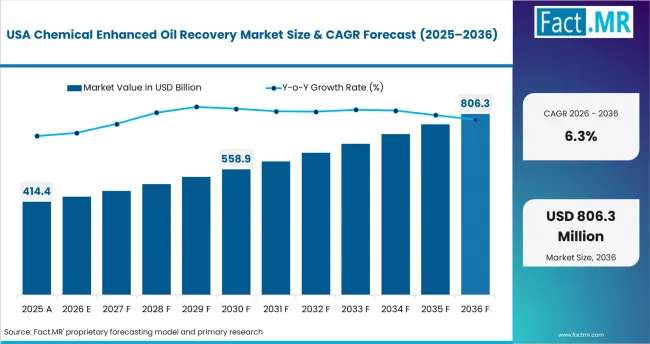
North America serves as the technology and funding hub for CEOR innovation. Federal support and operator-led R&D are accelerating field-level adoption. Activity is concentrated in the Permian Basin and Gulf Coast. Leading players such as Halliburton Company, Baker Hughes Company, and Occidental Petroleum Corporation compete on formulation expertise and field integration capability.
- United States: The United States shows steady expansion with a projected CAGR of 6.3% through 2036. Federal funding continues to support CEOR deployment. The Department of Energy allocated over USD 12 million for polymer and surfactant flood trials in 2024. Occidental Petroleum Corporation expanded chemical EOR programs in the Permian using advanced formulations. Favorable permitting conditions in Texas and Louisiana are enabling faster project execution and scale-up.
FACT.MR's North America analysis covers the United States, Canada, and Mexico. It includes DOE program-linked procurement trends, operator capex flows, and EOR chemical supply chain structures across covered markets.
Asia Pacific Chemical EOR Market Analysis
Asia Pacific overall reflects a production-led CEOR landscape. China dominates execution, while other markets focus on research and supply chain integration. Regional demand is shaped by national oil company strategies and petrochemical capabilities.
- China: China remains the global volume anchor for chemical EOR, with demand rising at 5.9% CAGR through 2036. National policy continues to prioritise production stability at mature fields. China National Petroleum Corporation (CNPC) is driving large-scale CEOR deployment under its five-year plan. PetroChina increased capital allocation toward ASP flooding programs. Field-level innovation includes biopolymer trials designed for deeper and higher-temperature reservoirs.
- Japan: Japan presents a research-driven growth model, with demand expanding at 5.6% CAGR through 2036. Government-backed programs are supporting overseas EOR investments. JOGMEC is funding feasibility studies in Southeast Asian fields. Inpex Corporation is evaluating polymer flood applications with international partners. Domestic demand remains limited, with growth tied to offshore and external asset participation.
- South Korea: South Korea reflects a supply chain-linked growth profile, with a CAGR of 4.5% through 2036. Government initiatives are supporting upstream technology development. Korea National Oil Corporation is investing in EOR research programs. Local producers such as LG Chem and SK Chemicals supply polymer inputs for global CEOR applications. Growth is tied more to export-oriented chemical production than domestic oilfield deployment.
FACT.MR's Asia Pacific analysis covers China, Japan, South Korea, India, ASEAN, and Australia and New Zealand. It captures NOC investment mandates, government EOR support programs, and petrochemical supply chain dynamics across the region.
Competitive Aligners for Market Players
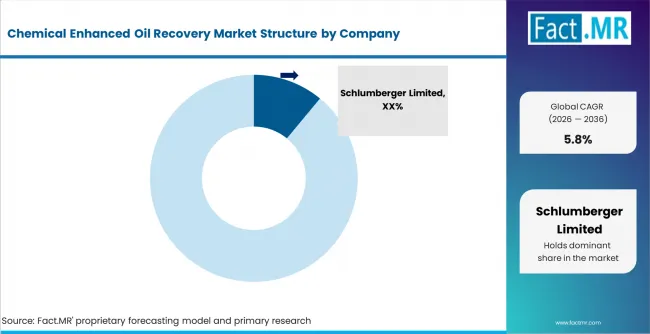
Competitive positioning in the chemical enhanced oil recovery (CEOR) market is increasingly defined by formulation capability, field integration expertise, and long-term service alignment. Market leaders are differentiating through advanced chemical systems that deliver consistent recovery performance across heterogeneous and high-temperature reservoirs. Operators are prioritizing vendors capable of tailoring polymer, surfactant, and alkali blends to specific reservoir conditions, rather than relying on standard formulations.
Integration capability is emerging as a critical competitive aligner. Companies such as Halliburton Company and Baker Hughes Company are strengthening their position by combining chemical supply with reservoir modeling, injection design, and real-time monitoring services. This integrated approach reduces operational risk and improves recovery predictability, making it more attractive for operators managing mature assets.
Field validation and performance data are central to supplier selection. Vendors that can demonstrate proven incremental recovery rates and stable chemical performance under field conditions are gaining preferred partner status. Long-term contracts are increasingly structured around performance benchmarks, aligning supplier incentives with production outcomes.
Supply chain reliability and cost control also play a decisive role. Producers with backward integration into polymer and surfactant manufacturing are better positioned to manage price volatility and ensure consistent chemical availability. Additionally, collaboration with national oil companies and participation in government-backed pilot programs enhance market credibility. Thus, competitive advantage is shifting from product supply toward solution-oriented partnerships, where technical depth, field execution capability, and lifecycle support determine long-term market leadership.
Key Players
- Schlumberger Limited
- Halliburton Company
- Baker Hughes Company
- Shell plc
- BP plc
- Chevron Corporation
- China National Petroleum Corporation (CNPC)
- PetroChina Company Limited
- Occidental Petroleum Corporation
- ConocoPhillips Company
- Core Laboratories N.V.
Bibliography
- [1] ConocoPhillips. (2024). Q3 2024 Earnings Call Transcript: CEO Remarks on Mature Field Recovery and Portfolio Cost Management. conocophillips.com/investor-relations
- [2] International Energy Agency. (2024). World Energy Outlook 2024: Mature Field Decline Rates and Enhanced Oil Recovery Investment Requirements. iea.org/reports/world-energy-outlook-2024
- [3] U.S. Department of Energy, Office of Fossil Energy and Carbon Management. (2024). FY 2024 EOR Technology Development Grant Awards: Polymer and Surfactant Flood Field Validation Projects. energy.gov/fecm/enhanced-oil-recovery
- [4] PetroChina Company Limited. (2024). Annual Report 2024: CEOR Program Capex, Daqing ASP Flood Commercial Phase Results, and CNPC Research Institute Biopolymer Field Trial Publications. petrochina.com.cn/investor-relations
- [5] Shell plc. (2024). Annual Report and Accounts 2024: PDO Oman Polymer Flood Chemical Procurement and North Sea Low-Tension Gas Flood Evaluation. shell.com/investor-relations
- [6] Schlumberger Limited. (2025). Technology Announcement: Bio-derived Polymer Field Trial for High-Temperature Carbonate Reservoir EOR Applications. slb.com/news
- [7] Occidental Petroleum Corporation. (2024). Annual Report 2024: Permian Basin Chemical EOR Program Expansion and Core Laboratories SPE Shale EOR Research Collaboration. oxy.com/investor-relations
- [8] Baker Hughes Company. (Early 2025). Technology Services Announcement: Deepwater Polymer Flood Feasibility Study for Brazilian Pre-salt Operator. bakerhughes.com/news
- [9] Halliburton Company. (2024). Q3 2024 Earnings Release: Polyacrylamide Production Capacity Expansion and NOC Multi-year EOR Chemical Supply Agreements. halliburton.com/investor-relations
- [10] Core Laboratories N.V. (2025). Product Launch: Updated Surfactant-Reservoir Compatibility Screening Platform for ASP Flood Program Design in Carbonate Reservoirs. corelab.com/news
- [11] Chevron Corporation. (2025). Technology Update: Low-Salinity Co-Solvent Polymer Flood Pilot in San Joaquin Valley Heavy Oil Sandstone Formation. chevron.com/technology
- [12] Saudi Aramco. (2025). Research and Development Update: Carbonate Reservoir EOR Feasibility Program at Ghawar Field Including Alkaline and Surfactant Formulation Evaluation. saudiaramco.com/en/research-and-development
This Report Addresses
- Strategic intelligence on chemical EOR demand across polymer flooding, ASP, ACP, and LTG techniques for onshore and offshore mature field operations in sandstone, carbonate, and shale reservoir types globally.
- Market forecast from USD 0.9 billion in 2026 to USD 1.6 billion by 2036, at a CAGR of 5.8%.
- Growth opportunity mapping across U.S. DOE-funded CEOR pilots, China NOC field program expansions, Japan JOGMEC-supported offshore feasibility programs, and Saudi Aramco carbonate EOR development initiatives.
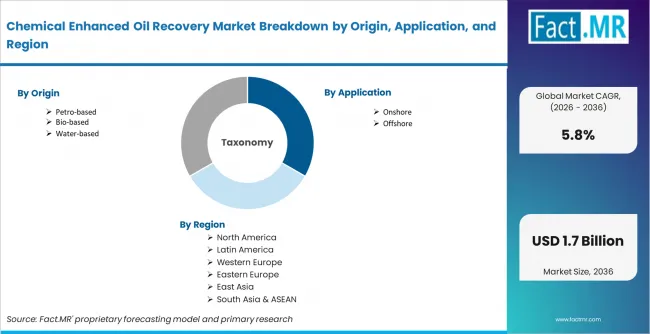
- Segment analysis by origin (petro-based, bio-based, water-based), application (onshore, offshore), type (polymers, surfactants, biopolymers), technique (PF, SP, ASP, ACP, LTG), and reservoir type (sandstone, carbonate, shale).
- Regional outlook covering North America DOE-backed EOR investment, Asia Pacific NOC-mandated production stabilisation programs, and Middle East carbonate reservoir chemical flood feasibility expansion.
- Competitive analysis of Schlumberger, Halliburton, Baker Hughes, Shell, and Core Laboratories. Focus on polymer formulation depth, ASP program integration, reservoir engineering capability, and NOC supply contract positioning.
- Regulatory and environmental impact analysis covering EPA oilfield chemical discharge standards, Chinese environmental compliance requirements for EOR chemical operations, and emerging sustainability criteria in NOC procurement frameworks.
- Report delivered in PDF, Excel, and presentation formats. Supported by primary interviews, DOE EOR program data, SPE technical publications, and operator capex benchmarks.
Chemical Enhanced Oil Recovery Market Definition
Chemical enhanced oil recovery refers to the injection of chemical agents including polymers, surfactants, alkalis, and their combinations into oil reservoirs to increase displacement efficiency and mobilise residual crude beyond the reach of conventional water flooding.
Chemical Enhanced Oil Recovery Market Inclusions
Covers global and regional market sizes from 2026 to 2036. Includes origin, application, type, technique, and reservoir type segments. Covers onshore and offshore field applications. Includes chemical formulation sales, injection service revenues, and field trial program expenditures for polymer flooding, SP, ASP, and ACP flooding techniques.
Chemical Enhanced Oil Recovery Market Exclusions
Excludes thermal and gas-based EOR methods not involving chemical injection. Omits standalone water flooding and pressure maintenance programs. Also excludes oilfield specialty chemical products not directly deployed in recovery flooding operations, including scale inhibitors, corrosion inhibitors, and general production chemistry.
Chemical Enhanced Oil Recovery Market Research Methodology
- Primary Research
- Interviews with EOR project managers, reservoir engineers, oilfield chemical procurement leads, and NOC planning executives. Covers field operators, chemical suppliers, and service contractors across North America, the Middle East, and Asia Pacific.
- Desk Research
- Uses Schlumberger, Halliburton, Baker Hughes, Shell, and CNPC disclosed EOR program data. Includes oilfield chemical shipment records, DOE EOR program databases, and SPE technical paper repositories from 2024–2025.
- Market-Sizing and Forecasting
- Hybrid top-down and bottom-up model. Based on chemical volume deployments per field, average chemical cost per barrel of incremental oil, and EOR program capex disclosures. Segmented by origin, technique, and reservoir type.
- Data Validation and Update Cycle
- Validated using EOR program cost benchmarks, oilfield chemical shipment volumes, and operator capex filings. Cross-checked against SPE case study data and expert interviews. Updated regularly.
Scope of Report
| Attribute | Details |
|---|---|
| Quantitative Units | USD 0.9 billion (2026) to USD 1.6 billion (2036), at a CAGR of 5.8% |
| Market Definition | Chemical agents including polymers, surfactants, alkalis, and their combinations injected into oil reservoirs to improve displacement efficiency and mobilise residual crude in mature onshore and offshore field operations globally. |
| Origin Segmentation | Petro-based, Bio-based, Water-based |
| Application Segmentation | Onshore, Offshore |
| Type Segmentation | Water-soluble Polymers, Surfactants, Polymer Gels, Biopolymers, Alkaline Chemicals |
| Technique Segmentation | Polymer Flooding, Surfactant-Polymer Flooding, Alkali-Surfactant-Polymer Flooding, Alkali-Co-Solvent-Polymer Flooding, Low Tension Gas Flooding |
| Reservoir Type Segmentation | Sandstone Reservoirs, Carbonate Reservoirs, Shale & Tight Reservoirs |
| Application Coverage | Mature field polymer flooding, ASP and ACP multi-chemical flooding, offshore polymer flood feasibility, sandstone and carbonate wettability modification, and shale reservoir nano-surfactant EOR programs. |
| Regions Covered | North America, Europe, Asia Pacific, Latin America, Middle East and Africa |
| Countries Covered | USA, Canada, Mexico, Germany, UK, France, Italy, Spain, China, Japan, South Korea, India, ASEAN, Australia and New Zealand, Brazil, Argentina, Saudi Arabia, GCC, UAE, South Africa, Rest of MEA |
| Key Companies Profiled | Schlumberger Limited, Halliburton Company, Baker Hughes Company, Shell plc, BP plc, Chevron Corporation, CNPC, PetroChina Company Limited, Occidental Petroleum Corporation, ConocoPhillips Company, Core Laboratories N.V. |
| Forecast Period | 2026 to 2036 |
| Approach | Hybrid top-down and bottom-up model using chemical volume deployments per EOR program, average chemical cost per barrel of incremental oil, operator capex disclosures, DOE EOR program data, SPE technical publications, and primary interviews with reservoir engineers and EOR procurement executives. |
Chemical Enhanced Oil Recovery Market by Segments
-
By Origin:
- Petro-based
- Bio-based
- Water-based
-
By Application:
- Onshore
- Offshore
-
By Type:
- Water-soluble Polymers
- Surfactants
- Polymer Gels
- Biopolymers
- Alkaline Chemicals
-
By Technique:
- Polymer Flooding (PF)
- Surfactant-Polymer (SP) Flooding
- Alkali-Surfactant-Polymer (ASP) Flooding
- Alkali-Co-Solvent-Polymer (ACP) Flooding
- Low Tension Gas Flooding (LTG)
-
By Reservoir Type:
- Sandstone Reservoirs
- Carbonate Reservoirs
- Shale & Tight Reservoirs
-
By Region:
- North America
- United States
- Canada
- Mexico
- Latin America
- Brazil
- Mexico
- Argentina
- Rest of Latin America
- Western Europe
- Germany
- United Kingdom
- France
- Italy
- Spain
- Nordic Countries
- BENELUX
- Rest of Western Europe
- Middle East and Africa
- Kingdom of Saudi Arabia
- Other GCC Countries
- UAE
- Rest of Middle East and Africa
- East Asia
- China
- Japan
- South Korea
- South Asia and Pacific
- India
- ASEAN
- Australia and New Zealand
- Rest of South Asia and Pacific
- North America

- Frequently Asked Questions -
How large is the chemical enhanced oil recovery market?
In 2025, the chemical EOR market was valued at USD 0.8 billion, with estimated demand of USD 0.9 billion in 2026.
What will the market size be by 2036?
The chemical EOR market is forecast to reach USD 1.6 billion by 2036, generating USD 0.7 billion in incremental revenue over the forecast period.
What is the expected CAGR for the chemical EOR market?
FACT.MR projects a CAGR of 5.8% for the chemical enhanced oil recovery market during the 2026 to 2036 forecast period.
Which technique segment is poised to lead the chemical EOR market?
Polymer flooding holds approximately 55% share in 2026, driven by proven recovery performance, cost-effectiveness, and the broadest base of commercial field documentation globally.
Which origin segment dominates the chemical EOR market?
Petro-based chemicals hold approximately 65% share in 2026, underpinned by established field performance benchmarks and full compatibility with existing onshore EOR injection infrastructure.
How significant is the onshore application segment?
Onshore applications hold approximately 70% share in 2026, sustained by the concentration of mature field CEOR deployments in land-based sandstone reservoir operations across China, the U.S., and the Middle East.
What is driving demand in the chemical EOR market?
Rising production decline in mature oilfields and the need to maximise recovery from existing assets are the primary demand drivers.
Which regions are leading chemical EOR adoption?
China, the United States lead adoption due to large mature reservoir bases and active CEOR programs.
What are the key chemicals used in CEOR processes?
Polymers, surfactants, and alkali chemicals are the primary components used to enhance oil recovery efficiency.
Why is polymer flooding widely adopted in CEOR?
Polymer flooding improves sweep efficiency and mobility control at relatively lower cost compared to complex formulations.
What is limiting CEOR market growth?
High chemical costs, crude price volatility, and reservoir-specific complexity are key constraints.
How are ASP formulations impacting the market?
ASP formulations are gaining traction in complex reservoirs due to higher incremental recovery despite higher costs.
What role do national oil companies play in CEOR adoption?
National oil companies drive large-scale deployment through long-term production stabilisation programs.
How does crude oil price impact CEOR investments?
Higher oil prices improve project economics, while volatility delays investment decisions in marginal fields.
What is the role of government funding in CEOR development?
Government programs reduce pilot risk and accelerate commercial adoption of advanced EOR techniques.
Table of Content
- Executive Summary
- Global Market Outlook
- Demand to side Trends
- Supply to side Trends
- Technology Roadmap Analysis
- Analysis and Recommendations
- Market Overview
- Market Coverage / Taxonomy
- Market Definition / Scope / Limitations
- Research Methodology
- Chapter Orientation
- Analytical Lens and Working Hypotheses
- Market Structure, Signals, and Trend Drivers
- Benchmarking and Cross-market Comparability
- Market Sizing, Forecasting, and Opportunity Mapping
- Research Design and Evidence Framework
- Desk Research Programme (Secondary Evidence)
- Company Annual and Sustainability Reports
- Peer-reviewed Journals and Academic Literature
- Corporate Websites, Product Literature, and Technical Notes
- Earnings Decks and Investor Briefings
- Statutory Filings and Regulatory Disclosures
- Technical White Papers and Standards Notes
- Trade Journals, Industry Magazines, and Analyst Briefs
- Conference Proceedings, Webinars, and Seminar Materials
- Government Statistics Portals and Public Data Releases
- Press Releases and Reputable Media Coverage
- Specialist Newsletters and Curated Briefings
- Sector Databases and Reference Repositories
- Fact.MR Internal Proprietary Databases and Historical Market Datasets
- Subscription Datasets and Paid Sources
- Social Channels, Communities, and Digital Listening Inputs
- Additional Desk Sources
- Expert Input and Fieldwork (Primary Evidence)
- Primary Modes
- Qualitative Interviews and Expert Elicitation
- Quantitative Surveys and Structured Data Capture
- Blended Approach
- Why Primary Evidence is Used
- Field Techniques
- Interviews
- Surveys
- Focus Groups
- Observational and In-context Research
- Social and Community Interactions
- Stakeholder Universe Engaged
- C-suite Leaders
- Board Members
- Presidents and Vice Presidents
- R&D and Innovation Heads
- Technical Specialists
- Domain Subject-matter Experts
- Scientists
- Physicians and Other Healthcare Professionals
- Governance, Ethics, and Data Stewardship
- Research Ethics
- Data Integrity and Handling
- Primary Modes
- Tooling, Models, and Reference Databases
- Desk Research Programme (Secondary Evidence)
- Data Engineering and Model Build
- Data Acquisition and Ingestion
- Cleaning, Normalisation, and Verification
- Synthesis, Triangulation, and Analysis
- Quality Assurance and Audit Trail
- Market Background
- Market Dynamics
- Drivers
- Restraints
- Opportunity
- Trends
- Scenario Forecast
- Demand in Optimistic Scenario
- Demand in Likely Scenario
- Demand in Conservative Scenario
- Opportunity Map Analysis
- Product Life Cycle Analysis
- Supply Chain Analysis
- Investment Feasibility Matrix
- Value Chain Analysis
- PESTLE and Porter’s Analysis
- Regulatory Landscape
- Regional Parent Market Outlook
- Production and Consumption Statistics
- Import and Export Statistics
- Market Dynamics
- Global Market Analysis 2021 to 2025 and Forecast, 2026 to 2036
- Historical Market Size Value (USD Million) Analysis, 2021 to 2025
- Current and Future Market Size Value (USD Million) Projections, 2026 to 2036
- Y to o to Y Growth Trend Analysis
- Absolute $ Opportunity Analysis
- Global Market Pricing Analysis 2021 to 2025 and Forecast 2026 to 2036
- Global Market Analysis 2021 to 2025 and Forecast 2026 to 2036, By Product Type
- Introduction / Key Findings
- Historical Market Size Value (USD Million) Analysis By Product Type , 2021 to 2025
- Current and Future Market Size Value (USD Million) Analysis and Forecast By Product Type , 2026 to 2036
- Tanks
- Valves
- Pumps
- Tanks
- Y to o to Y Growth Trend Analysis By Product Type , 2021 to 2025
- Absolute $ Opportunity Analysis By Product Type , 2026 to 2036
- Global Market Analysis 2021 to 2025 and Forecast 2026 to 2036, By Cryogen
- Introduction / Key Findings
- Historical Market Size Value (USD Million) Analysis By Cryogen, 2021 to 2025
- Current and Future Market Size Value (USD Million) Analysis and Forecast By Cryogen, 2026 to 2036
- LNG
- Nitrogen
- Oxygen
- LNG
- Y to o to Y Growth Trend Analysis By Cryogen, 2021 to 2025
- Absolute $ Opportunity Analysis By Cryogen, 2026 to 2036
- Global Market Analysis 2021 to 2025 and Forecast 2026 to 2036, By Application
- Introduction / Key Findings
- Historical Market Size Value (USD Million) Analysis By Application, 2021 to 2025
- Current and Future Market Size Value (USD Million) Analysis and Forecast By Application, 2026 to 2036
- Storage
- On-Site Supply
- Storage
- Y to o to Y Growth Trend Analysis By Application, 2021 to 2025
- Absolute $ Opportunity Analysis By Application, 2026 to 2036
- Global Market Analysis 2021 to 2025 and Forecast 2026 to 2036, By End Use
- Introduction / Key Findings
- Historical Market Size Value (USD Million) Analysis By End Use, 2021 to 2025
- Current and Future Market Size Value (USD Million) Analysis and Forecast By End Use, 2026 to 2036
- Oil & Gas
- Metallurgy
- Automotive
- Oil & Gas
- Y to o to Y Growth Trend Analysis By End Use, 2021 to 2025
- Absolute $ Opportunity Analysis By End Use, 2026 to 2036
- Global Market Analysis 2021 to 2025 and Forecast 2026 to 2036, By Sales Channel
- Introduction / Key Findings
- Historical Market Size Value (USD Million) Analysis By Sales Channel, 2021 to 2025
- Current and Future Market Size Value (USD Million) Analysis and Forecast By Sales Channel, 2026 to 2036
- EPC and Project Supply
- Aftermarket and Service Contracts
- Online Industrial Supply
- EPC and Project Supply
- Y to o to Y Growth Trend Analysis By Sales Channel, 2021 to 2025
- Absolute $ Opportunity Analysis By Sales Channel, 2026 to 2036
- Global Market Analysis 2021 to 2025 and Forecast 2026 to 2036, By Region
- Introduction
- Historical Market Size Value (USD Million) Analysis By Region, 2021 to 2025
- Current Market Size Value (USD Million) Analysis and Forecast By Region, 2026 to 2036
- North America
- Latin America
- Western Europe
- Eastern Europe
- East Asia
- South Asia and Pacific
- Middle East & Africa
- Market Attractiveness Analysis By Region
- North America Market Analysis 2021 to 2025 and Forecast 2026 to 2036, By Country
- Historical Market Size Value (USD Million) Trend Analysis By Market Taxonomy, 2021 to 2025
- Market Size Value (USD Million) Forecast By Market Taxonomy, 2026 to 2036
- By Country
- USA
- Canada
- Mexico
- By Product Type
- By Cryogen
- By Application
- By End Use
- By Sales Channel
- By Country
- Market Attractiveness Analysis
- By Country
- By Product Type
- By Cryogen
- By Application
- By End Use
- By Sales Channel
- Key Takeaways
- Latin America Market Analysis 2021 to 2025 and Forecast 2026 to 2036, By Country
- Historical Market Size Value (USD Million) Trend Analysis By Market Taxonomy, 2021 to 2025
- Market Size Value (USD Million) Forecast By Market Taxonomy, 2026 to 2036
- By Country
- Brazil
- Chile
- Rest of Latin America
- By Product Type
- By Cryogen
- By Application
- By End Use
- By Sales Channel
- By Country
- Market Attractiveness Analysis
- By Country
- By Product Type
- By Cryogen
- By Application
- By End Use
- By Sales Channel
- Key Takeaways
- Western Europe Market Analysis 2021 to 2025 and Forecast 2026 to 2036, By Country
- Historical Market Size Value (USD Million) Trend Analysis By Market Taxonomy, 2021 to 2025
- Market Size Value (USD Million) Forecast By Market Taxonomy, 2026 to 2036
- By Country
- Germany
- UK
- Italy
- Spain
- France
- Nordic
- BENELUX
- Rest of Western Europe
- By Product Type
- By Cryogen
- By Application
- By End Use
- By Sales Channel
- By Country
- Market Attractiveness Analysis
- By Country
- By Product Type
- By Cryogen
- By Application
- By End Use
- By Sales Channel
- Key Takeaways
- Eastern Europe Market Analysis 2021 to 2025 and Forecast 2026 to 2036, By Country
- Historical Market Size Value (USD Million) Trend Analysis By Market Taxonomy, 2021 to 2025
- Market Size Value (USD Million) Forecast By Market Taxonomy, 2026 to 2036
- By Country
- Russia
- Poland
- Hungary
- Balkan & Baltic
- Rest of Eastern Europe
- By Product Type
- By Cryogen
- By Application
- By End Use
- By Sales Channel
- By Country
- Market Attractiveness Analysis
- By Country
- By Product Type
- By Cryogen
- By Application
- By End Use
- By Sales Channel
- Key Takeaways
- East Asia Market Analysis 2021 to 2025 and Forecast 2026 to 2036, By Country
- Historical Market Size Value (USD Million) Trend Analysis By Market Taxonomy, 2021 to 2025
- Market Size Value (USD Million) Forecast By Market Taxonomy, 2026 to 2036
- By Country
- China
- Japan
- South Korea
- By Product Type
- By Cryogen
- By Application
- By End Use
- By Sales Channel
- By Country
- Market Attractiveness Analysis
- By Country
- By Product Type
- By Cryogen
- By Application
- By End Use
- By Sales Channel
- Key Takeaways
- South Asia and Pacific Market Analysis 2021 to 2025 and Forecast 2026 to 2036, By Country
- Historical Market Size Value (USD Million) Trend Analysis By Market Taxonomy, 2021 to 2025
- Market Size Value (USD Million) Forecast By Market Taxonomy, 2026 to 2036
- By Country
- India
- ASEAN
- Australia & New Zealand
- Rest of South Asia and Pacific
- By Product Type
- By Cryogen
- By Application
- By End Use
- By Sales Channel
- By Country
- Market Attractiveness Analysis
- By Country
- By Product Type
- By Cryogen
- By Application
- By End Use
- By Sales Channel
- Key Takeaways
- Middle East & Africa Market Analysis 2021 to 2025 and Forecast 2026 to 2036, By Country
- Historical Market Size Value (USD Million) Trend Analysis By Market Taxonomy, 2021 to 2025
- Market Size Value (USD Million) Forecast By Market Taxonomy, 2026 to 2036
- By Country
- Kingdom of Saudi Arabia
- Other GCC Countries
- Turkiye
- South Africa
- Other African Union
- Rest of Middle East & Africa
- By Product Type
- By Cryogen
- By Application
- By End Use
- By Sales Channel
- By Country
- Market Attractiveness Analysis
- By Country
- By Product Type
- By Cryogen
- By Application
- By End Use
- By Sales Channel
- Key Takeaways
- Key Countries Market Analysis
- USA
- Pricing Analysis
- Market Share Analysis, 2025
- By Product Type
- By Cryogen
- By Application
- By End Use
- By Sales Channel
- Canada
- Pricing Analysis
- Market Share Analysis, 2025
- By Product Type
- By Cryogen
- By Application
- By End Use
- By Sales Channel
- Mexico
- Pricing Analysis
- Market Share Analysis, 2025
- By Product Type
- By Cryogen
- By Application
- By End Use
- By Sales Channel
- Brazil
- Pricing Analysis
- Market Share Analysis, 2025
- By Product Type
- By Cryogen
- By Application
- By End Use
- By Sales Channel
- Chile
- Pricing Analysis
- Market Share Analysis, 2025
- By Product Type
- By Cryogen
- By Application
- By End Use
- By Sales Channel
- Germany
- Pricing Analysis
- Market Share Analysis, 2025
- By Product Type
- By Cryogen
- By Application
- By End Use
- By Sales Channel
- UK
- Pricing Analysis
- Market Share Analysis, 2025
- By Product Type
- By Cryogen
- By Application
- By End Use
- By Sales Channel
- Italy
- Pricing Analysis
- Market Share Analysis, 2025
- By Product Type
- By Cryogen
- By Application
- By End Use
- By Sales Channel
- Spain
- Pricing Analysis
- Market Share Analysis, 2025
- By Product Type
- By Cryogen
- By Application
- By End Use
- By Sales Channel
- France
- Pricing Analysis
- Market Share Analysis, 2025
- By Product Type
- By Cryogen
- By Application
- By End Use
- By Sales Channel
- India
- Pricing Analysis
- Market Share Analysis, 2025
- By Product Type
- By Cryogen
- By Application
- By End Use
- By Sales Channel
- ASEAN
- Pricing Analysis
- Market Share Analysis, 2025
- By Product Type
- By Cryogen
- By Application
- By End Use
- By Sales Channel
- Australia & New Zealand
- Pricing Analysis
- Market Share Analysis, 2025
- By Product Type
- By Cryogen
- By Application
- By End Use
- By Sales Channel
- China
- Pricing Analysis
- Market Share Analysis, 2025
- By Product Type
- By Cryogen
- By Application
- By End Use
- By Sales Channel
- Japan
- Pricing Analysis
- Market Share Analysis, 2025
- By Product Type
- By Cryogen
- By Application
- By End Use
- By Sales Channel
- South Korea
- Pricing Analysis
- Market Share Analysis, 2025
- By Product Type
- By Cryogen
- By Application
- By End Use
- By Sales Channel
- Russia
- Pricing Analysis
- Market Share Analysis, 2025
- By Product Type
- By Cryogen
- By Application
- By End Use
- By Sales Channel
- Poland
- Pricing Analysis
- Market Share Analysis, 2025
- By Product Type
- By Cryogen
- By Application
- By End Use
- By Sales Channel
- Hungary
- Pricing Analysis
- Market Share Analysis, 2025
- By Product Type
- By Cryogen
- By Application
- By End Use
- By Sales Channel
- Kingdom of Saudi Arabia
- Pricing Analysis
- Market Share Analysis, 2025
- By Product Type
- By Cryogen
- By Application
- By End Use
- By Sales Channel
- Turkiye
- Pricing Analysis
- Market Share Analysis, 2025
- By Product Type
- By Cryogen
- By Application
- By End Use
- By Sales Channel
- South Africa
- Pricing Analysis
- Market Share Analysis, 2025
- By Product Type
- By Cryogen
- By Application
- By End Use
- By Sales Channel
- USA
- Market Structure Analysis
- Competition Dashboard
- Competition Benchmarking
- Market Share Analysis of Top Players
- By Regional
- By Product Type
- By Cryogen
- By Application
- By End Use
- By Sales Channel
- Competition Analysis
- Competition Deep Dive
- Linde plc
- Overview
- Product Portfolio
- Profitability by Market Segments (Product/Age /Sales Channel/Region)
- Sales Footprint
- Strategy Overview
- Marketing Strategy
- Product Strategy
- Channel Strategy
- Chart Industries Inc.
- Herose GmbH
- Nikkiso Co. Ltd.
- Wessington Cryogenics
- Braunschweiger Flammenfilter GmbH
- Standex International Corporation
- Linde plc
- Competition Deep Dive
- Assumptions & Acronyms Used
List Of Table
- Table 1: Global Market Value (USD Million) Forecast by Region, 2021 to 2036
- Table 2: Global Market Value (USD Million) Forecast by Product Type, 2021 to 2036
- Table 3: Global Market Value (USD Million) Forecast by Cryogen, 2021 to 2036
- Table 4: Global Market Value (USD Million) Forecast by Application, 2021 to 2036
- Table 5: Global Market Value (USD Million) Forecast by End Use, 2021 to 2036
- Table 6: Global Market Value (USD Million) Forecast by Sales Channel, 2021 to 2036
- Table 7: North America Market Value (USD Million) Forecast by Country, 2021 to 2036
- Table 8: North America Market Value (USD Million) Forecast by Product Type, 2021 to 2036
- Table 9: North America Market Value (USD Million) Forecast by Cryogen, 2021 to 2036
- Table 10: North America Market Value (USD Million) Forecast by Application, 2021 to 2036
- Table 11: North America Market Value (USD Million) Forecast by End Use, 2021 to 2036
- Table 12: North America Market Value (USD Million) Forecast by Sales Channel, 2021 to 2036
- Table 13: Latin America Market Value (USD Million) Forecast by Country, 2021 to 2036
- Table 14: Latin America Market Value (USD Million) Forecast by Product Type, 2021 to 2036
- Table 15: Latin America Market Value (USD Million) Forecast by Cryogen, 2021 to 2036
- Table 16: Latin America Market Value (USD Million) Forecast by Application, 2021 to 2036
- Table 17: Latin America Market Value (USD Million) Forecast by End Use, 2021 to 2036
- Table 18: Latin America Market Value (USD Million) Forecast by Sales Channel, 2021 to 2036
- Table 19: Western Europe Market Value (USD Million) Forecast by Country, 2021 to 2036
- Table 20: Western Europe Market Value (USD Million) Forecast by Product Type, 2021 to 2036
- Table 21: Western Europe Market Value (USD Million) Forecast by Cryogen, 2021 to 2036
- Table 22: Western Europe Market Value (USD Million) Forecast by Application, 2021 to 2036
- Table 23: Western Europe Market Value (USD Million) Forecast by End Use, 2021 to 2036
- Table 24: Western Europe Market Value (USD Million) Forecast by Sales Channel, 2021 to 2036
- Table 25: Eastern Europe Market Value (USD Million) Forecast by Country, 2021 to 2036
- Table 26: Eastern Europe Market Value (USD Million) Forecast by Product Type, 2021 to 2036
- Table 27: Eastern Europe Market Value (USD Million) Forecast by Cryogen, 2021 to 2036
- Table 28: Eastern Europe Market Value (USD Million) Forecast by Application, 2021 to 2036
- Table 29: Eastern Europe Market Value (USD Million) Forecast by End Use, 2021 to 2036
- Table 30: Eastern Europe Market Value (USD Million) Forecast by Sales Channel, 2021 to 2036
- Table 31: East Asia Market Value (USD Million) Forecast by Country, 2021 to 2036
- Table 32: East Asia Market Value (USD Million) Forecast by Product Type, 2021 to 2036
- Table 33: East Asia Market Value (USD Million) Forecast by Cryogen, 2021 to 2036
- Table 34: East Asia Market Value (USD Million) Forecast by Application, 2021 to 2036
- Table 35: East Asia Market Value (USD Million) Forecast by End Use, 2021 to 2036
- Table 36: East Asia Market Value (USD Million) Forecast by Sales Channel, 2021 to 2036
- Table 37: South Asia and Pacific Market Value (USD Million) Forecast by Country, 2021 to 2036
- Table 38: South Asia and Pacific Market Value (USD Million) Forecast by Product Type, 2021 to 2036
- Table 39: South Asia and Pacific Market Value (USD Million) Forecast by Cryogen, 2021 to 2036
- Table 40: South Asia and Pacific Market Value (USD Million) Forecast by Application, 2021 to 2036
- Table 41: South Asia and Pacific Market Value (USD Million) Forecast by End Use, 2021 to 2036
- Table 42: South Asia and Pacific Market Value (USD Million) Forecast by Sales Channel, 2021 to 2036
- Table 43: Middle East & Africa Market Value (USD Million) Forecast by Country, 2021 to 2036
- Table 44: Middle East & Africa Market Value (USD Million) Forecast by Product Type, 2021 to 2036
- Table 45: Middle East & Africa Market Value (USD Million) Forecast by Cryogen, 2021 to 2036
- Table 46: Middle East & Africa Market Value (USD Million) Forecast by Application, 2021 to 2036
- Table 47: Middle East & Africa Market Value (USD Million) Forecast by End Use, 2021 to 2036
- Table 48: Middle East & Africa Market Value (USD Million) Forecast by Sales Channel, 2021 to 2036
List Of Figures
- Figure 1: Global Market Pricing Analysis
- Figure 2: Global Market Value (USD Million) Forecast 2021-2036
- Figure 3: Global Market Value Share and BPS Analysis by Product Type, 2026 and 2036
- Figure 4: Global Market Y-o-Y Growth Comparison by Product Type, 2026 to 2036
- Figure 5: Global Market Attractiveness Analysis by Product Type
- Figure 6: Global Market Value Share and BPS Analysis by Cryogen, 2026 and 2036
- Figure 7: Global Market Y-o-Y Growth Comparison by Cryogen, 2026 to 2036
- Figure 8: Global Market Attractiveness Analysis by Cryogen
- Figure 9: Global Market Value Share and BPS Analysis by Application, 2026 and 2036
- Figure 10: Global Market Y-o-Y Growth Comparison by Application, 2026 to 2036
- Figure 11: Global Market Attractiveness Analysis by Application
- Figure 12: Global Market Value Share and BPS Analysis by End Use, 2026 and 2036
- Figure 13: Global Market Y-o-Y Growth Comparison by End Use, 2026 to 2036
- Figure 14: Global Market Attractiveness Analysis by End Use
- Figure 15: Global Market Value Share and BPS Analysis by Sales Channel, 2026 and 2036
- Figure 16: Global Market Y-o-Y Growth Comparison by Sales Channel, 2026 to 2036
- Figure 17: Global Market Attractiveness Analysis by Sales Channel
- Figure 18: Global Market Value (USD Million) Share and BPS Analysis by Region, 2026 and 2036
- Figure 19: Global Market Y-o-Y Growth Comparison by Region, 2026 to 2036
- Figure 20: Global Market Attractiveness Analysis by Region
- Figure 21: North America Market Incremental Dollar Opportunity, 2026 to 2036
- Figure 22: Latin America Market Incremental Dollar Opportunity, 2026 to 2036
- Figure 23: Western Europe Market Incremental Dollar Opportunity, 2026 to 2036
- Figure 24: Eastern Europe Market Incremental Dollar Opportunity, 2026 to 2036
- Figure 25: East Asia Market Incremental Dollar Opportunity, 2026 to 2036
- Figure 26: South Asia and Pacific Market Incremental Dollar Opportunity, 2026 to 2036
- Figure 27: Middle East & Africa Market Incremental Dollar Opportunity, 2026 to 2036
- Figure 28: North America Market Value Share and BPS Analysis by Country, 2026 and 2036
- Figure 29: North America Market Value Share and BPS Analysis by Product Type, 2026 and 2036
- Figure 30: North America Market Y-o-Y Growth Comparison by Product Type, 2026 to 2036
- Figure 31: North America Market Attractiveness Analysis by Product Type
- Figure 32: North America Market Value Share and BPS Analysis by Cryogen, 2026 and 2036
- Figure 33: North America Market Y-o-Y Growth Comparison by Cryogen, 2026 to 2036
- Figure 34: North America Market Attractiveness Analysis by Cryogen
- Figure 35: North America Market Value Share and BPS Analysis by Application, 2026 and 2036
- Figure 36: North America Market Y-o-Y Growth Comparison by Application, 2026 to 2036
- Figure 37: North America Market Attractiveness Analysis by Application
- Figure 38: North America Market Value Share and BPS Analysis by End Use, 2026 and 2036
- Figure 39: North America Market Y-o-Y Growth Comparison by End Use, 2026 to 2036
- Figure 40: North America Market Attractiveness Analysis by End Use
- Figure 41: North America Market Value Share and BPS Analysis by Sales Channel, 2026 and 2036
- Figure 42: North America Market Y-o-Y Growth Comparison by Sales Channel, 2026 to 2036
- Figure 43: North America Market Attractiveness Analysis by Sales Channel
- Figure 44: Latin America Market Value Share and BPS Analysis by Country, 2026 and 2036
- Figure 45: Latin America Market Value Share and BPS Analysis by Product Type, 2026 and 2036
- Figure 46: Latin America Market Y-o-Y Growth Comparison by Product Type, 2026 to 2036
- Figure 47: Latin America Market Attractiveness Analysis by Product Type
- Figure 48: Latin America Market Value Share and BPS Analysis by Cryogen, 2026 and 2036
- Figure 49: Latin America Market Y-o-Y Growth Comparison by Cryogen, 2026 to 2036
- Figure 50: Latin America Market Attractiveness Analysis by Cryogen
- Figure 51: Latin America Market Value Share and BPS Analysis by Application, 2026 and 2036
- Figure 52: Latin America Market Y-o-Y Growth Comparison by Application, 2026 to 2036
- Figure 53: Latin America Market Attractiveness Analysis by Application
- Figure 54: Latin America Market Value Share and BPS Analysis by End Use, 2026 and 2036
- Figure 55: Latin America Market Y-o-Y Growth Comparison by End Use, 2026 to 2036
- Figure 56: Latin America Market Attractiveness Analysis by End Use
- Figure 57: Latin America Market Value Share and BPS Analysis by Sales Channel, 2026 and 2036
- Figure 58: Latin America Market Y-o-Y Growth Comparison by Sales Channel, 2026 to 2036
- Figure 59: Latin America Market Attractiveness Analysis by Sales Channel
- Figure 60: Western Europe Market Value Share and BPS Analysis by Country, 2026 and 2036
- Figure 61: Western Europe Market Value Share and BPS Analysis by Product Type, 2026 and 2036
- Figure 62: Western Europe Market Y-o-Y Growth Comparison by Product Type, 2026 to 2036
- Figure 63: Western Europe Market Attractiveness Analysis by Product Type
- Figure 64: Western Europe Market Value Share and BPS Analysis by Cryogen, 2026 and 2036
- Figure 65: Western Europe Market Y-o-Y Growth Comparison by Cryogen, 2026 to 2036
- Figure 66: Western Europe Market Attractiveness Analysis by Cryogen
- Figure 67: Western Europe Market Value Share and BPS Analysis by Application, 2026 and 2036
- Figure 68: Western Europe Market Y-o-Y Growth Comparison by Application, 2026 to 2036
- Figure 69: Western Europe Market Attractiveness Analysis by Application
- Figure 70: Western Europe Market Value Share and BPS Analysis by End Use, 2026 and 2036
- Figure 71: Western Europe Market Y-o-Y Growth Comparison by End Use, 2026 to 2036
- Figure 72: Western Europe Market Attractiveness Analysis by End Use
- Figure 73: Western Europe Market Value Share and BPS Analysis by Sales Channel, 2026 and 2036
- Figure 74: Western Europe Market Y-o-Y Growth Comparison by Sales Channel, 2026 to 2036
- Figure 75: Western Europe Market Attractiveness Analysis by Sales Channel
- Figure 76: Eastern Europe Market Value Share and BPS Analysis by Country, 2026 and 2036
- Figure 77: Eastern Europe Market Value Share and BPS Analysis by Product Type, 2026 and 2036
- Figure 78: Eastern Europe Market Y-o-Y Growth Comparison by Product Type, 2026 to 2036
- Figure 79: Eastern Europe Market Attractiveness Analysis by Product Type
- Figure 80: Eastern Europe Market Value Share and BPS Analysis by Cryogen, 2026 and 2036
- Figure 81: Eastern Europe Market Y-o-Y Growth Comparison by Cryogen, 2026 to 2036
- Figure 82: Eastern Europe Market Attractiveness Analysis by Cryogen
- Figure 83: Eastern Europe Market Value Share and BPS Analysis by Application, 2026 and 2036
- Figure 84: Eastern Europe Market Y-o-Y Growth Comparison by Application, 2026 to 2036
- Figure 85: Eastern Europe Market Attractiveness Analysis by Application
- Figure 86: Eastern Europe Market Value Share and BPS Analysis by End Use, 2026 and 2036
- Figure 87: Eastern Europe Market Y-o-Y Growth Comparison by End Use, 2026 to 2036
- Figure 88: Eastern Europe Market Attractiveness Analysis by End Use
- Figure 89: Eastern Europe Market Value Share and BPS Analysis by Sales Channel, 2026 and 2036
- Figure 90: Eastern Europe Market Y-o-Y Growth Comparison by Sales Channel, 2026 to 2036
- Figure 91: Eastern Europe Market Attractiveness Analysis by Sales Channel
- Figure 92: East Asia Market Value Share and BPS Analysis by Country, 2026 and 2036
- Figure 93: East Asia Market Value Share and BPS Analysis by Product Type, 2026 and 2036
- Figure 94: East Asia Market Y-o-Y Growth Comparison by Product Type, 2026 to 2036
- Figure 95: East Asia Market Attractiveness Analysis by Product Type
- Figure 96: East Asia Market Value Share and BPS Analysis by Cryogen, 2026 and 2036
- Figure 97: East Asia Market Y-o-Y Growth Comparison by Cryogen, 2026 to 2036
- Figure 98: East Asia Market Attractiveness Analysis by Cryogen
- Figure 99: East Asia Market Value Share and BPS Analysis by Application, 2026 and 2036
- Figure 100: East Asia Market Y-o-Y Growth Comparison by Application, 2026 to 2036
- Figure 101: East Asia Market Attractiveness Analysis by Application
- Figure 102: East Asia Market Value Share and BPS Analysis by End Use, 2026 and 2036
- Figure 103: East Asia Market Y-o-Y Growth Comparison by End Use, 2026 to 2036
- Figure 104: East Asia Market Attractiveness Analysis by End Use
- Figure 105: East Asia Market Value Share and BPS Analysis by Sales Channel, 2026 and 2036
- Figure 106: East Asia Market Y-o-Y Growth Comparison by Sales Channel, 2026 to 2036
- Figure 107: East Asia Market Attractiveness Analysis by Sales Channel
- Figure 108: South Asia and Pacific Market Value Share and BPS Analysis by Country, 2026 and 2036
- Figure 109: South Asia and Pacific Market Value Share and BPS Analysis by Product Type, 2026 and 2036
- Figure 110: South Asia and Pacific Market Y-o-Y Growth Comparison by Product Type, 2026 to 2036
- Figure 111: South Asia and Pacific Market Attractiveness Analysis by Product Type
- Figure 112: South Asia and Pacific Market Value Share and BPS Analysis by Cryogen, 2026 and 2036
- Figure 113: South Asia and Pacific Market Y-o-Y Growth Comparison by Cryogen, 2026 to 2036
- Figure 114: South Asia and Pacific Market Attractiveness Analysis by Cryogen
- Figure 115: South Asia and Pacific Market Value Share and BPS Analysis by Application, 2026 and 2036
- Figure 116: South Asia and Pacific Market Y-o-Y Growth Comparison by Application, 2026 to 2036
- Figure 117: South Asia and Pacific Market Attractiveness Analysis by Application
- Figure 118: South Asia and Pacific Market Value Share and BPS Analysis by End Use, 2026 and 2036
- Figure 119: South Asia and Pacific Market Y-o-Y Growth Comparison by End Use, 2026 to 2036
- Figure 120: South Asia and Pacific Market Attractiveness Analysis by End Use
- Figure 121: South Asia and Pacific Market Value Share and BPS Analysis by Sales Channel, 2026 and 2036
- Figure 122: South Asia and Pacific Market Y-o-Y Growth Comparison by Sales Channel, 2026 to 2036
- Figure 123: South Asia and Pacific Market Attractiveness Analysis by Sales Channel
- Figure 124: Middle East & Africa Market Value Share and BPS Analysis by Country, 2026 and 2036
- Figure 125: Middle East & Africa Market Value Share and BPS Analysis by Product Type, 2026 and 2036
- Figure 126: Middle East & Africa Market Y-o-Y Growth Comparison by Product Type, 2026 to 2036
- Figure 127: Middle East & Africa Market Attractiveness Analysis by Product Type
- Figure 128: Middle East & Africa Market Value Share and BPS Analysis by Cryogen, 2026 and 2036
- Figure 129: Middle East & Africa Market Y-o-Y Growth Comparison by Cryogen, 2026 to 2036
- Figure 130: Middle East & Africa Market Attractiveness Analysis by Cryogen
- Figure 131: Middle East & Africa Market Value Share and BPS Analysis by Application, 2026 and 2036
- Figure 132: Middle East & Africa Market Y-o-Y Growth Comparison by Application, 2026 to 2036
- Figure 133: Middle East & Africa Market Attractiveness Analysis by Application
- Figure 134: Middle East & Africa Market Value Share and BPS Analysis by End Use, 2026 and 2036
- Figure 135: Middle East & Africa Market Y-o-Y Growth Comparison by End Use, 2026 to 2036
- Figure 136: Middle East & Africa Market Attractiveness Analysis by End Use
- Figure 137: Middle East & Africa Market Value Share and BPS Analysis by Sales Channel, 2026 and 2036
- Figure 138: Middle East & Africa Market Y-o-Y Growth Comparison by Sales Channel, 2026 to 2036
- Figure 139: Middle East & Africa Market Attractiveness Analysis by Sales Channel
- Figure 140: Global Market - Tier Structure Analysis
- Figure 141: Global Market - Company Share Analysis