Chemicals for Acid Mine Drainage Neturalization Market
Chemicals for Acid Mine Drainage Neturalization Market Size and Share Forecast Outlook 2026 to 2036
Chemicals for acid mine drainage neturalization market is projected to grow from USD 0.6 billion in 2026 to USD 1.2 billion by 2036, at a CAGR of 7.9%. Hydrated lime & quicklime will dominate with a 38.0% market share, while active treatment plants (lime dosing & ph control) will lead the process segment with a 42.0% share.
Chemicals for Acid Mine Drainage Neutralization Market Forecast and Outlook 2026 to 2036
The global chemicals for acid mine drainage (AMD) neutralization market is projected to reach USD 1.21 billion by 2036. The market is valued at USD 0.56 billion in 2026 and is set to rise at a CAGR of 7.9% during the assessment period. By neutralizing chemistry, hydrated lime & quicklime hold a dominant 38% share. Active treatment plants (lime dosing & pH control) represent the leading process at 42%, while mining companies (integrated water treatment systems) are the primary customer, accounting for 48.00% market share.
Key Takeaways from the Chemicals for Acid Mine Drainage Neutralization Market
- Market Value for 2026: USD 0.56 Billion
- Market Value for 2036: USD 1.21 Billion
- Forecast CAGR (2026-2036): 7.9%
- Leading Neutralizing Chemistry Share (2026): Hydrated Lime & Quicklime (38%)
- Leading Process Share (2026): Active Treatment Plants (42%)
- Leading Customer Segment Share (2026): Mining Companies (48.00%)
- Key Players in the Market: Carmeuse, Graymont, Lhoist, Kemira, Ecolab, Solenis
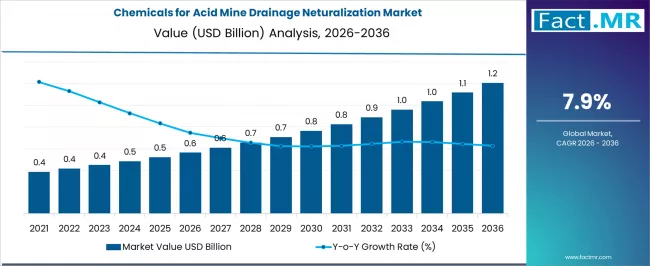
Defining trends involve the optimization of traditional alkaline reagents for higher efficiency and lower sludge generation, alongside the integration of alternative alkaline by-products into treatment blends. Innovation is focused on automated, real-time dosing systems that adjust chemical feed based on influent acidity and flow, minimizing reagent waste. Integration of these chemical treatment systems with comprehensive site water closure plans and long-term monitoring protocols is becoming critical for sustainable mine closure and liability management.
Regulatory frameworks mandating the treatment of contaminated mine water during operation and after closure are the primary market drivers. Policies enforcing stringent water quality standards for discharge and increasing financial assurance requirements for legacy sites act as significant catalysts, positioning reliable, cost-effective neutralization chemicals as a non-negotiable operational and compliance cost for the global mining industry.
Chemicals for Acid Mine Drainage Neutralization Market
| Metric | Value |
|---|---|
| Market Value (2026) | USD 0.56 Billion |
| Market Forecast Value (2036) | USD 1.21 Billion |
| Forecast CAGR (2026-2036) | 7.9% |
Category
| Category | Segments |
|---|---|
| Neutralizing Chemistry | Hydrated lime & quicklime, Limestone, crushed rock and alkaline sources, Caustic soda (NaOH) & Sodium-based alkalis, Magnesium hydroxide and MgO systems, Soda-ash & carbonate blends, Alkaline industrial by-products, Proprietary blended neutralizers |
| Process | Active treatment plants (lime dosing & pH control), Passive treatment & constructed wetlands (alkaline dosing), Stockpile & runoff neutralization (pre-treatment), Tailings & seepage collection & neutralization, On-site reagent staging & intermittent dosing |
| Customer & End User | Mining companies (integrated water treatment systems), Contract water treatment & EPC firms, Government & remediation projects, Industrial/minerals processors with AMD issues, Specialty toll-treaters & service providers |
| Region | North America, Latin America, Western Europe, Eastern Europe, East Asia, South Asia & Pacific, MEA |
Segmental Analysis
By Neutralizing Chemistry, Which Reagent is the Industry Standard for High-Acidity AMD?
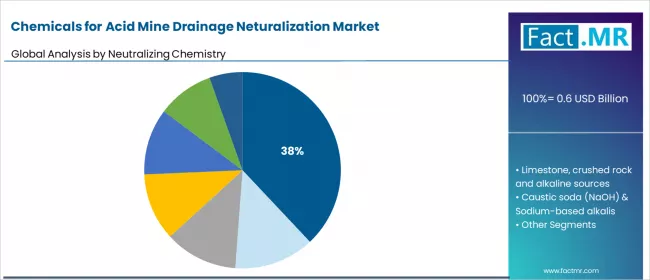
Hydrated lime & quicklime lead the segment with a 38% share. This dominance is due to lime's high neutralizing capacity, effectiveness in precipitating heavy metals, and well-understood application in high-flow, high-acidity scenarios. Despite challenges with sludge volume, its cost-effectiveness and reliability make it the cornerstone reagent for most active AMD treatment plants, especially where acid loads are significant and consistent.
By Process, Which Method Represents the Primary Engineered Solution for Ongoing Mining Operations?
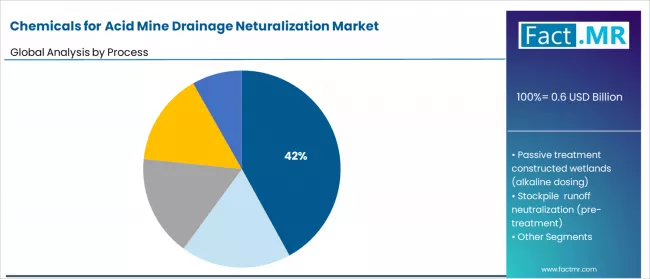
Active treatment plants command the largest process share at 42%. These facilities involve continuous, often automated, chemical dosing (typically lime-based) to treat AMD from active mines or legacy sites with high water volumes. They represent the most capital-intensive but most controllable and effective method for meeting strict discharge permits, forming the core of the market's chemical consumption.
By Customer & End User, Who Bears the Direct Operational and Liability Responsibility?
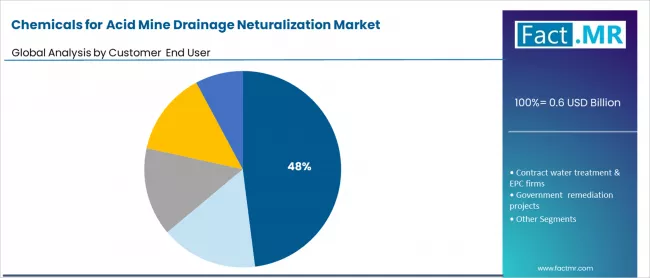
Mining companies are the dominant customer at 48.00%. Whether for active sites or legacy liability management, mining companies are directly responsible for treating contaminated water to regulatory standards. They are the primary purchasers, operating integrated treatment systems and driving demand for bulk chemicals. Their focus is on total lifecycle cost, supply reliability, and treatment efficacy to ensure compliance and protect their social license.
What are the Drivers, Restraints, and Key Trends of the Chemicals for Acid Mine Drainage Neutralization Market?
Market growth is driven by the global expansion of mining in sulfide-bearing ore bodies, which inherently generate AMD. Stricter enforcement of water discharge regulations globally, and particularly robust policies in regions like North America and the EU, mandate treatment. Increasing numbers of legacy mine sites entering formal remediation phases under government supervision create long-term demand. The rising focus on ESG performance also pressures companies to invest in effective water stewardship.
A significant restraint is the high operational cost of perpetual chemical treatment, especially for closed or abandoned mines with no revenue stream. The large volumes of sludge generated by conventional lime treatment pose a secondary disposal challenge and cost. Transportation and handling logistics for bulk alkalis in remote mining regions add expense. Furthermore, the variable and often unpredictable chemistry of AMD can make process control and chemical optimization difficult.
Key trends include the development and use of proprietary blended neutralizers that offer higher efficiency, lower sludge production, and better metal removal. There is growing interest in utilizing industrial alkaline by-products (e.g., slag, ash) as cost-effective alternatives. The market is also seeing a shift towards more automated, sensor-driven dosing to optimize chemical use. Additionally, integration of neutralization with other technologies (e.g., reverse osmosis, selective ion exchange) for polished water is emerging for sensitive environments.
Analysis of the Chemicals for Acid Mine Drainage Neutralization Market by Key Countries
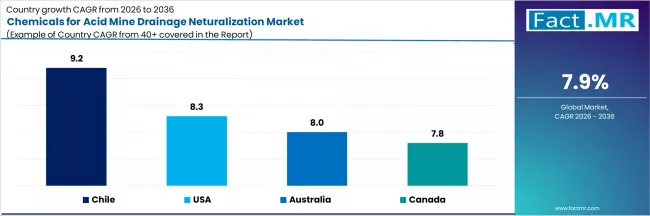
| Country | CAGR (2026-2036) |
|---|---|
| Chile | 9.20% |
| USA | 8.30% |
| Australia | 8.00% |
| Canada | 7.80% |
| South Africa | 7.00% |
How does Chile's Copper-Dominant Mining and Water Scarcity Drive High Growth?
Chile leads with a 9.20% CAGR, driven by its massive copper mining industry, where sulfide ore processing is a major AMD generator. Operating in an arid environment, the industry faces extreme scrutiny over water use and quality. Regulations require extensive water recycling and treatment, making efficient, reliable neutralization chemistry critical for both operational continuity and maintaining the social license to operate in water-stressed regions.
Why is the USA's Legacy Mine Liability and Regulatory Framework a Key Driver?
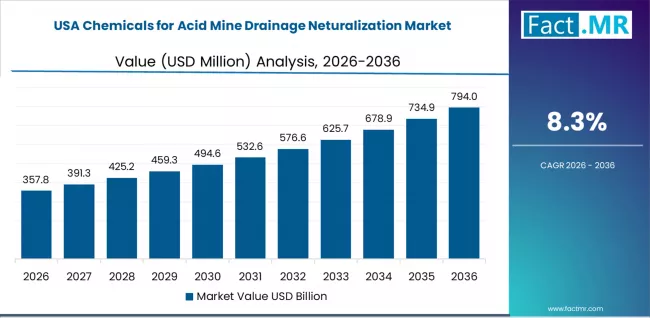
The USA's 8.30% growth is anchored in a vast inventory of both active mines and legacy sites under programs like CERCLA (Superfund). Federal and state agencies enforce stringent treatment requirements, creating a steady, compliance-driven demand for neutralization chemicals. A mix of active large-scale, government-funded remediation projects, requiring a range of chemical solutions and services and mine operations, characterizes the market.
What Role does Australia's Large-Scale Mining and Closure Planning Focus Play?
Australia's 8.00% growth is fueled by its large-scale metal mining sector and a strong regulatory emphasis on mine closure planning and financial provisioning. Companies must demonstrate viable, long-term water treatment strategies to obtain permits and release closure bonds. This forward-looking approach drives investment in both active treatment systems for operating mines and research into cost-effective, long-term passive or semi-active treatment solutions for post-closure.
How does Canada's Acid-Generating Geology and Stringent Standards Influence the Market?
Canada's 7.80% growth reflects its significant base and precious metal mining in sulfide-rich geological formations prone to AMD. Stringent federal and provincial effluent regulations, particularly for metal leaching and acidity, mandate robust treatment. The cold climate also presents unique challenges for treatment system operation, influencing the choice of chemicals and delivery systems (e.g., freeze-protected dosing).
What Factors Underpin South Africa's Legacy Coal and Gold Mining Sector?
South Africa's 7.00% growth is motivated by the extensive AMD legacy from its coal and gold mining industries, which is a national water quality priority. Government-led and corporate remediation programs for these large, acidic discharges create substantial demand for bulk alkaline reagents. The market often focuses on cost-effective solutions, including the assessment of local industrial by-products for use in treatment blends.
Competitive Landscape of the Chemicals for Acid Mine Drainage Neutralization Market
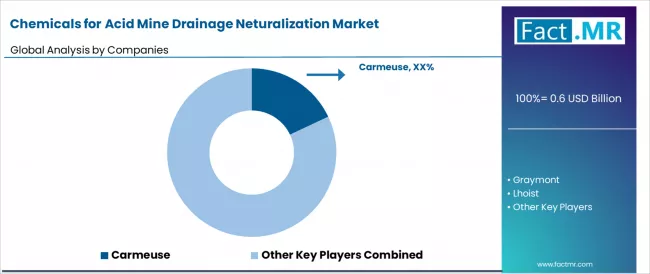
Global and regional lime and alkaline material producers, alongside specialty water treatment chemical suppliers, dominate the competitive landscape. Lime giants like Carmeuse, Graymont, and Lhoist compete based on the quality and consistency of their calcium and magnesium-based products, strategic location of production near mining districts, and logistical capabilities for bulk supply.
Water treatment chemical specialists like Kemira, Ecolab, and Solenis compete by offering proprietary blends, advanced dosing control systems, and comprehensive technical services aimed at optimizing the entire treatment process, including sludge management. Competition centers on providing the lowest total cost of treatment, reliable supply chains, and expertise in navigating complex regulatory requirements.
Key Players in the Chemicals for Acid Mine Drainage Neutralization Market
- Carmeuse
- Graymont
- Lhoist
- Kemira
- Ecolab
- Solenis
Scope of Report
| Items | Values |
|---|---|
| Quantitative Units | USD Billion |
| Neutralizing Chemistry | Hydrated lime & quicklime, Limestone & alkaline sources, Caustic soda, Magnesium hydroxide, Soda-ash & carbonates, Alkaline by-products, Proprietary blends |
| Process | Active treatment plants, Passive treatment, Stockpile/runoff neutralization, Tailings/seepage treatment, On-site staging |
| Customer & End User | Mining companies, Contract/EPC firms, Government remediation, Industrial processors, Specialty service providers |
| Key Countries | Chile, USA, Australia, Canada, South Africa |
| Key Companies | Carmeuse, Graymont, Lhoist, Kemira, Ecolab, Solenis |
| Additional Analysis | Analysis of neutralization efficiency (kg acid/kg reagent), sludge generation and dewaterability, reagent handling and safety considerations, corrosion impacts on infrastructure, and total lifecycle cost modeling for different chemical strategies. |
Chemicals for Acid Mine Drainage Neutralization Market by Segments
-
Neutralizing Chemistry :
- Hydrated lime & quicklime
- Limestone, crushed rock and alkaline sources
- Caustic soda (NaOH) & Sodium-based alkalis
- Magnesium hydroxide and MgO systems
- Soda-ash & carbonate blends
- Alkaline industrial by-products
- Proprietary blended neutralizers
-
Process :
- Active treatment plants (lime dosing & pH control)
- Passive treatment & constructed wetlands (alkaline dosing)
- Stockpile & runoff neutralization (pre-treatment)
- Tailings & seepage collection & neutralization
- On-site reagent staging & intermittent dosing
-
Customer & End User :
- Mining companies (integrated water treatment systems)
- Contract water treatment & EPC firms
- Government & remediation projects
- Industrial/minerals processors with AMD issues
- Specialty toll-treaters & service providers
-
Region :
-
North America
- USA
- Canada
-
Latin America
- Chile
- Brazil
- Peru
- Argentina
- Brazil
- Rest of Latin America
-
Western Europe
- Germany
- UK
- France
- Spain
- BENELUX
- Italy
- Rest of Western Europe
-
Eastern Europe
- Poland
- Russia
- Czech Republic
- Rest of Eastern Europe
-
East Asia
- China
- Japan
- South Korea
- Rest of East Asia
-
South Asia & Pacific
- Australia
- India
- ASEAN
- Rest of South Asia & Pacific
-
MEA
- GCC Countries
- South Africa
- Rest of MEA
-
Table of Content
- Executive Summary
- Global Market Outlook
- Demand to side Trends
- Supply to side Trends
- Technology Roadmap Analysis
- Analysis and Recommendations
- Market Overview
- Market Coverage / Taxonomy
- Market Definition / Scope / Limitations
- Market Background
- Market Dynamics
- Drivers
- Restraints
- Opportunity
- Trends
- Scenario Forecast
- Demand in Optimistic Scenario
- Demand in Likely Scenario
- Demand in Conservative Scenario
- Opportunity Map Analysis
- Product Life Cycle Analysis
- Supply Chain Analysis
- Investment Feasibility Matrix
- Value Chain Analysis
- PESTLE and Porter’s Analysis
- Regulatory Landscape
- Regional Parent Market Outlook
- Production and Consumption Statistics
- Import and Export Statistics
- Market Dynamics
- Global Market Analysis 2021 to 2025 and Forecast, 2026 to 2036
- Historical Market Size Value (USD Million) Analysis, 2021 to 2025
- Current and Future Market Size Value (USD Million) Projections, 2026 to 2036
- Y to o to Y Growth Trend Analysis
- Absolute $ Opportunity Analysis
- Global Market Pricing Analysis 2021 to 2025 and Forecast 2026 to 2036
- Global Market Analysis 2021 to 2025 and Forecast 2026 to 2036, By Neutralizing Chemistry
- Introduction / Key Findings
- Historical Market Size Value (USD Million) Analysis By Neutralizing Chemistry, 2021 to 2025
- Current and Future Market Size Value (USD Million) Analysis and Forecast By Neutralizing Chemistry, 2026 to 2036
- Hydrated lime & quicklime
- Limestone, crushed rock and alkaline sources
- Caustic soda (NaOH) & Sodium-based alkalis
- Magnesium hydroxide and MgO systems
- Soda-ash & carbonate blends
- Alkaline industrial by-products
- Proprietary blended neutralizers
- Hydrated lime & quicklime
- Y to o to Y Growth Trend Analysis By Neutralizing Chemistry, 2021 to 2025
- Absolute $ Opportunity Analysis By Neutralizing Chemistry, 2026 to 2036
- Global Market Analysis 2021 to 2025 and Forecast 2026 to 2036, By Process
- Introduction / Key Findings
- Historical Market Size Value (USD Million) Analysis By Process, 2021 to 2025
- Current and Future Market Size Value (USD Million) Analysis and Forecast By Process, 2026 to 2036
- Active treatment plants (lime dosing & pH control)
- Passive treatment constructed wetlands (alkaline dosing)
- Stockpile runoff neutralization (pre-treatment)
- Tailings seepage collection & neutralization
- On-site reagent staging & intermittent dosing
- Active treatment plants (lime dosing & pH control)
- Y to o to Y Growth Trend Analysis By Process, 2021 to 2025
- Absolute $ Opportunity Analysis By Process, 2026 to 2036
- Global Market Analysis 2021 to 2025 and Forecast 2026 to 2036, By Customer End User
- Introduction / Key Findings
- Historical Market Size Value (USD Million) Analysis By Customer End User, 2021 to 2025
- Current and Future Market Size Value (USD Million) Analysis and Forecast By Customer End User, 2026 to 2036
- Mining companies (integrated water treatment systems)
- Contract water treatment & EPC firms
- Government remediation projects
- Industrialminerals processors with AMD issues
- Specialty toll-treaters & service providers
- Mining companies (integrated water treatment systems)
- Y to o to Y Growth Trend Analysis By Customer End User, 2021 to 2025
- Absolute $ Opportunity Analysis By Customer End User, 2026 to 2036
- Global Market Analysis 2021 to 2025 and Forecast 2026 to 2036, By Region
- Introduction
- Historical Market Size Value (USD Million) Analysis By Region, 2021 to 2025
- Current Market Size Value (USD Million) Analysis and Forecast By Region, 2026 to 2036
- North America
- Latin America
- Western Europe
- Eastern Europe
- East Asia
- South Asia and Pacific
- Middle East & Africa
- Market Attractiveness Analysis By Region
- North America Market Analysis 2021 to 2025 and Forecast 2026 to 2036, By Country
- Historical Market Size Value (USD Million) Trend Analysis By Market Taxonomy, 2021 to 2025
- Market Size Value (USD Million) Forecast By Market Taxonomy, 2026 to 2036
- By Country
- USA
- Canada
- Mexico
- By Neutralizing Chemistry
- By Process
- By Customer End User
- By Country
- Market Attractiveness Analysis
- By Country
- By Neutralizing Chemistry
- By Process
- By Customer End User
- Key Takeaways
- Latin America Market Analysis 2021 to 2025 and Forecast 2026 to 2036, By Country
- Historical Market Size Value (USD Million) Trend Analysis By Market Taxonomy, 2021 to 2025
- Market Size Value (USD Million) Forecast By Market Taxonomy, 2026 to 2036
- By Country
- Brazil
- Chile
- Rest of Latin America
- By Neutralizing Chemistry
- By Process
- By Customer End User
- By Country
- Market Attractiveness Analysis
- By Country
- By Neutralizing Chemistry
- By Process
- By Customer End User
- Key Takeaways
- Western Europe Market Analysis 2021 to 2025 and Forecast 2026 to 2036, By Country
- Historical Market Size Value (USD Million) Trend Analysis By Market Taxonomy, 2021 to 2025
- Market Size Value (USD Million) Forecast By Market Taxonomy, 2026 to 2036
- By Country
- Germany
- UK
- Italy
- Spain
- France
- Nordic
- BENELUX
- Rest of Western Europe
- By Neutralizing Chemistry
- By Process
- By Customer End User
- By Country
- Market Attractiveness Analysis
- By Country
- By Neutralizing Chemistry
- By Process
- By Customer End User
- Key Takeaways
- Eastern Europe Market Analysis 2021 to 2025 and Forecast 2026 to 2036, By Country
- Historical Market Size Value (USD Million) Trend Analysis By Market Taxonomy, 2021 to 2025
- Market Size Value (USD Million) Forecast By Market Taxonomy, 2026 to 2036
- By Country
- Russia
- Poland
- Hungary
- Balkan & Baltic
- Rest of Eastern Europe
- By Neutralizing Chemistry
- By Process
- By Customer End User
- By Country
- Market Attractiveness Analysis
- By Country
- By Neutralizing Chemistry
- By Process
- By Customer End User
- Key Takeaways
- East Asia Market Analysis 2021 to 2025 and Forecast 2026 to 2036, By Country
- Historical Market Size Value (USD Million) Trend Analysis By Market Taxonomy, 2021 to 2025
- Market Size Value (USD Million) Forecast By Market Taxonomy, 2026 to 2036
- By Country
- China
- Japan
- South Korea
- By Neutralizing Chemistry
- By Process
- By Customer End User
- By Country
- Market Attractiveness Analysis
- By Country
- By Neutralizing Chemistry
- By Process
- By Customer End User
- Key Takeaways
- South Asia and Pacific Market Analysis 2021 to 2025 and Forecast 2026 to 2036, By Country
- Historical Market Size Value (USD Million) Trend Analysis By Market Taxonomy, 2021 to 2025
- Market Size Value (USD Million) Forecast By Market Taxonomy, 2026 to 2036
- By Country
- India
- ASEAN
- Australia & New Zealand
- Rest of South Asia and Pacific
- By Neutralizing Chemistry
- By Process
- By Customer End User
- By Country
- Market Attractiveness Analysis
- By Country
- By Neutralizing Chemistry
- By Process
- By Customer End User
- Key Takeaways
- Middle East & Africa Market Analysis 2021 to 2025 and Forecast 2026 to 2036, By Country
- Historical Market Size Value (USD Million) Trend Analysis By Market Taxonomy, 2021 to 2025
- Market Size Value (USD Million) Forecast By Market Taxonomy, 2026 to 2036
- By Country
- Kingdom of Saudi Arabia
- Other GCC Countries
- Turkiye
- South Africa
- Other African Union
- Rest of Middle East & Africa
- By Neutralizing Chemistry
- By Process
- By Customer End User
- By Country
- Market Attractiveness Analysis
- By Country
- By Neutralizing Chemistry
- By Process
- By Customer End User
- Key Takeaways
- Key Countries Market Analysis
- USA
- Pricing Analysis
- Market Share Analysis, 2025
- By Neutralizing Chemistry
- By Process
- By Customer End User
- Canada
- Pricing Analysis
- Market Share Analysis, 2025
- By Neutralizing Chemistry
- By Process
- By Customer End User
- Mexico
- Pricing Analysis
- Market Share Analysis, 2025
- By Neutralizing Chemistry
- By Process
- By Customer End User
- Brazil
- Pricing Analysis
- Market Share Analysis, 2025
- By Neutralizing Chemistry
- By Process
- By Customer End User
- Chile
- Pricing Analysis
- Market Share Analysis, 2025
- By Neutralizing Chemistry
- By Process
- By Customer End User
- Germany
- Pricing Analysis
- Market Share Analysis, 2025
- By Neutralizing Chemistry
- By Process
- By Customer End User
- UK
- Pricing Analysis
- Market Share Analysis, 2025
- By Neutralizing Chemistry
- By Process
- By Customer End User
- Italy
- Pricing Analysis
- Market Share Analysis, 2025
- By Neutralizing Chemistry
- By Process
- By Customer End User
- Spain
- Pricing Analysis
- Market Share Analysis, 2025
- By Neutralizing Chemistry
- By Process
- By Customer End User
- France
- Pricing Analysis
- Market Share Analysis, 2025
- By Neutralizing Chemistry
- By Process
- By Customer End User
- India
- Pricing Analysis
- Market Share Analysis, 2025
- By Neutralizing Chemistry
- By Process
- By Customer End User
- ASEAN
- Pricing Analysis
- Market Share Analysis, 2025
- By Neutralizing Chemistry
- By Process
- By Customer End User
- Australia & New Zealand
- Pricing Analysis
- Market Share Analysis, 2025
- By Neutralizing Chemistry
- By Process
- By Customer End User
- China
- Pricing Analysis
- Market Share Analysis, 2025
- By Neutralizing Chemistry
- By Process
- By Customer End User
- Japan
- Pricing Analysis
- Market Share Analysis, 2025
- By Neutralizing Chemistry
- By Process
- By Customer End User
- South Korea
- Pricing Analysis
- Market Share Analysis, 2025
- By Neutralizing Chemistry
- By Process
- By Customer End User
- Russia
- Pricing Analysis
- Market Share Analysis, 2025
- By Neutralizing Chemistry
- By Process
- By Customer End User
- Poland
- Pricing Analysis
- Market Share Analysis, 2025
- By Neutralizing Chemistry
- By Process
- By Customer End User
- Hungary
- Pricing Analysis
- Market Share Analysis, 2025
- By Neutralizing Chemistry
- By Process
- By Customer End User
- Kingdom of Saudi Arabia
- Pricing Analysis
- Market Share Analysis, 2025
- By Neutralizing Chemistry
- By Process
- By Customer End User
- Turkiye
- Pricing Analysis
- Market Share Analysis, 2025
- By Neutralizing Chemistry
- By Process
- By Customer End User
- South Africa
- Pricing Analysis
- Market Share Analysis, 2025
- By Neutralizing Chemistry
- By Process
- By Customer End User
- USA
- Market Structure Analysis
- Competition Dashboard
- Competition Benchmarking
- Market Share Analysis of Top Players
- By Regional
- By Neutralizing Chemistry
- By Process
- By Customer End User
- Competition Analysis
- Competition Deep Dive
- Carmeuse
- Overview
- Product Portfolio
- Profitability by Market Segments (Product/Age /Sales Channel/Region)
- Sales Footprint
- Strategy Overview
- Marketing Strategy
- Product Strategy
- Channel Strategy
- Graymont
- Lhoist
- Kemira
- Ecolab
- Solenis
- Carmeuse
- Competition Deep Dive
- Assumptions & Acronyms Used
- Research Methodology
List Of Table
- Table 1: Global Market Value (USD Million) Forecast by Region, 2021 to 2036
- Table 2: Global Market Value (USD Million) Forecast by Neutralizing Chemistry, 2021 to 2036
- Table 3: Global Market Value (USD Million) Forecast by Process, 2021 to 2036
- Table 4: Global Market Value (USD Million) Forecast by Customer End User, 2021 to 2036
- Table 5: North America Market Value (USD Million) Forecast by Country, 2021 to 2036
- Table 6: North America Market Value (USD Million) Forecast by Neutralizing Chemistry, 2021 to 2036
- Table 7: North America Market Value (USD Million) Forecast by Process, 2021 to 2036
- Table 8: North America Market Value (USD Million) Forecast by Customer End User, 2021 to 2036
- Table 9: Latin America Market Value (USD Million) Forecast by Country, 2021 to 2036
- Table 10: Latin America Market Value (USD Million) Forecast by Neutralizing Chemistry, 2021 to 2036
- Table 11: Latin America Market Value (USD Million) Forecast by Process, 2021 to 2036
- Table 12: Latin America Market Value (USD Million) Forecast by Customer End User, 2021 to 2036
- Table 13: Western Europe Market Value (USD Million) Forecast by Country, 2021 to 2036
- Table 14: Western Europe Market Value (USD Million) Forecast by Neutralizing Chemistry, 2021 to 2036
- Table 15: Western Europe Market Value (USD Million) Forecast by Process, 2021 to 2036
- Table 16: Western Europe Market Value (USD Million) Forecast by Customer End User, 2021 to 2036
- Table 17: Eastern Europe Market Value (USD Million) Forecast by Country, 2021 to 2036
- Table 18: Eastern Europe Market Value (USD Million) Forecast by Neutralizing Chemistry, 2021 to 2036
- Table 19: Eastern Europe Market Value (USD Million) Forecast by Process, 2021 to 2036
- Table 20: Eastern Europe Market Value (USD Million) Forecast by Customer End User, 2021 to 2036
- Table 21: East Asia Market Value (USD Million) Forecast by Country, 2021 to 2036
- Table 22: East Asia Market Value (USD Million) Forecast by Neutralizing Chemistry, 2021 to 2036
- Table 23: East Asia Market Value (USD Million) Forecast by Process, 2021 to 2036
- Table 24: East Asia Market Value (USD Million) Forecast by Customer End User, 2021 to 2036
- Table 25: South Asia and Pacific Market Value (USD Million) Forecast by Country, 2021 to 2036
- Table 26: South Asia and Pacific Market Value (USD Million) Forecast by Neutralizing Chemistry, 2021 to 2036
- Table 27: South Asia and Pacific Market Value (USD Million) Forecast by Process, 2021 to 2036
- Table 28: South Asia and Pacific Market Value (USD Million) Forecast by Customer End User, 2021 to 2036
- Table 29: Middle East & Africa Market Value (USD Million) Forecast by Country, 2021 to 2036
- Table 30: Middle East & Africa Market Value (USD Million) Forecast by Neutralizing Chemistry, 2021 to 2036
- Table 31: Middle East & Africa Market Value (USD Million) Forecast by Process, 2021 to 2036
- Table 32: Middle East & Africa Market Value (USD Million) Forecast by Customer End User, 2021 to 2036
List Of Figures
- Figure 1: Global Market Pricing Analysis
- Figure 2: Global Market Value (USD Million) Forecast 2021 to 2036
- Figure 3: Global Market Value Share and BPS Analysis by Neutralizing Chemistry, 2026 and 2036
- Figure 4: Global Market Y to o to Y Growth Comparison by Neutralizing Chemistry, 2026 to 2036
- Figure 5: Global Market Attractiveness Analysis by Neutralizing Chemistry
- Figure 6: Global Market Value Share and BPS Analysis by Process, 2026 and 2036
- Figure 7: Global Market Y to o to Y Growth Comparison by Process, 2026 to 2036
- Figure 8: Global Market Attractiveness Analysis by Process
- Figure 9: Global Market Value Share and BPS Analysis by Customer End User, 2026 and 2036
- Figure 10: Global Market Y to o to Y Growth Comparison by Customer End User, 2026 to 2036
- Figure 11: Global Market Attractiveness Analysis by Customer End User
- Figure 12: Global Market Value (USD Million) Share and BPS Analysis by Region, 2026 and 2036
- Figure 13: Global Market Y to o to Y Growth Comparison by Region, 2026 to 2036
- Figure 14: Global Market Attractiveness Analysis by Region
- Figure 15: North America Market Incremental Dollar Opportunity, 2026 to 2036
- Figure 16: Latin America Market Incremental Dollar Opportunity, 2026 to 2036
- Figure 17: Western Europe Market Incremental Dollar Opportunity, 2026 to 2036
- Figure 18: Eastern Europe Market Incremental Dollar Opportunity, 2026 to 2036
- Figure 19: East Asia Market Incremental Dollar Opportunity, 2026 to 2036
- Figure 20: South Asia and Pacific Market Incremental Dollar Opportunity, 2026 to 2036
- Figure 21: Middle East & Africa Market Incremental Dollar Opportunity, 2026 to 2036
- Figure 22: North America Market Value Share and BPS Analysis by Country, 2026 and 2036
- Figure 23: North America Market Value Share and BPS Analysis by Neutralizing Chemistry, 2026 and 2036
- Figure 24: North America Market Y to o to Y Growth Comparison by Neutralizing Chemistry, 2026 to 2036
- Figure 25: North America Market Attractiveness Analysis by Neutralizing Chemistry
- Figure 26: North America Market Value Share and BPS Analysis by Process, 2026 and 2036
- Figure 27: North America Market Y to o to Y Growth Comparison by Process, 2026 to 2036
- Figure 28: North America Market Attractiveness Analysis by Process
- Figure 29: North America Market Value Share and BPS Analysis by Customer End User, 2026 and 2036
- Figure 30: North America Market Y to o to Y Growth Comparison by Customer End User, 2026 to 2036
- Figure 31: North America Market Attractiveness Analysis by Customer End User
- Figure 32: Latin America Market Value Share and BPS Analysis by Country, 2026 and 2036
- Figure 33: Latin America Market Value Share and BPS Analysis by Neutralizing Chemistry, 2026 and 2036
- Figure 34: Latin America Market Y to o to Y Growth Comparison by Neutralizing Chemistry, 2026 to 2036
- Figure 35: Latin America Market Attractiveness Analysis by Neutralizing Chemistry
- Figure 36: Latin America Market Value Share and BPS Analysis by Process, 2026 and 2036
- Figure 37: Latin America Market Y to o to Y Growth Comparison by Process, 2026 to 2036
- Figure 38: Latin America Market Attractiveness Analysis by Process
- Figure 39: Latin America Market Value Share and BPS Analysis by Customer End User, 2026 and 2036
- Figure 40: Latin America Market Y to o to Y Growth Comparison by Customer End User, 2026 to 2036
- Figure 41: Latin America Market Attractiveness Analysis by Customer End User
- Figure 42: Western Europe Market Value Share and BPS Analysis by Country, 2026 and 2036
- Figure 43: Western Europe Market Value Share and BPS Analysis by Neutralizing Chemistry, 2026 and 2036
- Figure 44: Western Europe Market Y to o to Y Growth Comparison by Neutralizing Chemistry, 2026 to 2036
- Figure 45: Western Europe Market Attractiveness Analysis by Neutralizing Chemistry
- Figure 46: Western Europe Market Value Share and BPS Analysis by Process, 2026 and 2036
- Figure 47: Western Europe Market Y to o to Y Growth Comparison by Process, 2026 to 2036
- Figure 48: Western Europe Market Attractiveness Analysis by Process
- Figure 49: Western Europe Market Value Share and BPS Analysis by Customer End User, 2026 and 2036
- Figure 50: Western Europe Market Y to o to Y Growth Comparison by Customer End User, 2026 to 2036
- Figure 51: Western Europe Market Attractiveness Analysis by Customer End User
- Figure 52: Eastern Europe Market Value Share and BPS Analysis by Country, 2026 and 2036
- Figure 53: Eastern Europe Market Value Share and BPS Analysis by Neutralizing Chemistry, 2026 and 2036
- Figure 54: Eastern Europe Market Y to o to Y Growth Comparison by Neutralizing Chemistry, 2026 to 2036
- Figure 55: Eastern Europe Market Attractiveness Analysis by Neutralizing Chemistry
- Figure 56: Eastern Europe Market Value Share and BPS Analysis by Process, 2026 and 2036
- Figure 57: Eastern Europe Market Y to o to Y Growth Comparison by Process, 2026 to 2036
- Figure 58: Eastern Europe Market Attractiveness Analysis by Process
- Figure 59: Eastern Europe Market Value Share and BPS Analysis by Customer End User, 2026 and 2036
- Figure 60: Eastern Europe Market Y to o to Y Growth Comparison by Customer End User, 2026 to 2036
- Figure 61: Eastern Europe Market Attractiveness Analysis by Customer End User
- Figure 62: East Asia Market Value Share and BPS Analysis by Country, 2026 and 2036
- Figure 63: East Asia Market Value Share and BPS Analysis by Neutralizing Chemistry, 2026 and 2036
- Figure 64: East Asia Market Y to o to Y Growth Comparison by Neutralizing Chemistry, 2026 to 2036
- Figure 65: East Asia Market Attractiveness Analysis by Neutralizing Chemistry
- Figure 66: East Asia Market Value Share and BPS Analysis by Process, 2026 and 2036
- Figure 67: East Asia Market Y to o to Y Growth Comparison by Process, 2026 to 2036
- Figure 68: East Asia Market Attractiveness Analysis by Process
- Figure 69: East Asia Market Value Share and BPS Analysis by Customer End User, 2026 and 2036
- Figure 70: East Asia Market Y to o to Y Growth Comparison by Customer End User, 2026 to 2036
- Figure 71: East Asia Market Attractiveness Analysis by Customer End User
- Figure 72: South Asia and Pacific Market Value Share and BPS Analysis by Country, 2026 and 2036
- Figure 73: South Asia and Pacific Market Value Share and BPS Analysis by Neutralizing Chemistry, 2026 and 2036
- Figure 74: South Asia and Pacific Market Y to o to Y Growth Comparison by Neutralizing Chemistry, 2026 to 2036
- Figure 75: South Asia and Pacific Market Attractiveness Analysis by Neutralizing Chemistry
- Figure 76: South Asia and Pacific Market Value Share and BPS Analysis by Process, 2026 and 2036
- Figure 77: South Asia and Pacific Market Y to o to Y Growth Comparison by Process, 2026 to 2036
- Figure 78: South Asia and Pacific Market Attractiveness Analysis by Process
- Figure 79: South Asia and Pacific Market Value Share and BPS Analysis by Customer End User, 2026 and 2036
- Figure 80: South Asia and Pacific Market Y to o to Y Growth Comparison by Customer End User, 2026 to 2036
- Figure 81: South Asia and Pacific Market Attractiveness Analysis by Customer End User
- Figure 82: Middle East & Africa Market Value Share and BPS Analysis by Country, 2026 and 2036
- Figure 83: Middle East & Africa Market Value Share and BPS Analysis by Neutralizing Chemistry, 2026 and 2036
- Figure 84: Middle East & Africa Market Y to o to Y Growth Comparison by Neutralizing Chemistry, 2026 to 2036
- Figure 85: Middle East & Africa Market Attractiveness Analysis by Neutralizing Chemistry
- Figure 86: Middle East & Africa Market Value Share and BPS Analysis by Process, 2026 and 2036
- Figure 87: Middle East & Africa Market Y to o to Y Growth Comparison by Process, 2026 to 2036
- Figure 88: Middle East & Africa Market Attractiveness Analysis by Process
- Figure 89: Middle East & Africa Market Value Share and BPS Analysis by Customer End User, 2026 and 2036
- Figure 90: Middle East & Africa Market Y to o to Y Growth Comparison by Customer End User, 2026 to 2036
- Figure 91: Middle East & Africa Market Attractiveness Analysis by Customer End User
- Figure 92: Global Market - Tier Structure Analysis
- Figure 93: Global Market - Company Share Analysis
- FAQs -
How big is the chemicals for acid mine drainage neturalization market in 2026?
The global chemicals for acid mine drainage neturalization market is estimated to be valued at USD 0.6 billion in 2026.
What will be the size of chemicals for acid mine drainage neturalization market in 2036?
The market size for the chemicals for acid mine drainage neturalization market is projected to reach USD 1.2 billion by 2036.
How much will be the chemicals for acid mine drainage neturalization market growth between 2026 and 2036?
The chemicals for acid mine drainage neturalization market is expected to grow at a 7.9% CAGR between 2026 and 2036.
What are the key product types in the chemicals for acid mine drainage neturalization market?
The key product types in chemicals for acid mine drainage neturalization market are hydrated lime & quicklime, limestone, crushed rock and alkaline sources, caustic soda (naoh) & sodium-based alkalis, magnesium hydroxide and mgo systems, soda-ash & carbonate blends, alkaline industrial by-products and proprietary blended neutralizers.
Which process segment to contribute significant share in the chemicals for acid mine drainage neturalization market in 2026?
In terms of process, active treatment plants (lime dosing & ph control) segment to command 42.0% share in the chemicals for acid mine drainage neturalization market in 2026.