- Market Value (2025): USD 34.8 Bn
- Estimated Value (2026): USD 35.8 Bn
- Forecast Value (2036): USD 47.1 Bn
- CAGR (2026-2036): 2.8%
What is the Chewing Tobacco Market forecast to be worth by 2036?
USD 35.8 billion in 2026 to USD 47.2 billion by 2036 at a 2.8% CAGR.
- Fact.MR estimates the chewing tobacco market at USD 34.8 billion for 2025, with loose leaf pouches accounting for the bulk of purchases.
- The market will reach USD 47.1 billion by 2036, up from USD 35.8 billion in 2026, as price increases offset flat or falling unit volumes in mature countries.
- Value gains will average 2.8% CAGR from 2026 to 2036, a pace held down by tobacco-control measures and the shift of some users toward nicotine pouches.
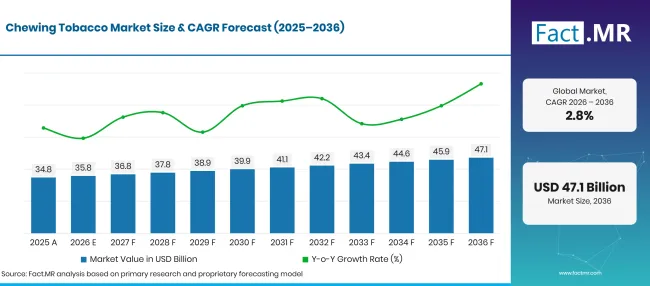
Chewing Tobacco Market Forecast Global | Source: Fact.MR
| Year | Basis | Market Value (USD billion) |
|---|---|---|
| 2025 | Actual | 34.8 |
| 2026 | Estimate | 35.8 |
| 2036 | Forecast | 47.1 |
| CAGR 2026 to 2036 | Forecast period | 2.8% |
Source: Fact.MR analysis. Updated Oct 26, 2026
What are the defining numbers behind Chewing Tobacco Market growth?
USD 11.4 billion of new value will accrue between 2026 and 2036, drawn mainly from price and mix in established markets.
- Demand Drivers in the Market
- A large installed base of tobacco users keeps oral formats on shelves. The World Health Organization states that there are 1.2 billion tobacco users worldwide and that about 80% of them live in low- and middle-income countries [1]. Chewing products serve a slice of this base where oral use is culturally established.
- Flavor remains a central purchase cue, though rules are tightening. The WHO FCTC Secretariat reported in May 2025 that more than 50 countries had banned flavoured tobacco products, and it urged its 183 Parties to prohibit attractiveness-enhancing ingredients [2]. Brands with mint and wintergreen lines must track each country’s ingredient list before launches.
- Clearer product standards give compliant manufacturers a stable operating frame. In October 2025, the WHO FCTC Secretariat issued a guide for drafting smokeless tobacco regulation that covers product contents and labelling [3]. Firms that already meet such requirements face fewer reformulation costs when rules arrive.
- Value pricing holds users who would otherwise quit or switch. Discount loose leaf brands give price-sensitive buyers an option when excise increases push premium products higher.
- Oral nicotine pouches are reshaping the shelf around traditional chew. In January 2025, the U.S. Food and Drug Administration authorized 20 ZYN nicotine pouch products, the first pouches it had cleared, while stating that the authorization does not mean the products are safe [4]. Chew makers now share counter space and distributor attention with these tobacco-free formats.
- Key Segments Analyzed
- By Product Type: Loose Leaf will hold 43.2% share in 2026, since users portion shredded leaf by the pinch and discount brands keep it within reach of price-sensitive buyers.
- By Flavor: Mint will account for 47.7% share in 2026, given that wintergreen and spearmint notes have long defined the taste of oral tobacco.
- By Distribution Channel: Convenience Stores will capture 38.5% share in 2026 through long opening hours and counter displays placed near the till.
- By End-User: Male Consumers will represent 67.8% share in 2026, reflecting much higher tobacco use among men than among women.
- Analyst Opinion at Fact.MR
- Shambhu Nath Jha, Principal Consultant at Fact.MR, states, “Chewing tobacco is a mature category in which revenue now comes more from price than from new users. Manufacturers that keep a value tier, meet each country’s flavor and labelling rules and hold convenience store distribution will keep their volumes steadier. Health policy will continue to narrow the category, so planning must assume shrinking unit sales in most high-income countries.”
- Strategic Implications
- Manufacturers should audit flavor portfolios against national ingredient bans before each launch, given that mint and fruit variants face the most regulatory scrutiny.
- Distributors should invest in age verification and licensing records at store level, since compliance failures can cost retail accounts.
- Retailers should plan shelf space for chew alongside nicotine pouches and moist snuff, as some buyers move between oral formats.
- Investors should judge chew businesses on pricing power and regulatory exposure, because unit volumes in mature countries are flat to declining.
Japan will lead the comparison at 3.6% CAGR, where adult smoking rates continue to fall and oral products remain a small niche. The United Kingdom follows at 3.2% as declining cigarette use leaves room for other formats among adult tobacco users. Germany will grow at 2.8%, matching the global pace, with a large taxed tobacco market. A 2.4% rate in the United States reflects a big but slowly shrinking loose leaf user base. Brazil completes the group at 2.0%, held back by strict national tobacco control.
How does the Chewing Tobacco Market break down by segment?
Loose Leaf will lead Product Type at 43.2%; Mint will top Flavor at 47.7%; Convenience Stores will head Distribution Channel at 38.5%; Male Consumers will hold first place in End-User at 67.8%.
Which Product Type dominates?
Loose Leaf takes 43.2% of 2026 sales.
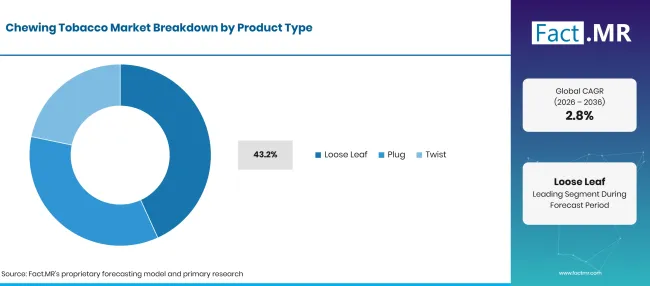
Chewing Tobacco Market Breakdown Product Type | Source: Fact.MR
| Product Type | Share (2026) |
|---|---|
| Loose Leaf (Leading segment) | 43.2% |
| Other segments combined | 56.8%* |
| Total | 100.0% |
Source: Fact.MR analysis. Updated Oct 26, 2026
Shredded leaf sold in resealable foil pouches lets each user decide the size of a portion. Discount brands in this format give buyers a lower price per ounce than premium plug products. Some loose leaf is now packed in pre-portioned bags, a format closer to snus pouches sold in Northern Europe. Plug tobacco is pressed into bricks and cut by the user, and it appeals to older buyers with fixed habits. Twist, a rope of cured leaf, remains a small regional product with a few heritage brands. Both formats depend on long-standing users, with few new entrants.
What leads the Flavor segment?
Mint represents 47.7% of 2026 sales.
| Flavor | Share (2026) |
|---|---|
| Mint (Leading segment) | 47.7% |
| Other segments combined | 52.3%* |
| Total | 100.0% |
Source: Fact.MR analysis. Updated Oct 26, 2026
A cooling taste masks the bitterness of cured leaf, which keeps wintergreen and spearmint at the front of the shelf. Flavor houses supply natural extracts such as spearmint oil and synthetic menthol blends to tobacco manufacturers. Fruit variants face the closest regulatory review, and the WHO FCTC Secretariat named mango and menthol among flavors that draw in new users [2]. Classic unflavored and lightly sweetened products hold steady among older buyers. Flavor bans in several countries will push portfolios toward fewer, simpler profiles.
How does Distribution Channel shape demand?
Convenience Stores make 38.5% of 2026 sales.
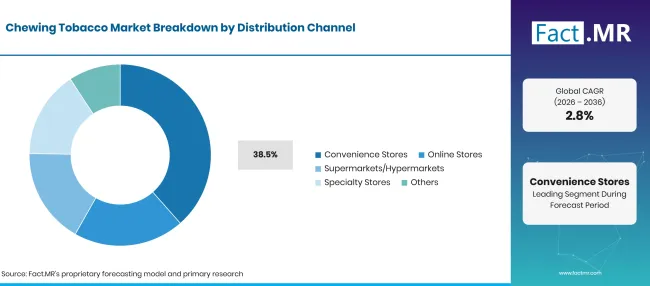
Chewing Tobacco Market Breakdown Distribution Channel | Source: Fact.MR
| Distribution Channel | Share (2026) |
|---|---|
| Convenience Stores (Leading segment) | 38.5% |
| Other segments combined | 61.5%* |
| Total | 100.0% |
Source: Fact.MR analysis. Updated Oct 26, 2026
Most chew users buy small pouches several times a week, which suits stores open early and late near fuel pumps and on rural routes. Wholesalers deliver mixed tobacco orders on fixed schedules, and manufacturers pay for counter fixtures and promotional space. Supermarkets and hypermarkets stock fewer variants in locked cabinets. Specialty tobacconists carry premium plug and twist brands. Online sales face age verification and shipping limits in many countries, and retail packs must carry warnings that drive demand for compliant tobacco packaging.
What supports Male Consumers within End-User?
Male Consumers buy 67.8% of 2026 volume by value.
| End-User | Share (2026) |
|---|---|
| Male Consumers (Leading segment) | 67.8% |
| Other segments combined | 32.2%* |
| Total | 100.0% |
Source: Fact.MR analysis. Updated Oct 26, 2026
Oral tobacco use has long been concentrated among men in outdoor trades, farming and sport. The WHO reported in October 2025 that just under 1 billion men use tobacco, more than four in five users worldwide, while female prevalence fell to 6.6% in 2024 [5]. Female Consumers remain a small group in most countries, and their tobacco use has fallen faster than men’s. Brands avoid marketing aimed at new users because many jurisdictions limit tobacco advertising. Some users who try to quit chew turn to nicotine replacement therapy. Others use nicotine gum to manage cravings.
What is accelerating Chewing Tobacco Market adoption, and what is holding it back?
Price increases, value brands and broad store access keep revenue moving even as user numbers fall. Tobacco-control policy now reaches most of the world, and the WHO reported in June 2025 that 6.1 billion people are covered by at least one best-practice tobacco control measure [6].
Drivers Impact Analysis
| DRIVER | (~) % IMPACT ON CAGR | GEOGRAPHIC RELEVANCE | IMPACT TIMELINE |
|---|---|---|---|
| Price increases and excise pass-through on established brands | +0.9% | North America, South Asia & Pacific | Short term (<= 2 years) |
| Convenience store reach and counter placement | +0.7% | North America, Latin America | Short term (<= 2 years) |
| Value loose leaf brands that retain price-sensitive users | +0.6% | North America, Western Europe | Medium term (2-4 years) |
| Mint and wintergreen product lines where flavors stay permitted | +0.4% | North America, Middle East & Africa | Medium term (2-4 years) |
Source: Fact.MR analysis. Updated Oct 26, 2026
Opportunity Impact Analysis
| OPPORTUNITY | (~) % IMPACT ON CAGR | GEOGRAPHIC RELEVANCE | IMPACT TIMELINE |
|---|---|---|---|
| Pre-portioned chew bags for cleaner use | +0.5% | North America, Western Europe | Medium term (2-4 years) |
| Branded chewing tobacco in South Asian markets | +0.4% | South Asia & Pacific | Long term (>= 4 years) |
| Compliant packaging and age-verified online ordering | +0.3% | North America, Western Europe | Medium term (2-4 years) |
Source: Fact.MR analysis. Updated Oct 26, 2026
Restraints Impact Analysis
| RESTRAINT | (~) % IMPACT ON CAGR | GEOGRAPHIC RELEVANCE | IMPACT TIMELINE |
|---|---|---|---|
| Tobacco-control policy, advertising limits and tax increases | -0.7% | Global | Short term (<= 2 years) |
| User switching to nicotine pouches and other oral nicotine | -0.6% | North America, Western Europe | Medium term (2-4 years) |
| Flavor and ingredient bans | -0.4% | Western Europe, Latin America | Medium term (2-4 years) |
| Health risks of smokeless tobacco and declining user numbers | -0.4% | Global | Long term (>= 4 years) |
Source: Fact.MR analysis. Updated Oct 26, 2026
Which countries are scaling the Chewing Tobacco Market through 2036?
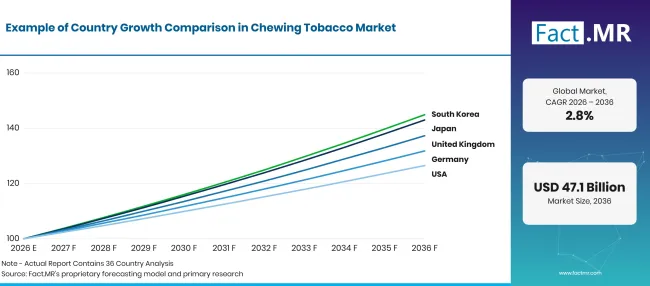
Chewing Tobacco Market Growth Index | Source: Fact.MR
| Country | CAGR (2026 to 2036) |
|---|---|
| Japan | 3.6% |
| United Kingdom | 3.2% |
| Germany | 2.8% |
| United States | 2.4% |
| Brazil | 2.0% |
Source: Fact.MR analysis. Updated Oct 26, 2026
How does Japan perform?
3.6% CAGR, helped by a small oral tobacco base that grows from new product listings.
Smoking keeps declining in Japan, which changes the mix of products that adult tobacco users buy. The Ministry of Health, Labour and Welfare reported in December 2025 that 14.8% of adults were habitual smokers in 2024, tied with 2022 as the lowest level in 12 years [7]. Chewing products in Japan remain a niche sold through tobacconists and online retailers.
How is the United Kingdom developing demand?
3.2% CAGR, reflecting falling cigarette use and a shift toward non-combustible formats.
The Office for National Statistics reported that 9.8% of UK adults, about 4.9 million people, smoked cigarettes in 2025 [8]. The rate was 10.6% in 2024, and men smoked at 11.3% against 8.2% for women [8]. Sales of chew to adults remain legal, and specialist shops and online sellers stock imported loose leaf and South Asian chewing products.
What supports Germany’s growth?
2.8% CAGR, driven by a large and stable taxed tobacco market.
Destatis reported that 66.4 billion cigarettes were taxed in Germany in 2025, up 0.2% from 2024 [9]. Classic pipe tobacco volumes rose 2.9% to 323 tonnes, while cigars and cigarillos fell 6.6% [9]. Tobacconists sell chew in small volumes, where it shares space with snuff and pipe products under EU labelling rules.
What supports United States adoption?
2.4% CAGR, backed by discount loose leaf brands and wide convenience store distribution.
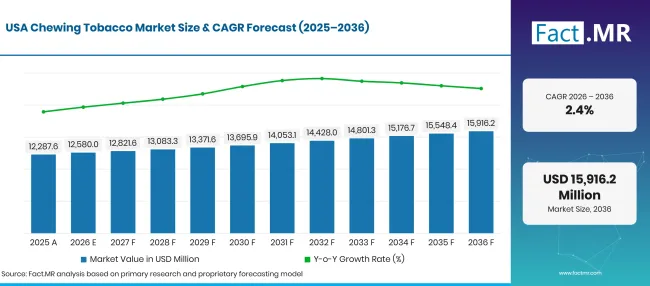
Chewing Tobacco Market Forecast Usa | Source: Fact.MR
The United States has a long-established base of loose leaf chew users, but youth use keeps falling. FDA data from the 2025 National Youth Tobacco Survey showed that 7.2% of middle and high school students currently used any tobacco product, and 1.7% used nicotine pouches [10]. Value pricing and rural convenience stores keep adult purchases steady.
How is Brazil developing demand?
2.0% CAGR, as strict tobacco-control policy limits category growth.
Brazil runs one of the most active national tobacco-control programs in Latin America. The National Cancer Institute reported that adult smoking prevalence in state capitals reached 11.5% in 2024, at 13.9% for men and 9.5% for women [11]. INCA also links smokeless products to cancers of the head and neck, esophagus and pancreas [11]. Chew remains a minor product, sold mainly in rural areas.
Who leads the Chewing Tobacco Market?
Competition splits into three groups. U.S. loose leaf specialists such as Turning Point Brands, Swedish Match, American Snuff Company and Swisher International compete on discount pricing, wholesaler reach and counter placement in convenience stores.
Turning Point Brands reported in March 2026 that its legacy Stoker’s products grew by a high single digit in 2025, while modern oral pouches drove most segment growth [12]. Swedish Match runs chewing tobacco next to ZYN, which became the first nicotine pouch line authorized by the FDA in January 2025 [4]. European craft makers such as Mac Baren supply chew bags and snuff to tobacconists, and DS Group sells BABA chewing tobacco in India and export markets with saffron and premium variants. Each of these firms is balancing a declining chew base against faster pouch sales. Through 2036, pricing power, flavor compliance and the speed of the move into tobacco-free oral products will separate the groups that hold revenue from those that lose it.
Which companies are the key providers?
Key companies include Turning Point Brands Inc.; Swedish Match; American Snuff Company, LLC; Swisher International, Inc.; Mac Baren Tobacco Company; and DS Group.
- Turning Point Brands Inc.
- Swedish Match
- American Snuff Company, LLC
- Swisher International, Inc.
- Mac Baren Tobacco Company
- DS Group
Bibliography
- [1] World Health Organization. (2026, June 26). Tobacco and nicotine.
- [2] WHO Framework Convention on Tobacco Control Secretariat. (2025, May 30). WHO FCTC urges Parties to prohibit ingredients used to increase product attractiveness and palatability.
- [3] WHO Framework Convention on Tobacco Control Secretariat. (2025, October 16). Smokeless tobacco products: guide to drafting regulation to implement the WHO FCTC.
- [4] U.S. Food and Drug Administration. (2025, January 16). FDA Authorizes Marketing of 20 ZYN Nicotine Pouch Products after Extensive Scientific Review.
- [5] World Health Organization. (2025, October 6). WHO tobacco trends report: 1 in 5 adults still addicted to tobacco.
- [6] World Health Organization. (2025, June 23). WHO report on the global tobacco epidemic, 2025: warning about the dangers of tobacco.
- [7] Ministry of Health, Labour and Welfare, Japan. (2025, December 2). 令和6年「国民健康・栄養調査」の結果 [Results of the 2024 National Health and Nutrition Survey].
- [8] Office for National Statistics. (2026, October 6). Adult smoking habits in the UK: 2025.
- [9] Statistisches Bundesamt (Destatis). (2026, January 23). 0,2 % mehr versteuerte Zigaretten im Jahr 2025 [0.2% more taxed cigarettes in 2025].
- [10] U.S. Food and Drug Administration. (2026, June 23). National Youth Tobacco Survey: FDA Publishes Peer-Reviewed Journal Article, Releases 2025 Findings.
- [11] Instituto Nacional de Câncer (INCA), Brazil. (2026, July 23). Dia Nacional de Combate ao Fumo 2026: nota técnica [National Day Against Smoking 2026: technical note].
- [12] Turning Point Brands. (2026, March 2). Turning Point Brands Announces Fourth Quarter and Full Year 2025 Results.
This Report Answers
- Revenue for 2026 to 2036 is split by format, flavor, sales channel and user group.
- Each segment shows which subsegment leads and why buyers favor it.
- Five countries are compared on tax, smoking trends and tobacco-control rules.
- Profiles group chew makers by price tier, region and exposure to oral nicotine pouches.
- Restraint tables weigh flavor bans, advertising limits and user decline against price-led value gains.
What does the Chewing Tobacco Market cover?
Chewing tobacco in this study means cured tobacco leaf placed in the mouth and chewed or held without burning. It is sold as shredded loose leaf, pressed plug and twisted rope in mint, fruit, classic and other flavors.
Value is tracked at the manufacturer level across convenience stores, supermarkets, specialty tobacconists and online sellers. Male and female users are measured separately to show how use differs between the two groups.
What is included in the scope?
Branded and private label loose leaf, plug and twist products sold to adults are in scope, including pre-portioned chew bags made from cut leaf. Regional chewing products such as South Asian branded chewing tobacco count when sold in packaged retail form.
Sales through licensed retail outlets and age-verified online stores are included at the value paid to the manufacturer.
What is excluded from the scope?
Moist snuff, dry snuff and nicotine pouches without tobacco leaf are left out. Cigarettes, cigars, heated tobacco and e-cigarettes are also outside the boundary. Nicotine replacement products and smoking-cessation medicines are not counted.
Betel quid, paan and gutka mixes prepared by vendors at the point of sale are excluded, along with accessories such as spittoons and pouches sold separately.
How Was the Analysis Built?
The analysis draws on 120+ sources, 35+ company portfolios, 25+ countries, and more than 20 industry interviews.
- Primary Research: Primary research includes discussions with manufacturers, service providers, technology developers, distributors, end users, and subject-matter experts. These conversations examine purchasing priorities, product adoption, operational challenges, approval requirements, competitive positioning, and the factors that influence wider market acceptance.
- Desk Research: Desk research covers government statistics, regulatory publications, company filings, trade data, technical studies, industry associations, standards, public policy, and other authoritative sources. Every source used in the analysis is documented in the bibliography.
- Market Sizing and Forecasting: Market estimates combine historical performance, demand indicators, pricing and volume trends, segment shares, company participation, country-level growth, adoption patterns, investment activity, and barriers to market expansion.
- Data Validation and Update Cycle: Findings are validated by comparing primary interviews with public data, company activity, regulatory changes, trade patterns, and industry developments. Regular updates review new product launches, capacity changes, partnerships, approvals, and shifts in commercial adoption.
Segmentation
What is the report’s scope and coverage?
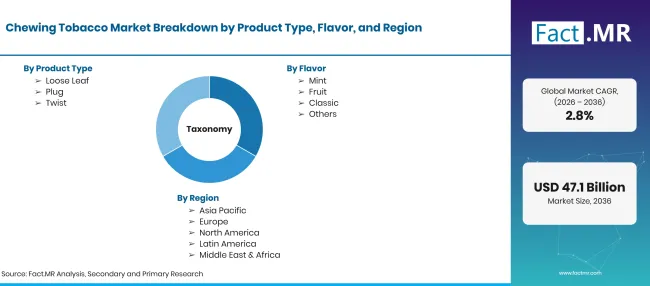
Chewing Tobacco Market Taxonomy | Source: Fact.MR
| Attribute | Details |
|---|---|
| Quantitative Units | USD billion in 2026 to USD billion by 2036 at CAGR |
| Market Definition | Cured tobacco for oral use without combustion, sold as loose leaf, plug or twist. Revenue is measured at manufacturer selling value across retail channels. |
| Product Type | Loose Leaf; Plug; Twist |
| Flavor | Mint; Fruit; Classic; Others |
| Distribution Channel | Convenience Stores; Online Stores; Supermarkets/Hypermarkets; Specialty Stores; Others |
| End-User | Male Consumers; Female Consumers |
| Regions Covered | North America; Latin America; Western Europe; Eastern Europe; East Asia; South Asia & Pacific; Middle East & Africa |
| Countries Covered | Japan; United Kingdom; Germany; United States; Brazil |
| Companies Profiled | Turning Point Brands Inc.; Swedish Match; American Snuff Company, LLC; Swisher International, Inc.; Mac Baren Tobacco Company; DS Group |
| Forecast Period | 2026 to 2036 |
| Approach | Hybrid top-down and bottom-up approach using taxed tobacco volumes, user prevalence surveys, retail price tracking by format, channel splits and manufacturer portfolio review. |
Source: Fact.MR analysis. Updated Oct 26, 2026
How is the market segmented?
-
By Product Type
- Loose Leaf
- Plug
- Twist
-
By Flavor
- Mint
- Fruit
- Classic
- Others
-
By Distribution Channel
- Convenience Stores
- Online Stores
- Supermarkets/Hypermarkets
- Specialty Stores
- Others
-
By End-User
- Male Consumers
- Female Consumers
-
By Region
- North America
- Latin America
- Western Europe
- Eastern Europe
- East Asia
- South Asia & Pacific
- Middle East & Africa
Frequently Asked Questions
How big is the chewing tobacco market in 2026?
What is the CAGR of the chewing tobacco market from 2026 to 2036?
Which product type leads the chewing tobacco market?
Which flavor leads the chewing tobacco market?
Which distribution channel leads the chewing tobacco market?
Which end-user leads the chewing tobacco market?
Which country will grow the most in the chewing tobacco market?
Who are the main companies in the chewing tobacco market?
Who worked on this report


Preview the report firsthand - request a free sample
Free SampleGet the brochure for pricing and purchase details
Download PDF