- Base Value(2024): Bn
- Estimated Value(2025): 6.2 Bn
- Forecast Value (2035): 7.7 Bn
- CAGR (2025 - 2035): 2.40%
Tobacco Packaging Market Market Size, Market Forecast and Outlook By Fact.MR
The tobacco packaging market was valued at USD Billion 21.66 in 2025, projected to reach USD Billion 22.18 in 2026, and is forecast to expand to USD Billion 28.12 by 2036 at a 2.40% CAGR. Expanding end-use application requirements, tightening performance specifications, and growing adoption across industrial and commercial sectors are driving sustained procurement growth globally.
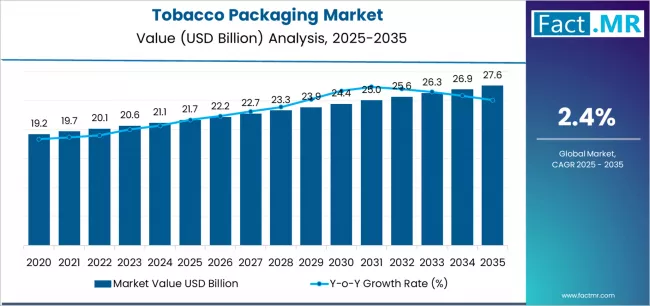
Tobacco Packaging Market Market Value Analysis | Source: Fact.MR
Summary of Tobacco Packaging Market
-
Market Overview
-
The market is valued at USD Billion 21.66 in 2025 and is projected to reach USD Billion 28.12 by 2036.
-
The industry is expected to grow at a 2.40% CAGR from 2026 to 2036, creating an incremental opportunity of USD Billion 5.94.
-
The market is a performance-driven category where product quality specifications, application-specific qualification, and supply chain reliability define competitive positioning across primary end-use sectors.
-
-
Demand and Growth Drivers
-
Demand is sustained by expanding secondary application requirements that specify paper & paperboard product configurations for performance-critical operations.
-
Tightening regulatory and quality standards across major consuming industries are driving specification upgrades toward higher-performance product grades.
-
Growing adoption in emerging application segments is creating incremental demand channels beyond traditional end-use categories.
-
Supply chain reliability and product consistency requirements are consolidating procurement toward qualified suppliers with demonstrated manufacturing capabilities.
-
-
Product and Segment View
-
The tobacco packaging market encompasses specialized products serving multiple industrial and commercial end-use applications with differentiated specifications.
-
The market is segmented by Material (Paper & Paperboard, Plastic, Other) and Type (Secondary, Primary).
-
Paper & Paperboard leads by Material with 83.2% share in 2026.
-
Secondary leads by Type with 76.5% share in 2026.
-
Scope includes all product variants and grades within the defined market, while excluding raw material feedstock valuations, downstream finished product pricing, and processing equipment.
-
-
Geography and Competitive Outlook
-
The global market spans all major manufacturing and consuming regions, with regional dynamics shaped by local regulatory frameworks and end-use industry concentration.
-
Competition is shaped by production capability, application expertise, and regulatory compliance, with key players including WestRock Company, Amcor plc, International Paper Company, Mondi plc, Sonoco Products Company, Siegwerk Druckfarben AG & Co. KGaA.
-
Supply chain positioning and customer qualification credentials determine procurement allocation across tier-1 and tier-2 supplier categories.
-
-
Analyst Opinion at Fact.MR
-
Shambhu Nath Jha, Principal Consultant at Fact.MR, opines: 'In my analysis, I have observed that procurement decisions in the tobacco packaging market increasingly depend on application-specific performance documentation and supply chain reliability credentials rather than per-unit pricing alone. Suppliers investing in technical service capabilities and quality consistency documentation hold procurement advantages over commodity-positioned competitors.'
-
Strategic Implications / Executive Takeaways
-
Manufacturers must invest in application-specific performance testing and qualification data to secure procurement positions with tier-1 end-use customers.
-
Procurement teams should evaluate total cost of ownership including product performance benefits and supply reliability rather than unit material pricing alone.
-
Companies must monitor regulatory developments across key consuming markets to anticipate specification changes and reformulation requirements.
-
Tobacco Packaging Market Market Key Takeaways
| Metric | Details |
|---|---|
| Industry Size (2026) | USD Billion 22.18 |
| Industry Value (2036) | USD Billion 28.12 |
| CAGR (2026 to 2036) | 2.40% |
Source: Fact.MR analysis. Updated Apr 2, 2026
Source: Fact.MR, 2026
The absolute dollar expansion of USD Billion 5.94 between 2026 and 2036 reflects structural demand growth across multiple independent consumption channels. As per Fact.MR, Paper & Paperboard maintains category leadership at 83.2% share, supported by established performance characteristics and cost-effectiveness advantages across primary application segments.
Fact.MR analysis indicates that Secondary applications command 76.5% of end-use demand, driven by specification requirements that favour established product formulations. The competitive landscape features both global multinational suppliers and specialized regional manufacturers competing on technical performance, application expertise, and supply chain reliability.
Imperatives for Stakeholders in Tobacco Packaging Market
Design for compliance and authentication, not just containment
- Offer complete regulatory solutions: advanced printing systems + track-and-trace integration + tamper-evidence features + health warning optimization + authentication technology platforms.
- Preconfigured compliance packages: plain packaging specifications, track-and-trace configurations, health warning programs, and combination anti-counterfeiting protocols for diverse regulatory requirements.
Regulatory readiness for tobacco packaging applications
- Comprehensive WHO FCTC documentation, track-and-trace compliance systems, and authentication infrastructure (serialization codes, holographic features, digital verification protocols).
Affordability-by-design approach
- Cost-optimized material portfolios, flexible volume models, manufacturer partnership programs, and transparent total packaging cost documentation.
Manufacturer training-focused market penetration
- Established compliance technology workshops + comprehensive certification programs (track-and-trace implementation, authentication systems, quality control); direct manufacturer engagement for relationship development and regulatory confidence building.
Segmental Analysis
Primary Classification: The market segments by material into Paper & Paperboard, Plastic, and Other, representing the evolution from basic containment toward sophisticated regulatory-compliant packaging with health warning capabilities, comprehensive authentication characteristics, and integrated brand protection features.
Secondary Classification: The packaging type segmentation divides the market into Secondary (76.5%) and Primary, reflecting distinct functional objectives for retail distribution and carton bundling versus direct product contact implementation and immediate protection.
Tertiary Classification: The product segmentation shows boxes commanding 48.5% position, followed by folding cartons at 28.0%, bags & pouches at 18.5%, and others at 5.0%, demonstrating varied packaging format levels and application requirement concentrations.
The segmentation structure reveals tobacco packaging evolution from basic protective technology toward comprehensive regulatory compliance platforms with enhanced authentication characteristics and multi-dimensional anti-illicit trade capabilities, while material diversity spans from traditional paperboard to specialized anti-counterfeiting substrates requiring advanced printing infrastructure.
What Makes Paper & Paperboard Command the Largest Share in the Tobacco Packaging Market?
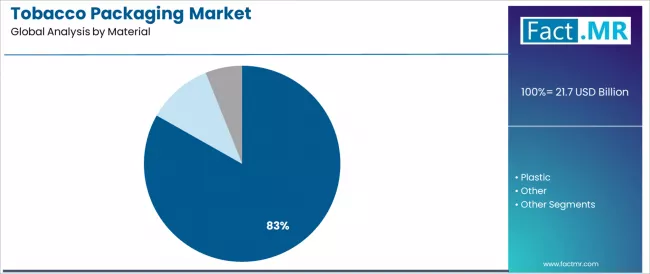
Tobacco Packaging Market Analysis By Material | Source: Fact.MR
Market Position: Paper & paperboard commands the leading position in the tobacco packaging market with an 83.2% share through superior printability characteristics, including established graphic reproduction presence, extensive health warning display capabilities, and standardized regulatory compliance pathways that enable manufacturers to achieve predictable packaging outcomes across varied tobacco products and diverse regulatory demographics.
Value Drivers: The segment benefits from compliance advantages through high-quality print reproduction, health warning visibility without compromise, and established manufacturing frameworks without requiring extensive capital modifications. Advanced Paper & Paperboard technology enables coated board optimization, folding boxboard customization, and specialty paperboard variation, where print quality and structural integrity represent critical regulatory requirements. Folding boxboard holds significant share within the paper segment, appealing to cigarette manufacturers seeking reliable folding carton capabilities for retail packaging.
Competitive Advantages: Paper & paperboard solutions differentiate through proven regulatory acceptance profiles, cost-effectiveness advantages, and integration with established printing protocols that enhance compliance confidence while maintaining economical packaging outcomes for diverse tobacco applications.
Key market characteristics:
- Advanced printability properties with high-resolution graphics and color accuracy for health warning compliance
- Superior regulatory acceptance, enabling plain packaging compliance and standardized warning display for tobacco applications
- Comprehensive cost-effectiveness, including established supply chains and competitive pricing for packaging optimization
Why Does Plastic Represent a Specialized Inner Liner Segment?
Plastic maintains specialized market position at 12.4% through barrier protection capabilities and moisture resistance characteristics. These materials appeal to manufacturers seeking product freshness preservation with aroma retention, offering flexible film properties and heat-sealing compatibility through polymer-based systems. Market adoption is driven by inner liner applications, emphasizing complete moisture barrier evaluation and product integrity progression through specialized film mechanisms.
How Does Secondary Packaging Dominance Shape Type Preferences in Tobacco Packaging?
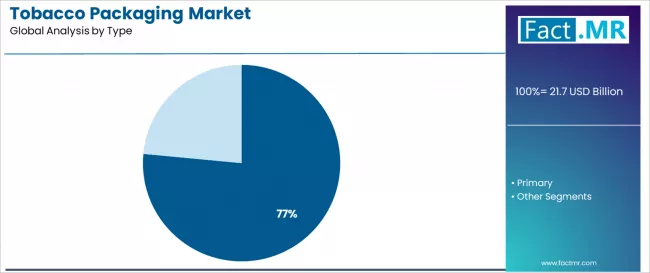
Tobacco Packaging Market Analysis By Type | Source: Fact.MR
Market Context: Secondary packaging demonstrates type leadership in the tobacco packaging market with a 76.5% share due to widespread distribution requirements and established focus on retail carton bundling, transportation protection, and tax stamp application that maximizes supply chain efficiency while maintaining consistent regulatory compliance standards.
Appeal Factors: Manufacturers and distributors prioritize secondary packaging for multi-pack consolidation, shelf-ready packaging integration, and alignment with established retail distribution workflows that enables coordinated logistics experiences across multiple market categories. The segment benefits from substantial tax administration standardization and anti-counterfeiting documentation that emphasizes carton-level packaging approaches for revenue protection across diverse tobacco demographics. Ten-pack cartons capture significant volume within the secondary segment, demonstrating distributor preference for standard retail formats.
Growth Drivers: Track-and-trace regulation expansion incorporates secondary packaging as essential compliance protocols for serialization implementation, while retail modernization growth increases shelf-ready packaging that meets merchandising requirements and ensures display efficiency capabilities.
What Drives Primary Packaging Adoption in Direct Product Contact?
Primary packaging captures substantial type share at 23.5% through comprehensive requirements in immediate protection frameworks, direct consumer interaction capabilities, and integrated freshness preservation protocols. These applications demand sophisticated barrier materials capable of achieving aroma retention while providing tamper-evidence and child-resistant features, appealing to premium brands and regulatory-focused manufacturers seeking evidence-based quality advantages beyond secondary packaging approaches.
What Establishes Boxes' Market Leadership in Tobacco Packaging Products?
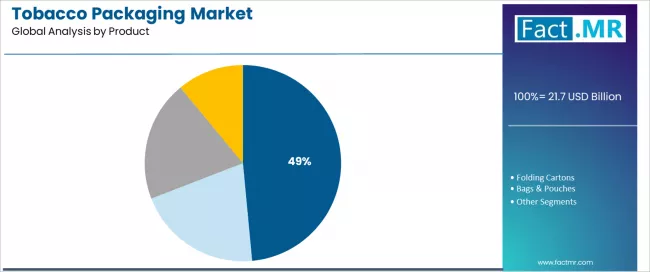
Tobacco Packaging Market Analysis By Product | Source: Fact.MR
Market Context: Boxes establish market leadership in the tobacco packaging sector with a 48.5% share due to comprehensive structural protection requirements and sustained focus on cigarette packaging, premium product presentation, and flip-top functionality that maximizes brand differentiation while maintaining appropriate product protection standards.
Appeal Factors: Manufacturers and consumers prioritize box formats for rigid structure benefits, premium brand perception, and integration with established smoking rituals that enables coordinated user experiences across multiple cigarette categories. The sector benefits from substantial hinge-lid design standardization and slide-and-shell innovation campaigns that emphasize rigid box delivery for critical brand positioning applications.
Growth Drivers: Premium cigarette expansion incorporates rigid boxes as standard packaging protocols for luxury positioning, while limited edition launches increase packaging sophistication that meets collector appeal requirements and ensures brand differentiation capabilities.
Product dynamics include:
- Strong growth in slide-and-shell boxes requiring precision manufacturing and structural engineering arrangements
- Increasing adoption in cigarillo packaging for premium positioning and structural protection enhancement
- Rising integration with magnetic closure systems for luxury appeal and reusability features
How are Folding Cartons Advancing Cost-effective Solutions?
Folding cartons capture substantial product share at 28.0% through established cigarette packaging frameworks, complex fold patterns capabilities, and integrated cost optimization protocols. The segment demonstrates specialized manufacturing expertise across diverse cigarette populations, with advanced flip-top designs applications and hinged-lid construction infrastructure gaining traction in mainstream cigarette programs while material efficiency frameworks drive continued format selection requiring careful balance between structural protection and manufacturing cost assurance.
What are the Drivers, Restraints, and Key Trends of the Tobacco Packaging Market?
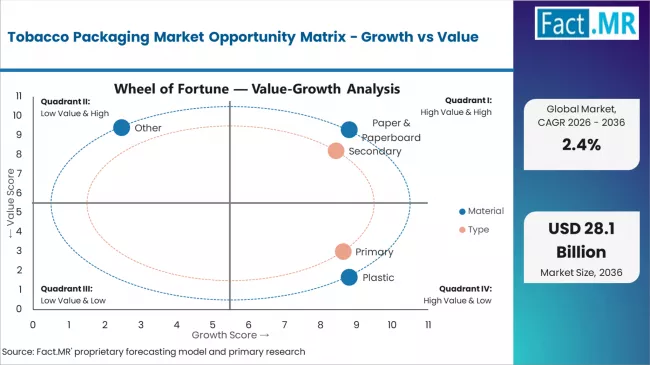
Tobacco Packaging Market Opportunity Matrix Growth Vs Value | Source: Fact.MR
| Category | Factor | Impact | Why It Matters |
|---|---|---|---|
| Driver | Rising regulatory compliance requirements & plain packaging mandates (WHO FCTC, national legislation) | ★★★★★ | Compliance requirements enable specialized packaging demand for health warning display; increasing regulations drive standardized packaging adoption across tobacco markets and diverse geographic segments. |
| Driver | Growth in anti-counterfeiting measures and track-and-trace systems (illicit trade prevention, authentication) | ★★★★★ | Drives demand for serialization systems and authentication technologies; manufacturers providing tamper-evident solutions gain competitive advantage in regulatory-focused tobacco segments. |
| Driver | Sustainable packaging trends and recyclable material adoption (environmental consciousness, EPR schemes) | ★★★★☆ | Manufacturers seek validated sustainable materials and documented recyclability systems; environmental framework visibility expanding addressable segments beyond traditional packaging demographics and cost-focused clientele. |
| Restraint | Declining smoking rates & tobacco consumption reduction (health awareness, smoking bans) | ★★★★☆ | Volume-conscious manufacturers face declining demand and market contraction, restricting packaging growth and affecting traditional tobacco penetration in health-conscious populations and developed markets. |
| Restraint | Regulatory restrictions on branding & design limitations (plain packaging, color restrictions) | ★★★☆☆ | Manufacturers face creativity constraints and differentiation limitations; increases commoditization pressures and affects premium positioning penetration in brand-conscious categories and design-driven segments. |
| Trend | Digital printing & variable data capabilities (personalization, track-and-trace, limited editions) | ★★★★★ | Growing manufacturer acceptance for flexible production and serialization integration preferences beyond traditional offset printing; digital technologies become core differentiation strategy for compliance-focused positioning. |
| Trend | Alternative tobacco products & reduced-risk packaging (heated tobacco, nicotine pouches, vaping) | ★★★★☆ | Tobacco packaging evolving beyond traditional cigarettes toward alternative product protocols; format innovation positioning drives enhanced category diversification and product portfolio expansion in sophisticated tobacco environments. |
Source: Fact.MR analysis. Updated Apr 2, 2026
Analysis of the Tobacco Packaging Market by Key Countries
The tobacco packaging market demonstrates robust regional growth dynamics with emerging leaders including India (4.2% CAGR) and China (3.8% CAGR) driving expansion through consumption growth programs and packaging modernization development. Strong performers encompass the USA (2.6% CAGR), Germany (2.4% CAGR), and UK (2.3% CAGR), benefiting from established regulatory compliance infrastructure and plain packaging demographics. Developed markets feature Brazil (2.1% CAGR) and South Africa (1.9% CAGR), where health warning normalization and compliance frameworks support consistent growth patterns.
Regional synthesis reveals Asian markets leading adoption through comprehensive manufacturing capacity positioning and urbanization expansion, while Western countries demonstrate measured growth potential supported by regulatory compliance preferences and sustainable packaging influence. Global markets show solid development driven by track-and-trace culture integration and authentication technology infrastructure.
.webp "Top Country Growth Comparison Tobacco Packaging Market Cagr (2026 2036)")
Top Country Growth Comparison Tobacco Packaging Market Cagr (2026 2036) | Source: Fact.MR
| Region/Country | 2025-2035 Growth | How to win | What to watch out |
|---|---|---|---|
| India | 4.2% | Focus on premium packaging portfolios | Regulatory uncertainty; tax increases |
| China | 3.8% | Lead with manufacturing scale positioning | State monopoly dynamics; export restrictions |
| USA | 2.6% | Provide sustainable solutions | Declining consumption; regulatory complexity |
| Germany | 2.4% | Maintain compliance-focused positioning | Plain packaging expansion; eco-regulations |
| UK | 2.3% | Deliver health warning innovations | Tax escalation; consumption decline |
| Brazil | 2.1% | Offer cost-effective compliance | Economic volatility; counterfeit issues |
| South Africa | 1.9% | Push illicit trade prevention | Regulatory delays; economic constraints |
Source: Fact.MR analysis. Updated Apr 2, 2026
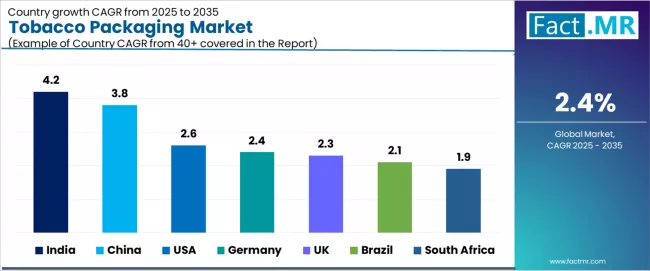
Tobacco Packaging Market Cagr Analysis By Country | Source: Fact.MR
India drives Premium Packaging Demand
India establishes premium packaging demand through progressive urbanization expansion and comprehensive retail modernization programs, positioning tobacco packaging technologies as essential brand differentiation solutions in organized retail channels and emerging premium cigarette facilities.
The country's 4.2% growth rate reflects rising disposable income levels supporting premium tobacco consumption and growing packaging sophistication that encourages the deployment of advanced packaging solutions in diverse market settings. Growth concentrates in major urban centers, including Mumbai, Delhi, and Bangalore, where retail outlets showcase increasing capacity for international packaging standard adoption that appeal to brand-conscious consumers demanding validated quality and premium presentation outcomes.
Indian manufacturers are developing standardized packaging protocols that combine imported printing technology with domestic production capacity, including track-and-trace readiness expansion and anti-counterfeiting feature growth. Distribution channels through organized retail networks and premium tobacco outlets expand market access, while regulatory compliance initiatives support adoption across diverse product types and brand positioning levels.
China Emerges as Manufacturing Scale Leader
In Yunnan, Hunan, and Guangdong regions, tobacco manufacturers and packaging converters are adopting advanced packaging technologies as essential production tools for domestic cigarette operations, driven by increasing China National Tobacco Corporation alignment with international standards and elevation of packaging quality expectations that emphasize the importance of validated brand protection.
The market holds a 3.8% growth rate, supported by state tobacco monopoly modernization and export packaging investment that promote advanced packaging adoption for domestic and international applications. Chinese manufacturers are favoring automated packaging platforms that provide comprehensive production capabilities and cost-competitive positioning, particularly appealing in manufacturing clusters where scale efficiency and quality consistency represent critical business factors.
Market expansion benefits from substantial cigarette production volume and packaging technology investment that enable widespread adoption of evidence-based packaging methodologies for diverse tobacco applications. Industry adoption follows patterns established in consumer goods packaging excellence, where manufacturing scale advantages and technology integration documentation drive brand confidence and export market achievement.
USA Shows Sustainability Leadership
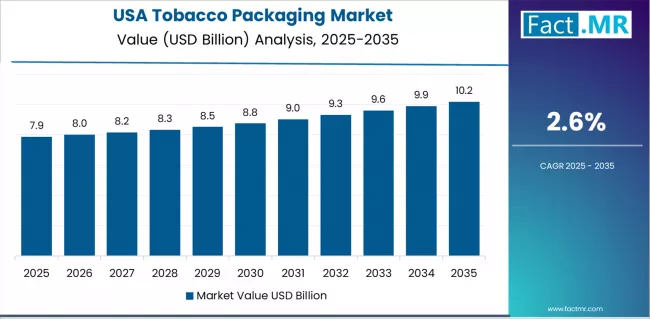
Tobacco Packaging Market Country Value Analysis | Source: Fact.MR
USA establishes sustainability leadership through comprehensive environmental regulation framework and established FDA compliance ecosystem, integrating tobacco packaging solutions across cigarette manufacturers, alternative tobacco producers, and packaging converters. The country's 2.6% growth rate reflects established tobacco control regulatory maturity and sophisticated environmental commitment levels that support widespread deployment of validated sustainable packaging solutions in commercial and retail applications.
Growth concentrates in established tobacco regions, including North Carolina, Virginia, and Kentucky, where manufacturers showcase advanced sustainable material adoption that appeals to environmentally-focused organizations seeking predictable recyclability outcomes and comprehensive lifecycle documentation.
American tobacco manufacturers leverage established converter relationships and comprehensive compliance frameworks, including Master Settlement Agreement provisions and FDA deeming rule requirements that create regulatory confidence and environmental assurance. The market benefits from substantial alternative tobacco product development and reduced-risk category expansion that encourage innovative packaging purchases while supporting continuous material innovation investments and sustainability technology funding.
Germany Demonstrates Regulatory Excellence
Germany's sophisticated tobacco market demonstrates established packaging integration with documented compliance emphasis in plain packaging implementation and health warning execution through specialized cigarette manufacturers and established packaging converter organizations. The country maintains a 2.4% growth rate, leveraging stringent EU Tobacco Products Directive compliance with national packaging regulations.
Premium tobacco regions, including Bavaria, North Rhine-Westphalia, and Baden-Württemberg, showcase regulatory-driven approaches where tobacco packaging integrates with established compliance cultures and thorough documentation practices to optimize health warning display and ensure appropriate authentication features.
German tobacco manufacturers prioritize regulatory compliance requirements and comprehensive sustainable material documentation in packaging procurement, creating demand for certified solutions with extensive environmental characteristics, including recyclable substrates, reduced plastic content, and comprehensive lifecycle analysis. The market benefits from established premium cigarette segments and quality packaging tradition that provide differentiation opportunities and compliance with strict German packaging regulations.
UK Shows Plain Packaging Adoption
UK's mature tobacco market demonstrates established plain packaging integration with documented standardization emphasis in health warning implementation and brand restriction execution through comprehensive cigarette manufacturers and established retail organizations.
The country maintains a 2.3% growth rate, leveraging mandatory standardized packaging framework with pictorial health warning requirements. Major tobacco regions, including England and Scotland, showcase compliance-focused approaches where tobacco packaging integrates with established public health cultures and comprehensive tobacco control systems to optimize smoking deterrence and maintain regulatory compliance under Department of Health supervision.
UK tobacco manufacturers prioritize plain packaging compliance and comprehensive health warning effectiveness in packaging implementation, creating demand for standardized solutions with extensive regulatory characteristics, including prescribed color specifications, mandated warning sizes, and comprehensive track-and-trace integration. The market benefits from established tobacco control leadership sectors and public health policy rigor that provide regulatory positioning opportunities and maintain alignment with comprehensive tobacco control strategies.
Brazil Shows Consumption Growth
Brazil's developing tobacco market demonstrates progressive packaging adoption with documented consumption expansion in urban centers and packaging modernization through established cigarette manufacturers and regional tobacco processing organizations. The country maintains a 2.1% growth rate, leveraging agricultural tobacco production with domestic consumption growth and export packaging investment.
Major tobacco regions, including Rio Grande do Sul, Santa Catarina, and Paraná, showcase modernization approaches where tobacco packaging integrates with established production cultures and comprehensive quality systems to optimize brand presentation and maintain product protection under ANVISA regulatory requirements.
Brazilian tobacco manufacturers prioritize cost-effectiveness and comprehensive visual appeal in packaging selection, creating demand for affordable solutions with extensive printing characteristics, including vibrant graphics, brand differentiation features, and comprehensive shelf appeal. The market benefits from established cigarette consumption tradition sectors and tobacco agriculture expertise that provide volume opportunities and maintain alignment with Brazilian packaging regulations.
South Africa Shows Compliance Investment
South Africa's evolving tobacco market demonstrates progressive packaging adoption with documented compliance focus in illicit trade prevention and health warning implementation through established cigarette manufacturers and tobacco control organizations. The country maintains a 1.9% growth rate, leveraging government anti-illicit trade initiatives with packaging security investment.
Major urban regions, including Gauteng, Western Cape, and KwaZulu-Natal, showcase compliance approaches where tobacco packaging integrates with established enforcement cultures and comprehensive authentication systems to optimize tax revenue protection and maintain product legitimacy under National Treasury supervision.
South African tobacco manufacturers prioritize track-and-trace readiness and comprehensive anti-counterfeiting features in packaging development, creating demand for secure solutions with extensive authentication characteristics, including holographic elements, serialization codes, and comprehensive tamper-evidence. The market benefits from established illicit trade prevention sectors and revenue protection programs that provide positioning opportunities and maintain alignment with government tobacco control objectives.
Europe Market Split by Country
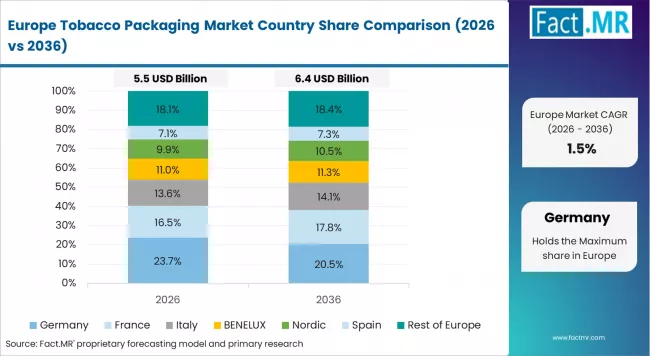
Tobacco Packaging Market Europe Country Market Share Analysis, 2026 & 2036 | Source: Fact.MR
The European tobacco packaging market is projected to grow from USD 6.2 billion in 2025 to USD 7.7 billion by 2035, registering a CAGR of 2.2% over the forecast period. Germany is expected to maintain its leadership position with a 26.8% market share in 2025, declining slightly to 25.4% by 2035, supported by its advanced tobacco manufacturing infrastructure and major packaging converter facilities including specialized printing operations.
France follows with a 18.9% share in 2025, projected to reach 19.2% by 2035, driven by comprehensive tobacco regulation compliance and Paris-based multinational tobacco headquarters concentration. The UK holds a 17.3% share in 2025, expected to decrease to 16.8% by 2035 due to declining smoking rates.
Italy commands a 14.2% share, while Spain accounts for 11.6% in 2025. The Rest of Europe region is anticipated to gain momentum, expanding its collective share from 11.2% to 12.4% by 2035, attributed to increasing track-and-trace adoption in Nordic countries and emerging Eastern European tobacco facilities implementing authentication programs.
Competitive Landscape of the Tobacco Packaging Market
Tobacco Packaging Market Analysis By Type | Source: Fact.MR
The tobacco packaging market exhibits a moderately consolidated competitive structure with approximately 60-80 active players operating across global packaging converter networks and regional specialty supplier portfolios. WestRock Company maintains market leadership at a 16.0% share, reflecting strong integrated packaging positioning across diverse tobacco segments with sophisticated converting strategies.
This competitive landscape demonstrates the maturation of tobacco packaging technology, where established players leverage manufacturing scale advantages, extensive tobacco manufacturer relationship programs, and regulatory expertise to maintain dominant positions, while emerging authentication technology providers and sustainable material innovators create niche opportunities through specialized security offerings and eco-friendly material strategies.
Market leadership is maintained through several critical competitive advantages extending beyond converting capabilities and material portfolios. Global manufacturing networks enable leading players to navigate diverse regulatory requirements and access varied tobacco segments including cigarettes, cigars, and alternative tobacco products.
Technical expertise and compliance support program availability represent crucial differentiators in tobacco packaging categories, where decades of printing technology experience, track-and-trace implementation protocols, and regulatory navigation frameworks create procurement preference among quality-focused tobacco manufacturers.
Converting efficiency in high-speed folding carton facilities, quality control operations, and supply chain material sourcing separate major converters from smaller competitors, while comprehensive regulatory documentation addressing plain packaging compliance, health warning reproduction, and anti-counterfeiting validation strengthen market position and manufacturer confidence.
The market demonstrates emerging differentiation opportunities in digital authentication categories and biodegradable barrier technologies, where traditional paper-plastic laminate methodologies face competition from innovation-focused entrants offering sustainability advantages.
Significant competitive advantages persist in established folding carton categories through comprehensive tobacco manufacturer approval portfolios and long-term contract depth. Premium positioning strategies with integrated track-and-trace capabilities and holographic security integration command margin premiums through superior authentication credibility and regulatory compliance facilitation.
Specialized packaging portfolios combining multiple security features with sustainable material options create comprehensive positioning that justifies higher price points beyond commodity packaging competition. Integrated solution offerings emphasizing complementary printing services, unified compliance support platforms, and cross-brand packaging programs generate tobacco manufacturer loyalty and contract preferences beyond transactional packaging purchases.
| Stakeholder | What they actually control | Typical strengths | Typical blind spots |
|---|---|---|---|
| Global packaging converters | Comprehensive manufacturing networks; tobacco relationships; regulatory expertise | Scale advantages; quality assurance; compliance knowledge; innovation resources | Regional customization; startup agility; niche authentication; sustainable innovation |
| Specialized security providers | Authentication technology; anti-counterfeiting expertise; digital integration | Security differentiation; technology leadership; track-and-trace capabilities; IP protection | Manufacturing scale; tobacco relationships; cost competitiveness; commodity packaging |
| Regional converters | Local manufacturing; market proximity; customer service; flexibility | Responsiveness; cultural understanding; rapid turnaround; relationship depth | Technology investment; global reach; authentication capabilities; sustainability credentials |
| Material suppliers | Substrate control; paperboard production; coating technology; barrier films | Raw material expertise; cost structure; innovation pipeline; supply security | Tobacco knowledge; converting capabilities; end-customer relationships; application expertise |
| Tobacco manufacturers | Procurement control; volume leverage; specification decisions; brand requirements | Market intelligence; consumption patterns; regulatory insight; compliance needs | Packaging technology; sustainability innovation; authentication development; material science |
Source: Fact.MR analysis. Updated Apr 2, 2026
Key Players in the Tobacco Packaging Market
- WestRock Company
- Amcor plc
- International Paper Company
- Mondi plc
- Sonoco Products Company
- Siegwerk Druckfarben AG & Co. KGaA
- Stora Enso Oyj
- Binhao (Guangzhou) Packaging Materials Co., Ltd.
- RX Packaging Ltd.
- Philip Morris International Inc.
Bibliography
- Relevant industry regulatory authority. (2025). Industry guidance and standards documentation.
- International trade association. (2025). Market statistics and industry annual report.
- International standards organization. (2025). Product specification and testing standards.
- Leading industry participant. (2025). Annual report and public filings.
- Government statistical agency. (2025). Production and trade statistics database.
- This bibliography is provided for reader reference. The full Fact.MR report contains the complete reference list with primary research documentation.
This Report Addresses
- Market sizing and quantitative forecast metrics detailing consumption across material and type segments globally through 2036.
- Material analysis comparing adoption rates and evaluating performance differentials across product categories.
- Type intelligence evaluating demand trajectories across leading application segments.
- Regulatory compliance assessment analyzing specification standard impacts on procurement decisions.
- Competitive posture evaluation tracking manufacturer capability investments and market positioning strategies.
- Supply chain intelligence identifying sourcing dynamics and pricing trends across major consuming regions.
- Custom data delivery formats encompassing interactive dashboards, raw Excel datasets, and comprehensive PDF narrative reports.
Tobacco Packaging Market Market Definition
The tobacco packaging market encompasses the production, distribution, and consumption of specialized products serving defined industrial, commercial, and consumer applications globally. Products within this category are manufactured to specific quality, purity, and performance standards required by downstream end-use specifications.
Tobacco Packaging Market Market Inclusions
Market scope includes all product types and grades within the tobacco packaging market consumed across defined end-use applications globally. Forecast coverage spans 2026 to 2036 across material and type segments.
Tobacco Packaging Market Market Exclusions
The scope excludes raw material feedstock valuations prior to processing, downstream finished end-use product pricing, and manufacturing equipment used in production processes.
Tobacco Packaging Market Market Research Methodology
- Primary Research: Analysts conducted interviews with end-use manufacturers, procurement directors, and product development managers across key consuming industries.
- Desk Research: Data collection aggregated regulatory databases, trade association statistics, and publicly filed company annual reports from major market participants.
- Market-Sizing and Forecasting: Baseline values derive from a bottom-up aggregation of product shipment volumes by type and application, applying end-use consumption growth rates and market penetration projections.
- Data Validation and Update Cycle: Projections are cross-validated against industry production statistics, trade flow data, and quarterly pricing benchmarks from recognized industry sources.
Segmentation
Scope of the Report
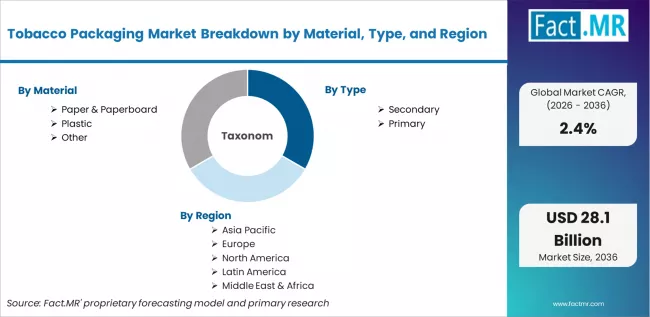
Tobacco Packaging Market Breakdown By Material Type And Region | Source: Fact.MR
| Metric | Value |
|---|---|
| Quantitative Units | USD Billion 22.18 to USD Billion 28.12, at a CAGR of 2.40% |
| Market Definition | The Tobacco Packaging Market encompasses all defined product types and grades across end-use applications globally. |
| Material Segmentation | Paper & Paperboard, Plastic, Other |
| Type Segmentation | Secondary, Primary |
| Regions Covered | North America, Latin America, Europe, East Asia, South Asia, Oceania, Middle East & Africa |
| Key Companies Profiled | WestRock Company, Amcor plc, International Paper Company, Mondi plc, Sonoco Products Company, Siegwerk Druckfarben AG & Co. KGaA, Stora Enso Oyj, Binhao (Guangzhou) Packaging Materials Co., Ltd. |
| Forecast Period | 2026 to 2036 |
| Approach | Forecasting models apply a bottom-up methodology starting from product consumption volumes, projecting growth based on end-use demand trends, regulatory conversion timelines, and market penetration rates. |
Source: Fact.MR analysis. Updated Apr 2, 2026
Tobacco Packaging Market by Segments
-
Material :
- Paper & Paperboard
- Plastic
- Other
-
Type :
- Primary
- Secondary
-
Product :
- Boxes
- Folding Cartons
- Bags & Pouches
- Others
-
Region :
- North America
- USA
- Canada
- Mexico
- Europe
- Germany
- France
- UK
- Italy
- Spain
- Rest of Europe
- Asia Pacific
- India
- China
- Japan
- South Korea
- ASEAN
- Australia & New Zealand
- Rest of Asia Pacific
- Latin America
- Brazil
- Rest of Latin America
- Middle East & Africa
- GCC Countries
- South Africa
- Rest of Middle East & Africa
- North America
Frequently Asked Questions
How large is the tobacco packaging market in 2026?
What will be the market size by 2036?
What is the expected CAGR between 2026 and 2036?
Which material is poised to lead in 2026?
Which type leads in 2026?
What is driving market growth?
What is the tobacco packaging market?
Who worked on this report


Preview the report firsthand - request a free sample
Free SampleGet the brochure for pricing and purchase details
Download PDF