- Market Value (2025): USD 1.04 Bn
- Estimated Value (2026): USD 1.12 Bn
- Forecast Value (2036): USD 2.35 Bn
- CAGR (2026-2036): 7.7%
What is the Chiral Chromatography Market forecast to be worth by 2036?
USD 1.1 billion in 2026 to USD 2.4 billion by 2036, at a CAGR of 7.7%.
- As per Fact.MR analysis, the chiral chromatography market was valued at USD 1.04 billion in 2025.
- Demand is projected to reach from USD 1.12 billion in 2026 to USD 2.35 billion by 2036.
- The forecast records a 7.7% CAGR from 2026 to 2036, supported by demand for enantiomer separation in pharmaceutical research and drug manufacturing.
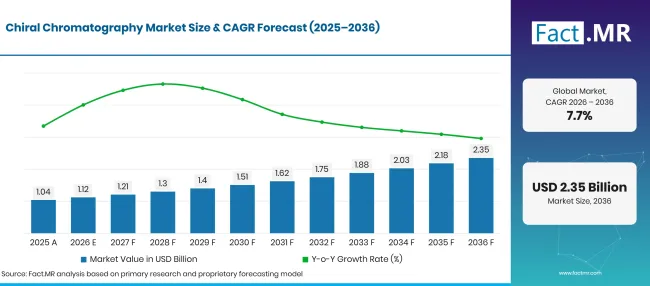
Chiral Chromatography Market Forecast Global 1 | Source: Fact.MR
| Year | Basis | Market Value (USD billion) |
|---|---|---|
| 2025 | Actual | 1.04 |
| 2026 | Estimate | 1.12 |
| 2036 | Forecast | 2.35 |
| CAGR 2026 to 2036 | Forecast period | 7.7% |
Source: Fact.MR analysis. Updated Nov 4, 2026
What are the defining numbers behind Chiral Chromatography Market growth?
USD 1.3 billion absolute opportunity between 2026 and 2036
- Demand Drivers in the Market
- Pharmaceutical developers need reliable methods to separate and characterize enantiomers during drug discovery and development. Chiral analysis helps determine the composition and purity of active pharmaceutical ingredients and supports analytical method development.
- Preparative separation is important when pharmaceutical and biotechnology companies need to isolate specific enantiomers for research, process development or commercial production. Daicel offers chiral columns for analytical and commercial-scale separation, including simulated moving bed systems.
- Increasing use of advanced liquid chromatography and supercritical fluid chromatography supports demand for specialized chiral stationary phases. These techniques offer different separation conditions and can be selected according to compound properties, throughput and purification requirements.
- Key Segments Analyzed
- By Type: Preparative Chiral Chromatography will account for 57.4% of the market in 2026, reflecting demand for enantiomer isolation and purification beyond analytical testing.
- By Technology: Liquid Chromatography is projected to hold 61.0% share in 2026, supported by its use in analytical testing and preparative separation.
- By Application: Pharmaceuticals will capture 42.5% share in 2026, reflecting the need to evaluate chiral compounds during drug development and quality control.
- By End User: Pharmaceutical Companies lead with 45.0% share in 2026, driven by in-house analytical testing and process development requirements.
- Analyst Opinion at Fact.MR
- Shambhu Nath Jha, Principal Consultant at Fact.MR, states, “Chiral chromatography is likely to remain important as pharmaceutical developers place greater emphasis on enantiomeric purity and reliable analytical methods. Suppliers need to offer consistent stationary phases, scalable separation options and technical support to meet requirements across drug discovery and manufacturing.”
- Strategic Implications
- Chiral column manufacturers should expand stationary-phase options to address a wider range of molecular structures and separation conditions.
- Pharmaceutical companies need to evaluate column selectivity, resolution and reproducibility during method development and process validation.
- Instrument suppliers can strengthen their position by improving compatibility between chromatography platforms and specialized chiral columns.
- Preparative chromatography providers must focus on scalability and separation efficiency to support the transition from laboratory research to larger production volumes.
- Suppliers serving biotechnology and contract research organizations should provide application support and method-development services for complex chiral compounds.
The UK is projected to record a 9.9% CAGR through 2036, followed by Germany at 8.4% and Japan at 8.0%. The USA is forecast to expand at 6.4%, while Brazil is expected to register a 5.8% CAGR.
How does the Chiral Chromatography Market break down by segment?
Fact.MR finds that Preparative Chiral Chromatography leads Type with 57.4%; Liquid Chromatography leads Technology with 61.0%; Pharmaceuticals leads Application with 42.5%; and Pharmaceutical Companies lead End User with 45.0%.
Which Type dominates?
Preparative Chiral Chromatography is set to hold 57.4% share in 2026.
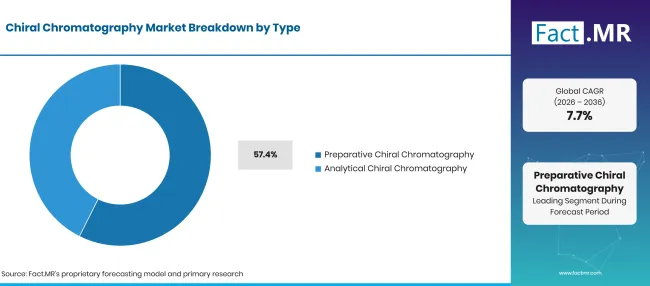
Chiral Chromatography Market Breakdown Type | Source: Fact.MR
| Type | Share (2026) |
|---|---|
| Preparative Chiral Chromatography (Leading segment) | 57.4% |
| Other segments combined | 42.6%* |
| Total | 100.0% |
Source: Fact.MR analysis. Updated Nov 4, 2026
Preparative chiral chromatography accounts for the leading share because pharmaceutical and biotechnology companies need to isolate specific enantiomers for research, process development and production. Preparative systems support the purification of target compounds from racemic mixtures and can be scaled according to required output. Analytical chiral chromatography remains important for determining enantiomeric composition and evaluating product purity during development and quality testing.
Which Technology leads the market?
Liquid Chromatography is projected to account for 61.0% share in 2026.
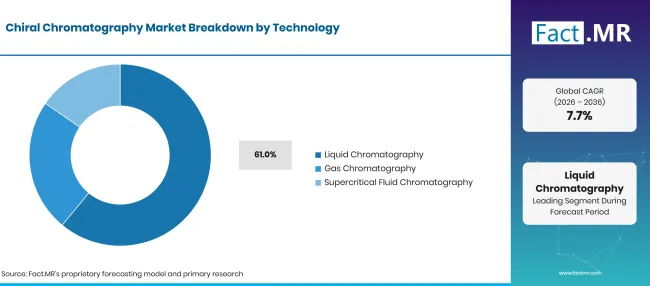
Chiral Chromatography Market Breakdown Technology | Source: Fact.MR
| Technology | Share (2026) |
|---|---|
| Liquid Chromatography (Leading segment) | 61.0% |
| Other segments combined | 39.0%* |
| Total | 100.0% |
Source: Fact.MR analysis. Updated Nov 4, 2026
Liquid chromatography leads because chiral LC columns can separate enantiomers across a range of stationary phases and operating conditions. High-performance liquid chromatography is widely used for analytical testing and can also support preparative purification when suitable column dimensions and loading conditions are selected. Gas chromatography serves compounds that are suitable for gas-phase analysis, while supercritical fluid chromatography offers an alternative for chiral separation and preparative purification.
Which Application leads the market?
Pharmaceuticals is set to represent 42.5% share in 2026.
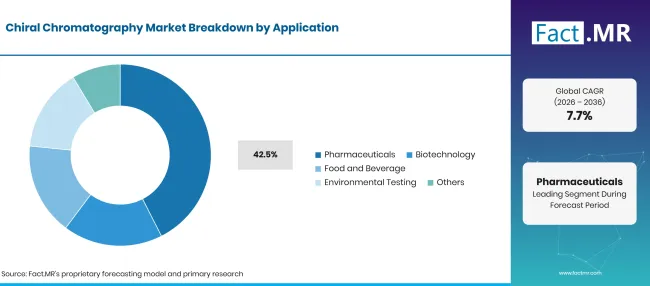
Chiral Chromatography Market Breakdown Application | Source: Fact.MR
| Application | Share (2026) |
|---|---|
| Pharmaceuticals (Leading segment) | 42.5% |
| Other segments combined | 57.5%* |
| Total | 100.0% |
Source: Fact.MR analysis. Updated Nov 4, 2026
Pharmaceutical companies use chiral chromatography to separate and characterize enantiomers during drug discovery, formulation development and manufacturing. Chiral analysis helps determine enantiomeric purity and identify unwanted stereoisomers in active pharmaceutical ingredients. Biotechnology applications include characterization and purification of chiral compounds used in research and development. Food and beverage testing can use chiral separation to examine specific compounds, while environmental testing applies chromatographic techniques to selected chiral contaminants and residues.
Which End User dominates demand?
Pharmaceutical Companies are projected to lead with 45.0% share in 2026.
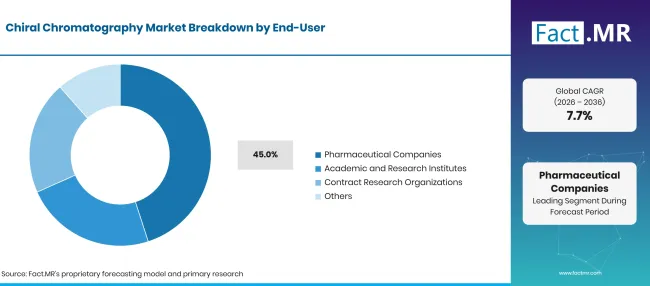
Chiral Chromatography Market Breakdown End User | Source: Fact.MR
| End User | Share (2026) |
|---|---|
| Pharmaceutical Companies (Leading segment) | 45.0% |
| Other segments combined | 55.0%* |
| Total | 100.0% |
Source: Fact.MR analysis. Updated Nov 4, 2026
Pharmaceutical companies account for the largest end-user share because they require chiral analysis throughout drug discovery, development and production. Their requirements include method screening, enantiomeric purity assessment and preparative isolation of selected compounds. Academic and research institutes use chiral chromatography to study stereochemistry and develop separation methods. Contract research organizations provide analytical and purification services to pharmaceutical and biotechnology clients, while other users apply these techniques to specialized testing requirements.
What is accelerating Chiral Chromatography Market adoption, and what is holding it back?
Demand for enantiomeric purity testing and preparative compound isolation supports adoption, while high equipment costs and method-development complexity can limit wider use.
Drivers Impact Analysis
| Driver | (~) % Impact on CAGR | Geographic Relevance | Impact Timeline |
|---|---|---|---|
| Enantiomeric purity testing in pharmaceutical development | +1.0% | Global | Short term (≤ 2 years) |
| Preparative isolation of chiral compounds | +0.9% | North America, Europe, Asia | Medium term (2–4 years) |
| Growth in pharmaceutical and biotechnology research | +0.7% | Global | Medium term (2–4 years) |
| Demand for reproducible analytical methods | +0.5% | Global | Short term (≤ 2 years) |
| Adoption of advanced SFC separation platforms | +0.4% | North America, Europe | Long term (≥ 4 years) |
Source: Fact.MR analysis. Updated Nov 4, 2026
Opportunity Impact Analysis
| Opportunity | (~) % Impact on CAGR | Geographic Relevance | Impact Timeline |
|---|---|---|---|
| High-capacity preparative chiral columns | +0.8% | Global | Medium term (2–4 years) |
| Improved chiral stationary phases | +0.6% | Europe, Asia | Medium term (2–4 years) |
| Integrated analytical and preparative workflows | +0.5% | North America, Europe | Long term (≥ 4 years) |
| Method-development services for complex compounds | +0.4% | Global | Short term (≤ 2 years) |
Source: Fact.MR analysis. Updated Nov 4, 2026
Restraints Impact Analysis
| Restraint | (~) % Impact on CAGR | Geographic Relevance | Impact Timeline |
|---|---|---|---|
| High cost of specialized columns and instruments | -0.8% | Global | Short term (≤ 2 years) |
| Complex method development and column screening | -0.6% | Global | Medium term (2–4 years) |
| Limited selectivity for certain compounds | -0.5% | Global | Medium term (2–4 years) |
| Need for skilled chromatography personnel | -0.4% | Emerging markets | Long term (≥ 4 years) |
Source: Fact.MR analysis. Updated Nov 4, 2026
Which countries are scaling the Chiral Chromatography Market through 2036?
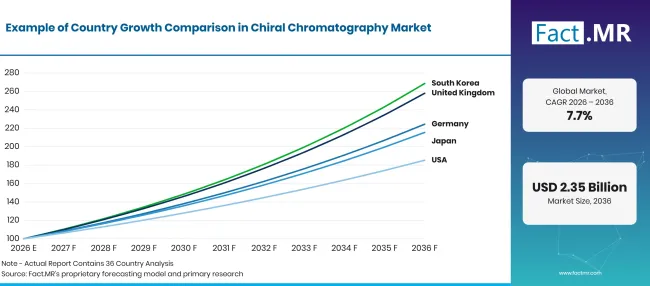
Chiral Chromatography Market Growth Index | Source: Fact.MR
| Country | CAGR (2026–2036) |
|---|---|
| Germany | 8.4% |
| Brazil | 5.8% |
| USA | 6.4% |
| UK | 9.9% |
| Japan | 8.0% |
Source: Fact.MR analysis. Updated Nov 4, 2026
What supports Germany adoption?
8.4% CAGR, supported by pharmaceutical research and established drug manufacturing.
Germany's pharmaceutical industry provides a substantial base for demand for analytical and preparative chromatography. Pharmaceutical companies use chiral separation during drug development and quality assessment, while research organizations require reliable methods to characterize complex compounds. Germany Trade and Invest reported pharmaceutical industry revenue of €67.9 billion in 2025 and more than 650 pharmaceutical companies. Pharmaceutical R&D investment reached €10.7 billion in 2024. [1]
How is Brazil developing chiral chromatography adoption?
5.8% CAGR, driven by pharmaceutical market expansion and increasing analytical testing requirements.
Brazil's pharmaceutical industry creates opportunities for analytical laboratories and manufacturers supplying drug-development and quality-control services. Chiral chromatography can support the characterization of active pharmaceutical ingredients and the evaluation of enantiomeric purity. Brazil's medicines regulator, Anvisa, reported that the country's pharmaceutical market generated approximately R$182 billion in revenue in 2025, with 6.3 billion medicine packages sold. The market included 230 companies and 7,096 pharmaceutical products. This established pharmaceutical market supports demand for analytical testing technologies used in drug development and quality assessment. [2]
What supports United States adoption?
6.4% CAGR, led by pharmaceutical manufacturing and biotechnology research.
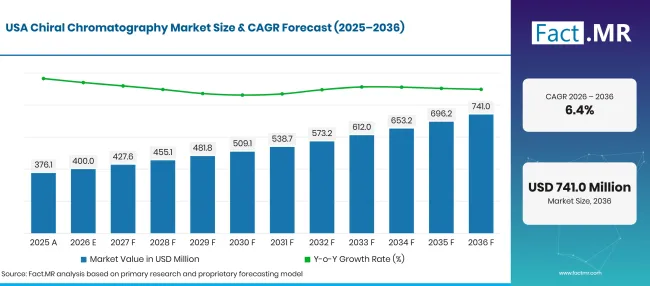
Chiral Chromatography Market Forecast Usa | Source: Fact.MR
The United States has a large pharmaceutical and biotechnology ecosystem with demand for analytical methods that support drug discovery, development and manufacturing. Chiral chromatography is used to separate enantiomers and evaluate the stereochemical purity of pharmaceutical compounds. The U.S. Census Bureau reported pharmaceutical and medicine manufacturing sales, shipments or revenue of approximately US$259.5 billion in 2024. The scale of domestic pharmaceutical manufacturing supports the need for analytical testing and quality-control infrastructure. [3]
How is the United Kingdom building adoption?
9.9% CAGR, shaped by pharmaceutical manufacturing and life sciences research.
The UK's pharmaceutical sector creates demand for analytical separation methods used in drug development and manufacturing. Chiral chromatography supports the evaluation of enantiomeric purity and the isolation of target compounds. The Office for National Statistics reported that UK manufacturers generated approximately £46.8 billion in sales from the manufacture of basic pharmaceutical products and preparations in 2025. This manufacturing base supports demand for laboratory testing and analytical technologies used across pharmaceutical production. [4]
What supports Japan adoption?
8.0% CAGR, backed by pharmaceutical production and precision analytical requirements.
Japan's pharmaceutical manufacturing and research sectors require reliable analytical methods for compound identification and quality evaluation. Chiral chromatography supports the separation of enantiomers during drug development and can be used in analytical and preparative workflows. Japan's Ministry of Health, Labour and Welfare reported domestic pharmaceutical production value of approximately ¥10.25 trillion in 2024, an increase of 2.1% from the previous year. The size of the pharmaceutical production base supports demand for analytical technologies used in product development and manufacturing quality control. [5]
Who leads the Chiral Chromatography Market?
Fact.MR profiles Agilent Technologies, Thermo Fisher Scientific, Waters Corporation, Shimadzu Corporation, Merck KGaA, Phenomenex and Daicel Corporation across the chiral chromatography equipment and consumables value chain.
Agilent Technologies offers chiral LC columns designed for reproducible enantiomer separation and chiral method screening [6]. Thermo Fisher Scientific supplies Hypersil Chiral HPLC columns in analytical and preparative formats [7]. Merck KGaA, through its Supelco and Astec chromatography portfolio, offers chiral HPLC columns based on cyclodextrin, macrocyclic glycoprotein and cellulose-based stationary phases [9].
Phenomenex supplies Chirex and Lux chiral LC columns for the separation of enantiomers across different chromatographic conditions [10]. Daicel Corporation is a specialist provider of chiral stationary phases and columns under the CHIRALPAK, CHIRALCEL and CROWNPAK brands. Its portfolio includes analytical, semi-preparative and preparative formats as well as SFC columns and large-scale separation services.
Waters Corporation participates through its supercritical fluid chromatography column portfolio, which includes products designed for chiral separations [8]. Shimadzu provides chromatography platforms and chiral separation workflows, including LC/SFC switching systems used with chiral columns.
Which companies are the key providers?
Key companies include Agilent Technologies; Thermo Fisher Scientific Inc.; Waters Corporation; Shimadzu Corporation; Merck KGaA; Phenomenex Inc.; and Daicel Corporation.
- Agilent Technologies
- Thermo Fisher Scientific Inc.
- Waters Corporation
- Shimadzu Corporation
- Merck KGaA
- Phenomenex Inc.
Daicel Corporation
Bibliography
- [1] Germany Trade & Invest. (n.d.). The pharmaceutical industry in Germany. https://www.gtai.de/en/invest/industries/healthcare-market-germany/pharmaceutical-industry
- [2] Agência Nacional de Vigilância Sanitária. (2026, September 28). CMED divulga 9° edição do Anuário Estatístico do Mercado Farmacêutico. https://www.gov.br/anvisa/pt-br/assuntos/noticias-anvisa/2026/cmed-divulga-9deg-edicao-do-anuario-estatistico-do-mercado-farmaceutico
- [3] U.S. Census Bureau. (2026, September 3). 2024 Annual Integrated Economic Survey (AIES). https://www.census.gov/programs-surveys/aies.html
- [4] Office for National Statistics. (2026, August 13). UKProdTO: 21 - Manuf of Basic Pharmaceutical Products & Preparations TOTAL (£m). https://www.ons.gov.uk/businessindustryandtrade/manufacturingandproductionindustry/timeseries/jq7k
- [5] Ministry of Health, Labour and Welfare. (2025, December 24). 「令和6年 薬事工業生産動態統計年報」の公表について [Publication of the 2024 annual report on pharmaceutical industry production statistics]. https://www.mhlw.go.jp/stf/newpage_67099.html
- [6] Agilent Technologies. (n.d.). Chiral LC columns. https://www.agilent.com/en/product/small-molecule-columns/chiral-columns
- [7] Thermo Fisher Scientific. (n.d.). Hypersil™ Chiral HPLC columns (Catalog No. 42005-254630). https://www.thermofisher.com/order/catalog/product/42005-254630
- [8] Waters Corporation. (n.d.). Supercritical fluid chromatography (SFC) columns. https://www.waters.com/nextgen/en/products/columns/sfc-columns.html
- [9] Merck KGaA. (n.d.). Astec® CHIROBIOTIC® T Chiral HPLC Column (Product No. 12021AST). https://www.sigmaaldrich.com/IN/en/product/supelco/12021ast
- [10] Phenomenex Inc. (n.d.). Lux Chiral HPLC columns. https://www.phenomenex.com/products/lux-chiral-lc-column
This Report Answers
- The report examines demand for preparative and analytical chiral chromatography across pharmaceutical and other testing applications.
- Type analysis compares preparative separation with analytical enantiomer testing.
- Technology analysis evaluates liquid chromatography, gas chromatography and supercritical fluid chromatography.
- Application analysis covers pharmaceuticals, biotechnology, food and beverage and environmental testing.
- End-user analysis compares pharmaceutical companies, academic and research institutes and contract research organizations.
- Country analysis covers Germany, Brazil, USA, UK and Japan.
- The competitive overview profiles seven companies participating in chiral chromatography equipment, columns and separation technologies.
What does the Chiral Chromatography Market cover?
The market covers chromatographic techniques and associated products used to separate and analyze enantiomers. It includes preparative systems used to isolate target compounds and analytical systems used to assess enantiomeric composition and purity. Technology coverage includes liquid chromatography, gas chromatography and supercritical fluid chromatography. Purchasing decisions depend on separation selectivity, resolution, reproducibility, sample capacity and compatibility with the compound being analyzed.
What is included in the scope?
The analysis includes preparative and analytical chiral chromatography systems and related separation products.
It covers chiral columns and stationary phases used with liquid chromatography and supercritical fluid chromatography, along with relevant gas chromatography applications. Applications include pharmaceutical research and manufacturing, biotechnology, food and beverage testing and environmental analysis. Revenue coverage should be restricted to products and services directly attributable to chiral chromatography.
What is excluded from the scope?
The analysis excludes general-purpose chromatography products that are not configured or marketed for chiral separation.
Standard achiral HPLC columns, general laboratory instruments and unrelated analytical equipment are outside the defined market. General laboratory consumables and software are excluded unless their revenue is directly attributable to chiral chromatography. Pharmaceutical products and contract manufacturing revenue are also excluded.
How Was the Analysis Built?
The analysis draws on 120+ sources, 35+ company portfolios, 25+ countries and more than 20 industry interviews.
- Primary Research: Primary research includes discussions with chromatography column manufacturers, instrument suppliers, pharmaceutical companies, biotechnology firms, contract research organizations, distributors and subject-matter experts. These conversations examine purchasing priorities, separation requirements, method-development challenges, equipment adoption and competitive positioning.
- Desk Research: Desk research covers government statistics, pharmaceutical industry publications, company filings, product catalogues, technical documentation, chromatography research, regulatory publications and industry associations. Every source used in the analysis is documented in the bibliography.
- Market Sizing and Forecasting: Market estimates combine historical performance, equipment and column pricing, installation volumes, segment shares, company participation, country-level growth, pharmaceutical research activity and barriers to market expansion.
- Data Validation and Update Cycle: Findings are validated by comparing primary interviews with public data, company product portfolios, new product introductions, technology improvements, research investments and changes in pharmaceutical manufacturing activity. Regular updates review developments in stationary phases, separation systems and preparative chromatography capabilities.
Segmentation
What is the report's scope and coverage?
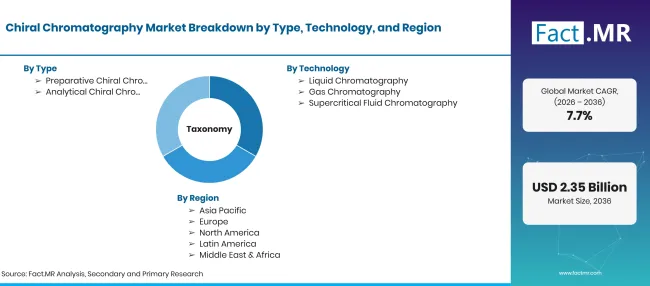
Chiral Chromatography Market Taxonomy | Source: Fact.MR
| Attribute | Details |
|---|---|
| Quantitative Units | USD billion in 2026 to USD billion by 2036, at CAGR |
| Market Definition | The chiral chromatography market comprises chromatographic systems, columns, stationary phases and related consumables used to separate, identify, analyze and purify enantiomers and other chiral compounds. These technologies enable the determination of enantiomeric purity and the isolation of individual stereoisomers across analytical and preparative applications. |
| Type | Preparative Chiral Chromatography; Analytical Chiral Chromatography |
| Technology | Liquid Chromatography; Gas Chromatography; Supercritical Fluid Chromatography |
| Application | Pharmaceuticals; Biotechnology; Food and Beverage; Environmental Testing; Others |
| End User | Pharmaceutical Companies; Academic and Research Institutes; Contract Research Organizations; Others |
| Regions Covered | North America; Latin America; Western Europe; Eastern Europe; East Asia; South Asia & Pacific; Middle East & Africa |
| Countries Covered | Germany; Brazil; USA; UK; Japan |
| Companies Profiled | Agilent Technologies; Thermo Fisher Scientific; Waters Corporation; Shimadzu Corporation; Merck KGaA; Phenomenex; Daicel Corporation |
| Forecast Period | 2026 to 2036 |
| Approach | Market segmentation and scenario-based analysis supported by company product portfolios, pharmaceutical research activity and chromatography applications |
Source: Fact.MR analysis. Updated Nov 4, 2026
How is the market segmented?
-
By Type
- Preparative Chiral Chromatography
- Analytical Chiral Chromatography
-
By Technology
- Liquid Chromatography
- Gas Chromatography
- Supercritical Fluid Chromatography
-
By Application
- Pharmaceuticals
- Biotechnology
- Food and Beverage
- Environmental Testing
- Others
-
By End User
- Pharmaceutical Companies
- Academic and Research Institutes
- Contract Research Organizations
- Others
-
By Region
- North America
- Latin America
- Western Europe
- Eastern Europe
- East Asia
- South Asia & Pacific
- Middle East & Africa
Frequently Asked Questions
How big is the chiral chromatography market in 2026?
What is the CAGR from 2026 to 2036?
Which type has the largest share?
Which technology leads the market?
Which application leads the market?
Which end user dominates the market?
Which companies are covered?
Who worked on this report


Preview the report firsthand - request a free sample
Free SampleGet the brochure for pricing and purchase details
Download PDF