- Market Value (2025): USD 145.7 Mn
- Estimated Value (2026): USD 152.8 Mn
- Forecast Value (2036): USD 245.9 Mn
- CAGR (2026-2036): 4.9%
What is the Intermittent Checkweigher Market forecast to be worth by 2036?
USD 152.8 million in 2026 to USD 245.9 million by 2036 at a 4.9% CAGR.
- As per Fact.MR analysis, the intermittent checkweigher market was valued at USD 145.7 million in 2025.
- Demand is projected to reach from USD 152.8 million in 2026 to USD 245.9 million by 2036.
- The market is forecast to expand at a 4.9% CAGR from 2026 to 2036 as manufacturers prioritize accurate product-weight verification and packaging quality control.
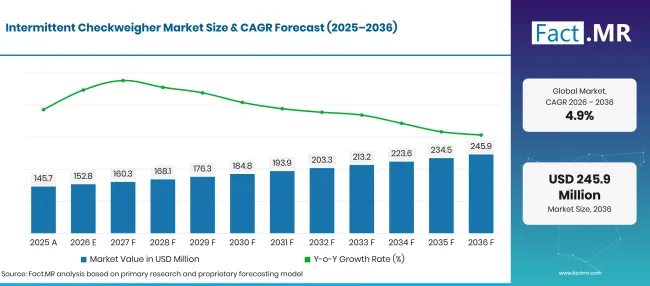
Intermittent Checkweigher Market Forecast Global | Source: Fact.MR
| Year | Basis | Market Value (USD million) |
|---|---|---|
| 2025 | Actual | 145.7 |
| 2026 | Estimate | 152.8 |
| 2036 | Forecast | 245.9 |
| CAGR 2026 to 2036 | Forecast period | 4.9% |
Source: Fact.MR analysis. Updated Nov 4, 2026
What are the defining numbers behind Intermittent Checkweigher Market growth?
USD 93.1 million absolute opportunity between 2026 and 2036.
- Demand Drivers in the Market
- Food and beverage manufacturers require accurate weight verification to maintain package consistency and reduce product giveaway. Automated weighing systems support quality control across packaged food production and help identify products outside specified weight limits.
- Pharmaceutical manufacturers require controlled weighing and inspection procedures to maintain product quality. Checkweighers can support packaging-line verification where individual packaged products need to meet specified weight requirements.
- Manufacturing and packaging facilities are adopting automated inspection systems to improve production consistency. Integration of checkweighers with conveyors, rejection mechanisms and production monitoring systems can reduce manual inspection requirements and improve operational visibility.
- Key Segments Analyzed
- By Product Type: Dynamic Checkweighers will account for 58.3% of the market in 2026, as reported in the product-type segmentation. Dynamic weighing measures products in motion, whereas intermittent-motion checkweighing stops products for weighing.
- By Application: Food and Beverage capture 36.5% share in 2026, supported by packaged-food production and weight-compliance requirements.
- By Technology: Electromagnetic Force Restoration will hold 62.1% share in 2026, reflecting its importance in precision weighing applications.
- By End User: Manufacturing segment lead with 47.2% share in 2026, driven by quality-control requirements across industrial production facilities.
- Analyst Opinion at Fact.MR
- Shambhu Nath Jha, Principal Consultant at Fact.MR, states, “Intermittent checkweighing systems are likely to attract investment as manufacturers seek greater control over package weights and production quality. Suppliers need to demonstrate measurement reliability, operational flexibility and compatibility with existing packaging lines to strengthen adoption.”
- Strategic Implications
- Manufacturers should improve weighing accuracy and system reliability while ensuring compatibility with different product sizes and packaging formats.
- Checkweigher suppliers can offer integration capabilities that connect weighing equipment with production monitoring and automated rejection systems.
- Food and beverage processors must prioritize weighing systems that support consistent package weights and reduce material losses.
- Pharmaceutical manufacturers need to evaluate equipment according to validation requirements, measurement repeatability and production-line compatibility.
- Technology providers must strengthen electromagnetic force restoration capabilities for applications requiring precise weight measurement.
Germany is set to record a 5.5% CAGR through 2036. Brazil is projected to post 4.1%, followed by the USA at 5.1%. The UK is forecast to advance at 6.0%, while Japan is expected to register 4.7%.
How does the Intermittent Checkweigher Market break down by segment?
Fact.MR finds that Dynamic Checkweighers lead Product Type with 58.3%; Food and Beverage leads Application with 36.5%; Electromagnetic Force Restoration leads Technology with 62.1%; and Manufacturing Leads End User with 47.2%.
Which Product Type dominates?
Dynamic Checkweighers are set to hold 58.3% share in 2026.
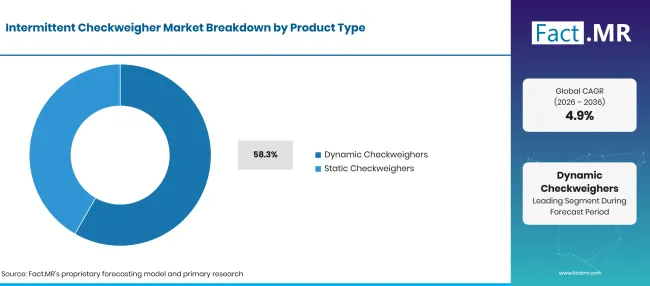
Intermittent Checkweigher Market Breakdown Product Type | Source: Fact.MR
| Product Type | Share (2026) |
|---|---|
| Dynamic Checkweighers (Leading segment) | 58.3% |
| Other segments combined | 41.7%* |
| Total | 100.0% |
Source: Fact.MR analysis. Updated Nov 4, 2026
Dynamic checkweighers measure individual product weights while items remain in motion. Intermittent-motion checkweighers instead stop each item on the weighing section, measure its static weight and then discharge it. Automated weight inspection can identify products outside specified weight limits and reduce manual intervention. The product-type share reported above reflects the original segmentation and should be interpreted separately from the operating definition of intermittent-motion weighing [6].
Which Application leads the market?
Food and Beverage is set to represent 36.5% share in 2026.
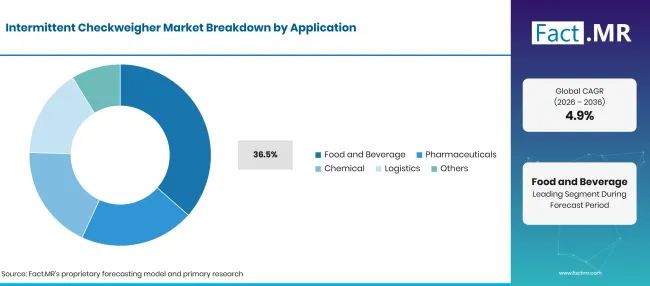
Intermittent Checkweigher Market Breakdown Application | Source: Fact.MR
| Application | Share (2026) |
|---|---|
| Food and Beverage (Leading segment) | 36.5% |
| Other segments combined | 63.5%* |
| Total | 100.0% |
Source: Fact.MR analysis. Updated Nov 4, 2026
Food and beverage manufacturers use checkweighers to verify the weight of packaged products and maintain consistency across production batches. Applications include packaged snacks, dairy products, meat, bakery goods, beverages and ready-to-eat foods. Weighing systems can identify underfilled or overfilled packages and support production quality control. Hygienic equipment design and washdown capabilities are important selection criteria for food-processing facilities.
Which Technology leads the market?
Electromagnetic Force Restoration is projected to account for 62.1% share in 2026.
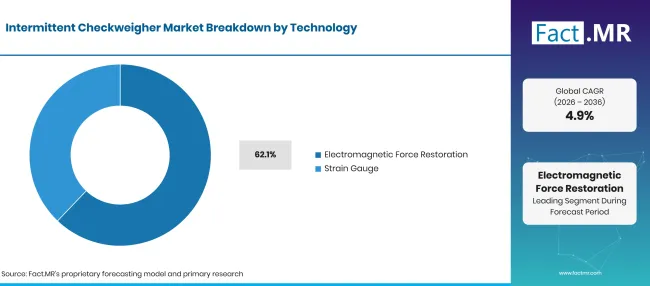
Intermittent Checkweigher Market Breakdown Technology | Source: Fact.MR
| Technology | Share (2026) |
|---|---|
| Electromagnetic Force Restoration (Leading segment) | 62.1% |
| Other segments combined | 37.9%* |
| Total | 100.0% |
Source: Fact.MR analysis. Updated Nov 4, 2026
Electromagnetic Force Restoration (EMFR) technology uses a feedback mechanism to restore a displaced weighing element to its original position. The electrical current required to generate the restoring force is used to determine the applied weight. This technology supports high-resolution measurement and precision weighing. Strain gauge technology measures the deformation of a sensing element under an applied load and converts the resulting electrical signal into a weight reading. Both technologies serve different weighing capacities and accuracy requirements.
Which End User dominates demand?
Manufacturing is projected to lead with 47.2% share in 2026.
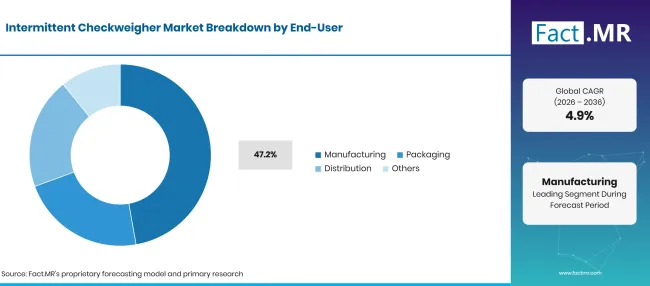
Intermittent Checkweigher Market Breakdown End User | Source: Fact.MR
| End User | Share (2026) |
|---|---|
| Manufacturing (Leading segment) | 47.2% |
| Other segments combined | 52.8%* |
| Total | 100.0% |
Source: Fact.MR analysis. Updated Nov 4, 2026
Manufacturing accounts for the largest end-user share because weight verification is an important part of production quality control. Manufacturers use checkweighers to identify deviations from target package weights and maintain consistent output. Packaging companies also require weighing systems that can handle different product formats and production volumes. Distribution and logistics operations use weighing equipment for shipment verification and package handling, although their requirements differ from production-line inspection.
What is accelerating Intermittent Checkweigher Market adoption, and what is holding it back?
Packaging accuracy and manufacturing automation support demand, while equipment costs and integration requirements can slow adoption.
Drivers Impact Analysis
| DRIVER | (~) % IMPACT ON CAGR | GEOGRAPHIC RELEVANCE | IMPACT TIMELINE |
|---|---|---|---|
| Packaged food weight verification | +1.0% | Europe, Americas | Short term (≤ 2 years) |
| Pharmaceutical quality-control requirements | +0.9% | Global | Medium term (2–4 years) |
| Manufacturing-line automation | +0.7% | Global | Medium term (2–4 years) |
| Precision weighing requirements | +0.5% | Europe, Asia | Medium term (2–4 years) |
| Integration with automated inspection systems | +0.4% | Global | Long term (≥ 4 years) |
Source: Fact.MR analysis. Updated Nov 4, 2026
Opportunity Impact Analysis
| OPPORTUNITY | (~) % IMPACT ON CAGR | GEOGRAPHIC RELEVANCE | IMPACT TIMELINE |
|---|---|---|---|
| High-precision weighing systems | +0.8% | Global | Medium term (2–4 years) |
| Pharmaceutical packaging inspection | +0.6% | North America, Europe | Medium term (2–4 years) |
| Integrated metal detection and checkweighing | +0.5% | Global | Short term (≤ 2 years) |
| Hygienic equipment for food processing | +0.4% | Europe, Asia | Long term (≥ 4 years) |
Source: Fact.MR analysis. Updated Nov 4, 2026
Restraints Impact Analysis
| RESTRAINT | (~) % IMPACT ON CAGR | GEOGRAPHIC RELEVANCE | IMPACT TIMELINE |
|---|---|---|---|
| High equipment acquisition costs | -0.8% | Global | Short term (≤ 2 years) |
| Integration with existing production lines | -0.6% | Global | Medium term (2–4 years) |
| Calibration and maintenance requirements | -0.5% | Global | Medium term (2–4 years) |
| Limited investment capacity among small manufacturers | -0.4% | Asia, Latin America | Long term (≥ 4 years) |
Source: Fact.MR analysis. Updated Nov 4, 2026
Which countries are scaling the Intermittent Checkweigher Market through 2036?
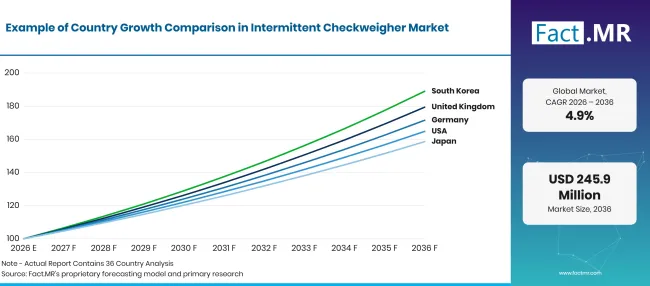
Intermittent Checkweigher Market Growth Index | Source: Fact.MR
| Country | CAGR (2026–2036) |
|---|---|
| Germany | 5.5% |
| Brazil | 4.1% |
| USA | 5.1% |
| UK | 6.0% |
| Japan | 4.7% |
Source: Fact.MR analysis. Updated Nov 4, 2026
What supports Germany adoption?
5.5% CAGR, shaped by advanced manufacturing facilities and industrial quality-control requirements.
Germany's market is supported by its established food-processing, pharmaceutical and industrial manufacturing base. Manufacturers require weighing systems that maintain packaging consistency and support production quality standards. Suppliers can strengthen adoption through precision weighing technology, reliable calibration services and integration with existing inspection equipment.
Germany's food manufacturing industry generated €232.7 billion in revenue in 2024, according to the Federal Ministry for Economic Affairs and Energy. The sector included 5,991 manufacturing establishments and employed approximately 651,150 people. Its large production base supports demand for accurate weighing systems that maintain package-weight consistency and reduce product giveaway. [1]
How is Brazil developing checkweigher adoption?
4.1% CAGR, driven by food processing and growing requirements for automated packaging inspection.
Brazil's food and beverage processing industry creates demand for weighing equipment that supports packaged-product quality and production efficiency. Manufacturers can benefit from checkweighers that handle different package sizes and operate in demanding production environments. Suppliers should focus on equipment reliability, local service availability and cost-effective installation.
Brazil's national statistics agency IBGE reported that its packaging production index recorded 8.0% year-to-date growth in August 2026 for the selected packaging groups' total index. This reflects activity across packaging-related manufacturing and supports demand for equipment that verifies packaged-product weights. [2]
What supports United States adoption?
5.1% CAGR, supported by automated packaging operations and quality-control requirements.
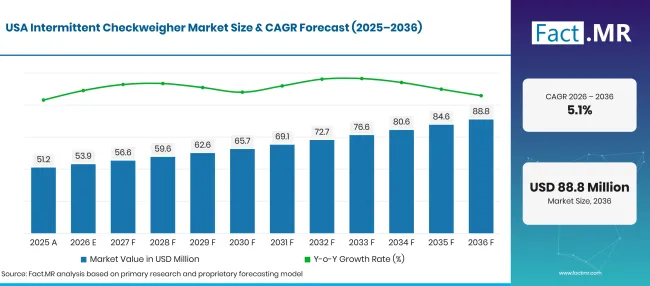
Intermittent Checkweigher Market Forecast Usa | Source: Fact.MR
The United States has an established market for industrial weighing and product inspection equipment. Food processors and pharmaceutical manufacturers require accurate weight verification to maintain product consistency and meet applicable packaging requirements. Suppliers can strengthen their position through high-speed inspection, data recording and integration with automated production systems. The U.S. Census Bureau reported that food manufacturing generated approximately US$1.054 trillion in sales during 2024, based on its Annual Integrated Economic Survey released in 2026. [3]
How is the United Kingdom building adoption?
6.0% CAGR, led by packaging quality requirements and investments in manufacturing automation.
UK manufacturers require reliable weight verification across food processing, pharmaceutical production and industrial packaging operations. Checkweighers help identify packages that do not meet specified weight limits and can reduce unnecessary product giveaway. Equipment providers can support adoption through flexible system configurations, calibration services and integration with existing production lines.
According to the UK Department for Environment, Food and Rural Affairs, food and drink manufacturing employed approximately 444,000 people in Great Britain in 2025, based on statistics updated in July 2026. This established production base supports demand for weighing systems that maintain package-weight accuracy and identify underweight products. [4]
What supports Japan adoption?
4.7% CAGR, backed by precision manufacturing and automated packaging processes.
Japan's market opportunity is linked to the importance of precision and operational consistency across food processing and industrial production. Manufacturers require weighing systems that maintain accuracy across different product formats while supporting efficient production operations. Suppliers can expand their presence through compact equipment, high-resolution weighing technology and automated inspection capabilities.
Japan's Ministry of Agriculture, Forestry and Fisheries reported that labour productivity in food manufacturing increased by 4.1% in FY2024 to ¥7.386 million per worker, according to its 2026 White Paper. [5]
Who leads the Intermittent Checkweigher Market?
Fact.MR identifies Mettler-Toledo, Ishida, Minebea Intec, Anritsu Corporation, Yamato Scale, Thermo Fisher Scientific, Bizerba, Loma Systems, Cardinal Scale Manufacturing Company and Avery Weigh-Tronix as companies participating in industrial checkweighing equipment.
Mettler-Toledo offers dynamic checkweighing systems for food, pharmaceutical and chemical manufacturing applications. Ishida supplies DACS checkweighers for different product sizes and packaging requirements. Minebea Intec offers Essentus, Synus, Flexus and EWK checkweighers, including systems based on electromagnetic force restoration technology. Anritsu supplies high-accuracy checkweighers for food and pharmaceutical production.
Yamato Scale provides checkweighers and integrated weighing and packaging solutions. Thermo Fisher Scientific offers general-purpose and pharmaceutical checkweighing systems. Bizerba supplies dynamic checkweighers for food-processing and packaging applications, while Loma Systems provides inspection systems for packaged products across food and pharmaceutical industries.
Commercial competition depends on weighing precision, throughput, equipment reliability, calibration support and integration capabilities. Manufacturers need to provide systems that accommodate different product weights and packaging formats. Food processors prioritize hygienic construction, while pharmaceutical manufacturers place greater emphasis on measurement accuracy, validation and production documentation.
Which companies are the key providers?
Key companies include Mettler-Toledo; Ishida Co., Ltd.; Minebea Intec; Anritsu Corporation; Yamato Scale Co., Ltd.; Thermo Fisher Scientific Inc.; Bizerba SE; Loma Systems; Cardinal Scale Manufacturing Company; and Avery Weigh-Tronix.
- Mettler-Toledo
- Ishida Co., Ltd.
- Minebea Intec
- Anritsu Corporation
- Yamato Scale Co., Ltd.
- Thermo Fisher Scientific Inc.
- Bizerba SE
- Loma Systems
- Cardinal Scale Manufacturing Company
- Avery Weigh-Tronix
Bibliography
- [1] Statistisches Bundesamt (Destatis). (2026, January 14). Produktion von Fertiggerichten binnen fünf Jahren mengenmäßig um 25,6 % gestiegen.
- [2] Instituto Brasileiro de Geografia e Estatística. (2026, October 2). Industrial production changes by 0.6% in August.
- [3] U.S. Census Bureau. (2026, September 3). Manufacturing: Summary statistics for industry groups and industries for employer firms in the U.S. and states: 2024 (Table AIES31BASIC02).
- [4] Department for Environment, Food & Rural Affairs. (2026, July 29). Food statistics in your pocket.
- [5] Ministry of Agriculture, Forestry and Fisheries. (2026, May 29). 第2節 食品産業の発展 [Section 2: Development of the food industry]. In 令和7年度 食料・農業・農村白書 [FY2025 White Paper on Food, Agriculture and Rural Areas].
- [6] Mettler-Toledo. (2026). Checkweighing guidance: Intermittent motion checkweigher.
This Report Answers
- The report examines the adoption of industrial checkweighing systems across manufacturing and packaging operations.
- Product-type analysis compares dynamic and static checkweighing equipment.
- Application analysis evaluates food and beverage, pharmaceuticals, chemicals and logistics.
- Technology analysis compares electromagnetic force restoration and strain gauge weighing systems.
- Country analysis covers Germany, Brazil, USA, UK and Japan.
- The competitive overview profiles ten companies participating in industrial weighing and checkweighing equipment.
What does the Intermittent Checkweigher Market cover?
The market covers industrial weighing systems designed to verify individual product or package weights against predetermined limits. It evaluates equipment used across food and beverage, pharmaceutical, chemical and logistics applications. Product coverage includes dynamic and static checkweighers, while technology coverage distinguishes electromagnetic force restoration from strain gauge measurement. Purchasing decisions depend on accuracy, weighing capacity, production throughput, calibration requirements and compatibility with existing processing equipment.
What is included in the scope?
The analysis includes industrial checkweighing equipment used for individual product-weight verification.
It covers systems based on electromagnetic force restoration and strain gauge technologies, along with dynamic and static product configurations. Applications include packaged food, pharmaceutical products, chemical products and logistics operations. Revenue coverage focuses on checkweigher equipment rather than the entire industrial weighing and inspection equipment market.
What is excluded from the scope?
The analysis excludes ordinary weighing scales used solely for general-purpose measurement without product-weight verification.
Industrial floor scales, truck scales, laboratory balances and standalone retail weighing equipment are outside the defined market unless specifically incorporated into a checkweighing system. Metal detectors, X-ray inspection equipment, labeling machines and packaging machinery sold independently are also excluded. Revenue from general weighing software and unrelated industrial automation equipment is not included.
How Was the Analysis Built?
The analysis draws on 120+ sources, 35+ company portfolios, 25+ countries and more than 20 industry interviews.
- Primary Research: Primary research includes discussions with weighing equipment manufacturers, packaging machinery suppliers, industrial automation providers, distributors, manufacturing companies and subject-matter experts. These conversations examine purchasing priorities, weighing accuracy, equipment adoption, operational challenges, integration requirements and competitive positioning.
- Desk Research: Desk research covers government publications, industrial standards, company filings, product catalogues, technical documentation, trade data, industry associations and other authoritative sources. Every source used in the analysis is documented in the bibliography.
- Market Sizing and Forecasting: Market estimates combine historical performance, demand indicators, equipment pricing, installation volumes, segment shares, company participation, country-level growth, automation investments and barriers to market expansion.
- Data Validation and Update Cycle: Findings are validated by comparing primary interviews with public data, company product portfolios, technological developments, capacity changes, partnerships and industrial adoption patterns. Regular updates review new product introductions, weighing technology improvements and changes in manufacturing investment.
Segmentation
What is the report's scope and coverage?
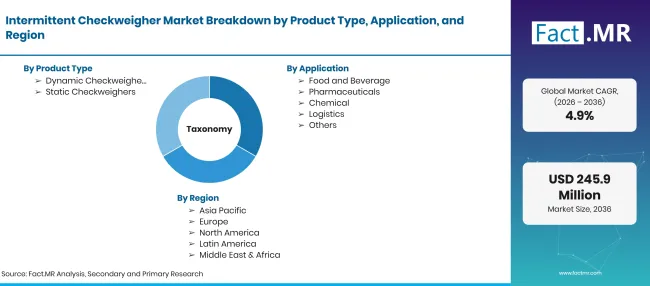
Intermittent Checkweigher Market Taxonomy | Source: Fact.MR
| Attribute | Details |
|---|---|
| Quantitative Units | USD billion in 2026 to USD billion by 2036, at CAGR |
| Market Definition | Intermittent checkweighers are industrial weighing systems that briefly stop individual products on a weighing platform to measure their weight against predefined limits. |
| Product Type | Dynamic Checkweighers; Static Checkweighers |
| Application | Food and Beverage; Pharmaceuticals; Chemical; Logistics; Others |
| Technology | Electromagnetic Force Restoration; Strain Gauge |
| End User | Manufacturing; Packaging; Distribution; Others |
| Regions Covered | North America; Latin America; Western Europe; Eastern Europe; East Asia; South Asia & Pacific; Middle East & Africa |
| Countries Covered | Germany; Brazil; USA; UK; Japan |
| Companies Profiled | Mettler-Toledo; Ishida; Minebea Intec; Anritsu; Yamato Scale; Thermo Fisher Scientific; Bizerba; Loma Systems; Cardinal Scale; Avery Weigh-Tronix |
| Forecast Period | 2026 to 2036 |
| Approach | Market segmentation and scenario-based analysis supported by company product portfolios, industrial weighing applications and packaging quality-control requirements |
Source: Fact.MR analysis. Updated Nov 4, 2026
How is the market segmented?
-
By Product Type
- Dynamic Checkweighers
- Static Checkweighers
-
By Application
- Food and Beverage
- Pharmaceuticals
- Chemical
- Logistics
- Others
-
By Technology
- Electromagnetic Force Restoration
- Strain Gauge
-
By End User
- Manufacturing
- Packaging
- Distribution
- Others
-
By Region
- North America
- Latin America
- Western Europe
- Eastern Europe
- East Asia
- South Asia & Pacific
- Middle East & Africa
Frequently Asked Questions
How big is the intermittent checkweigher market in 2026?
What is the CAGR from 2026 to 2036?
Which product type has the largest share?
Which application leads the market?
Which technology has the largest share?
Which end user dominates the market?
Which companies are covered?
Who worked on this report


Preview the report firsthand - request a free sample
Free SampleGet the brochure for pricing and purchase details
Download PDF