- Market Value (2025): USD 14.8 Bn
- Estimated Value (2026): USD 15.6 Bn
- Forecast Value (2036): USD 25.2 Bn
- CAGR (2026-2036): 5.0%
What is the Chrome Ores Market forecast to be worth by 2036?
USD 15.6 billion in 2026 to USD 25.2 billion by 2036, at a 5.0% CAGR.
- As per Fact.MR analysis, the chrome ores market reached USD 14.8 billion in 2025.
- Market value is projected to move from USD 15.6 billion in 2026 to USD 25.2 billion by 2036.
- Sales are forecast to record a 5.0% CAGR between 2026 and 2036 as ferrochrome smelters and specialist mineral processors secure grade-matched ore.
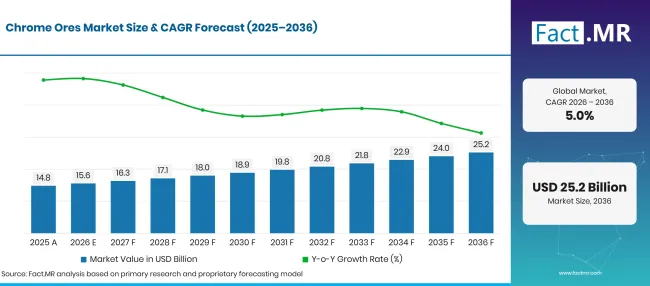
Chrome Ores Market Forecast Global | Source: Fact.MR
| Year | Basis | Market Value (USD billion) |
|---|---|---|
| 2025 | Historical estimate | 14.9 |
| 2026 | Estimate | 15.6 |
| 2036 | Forecast | 25.2 |
| CAGR 2026 to 2036 | Forecast period | 5.0% |
Source: Fact.MR analysis. Updated Oct 22, 2026
What are the defining numbers behind Chrome Ores Market growth?
An additional USD 9.6 billion in market value by 2036, with metallurgical-grade ore and metallurgy forming the main commercial base.
- Demand Drivers in the Market
- Ferrochrome smelters purchase chrome concentrates against chromium content and gangue specifications. Ore that meets a stable furnace recipe cuts the need for blending and reduces the risk of an expensive process adjustment.
- Chemical producers select chrome ore for controlled downstream processing and tighter impurity requirements. Their purchasing decisions involve qualification tests and the ability to receive repeat batches with similar chemical properties.
- Refractory and foundry customers buy particular chromite grades for heat-resistant or casting-related applications. Suppliers gain repeat orders when particle size and mineral properties remain predictable from one delivery to the next.
- Key Segments Analyzed
- By Product Type: Metallurgical Grade holds 62.3% of the market in 2026, reflecting its role in ferrochrome smelting.
- By Application: Metallurgy captures 54.7% share in 2026 as smelters convert ore into chromium-bearing alloys.
- By End-User Industry: Steel represents 35.0% share in 2026, mainly through the use of ferrochrome in alloy production.
- Analyst Opinion at Fact.MR
- Shambhu Nath Jha, Principal Consultant at Fact.MR, states, “Chrome ore contracts depend on recoverable chromium and the consistency of each shipment. Smelters often prefer a stable mineral composition because changes in the feed can raise blending and processing costs.”
- Strategic Implications
- Mine operators should present ore assays alongside shipment consistency records so smelters can compare the real cost of usable chromium.
- As per Fact.MR analysis, smelters should assess ore quality and the electricity required for ferrochrome production together when comparing supply contracts.
- mineral traders need clear origin records and batch specifications because freight delays can change the delivered cost of every ore shipment.
- As per Fact.MR analysis, chemical and refractory processors should qualify each grade for its intended process before committing to longer supply agreements.
Germany is forecast to achieve a 6.2% CAGR through 2036, followed by the United Kingdom at 5.6%. Brazil is projected to advance at 4.7%, while the United States records 4.3%. Japan has a 3.9% CAGR outlook, shaped by demand for chromium-bearing materials in its mature metalworking base.
How does the Chrome Ores Market break down by segment?
Metallurgical Grade 62.3%; Metallurgy 54.7%; Steel 35.0% in 2026.
Which Product Type dominates?
Metallurgical Grade holds 62.3% share in 2026.
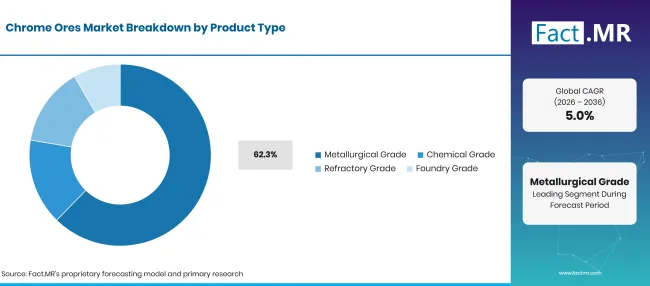
Chrome Ores Market Breakdown Product Type | Source: Fact.MR
| Product Type dominates | Share (2026) |
|---|---|
| Metallurgical Grade (Leading segment) | 62.3% |
| Other segments combined | 37.7% |
| Total | 100.0% |
Source: Fact.MR analysis. Updated Oct 22, 2026
Metallurgical-grade chromite is purchased mainly for ferrochrome production. Smelters assess chromium oxide grade and the ratio of chromium to iron when planning a feed mix. Ore preparation and washing can affect the grade a mining operation offers to its customers.
Chemical-grade chromite enters processes where impurity limits shape downstream chemical output. Refractory-grade minerals are chosen for materials that must tolerate high heat, while foundry-grade sands serve casting operations requiring a predictable grain size.
What leads the Application segment?
Metallurgy accounts for 54.7% share in 2026.
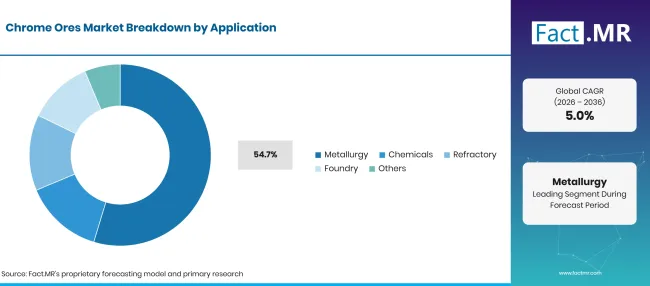
Chrome Ores Market Breakdown Application | Source: Fact.MR
| Application segment | Share (2026) |
|---|---|
| Metallurgy (Leading segment) | 54.7% |
| Other segments combined | 45.3% |
| Total | 100.0% |
Source: Fact.MR analysis. Updated Oct 22, 2026
Metallurgy accounts for the wider ore flow because ferrochrome smelters take large quantities of chromite feed. The sale depends on furnace suitability and the cost of moving ore from mine to plant. Smelters also compare blending requirements when deliveries vary in chromium content.
Chromium chemicals are manufactured from qualifying chromite feed, while refractory applications require mineral properties suited to high-temperature service. Foundry customers assess chromite sand for casting performance and stable grain characteristics before changing material sources.
How does End-User Industry purchasing shape sales?
Steel leads with 35.0% share in 2026.
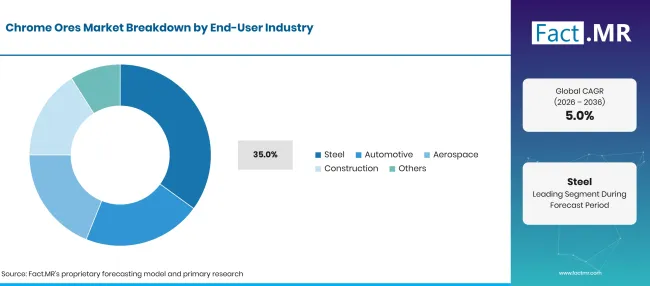
Chrome Ores Market Breakdown End User Industry | Source: Fact.MR
| End-User Industry purchasing shape sales | Share (2026) |
|---|---|
| Steel (Leading segment) | 35.0% |
| Other segments combined | 65.0% |
| Total | 100.0% |
Source: Fact.MR analysis. Updated Oct 22, 2026
The steel end-user category reflects chromium consumed through ferrochrome and other chromium-bearing inputs. Chromium is used to produce stainless and heat-resistant grades, which makes the smelting route central to ore purchasing. Steel users mainly buy processed chromium materials while their upstream suppliers buy ore.
automotive and aerospace applications appear downstream through alloy manufacturing. Construction uses chromium-bearing steel where corrosion resistance is required. The steel category therefore needs careful separation from finished component sales to avoid counting the same material several times.
What is accelerating Chrome Ores Market adoption, and what is holding it back?
Smelter feed requirements and the scale of chromium-bearing steel production support ore sales. Electricity costs and uneven ore quality can limit conversion economics.
Drivers Impact Analysis
| DRIVER | (~) % IMPACT ON CAGR | GEOGRAPHIC RELEVANCE | IMPACT TIMELINE |
|---|---|---|---|
| Ferrochrome feed purchasing | +1.0% | South Africa, Asia | Medium term (2–4 years) |
| Smelter-grade consistency | +0.8% | Global | Short term (<= 2 years) |
| Chromium alloy requirements | +0.7% | Europe, Japan | Medium term (2–4 years) |
| Ore processing improvements | +0.5% | Mining regions | Medium term (2–4 years) |
| Specialist refractory uses | +0.4% | Global | Long term (>= 4 years) |
Source: Fact.MR analysis. Updated Oct 22, 2026
Opportunity Impact Analysis
| OPPORTUNITY | (~) % IMPACT ON CAGR | GEOGRAPHIC RELEVANCE | IMPACT TIMELINE |
|---|---|---|---|
| Ore grading and blending | +0.8% | Mining regions | Medium term (2–4 years) |
| Integrated mine-to-smelter logistics | +0.6% | South Africa, Asia | Medium term (2–4 years) |
| Chemical-grade preparation | +0.5% | Global | Long term (>= 4 years) |
| Foundry-grade specialty sales | +0.4% | Global | Medium term (2–4 years) |
Source: Fact.MR analysis. Updated Oct 22, 2026
Restraints Impact Analysis
| RESTRAINT | (~) % IMPACT ON CAGR | GEOGRAPHIC RELEVANCE | IMPACT TIMELINE |
|---|---|---|---|
| Smelting electricity exposure | -0.8% | South Africa | Short term (<= 2 years) |
| Freight and port constraints | -0.6% | Export corridors | Medium term (2–4 years) |
| Ore grade variability | -0.5% | Global | Medium term (2–4 years) |
| Ferrochrome market swings | -0.4% | Global | Long term (>= 4 years) |
Source: Fact.MR analysis. Updated Oct 22, 2026
Which countries are scaling the Chrome Ores Market through 2036?
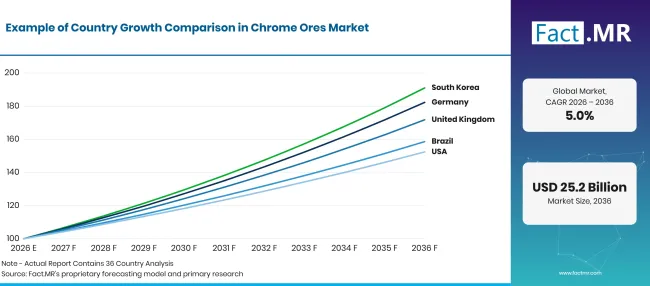
Chrome Ores Market Growth Index | Source: Fact.MR
| Country | CAGR (2026–2036) |
|---|---|
| Germany | 6.2% |
| United Kingdom | 5.6% |
| Brazil | 4.7% |
| United States | 4.3% |
| Japan | 3.9% |
Source: Fact.MR analysis. Updated Oct 22, 2026
Why is Germany expanding chrome ore-linked purchases?
6.2% CAGR, linked to specialty steel and quality-led metal production.
German alloy and heat-resistant component makers generally buy chromium after chromite has been converted into ferrochrome. The world stainless association reported in February 2026 that the European Union produced 5.7 million tonnes of stainless steel in 2025 [2].
How is the United Kingdom using chromium-bearing materials?
5.6% CAGR, supported by specialist alloy requirements and imported metal supply.
British manufacturers use chromium-bearing alloys where corrosion resistance and consistent processing quality matter. The world stainless association reported 1.1 million tonnes of stainless steel output in 2025 for its combined “other countries” group, which includes the United Kingdom.
What supports Brazil’s chrome ore outlook?
4.7% CAGR, shaped by domestic chromite output and local mineral processing.
Brazil has chromite mines in Bahia, providing material for ferroalloys and specialist mineral processing. The National Mining Agency reported approximately 530,000 tonnes of chromite production in 2024 in its 2025 mineral summary [3].
Why does the United States remain a chromium buyer?
4.3% CAGR, influenced by imported chromium materials and industrial-grade requirements.
United States chromium users rely heavily on international sources for ore and related metal inputs. The U.S. Geological Survey's 2025 mineral summary estimated net import reliance for chromium at 77% of apparent consumption in 2024 [1]. Smelters and specialty mineral processors therefore assess the delivered cost of chromium-containing materials alongside the chemistry of individual shipments.
How is Japan maintaining chrome ore-related sales?
3.9% CAGR, connected to established steel and precision-alloy production.
Japan's established metalworking and alloy sectors require consistent chromium-bearing inputs for applications where material composition affects performance. Japanese customers are expected to compare alloy purity and delivery reliability, while ore mining and smelting remain separate commercial steps further upstream.
Who leads the Chrome Ores Market?
Glencore and Samancor Chrome operate in the South African chromium supply chain, while Eurasian Resources Group and Yilmaden have mining and ferroalloy activities. Tharisa Minerals markets chrome concentrates alongside its other mineral products. Mine location and concentrate specifications shape their relevance to direct chrome ore purchasing.
Tata Steel have links to chrome ore or ferroalloy value chains. Merafe Resources participates in the Glencore-Merafe Chrome Venture, so its production exposure should be understood alongside that partnership. Afarak Group serves specialist chromium operations.
Which companies are the key providers?
Key companies include Glencore; Samancor Chrome; Eurasian Resources Group; Tata Steel; Tharisa Minerals; Merafe Resources; Yilmaden Holding; and Afarak Group.
- Glencore
- Samancor Chrome
- Eurasian Resources Group
- Tata Steel
- Tharisa Minerals
- Merafe Resources
- Yilmaden Holding
- Afarak Group
Bibliography
- [1] U.S. Geological Survey. (2025, January 31). Mineral commodity summaries 2025: Chromium.
- [2] World Stainless Association. (2026, February 27). Stainless steel melt shop production increases by 2.1% in 2025.
- [3] Agência Nacional de Mineração. (2025, October 2). Sumário Mineral Brasileiro 2025: Cromo.
- [4] World Steel Association. (2026, January 23). December 2025 crude steel production and 2025 global crude steel production totals
- [5] Glencore. (2026, January 29). Full Year 2025 Production Report.
This Report Answers
- The study compares grade requirements across chrome ore sold for smelting and specialist industrial processing.
- Product analysis explains the commercial role of metallurgical-grade ore in ferrochrome production.
- Application analysis separates the ore-to-alloy pathway from direct chemical and foundry mineral use.
- Country coverage compares ore production conditions with downstream alloy purchasing and trade exposure.
Competitive analysis distinguishes mine output from ferrochrome and finished-steel activities
What does the Chrome Ores Market cover?
The market covers chromite ore and concentrates prepared for metallurgical, chemical, refractory and foundry uses. It includes material traded from mines and concentrators to downstream processors. Chromium metal and ferrochrome are considered in the analysis as major downstream uses of ore, not as interchangeable forms of the raw material.
What is included in the scope?
Sales of metallurgical-grade chrome ore and processed chromite concentrates belong in the core scope.
Chemical, refractory and foundry ore grades are included when the product sold remains a mineral input. The review covers mine output, grade assessment and shipment economics. It also considers how downstream furnace activity affects mine orders. Connections to adjacent Fact.MR material research include chromium mining and relevant ferroalloy processing.
What is excluded from the scope?
Finished stainless steel and manufactured automotive parts are outside direct chrome ore sales.
Ferrochrome, chromium metal and downstream chromium chemical products are separate products after mineral conversion. Equipment sold to mines and transport companies is also excluded. These boundaries help separate mineral revenue from the value of materials produced later in the chain.
How Was the Analysis Built?
The analysis draws on 120+ sources, 35+ company portfolios, 25+ countries, and more than 20 industry interviews.
- Primary Research: Primary research includes discussions with manufacturers, service providers, technology developers, distributors, end users, and subject-matter experts. These conversations examine purchasing priorities, product adoption, operational challenges, approval requirements, competitive positioning, and the factors that influence wider market acceptance.
- Desk Research: Desk research covers government statistics, regulatory publications, company filings, trade data, technical studies, industry associations, standards, public policy, and other authoritative sources. Every source used in the analysis is documented in the bibliography.
- Market Sizing and Forecasting: Market estimates combine historical performance, demand indicators, pricing and volume trends, segment shares, company participation, country-level growth, adoption patterns, investment activity, and barriers to market expansion.
- Data Validation and Update Cycle: Findings are validated by comparing primary interviews with public data, company activity, regulatory changes, trade patterns, and industry developments. Regular updates review new product launches, capacity changes, partnerships, approvals, and shifts in commercial adoption.
Segmentation
What is the report’s scope and coverage?
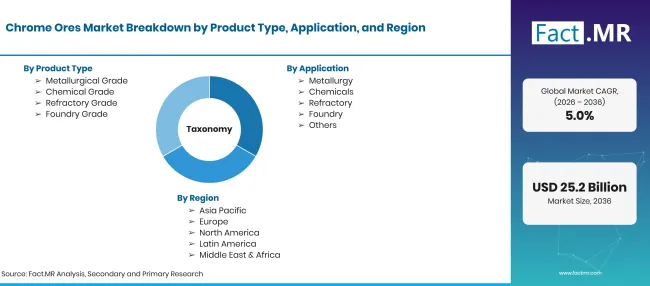
Chrome Ores Market Taxonomy | Source: Fact.MR
| Attribute | Details |
|---|---|
| Quantitative Units | USD billion |
| Market Definition | Chromite ore and concentrates supplied for metallurgical, chemical, refractory and foundry use |
| Product Type | Metallurgical Grade; Chemical Grade; Refractory Grade; Foundry Grade |
| Application | Metallurgy; Chemicals; Refractory; Foundry; Others |
| End-User Industry | Steel; Automotive; Aerospace; Construction; Others |
| Regions Covered | North America; Latin America; Western Europe; Eastern Europe; East Asia; South Asia & Pacific; Middle East & Africa |
| Countries Covered | Germany; Brazil; United States; United Kingdom; Japan |
| Companies Profiled | Glencore; Samancor Chrome; Eurasian Resources Group; Tata Steel; Tharisa Minerals; Merafe Resources; Yilmaden Holding; and Afarak Group |
| Forecast Period | 2026 to 2036 |
| Approach | Ore-grade assessment, downstream alloy demand, production and country trends |
Source: Fact.MR analysis. Updated Oct 22, 2026
How is the market segmented?
-
By Product Type
- Metallurgical Grade
- Chemical Grade
- Refractory Grade
- Foundry Grade
-
By Application
- Metallurgy
- Chemicals
- Refractory
- Foundry
- Others
-
By End-User Industry
- Steel
- Automotive
- Aerospace
- Construction
- Others
-
By Region
- North America
- Latin America
- Western Europe
- Eastern Europe
- East Asia
- South Asia & Pacific
- Middle East & Africa
Frequently Asked Questions
How big is the chrome ores market in 2026?
What is the CAGR between 2026 and 2036?
Which product type leads?
Which application leads?
Who are the main companies in the chrome ores market?
Who worked on this report


Preview the report firsthand - request a free sample
Free SampleGet the brochure for pricing and purchase details
Download PDF