- Market Value (2025): USD 127.5 Mn
- Estimated Value (2026): USD 133.2 Mn
- Forecast Value (2036): USD 206.7 Mn
- CAGR (2026-2036): 4.5%
What is the Circuit Breaker, Fuse, and Relay Market forecast to be worth by 2036?
USD 133.2 billion in 2026 to USD 206.7 billion by 2036 at a 4.5% CAGR.
- The circuit breaker, fuse, and relay market reached USD 127.5 billion in 2025.
- As per Fact.MR analysis, demand is projected to increase from USD 133.2 billion in 2026 to USD 206.7 billion by 2036.
- The market is forecast to record 4.5% CAGR from 2026 to 2036 as utilities and industrial facilities add protection around new loads and grid connections.
.webp "Circuit Breaker, Fuse, And Relay Market (11)")
Circuit Breaker, Fuse, And Relay Market | Source: Fact.MR
| Year | Basis | Market value (USD Billion) |
|---|---|---|
| 2025 | Actual | 127.5 |
| 2026 | Estimate | 133.2 |
| 2036 | Forecast | 206.7 |
| CAGR, 2026 to 2036 | 4.5% | |
What are the defining numbers behind Circuit Breaker, Fuse, and Relay Market growth?
An absolute opportunity of USD 73.5 billion is projected between 2026 and 2036.
- Demand Drivers in the Market
- New power plants increase the need for reliable fault protection as they connect to the grid. In February 2025, the U.S. Energy Information Administration said 63 GW of utility-scale capacity was expected to be added during 2025 [1].
- Investment in transmission networks is increasing as grid owners replace older systems and expand power connections. In March 2026, the U.S. Department of Energy announced an approximately USD 1.9 billion funding opportunity for critical upgrades to the nation’s power grid [2].
- Transmission companies are placing orders earlier for equipment that takes longer to produce and deliver. In March 2025, Ofgem said almost GBP 4 billion could be accessed early for transmission equipment, including switchgear [3].
- Key Segments Analyzed
- By Product Type: Circuit Breakers are projected to hold 42.3% share in 2026 because they can interrupt faults and then be reset for continued service.
- By Application: Industrial is estimated to account for 38.1% share in 2026 as factories use protection across motors, feeders, panels and process equipment.
- By Voltage: Low Voltage is anticipated to capture 43.6% share in 2026 owing to its broad use in buildings, industrial panels, vehicles and final distribution circuits.
- By End-User: Automotive is forecast to represent 38.1% share in 2026 as vehicle electrical systems require fuses, relays and breaker-based protection across more powered functions.
- Analyst Opinion at Fact.MR
- Shambhu Nath Jha, Principal Consultant at Fact.MR, states, “Electrical protection is becoming more connected with the data available from each circuit. Breakers, fuses, and relays are moving toward designs that stop faults while providing clearer information about what happened and where. Suppliers covering both low- and medium-voltage systems can serve a wider range of utility, and vehicle projects.”
- Strategic Implications
- Efficient power switchgear provides a useful view of how low-voltage protection systems are developing. Manufacturers need product ranges that work with common panel ratings and the fault levels found in different electrical systems.
- Utilities need to adjust relay settings as grid conditions and breaker requirements change. In March 2026, the U.S. Energy Information Administration reported that U.S. electricity generation reached 4.43 thousand TWh in 2025 [4].
- Smart junction box and power distribution box systems reflect the growing use of electronic controls for vehicle power protection. Automotive engineers need to select fuses and relays that handle higher electrical loads while remaining easy to access for service and replacement.
As per Fact.MR analysis, Japan is projected at 5.7% CAGR through 2036. Brazil is anticipated at 5.4% while Germany is estimated at 4.8%. The United Kingdom is forecast at 4.0% and the USA is projected at 3.4%.
How does the Circuit Breaker, Fuse, and Relay Market break down by segment?
Circuit Breakers lead Product Type at 42.3%; Industrial leads Application at 38.1%; Low Voltage leads Voltage at 43.6%; Automotive leads End-User at 38.1%.
Which Product Type dominates?
Circuit Breakers are projected to hold 42.3% share in 2026.
.webp "Circuit Breaker, Fuse, And Relay Market (3)")
Circuit Breaker, Fuse, And Relay Market | Source: Fact.MR
Circuit Breaker, Fuse, and Relay Market Breakdown by Product Type
| Product Type | Share (2026) |
|---|---|
| Circuit Breakers (Leading Segment) | 42.3% |
| Fuses and Relays Combined | 57.7% |
| Total | 100.0% |
Circuit breakers are likely to hold the largest product share because they stop power during a fault and can be used again after the problem is cleared. Fuses remain widely used when a simple, single-use protection device is enough. Relays identify unusual electrical conditions and signal breakers to disconnect the affected circuit. Molded case circuit breakers are also widely used for low-voltage protection in industrial and commercial electrical systems.
What leads the Application segment?
Industrial is estimated to account for 38.1% share in 2026.
.webp "Circuit Breaker, Fuse, And Relay Market (1)")
Circuit Breaker, Fuse, And Relay Market | Source: Fact.MR
Circuit Breaker, Fuse, and Relay Market Breakdown by Application
| Application | Share (2026) |
|---|---|
| Industrial (Leading Segment) | 38.1% |
| Other Segments Combined | 61.9% |
| Total | 100.0% |
Factories rely on breakers and relays to protect power lines, motors, control panels, and distribution boards. In June 2026, Japan’s Ministry of Economy, Trade and Industry reported that electrical machinery production increased by 0.7% in 2025 [5]. Industrial sites also use these devices to manage overloads and electrical faults that could affect motors and other plant equipment.
How does Voltage shape demand?
Low Voltage is anticipated to capture 43.6% share in 2026.
.webp "Circuit Breaker, Fuse, And Relay Market (4)")
Circuit Breaker, Fuse, And Relay Market | Source: Fact.MR
Circuit Breaker, Fuse, and Relay Market Breakdown by Voltage
| Voltage | Share (2026) |
|---|---|
| Low Voltage (Leading Segment) | 43.6% |
| Other Segments Combined | 56.4% |
| Total | 100.0% |
Low-voltage devices protect electrical systems near the point where power is used in buildings and factories. Medium-voltage units are mainly used for feeders and substations, where protection settings require more detailed control. High-voltage breakers handle transmission networks and connections to large power plants. DC power distribution also requires protection devices to manage power supplied to digital systems and industrial equipment.
What supports Automotive within End-User?
Automotive is forecast to represent 38.1% share in 2026.
.webp "Circuit Breaker, Fuse, And Relay Market (2)")
Circuit Breaker, Fuse, And Relay Market | Source: Fact.MR
Circuit Breaker, Fuse, and Relay Market Breakdown by End-User
| End-User | Share (2026) |
|---|---|
| Automotive (Leading Segment) | 38.1% |
| Other Segments Combined | 61.9% |
| Total | 100.0% |
Vehicles use fuses and relays to protect wiring and electrical features from faults. In May 2026, the International Energy Agency reported that global electric car sales exceeded 20 million units in 2025 [6]. As vehicles add more electrical features, more circuits require reliable protection. Electronic circuit protectors provide another option for controlling faults closer to the parts using the power.
What is accelerating Circuit Breaker, Fuse, and Relay Market adoption, and what is holding it back?
Demand for breakers, relays, and other protection devices rises as power distribution automation systems expand across feeders and substations. Grid expansion and higher electrical loads add to this demand, while long replacement cycles limit how often utilities place new orders.
Drivers Impact Analysis
| DRIVER | (~) % IMPACT ON CAGR | GEOGRAPHIC RELEVANCE | IMPACT TIMELINE |
|---|---|---|---|
| Grid reinforcement and renewable connections | +0.9% | North America, Europe, Latin America | Medium term (2-4 years) |
| Industrial power-system expansion | +0.7% | Global | Medium term (2-4 years) |
| Data center and high-load building construction | +0.6% | North America, Western Europe, East Asia | Short term (<= 2 years) |
| Vehicle electrification and higher electrical content | +0.5% | East Asia, Europe, North America | Long term (>= 4 years) |
| Protection monitoring and relay upgrades | +0.4% | Global | Medium term (2-4 years) |
Opportunity Impact Analysis
| OPPORTUNITY | (~) % IMPACT ON CAGR | GEOGRAPHIC RELEVANCE | IMPACT TIMELINE |
|---|---|---|---|
| Connected breakers and digital trip units | +0.6% | Global | Medium term (2-4 years) |
| Protection for battery storage and renewable plants | +0.5% | North America, Europe, Asia | Medium term (2-4 years) |
| Relay modernization in aging substations | +0.4% | Europe, North America | Long term (>= 4 years) |
| Regional manufacturing expansion | +0.3% | North America, Europe, Asia | Short term (<= 2 years) |
Restraints Impact Analysis
| RESTRAINT | (~) % IMPACT ON CAGR | GEOGRAPHIC RELEVANCE | IMPACT TIMELINE |
|---|---|---|---|
| Long service life of installed protection devices | -0.5% | Global | Long term (>= 4 years) |
| Project delays in utility and construction work | -0.4% | Europe, North America | Medium term (2-4 years) |
| Price pressure in standard low-voltage products | -0.3% | Global | Short term (<= 2 years) |
| Complex coordination and qualification for critical systems | -0.2% | Global | Medium term (2-4 years) |
Which countries are scaling the Circuit Breaker, Fuse, and Relay Market through 2036?
- Japan is projected to keep a 0.3-point lead over Brazil as construction spending and electricity demand support new protection installations.
- Brazil is anticipated to remain 0.6 points above Germany as transmission work expands network equipment needs.
- Germany is estimated to stay 0.8 points above the United Kingdom as renewable capacity supports grid equipment replacement.
- The United Kingdom is forecast to stay 0.6 points above the USA as transmission investment supports switchgear and related protection.
- The USA is projected to close the range as grid capacity additions support replacement work across a large installed base.
This report covers North America and Latin America plus Europe. It also covers East Asia, South Asia & Pacific and Middle East & Africa. Country growth differs with grid spending and construction activity.
.webp "Circuit Breaker, Fuse, And Relay Market (13)")
Circuit Breaker, Fuse, And Relay Market (13) | Source: Fact.MR
| Country | CAGR (2026-2036) |
|---|---|
| Japan | 5.7% |
| Brazil | 5.4% |
| Germany | 4.8% |
| UK | 4.0% |
| USA | 3.4% |
What supports Japan adoption?
5.7% CAGR, supported by construction investment and higher electricity use.
New construction and infrastructure projects in Japan create regular demand for electrical protection products. The Ministry of Land, Infrastructure, Transport and Tourism projected JPY 75.57 trillion in construction investment for fiscal 2025 [7]. This spending increases the use of breakers and relays in commercial buildings, factories, utility connections, and other electrical systems.
How is Brazil scaling demand?
5.4% CAGR, shaped by transmission expansion and rising electricity use.
Transmission projects are creating more demand for electrical protection products across Brazil. Empresa de Pesquisa Energética reported that Transmission Auction No. 4/2025 covered projects worth about BRL 5.5 billion in investment [8]. As the grid expands, more breakers and relays are required in substations, industrial connections, and other parts of the transmission network.
What supports Germany adoption?
4.8% CAGR, supported by renewable capacity and non-residential investment.
Germany’s growing renewable power capacity is creating more grid connections that require reliable electrical protection. The Bundesnetzagentur reported that renewable capacity reached just under 210 GW at the end of 2025 [9]. New connections and substations increase the use of breakers, fuses, and relays across utility networks and industrial electrical systems.
What supports UK adoption?
4.0% CAGR, supported by renewable generation and construction activity.
Renewable power is taking a larger role in the UK electricity system, creating more need for reliable protection at grid connections. The Department for Energy Security and Net Zero reported that renewables provided 53.3% of electricity generated by major power producers from February to April 2026 [10]. As more renewable power enters the grid, breakers and relays are needed to manage faults and protect connected systems.
What supports USA adoption?
3.4% CAGR, supported by high electricity use and manufacturing investment.
High electricity use across the United States creates steady demand for electrical protection in utilities, factories, and commercial facilities. The U.S. Energy Information Administration forecast 4,135 billion kWh of electricity sales in 2026 [11]. This large power base requires breakers, fuses, and relays to protect grid connections and industrial electrical systems.
Who leads the Circuit Breaker, Fuse, and Relay Market?
The market includes large electrical companies with products across several voltage levels, along with suppliers focused on specific protection products. Siemens, ABB, Schneider Electric, and Eaton offer circuit breakers and other electrical protection systems. Mitsubishi Electric and GE Vernova have a stronger presence in medium- and high-voltage equipment. Recloser controls also show how protection systems are adding communication and automatic fault control to power distribution networks.
Recent investments show a focus on production capacity and better-connected products. In August 2025, ABB announced an investment of more than CAD 130 million in a Canadian facility for power-protection and grid-resilience technologies [12]. Schneider Electric introduced a new Breaker Status and Communication Module for ComPacT NSX circuit breakers in May 2025 [13]. In October 2026, Eaton announced a 5,000 m² expansion of its Schrems facility in Austria, including automated production of miniature circuit breakers [14]
Which companies are the key providers?
Key companies include Siemens AG; ABB Ltd.; Schneider Electric SE; Eaton Corporation plc; Mitsubishi Electric Corporation; GE Vernova Inc.; Legrand SA; Rockwell Automation, Inc.; and Toshiba Corporation.
- Siemens AG
- ABB Ltd.
- Schneider Electric SE
- Eaton Corporation plc
- Mitsubishi Electric Corporation
- GE Vernova Inc.
- Legrand SA
- Rockwell Automation, Inc.
- Toshiba Corporation
Bibliography
- [1] U.S. Energy Information Administration. (2025, February 24). Solar, battery storage to lead new U.S. generating capacity additions in 2025.
- [2] U.S. Department of Energy. (2026, March 12). Energy Department Announces $1.9B Investment in Critical Grid Infrastructure to Reduce Electricity Costs.
- [3] Office of Gas and Electricity Markets. (2025, March 20). Britain on fast track to net zero with early access to £4 billion infrastructure investment.
- [4] U.S. Energy Information Administration. (2026, March 5). U.S. electricity generation in 2025 hit a record, again.
- [5] Ministry of Economy, Trade and Industry. (2026, June 30). Current Survey of Production: Yearbook 2025.
- [6] International Energy Agency. (2026, May 20). Global EV Outlook 2026: Trends in electric cars.
- [7] Ministry of Land, Infrastructure, Transport and Tourism, Japan. (2025, August 29). 令和7年度(2025年度)建設投資見通し [Construction investment outlook for fiscal 2025].
- [8] Empresa de Pesquisa Energética. (2025, October 31). Leilão de transmissão nº 4/2025 é realizado com deságio e contrata todos os lotes [Transmission Auction No. 4/2025 is held with discounts and all lots awarded].
- [9] Statistisches Bundesamt (Destatis). (2026, January 15). Gross fixed capital formation at current prices.
- [10] Department for Energy Security and Net Zero. (2026, June 30). Energy Trends and Prices statistical release: 30 June 2026.
- [11] U.S. Energy Information Administration. (2026, September 9). Short-Term Energy Outlook: Electricity, Coal, and Renewables.
- [12] ABB. (2025, August 5). ABB to invest more than CA$130 million in Canadian R&D and manufacturing.
- [13] Schneider Electric. (2025, May 7). Schneider Electric launches new and enhanced Breaker Status and Communication Module (BSCM) Modbus SL/ULP at AATF 2025.
- [14] Eaton. (2026, October 1). Eaton strengthens European manufacturing with expanded production facility in Austria.
This Report Answers
- The report explains how circuit breakers, fuses and relays are used across industrial, building, automotive and utility protection.
- Segment analysis identifies the leading subsegment in each listed category and explains the operating reason behind its 2026 share.
- Country analysis compares Japan, Brazil, Germany, the UK and the USA using grid, construction and industrial evidence.
- Competitive analysis reviews active companies across low-, medium- and high-voltage protection and switching products.
- Technology analysis explains how interruption, fault sensing, reset capability and communication features shape device selection.
What does the Circuit Breaker, Fuse, and Relay Market cover?
The market covers protection equipment sold as circuit breakers, fuses and relays for electrical systems. Adjacent categories include switchgear systems, molded case circuit breakers and circuit protection modules where protection functions are integrated into wider assemblies.
The assessment counts protection devices used in utility networks, industrial plants, buildings and vehicles. It includes devices sold for new installations and replacement where the main commercial function is electrical fault protection or fault-triggered switching.
What is included in the scope?
The scope includes low-, medium- and high-voltage protection and related switching functions. It also considers adjacent demand from efficient power switchgear, DC power distribution, and load break switches where protection equipment is purchased with distribution hardware.
Automotive coverage includes fuses, relays and relevant resettable protection. Industrial coverage includes plant feeders, machine circuits and control panels. Utility coverage includes substation breakers and protective relays used to detect and isolate faults.
What is excluded from the scope?
The scope excludes power transformers, cables, standalone metering software and protection services sold without hardware. It also excludes equipment whose main function is outside circuit protection. Relay boxes, DC circuit breakers and electrical safety products are treated as adjacent categories only.
Complete switchgear assemblies are outside the revenue boundary when the breaker, fuse or relay value cannot be separated. Installation labor, maintenance contracts and engineering services are excluded unless they are bundled and inseparable from the sold protection device.
How Was the Analysis Built?
The analysis draws on 120+ sources, 35+ company portfolios, 25+ countries, and more than 20 industry interviews.
- Primary Research: Primary research includes discussions with manufacturers, service providers, technology developers, distributors, end users, and subject-matter experts. These conversations examine purchasing priorities, product adoption, operational challenges, approval requirements, competitive positioning, and the factors that influence wider market acceptance.
- Desk Research: Desk research covers government statistics, regulatory publications, company filings, trade data, technical studies, industry associations, standards, public policy, and other authoritative sources. Every source used in the analysis is documented in the bibliography.
- Market Sizing and Forecasting: Market estimates combine historical performance, demand indicators, pricing and volume trends, segment shares, company participation, country-level growth, adoption patterns, investment activity, and barriers to market expansion.
- Data Validation and Update Cycle: Findings are validated by comparing primary interviews with public data, company activity, regulatory changes, trade patterns, and industry developments. Regular updates review new product launches, capacity changes, partnerships, approvals, and shifts in commercial adoption.
What is the report’s scope and coverage?
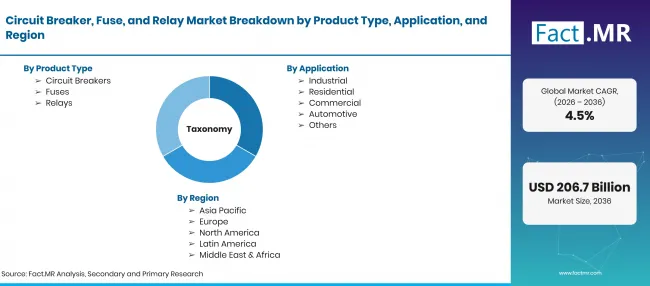
Factmr Circuit Breaker, Fuse, And Relay Market Taxonomy | Source: Fact.MR
| Attribute | Details |
|---|---|
| Quantitative Units | USD billion |
| Market Definition | Circuit breakers, fuses and protective relays used to interrupt, isolate or signal electrical faults across low-, medium- and high-voltage systems. |
| Product Type | Circuit Breakers; Fuses; Relays |
| Application | Industrial; Residential; Commercial; Automotive; Others |
| Voltage | Low Voltage; Medium Voltage; High Voltage |
| End-User | Automotive; Utilities; Manufacturing; Construction; Others |
| Regions Covered | North America; Latin America; Western Europe; Eastern Europe; East Asia; South Asia & Pacific; Middle East & Africa |
| Countries Covered | Japan; Brazil; Germany; UK; USA |
| Key Companies Profiled | Siemens AG; ABB Ltd.; Schneider Electric SE; Eaton Corporation plc; Mitsubishi Electric Corporation; GE Vernova Inc.; Legrand SA; Rockwell Automation, Inc.; Toshiba Corporation |
| Forecast Period | 2026 to 2036 |
| Approach | Hybrid top-down and bottom-up approach using installed electrical equipment, grid additions, industrial activity, construction demand, voltage mix, country growth and company portfolio review. |
How is the market segmented?
-
By Product Type:
- Circuit Breakers
- Fuses
- Relays
-
By Application:
- Industrial
- Residential
- Commercial
- Automotive
- Others
-
By Voltage:
- Low Voltage
- Medium Voltage
- High Voltage
-
By End-User:
- Automotive
- Utilities
- Manufacturing
- Construction
- Others
-
By Region:
- North America
- Latin America
- Western Europe
- Eastern Europe
- East Asia
- South Asia & Pacific
- Middle East & Africa