- Base Value(2025): 5.1 Bn
- Estimated Value(2026): 5.4 Bn
- Forecast Value (2036): 9.2 Bn
- CAGR (2026 - 2036): 5.3%
Smart Junction Box and Power Distribution Box Systems Market Forecast and Outlook by Fact.MR
- The smart junction box and power distribution box systems market was valued at USD 5.1 billion in 2025.
- According to Fact.MR, demand is projected to reach USD 5.4 billion in 2026 and expand to USD 9.2 billion by 2036, reflecting a CAGR of 5.3% during the forecast period.
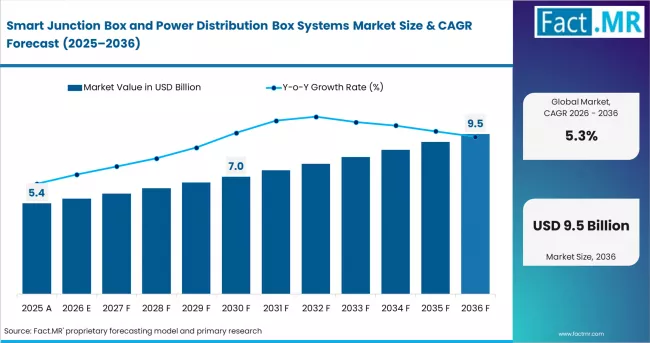
Smart Junction Box And Power Distribution Box Systems Market Value Analysis | Source: Fact.MR
| Metric | Value |
|---|---|
| Estimated Value in 2026 | USD 5.4 billion |
| Forecast Value in 2036 | USD 9.2 billion |
| Forecast CAGR (2026 to 2036) | 5.3% |
Source: Fact.MR analysis. Updated May 11, 2026
Summary of the Smart Junction Box and Power Distribution Box Systems Market
- Market Definition
- The smart junction box and power distribution box systems market includes automotive electrical-distribution assemblies that route, protect, and increasingly monitor power delivery across vehicle systems.
- Demand Drivers
- Vehicle architecture teams need more manageable power routing as electronic loads continue to rise.
- OEMs are shifting toward smart fusing and zonal layouts that reduce wiring complexity and improve fault control.
- EV and high-content vehicle programs require more robust low-voltage and high-voltage distribution logic than legacy fuse-box layouts can provide.
- Key Segments Analyzed
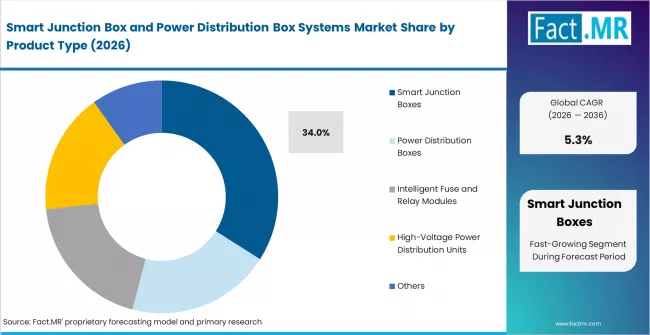
- By Product Type: Smart Junction Boxes are expected to account for 34.0% share in 2026, supported by their role in low-voltage circuit management and body-electronics power routing.
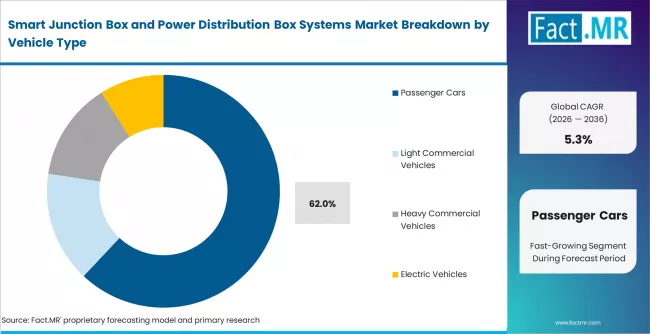
- By Vehicle Type: Passenger Cars are projected to hold 62.0% share in 2026 because power-distribution intelligence is spreading broadly across mainstream vehicles.
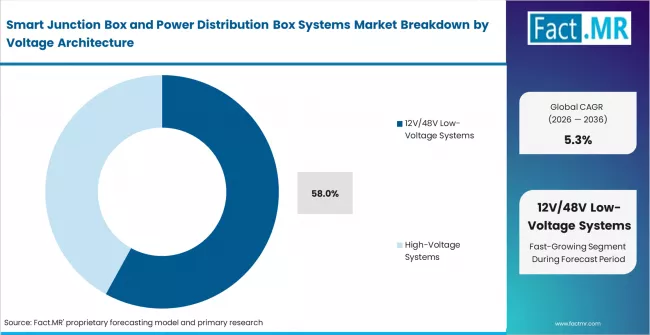
- By Voltage Architecture: 12V/48V Low-Voltage Systems are expected to capture 58.0% share in 2026 due to wide vehicle parc coverage and broad body-electronics content.
- By Geography: China leads growth with a 6.4% CAGR through 2036, supported by vehicle scale, electrification momentum, and strong electrical-system localization.
- Analyst Opinion at Fact.MR
- Shambhu Nath Jha, Senior Analyst at Fact.MR, states, strongest change in this market is that the distribution box is no longer treated as a passive container of fuses and relays. It is becoming part of the vehicle’s intelligence layer. Once smart fusing, diagnostics, and zonal design enter the architecture, power distribution becomes a systems decision rather than a packaging decision.”
- Strategic Implications
- Suppliers that combine protected power routing with diagnostics and software compatibility will be better placed in next-generation platforms.
- OEMs need distribution-module vendors that support architecture simplification and fault-management logic, not only hardware packaging.
- Aftermarket participants gain more from fitment reliability and service continuity than from low-price generic assemblies.
- Methodology
- Market sizing used vehicle production, electrical content, and architecture complexity as baseline anchors.
- Analysis incorporated supplier positioning around smart fusing, iPDM, battery distribution, and zonal architecture.
- Forecasts were checked against regulatory and design requirements tied to automotive EMC, functional safety, and software-defined vehicle evolution.
The market is expected to create an absolute opportunity of USD 3.78 billion between 2026 and 2036, supported by the shift toward smarter electrical architectures. Growth remains steady because the category is no longer defined by current routing alone. Buyers increasingly evaluate how effectively these systems support protected power delivery, diagnostics, space efficiency, and software-based fault management within centralized and zonal vehicle platforms. Aptiv positions power and data distribution as a core layer of software-defined vehicles, while HELLA uses electronic protection logic in its iPDM systems to replace conventional fuse functions and help maintain power continuity. [1]
China is projected to remain the fastest-growing country, with a CAGR of 6.4% from 2026 to 2036, followed by India at 6.1% and Mexico at 5.8%. The United States is expected to expand at 5.5%, Germany at 5.2%. Fact.MR views this spread as a reflection of differences in vehicle electrification, zonal architecture rollout, electronic-content intensity, and local supplier capability in intelligent power management systems. HELLA’s recent strategy materials cite growth areas such as HV power box and zonal control, which supports the relevance of these adoption differences across regions. [2]
Segmental Analysis
Smart Junction Box and Power Distribution Box Systems Market Analysis by Product Type
Smart Junction Box And Power Distribution Box Systems Market Analysis By Product Type | Source: Fact.MR
Smart junction boxes are expected to hold 34.0% share in 2026. Their lead comes from the fact that low-voltage power routing across body electronics, lighting, cabin functions, and convenience systems still represents the largest practical base for intelligent distribution. The category gains strength because automakers want more than organized circuits. They want localized protection, diagnostics, and better control over fault behavior without letting wiring complexity escalate. Aptiv’s zone-controller materials refer to smart fusing as a way to optimize wiring and improve control, while HELLA’s iPDM shows how electronic protection can replace traditional fuse behavior in modern architectures. [3]
- Circuit intelligence: Smart junction boxes improve the ability to detect, isolate, and manage faults without relying only on passive fuse replacement.
- Packaging control: They help organize rising electrical loads in a way that fits tighter vehicle packaging constraints.
- Architecture transition: These modules support the shift from legacy fuse-box logic toward smarter and more software-compatible power distribution.
Smart Junction Box and Power Distribution Box Systems Market Analysis by Vehicle Type
Smart Junction Box And Power Distribution Box Systems Market Analysis By Vehicle Type | Source: Fact.MR
Passenger cars are expected to represent 62.0% share in 2026, supported by their large production base and rising integration of electronic systems. Modern passenger vehicles carry more lighting controls, seat comfort modules, infotainment units, ADAS loads, and connected body functions, all of which require efficient power distribution. This is increasing the value of smart junction boxes that can manage routing, protection, and diagnostics. HELLA highlights smooth power supply and failure prevention through its iPDM platform, which aligns closely with high-content passenger car requirements.
- Electrical content density: Passenger vehicles carry rising numbers of powered and connected subsystems that need structured protection.
- Feature migration: Smart power management is spreading from premium models into broader passenger-car segments.
- Platform scale: High build volumes allow OEMs to standardize distribution strategies across multiple models.
Smart Junction Box and Power Distribution Box Systems Market Analysis by Voltage Architecture
Smart Junction Box And Power Distribution Box Systems Market Analysis By Voltage Architecture | Source: Fact.MR
12V/48V low-voltage systems are expected to capture 58.0% share in 2026. This lead comes from the sheer scale of conventional and mild-hybrid vehicle architectures, where body functions, lighting, infotainment, comfort electronics, and many control systems still operate through low-voltage distribution. Smart junction boxes remain highly relevant here because low-voltage networks carry the largest spread of switched and protected loads in the vehicle. At the same time, high-voltage power distribution units are gaining importance in EVs, and HELLA has explicitly highlighted HV power box as a growth technology.
The segment stays ahead because even as EV adoption rises, low-voltage distribution does not disappear. It continues to run most body and auxiliary electronics. That gives low-voltage smart distribution systems a broader addressable base across the forecast period.
- Fleet breadth: Low-voltage architectures still cover the widest share of the global vehicle parc.
- Body-electronics reliance: Most comfort and convenience systems remain tied to structured low-voltage power routing.
- Transition resilience: Growth in high-voltage systems adds opportunity, though low-voltage smart distribution keeps the larger base.
Smart Junction Box and Power Distribution Box Systems Market Drivers, Restraints, and Opportunities
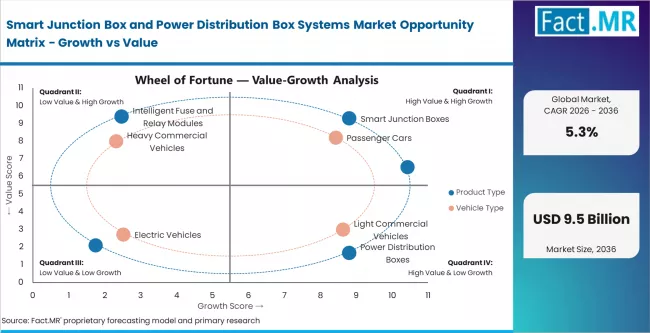
Smart Junction Box And Power Distribution Box Systems Market Opportunity Matrix Growth Vs Value | Source: Fact.MR
The strongest market driver is the need to manage growing electrical complexity without allowing vehicle wiring and protection logic to become unworkably fragmented. Zonal architecture, smart fusing, and centralized power-management concepts are all responses to this pressure. Aptiv states that zone controllers manage power distribution centrally through smart fusing, and its CES material describes Power Data Center zone controllers as part of the Smart Vehicle Architecture stack. These signals support the view that intelligent power distribution is becoming a design requirement rather than an optional upgrade.
The main restraint is integration burden. Smart distribution modules sit at the intersection of packaging, protection, software, and safety expectations. OEMs need them to work reliably under automotive EMC conditions and, in higher-content applications, support architecture-level fault handling without introducing new complexity. That raises the qualification bar and narrows the field of suppliers that can support both hardware and software demands. UNECE R10 and ISO 26262 remain relevant reference points in this environment. [5]
Opportunities in the Smart Junction Box and Power Distribution Box Systems Market
- Zonal architecture rollout: Vehicles moving toward zonal E/E layouts create room for smarter, more distributed power routing with localized fault control. Aptiv’s zone-controller and Smart Vehicle Architecture materials reinforce this opportunity.
- High-voltage distribution growth: EVs create added demand for battery and high-voltage distribution units that act as the vehicle’s organized power-delivery hub. Littelfuse and HELLA both point to this direction through battery distribution and HV power box references. [4]
- Software-controlled protection: Electronic protection and smart fusing can reduce service disruption and improve failure management in increasingly automated vehicles. HELLA’s iPDM positioning supports this pathway.
Regional Analysis
Based on the regional analysis, the Smart Junction Box and Power Distribution Box Systems Market is segmented into East Asia, South Asia and Pacific, North America, Europe, Latin America, and Middle East and Africa across 40 plus countries.
.webp "Top Country Growth Comparison Smart Junction Box And Power Distribution Box Systems Market Cagr (2026 2036)")
Top Country Growth Comparison Smart Junction Box And Power Distribution Box Systems Market Cagr (2026 2036) | Source: Fact.MR
| Country | CAGR (2026 to 2036) |
|---|---|
| China | 6.4% |
| India | 6.1% |
| Mexico | 5.8% |
| United States | 5.5% |
| Germany | 5.2% |
Source: Fact.MR analysis. Updated May 11, 2026
Source: Fact.MR analysis, based on proprietary forecasting model and primary research
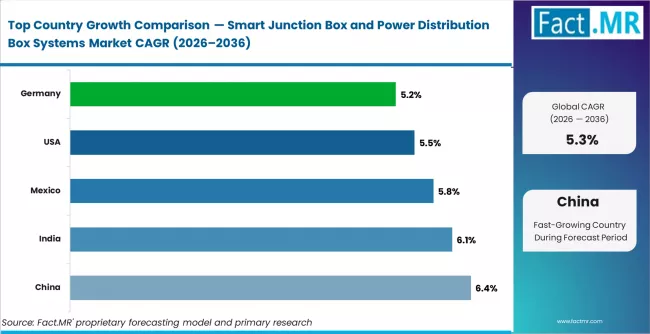
Smart Junction Box And Power Distribution Box Systems Market Cagr Analysis By Country | Source: Fact.MR
East Asia Smart Junction Box and Power Distribution Box Systems Market Analysis
East Asia remains the strongest production and supply base for this market. The region combines large vehicle output with deep electrical and electronics manufacturing ecosystems, which matters because smart power distribution boxes and junction systems perform best when suppliers can align closely with evolving vehicle architectures. China, Japan, and South Korea each contribute differently, with China adding scale, Japan reinforcing quality discipline, and South Korea supporting tightly integrated electronics programs.
- China: Strong vehicle production, rapid electrification, and greater rollout of high-content electronics support China’s lead. Smart junction box and power distribution box systems demand in China is projected to grow at a CAGR of 6.4% through 2036. The country benefits from high EV momentum and strong localization of electrical-system supply.
Fact.MR’s report also covers ASEAN, Australia and New Zealand, and other South Asia and Pacific countries. These markets matter where EV adoption, electronics content, and architecture modernization continue to rise.
South Asia & Pacific Smart Junction Box and Power Distribution Box Systems Market Analysis
South Asia & Pacific is emerging as a meaningful growth region where EV adoption, rising electronics penetration, and vehicle architecture upgrades are increasing demand for advanced power-distribution systems. Growth is supported by expanding assembly footprints and localization of electrical components.
- India: India is expected to expand at a 6.1% CAGR through 2036, supported by growing passenger vehicle production, rising EV programs, and stronger adoption of electronics-rich vehicle platforms. Automakers are increasingly adopting smarter power-distribution systems to manage higher loads from infotainment, safety systems, connected features, and electrified drivetrains. Demand is especially relevant in SUVs, passenger EVs, and premium trims.
Fact.MR’s report also includes ASEAN, Australia, and New Zealand, where architecture modernization and increasing electronics content continue to support gradual market growth.
North America Smart Junction Box and Power Distribution Box Systems Market Analysis
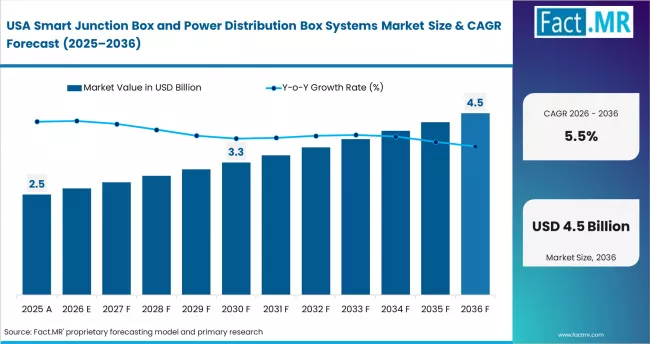
Smart Junction Box And Power Distribution Box Systems Market Country Value Analysis | Source: Fact.MR
North America is shaped by high electrical content, a growing EV mix, and strong demand for architecture simplification in larger and feature-rich vehicles. Intelligent power distribution matters in this region because vehicles increasingly rely on coordinated fault handling and stable supply for comfort, safety, and connectivity systems. This creates a market where OE design wins remain important while the installed fleet supports a meaningful replacement cycle.
- United States: Smart junction box and power distribution box systems demand in the United States is projected to rise at a CAGR of 5.5% through 2036. The country supports demand through EV growth, high-content passenger vehicles, and broader movement toward smarter electrical architectures.
- Mexico: Mexico is expected to record a CAGR of 5.8% through 2036. Its faster growth comes from vehicle assembly momentum and increasing participation in architecture-intensive programs serving North American OEM production.
Fact.MR’s report also includes Canada and the wider North American supply ecosystem. Additional regional value comes from feature-rich platforms, software-defined vehicle interest, and strong demand for reliable power distribution in advanced vehicle systems.
Europe Smart Junction Box and Power Distribution Box Systems Market Analysis
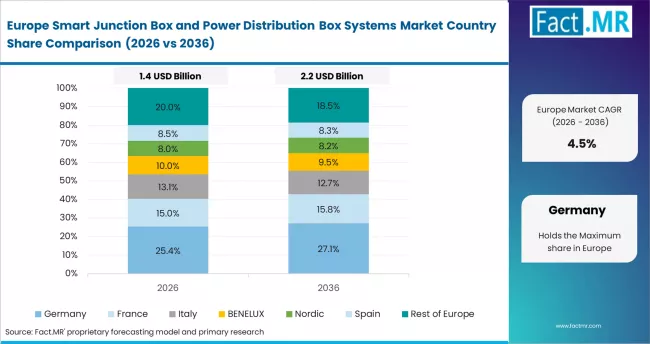
Smart Junction Box And Power Distribution Box Systems Market Europe Country Market Share Analysis, 2026 & 2036 | Source: Fact.MR
Europe remains a high-discipline market rather than the fastest-growing one. Vehicle makers in the region put strong weight on electrical efficiency, functional integration, and architecture modernization. HELLA’s recent recognition for its iPDM and its strategic focus on HV power box and zonal control underscore Europe’s role as a systems-driven market for intelligent power distribution.
- Germany: Germany is projected to expand at a CAGR of 5.2% through 2036. Its importance comes from engineering intensity, premium vehicle content, and strong demand for validated power-distribution systems that support both electrification and advanced body electronics.
Fact.MR’s report also covers France, Italy, the United Kingdom, Spain, and the rest of Europe. These markets add commercial depth through mature electronics adoption and continued emphasis on more integrated vehicle architectures.
Competitive Aligners for Market Players
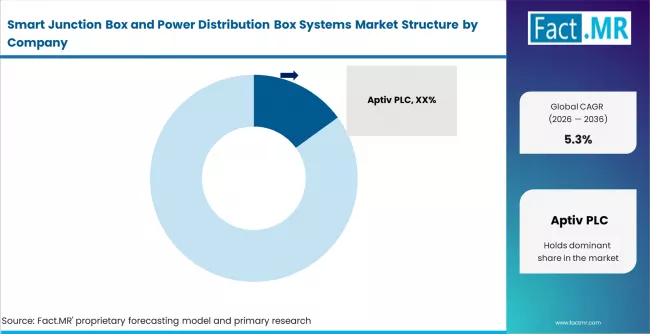
Smart Junction Box And Power Distribution Box Systems Market Analysis By Company | Source: Fact.MR
The smart junction box and power distribution box systems market is moderately consolidated. Buyers do not choose suppliers only on enclosure design or fuse count. They choose on power-routing intelligence, protection behavior, diagnostics, software compatibility, and packaging efficiency. Companies such as Aptiv, FORVIA HELLA, Littelfuse, Bosch, Molex, and other electrical-system suppliers remain relevant because they operate close to architecture design, smart protection, or high-reliability interconnect ecosystems.
Incumbents hold an advantage because power distribution is difficult to separate from full electrical-architecture understanding. A challenger may build a capable box, but replicating OEM confidence is harder. The supplier must support fault logic, integration, EMC expectations, and architecture migration over the platform cycle. That is why the market does not fragment like a generic fuse-holder category.
Buyer power still matters, though it is limited by validation cost and architecture dependence. OEMs want sourcing flexibility, but they also want low risk in systems that support growing vehicle electrification and software-defined functions. Through 2036, Fact.MR expects competition to remain rational, with stronger selectivity in zonal and high-voltage applications.
Key Players in Smart Junction Box and Power Distribution Box Systems Market
- Aptiv PLC
- FORVIA HELLA
- Littelfuse, Inc.
- Robert Bosch GmbH
- Molex
- Eaton Corporation
- MTA S.p.A.
- TE Connectivity
- Lear Corporation
- Yazaki Corporation
- Sumitomo Electric Industries
- Leoni AG
Bibliography
- [1] Aptiv. CES 2024: What You Need to Know. PDF referencing Power Data Center zone controllers and the Smart Vehicle Architecture stack.
- [2] FORVIA HELLA. Annual Report FY2024. PDF referencing the intelligent Power Distribution Module and its use of software-controlled electronic protection.
- [3] Aptiv. Gen 6 ADAS Platform for Software-Defined Vehicles. White paper referencing data and power distribution compatibility with zonal architecture.
- [4] Littelfuse. Automotive World 2025. Event material describing the battery distribution unit as the vehicle’s junction or panel box in EVs.
- [5] UNECE. UN Regulation No. 10 / EMC framework for vehicles. Relevant automotive EMC basis for electrical-system qualification.
This Report Addresses
- Strategic demand outlook for smart junction box and power distribution box systems across modern vehicle electrical architectures.
- Market forecast from USD 5.4 billion in 2026 to USD 9.2 billion by 2036.
- The growing role of smart fusing, diagnostics, and architecture-aware power management.
- The effect of electrification and zonal design on distribution-module demand.
- OEM versus aftermarket demand patterns in a validation-sensitive electrical-systems category.
- Regional differences in electrification, electronics content, and supplier depth.
- Competitive positioning of suppliers active in smart power distribution, protection, and vehicle architecture.
- Segment analysis by product type, vehicle type, voltage architecture, sales channel, and geography.
Smart Junction Box and Power Distribution Box Systems Market Definition
The market covers vehicle-mounted electrical distribution systems that manage, protect, and route power across multiple circuits using junction boxes, power distribution boxes, intelligent fuse and relay modules, and software-assisted power management assemblies. These systems serve as the organized control point for electrical power distribution, protection, and fault handling inside modern vehicle architectures.
Smart Junction Box and Power Distribution Box Systems Market Inclusions
The market includes smart junction boxes, low-voltage and high-voltage power distribution boxes, intelligent power distribution modules, fuse-and-relay control units with diagnostics, and related hardware-software combinations used in internal combustion, hybrid, and battery electric vehicles. Scope includes modules designed for conventional E/E layouts as well as zonal architectures.
Smart Junction Box and Power Distribution Box Systems Market Exclusions
The market excludes full vehicle zone controllers where power distribution value cannot be isolated, complete battery packs, standalone high-voltage contactors sold outside a distribution assembly, and generic industrial power panels. It also excludes non-automotive building and utility distribution boxes. The market boundary remains limited to vehicle-specific power distribution and protection boxes that serve as the organized electrical junction and control point within automotive platforms.
Smart Junction Box and Power Distribution Box Systems Market Research Methodology
- Primary Research
- Interviews with E/E architecture engineers, vehicle power-distribution designers, OEM electrical integration managers, fuse and relay module suppliers, and aftermarket electrical-system specialists.
- Desk Research
- Review of supplier portfolios, annual reports, architecture white papers, standards related to vehicle EMC and functional safety, and public technical materials from Aptiv, FORVIA HELLA, Littelfuse, and Molex.
- Market-Sizing and Forecasting
- Fact.MR used a blended model based on vehicle production, electronic content per vehicle, penetration of smart power protection, EV and zonal-architecture growth, and replacement demand in the installed fleet.
- Data Validation and Update Cycle
- Forecasts were cross-checked through supplier positioning, standards relevance for vehicle electronics, and ongoing architecture changes linked to software-defined and zonal vehicle platforms. UNECE Regulation No. 10 remains relevant for automotive EMC, while ISO 26262 remains central to safety-related road-vehicle electrical and electronic systems.
Segmentation
Scope of the Report
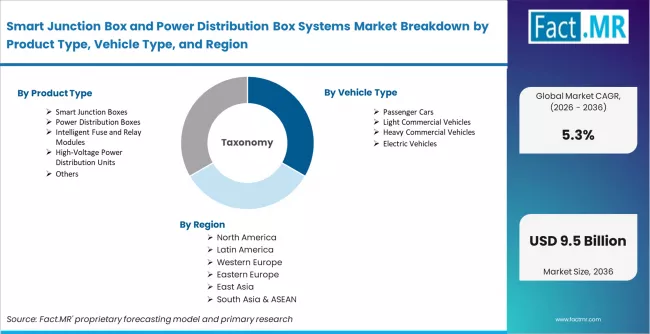
Smart Junction Box And Power Distribution Box Systems Market Breakdown By Product Type, Vehicle Type, And Region | Source: Fact.MR
| Attribute | Details |
|---|---|
| Quantitative Units | USD 5.4 billion in 2026 to USD 9.2 billion in 2036, at a CAGR of 5.3% |
| Market Definition | Automotive smart junction box and power distribution box systems that route, protect, and increasingly monitor vehicle electrical power across low-voltage and high-voltage architectures. |
| Product Type Segmentation | Smart Junction Boxes, Power Distribution Boxes, Intelligent Fuse and Relay Modules, High-Voltage Power Distribution Units, Others |
| Vehicle Type Segmentation | Passenger Cars, Light Commercial Vehicles, Heavy Commercial Vehicles, Electric Vehicles |
| Voltage Architecture Segmentation | 12V/48V Low-Voltage Systems, High-Voltage Systems |
| Regions Covered | East Asia, South Asia and Pacific, North America, Europe, Latin America, Middle East and Africa |
| Countries Covered | China, India, Mexico, United States, Germany, Japan, South Korea, and 40+ countries |
| Key Companies Profiled | Aptiv, FORVIA HELLA, Littelfuse, Bosch, Molex, Eaton, MTA, TE Connectivity, Lear, Yazaki, Sumitomo Electric, Leoni |
| Forecast Period | 2026 to 2036 |
| Approach | Fact.MR combined primary interviews with vehicle electrical-architecture stakeholders, desk research across supplier materials and standards relevance, and a forecast model anchored in vehicle production, electrification, and electrical-content growth. |
Source: Fact.MR analysis. Updated May 11, 2026
Smart Junction Box and Power Distribution Box Systems Market by Segments
-
By Product Type:
- Smart Junction Boxes
- Power Distribution Boxes
- Intelligent Fuse and Relay Modules
- High-Voltage Power Distribution Units
- Others
-
By Vehicle Type:
- Passenger Cars
- Light Commercial Vehicles
- Heavy Commercial Vehicles
- Electric Vehicles
-
By Voltage Architecture:
- 12V/48V Low-Voltage Systems
- High-Voltage Systems
-
By Region:
- North America
- United States
- Canada
- Mexico
- Latin America
- Brazil
- Argentina
- Rest of Latin America
- Europe
- Germany
- France
- United Kingdom
- Italy
- Spain
- Rest of Europe
- East Asia
- China
- Japan
- South Korea
- South Asia and Pacific
- India
- ASEAN
- Australia and New Zealand
- Rest of South Asia and Pacific
- Middle East and Africa
- GCC Countries
- South Africa
- Turkey
- Rest of Middle East and Africa
- North America
Frequently Asked Questions
What is the estimated size of the smart junction box and power distribution box systems market in 2026?
How large is the market expected to become by 2036?
What is the forecast CAGR for 2026 to 2036?
Which product type leads the market?
Which vehicle type dominates demand?
Why does the OEM channel dominate?
Why are smart junction boxes important here?
What is the strongest demand driver?
What is the key restraint?
Which country is growing fastest?
Why is China ahead?
How does India compare?
Why does Mexico rank strongly?
Why does Germany remain important?
How do zonal architectures affect this market?
Is this a fragmented supplier market?
What do OEM buyers prioritize?
Why does high-voltage distribution matter in this segment?
Is the aftermarket attractive?
Which companies are most visible in this market?
What is the broader outlook through 2036?
Who worked on this report


Preview the report firsthand - request a free sample
Free SampleGet the brochure for pricing and purchase details
Download PDF