- Market Value (2025): USD 17.3 Bn
- Estimated Value (2026): USD 18.4 Bn
- Forecast Value (2036): USD 34.2 Bn
- CAGR (2026-2036): 6.4%
What is the Efficient Power Switchgear Market forecast to be worth by 2036?
USD 18.4 billion in 2026 to USD 34.2 billion by 2036 at a 6.4% CAGR.
- 2025 Market Value: USD 17.3 billion.
- 2026 to 2036 Market Progression: USD 18.4 billion to USD 34.2 billion.
- Forecast CAGR (2026-2036): 6.4%.
What are the defining numbers behind Efficient Power Switchgear Market growth?
The market creates an absolute opportunity of USD 15.8 billion between 2026 and 2036.
- Demand Drivers in the Market
- Grid reinforcement is creating direct procurement for replacement bays, distribution boards, protection assemblies, and substation switchgear. The International Energy Agency reported annual grid investment of about USD 400 billion in 2025 and said network spending still needs to rise as electricity demand and generation capacity expand. This supports efficient equipment within the wider switchgear market, especially where utilities can reduce losses while increasing capacity and reliability.
- Electrical losses inside assemblies create a measurable thermal burden. IEC TR 60890 includes power-loss calculation in temperature-rise verification for low-voltage assemblies, while peer-reviewed switchgear studies show that busbar resistance, contact resistance, skin effect, and proximity effect contribute to heat generation. Buyers therefore have a direct engineering reason to specify conductive paths and contact systems that reduce losses under sustained load.
- Digital protection and condition monitoring are shifting maintenance from fixed inspection intervals toward asset-state decisions. IEC TR 62271-322:2026 addresses IoT, edge and cloud computing, digital twins, artificial intelligence, and cybersecurity across the switchgear lifecycle. This gives utilities and facility operators a standards-based path to integrate sensing and analytics with switching equipment rather than treat monitoring as a separate afterthought.
- F-gas regulation is changing medium-voltage specifications in Europe. Regulation (EU) 2024/573 prohibits putting into operation new electrical switchgear using fluorinated greenhouse gases up to and including 24 kV from 1 January 2026, with the threshold extending above 24 kV to 52 kV from 2030, subject to defined derogations. This moves SF6-free insulation from an environmental preference into a procurement requirement for many new installations.
- Large-load growth is increasing the value of efficient distribution at the facility edge. Lawrence Berkeley National Laboratory estimates that U.S. data centers could account for 11.8% of national electricity use by 2030. Higher campus loads raise current levels through low- and medium-voltage distribution, making conductor losses, protection selectivity, monitoring, and maintainability more material to lifecycle cost.
- Key Segments Analyzed
- Low-voltage switchgear accounts for 36.0% of Switchgear Type in 2026 because it sits close to commercial, industrial, utility auxiliary, and data-center loads where current levels are high and distribution equipment is deployed in large numbers.
- Low-loss conductors and contacts hold 28.0% of Efficiency Lever in 2026 because lower resistance directly reduces heat generation and wasted electrical energy in busbars, joints, and switching paths.
- Utilities account for 29.0% of End-use in 2026 because network operators procure switchgear across substations, distribution feeders, renewable interconnections, and replacement programs where reliability and lifecycle loss matter together.
- <1 kV accounts for 36.0% of Voltage Class in 2026 because low-voltage assemblies serve the final distribution stage across buildings, industrial plants, data centers, and utility auxiliaries.
- Analyst Opinion at Fact.MR
- Shambhu Nath Jha, Principal Consultant, Fact.MR, states, "Efficient switchgear purchasing is moving beyond the nameplate interruption rating. Utilities and large facilities increasingly have to consider conductor loss, thermal headroom, insulation choice, protection intelligence, and maintainability over the operating life of the asset. Suppliers that can quantify these operating effects and integrate them into familiar switchgear architectures are better positioned for replacement and expansion projects through 2036."
- Strategic Implications
- Manufacturers should document assembly power losses and temperature-rise behavior at practical loading conditions, because efficiency claims become more credible when engineering teams can compare thermal performance against conventional designs. This is especially relevant to low-voltage boards and circuit breaker configurations used at high current.
- Utilities should evaluate SF6-free replacements alongside footprint, operating sequence, maintenance practice, and retrofit compatibility. A lower-impact insulating medium is commercially useful only when the replacement can be integrated without creating avoidable civil work or operating complexity.
- Digital functions should be specified around decisions that operators actually make, such as breaker wear, partial-discharge indication, thermal loading, trip history, or abnormal operating states. This reduces the risk of adding sensors without a maintenance workflow and strengthens the case for switchgear monitoring as part of asset management.
- Data-center and industrial projects should coordinate switchgear efficiency with transformers, protection settings, busway, and backup-power architecture. The value comes from reducing total distribution loss and thermal stress across the electrical path, not from optimizing one component in isolation. Similar design logic appears in transmission equipment projects where equipment selection must fit the wider network.
How does the Efficient Power Switchgear Market break down by segment?
The market is segmented by Switchgear Type, Efficiency Lever, End-use, and Voltage Class.
Why does Low-voltage switchgear lead Switchgear Type?
Low-voltage switchgear accounts for 36.0% of Switchgear Type in 2026.
The category serves the final distribution stage where electrical current is comparatively high for a given power level. Resistive losses therefore become visible as heat inside busbars, joints, breakers, and enclosures. IEC 61439-1 governs low-voltage assemblies up to 1,000 V AC, while IEC TR 60890 provides a method for temperature-rise verification that includes power-loss calculation.
The same installations are common in commercial facilities, industrial plants, and data centers, where space, uptime, and cooling burden influence equipment choice. This broad installation base also supports demand for compact feeder protection and pad-mounted switchgear in distribution networks where enclosure and footprint constraints are material.
Why do Low-loss conductors and contacts lead Efficiency Lever?
Low-loss conductors and contacts hold 28.0% of Efficiency Lever in 2026.
This efficiency lever acts on a basic source of loss rather than depending on software or operating behavior. Current flowing through busbars and electrical joints produces heat according to resistance and current loading. Peer-reviewed modeling of low-voltage switchgear shows that busbar losses, contact resistance, skin effect, and proximity effect shape the thermal profile of the assembly.
For buyers, lower resistance can preserve more thermal headroom at high utilization and reduce the need to compensate for avoidable heat with larger conductors, derating, or ventilation. The commercial value is therefore easiest to verify in high-current installations where even small changes in resistance are multiplied by sustained load.
Why do Utilities lead End-use?
Utilities account for 29.0% of End-use in 2026.
Network operators buy switchgear as part of feeder expansion, substation renewal, renewable connection, and capacity reinforcement. The IEA has identified a persistent need for higher grid investment, while current national network plans in Germany, the UK, France, Japan, and the USA are expanding or modernizing electricity infrastructure.
Utility procurement also has a long operating horizon. Losses, maintenance intervals, insulation choice, fault performance, and spare-part continuity affect the asset over years of service. This makes lifecycle efficiency more relevant than a narrow comparison of initial switchgear price.
Why does <1 kV lead Voltage Class?
<1 kV accounts for 36.0% of Voltage Class in 2026.
Low-voltage distribution is the interface between upstream supply and the equipment that consumes electricity. Commercial buildings, factories, data centers, transport infrastructure, and utility auxiliaries all require low-voltage switching and protection close to the load. The number of boards and feeders can therefore be high even when each individual unit has a lower voltage rating than substation equipment.
Efficiency also matters because high current at low voltage increases resistive heating. Buyers can address this through conductor sizing, joint design, contact materials, protection coordination, and monitoring. The result is a broad replacement and new-build market for assemblies that combine electrical protection with lower operating loss.
What is accelerating Efficient Power Switchgear Market adoption, and what is holding it back?
Adoption is being accelerated by grid-capacity investment, high-load data centers, replacement of aging substations, and the shift toward lower-loss or SF6-free equipment. Digital protection and condition monitoring add another purchase mechanism because operators can combine switching functions with asset-state information and planned maintenance.
The main constraints are capital cost, qualification cycles, long equipment lead times, and the risk of integration problems when new digital or insulation technologies must fit legacy electrical systems. Buyers also have to balance efficiency gains against footprint, interruption rating, arc safety, service skills, and the remaining life of installed equipment.
Drivers Impact Analysis
| Factor | (~) % Impact on CAGR | Geographic Relevance | Impact Timeline |
|---|---|---|---|
| Grid reinforcement and substation capacity additions | +1.1% | USA; Germany; UK; France; Japan | Near term |
| Data-center and industrial load connection | +0.8% | USA; Japan; France; UK | Near to mid term |
| SF6-free specification and replacement | +0.7% | Europe; Japan | Mid term |
| Digital protection and condition monitoring | +0.5% | Global | Mid term |
Source: Fact.MR analysis. Updated Sep 7, 2026
Opportunity Impact Analysis
| Factor | (~) % Impact on CAGR | Geographic Relevance | Impact Timeline |
|---|---|---|---|
| Low-loss LV and MV retrofit programs | +0.6% | Global | Near to mid term |
| SF6-free conversion through 52 kV | +0.5% | Europe; Japan | Mid term |
| Condition-based maintenance integration | +0.4% | Global | Mid term |
| Hybrid and solid-state switching for high-duty loads | +0.3% | Data centers; renewables; transport | Long term |
Source: Fact.MR analysis. Updated Sep 7, 2026
Restraints Impact Analysis
| Factor | (~) % Impact on CAGR | Geographic Relevance | Impact Timeline |
|---|---|---|---|
| Higher capital cost and qualification burden | -0.6% | Global | Near term |
| Long procurement lead times for grid equipment | -0.5% | USA; Europe; Japan | Near to mid term |
| Digital interoperability and cybersecurity requirements | -0.3% | Global | Mid term |
| Long installed-base replacement cycles | -0.3% | Mature utility and industrial markets | Mid to long term |
Source: Fact.MR analysis. Updated Sep 7, 2026
Which countries are scaling the Efficient Power Switchgear Market through 2036?
- USA: Rising electricity demand from data centers and industrial loads is increasing pressure on utilities to expand grid capacity. DOE programs supporting transmission and grid upgrades create a direct route to substation and switching-equipment renewal.
- Germany: Bundesnetzagentur is reviewing the 2025-2037/2045 network development plan as transmission operators define expansion needs. The EU F-gas timetable adds a second specification trigger for new medium-voltage switchgear.
- Japan: METI identifies grid reinforcement as necessary for higher renewable penetration and notes that data-center development can require new or expanded substations. This connects load growth directly with switchgear and control investment.
- UK: Ofgem created an Advanced Procurement Mechanism that explicitly allows transmission owners to buy switchgear and other critical equipment earlier in project development. The framework addresses supply-chain timing as network capacity is expanded.
- France: RTE is preparing a network investment plan through 2040 that combines asset renewal with new connections for industrial sites, data centers, and low-carbon generation. These projects require new and replacement switching equipment across the network.
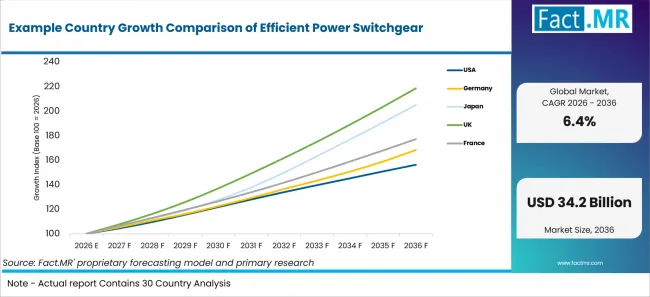
Example Country Growth Comparison Of Efficient Power Switchgear | Source: Fact.MR
| Country | CAGR (2026-2036) |
|---|---|
| USA | 4.6% |
| Germany | 5.4% |
| Japan | 7.4% |
| UK | 8.1% |
| France | 5.9% |
Source: Fact.MR analysis. Updated Sep 7, 2026
What is driving USA's growth through 2036?
The USA is forecast to expand at a 4.6% CAGR from 2026 to 2036.
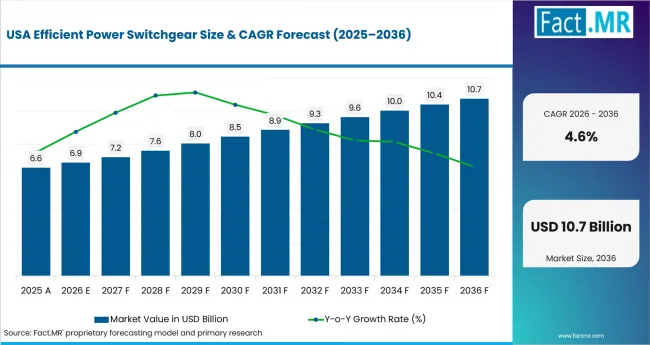
Efficient Power Switchgear Country Value Analysis | Source: Fact.MR
Lawrence Berkeley National Laboratory estimates that data centers could account for 11.8% of U.S. electricity use by 2030. Large campuses often require new substations, higher-capacity feeders, and extensive low- and medium-voltage distribution. This raises demand for switchgear that can handle sustained high current with dependable protection and monitoring.
Federal grid programs also support network reinforcement. In March 2026, the U.S. Department of Energy announced a funding opportunity for rapid grid-capacity upgrades under the Speed to Power initiative. Even where a project begins with conductors or transmission constraints, increased network capacity creates downstream requirements for protection, isolation, and switching equipment.
What is driving Germany's growth through 2036?
Germany is forecast to expand at a 5.4% CAGR from 2026 to 2036.
Bundesnetzagentur is consulting on the electricity network development plan for 2037 with an outlook to 2045. The planning process translates future generation and demand assumptions into transmission expansion requirements, creating recurring procurement for substations and associated switchgear.
Germany is also directly exposed to Regulation (EU) 2024/573. New switchgear up to 24 kV using fluorinated greenhouse gases faces the 2026 prohibition on putting equipment into operation, subject to defined derogations. Utilities and industrial buyers therefore have to qualify SF6-free alternatives earlier in the project cycle.
What is driving Japan's growth through 2036?
Japan is forecast to expand at a 7.4% CAGR from 2026 to 2036.
Japan's 2025 Energy White Paper identifies reinforcement and more advanced operation of the electricity network as necessary for renewable integration and stable supply. Grid-code development and planned network investment increase demand for switchgear that can support protection, control, and higher system flexibility.
METI also notes that concentrated data-center development can require new or expanded substations and has promoted coordination between power and communications infrastructure. This creates a market mechanism for efficient switchgear close to new large-load sites, particularly where available network capacity determines the speed of connection.
What is driving UK's growth through 2036?
The UK is forecast to expand at an 8.1% CAGR from 2026 to 2036.
Ofgem's 2025 Advanced Procurement Mechanism allows electricity transmission owners to procure critical equipment such as switchgear before final project construction begins. The measure addresses long equipment lead times and gives suppliers earlier visibility into transmission expansion programs.
The regulator is also designing the ED3 distribution price control for 2028 to 2033 around longer-term network planning and capacity investment. Distribution reinforcement increases demand for low- and medium-voltage switchgear, while procurement teams must also consider insulation transition, digital monitoring, and lifecycle loss.
What is driving France's growth through 2036?
France is forecast to expand at a 5.9% CAGR from 2026 to 2036.
RTE's network development plan through 2040 is designed around renewal of existing assets and connection of new electricity demand from industry, data centers, and electrification. New low-carbon generation also requires additional network connections. These changes create procurement for protection and switching equipment at both new and modified substations.
France also operates under the EU F-gas timetable for electrical switchgear. The combination of network renewal and new insulation rules means equipment selection increasingly has to address environmental compliance at the same time as footprint, reliability, and maintainability.
Who Leads the Efficient Power Switchgear Market?
Key players in the Efficient Power Switchgear Market include Schneider Electric, Siemens, ABB, Eaton, Mitsubishi Electric, and GE Vernova.
Competition is shaped by voltage coverage, installed-base compatibility, low-loss design, digital protection, SF6-free capability, and service support. Schneider Electric offers SF6-free medium-voltage systems using air and vacuum technology with connected monitoring. ABB has expanded dry-air and vacuum-based medium-voltage portfolios, while Siemens supplies Clean Air blue GIS for utility and infrastructure applications.
Eaton competes through long-standing SF6-free air-insulated medium-voltage platforms and broad low-voltage distribution capability. Mitsubishi Electric combines vacuum interruption with dry-air insulation in selected switchgear families. GE Vernova extends competition into high-voltage GIS through its g3 platform and launched a 170 kV SF6-free GIS in August 2026, adding another option for transmission-level projects.
Which companies are the key providers?
Key providers include Schneider Electric, Siemens, ABB, Eaton, Mitsubishi Electric, and GE Vernova.
- Schneider Electric
- Siemens
- ABB
- Eaton
- Mitsubishi Electric
- GE Vernova
Bibliography
- International Energy Agency. (2025). World Energy Investment 2025. IEA.
- International Energy Agency. (2025). Grid investments. IEA.
- European Union. (2024). Regulation (EU) 2024/573 on fluorinated greenhouse gases. Official Journal of the European Union.
- U.S. Environmental Protection Agency. (2026). Sulfur Hexafluoride (SF6) Basics. U.S. EPA.
- U.S. Department of Energy. (2026). Energy Department Announces USD 1.9 Billion Investment in Critical Grid Infrastructure to Reduce Electricity Costs. Office of Electricity.
- Lawrence Berkeley National Laboratory. (2026). United States Data Center Energy Usage Report: 2025 Update. U.S. Department of Energy.
- Bundesnetzagentur. (2026). Netzentwicklungsplan Strom 2025-2037/2045. Federal Network Agency, Germany.
- Agency for Natural Resources and Energy. (2025). Energy White Paper 2025: Formation of Next-Generation Power Networks. Ministry of Economy, Trade and Industry, Japan.
- Ministry of Economy, Trade and Industry and Ministry of Internal Affairs and Communications. (2025). Watt-Bit Collaboration Public-Private Council Summary 1.0. Government of Japan.
- Ofgem. (2025). Britain on fast track to net zero with early access to infrastructure investment. Office of Gas and Electricity Markets.
- Ofgem. (2025). Framework decision: electricity distribution price control (ED3). Office of Gas and Electricity Markets.
- RTE. (2025). France's Network Development Plan (SDDR). RTE.
- International Electrotechnical Commission. (2026). IEC TR 62271-322: High-voltage switchgear and controlgear - The use of digital technologies. IEC.
- International Electrotechnical Commission. (2022). IEC TR 60890: A method of temperature-rise verification of low-voltage switchgear and controlgear assemblies by calculation. IEC.
- International Electrotechnical Commission. (2020). IEC 61439-1: Low-voltage switchgear and controlgear assemblies - General rules. IEC.
- Bedkowski, M., Smolka, J., Banasiak, K., Bulinski, Z., Nowak, A. J., Tomanek, T., and Wajda, A. (2014). Coupled numerical modelling of power loss generation in busbar system of low-voltage switchgear. International Journal of Thermal Sciences.
- Schneider Electric. (n.d.). SF6-Free Switchgear. Schneider Electric.
- Siemens. (2024). Siemens drives sustainable and future-proof power distribution across Norway. Siemens AG.
- ABB. (n.d.). SF6-Free Switchgear Portfolio. ABB.
- Eaton. (n.d.). SF6-Free Switchgear. Eaton.
- Mitsubishi Electric. (n.d.). Medium- and Low-voltage Switchgear and Circuit Breaker. Mitsubishi Electric Corporation.
- GE Vernova. (2026). GE Vernova marks 10 years of SF6-free innovation with launch of new 170 kV gas-insulated switchgear. GE Vernova.
This Report Answers
- How the market progresses from USD 18.4 billion in 2026 to USD 34.2 billion by 2036.
- Why low-voltage switchgear and the <1 kV class hold 36.0% shares in 2026.
- How conductor and contact losses influence efficient-switchgear purchasing.
- How F-gas rules affect medium-voltage specification and replacement decisions.
- Why utilities account for 29.0% of end-use and how data-center load affects adjacent demand.
- How the USA, Germany, Japan, the UK, and France develop through 2036.
- Which current suppliers participate across low-, medium-, and high-voltage efficient switchgear.
What does the Efficient Power Switchgear Market cover?
The Efficient Power Switchgear Market covers revenue from switchgear assemblies and integrated switching or protection systems sold with one or more efficiency-oriented design features included in the defined taxonomy. Revenue is counted for complete low-, medium-, and selected high-voltage switchgear where the commercial offer incorporates lower electrical loss, digital protection and control, SF6-free insulation, condition-based operation, or hybrid and solid-state assistance.
Applications include utility networks, data centers, industrial facilities, commercial buildings, and renewable or transport infrastructure. The market follows the specified switchgear types and voltage classes rather than counting every electrical-distribution component sold around a switchgear installation.
What is included in the scope?
Included switchgear types are Low-voltage switchgear, Medium-voltage AIS, Medium-voltage GIS, Hybrid and solid-state assisted systems, and High-efficiency specialty systems. Efficiency coverage includes Low-loss conductors and contacts, Digital protection & control, SF6-free insulation, Condition-based operation, and Solid-state and hybrid switching.
End-use coverage includes Utilities, Data centers, Industrial facilities, Commercial buildings, and Renewables and transport. Voltage coverage includes <1 kV, 1-12 kV, 12-36 kV, 36-72.5 kV, and >72.5 kV.
What is excluded from the scope?
Standalone relays, sensors, monitoring software, and communications gateways are excluded when sold independently from a switchgear assembly. Transformers, cables, busway, generators, UPS systems, and complete substations are outside the market except for the revenue attributable to included switchgear installed within those projects.
Routine switchgear maintenance, field service, refurbishment, and spare parts are excluded when sold as service-only activity. Conventional electrical-distribution equipment without an included efficiency lever is treated as adjacent equipment rather than automatically counted in this market.
How Was the Analysis Built?
- Primary Research: Interviews with switchgear manufacturers, utilities, transmission and distribution engineers, electrical consultants, data-center infrastructure teams, industrial power managers, and system integrators examine procurement criteria, loss reduction, insulation choice, replacement cycles, digital functions, and qualification requirements.
- Desk Research: The review covers electricity-network investment, F-gas regulation, switchgear and assembly standards, data-center load growth, national grid plans, technical literature on busbar and contact losses, and current company product portfolios.
- Market Sizing and Forecasting: The analysis combines switchgear demand by voltage class and end-use with replacement activity, network expansion, data-center connections, efficiency-feature mix, equipment pricing, and country growth. The model distinguishes complete switchgear revenue from standalone monitoring or adjacent distribution equipment.
- Data Validation and Update Cycle: Market assumptions are checked against public grid plans, regulatory milestones, current supplier portfolios, and technology standards. Updates account for network investment, large-load interconnections, insulation regulations, switchgear digitization, and changes in current company offerings.
Segmentation
What is the report's scope and coverage?
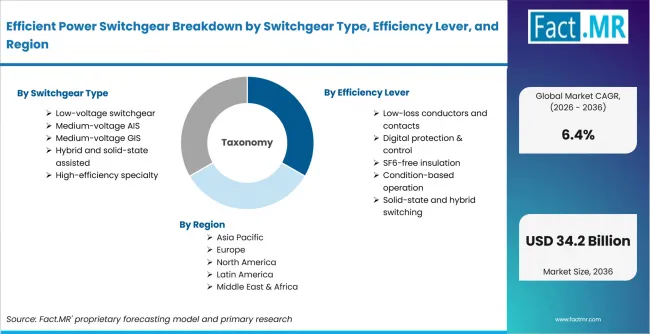
Efficient Power Switchgear Breakdown By Switchgear Type, Efficiency Lever, And Region | Source: Fact.MR
| Attribute | Details |
|---|---|
| Quantitative Units | USD Billion |
| Market Definition | Efficient switchgear assemblies and integrated switching or protection systems with defined loss-reduction, digital, insulation, condition-based, or hybrid efficiency features |
| Segments Covered | Switchgear Type; Efficiency Lever; End-use; Voltage Class |
| Countries Covered | USA; Germany; Japan; UK; France |
| Key Companies Profiled | Schneider Electric; Siemens; ABB; Eaton; Mitsubishi Electric; GE Vernova |
| Forecast Period | 2026 to 2036 |
| Base Year | 2026 |
| Market Value, 2026 | USD 18.4 billion |
| Market Value, 2036 | USD 34.2 billion |
| CAGR, 2026-2036 | 6.4% |
| Absolute Opportunity | USD 15.8 billion |
| Approach | Demand-side and equipment-level analysis using network investment, switchgear replacement, voltage mix, efficiency features, end-use demand, pricing, and country growth |
Source: Fact.MR analysis. Updated Sep 7, 2026
How is the market segmented?
-
By Switchgear Type:
- Low-voltage switchgear
- Medium-voltage AIS
- Medium-voltage GIS
- Hybrid and solid-state assisted
- High-efficiency specialty
-
By Efficiency Lever:
- Low-loss conductors and contacts
- Digital protection & control
- SF6-free insulation
- Condition-based operation
- Solid-state and hybrid switching
-
By End-use:
- Utilities
- Data centers
- Industrial facilities
- Commercial buildings
- Renewables and transport
-
By Voltage Class:
- <1 kV
- 1-12 kV
- 12-36 kV
- 36-72.5 kV
- >72.5 kV
-
By Region:
- North America
- Latin America
- Western Europe
- Eastern Europe
- East Asia
- South Asia and Pacific
- Middle East & Africa
Frequently Asked Questions
What is the Efficient Power Switchgear Market value in 2026?
At what CAGR is the market projected to grow?
What is the projected market value by 2036?
Utilities lead End-use with a 29.0% share in 2026.Which Switchgear Type leads the market?
Which Efficiency Lever leads the market?
Which End-use leads the market?
Which Voltage Class leads the market?
What is the UK CAGR from 2026 to 2036?
What is the primary driver in this market?
What is the main restraint?
Which companies are active in the Efficient Power Switchgear Market?
Who worked on this report


Preview the report firsthand - request a free sample
Free SampleGet the brochure for pricing and purchase details
Download PDF