- Base Value(2025): 1.5 Bn
- Estimated Value(2026): 1.6 Bn
- Forecast Value (2036): 2.7 Bn
- CAGR (2026 - 2036): 5.5%
Recloser Controls Market Analysis and Forecast by Fact.MR
- The global recloser controls market is estimated at USD 1.58 billion in 2026 and is forecast to expand at a CAGR of 5.5% to reach USD 2.7 billion by 2036.
- The market covers electronic and electromechanical control systems for automatic circuit reclosers used in medium-voltage electrical distribution networks for fault detection, protection, and power restoration across utility, industrial, and renewable energy grid applications.
- Products include electronic recloser controls, microprocessor-based recloser controllers, communication-enabled recloser management systems, and integrated protection relay platforms for distribution network protection, feeder automation, distributed energy resource integration, and grid reliability management.
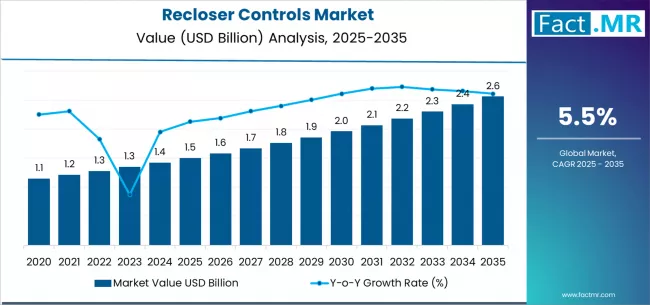
Recloser Controls Market Value Analysis | Source: Fact.MR
Summary of the Recloser Controls Market
- Market Snapshot
- In 2025, the global Recloser Controls Market was valued at approximately USD 1.5 billion.
- The market is estimated to reach USD 1.58 billion in 2026 and is projected to attain USD 2.7 billion by 2036.
- The recloser controls market is likely to expand at a CAGR of 5.5% during the forecast period.
- The market is anticipated to create an absolute dollar opportunity of USD 1.12 billion between 2026 and 2036.
- Electronic Recloser Control accounts for 34.7% of product segment share in 2026.
- USA (6.0%) and Mexico (5.7%) are the key growth markets during the forecast period.
- Demand and Growth Drivers
- Expanding industrial and commercial demand for recloser controls systems is sustained by manufacturing modernization, technology advancement, and regulatory requirements across major economies.
- Technology advancement in electronic recloser control platforms is increasing system capability, reducing lifecycle costs, and broadening the addressable application range.
- Government investment programs in the U.S., EU, and Asia Pacific generate facility construction and equipment procurement cycles that include recloser controls specification.
- Growing adoption across emerging markets driven by industrialization and expanding manufacturing capacity widens the geographic buyer base.
- Integration with digital monitoring, IoT connectivity, and AI-powered control systems is creating premium product tiers with higher margins and specification preference.
- Product and Segment View
- Electronic Recloser Control accounts for 34.7% of the product segment in 2026.
- Distribution Network Protection represents 31.5% of the application segment in 2026.
- Electric Utility Companies accounts for 42.3% of the end use segment in 2026.
- Key segmentation includes:
- By Product: Electronic Recloser Control and related product categories
- By Application: Distribution Network Protection and related application categories
- These systems enable:
- High-precision operation across primary deployment scenarios with consistent performance and reliability
- Digital integration with monitoring, control, and IoT connectivity for real-time performance optimization
- Scalable deployment across facility sizes and application requirements with modular configuration capability
- Geography and Competitive Outlook
- USA leads growth at 6.0%, reflecting strong demand from industrial and technology sectors.
- Mexico at 5.7% sustains demand through facility construction and manufacturing expansion.
- Germany at 5.5% maintains demand through manufacturing automation and technology investment.
- Key players include Schweitzer Engineering Laboratories, ABB, Eaton, Siemens, General Electric, SEL, Mitsubishi Electric, Schneider Electric.
- Analyst Opinion
- Shambhu Nath Jha, Principal Consultant at Fact.MR, says 'The recloser controls market is shaped by the convergence of technology advancement, industrial automation demand, and digital integration requirements. Schweitzer Engineering Laboratories holds an estimated 12.0% market share through product portfolio breadth and established market positioning. Competition is defined by technical capability, application engineering support, and digital connectivity features that create specification preference among institutional buyers.'
Key Growth Drivers, Constraints, and Opportunities
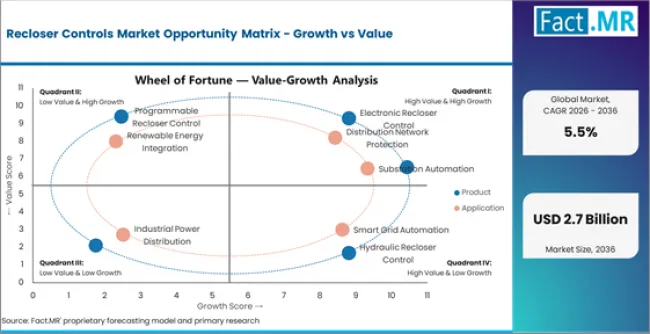
Recloser Controls Market Opportunity Matrix Growth Vs Value | Source: Fact.MR
Key Factors Driving Growth
- Industrial and manufacturing investment expansion across developed and emerging economies sustains procurement growth for recloser controls systems.
- Technology advancement and digital integration are broadening the addressable application range and supporting premium pricing tiers.
- Government infrastructure and manufacturing programs create structured procurement pipelines aligned with multi-year budget allocations.
Key Market Constraints
- High capital cost of advanced system variants limits adoption among smaller enterprises without access to favorable financing.
- Supply chain concentration for critical components creates procurement vulnerability during demand surges or geopolitical disruption.
- Technical skill requirements for installation, programming, and operation create adoption barriers in markets with limited trained workforce.
Key Opportunity Areas
- AI and digital twin integration is creating next-generation system capability that transforms static equipment into adaptive, learning platforms.
- Nearshoring and reshoring investment is generating new facility procurement cycles that include recloser controls specification.
- Sustainability and energy efficiency mandates create specification preference for advanced variants with lower total cost of ownership.
Segment-wise Analysis of the Recloser Controls Market
- Electronic Recloser Control holds 34.7% of the product segment in 2026.
- Distribution Network Protection represents 31.5% of the application segment in 2026.
The recloser controls market is segmented by product, application, end use, technology, voltage range, and region.
Which Product Segment Dominates the Recloser Controls Market?
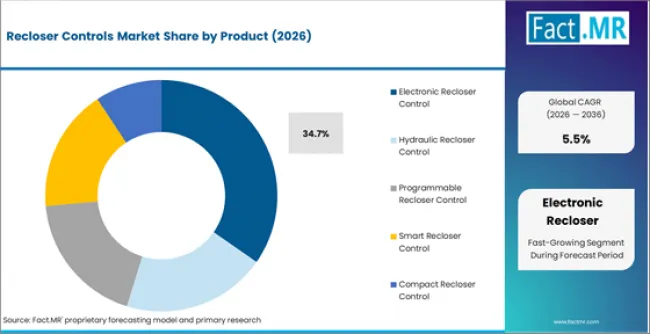
Recloser Controls Market Analysis By Product | Source: Fact.MR
Electronic Recloser Control is estimated to account for 34.7% of the product segment value in 2026. Leadership reflects broad applicability, established buyer preference, and competitive positioning across primary end-use applications.
Which Application Segment Dominates the Recloser Controls Market?
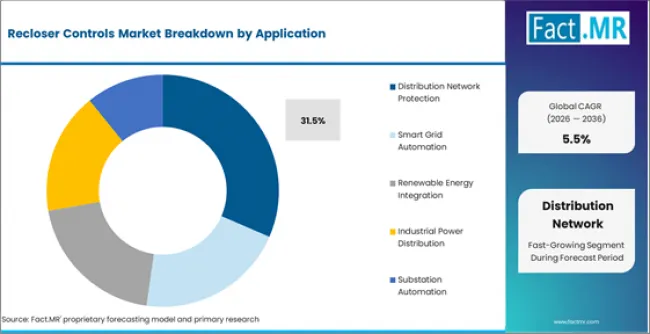
Recloser Controls Market Analysis By Application | Source: Fact.MR
Distribution Network Protection is expected to lead the application segment with 31.5% share in 2026. This application generates the most concentrated procurement demand supported by institutional requirements and structural activity cycles.
Which Product Trend is Shaping the Next Phase of Growth in the Recloser Controls Market?
Communication-enabled recloser controls with SCADA integration and distribution automation capability are the fastest-growing product category. Schweitzer Engineering Laboratories (SEL) and ABB are integrating IEC 61850 communication protocols, FLISR (Fault Location, Isolation, and Service Restoration) algorithms, and distributed energy resource management into recloser control platforms. Grid modernization programs and renewable energy integration requirements are driving the transition from standalone recloser controls to networked, intelligent distribution automation systems.
Regional Outlook Across Key Markets
- USA leads growth at 6.0%.
- Mexico at 5.7% sustains demand through expanding capacity.
- Germany at 5.5% maintains demand through technology investment and modernization.
.webp "Top Country Growth Comparison Recloser Controls Market Cagr (2026 2036)")
Top Country Growth Comparison Recloser Controls Market Cagr (2026 2036) | Source: Fact.MR
| Country | CAGR (%) |
|---|---|
| USA | 6.0% |
| Mexico | 5.7% |
| Germany | 5.5% |
| France | 5.2% |
| South Korea | 5.0% |
| UK | 5.0% |
| Japan | 4.8% |
Source: Fact.MR analysis. Updated Jun 3, 2026
Source: Fact MR (FMR) analysis, based on proprietary forecasting model and primary research.
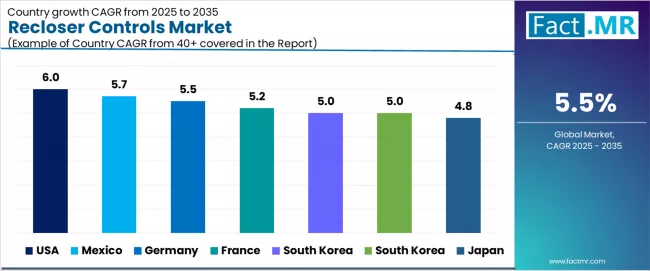
Recloser Controls Market Cagr Analysis By Country | Source: Fact.MR
Recloser Controls Demand Trends in USA
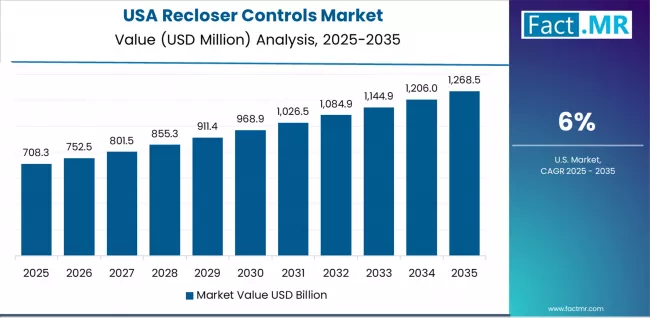
Recloser Controls Market Country Value Analysis | Source: Fact.MR
Utility grid modernization investment, distribution automation programs, and renewable energy integration requirements sustain the primary demand channel. SEL maintains the strongest domestic position. IRA clean energy provisions and state-level grid reliability mandates are generating multi-year recloser control procurement pipelines.
- Utility grid modernization investment, distribution automation programs, and renewable energy integration requirements sustain the primary demand channel.
- SEL maintains the strongest domestic position.
Market Outlook for Recloser Controls in Germany
Energiewende renewable energy integration and distribution grid modernization sustain institutional demand. Siemens and ABB hold strong European positions. EU grid code compliance and distributed energy resource management drive networked recloser control specification.
- Energiewende renewable energy integration and distribution grid modernization sustain institutional demand.
- Siemens and ABB hold strong European positions.
France Recloser Controls Growth Assessment
Enedis (EDF distribution) grid modernization programs and renewable energy integration drive institutional procurement. EU network code compliance and distribution automation requirements shape control platform specification.
- Enedis (EDF distribution) grid modernization programs and renewable energy integration drive institutional procurement.
- EU network code compliance and distribution automation requirements shape control platform specification.
South Korea Recloser Controls Market Positioning
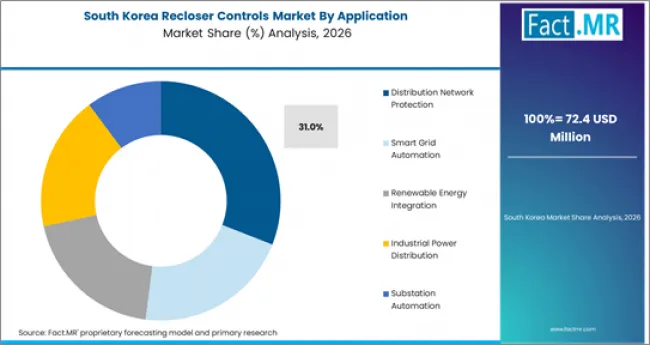
Recloser Controls Market South Korea Market Share Analysis By Application | Source: Fact.MR
KEPCO distribution modernization and smart grid programs sustain institutional demand. Semiconductor fabrication and data center power reliability requirements create parallel industrial procurement for premium recloser control systems.
- KEPCO distribution modernization and smart grid programs sustain institutional demand.
- Semiconductor fabrication and data center power reliability requirements create parallel industrial procurement for premium recloser control systems.
Competitive Benchmarking and Company Positioning
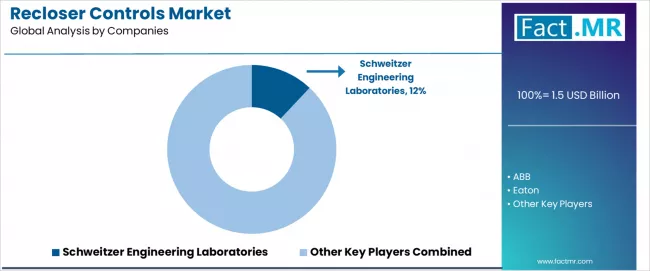
Recloser Controls Market Analysis By Company | Source: Fact.MR
Recloser Controls Market Analysis By Company
- Schweitzer Engineering Laboratories holds an estimated 12.0% market share through technology leadership and established market positioning.
- ABB and Eaton compete through specialized capabilities and regional market strength.
- Competition is shaped by product performance, digital integration, pricing, and service coverage across end-user industries.
The competitive landscape is moderately concentrated. Strategic priorities include expanding AI and digital capabilities, extending into high-growth segments, and deepening service networks in emerging markets.
Key Companies in the Recloser Controls Market
- Schweitzer Engineering Laboratories, ABB, Eaton, Siemens lead through technology, product breadth, and established positions.
- General Electric, SEL, Mitsubishi Electric, Schneider Electric maintain positions in specialized and regional segments.
Recent Industry Developments
- Schweitzer Engineering Laboratories, Advanced Recloser Control Platform (2025): SEL continued advancing its recloser control portfolio with enhanced FLISR algorithms, IEC 61850 communication capability, and cybersecurity features for smart grid distribution automation applications.
- ABB, Grid Automation Solutions Expansion (2025): ABB expanded its recloser and distribution automation portfolio with integrated communication and protection platforms supporting utility grid modernization, renewable energy integration, and distribution feeder automation programs.
- Eaton, Medium-Voltage Distribution Equipment Updates (2025): Eaton advanced its medium-voltage recloser and switchgear portfolio with updated electronic controls and communication capabilities, supporting utility procurement for distribution network reliability improvement and automation programs.
Leading Companies Shaping the Recloser Controls Market
- Schweitzer Engineering Laboratories
- ABB
- Eaton
- Siemens
- General Electric
- SEL
- Mitsubishi Electric
- Schneider Electric
- SELCO
- Toshiba
Sources and Research References
- Schweitzer Engineering Laboratories. Product specifications and corporate data.
- ABB. Product portfolio and market data.
- Industry trade associations. Market statistics and benchmarks.
- Government and regulatory agencies. Industry investment and compliance data.
- Primary interviews with manufacturers, integrators, distributors, and end users.
This bibliography is provided for reader reference and is not exhaustive. The full report contains the complete reference list and detailed citations.
Key Questions This Report Addresses
- What is the current and projected size of the Recloser Controls Market through 2036?
- Which product type leads the market by value in 2026?
- What industry factors are driving demand?
- How is technology advancement influencing market growth?
- Which countries show the fastest growth through 2036?
- Who are the leading companies?
- How does Fact.MR validate the forecast?
Recloser Controls Market Definition
The recloser controls market covers electronic and electromechanical control systems for automatic circuit reclosers used in medium-voltage electrical distribution networks for fault detection, protection, and power restoration across utility, industrial, and renewable energy grid applications.
Recloser Controls Market Inclusions
- The scope covers global and regional market size and forecasts for 2026 to 2036 across product type, application, end use, technology, and region.
- It includes demand analysis based on industrial output, manufacturing investment, infrastructure spending, and technology adoption rates.
- The report includes pricing and competitive benchmarking across product categories and regional markets.
Recloser Controls Market Exclusions
- The scope excludes adjacent equipment categories, standalone software, and aftermarket consumables sold independently.
- It excludes used and refurbished equipment transactions and internal fleet transfers.
Recloser Controls Market Research Methodology
- The methodology combines secondary research, primary interviews, and forecast modelling tied to industrial activity and technology investment.
- It draws on 100+ secondary sources including industry databases, manufacturer filings, and trade association data.
- Market sizing covers 30+ countries validated against industry benchmarks and technology adoption indices.
- Primary validation includes 25+ interviews across manufacturers, system integrators, distributors, and end users.
Segmentation
Scope of Analysis
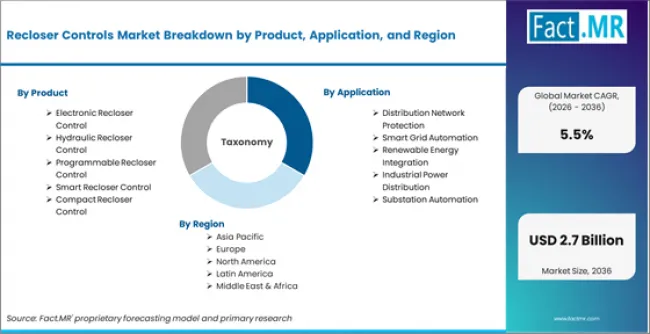
Recloser Controls Market Breakdown By Product, Application, And Region | Source: Fact.MR
| Parameter | Details |
|---|---|
| Quantitative Units | USD 1.58 billion to USD 2.7 billion, at a CAGR of 5.5% |
| Market Definition | The Recloser Controls Market covers electronic and electromechanical control systems for automatic circuit reclosers used in medium-voltage electrical distribution networks for fault detection, protection, and power restoration across utility, industrial, and renewable energy grid applications. |
| Regions Covered | North America, Latin America, Europe, East Asia, South Asia and Pacific, Middle East and Africa |
| Countries Covered | USA, Mexico, Germany, France, South Korea, 30 plus countries |
| Key Companies | Schweitzer Engineering Laboratories, ABB, Eaton, Siemens, General Electric, SEL, Mitsubishi Electric, Schneider Electric, SELCO, Toshiba |
| Forecast Period | 2026 to 2036 |
| Approach | Hybrid demand-side and top-down methodology built on industry data, manufacturing investment, technology adoption, and primary interviews. |
Source: Fact.MR analysis. Updated Jun 3, 2026
Recloser Controls Market Segmentation
-
Recloser Controls Market Segmented by Product:
- Electronic Recloser Control
- Microprocessor Based Recloser Control
- Distribution Network Fault Detection
- Automatic Circuit Reclosing Operations
- Digital Recloser Control
- Smart Grid Automation
- Remote Feeder Monitoring
- Microprocessor Based Recloser Control
- Hydraulic Recloser Control
- Single Phase Hydraulic Recloser Control
- Rural Distribution Line Protection
- Pole Mounted Circuit Protection
- Three Phase Hydraulic Recloser Control
- Industrial Power Distribution Protection
- Utility Feeder Line Operations
- Single Phase Hydraulic Recloser Control
- Programmable Recloser Control
- Adaptive Protection Recloser Control
- Dynamic Fault Current Management
- Grid Stability Operations
- Remote Configurable Recloser Control
- Substation Automation Applications
- Utility Network Optimization
- Adaptive Protection Recloser Control
- Smart Recloser Control
- Internet Connected Recloser Control
- Real Time Grid Monitoring
- Advanced Distribution Automation
- Integrated Communication Recloser Control
- Supervisory Control Integration
- Smart Utility Infrastructure Operations
- Internet Connected Recloser Control
- Compact Recloser Control
- Pole Mounted Compact Recloser Control
- Urban Distribution Network Protection
- Space Constrained Utility Installations
- Portable Recloser Testing Control
- Field Maintenance Operations
- Temporary Utility Protection Applications
- Pole Mounted Compact Recloser Control
- Electronic Recloser Control
-
Recloser Controls Market Segmented by Application:
- Distribution Network Protection
- Overcurrent Protection
- Utility Feeder Protection Operations
- Distribution Circuit Isolation
- Fault Interruption Operations
- Temporary Fault Clearing
- Automatic Service Restoration
- Overcurrent Protection
- Smart Grid Automation
- Remote Grid Monitoring
- Distribution Network Diagnostics
- Real Time Feeder Analysis
- Automated Grid Control
- Load Balancing Operations
- Utility Network Optimization
- Remote Grid Monitoring
- Renewable Energy Integration
- Solar Power Distribution Protection
- Distributed Solar Grid Management
- Photovoltaic Feeder Protection
- Wind Energy Network Protection
- Wind Farm Distribution Automation
- Renewable Power Stability Operations
- Solar Power Distribution Protection
- Industrial Power Distribution
- Manufacturing Facility Protection
- Industrial Equipment Circuit Protection
- Plant Distribution Automation
- Commercial Power Distribution
- Large Facility Feeder Protection
- Critical Infrastructure Power Control
- Manufacturing Facility Protection
- Substation Automation
- Feeder Automation Systems
- Substation Distribution Protection
- Automated Switching Operations
- Grid Reliability Management
- Power Outage Prevention
- Distribution Reliability Improvement
- Feeder Automation Systems
- Distribution Network Protection
-
Recloser Controls Market Segmented by End Use:
- Electric Utility Companies
- Public Utility Providers
- Urban Distribution Network Operations
- Rural Grid Protection Systems
- Private Utility Operators
- Industrial Utility Distribution
- Commercial Grid Management
- Public Utility Providers
- Industrial Facilities
- Manufacturing Plants
- Factory Power Distribution Protection
- Industrial Automation Infrastructure
- Oil And Gas Facilities
- Pipeline Power Distribution
- Refinery Electrical Protection
- Manufacturing Plants
- Renewable Energy Operators
- Solar Energy Companies
- Solar Farm Distribution Protection
- Grid Connected Renewable Operations
- Wind Energy Operators
- Wind Farm Circuit Protection
- Renewable Grid Stability Systems
- Solar Energy Companies
- Commercial Infrastructure Operators
- Data Center Operators
- Critical Power Distribution Systems
- Backup Power Protection
- Commercial Building Operators
- Facility Electrical Distribution
- Smart Building Energy Management
- Data Center Operators
- Government And Municipal Authorities
- Municipal Power Authorities
- Public Infrastructure Grid Protection
- City Distribution Automation
- Transportation Infrastructure Authorities
- Railway Power Distribution Protection
- Airport Electrical Network Management
- Municipal Power Authorities
- Electric Utility Companies
-
Recloser Controls Market Segmented by Technology:
- Protection Technology
- Overcurrent Protection Technology
- Fault Current Detection Operations
- Distribution Circuit Isolation
- Adaptive Protection Technology
- Dynamic Grid Response Operations
- Self Healing Grid Applications
- Overcurrent Protection Technology
- Communication Technology
- Wireless Communication Systems
- Remote Utility Monitoring
- Field Device Connectivity
- Fiber Optic Communication Systems
- High Speed Grid Data Transmission
- Substation Automation Networks
- Wireless Communication Systems
- Control Technology
- Microprocessor Based Control Systems
- Automated Reclosing Operations
- Digital Grid Protection
- Programmable Logic Control Systems
- Custom Utility Protection Settings
- Industrial Power Automation
- Microprocessor Based Control Systems
- Monitoring Technology
- Real Time Monitoring Systems
- Grid Health Diagnostics
- Fault Event Recording
- Remote Diagnostic Systems
- Predictive Maintenance Operations
- Distribution Network Analytics
- Real Time Monitoring Systems
- Protection Technology
-
Recloser Controls Market Segmented by Voltage Range:
- Medium Voltage Recloser Controls
- Distribution Feeder Protection Systems
- Urban Utility Networks
- Industrial Distribution Applications
- Rural Grid Protection Systems
- Remote Distribution Networks
- Agricultural Power Infrastructure
- Distribution Feeder Protection Systems
- High Voltage Recloser Controls
- Substation Protection Systems
- Transmission Distribution Interfaces
- Critical Grid Infrastructure
- Industrial High Voltage Systems
- Heavy Industrial Power Networks
- Large Utility Operations
- Substation Protection Systems
- Medium Voltage Recloser Controls
-
Recloser Controls Market by Region:
- North America
- USA
- Canada
- Mexico
- Latin America
- Brazil
- Chile
- Rest of Latin America
- Western Europe
- Germany
- UK
- Italy
- Spain
- France
- Nordic
- BENELUX
- Rest of Western Europe
- Eastern Europe
- Russia
- Poland
- Hungary
- Balkan & Baltic
- Rest of Eastern Europe
- East Asia
- China
- Japan
- South Korea
- South Asia and Pacific
- India
- ASEAN
- Australia & New Zealand
- Rest of South Asia and Pacific
- Middle East & Africa
- Kingdom of Saudi Arabia
- Other GCC Countries
- Turkiye
- South Africa
- Other African Union
- Rest of Middle East & Africa
- North America
Frequently Asked Questions
How big is the recloser controls market in 2026?
What will be the size of recloser controls market in 2036?
How much will be the recloser controls market growth between 2026 and 2036?
What are the key product types in the recloser controls market?
Which application segment is expected to contribute significant share in the recloser controls market in 2026?
Who worked on this report


Preview the report firsthand - request a free sample
Free SampleGet the brochure for pricing and purchase details
Download PDF