- Market Value (2025): USD 6.9 Bn
- Estimated Value (2026): USD 7.4 Bn
- Forecast Value (2036): USD 14.9 Bn
- CAGR (2026-2036): 7.2%
What is the Circuit Protection Modules Market forecast to be worth by 2036?
USD 7.4 billion in 2026 to USD 14.9 billion by 2036 at a 7.2% CAGR.
- The Circuit Protection Modules Market reached USD 6.9 billion in 2025.
- Demand is projected to increase from USD 7.4 billion in 2026 to USD 14.9 billion by 2036.
- The market is forecast to record 7.2% CAGR from 2026 to 2036.
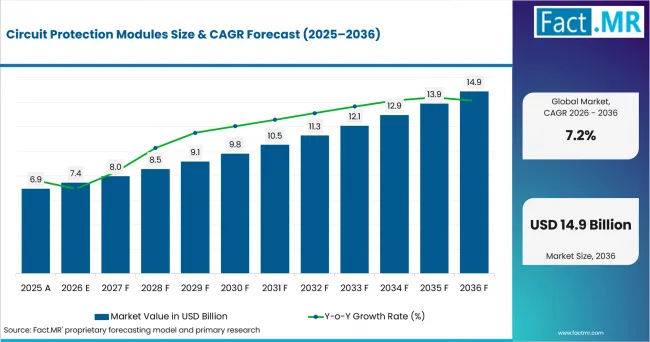
Circuit Protection Modules Value Analysis | Source: Fact.MR
What are the defining numbers behind Circuit Protection Modules Market growth?
An absolute opportunity of USD 7.4 billion is expected between 2026 and 2036.
- Demand Drivers in the Market
- Factory automation teams need resettable DC branch protection that isolates a machine fault without stopping the full control cabinet.
- Data center operators need faster interruption near racks and UPS rooms. The U.S. Energy Information Administration forecasted nationwide retail electricity sales to grow 2.2% in both 2025 and 2026.
- Vehicle platform engineers need compact high-voltage protection as 12-48 V auxiliaries and battery-electric architectures add protected circuits.
- Energy-system integrators need surge, overcurrent and monitoring functions inside one cabinet to reduce wiring time in field installations.
- Panel service teams need clear trip indication so a failed branch is identified quickly during maintenance.
- Key Segments Analyzed
- By Module Type: eFuse and smart fuse modules are expected to hold 29.0% share in 2026 due to electronic reset and diagnostics.
- By Voltage Domain: Low-voltage DC is projected to account for 27.0% share in 2026 since control cabinets commonly use protected DC branches.
- By Application: Industrial automation is anticipated to capture 26.0% share in 2026 supported by protected circuits around sensors and controllers.
- By Integration Level: Discrete module is estimated to represent 35.0% share in 2026 owing to replacement ease and multi-brand panel fit.
- Analyst Opinion at Fact.MR
- Shambhu Nath Jha, Principal Consultant at Fact.MR, states, "The value shift in this market comes from protection that reports its condition instead of only opening the circuit. Buyers are expected to compare response time, voltage class and reset behavior before approving a module for a platform. Suppliers with tested interruption ratings, clear thermal data and broad distributor support are better positioned for repeat design slots."
- Strategic Implications
- Device makers should qualify eFuse modules across 12 V, 24 V and 48 V platforms to match common control-cabinet architectures.
- Panel builders should standardize terminal layout and labeling so maintenance teams replace modules without changing the cabinet design.
- Vehicle engineers should validate high-voltage interruption early since late changes affect pack layout and harness routing.
- Distributors should stock discrete fuses, DIN-rail breakers and surge modules in coordinated ranges for field repair and new automation work.
The United States is projected to record 9.3% CAGR through 2036 due to grid upgrade spending and data center load growth. Japan is expected to post 8.9% CAGR as electronics production keeps compact protection design active. Mexico is forecast to advance at 7.1% CAGR, supported by manufacturing investment and vehicle assembly. The UK is anticipated to reach 6.3% CAGR through electrical equipment output and transmission investment. Germany is estimated to post 5.2% CAGR as grid expansion and factory automation sustain module demand.
How does the Circuit Protection Modules Market break down by segment?
eFuse and smart fuse modules lead Module Type at 29.0%; Discrete module leads Integration Level at 35.0%.
Which Module Type dominates?
eFuse and smart fuse modules are expected to hold 29.0% share in 2026.
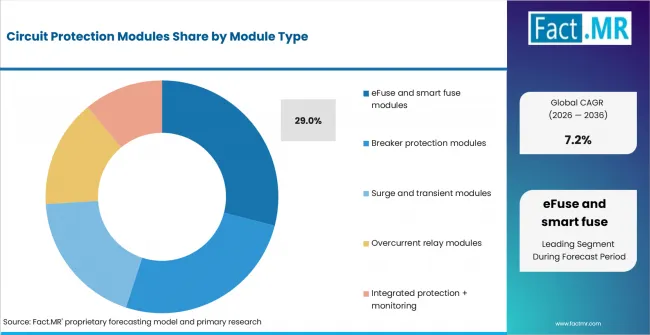
Circuit Protection Modules Analysis By Module Type | Source: Fact.MR
eFuse and smart fuse modules lead because they combine current limiting, reset behavior and fault reporting in compact designs. Engineers use them where manual fuse replacement is slow or where unplanned downtime affects machine output.
Sensata Technologies introduced the STPS500 Series PyroFuse in April 2025 for high-voltage applications up to 1000 V. Its high current rating and fast disconnect behavior show why module-level interruption is gaining attention in dense power systems.
What leads the Voltage Domain segment?
Low-voltage DC is projected to account for 27.0% share in 2026.
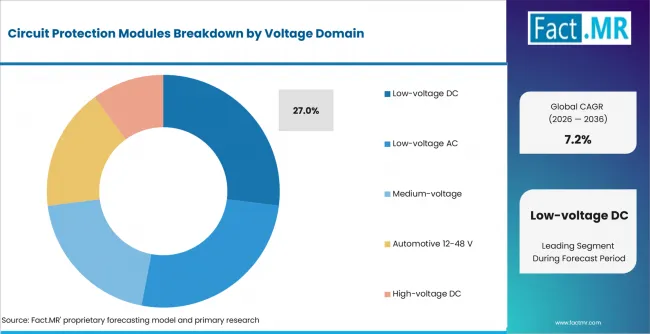
Circuit Protection Modules Analysis By Voltage Domain | Source: Fact.MR
Low-voltage DC leads as 24 V control circuits remain common in industrial panels. The same voltage family is used in building controls, battery auxiliaries and equipment monitoring loops.
Phoenix Contact launched the PTCB TM thermal-magnetic circuit-breaker family in October 2025 with an 8 mm width and direct bridging to its CLIPLINE complete system. That design direction fits control cabinets where space and diagnostics shape module selection.
How does Application shape demand?
Industrial automation is anticipated to represent 26.0% share in 2026.
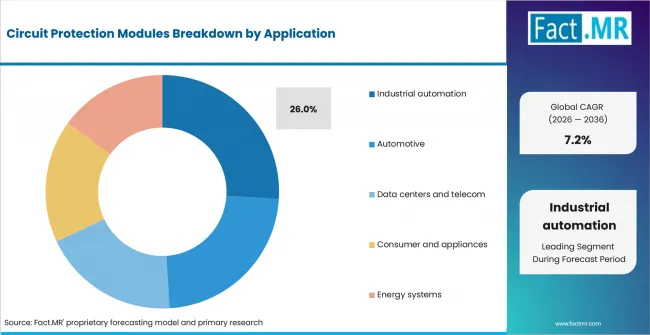
Circuit Protection Modules Analysis By Application | Source: Fact.MR
Industrial automation leads because every sensor branch and actuator branch needs protection that limits downtime. When a machine fault occurs, maintenance teams prefer modules that show the affected load quickly.
Schneider Electric launched its enhanced Breaker Status and Communication Module Modbus SL/ULP in May 2025 for power distribution systems. The product direction supports protection devices that communicate breaker state inside connected plant architectures.
What supports Discrete module demand within Integration Level?
Discrete module is estimated to hold 35.0% share in 2026.
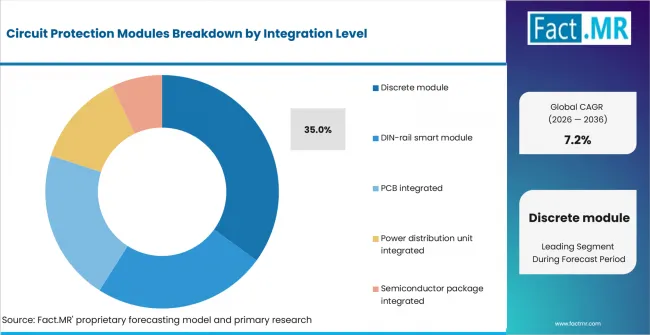
Circuit Protection Modules Analysis By Integration Level | Source: Fact.MR
Discrete modules lead since panel builders and service teams can specify them without committing to a single integrated platform. The format lowers replacement risk when installed equipment comes from several brands.
Mersen introduced its FS Series Class J Fused Switch in June 2025 for branch circuit protection using UL Listed Class J fuses. The switch delivers 200 kA SCCR in the footprint of a fuse holder and supports space-conscious panel designs.
What is accelerating Circuit Protection Modules Market adoption, and what is holding it back?
Demand is expected to rise through industrial automation, monitored protection, data center load growth and high-voltage vehicle platforms. Adoption is constrained by qualification cycles, thermal design pressure and project timing.
Drivers Impact Analysis
| DRIVER | (~) % IMPACT ON CAGR | GEOGRAPHIC RELEVANCE | IMPACT TIMELINE |
|---|---|---|---|
| Factory DC branch protection moving into monitored cabinets | +1.4% | Global | Short term (<= 2 years) |
| High-voltage vehicle and charging protection | +1.2% | USA, Japan, Mexico | Medium term (2-4 years) |
| Data center and grid reliability investment | +1.0% | USA, UK, Germany | Medium term (2-4 years) |
| Industrial panel standardization | +0.8% | Germany, UK, Japan | Long term (>= 4 years) |
- Factory DC branch protection moving into monitored cabinets: Automation teams need modules that trip quickly and identify the failed branch for technicians.
- High-voltage vehicle and charging protection: Electrified platforms raise fault energy, so engineers need compact interruption devices with verified isolation behavior.
- Data center and grid reliability investment: Higher electrical load is expected to create more protected nodes around switchgear, UPS cabinets and distribution units.
Opportunity Impact Analysis
| OPPORTUNITY | (~) % IMPACT ON CAGR | GEOGRAPHIC RELEVANCE | IMPACT TIMELINE |
|---|---|---|---|
| Smart DIN-rail modules with Ethernet status data | +0.9% | Europe, North America | Short term (<= 2 years) |
| High-voltage DC protection for energy systems | +0.8% | Global | Medium term (2-4 years) |
| Integrated protection in vehicle power distribution units | +0.6% | USA, Japan, Mexico | Long term (>= 4 years) |
- Smart DIN-rail modules with Ethernet status data: Suppliers are expected to win panel programs by making trip state and reset functions visible to controllers.
- High-voltage DC protection for energy systems: Battery storage and DC microgrid projects create demand for devices that interrupt faults without sustained arcing.
- Integrated protection in vehicle power distribution units: Automotive programs create design slots for compact modules that reduce harness complexity.
Restraints Impact Analysis
| RESTRAINT | (~) % IMPACT ON CAGR | GEOGRAPHIC RELEVANCE | IMPACT TIMELINE |
|---|---|---|---|
| Qualification cycles for safety-critical modules | -0.5% | Global | Short term (<= 2 years) |
| Component cost and thermal constraints in compact packages | -0.4% | Europe, North America | Medium term (2-4 years) |
| Project delays from grid connection and construction cycles | -0.3% | USA, UK | Medium term (2-4 years) |
- Qualification cycles for safety-critical modules: Automotive, industrial and energy applications require testing across voltage, temperature and fault-current cases.
- Component cost and thermal constraints: Compact electronic protection must handle heat during normal operation and during fault interruption.
- Project timing risk: Grid and construction delays can postpone switchgear rooms, automation cabinets and distribution equipment installation.
Which countries are scaling the Circuit Protection Modules Market through 2036?
- The country comparison spans 4.09 percentage points and forms three practical growth bands across the forecast period.
- The United States remains 0.36 percentage point above Japan through grid upgrade spending and data center load growth.
- Japan remains 1.78 percentage points above Mexico as electronics production keeps compact protection design active.
- Mexico remains 0.84 percentage point above the UK through manufacturing investment and vehicle assembly.
- The UK remains 1.11 percentage points above Germany through electrical equipment output and transmission investment.
- Germany closes the displayed range as grid expansion and factory automation support module use.
Comparable CAGRs create different entry conditions due to grid investment, electronics output, factory automation, vehicle platforms and electrical-equipment supply depth. Full report coverage includes North America, Latin America, Western Europe, Eastern Europe, East Asia, South Asia & Pacific, Middle East & Africa.
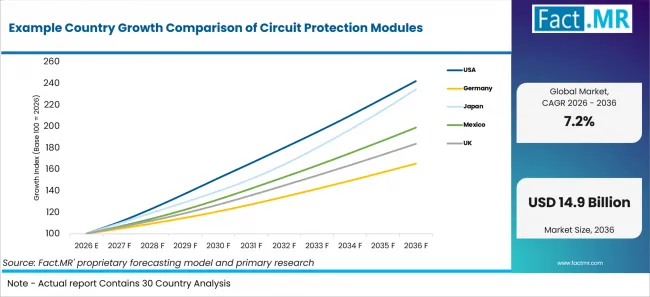
Example Country Growth Comparison Of Circuit Protection Modules | Source: Fact.MR
| Country | CAGR (2026-2036) |
|---|---|
| United States | 9.3% |
| Japan | 8.9% |
| Mexico | 7.1% |
| United Kingdom | 6.3% |
| Germany | 5.2% |
What supports USA adoption?
9.3% CAGR, supported by grid upgrade spending and data center load growth.
The USA market benefits from more protected electrical nodes in data centers, manufacturing sites and distribution upgrades. The U.S. Department of Energy announced approximately USD 1.9 billion in March 2026 to accelerate urgent grid upgrades through the SPARK funding opportunity. That investment route supports demand for modules used around switchgear, distribution cabinets and monitored low-voltage branches.
How is Japan scaling demand?
8.9% CAGR, supported by electronics production and compact high-voltage design.
Japan has a strong installed base for electronics and industrial control equipment. JEITA’s December 2025 production statistics, sourced from METI, showed that Japanese industrial electronic equipment production reached JPY 3,416,604 million cumulatively from January through December 2025. That production base supports demand for low-voltage DC protection, compact breaker modules and high-voltage DC devices used in dense systems.
How does Mexico develop demand?
7.1% CAGR, shaped by manufacturing investment and vehicle assembly.
Mexico has a substantial manufacturing investment base. The Secretaría de Economía reported in August 2026 that manufacturing accounted for 38.6% of Mexico's foreign direct investment in the first half of 2026. The agency said manufacturing investment growth was driven partly by computer, communications and electronic-component manufacturing and by machinery and equipment.
What supports the United Kingdom's growth?
6.3% CAGR, backed by electrical equipment output and transmission investment.
The UK market has a measurable domestic electrical-equipment production base. The Office for National Statistics reported in August 2026 that UK manufacture of electrical equipment recorded total turnover of GBP 17,853.0 million in 2025.
What is supporting Germany's adoption?
5.2% CAGR, backed by grid expansion and factory automation.
Germany links circuit protection module demand to grid expansion and machinery-intensive manufacturing. Bundesnetzagentur reported in January 2026 that it approved roughly 2,000 km of power lines in 2025, describing this as approximately 45% more than in 2024. Grid work and factory cabinet upgrades both increase the need for surge modules, breaker protection and DIN-rail smart devices.
Who leads the Circuit Protection Modules Market?
Eaton is active through Bussmann series fuses, EV fuses and Breaktor circuit protection technology. Its April 2026 Breaktor update added a single-pole variant and a 24-volt control interface for commercial vehicle applications. The update also expanded the portfolio with ASIL-D functional-safety capability, strengthening Eaton’s position in high-voltage EV circuit protection.
Schneider Electric serves the market through low-voltage circuit breakers and digitally connected power-distribution solutions. Its May 2025 BSCM Modbus SL/ULP launch added enhanced breaker-status and communication capabilities for power-distribution systems. Littelfuse maintains a broad circuit-protection portfolio that includes fuses, eFuse protection ICs, transient-voltage-suppression devices and DC power-distribution modules, with offerings spanning automotive, telecom, industrial and electronic applications.
Mersen participates through fuses, fusegear, surge-protection devices and power-distribution products. Its June 2025 Class J Fused Switch launch supports branch-circuit protection and space-efficient designs for panel builders. Phoenix Contact provides electronic, thermal-magnetic and thermal device circuit breakers, including DIN-rail solutions, alongside surge-protection products. Sensata Technologies supplies high-voltage pyrotechnic circuit breakers through its PyroFuse portfolio, along with GIGAVAC contactors and fuses for high-voltage power switching and protection applications.
Which companies are the key providers?
Key companies include Eaton; Schneider Electric; Littelfuse; Mersen; Phoenix Contact; and Sensata Technologies.
- Eaton
- Schneider Electric
- Littelfuse
- Mersen
- Phoenix Contact
- Sensata Technologies
Bibliography
- Bundesnetzagentur. (2026, January 2). Energy transition clears crucial hurdle – significant progress in electricity grid expansion in 2025.
- Eaton. (2026, April 30). Eaton to debut single-pole Breaktor® circuit protection technology at ACT Expo.
- Japan Electronics and Information Technology Industries Association. (2026, March 19). December 2025 production by the Japanese electronics industry.
- Mersen. (2025, June 16). Mersen introduces the Class J Fused Switch.
- Office for National Statistics. (2026, August 13). UKProdTO: 27 – Manufacture of electrical equipment total (£m).
- Phoenix Contact. (2025, October 29). Phoenix Contact extends its device protection portfolio: Thermal-magnetic protection with a width of just 8 mm.
- Schneider Electric. (2025, May 7). Schneider Electric launches new and enhanced Breaker Status and Communication Module (BSCM) Modbus SL/ULP at AATF 2025.
- Secretaría de Economía. (2026, August 24). México registra un máximo histórico de Inversión Extranjera Directa (IED) para un primer semestre: 34 mil 968 millones de dólares en 2026.
- Sensata Technologies. (2025, April 8). Sensata Technologies introduces new PyroFuse to improve high-voltage safety.
- U.S. Department of Energy. (2026, March 12). Energy Department announces $1.9B investment in critical grid infrastructure to reduce electricity costs.
- U.S. Energy Information Administration. (2025, July 31). We expect rapid electricity demand growth in Texas and the mid-Atlantic.
This Report Answers
- The report explains where circuit protection modules are used across module type and voltage domain. It also covers application, integration level and region.
- Segment analysis identifies the leading subsegments and the operating reasons engineering teams prioritize them.
- Country analysis examines the listed markets and the grid, industrial or vehicle mechanisms supporting module adoption.
- Competitive analysis reviews current providers across fuses, breaker modules, surge protection, electronic circuit breakers and high-voltage disconnect devices.
- Application analysis assesses how fault isolation, diagnostics, voltage class and service access influence supplier selection.
What does the Circuit Protection Modules Market cover?
The Circuit Protection Modules Market covers products that protect electrical loads from overcurrent, short-circuit, surge and transient events. The assessment includes related areas such as surge arrester equipment and motor protection devices where reliability and fault isolation shape product selection.
The scope spans discrete modules, DIN-rail smart modules, PCB-integrated protection and power distribution unit integration. It connects to molded case circuit breakers and DC circuit breakers when module-level protection sits inside a broader electrical system.
What is included in the scope?
The scope includes fuses, breakers, relays, surge modules and electronic protection used as modular products. Related downstream coverage includes vehicle power distribution modules and smart junction box and power distribution systems where circuit protection is packaged into larger architectures.
It includes protection modules for automation cabinets, battery-adjacent assemblies, vehicle junction boxes and data center distribution. Adjacent areas such as solid-state relay and fuse box platforms and EV battery current-interrupt devices clarify how resettable and high-voltage protection is integrated.
What is excluded from the scope?
The scope excludes bare commodity wire, loose connectors, general panels sold without protection functions and complete equipment assemblies where module value is inseparable. Larger reference areas such as switchgear assemblies define the upper equipment boundary.
Standalone grid automation controls are outside the module boundary unless a circuit protection product is part of the unit. Adjacent studies such as recloser controls help separate protection modules from wider restoration equipment.
How Was the Analysis Built?
The analysis draws on 120+ sources, 35+ company portfolios, 25+ countries, and more than 20 industry interviews.
- Primary Research: Primary research includes discussions with manufacturers, service providers, technology developers, distributors, end users, and subject-matter experts. These conversations examine purchasing priorities, product adoption, operational challenges, approval requirements, competitive positioning, and the factors that influence wider market acceptance.
- Desk Research: Desk research covers government statistics, regulatory publications, company filings, trade data, technical studies, industry associations, standards, public policy, and other authoritative sources. Every source used in the analysis is documented in the bibliography.
- Market Sizing and Forecasting: Market estimates combine historical performance, demand indicators, pricing and volume trends, segment shares, company participation, country-level growth, adoption patterns, investment activity, and barriers to market expansion.
- Data Validation and Update Cycle: Findings are validated by comparing primary interviews with public data, company activity, regulatory changes, trade patterns, and industry developments. Regular updates review new product launches, capacity changes, partnerships, approvals, and shifts in commercial adoption.
What is the report's scope and coverage?
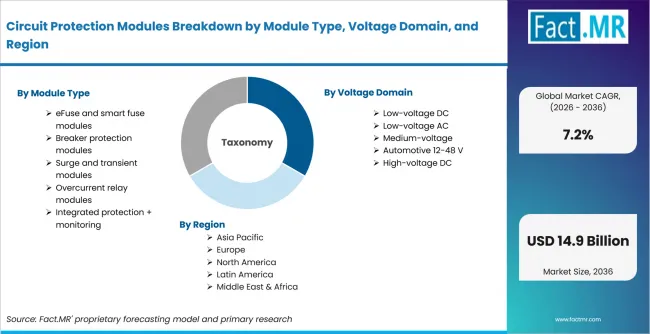
Circuit Protection Modules Breakdown By Module Type, Voltage Domain, And Region | Source: Fact.MR
| Attribute | Details |
|---|---|
| Quantitative Units | USD billion in 2026 to USD billion by 2036 at a CAGR |
| Market Definition | Circuit protection modules used to interrupt, isolate, monitor or limit faults across electrical and electronic systems. The scope includes fuse modules, breaker modules, surge and transient modules, relay protection modules and integrated protection with monitoring. |
| Module Type | eFuse and smart fuse modules; Breaker protection modules; Surge and transient modules; Overcurrent relay modules; Integrated protection and monitoring |
| Voltage Domain | Low-voltage DC; Low-voltage AC; Medium-voltage; Automotive 12-48 V; High-voltage DC |
| Application | Industrial automation; Automotive; Data centers and telecom; Consumer and appliances; Energy systems |
| Integration Level | Discrete module; DIN-rail smart module; PCB integrated; Power distribution unit integrated; Semiconductor package integrated |
| Regions Covered | North America; Latin America; Western Europe; Eastern Europe; East Asia; South Asia & Pacific; Middle East & Africa |
| Countries Covered | United States; Japan; Mexico; United Kingdom; Germany |
| Key Companies Profiled | Eaton; Schneider Electric; Littelfuse; Mersen; Phoenix Contact; Sensata Technologies |
| Forecast Period | 2026 to 2036 |
| Approach | Hybrid top-down and bottom-up approach using installed electrical equipment, automation indicators, voltage-domain demand, application mix, country growth patterns and provider portfolio review. |
How is the market segmented?
-
By Module Type
- eFuse and smart fuse modules
- Breaker protection modules
- Surge and transient modules
- Overcurrent relay modules
- Integrated protection and monitoring
-
By Voltage Domain
- Low-voltage DC
- Low-voltage AC
- Medium-voltage
- Automotive 12-48 V
- High-voltage DC
-
By Application
- Industrial automation
- Automotive
- Data centers and telecom
- Consumer and appliances
- Energy systems
-
By Integration Level
- Discrete module
- DIN-rail smart module
- PCB integrated
- Power distribution unit integrated
- Semiconductor package integrated
-
By Region
- North America
- Latin America
- Western Europe
- Eastern Europe
- East Asia
- South Asia & Pacific
- Middle East & Africa