- Market Value (2025): USD 405.1 Mn
- Estimated Value (2026): USD 480 Mn
- Forecast Value (2036): USD 2621 Mn
- CAGR (2026-2036): 18.5%
What is the EV Battery Current-Interrupt Devices Market forecast to be worth by 2036?
USD 480 million in 2026 to USD 2621 million by 2036 at an 18.5% CAGR.
- The EV Battery Current-Interrupt Devices Market reached USD 405.1 million in 2025.
- Demand is projected to increase from USD 480 million in 2026 to USD 2621 million by 2036.
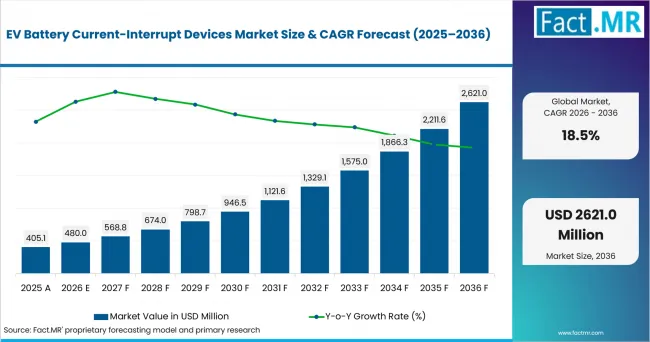
Ev Battery Current Interrupt Devices Market Value Analysis | Source: Fact.MR
What are the defining numbers behind EV Battery Current-Interrupt Devices Market growth?
An absolute opportunity of USD 2,141 million is expected between 2026 and 2036.
- Demand Drivers in the Market
- Higher electric-vehicle production is expanding battery-cell and battery-pack output. The International Energy Agency reported that nearly 22 million electric cars were produced in 2025, more than 25% above 2024. More battery output increases the volume of cell-level and pack-level current-interruption hardware that must be specified during manufacturing.
- Battery safety frameworks are increasing the value of validated protection architecture. UN GTR No. 20 addresses electric-vehicle safety, IEC 62660-3 defines safety testing for propulsion cells, and ISO 6469-1 covers rechargeable energy-storage-system safety. These standards do not prescribe one protection component, but they reinforce the need for cell and pack designs that can manage abnormal electrical and thermal conditions.
- Cylindrical battery formats are changing. Panasonic Energy has prepared its Wakayama facility for 4680 mass production, while LG Energy Solution and Samsung SDI are expanding 46-series cylindrical products. Larger cell formats change current levels and mechanical dimensions. They also alter pressure-management requirements, creating new qualification work for current-interrupt and fuse components.
- High-voltage EV architectures increase fault-interruption requirements at pack level. Sensata markets a pyrotechnic circuit breaker for rapid battery disconnection in high-voltage applications, while Littelfuse supplies automotive high-voltage fuses for EV batteries and charging circuits. This supports demand for coordinated cell-level and pack-level protection rather than a single protective element.
- Battery-manufacturing capacity is expanding closer to vehicle assembly. New plants in France, the United States and Hungary increase the need for regional supply, engineering support and automotive qualification of protection devices used on battery production and pack-assembly lines.
- Key Segments Analyzed
- Cell-level CID accounts for 41.0% of Device Type in 2026 because the device is integrated within the cell design, creating high unit requirements where cylindrical formats use internal current-interruption mechanisms.
- Cylindrical represents 44.0% of Cell Format in 2026, supported by established 1865 and 2170 production and the expansion of 46-series cells by automotive battery manufacturers.
- BEV holds 58.0% of Vehicle Type in 2026 because a full battery-electric traction system requires protection across the cell, module and high-voltage pack architecture.
- NMC accounts for 47.0% of Chemistry in 2026 as high-energy vehicle batteries using nickel-containing cathodes require coordinated fault protection at cell and pack level.
- Analyst Opinion at Fact.MR
- Shambhu Nath Jha, Principal Consultant at Fact.MR, states, “Current-interrupt protection is becoming a design-in decision that follows the battery architecture. Cell-level CID demand depends on cell format and production volume, while pack-level fuse and pyro-fuse demand follows system voltage, fault-current targets and crash-disconnection strategy. The move toward 46-series cylindrical cells means suppliers must requalify dimensions, trigger behavior and integration rather than assume older 1865 or 2170 designs transfer unchanged. Commercial advantage will depend on qualification support, traceable quality and dependable supply close to battery plants.”
- Strategic Implications
- Protection-device suppliers should separate cell-level CID programs from pack-level fuse and pyro-fuse programs because qualification requirements, buyers and integration points differ across the two layers.
- Suppliers serving cylindrical-cell manufacturers should prepare for 46-series qualification work covering mechanical fit and current rating. Trigger behavior and compatibility with automated cell assembly also require review.
- Pack-level suppliers should design around the fault-current and isolation requirements of high-voltage BEV architectures, with validation that reflects the intended battery system rather than generic voltage ratings alone.
- Regional engineering and supply support will matter as battery plants ramp in France, the United States and Hungary. Battery manufacturers need component availability that is aligned with local production schedules and automotive change-control requirements.
- Commercial documentation should distinguish what each safety standard tests from what a specific CID or fuse design actually does. Avoiding unsupported compliance claims reduces qualification risk with battery manufacturers and vehicle OEMs.
How does the EV Battery Current-Interrupt Devices Market break down by segment?
The market is segmented by Device Type, Cell Format, Vehicle Type and Chemistry.
Why does Cell-level CID lead Device Type?
Cell-level CID leads Device Type in 2026.
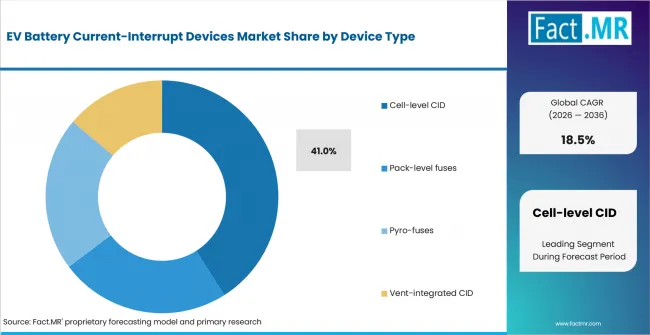
Ev Battery Current Interrupt Devices Market Analysis By Device Type | Source: Fact.MR
Cell-level CIDs are designed into the battery cell rather than added after pack assembly. In cylindrical designs that use an internal current-interruption mechanism, the device forms part of the cap and pressure-management architecture. This creates a direct unit relationship between cell output and CID demand.
IEC 62660-3 requires propulsion cells to be evaluated for safety under intended use and foreseeable misuse. The standard does not require a specific CID design, but it makes cell-level safety performance part of qualification. Battery manufacturers therefore evaluate the interruption mechanism together with venting, sealing and cell construction before releasing a design to volume production.
Why does Cylindrical lead Cell Format?
Cylindrical leads Cell Format in 2026.
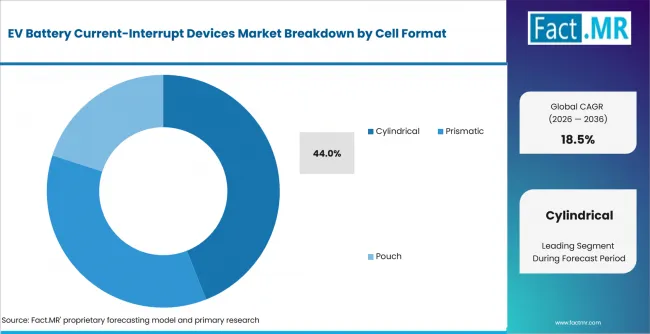
Ev Battery Current Interrupt Devices Market Analysis By Cell Format | Source: Fact.MR
Cylindrical cells support repeatable mechanical formats and automated high-volume production. Panasonic Energy continues automotive cylindrical-cell manufacturing, LG Energy Solution offers 4680, 4695 and 46120 products, and Samsung SDI began production of 46-series cylindrical batteries in 2025. These programs extend the installed base in which cell-level current-interruption features must be engineered into the cap assembly.
The move from 1865 and 2170 cells toward 46-series formats also changes the supplier task. Battery manufacturers need current-interrupt components that fit new dimensions and electrical conditions without weakening sealing, venting or manufacturing throughput. That makes requalification and co-development important purchasing criteria.
Why does BEV lead Vehicle Type?
BEV leads Vehicle Type in 2026.
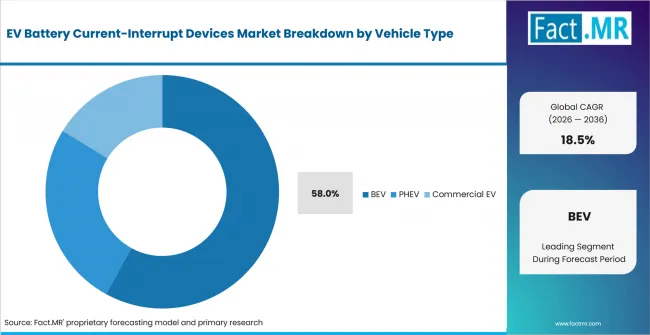
Ev Battery Current Interrupt Devices Market Analysis By Vehicle Type | Source: Fact.MR
Battery electric vehicles depend on the traction battery for propulsion and auxiliary power, so the battery pack remains continuously central to vehicle operation. Protection is required across the electrical path from cell groups to the high-voltage pack, creating demand for cell-level interruption features, conventional fuses and actively triggered disconnect devices.
The IEA reported continued expansion in electric-car production during 2025. As BEV production increases, suppliers are evaluated on current rating and interrupting capacity. Response time and compatibility with the vehicle’s battery-management and crash-signal architecture also matter. PHEVs also require protection, but the source segmentation assigns the larger 2026 share to BEVs.
Why does NMC lead Chemistry?
NMC leads Chemistry in 2026.
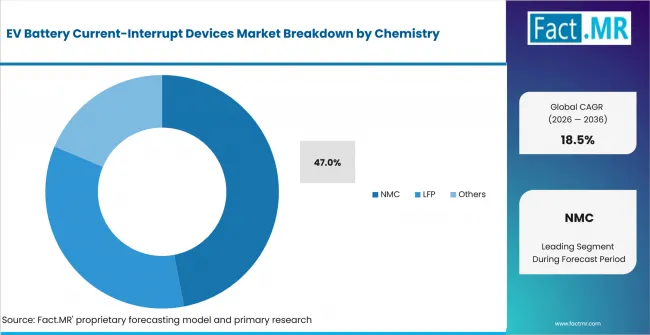
Ev Battery Current Interrupt Devices Market Analysis By Chemistry | Source: Fact.MR
NMC batteries remain important in vehicle applications where energy density is a design priority. High-energy cell and pack designs require protection that can isolate abnormal current without adding excessive resistance or packaging volume. The protection architecture is therefore coordinated with cell chemistry and format. Voltage and thermal design remain part of the same engineering review.
The segment share does not imply that current-interrupt protection is unique to NMC. LFP cells and packs also require safety controls. NMC leads the source taxonomy because its 2026 share of this protection-device market is higher, while suppliers must still qualify products across several chemistries and cell formats.
What is accelerating EV Battery Current-Interrupt Devices Market adoption, and what is holding it back?
Drivers Impact Analysis
| Driver | (~) % Impact on CAGR | Geographic Relevance | Impact Timeline |
|---|---|---|---|
| Higher EV battery cell and pack output | +1.0% | Global | Near term |
| EV battery safety validation and fault-interruption requirements | +0.9% | Europe, North America | Near term |
| Higher-energy battery architectures increasing protection complexity | +0.7% | Global | Mid term |
| Layered cell- and pack-level protection architectures | +0.5% | Asia-Pacific, Europe | Mid term |
Source: Fact.MR analysis. Updated Aug 19, 2026
Opportunity Impact Analysis
| Opportunity | (~) % Impact on CAGR | Geographic Relevance | Impact Timeline |
|---|---|---|---|
| Pyro-fuse adoption in 800 V and other high-voltage BEV architectures | +0.8% | Europe, Asia-Pacific | Near term |
| Regional CID and fuse supply near new battery plants | +0.6% | Europe, North America | Mid term |
| Protection-device redesign for 46-series and other large-format cylindrical cells | +0.4% | Global | Long term |
Source: Fact.MR analysis. Updated Aug 19, 2026
Restraints Impact Analysis
| Restraint | (~) % Impact on CAGR | Geographic Relevance | Impact Timeline |
|---|---|---|---|
| Unit-price pressure from high-volume battery manufacturing | -0.6% | Asia-Pacific | Near term |
| Battery-design changes that may alter conventional CID requirements | -0.4% | Global | Long term |
| East Asian concentration of specialist component supply | -0.3% | Europe, North America | Mid term |
Source: Fact.MR analysis. Updated Aug 19, 2026
Which countries are scaling the EV Battery Current-Interrupt Devices Market through 2036?
- France: Verkor opened its Dunkirk gigafactory in December 2025 with 16 GWh of initial annual capacity and planned commercial battery output from 2026. New cell production creates qualification and sourcing demand for protection components used within battery cells and packs.
- United States: The U.S. Department of Energy closed a USD 7.54 billion loan to StarPlus Energy for up to two lithium-ion cell and module plants in Kokomo, Indiana. Panasonic Energy also began mass production at its Kansas automotive battery factory in 2025, supporting local demand for cell and pack protection hardware.
- South Korea: LG Energy Solution started producing 4695 cells at its Ochang facility in late 2025, while Samsung SDI began 46-series cylindrical battery production in March 2025. Domestic battery engineering activity supports repeated qualification of current-interruption and fuse systems for export vehicle programs.
- Germany: Federal programs continue to support battery-cell production and battery research, while vehicle manufacturers develop high-voltage EV platforms for domestic and export markets. This keeps demand visible for protection devices that can be qualified within automotive battery systems.
- Japan: Panasonic Energy prepared its Wakayama facility for 4680 mass production and continues automotive cylindrical-cell development. New cell formats require changes in cap design and pack protection, supporting demand for current-interruption components that can be validated alongside the cell.
- Hungary: The Hungarian Investment Promotion Agency maps battery-cell investments from Samsung SDI, SK On and CATL within a broader local battery value chain. The ramp-up of cell and pack capacity creates demand for qualified protection components and supplier support close to production sites.
Country CAGR (2026-2036)
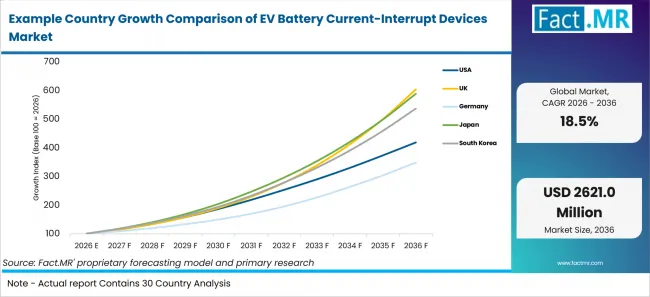
Example Country Growth Comparison Of Ev Battery Current Interrupt Devices Market | Source: Fact.MR
| Country | CAGR (2026-2036) |
|---|---|
| France | 18.64% |
| United States | 19.30% |
| South Korea | 20.05% |
| Germany | 18.92% |
| Japan | 18.73% |
| Hungary | 20.64% |
Source: Fact.MR analysis. Updated Aug 19, 2026
What is driving France's growth through 2036?
France is forecast to expand at an 18.64% CAGR from 2026 to 2036.
France is adding domestic battery-cell production that shortens the distance between cell manufacturing and vehicle assembly. Verkor opened its Dunkirk gigafactory in December 2025 with 16 GWh of initial annual capacity and planned commercial battery output from 2026.
Battery plants need protection components that can be qualified for the exact cell and pack architecture entering production. This supports local engineering support, traceable supply and faster design-change response from CID and fuse suppliers serving French and European vehicle programs.
What is driving United States' growth through 2036?
The United States is forecast to expand at a 19.30% CAGR from 2026 to 2036.
Domestic battery manufacturing is expanding through new cell and module plants. The U.S. Department of Energy closed a USD 7.54 billion loan for StarPlus Energy to finance up to two lithium-ion cell and module plants in Kokomo, Indiana. Panasonic Energy began mass production at its Kansas automotive lithium-ion battery factory in July 2025, with planned annual capacity of about 32 GWh.
More domestic cell and pack output increases demand for protection components that meet vehicle-program qualification and production traceability requirements. Suppliers that can support engineering changes and stable delivery near U.S. battery plants are better aligned with OEM sourcing needs.
What is driving South Korea's growth through 2036?
South Korea is forecast to expand at a 20.05% CAGR from 2026 to 2036.
South Korea combines battery-cell development with volume manufacturing. LG Energy Solution reported that it began producing 4695 cylindrical cells at its Ochang facility in late 2025, while Samsung SDI started 46-series cylindrical battery production in March 2025.
Each new cylindrical platform requires safety features to be validated together with the cell structure and manufacturing process. This creates recurring engineering demand for current-interruption components and pack-level protection as Korean battery companies qualify new formats for overseas vehicle customers.
What is driving Germany's growth through 2036?
Germany is forecast to expand at an 18.92% CAGR from 2026 to 2036.
Germany continues to support battery-cell production and battery research through federal industrial programs. The country also has a dense automotive engineering base that develops and assembles high-voltage EV systems for domestic and export vehicle programs.
Protection-device suppliers therefore compete on qualification depth and integration support. German vehicle and battery programs require fault-interruption hardware to be validated within the complete rechargeable energy-storage system, creating demand for documented electrical performance, change control and manufacturing consistency.
What is driving Japan's growth through 2036?
Japan is forecast to expand at an 18.73% CAGR from 2026 to 2036.
Panasonic Energy prepared its Wakayama facility for 4680 automotive lithium-ion battery mass production, adding a new cylindrical format to its established vehicle-battery operations. The shift to a larger cylindrical cell changes cap geometry and electrical conditions that protection components must accommodate.
Japanese suppliers also operate within long automotive qualification cycles. CID and fuse vendors that can document repeatability across high-volume cell production and support format changes are positioned to participate as battery manufacturers update vehicle programs.
What is driving Hungary's growth through 2036?
Hungary is forecast to expand at a 20.64% CAGR from 2026 to 2036.
Hungary has attracted battery-cell manufacturing projects from Samsung SDI, SK On and CATL. HIPA describes a local value chain that covers battery components and cells. It also includes modules and packs, which increases the number of production stages where protection-device suppliers can participate.
As new capacity ramps, battery manufacturers need approved components and process stability. They also need local responses to engineering changes. This supports demand for cell-level current-interruption hardware and pack-level fuses supplied under automotive quality and traceability requirements.
Who leads the EV Battery Current-Interrupt Devices Market?
Panasonic Energy Co., Ltd. is included in the listed company group because automotive cylindrical-cell production places current-interruption design within the cell-manufacturing process. Its 2170 and 4680 programs give the company direct influence over cap architecture, cell safety features and supplier qualification.
LG Energy Solution, Ltd. and Samsung SDI Co., Ltd. compete through cylindrical-cell development and battery manufacturing. LG Energy Solution is expanding 46-series products from 4680 to 46120, while Samsung SDI began 46-series production in 2025. Their role links protection-component demand to new cell formats and vehicle-customer qualification.
Bourns, Inc., Sensata Technologies and Littelfuse, Inc. compete more directly in circuit-protection hardware. Bourns offers high-power fuses for EV and HEV applications, Sensata supplies a pyrotechnic circuit breaker for high-voltage battery disconnection, and Littelfuse offers automotive high-voltage fuses for EV circuits and batteries.
Competition is shaped by interrupting capacity and response time. Voltage rating and mechanical integration also matter, together with manufacturing traceability. Cell-level suppliers must fit the cap and vent architecture, while pack-level suppliers must coordinate with the battery-management and crash-disconnection strategy. Long qualification cycles make engineering support and change control important to purchasing decisions.
Which companies are the key providers?
Key Companies Panasonic Energy Co., Ltd.; LG Energy Solution, Ltd.; Samsung SDI Co., Ltd.; Bourns, Inc.; Sensata Technologies; Littelfuse, Inc.
- Panasonic Energy Co., Ltd.
- LG Energy Solution, Ltd.
- Samsung SDI Co., Ltd.
- Bourns, Inc.
- Sensata Technologies
- Littelfuse, Inc.
Research Sources and Bibliography
- International Energy Agency. (2026). Global EV Outlook 2026. IEA.
- United Nations Economic Commission for Europe. (2026). Global Technical Regulations: UN GTR No. 20 - Electric Vehicle Safety. United Nations.
- International Electrotechnical Commission. (2022). IEC 62660-3:2022 Secondary Lithium-Ion Cells for the Propulsion of Electric Road Vehicles - Part 3: Safety Requirements. IEC.
- International Organization for Standardization. (2019). ISO 6469-1:2019 Electrically Propelled Road Vehicles - Safety Specifications - Part 1: Rechargeable Energy Storage System. ISO.
- U.S. Department of Energy. (2024). LPO Announces USD 7.54 Billion Loan to StarPlus Energy to Construct Lithium-Ion Battery Factories in Indiana. U.S. Department of Energy.
- Panasonic Energy Co., Ltd. (2025). Panasonic Energy Begins Mass Production at New Automotive Lithium-ion Battery Factory in Kansas, Aiming for Annual Capacity of 32 GWh to Accelerate U.S. Local Production. Panasonic Energy.
- Panasonic Energy Co., Ltd. (2024). Panasonic Energy Ready to Commence Mass Production of 4680 Automotive Lithium-ion Batteries. Panasonic Energy.
- LG Energy Solution. (2026). LG Energy Solution Releases 2026 First-Quarter Financial Results. LG Energy Solution.
- Samsung SDI Co., Ltd. (2025). Samsung SDI Begins Production of 46-Series Cylindrical Batteries and Initial Supply for U.S. Customer. Samsung SDI.
- Bourns, Inc. (2022). Bourns PF-K Series EV POWrFuse High-Power Fuses. Bourns.
- Sensata Technologies. (2026). PyroFuse Pyrotechnic Circuit Breaker. Sensata Technologies.
- Littelfuse, Inc. (2026). Automotive High-Voltage Fuses. Littelfuse.
- Verkor. (2025). Verkor Reaches a Decisive Milestone and Opens Its First Gigafactory. Verkor.
- Federal Ministry for Economic Affairs and Energy, Germany. (2026). Battery Cell Production Germany. Federal Government of Germany.
- Hungarian Investment Promotion Agency. (2026). Battery Industry in Hungary. HIPA.
This Report Answers
- How demand changes across Device Type and Cell Format. It also covers Vehicle Type and Chemistry.
- Why cell-level CIDs and cylindrical cells lead their respective segments. It also explains the leadership of BEVs and NMC batteries.
- How battery-manufacturing expansion and safety validation influence current-interrupt device purchasing.
- How the listed countries differ in battery-production activity and supplier qualification requirements.
- How battery manufacturers and protection-device suppliers compete through integration, electrical performance and automotive quality support.
What does the EV Battery Current-Interrupt Devices Market cover?
The market covers factory-installed devices that interrupt electrical current within an electric-vehicle battery cell or pack when a fault condition requires isolation. Included device types are cell-level CIDs, pack-level fuses, pyro-fuses and vent-integrated CIDs.
The assessment covers cylindrical, prismatic and pouch cell formats used in BEVs, PHEVs and commercial EVs. Chemistry coverage includes NMC, LFP and other battery chemistries within the stated source taxonomy.
What is included in the scope?
The scope includes cell-level current-interruption hardware integrated during battery-cell manufacturing and pack-level fuses or pyrotechnic disconnect devices supplied for original EV battery packs. Revenue is counted when the protection device is supplied as part of the factory battery architecture.
Buyer coverage includes battery-cell manufacturers, battery-pack manufacturers and vehicle programs that specify or qualify current-interruption hardware. The analysis considers device electrical performance, cell-format integration and pack-level fault isolation within the listed segments.
What is excluded from the scope?
The scope excludes battery-management-system software and electronic control units that monitor state of charge or state of health without directly interrupting current. Contactors and relays are excluded when sold as standalone power-distribution components outside the stated current-interrupt device categories.
Aftermarket replacement fuses, consumer-electronics battery protectors and protection devices used only in stationary energy storage are outside the market. Thermal-management components are excluded unless they are sold as part of a listed current-interruption device.
How Was the Analysis Built?
Fact.MR is of the opinion that this assessment combines primary research with a structured review of public information and industry evidence relevant to the market.
- Primary Research: Interviews with battery-cell manufacturers, battery-pack engineers, vehicle OEM engineering teams, circuit-protection suppliers and procurement specialists examine device qualification, cell-format integration, fault-interruption requirements and sourcing priorities.
- Desk Research: The review covers EV production, battery-manufacturing activity, cell-format developments, battery safety standards, company technical literature and public investment programs. External evidence used in the article is listed in the bibliography.
- Market Sizing and Forecasting: Estimates combine battery-cell and pack output with device content per battery architecture, cell-format mix, chemistry mix and country-level production growth. Segment shares and country projections are cross-checked against the stated market totals.
- Data Validation and Update Cycle: Evidence is reviewed against the defined market scope, segment boundaries and forecast period. The assessment is updated when source data, technology conditions, regulation or supplier activity materially changes the outlook.
Segmentation
Research Scope and Coverage
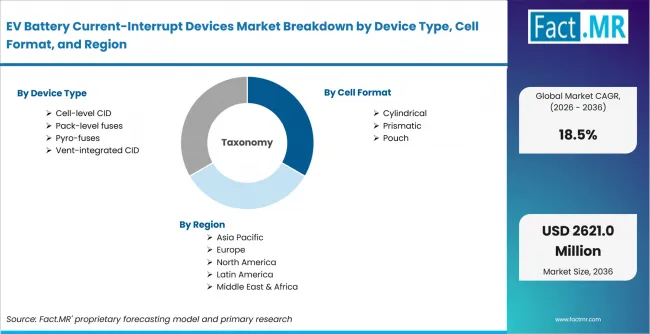
Ev Battery Current Interrupt Devices Market Breakdown By Device Type, Cell Format, And Region | Source: Fact.MR
| Attribute | Details |
|---|---|
| Quantitative Units | USD million |
| Market Definition | Factory-installed current-interrupt protection devices used within electric-vehicle battery cells or packs, including cell-level CIDs, pack-level fuses, pyro-fuses and vent-integrated CIDs. |
| Segments Covered | Device Type; Cell Format; Vehicle Type; Chemistry |
| Regions Covered | North America; Latin America; Western Europe; Eastern Europe; East Asia; South Asia & Pacific; Middle East & Africa |
| Countries Covered | France; United States; South Korea; Germany; Japan; Hungary |
| Key Companies Profiled | Panasonic Energy Co., Ltd.; LG Energy Solution, Ltd.; Samsung SDI Co., Ltd.; Bourns, Inc.; Sensata Technologies; Littelfuse, Inc. |
| Forecast Period | 2026 to 2036 |
| Approach | Hybrid top-down and bottom-up approach using EV battery-cell output, pack production, protection-device content, cell-format mix, chemistry mix, country growth and company portfolio review |
Source: Fact.MR analysis. Updated Aug 19, 2026
Market Breakdown by Segments
-
By Device Type:
- Cell-level CID
- Pack-level fuses
- Pyro-fuses
- Vent-integrated CID
-
By Cell Format:
- Cylindrical
- Prismatic
- Pouch
-
By Vehicle Type:
- BEV
- PHEV
- Commercial EV
-
By Chemistry
- NMC
- LFP
- Others
-
By Region:
- North America
- Latin America
- Western Europe
- Eastern Europe
- East Asia
- South Asia & Pacific
- Middle East & Africa
Frequently Asked Questions
What is the EV Battery Current-Interrupt Devices Market value in 2026?
At what CAGR is the market projected to grow?
What is the projected market value by 2036?
Which Device Type leads the market?
Which Cell Format leads the market?
Which Vehicle Type leads the market?
Which Chemistry leads the market?
Which listed country is projected to expand at a 20.64% CAGR?
What is the primary driver in this market?
What is the main restraint?
Which companies are included in the market assessment?
Who worked on this report


Preview the report firsthand - request a free sample
Free SampleGet the brochure for pricing and purchase details
Download PDF