- Market Value (2025): USD 5.3 Bn
- Estimated Value (2026): USD 5.7 Bn
- Forecast Value (2036): USD 11.9 Bn
- CAGR (2026-2036): 7.7%
What is the Aerospace and Defense Printed Circuit Board Market forecast to be worth by 2036?
The market is projected to grow reach USD 11.9 billion by 2036, registering a CAGR of 7.7%.
- The Aerospace and Defense Printed Circuit Board market reached USD 5.3 billion in 2025.
- Demand is forecast to increase from USD 5.7 billion in 2026 to USD 11.9 billion by 2036.
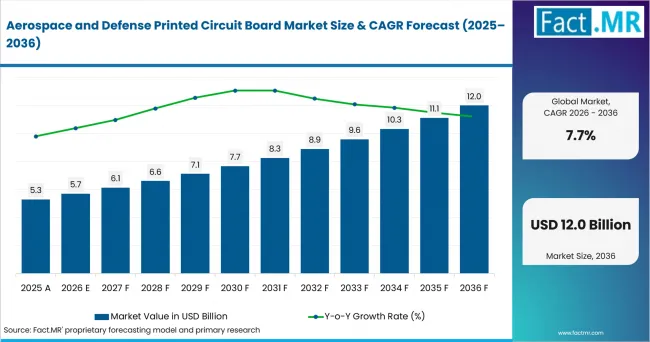
Aerospace And Defense Printed Circuit Board Market Value Analysis | Source: Fact.MR
What are the defining numbers behind Aerospace and Defense Printed Circuit Board Market growth?
An absolute dollar opportunity of USD 6.2 billion is expected between 2026 and 2036.
- Demand Drivers in the Market
- Defense platforms are carrying more electronics per airframe and vehicle. Radar, electronic warfare, mission computing, secure communications, and autonomy add sensors and processors at the platform edge, which in turn raises demand for denser routing, controlled impedance, and reliable power distribution.
- National defense investment is funding this electronics intensity. Australia allocated A$425 billion over the decade in its April 2026 Integrated Investment Program, with priorities including integrated air and missile defense, autonomous systems, counter-UAS, and secure multi-orbit satellite communications.
- Qualified domestic capacity is being treated as a strategic supply issue. The U.S. Department of Defense awarded USD 39.9 million in November 2023 to strengthen domestic HDBU and HDI capabilities for radar, electronic warfare, processing, and communications.
- Program upgrades favor boards that support high-speed and RF signal integrity. Low-loss materials, controlled impedance, and rigid-flex constructions let designers pack more performance into tight platform volumes while separating sensitive signals.
- Long production-readiness cycles and multi-year program commitments create durable demand. In January 2026, Raytheon awarded TTM Technologies a multi-year LTAMDS agreement covering RF assemblies, electronic hardware, and printed circuit boards with a potential value of USD 200 million.
- Harsh-environment reliability requirements keep demand anchored to qualified suppliers. Boards must perform under vibration, temperature extremes, and electromagnetic exposure across aircraft, naval, ground, missile, radar, and space applications, favoring process control over commodity supply.
- Key Segments Analyzed
- High-Reliability Multilayer PCB anchors the Board Category segment with a 36.0% share in 2026, as it balances routing density with a mature, reproducible qualification route.
- Military Aircraft lead the Aircraft Platform segment, taking 40.0% of demand in 2026, because flight-control, radar, and electronic warfare electronics concentrate within each platform.
- Defense dominates the End-use Sector segment with a 46.0% share in 2026, reflecting the volume and qualification burden of defense acquisition programs.
- High-Reliability PCB Fabrication leads Manufacturing Technology at 39.0% in 2026, since traceable, process-controlled fabrication is the core value a defense buyer purchases.
- Analyst Opinion at Fact.MR
- Shambhu Nath Jha, Senior Consultant at Fact.MR, states: “The aerospace and defense PCB market is being reshaped by rising electronics intensity and public investment in trusted domestic capacity. Buyers are not selecting boards on spot availability; they are qualifying processes, tying material traceability, and locking in long production-readiness cycles. That favors suppliers able to hold stable lamination and drilling, control impedance, and evidence every lot. High-Reliability Multilayer PCB already holds 36.0% of the market in 2026, and the same qualification logic is extending across HDI, RF, and rigid-flex constructions as program portfolios expand.”
- Strategic Implications
- Board suppliers should maintain defense-grade qualifications and approved-source listings, because traceability and process evidence are the entry criteria for every defense program.
- Fabricators should expand Ultra-HDI, RF, and rigid-flex capability aligned with funded programs, since radar, electronic warfare, and autonomous systems drive the fastest-growing board content.
- Capacity investment should follow national defense funding, including U.S., French, Japanese, and Australian programs, where public money is underwriting trusted domestic supply.
- Providers should build multi-year supply agreements and obsolescence support, because lead-time stability and lifecycle continuity matter as much as unit price in program buying.
- Design partners should tie their tooling to platform milestones rather than assume the same channel model across countries, as procurement timing differs by region.
How does the Aerospace and Defense Printed Circuit Board Market break down by segment?
The market is structured across four analytical dimensions plus region. Within Board Category, High-Reliability Multilayer PCB is the leading sub-segment. Military Aircraft lead among Aircraft Platforms. Defense is the dominant End-use Sector. High-Reliability PCB Fabrication leads Manufacturing Technology, and North America, Europe, and Asia Pacific anchor the regional demand base.
Why does High-Reliability Multilayer PCB lead Board Category?
High-Reliability Multilayer PCB is projected to account for a 36.0% share in 2026.
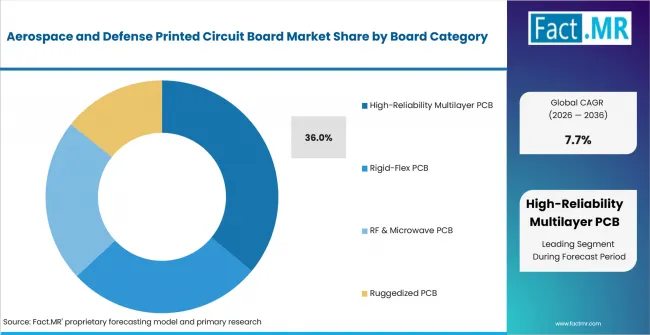
Aerospace And Defense Printed Circuit Board Market Analysis By Board Category | Source: Fact.MR
High-reliability multilayer boards offer a practical balance between routing density and proven process control. They support power distribution, digital processing, and sensor interfaces within a compact footprint, and multiple copper layers help designers separate sensitive signals and manage return paths. Aerospace and defense buyers can qualify a stable stack-up across several program variants, lowering redesign risk compared with introducing a new construction for every electronics package. DLA performance specifications formalize the verification burden for rigid and multilayer printed boards, which favors suppliers that can control lamination, drilling, plating, and inspection across repeat production lots. In September 2023, DLA listed MIL-PRF-55110 Revision J with Amendment 1 for rigid printed wiring boards, anchoring the performance and qualification expectations buyers apply.
Why does Military Aircraft lead Aircraft Platform?
Military Aircraft is projected to account for a 40.0% share in 2026.
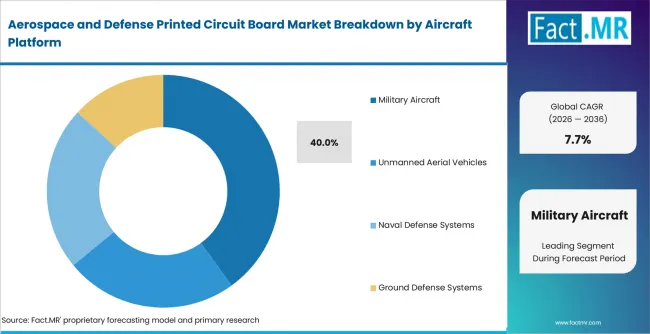
Aerospace And Defense Printed Circuit Board Market Analysis By Aircraft Platform | Source: Fact.MR
Military aircraft combine flight-control electronics with radar and electronic warfare, and add mission computing, communications, and stores management on top, creating demand for several board architectures within one platform. Weight and volume constraints favor HDI and rigid-flex designs, while high-frequency sensor paths require low-loss materials and controlled impedance. Aircraft qualification is costly because a board change can affect thermal behavior, vibration response, and certification, so buyers place long-lived orders with approved suppliers once production readiness is established. In January 2026, Raytheon awarded TTM Technologies a multi-year LTAMDS agreement covering RF assemblies, electronic hardware, and printed circuit boards with a potential value of USD 200 million, illustrating how program commitments support dedicated capacity for complex boards and RF assemblies.
Why does Defense lead End-use Sector?
Defense is projected to account for a 46.0% share in 2026.
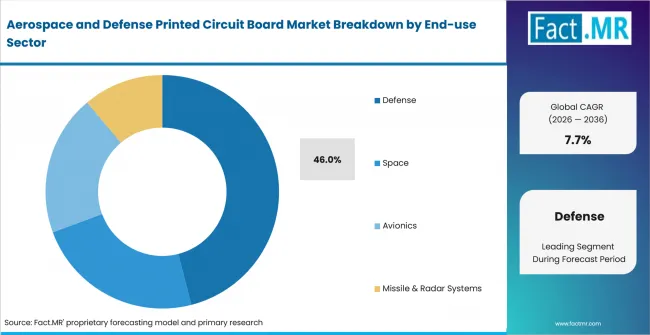
Aerospace And Defense Printed Circuit Board Market Analysis By End Use Sector | Source: Fact.MR
Defense procurement demands traceability, approved-source rules, and often domestic content or an approved country-of-origin route, which places greater value on process evidence than on spot-market availability. Investments in autonomous systems and integrated air and missile defense are increasing the number of distributed sensors and processors across the force, expanding demand for high-density interconnect, RF, and ruggedized boards while keeping qualification authority inside defense acquisition chains. Australia’s April 2026 Integrated Investment Program prioritized integrated air and missile defense, autonomous systems, counter-UAS, and resilient satellite communications, underscoring how defense budgets translate into board-level demand.
Why does High-Reliability PCB Fabrication lead Manufacturing Technology?
High-Reliability PCB Fabrication is projected to account for a 39.0% share in 2026.
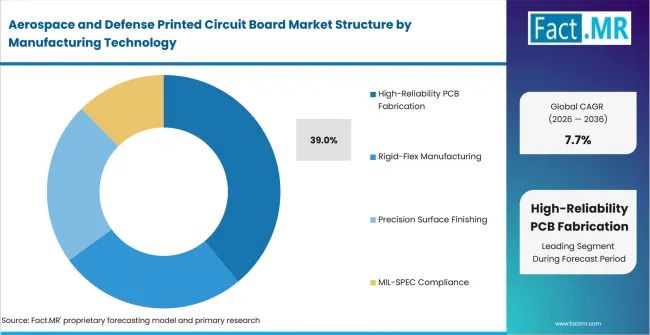
Aerospace And Defense Printed Circuit Board Market Analysis By Manufacturing Technology | Source: Fact.MR
High-reliability fabrication integrates process control with evidence that the board meets its drawing and specification. Military-grade lamination reduces the risk of delamination and dimensional drift, controlled drilling and copper plating protect via integrity, and impedance control preserves high-speed and RF performance. Automated optical inspection finds defects before final test, while environmental screening and reliability testing address the stresses expected in service. Because one upstream variation can appear as a downstream field failure, buyers prefer a qualified process chain with traceable materials and stable tooling. Public investment in domestic HDI capacity confirms this process depth is now a strategic supply issue; the U.S. Department of Defense funded HDBU and HDI capability in November 2023 for radar, electronic warfare, processing, and communications applications.
What is accelerating Aerospace and Defense Printed Circuit Board Market adoption, and what is holding it back?
Drivers Impact Analysis
| Driver | % Impact on CAGR | Geographic Relevance | Impact Timeline |
|---|---|---|---|
| Rising electronics intensity of defense platforms as sensors and processors are added at the platform edge | +0.8% | Global | Long term |
| Public defense investment in trusted domestic and sovereign PCB capacity | +0.7% | North America, Europe, Asia Pacific | Mid term |
| Radar, electronic warfare, and secure communications requiring denser routing and controlled impedance | +0.6% | North America, Europe | Mid term |
| Autonomous systems and counter-UAS programs expanding unmanned and edge processing content | +0.5% | Global | Long term |
Restraints Impact Analysis
| Restraint | % Impact on CAGR | Geographic Relevance | Impact Timeline |
|---|---|---|---|
| Supplier qualification, traceability, and approved-source rules lengthen design wins and slow source switching | -0.6% | Global | Mid term |
| Low production volumes cannot easily absorb qualification and tooling cost | -0.4% | Global | Mid term |
| Lead-time and redesign risk tied to certified capacity and material sourcing | -0.3% | North America, Europe | Near term |
Which countries are scaling the Aerospace and Defense Printed Circuit Board Market fastest?
- The United States leads the pace of expansion on the strength of large defense budgets, funded investment in domestic HDI and Ultra-HDI capability, and long U.S. production-readiness cycles that lock in demand for qualified high-reliability boards.
- France is scaling through a multi-year sovereignty framework, with the 2024 to 2030 Military Programming Law budgeting EUR 413.3 billion and favoring suppliers that work inside sovereign or European defense value chains.
- Japan is advancing as disciplined domestic program control and the SHIELD unmanned-assets project, backed by about JPY 100 billion in the FY2026 draft budget, drive local qualification and capability buildup.
- The United Kingdom is growing as it balances faster fielding with airworthiness and assurance controls, supported by a GBP 5 billion technology investment announced in June 2025 for drones, laser weapons, and defense innovation.
- Canada is expanding as procurement emphasizes Arctic reliability, interoperability, and long-term sustainment under a 2024 policy that added CAD 8.1 billion over five years and CAD 73 billion over 20 years.
- Australia is building demand for sovereign access and support across a dispersed operating environment, with the April 2026 program allocating A$425 billion over a decade and prioritizing missile defense.
- South Korea is gaining ground through compressed development cycles and strong domestic electronics, with the government stating in June 2026 that the military would acquire more than 20,000 drones and train 500,000 operators.
Country-wise CAGR Forecast (2026-2036)
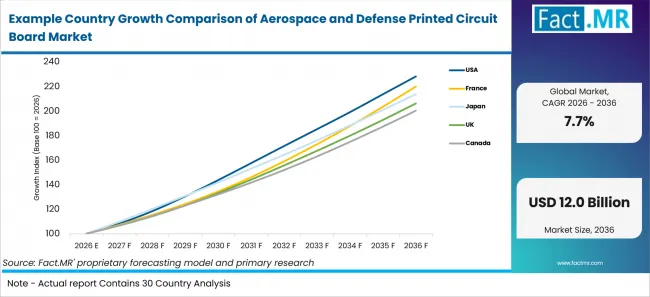
Example Country Growth Comparison Of Aerospace And Defense Printed Circuit Board Market | Source: Fact.MR
| Country | CAGR |
|---|---|
| USA | 8.6% |
| France | 8.2% |
| Japan | 7.9% |
| UK | 7.5% |
| Canada | 7.2% |
| Australia | 6.9% |
| South Korea | 6.6% |
What is driving the Aerospace and Defense Printed Circuit Board Market in the USA?
USA is projected to register an 8.6% CAGR through 2036, supported by domestic capacity investment and a large defense procurement base.
American defense OEMs use approved vendor lists and long production-readiness cycles, which favor suppliers with traceable, qualified processes. TTM Technologies opened a 215,000-square-foot Ultra-HDI plant in Syracuse in June 2026 after a USD 130 million investment, and the U.S. Department of Defense funded domestic HDBU and HDI capability in November 2023. This combination of public investment and existing procurement scale keeps the United States at the front of high-reliability board spending.
What is driving the Aerospace and Defense Printed Circuit Board Market in France?
France is projected to register an 8.2% CAGR through 2036, supported by a sovereign procurement framework and the 2024-2030 Military Programming Law.
French procurement favors suppliers that can work inside sovereign or European defense value chains. Parliament adopted the 2024 to 2030 Military Programming Law in July 2023 with EUR 413.3 billion for the armed forces, funding the modernized platforms and electronic systems that expand high-reliability board demand within a formal sovereignty framework.
What is driving the Aerospace and Defense Printed Circuit Board Market in Japan?
Japan is projected to register a 7.9% CAGR through 2036, supported by domestic program control and the SHIELD unmanned-assets project.
Japanese defense buyers emphasize domestic program control and disciplined qualification. The Ministry of Defense secured about JPY 100 billion for the SHIELD unmanned-assets project in the FY2026 draft budget, funding the autonomous platforms whose sensors and processors drive demand for high-density and ruggedized boards.
What is driving the Aerospace and Defense Printed Circuit Board Market in the UK?
The UK is projected to register a 7.5% CAGR through 2036, supported by technology investment and defense innovation programs.
British buyers are balancing faster fielding with established airworthiness and assurance controls. The government announced a GBP 5 billion technology investment in June 2025 for drones, laser weapons, and defense innovation, extending the electronics content that sustains demand for qualified printed circuit boards.
What is driving the Aerospace and Defense Printed Circuit Board Market in Canada?
Canada is projected to register a 7.2% CAGR through 2036, supported by Arctic reliability and long-term sustainment priorities.
Canadian procurement places strong weight on Arctic reliability, interoperability, and long-term sustainment. Canada’s 2024 policy added CAD 8.1 billion over five years and CAD 73 billion over 20 years, funding the modernized platforms whose mission electronics depend on high-reliability interconnect.
What is driving the Aerospace and Defense Printed Circuit Board Market in Australia?
Australia is projected to register a 6.9% CAGR through 2036, supported by the 2026 National Defence Strategy and Integrated Investment Program.
Australian programs favor sovereign access and support across a geographically dispersed operating environment. The April 2026 Integrated Investment Program allocated A$425 billion over a decade and prioritized missile defense, autonomous systems, and secure satellite communications, driving demand for high-density and RF board capability.
What is driving the Aerospace and Defense Printed Circuit Board Market in South Korea?
South Korea is projected to register a 6.6% CAGR through 2036, supported by compressed development cycles and strong domestic electronics.
South Korean defense manufacturers work through compressed development cycles and strong domestic electronics capabilities. The government stated in June 2026 that the military would acquire more than 20,000 drones and train 500,000 operators, expanding the unmanned and sensor electronics that drive board-level demand.
Who leads the Aerospace and Defense Printed Circuit Board Market?
Competition separates into three practical positions. Mission-critical board fabricators compete on military and aerospace qualifications, controlled processes, and secure production, with RF or rigid-flex depth providing further differentiation. Scaled interconnect platforms compete on HDI technology, material capability, and the ability to support complex designs across several regions. Integrated manufacturing and managed-supply providers compete on design support and assembly adjacency, with supplier orchestration and lifecycle continuity widening their role.
Qualified mission-critical PCB fabricators: TTM Technologies, Advanced Circuits, Eltek, and PCB Technologies compete through traceability, high-reliability processes, and advanced board constructions. Scaled advanced interconnect platforms: Unimicron, AT&S, and Würth Elektronik compete through HDI, flex, rigid-flex, RF, and industrialized process capability. Integrated and managed-supply providers: Benchmark Electronics, Sanmina, and NCAB Group add design support, assembly adjacency, and sourcing continuity.
Which companies are the key providers?
Key companies profiled in the Aerospace and Defense Printed Circuit Board market include TTM Technologies, Inc.; Advanced Circuits, Inc.; Eltek Ltd.; PCB Technologies Ltd.; Unimicron Technology Corporation; AT&S Austria Technologie & Systemtechnik AG; Würth Elektronik GmbH & Co. KG; Benchmark Electronics, Inc.; Sanmina Corporation; and NCAB Group AB.
- TTM Technologies, Inc.
- Advanced Circuits, Inc.
- Eltek Ltd.
- PCB Technologies Ltd.
- Unimicron Technology Corporation
- AT&S Austria Technologie & Systemtechnik AG
- Würth Elektronik GmbH & Co. KG
- Benchmark Electronics, Inc.
- Sanmina Corporation
- NCAB Group AB
Bibliography
- SAE International. (2016, September 20). AS9100D: Quality Management Systems - Requirements for Aviation, Space, and Defense Organizations.
- Defense Logistics Agency. (2023, September 25). MIL-PRF-55110: Printed Wiring Board, Rigid, General Specification for, Revision J with Amendment 1.
- Defense Logistics Agency. (2021, September 1). MIL-PRF-31032: Printed Circuit Board/Printed Wiring Board, General Specification for.
- U.S. Department of Defense. (2023, November 15). DOD Awards $39.9 Million to Strengthen U.S. Supply Chains for Printed Circuit Boards.
- TTM Technologies, Inc. (2026, June 22). TTM Technologies Opens Ultra-HDI Manufacturing Facility in Syracuse, NY.
- TTM Technologies, Inc. (2026, January 28). RTX’s Raytheon Awards TTM Technologies a Multi-Year Contract for LTAMDS Radar Components.
- Eltek Ltd. (2026, February 9). Eltek Receives Purchase Orders Totaling $12.2 Million.
- NCAB Group AB. (2026, June 24). NCAB Acquires Board Shark PCB in the USA.
- French Ministry of Armed Forces. (2023, July 14). The 2024-2030 Military Programming Law Is Definitively Adopted by Parliament.
- Japan Ministry of Defense. (2025, December 24). Extraordinary Press Conference by the Defense Minister.
- UK Ministry of Defence. (2025, June 2). Major £5 Billion Technology Investment Accelerates UK Defence Innovation.
- Department of National Defence Canada. (2024, May 15). Minister Blair Concludes Visit to Washington to Discuss Our North, Strong and Free.
- Department of National Defence Canada. (2024, October 10). Procurement: Modern Equipment and Major Capability Investments.
- Australian Department of Defence. (2026, April 16). 2026 National Defence Strategy and Integrated Investment Program.
- Republic of Korea. (2026, June 30). Military to Make Drones Standard Equipment for All Personnel.
This Report Answers
- The report provides strategic intelligence on the Aerospace and Defense Printed Circuit Board Market across the segment categories that drive industrial and enterprise purchasing behavior.
- Segment analysis covers High as the leading sub-segment within the 2026 market structure.
- Regional outlook evaluates USA, France and Japan while UK, Canada complete the country growth comparison.
- Competitive analysis profiles alongside , followed by additional active providers within the category.
- Category assessment covers demand across primary segment groupings within the market, evaluated by value (USD) and share.
- Use-case assessment covers key application areas and end-use sectors identified in the market analysis.
What does the Aerospace and Defense Printed Circuit Board Market cover?
The Aerospace and Defense Printed Circuit Board Market covers the systems, services, and software categories defined by Board Category, Aircraft Platform, End-use Sector and related market attributes.
The Aerospace and Defense Printed Circuit Board Market covers the full range of products and services segmented by Board Category, Aircraft Platform, End-use Sector, Manufacturing Technology within the 2026-2036 forecast horizon. Coverage includes High as the largest sub-segment and extends across all primary categories identified in the report.
The market differs from adjacent consumer or industrial categories because commercial value comes from the function and performance requirements captured within the supplied segmentation framework. Commodity components and general-purpose categories remain outside the boundary unless they are explicitly formulated or configured for the defined market application.
What is included in the scope?
Aerospace and Defense Printed Circuit Board Market products and services deployed across the major segment categories and geographies profiled in the report.
The scope includes all product categories segmented by Board Category, Aircraft Platform, End-use Sector alongside Manufacturing Technology covered through secondary research, supplier validation, and demand modeling. The leading sub-segment, High, is included with full value and share analysis alongside the complete set of profiled countries, companies, and end-use applications identified in the report.
What is excluded from the scope?
Commodity inputs, general-purpose goods, and unrelated service lines are outside the scope.
The scope excludes products and services that are not specifically designed, configured, or deployed for the Aerospace and Defense Printed Circuit Board Market. General-purpose or horizontal categories that may be used incidentally across multiple markets are excluded unless they are sold within a product or service bundle specific to the market under analysis. Adjacent categories and standalone commodity components remain outside the boundary unless their principal commercial function falls within the supplied segmentation framework.
How was the analysis built?
Fact.MR combines desk research with supplier, buyer and expert validation to define the market boundary and test segment adoption, pricing, deployment and regional demand assumptions. Company portfolios, product and technology documentation, regulatory material, industry publications and interview input are reconciled with activity-level data and country-level conditions before forecasts are updated.
What is the report’s scope and coverage?
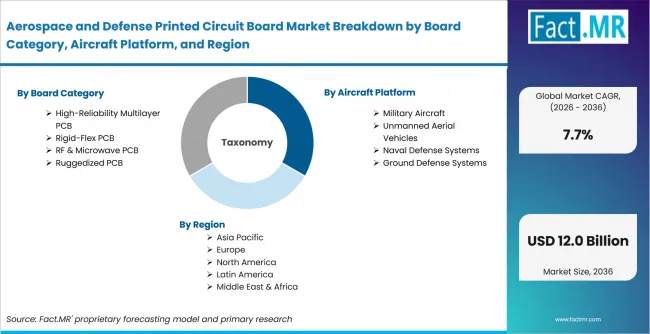
Aerospace And Defense Printed Circuit Board Market Breakdown By Board Category, Aircraft Platform, And Region | Source: Fact.MR
| Attribute | Details |
|---|---|
| Forecast Period | 2026-2036 |
| Base Year | 2025 |
| Market Value, 2026 | USD 5.7 billion |
| Market Value, 2036 | USD 11.9 billion |
| CAGR, 2026-2036 | 7.7% |
| Absolute Dollar Opportunity | USD 6.2 billion |
| Key Regions Covered | USA, France, Japan, UK, Canada, Australia, South Korea, and more than twenty-five additional countries in the full report |
How is the market segmented?
-
Board Category
- High-Reliability Multilayer PCB
- Rigid Multilayer PCB
- HDI PCB
- Rigid-Flex PCB
- Flexible PCB
- Rigid-Flex Assemblies
- RF & Microwave PCB
- High-frequency PCB
- Low-loss PCB
- Ruggedized PCB
- High-temperature PCB
- Shock-resistant PCB
- High-Reliability Multilayer PCB
-
Aircraft Platform
- Military Aircraft
- Fighter Aircraft
- Transport Aircraft
- Unmanned Aerial Vehicles
- Tactical UAVs
- Surveillance UAVs
- Naval Defense Systems
- Destroyers & Frigates
- Submarines
- Ground Defense Systems
- Missile Launch Systems
- Armored Vehicles
- Military Aircraft
-
End-use Sector
- Defense
- Defense Electronics
- Aerospace
- Space
- Satellite Systems
- Launch Vehicles
- Avionics
- Flight Control Systems
- Communication Systems
- Missile & Radar Systems
- Radar Systems
- Missile Guidance
- Defense
-
Manufacturing Technology
- High-Reliability PCB Fabrication
- Military-grade Lamination
- High-density Interconnect
- Rigid-Flex Manufacturing
- Flexible Circuit Processing
- Automated Optical Inspection
- Precision Surface Finishing
- Advanced Copper Plating
- Impedance Control
- MIL-SPEC Compliance
- Environmental Stress Screening
- Reliability Testing
- High-Reliability PCB Fabrication
-
Region
- North America
- Latin America
- Western Europe
- Eastern Europe
- East Asia
- South Asia and Pacific
- Middle East & Africa