- Market Value (2025): USD 423.6 Mn
- Estimated Value (2026): USD 474.1 Mn
- Forecast Value (2036): USD 1460.7 Mn
- CAGR (2026-2036): 11.9%
What is the Clean-Label Anti-Caking Agents Market forecast to be worth by 2036?
USD 474.1 million in 2026 to USD 1460.7 million by 2036 at an 11.9% CAGR.
-
Fact.MR estimates that the clean-label anti-caking agents market reached a value of USD 423.6 million in 2025.
- Demand is projected to increase from USD 474.1 million in 2026 to USD 1460.7 million by 2036.
- The market is projected to grow at a 11.9% CAGR from 2026 to 2036 as food producers seek functional ingredients that support clean-label positioning.
| Year | Basis | Market Value (USD million) |
|---|---|---|
| 2025 | Actual | 423.6 |
| 2026 | Estimate | 474.1 |
| 2036 | Forecast | 1460.7 |
| CAGR 2026 to 2036 | Forecast period | 11.9% |
Source: Fact.MR analysis. Updated Nov 11, 2026
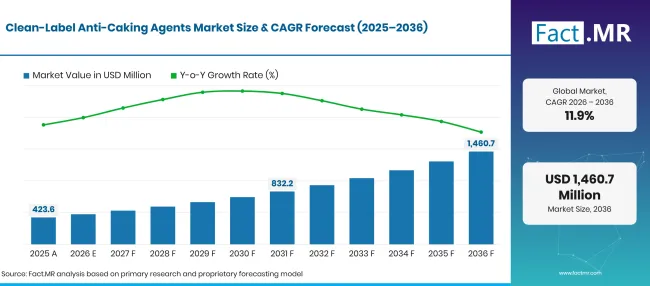
Clean Label Anti Caking Agents Forecast Global | Source: Fact.MR
What are the defining numbers behind Clean-Label Anti-Caking Agents Market growth?
USD 986.6 million in additional market value between 2026 and 2036.
- Demand Drivers in the Market
- Food brands are reviewing ingredient lists as consumers show greater interest in products with recognizable components. This encourages manufacturers to assess rice-based ingredients and plant-derived fibers as alternatives to conventional anti-caking materials, provided they deliver the required flow and storage performance.
- Growing demand for convenient powdered beverages is creating opportunities for ingredients that maintain free-flowing characteristics during processing and storage. Beverage mixes need to disperse consistently, while anti-caking systems help reduce lump formation and support a more uniform finished product.
- Food processors need anti-caking ingredients that perform reliably under different humidity and handling conditions. Ingredient selection depends on the food matrix and processing method, as well as the required texture and shelf stability. Suppliers that provide application guidance can help manufacturers qualify suitable formulations.
- Key Segments Analyzed
- By Anti-Caking Ingredient Base: Rice concentrate is projected to account for 30.5% of the market in 2026, supported by demand for plant-derived ingredients that fit clean-label formulation strategies.
- By Commercial Ingredient Form: Granulate / agglomerate segment is projected to lead with a 30.0% share in 2026, reflecting its suitability for handling and incorporation into dry food blends.
- By Food Application: Beverage is forecast to hold 26.8% of the market in 2026 as powdered drink mixes require consistent flow and dispersion.
- By Functional Purchasing Driver: Texture / mouthfeel is estimated to represent 24.6% of demand in 2026, highlighting the importance of maintaining product quality alongside anti-caking performance.
- Analyst Opinion at Fact.MR
- Shambhu Nath Jha, Principal Consultant at Fact.MR, states, “Clean-label anti-caking agents are gaining relevance as food manufacturers seek ingredients that support both product handling and recognizable labeling. Suppliers need to demonstrate consistent performance across food applications, particularly where moisture control and texture influence the finished product.”
- Strategic Implications
- Ingredient suppliers should validate rice-based and fiber-based anti-caking systems across diverse food matrices to establish consistent functionality. Testing should examine moisture sensitivity and powder flow under different storage conditions. Suppliers should also document dosage requirements and ingredient compatibility to support reliable performance in commercial food formulations.
- Food manufacturers need to evaluate the functional performance of clean-label anti-caking ingredients against existing formulation requirements before replacing conventional agents. Assessments should consider processing stability and shelf-life alongside ingredient declaration requirements. Pilot-scale trials can help identify changes in texture or handling before introducing reformulated products into commercial production.
- Beverage producers can assess dispersion behavior and mouthfeel alongside resistance to clumping when selecting ingredients for powdered drink mixes. Formulation trials should examine how anti-caking agents influence powder flow and dissolution during preparation. Ingredient selection should maintain consistent beverage texture without creating undesirable changes in flavor or appearance.
- Suppliers must provide application-specific technical guidance covering recommended dosage and suitable processing conditions for different food categories. Support should address ingredient handling and moisture management as well as compatibility with other formulation components. Clear documentation can help manufacturers improve processing consistency and maintain the desired quality of finished products.
India is projected to record the fastest growth among the listed countries at a 15.4% CAGR through 2036. China is set to expand at 13.6%, followed by the USA at 12.4%. Germany is forecast to grow at 11.2%, while France is expected to register an 11.1% CAGR.
How does the Clean-Label Anti-Caking Agents Market break down by segment?
Fact.MR finds that Rice Concentrate leads Anti-Caking Ingredient Base with a 30.5% share; Granulate / Agglomerate leads Commercial Ingredient Form at 30.0%; Beverage leads Food Application at 26.8%; and Texture / Mouthfeel leads Functional Purchasing Driver at 24.6%.
Which Anti-Caking Ingredient Base dominates?
Rice Concentrate is set to hold a 30.5% share in 2026.
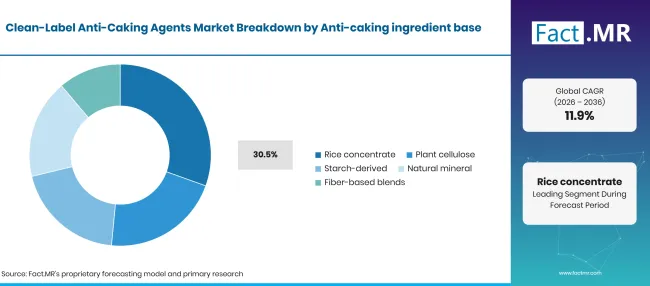
Clean Label Anti Caking Agents Breakdown Anti Caking Ingredient Base | Source: Fact.MR
| Anti-Caking Ingredient Base | Share (2026) |
|---|---|
| Rice Concentrate (Leading segment) | 30.5% |
| Other segments combined | 69.5%* |
| Total | 100.0% |
Source: Fact.MR analysis. Updated Nov 11, 2026
Rice concentrate leads the ingredient-base segment as food manufacturers evaluate plant-derived materials for clean-label formulations. Fiber-based blends and starch-derived ingredients also serve as alternatives where formulation requirements call for specific flow or texture characteristics. Natural mineral ingredients remain relevant where their functional properties and labeling requirements suit the application.
What leads the Commercial Ingredient Form segment?
Granulate / Agglomerate is set to represent a 30.0% share in 2026.
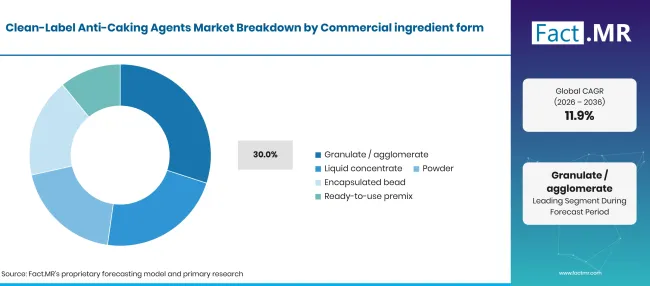
Clean Label Anti Caking Agents Breakdown Commercial Ingredient Form | Source: Fact.MR
| Commercial Ingredient Form | Share (2026) |
|---|---|
| Granulate / Agglomerate (Leading segment) | 30.0% |
| Other segments combined | 70.0%* |
| Total | 100.0% |
Source: Fact.MR analysis. Updated Nov 11, 2026
Granulated and agglomerated ingredients can support handling and controlled incorporation into dry food blends. Liquid concentrates serve applications that require liquid-phase processing, while powders remain suitable for direct blending in selected formulations. Encapsulated beads and ready-to-use premixes address more specific processing and formulation needs.
Which Food Application accounts for the largest share?
Beverage is likely to account for a 26.8% share in 2026.
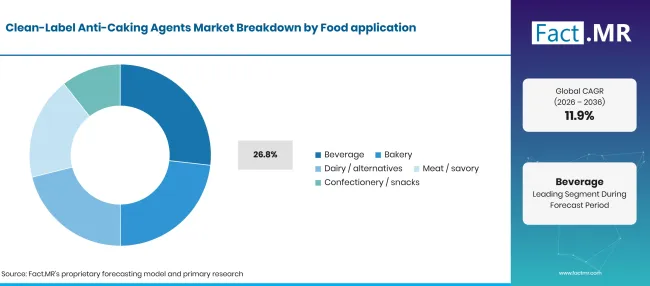
Clean Label Anti Caking Agents Breakdown Food Application | Source: Fact.MR
| Food Application | Share (2026) |
|---|---|
| Beverage (Leading segment) | 26.8% |
| Other segments combined | 73.2%* |
| Total | 100.0% |
Source: Fact.MR analysis. Updated Nov 11, 2026
Powdered beverages require ingredients that help maintain free-flowing characteristics during storage and handling. Anti-caking performance can also influence how consistently a powder disperses during preparation. Bakery products and confectionery mixes have different texture and processing requirements, while dairy alternatives and savory products need ingredient systems suited to their individual formulations.
What drives Functional Purchasing decisions?
Texture / Mouthfeel is expected to represent a 24.6% share in 2026.
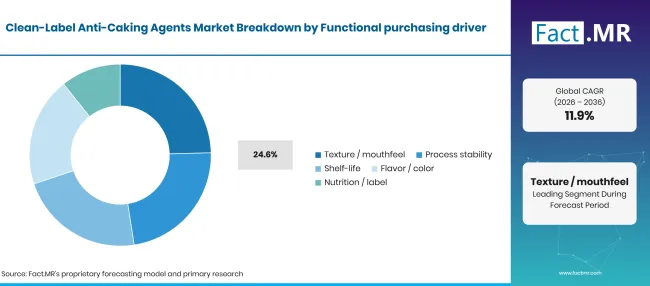
Clean Label Anti Caking Agents Breakdown Functional Purchasing Driver | Source: Fact.MR
| Functional Purchasing Driver | Share (2026) |
|---|---|
| Texture / Mouthfeel (Leading segment) | 24.6% |
| Other segments combined | 75.4%* |
| Total | 100.0% |
Source: Fact.MR analysis. Updated Nov 11, 2026
Texture and mouthfeel lead the purchasing-driver categories, indicating that manufacturers consider the effect of anti-caking ingredients on the finished food product. Nutrition and label considerations also influence ingredient selection. Flavor and color compatibility matter where ingredient additions could change sensory characteristics, while shelf-life and process stability remain important for storage and manufacturing performance.
What is accelerating Clean-Label Anti-Caking Agents Market growth, and what is holding it back?
Demand for recognizable ingredients and reliable powder handling supports growth, while formulation compatibility and performance validation can slow adoption.
Drivers Impact Analysis
| DRIVER | (~) % IMPACT ON CAGR | GEOGRAPHIC RELEVANCE | IMPACT TIMELINE |
|---|---|---|---|
| Demand for recognizable food ingredients | +1.8% | Global | Medium term (2–4 years) |
| Growth in powdered beverage formulations | +1.5% | Asia, North America | Short term (≤ 2 years) |
| Use of plant-derived ingredient bases | +1.2% | Europe, Asia | Medium term (2–4 years) |
| Need for consistent powder flow | +0.9% | Global | Short term (≤ 2 years) |
| Expansion of clean-label food portfolios | +0.7% | Global | Long term (≥ 4 years) |
Source: Fact.MR analysis. Updated Nov 11, 2026
Opportunity Impact Analysis
| OPPORTUNITY | (~) % IMPACT ON CAGR | GEOGRAPHIC RELEVANCE | IMPACT TIMELINE |
|---|---|---|---|
| Rice-based anti-caking ingredient development | +1.3% | Asia, North America | Medium term (2–4 years) |
| Fiber-based blends for specialized food matrices | +1.0% | Europe, North America | Medium term (2–4 years) |
| Application-specific beverage formulations | +0.8% | Global | Short term (≤ 2 years) |
| Ready-to-use ingredient premixes | +0.6% | Global | Long term (≥ 4 years) |
Source: Fact.MR analysis. Updated Nov 11, 2026
Restraints Impact Analysis
| RESTRAINT | (~) % IMPACT ON CAGR | GEOGRAPHIC RELEVANCE | IMPACT TIMELINE |
|---|---|---|---|
| Variable performance under high humidity | -1.0% | Global | Short term (≤ 2 years) |
| Formulation compatibility limitations | -0.8% | Global | Medium term (2–4 years) |
| Higher cost of specialized clean-label ingredients | -0.7% | Global | Short term (≤ 2 years) |
| Inconsistent sensory performance across applications | -0.5% | Global | Medium term (2–4 years) |
Source: Fact.MR analysis. Updated Nov 11, 2026
Which countries are scaling the Clean-Label Anti-Caking Agents Market through 2036?
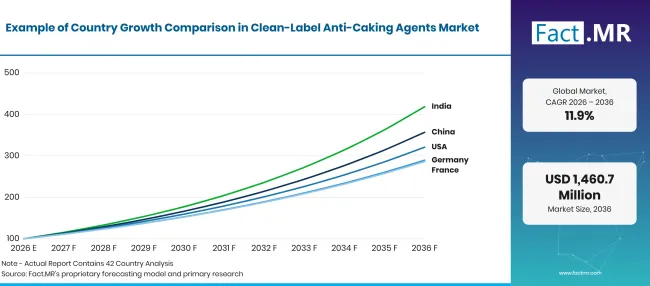
Clean Label Anti Caking Agents Growth Index | Source: Fact.MR
| Country | CAGR (2026–2036) |
|---|---|
| India | 15.4% |
| China | 13.6% |
| USA | 12.4% |
| Germany | 11.2% |
| France | 11.1% |
Source: Fact.MR analysis. Updated Nov 11, 2026
What supports India's market growth?
15.4% CAGR, supported by expanding food processing activity and demand for convenient packaged products.
India's food processing sector serves a broad range of packaged food categories, including beverage mixes and dry formulations. Manufacturers can evaluate rice-based and fiber-based anti-caking ingredients as they develop products with simpler ingredient declarations. Suppliers that provide reliable performance under local storage and humidity conditions can support wider commercial use.
How is China developing its market?
13.6% CAGR, driven by opportunities across packaged foods and powdered food formulations.
China’s expanding processed food sector supports demand for functional ingredients that help manufacturers maintain product quality during large-scale production. Growth in food processing and prepared meal categories creates opportunities for ingredients that improve powder handling and storage stability. Manufacturers can also benefit from anti-caking solutions that support production efficiency while meeting food safety and formulation requirements. According to the USDA Foreign Agricultural Service, the coChina had more than 100,000 registered food and agricultural processing companies in 2025, with estimated industry revenues exceeding USD 2.5 trillion.
What supports United States market growth?
12.4% CAGR, shaped by clean-label reformulation and established packaged food categories.
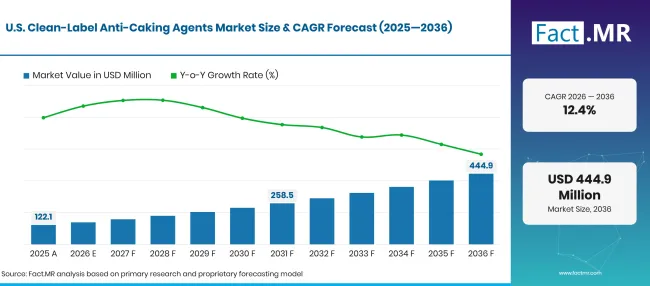
Clean Label Anti Caking Agents Forecast Usa | Source: Fact.MR
U.S. food manufacturers are evaluating ingredient solutions that support recognizable labels, product quality and efficient large-scale processing. The U.S. Bureau of Labor Statistics (BLS) reported that food manufacturing employed approximately 1.77 million people in September 2026. In In a June 2026 industry analysis, the BLS projected that combined food and beverage manufacturing employment would increase by approximately 130,000 jobs between 2024 and 2034, representing 6.2% growth.keries and tortilla manufacturing accounted for 350,400 jobs in 2024, while beverage manufacturing accounted for 333,000.
What is shaping market growth in Germany?
11.2% CAGR, backed by demand for ingredient transparency and reliable food processing performance.
German food producers need anti-caking ingredients that support powder handling while meeting product-specific labeling and quality requirements. Fiber-based and starch-derived materials can be considered where they provide suitable moisture management and flow characteristics. Ingredient suppliers can support manufacturers through technical documentation and formulation trials.
Why is France an important growth market?
11.1% CAGR, growth is linked to food formulation requirements and interest in plant-derived ingredients.
France's food manufacturing industry offers opportunities for clean-label ingredient systems across bakery products and beverages. Manufacturers need to preserve sensory quality while improving the handling of powdered ingredients. Suppliers can address these requirements by demonstrating how rice concentrates and fiber-based blends perform in different food matrices.
Who leads the Clean-Label Anti-Caking Agents Market?
Fact.MR profiles Ingredion Incorporated, Cargill, Incorporated, Kerry Group plc, International Flavors & Fragrances Inc. (IFF), and Tate & Lyle PLC across the food ingredient and clean-label solutions landscape.
Ingredion offers clean-label ingredients such as functional native starches and citrus fibers, which can support formulation and texture requirements. Its portfolio also includes rice flour products developed for clean-label food applications. These capabilities are relevant to the broader ingredient-base segment, although they do not by themselves establish a dedicated anti-caking product range.
Cargill and Kerry participate in the wider food ingredient market, where formulation support and ingredient functionality are important to food manufacturers. Their inclusion in the competitive landscape should be assessed against the specific anti-caking products and clean-label solutions they currently commercialize.
Tate & Lyle provides clean-label reformulation expertise and ingredients such as dietary fibers and plant-derived components. Its consumer-facing ingredient information also identifies maize starch as an anti-caking ingredient in icing sugar. This supports its relevance to anti-caking applications, although the cited example is a food product application rather than proof of a standalone clean-label anti-caking ingredient platform.
Competition in this market depends on ingredient functionality and the ability to meet food manufacturers' formulation requirements. Suppliers need to demonstrate that their ingredients reduce clumping without creating unwanted changes in flavor or texture. Product documentation and application testing are important when manufacturers evaluate alternatives to conventional flow aids.
Which companies are the key providers?
The companies profiled in the market scope are:
- Ingredion Incorporated
- Cargill, Incorporated
- Kerry Group plc
- International Flavors & Fragrances Inc. (IFF)
- Tate & Lyle PLC
Bibliography
- Hale, N., Ilic-Godfrey, S., & Mohiuddin, E. (2026, June). Feeding the economy: Employment growth in food and beverage manufacturing expected to continue through the 2024–34 decade. Monthly Labor Review, U.S. Bureau of Labor Statistics.
- National Bureau of Statistics of China. (2026, February 28). Statistical Communiqué of the People’s Republic of China on the 2025 National Economic and Social Development.
- U.S. Bureau of Labor Statistics. (n.d.). Food Manufacturing: NAICS 311.
- U.S. Department of Agriculture, Foreign Agricultural Service. (2024, May 6). Usage Standard for Food Additives Finalized (GAIN Report No. CH2024-0059).
- U.S. Department of Agriculture, Foreign Agricultural Service. (2026, April 1). Food Processing Ingredients Annual (GAIN Report No. CH2026-0042).
This Report Answers
- The report examines the use of clean-label anti-caking ingredients across the listed food applications.
- Segment analysis compares rice concentrate, plant cellulose, starch-derived ingredients, natural minerals and fiber-based blends.
- Commercial-form analysis evaluates granulates, liquid concentrates, powders, encapsulated beads and ready-to-use premixes.
- Country analysis compares the growth outlook for the USA, China, Germany, India and France.
- The competitive overview profiles the companies named in the company list.
What does the Clean-Label Anti-Caking Agents Market cover?
The market covers food-grade ingredients used to reduce clumping and improve the flow of powdered or granular food products. It includes rice concentrate and other plant-derived ingredient bases, alongside natural mineral options and fiber-based blends. Applications include beverages, bakery products, dairy alternatives, meat and savory products, and confectionery or snacks.
What is included in the scope?
Included products are clean-label-oriented anti-caking ingredients supplied for use in food formulations.
The scope covers the specified ingredient bases and commercial forms, including granulates, liquid concentrates, powders, encapsulated beads and ready-to-use premixes. It also considers purchasing priorities related to texture, processing stability, shelf-life and label requirements.
What is excluded from the scope?
The analysis excludes anti-caking agents used solely in pharmaceutical, cosmetic, industrial or agricultural applications.
Conventional food additives are excluded when they do not meet the defined clean-label positioning of this market. Finished food products and food-processing equipment are also outside the ingredient revenue boundary.
How Was the Analysis Built?
The analysis draws on 120+ sources, 35+ company portfolios, 25+ countries and more than 20 industry interviews.
- Primary Research: Primary research includes discussions with ingredient manufacturers, food processors, distributors, formulation specialists and subject-matter experts. These conversations examine ingredient selection, purchasing priorities, processing requirements, product performance and the factors influencing clean-label reformulation.
- Desk Research: Desk research covers government publications, regulatory information, company filings, ingredient portfolios, technical studies, food industry associations and other relevant sources. Product claims and application information are reviewed against available company documentation.
- Market Sizing and Forecasting: Market estimates combine historical performance, demand indicators, pricing and volume trends, segment shares, company participation, country-level growth, formulation trends and barriers to market expansion.
- Data Validation and Update Cycle: Findings are validated by comparing primary interviews with public information, company activity, product launches, regulatory developments and food industry trends. Regular updates review changes in ingredient portfolios and commercial application requirements.
Segmentation
What is the report's scope and coverage?
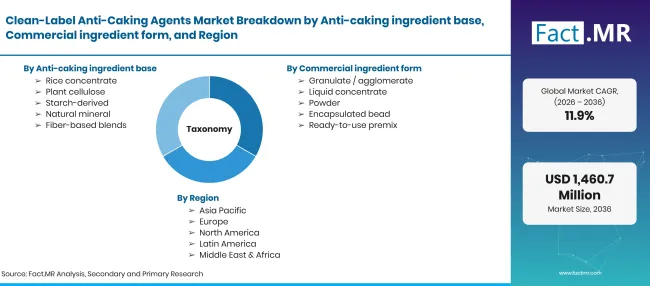
Clean Label Anti Caking Agents Taxonomy | Source: Fact.MR
| Attribute | Details |
|---|---|
| Quantitative Units | USD million |
| Market Definition | Clean-label anti-caking ingredients are naturally derived or label-friendly food ingredients incorporated into powdered and granular food formulations to minimize clumping, improve flow ability and support consistent handling, processing and storage while maintaining product quality and meeting clean-label preferences. |
| Anti-Caking Ingredient Base | Rice Concentrate; Plant Cellulose; Starch-Derived; Natural Mineral; Fiber-Based Blends |
| Commercial Ingredient Form | Granulate / Agglomerate; Liquid Concentrate; Powder; Encapsulated Bead; Ready-to-Use Premix |
| Food Application | Beverage; Bakery; Dairy / Alternatives; Meat / Savory; Confectionery / Snacks |
| Functional Purchasing Driver | Texture / Mouthfeel; Process Stability; Shelf-Life; Flavor / Color; Nutrition / Label |
| Regions Covered | North America; Latin America; Western Europe; Eastern Europe; East Asia; South Asia & Pacific; Middle East & Africa |
| Countries Covered | USA; China; Germany; India; France |
| Companies Profiled | Ingredion; Cargill; Kerry Group; IFF; Tate & Lyle |
| Forecast Period | 2026 to 2036 |
| Approach | Market segmentation and scenario-based analysis supported by food ingredient trends, product portfolios and application requirements |
Source: Fact.MR analysis. Updated Nov 11, 2026
How is the market segmented?
-
By Anti-Caking Ingredient Base
- Rice Concentrate
- Plant Cellulose
- Starch-Derived
- Natural Mineral
- Fiber-Based Blends
-
By Commercial Ingredient Form
- Granulate / Agglomerate
- Liquid Concentrate
- Powder
- Encapsulated Bead
- Ready-to-Use Premix
-
By Food Application
- Beverage
- Bakery
- Dairy / Alternatives
- Meat / Savory
- Confectionery / Snacks
-
By Functional Purchasing Driver
- Texture / Mouthfeel
- Process Stability
- Shelf-Life
- Flavor / Color
- Nutrition / Label
-
By Region
- North America
- Latin America
- Western Europe
- Eastern Europe
- East Asia
- South Asia & Pacific
- Middle East & Africa
Frequently Asked Questions
Fact.MR values the market at USD 474.1 million in 2026 and is projected to reach USD 1,460.7 million by 2036.
What is the CAGR from 2026 to 2036?
Which ingredient base has the largest share?
Which commercial ingredient form leads?
Which food application has the largest share?
Which functional purchasing driver leads?
Which country is expected to grow fastest?
Which companies are covered?
Who worked on this report


Preview the report firsthand - request a free sample
Free SampleGet the brochure for pricing and purchase details
Download PDF