- Market Value (2025): USD 2.54 Bn
- Estimated Value (2026): USD 2.72 Bn
- Forecast Value (2036): USD 5.29 Bn
- CAGR (2026-2036): 6.9%
What is the Wood-derived Food Additives Market forecast to be worth by 2036?
USD 2.72 billion in 2026 to USD 5.29 billion by 2036, at a 6.9% CAGR.
- The wood-derived food additives market was valued at USD 2.54 billion in 2025.
- According to Fact.MR analysis, market value is expected to increase from USD 2.72 billion in 2026 to USD 5.29 billion by 2036 as food manufacturers use selected cellulose-based ingredients in their formulations.
- The market is projected to grow at 6.9% between 2026 and 2036.
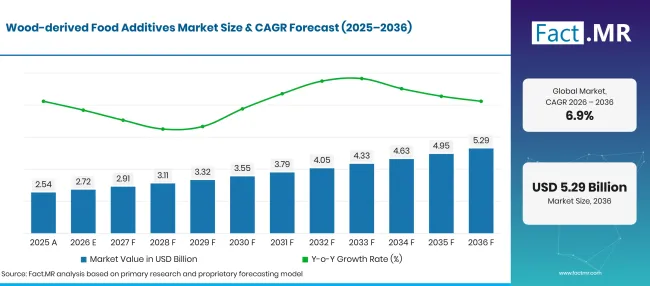
Wood Derived Food Additives Market Forecast Global | Source: Fact.MR
| Year | Basis | Market Value (USD billion) |
|---|---|---|
| 2025 | Actual | 2.54 |
| 2026 | Estimate | 2.72 |
| 2036 | Forecast | 5.29 |
| CAGR 2026 to 2036 | Forecast period | 6.9% |
Source: Fact.MR analysis. Updated Nov 5, 2026
What are the defining numbers behind Wood-derived Food Additives Market growth?
The market is forecast to generate USD 2.6 billion in value by 2036.
- Demand Drivers in the Market
- Bakery formulators use selected cellulose ingredients to hold water and maintain the handling properties of dough or filling. The choice depends on how an ingredient performs during mixing and heating, and on the permitted use level.
- Sauce producers choose hydrocolloids based on how well they maintain thickness after mixing, pumping and changes in temperature. Consistent viscosity helps factories fill packs reliably while keeping the intended texture throughout distribution.
- Food manufacturers also examine the stability of forest-based raw material supply. The Food and Agriculture Organization reported in December 2025 that worldwide wood pulp output reached 189 million tonnes in 2024 [1].
- Ingredient compliance influences formula decisions. A European Commission committee report issued in 2025 records a November 2024 discussion on revised cellulose additive specifications and a proposed withdrawal of authorisation for E 466 in specified infant medical-food categories [2].
- Reformulating a packaged food can require a different texture system, but the alternative ingredient must work on the existing production line. Manufacturers also check its approved uses and labeling requirements in each destination market before changing the recipe.
- Key Segments Analyzed
- By Product Type: Cellulose Derivatives account for 42.3% of 2026 value, reflecting their defined roles in texture control and moisture management.
- By Application: Bakery and Confectionery leads with 26.8% of 2026 value, supported by the need for stable fillings and workable dough systems.
- By Function: Stabilizers represent 42.3% of 2026 value, as formulators select ingredients that help keep finished products consistent.
- By Sales Channel: Supermarkets/Hypermarkets capture 54.3% of the 2026 downstream finished-food retail classification, rather than direct ingredient sales.
- Analyst Opinion at Fact.MR
- Shambhu Nath Jha, Principal Consultant at Fact.MR, states, “Food formulators are likely to put reliable batch performance and approved use conditions near the top of their purchasing criteria. The relative importance of those requirements could be tested in future customer research.”
- Strategic Implications
- Cellulose processors should document food-contact suitability and traceability for each grade, separating food-approved products from technically similar industrial materials.
- Food manufacturers should test texture and water retention under the actual conditions of their lines before changing an established formulation.
- Distributors need clear product specifications and shelf-life instructions so recipe teams can compare batches from different production sites.
- Retail food brands should align ingredient decisions with their required product label, since marketing claims do not replace additive-use approval.
Germany is forecast to record 8.3% CAGR. Brazil follows at 7.6%, the USA at 6.8%, the UK at 6.1% and Japan at 5.4%.
How does the Wood-derived Food Additives Market break down by segment?
Cellulose derivatives represent 42.3% of product value, while bakery and confectionery account for 26.8% of applications.
Cellulose Derivatives represent 42.3% of 2026 value.
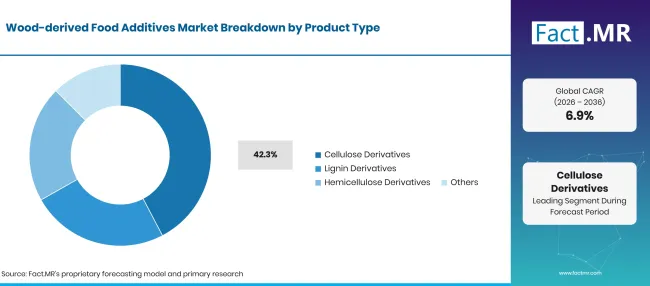
Wood Derived Food Additives Market Breakdown Product Type | Source: Fact.MR
| Product Type | Share (2026) |
|---|---|
| Cellulose Derivatives (Leading segment) | 42.3% |
| Other segments combined | 57.7% |
| Total | 100.0% |
Source: Fact.MR analysis. Updated Nov 5, 2026
Cellulose derivatives form the central product group because individual grades can change viscosity and help manage water in food mixtures. Methylcellulose and hydroxypropyl methylcellulose have useful heating behavior for selected processed foods.
What leads the Application segment?
Bakery and Confectionery leads with 26.8% share in 2026.
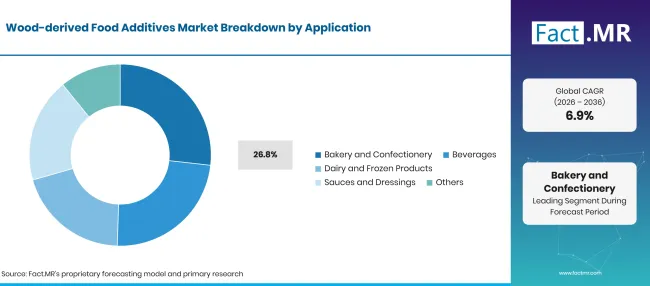
Wood Derived Food Additives Market Breakdown Application | Source: Fact.MR
| Application | Share (2026) |
|---|---|
| Bakery and Confectionery (Leading segment) | 26.8% |
| Other segments combined | 73.2% |
| Total | 100.0% |
Source: Fact.MR analysis. Updated Nov 5, 2026
Bakery and confectionery manufacturers check how additives affect dough handling and moisture during storage. A change that improves softness can still be unsuitable if it alters the bite of a finished biscuit or filling. Beverages need different performance, especially suspension and mouthfeel under processing conditions. Dairy and frozen products place further demands on stability during temperature changes.
How does Function shape demand?
Stabilizers account for 42.3% of 2026 value.
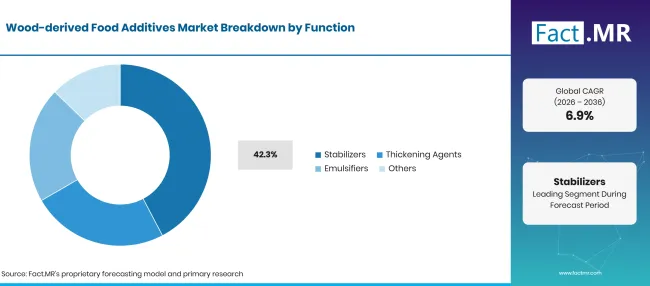
Wood Derived Food Additives Market Breakdown Function 1 | Source: Fact.MR
| Function | Share (2026) |
|---|---|
| Stabilizers (Leading segment) | 42.3% |
| Other segments combined | 57.7% |
| Total | 100.0% |
Source: Fact.MR analysis. Updated Nov 5, 2026
Stabilizers help food manufacturers manage separation or uneven texture during processing and storage. The desired effect differs by the type of food and the stress it experiences after packaging. Thickening agents primarily change how a product flows, while emulsifiers work at the boundary between ingredients that otherwise separate. Some modified cellulose grades perform more than one role in a specific recipe.
Which Sales Channel carries the larger share?
Supermarkets and hypermarkets represent 54.3% of the downstream 2026 retail-channel classification.
| Sales Channel | Share (2026) |
|---|---|
| Supermarkets/Hypermarkets (Leading segment) | 54.3% |
| Other segments combined | 45.7% |
| Total | 100.0% |
Source: Fact.MR analysis. Updated Nov 5, 2026
The sales-channel split describes downstream retail channels for finished foods containing wood-derived additives, rather than direct sales of industrial food ingredients. Supermarkets and hypermarkets offer broad access to packaged foods where texture and shelf performance matter. Online retail creates a different route for finished branded products. Ingredient manufacturers generally sell to food processors or distributors upstream.
What is accelerating Wood-derived Food Additives Market adoption, and what is holding it back?
Adoption will grow through demand for repeatable viscosity, moisture control and texture stability across bakery, prepared and frozen foods. Food-additive restrictions, wood-pulp input changes, recipe qualification time and price pressure on finished foods will limit how quickly demand expands.
Drivers Impact Analysis
| DRIVER | (~) % IMPACT ON CAGR | GEOGRAPHIC RELEVANCE | IMPACT TIMELINE |
|---|---|---|---|
| Repeatable viscosity during processing | +1.1% | Europe, USA, Japan | Short term |
| Moisture management in bakery foods | +0.9% | Global | Medium term |
| Reformulation of prepared foods | +0.7% | Europe, Brazil | Medium term |
| Food-grade traceability | +0.5% | Global | Long term |
| Product testing and technical support | +0.4% | Global | Medium term |
Source: Fact.MR analysis. Updated Nov 5, 2026
Opportunity Impact Analysis
| OPPORTUNITY | (~) % IMPACT ON CAGR | GEOGRAPHIC RELEVANCE | IMPACT TIMELINE |
|---|---|---|---|
| Frozen and prepared-food texture systems | +0.7% | Japan, Europe | Medium term |
| Gluten-free bakery formulation | +0.5% | USA, Europe | Medium term |
| Ingredient traceability services | +0.4% | Global | Short term |
| Specialty-grade distribution | +0.3% | Brazil, Japan | Long term |
Source: Fact.MR analysis. Updated Nov 5, 2026
Restraints Impact Analysis
| RESTRAINT | (~) % IMPACT ON CAGR | GEOGRAPHIC RELEVANCE | IMPACT TIMELINE |
|---|---|---|---|
| Food-additive restrictions by use | -0.6% | Europe, Global | Short term |
| Wood-pulp input changes | -0.5% | Global | Medium term |
| Recipe approval and testing time | -0.4% | Global | Medium term |
| Price pressure on finished foods | -0.3% | USA, UK, Brazil | Short term |
Source: Fact.MR analysis. Updated Nov 5, 2026
Which countries are scaling the Wood-derived Food Additives Market through 2036?
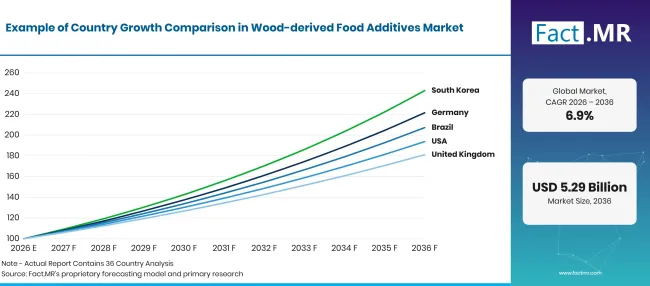
Wood Derived Food Additives Market Growth Index | Source: Fact.MR
| Country | CAGR (2026 to 2036) |
|---|---|
| Germany | 8.3% |
| Brazil | 7.6% |
| USA | 6.8% |
| UK | 6.1% |
| Japan | 5.4% |
Source: Fact.MR analysis. Updated Nov 5, 2026
What supports Germany’s adoption?
8.3% CAGR, linked to food-grade formulation and supplier documentation.
German food manufacturers examine recipe stability before switching to cellulose-based stabilizers. Each grade must comply with EU additive requirements and maintain its function after packing. Destatis reported in December 2025 that Germany had 209,815 manufacturing legal units in 2024 [5].
How is Brazil developing the market?
7.6% CAGR, with opportunities linked to food processing and ingredient supply.
Brazil has an established forest-products supply base alongside a large food-export industry. The Ministry of Agriculture reported in May 2026 that agribusiness exports reached USD 169.2 billion in 2025 [6]. For additive suppliers, commercial potential depends on supplying suitable food-grade material and advising food processors on use levels.
What is shaping USA demand?
6.8% CAGR, driven by food formulation activity and broad customer reach.
In the USA, manufacturers compare cellulose ingredients by their effect on product quality and recipe cost. The USDA Economic Research Service reported on June 11, 2026, that inflation-adjusted U.S. food spending reached USD 2.51 trillion in 2025, including food-at-home and food-away-from-home expenditure [7]. In January 2026, the Bureau of Labor Statistics reported that food prices rose 3.1% over the year to December 2025 [8].
How is the UK market progressing?
6.1% CAGR, associated with food-manufacturing scale and formulation quality.
UK food producers need steady texture in bakery products and packaged meals sold through major grocery channels. In July 2026, the Office for National Statistics reported that food manufacturing accounted for 22.9% of UK manufacturers’ product sales in 2025 [9].
What guides Japan’s ingredient choices?
5.4% CAGR, tied to precise food performance and export-ready formulas.
Japanese food developers evaluate how cellulose ingredients perform during heating and cooling in finished recipes. The Ministry of Agriculture, Forestry and Fisheries reported in February 2026 that food-related and agricultural exports reached JPY 1.7005 trillion in 2025 [3].
Who leads the Wood-derived Food Additives Market?
Competition involves suppliers with different levels of exposure to wood-derived food ingredients.
Shin-Etsu Chemical offers food-grade methylcellulose and hydroxypropyl methylcellulose under METOLOSE and Tylopur [4]. J. Rettenmaier & Söhne supplies VITACEL powdered cellulose for moisture management and food texture applications [10]. International Flavors & Fragrances, Borregaard, Ingredion and Ashland have broader specialty ingredient or material operations, but a company’s general involvement with cellulose or food processing does not establish sales of every wood-derived additive category.
Which companies are the key providers?
Companies reviewed include International Flavors & Fragrances Inc. (IFF); Borregaard ASA; Ingredion Incorporated; Ashland Inc; J. Rettenmaier & Söhne (JRS); and Shin-Etsu Chemical Co., Ltd.
- International Flavors & Fragrances Inc. (IFF)
- Borregaard ASA
- Ingredion Incorporated
- Ashland Inc.
- J. Rettenmaier & Söhne (JRS)
- Shin-Etsu Chemical Co., Ltd.
Bibliography
- [1] Food and Agriculture Organization of the United Nations. (2025, December 24). Global forest products trade and production show signs of recovery in 2024.
- [2] European Commission. (2025, March 3). Standing Committee on Plants, Animals, Food and Feed: Summary report of the 20 November 2024 meeting.
- [3] Ministry of Agriculture, Forestry and Fisheries of Japan. (2026, February 3). 2025 agricultural, forestry and fishery products and food export results.
- [4] Shin-Etsu Chemical Co., Ltd. (n.d.). METOLOSE®/Tylopur® (for food). https://www.shinetsu.co.jp/en/products/functional-materials/metolose-tylopur-for-food/
- [5] Statistisches Bundesamt (Destatis). (2025, December 1). Business register: Legal units, employees and turnover 2024.
- [6] Ministério da Agricultura e Pecuária. (2026, May 27). Agronegócio brasileiro fecha 2025 com recorde em exportações de US$ 169 bilhões e superávit de US$ 149,07 bilhões.
- [7] U.S. Department of Agriculture, Economic Research Service. (2026, June 11). Total U.S. food spending reached $2.51 trillion in 2025.
- [8] U.S. Bureau of Labor Statistics. (2026, January 21). Consumer Price Index: 2025 in review.
- [9] Office for National Statistics. (2026, July 24). UK manufacturers’ sales by product: 2025.
- [10] J. Rettenmaier & Söhne. (n.d.). VITACEL® L/LC powdered cellulose
This Report Answers
- The report explains how food-grade cellulose derivatives differ from other plant polymers in permitted use and function.
- Application analysis considers ingredient selection in bakery foods, sauces and temperature-sensitive products.
- Sales-channel analysis distinguishes finished-food retail routes from direct industrial ingredient sales.
- Country analysis evaluates food processing, quality rules and ingredient supply across five national markets.
- Competition is discussed through identifiable food-grade portfolios and relevant technical capabilities.
What does the Wood-derived Food Additives Market cover?
The market covers defined food-approved ingredients derived from wood feedstocks and used to alter food texture or stability. Products are counted when sold as food ingredients for use by manufacturers, including cellulose derivatives selected for bakery and sauce formulations.
What is included in the scope?
Food-grade refined cellulose and applicable cellulose ethers are included when they originate from wood and are marketed for food formulation.
Other lignin-derived or hemicellulose-derived substances enter scope only where their identity and food-use approval are established.
What is excluded from the scope?
Industrial cellulose used in construction materials or pharmaceuticals is excluded unless the exact material is sold and permitted for food use.
Pulp and paper production by itself is outside the revenue boundary, even though it helps describe the upstream fiber sector.
How Was the Analysis Built?
The analysis draws on 120+ sources, 35+ company portfolios, 25+ countries, and more than 20 industry interviews.
- Primary Research: Primary research includes discussions with manufacturers, service providers, technology developers, distributors, end users, and subject-matter experts. These conversations examine purchasing priorities, product adoption, operational challenges, approval requirements, competitive positioning, and the factors that influence wider market acceptance.
- Desk Research: Desk research covers government statistics, regulatory publications, company filings, trade data, technical studies, industry associations, standards, public policy, and other authoritative sources. Every source used in the analysis is documented in the bibliography.
- Market Sizing and Forecasting: Market estimates combine historical performance, demand indicators, pricing and volume trends, segment shares, company participation, country-level growth, adoption patterns, investment activity, and barriers to market expansion.
- Data Validation and Update Cycle: Findings are validated by comparing primary interviews with public data, company activity, regulatory changes, trade patterns, and industry developments. Regular updates review new product launches, capacity changes, partnerships, approvals, and shifts in commercial adoption.
Segmentation
What is the report’s scope and coverage?
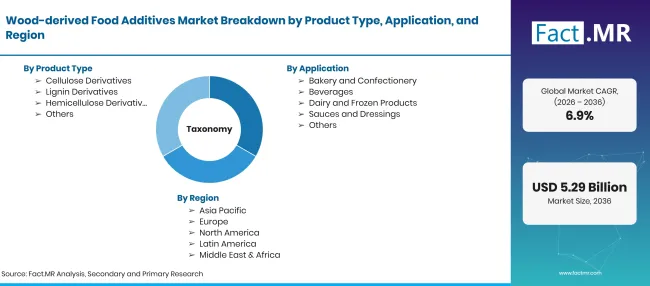
Wood Derived Food Additives Market Taxonomy | Source: Fact.MR
| Attribute | Details |
|---|---|
| Quantitative units | USD billion |
| Market definition | Food-approved cellulose and other defined wood-derived additives used for functional performance in food formulations. |
| Product Type | Cellulose Derivatives; Lignin Derivatives; Hemicellulose Derivatives; Others |
| Application | Bakery and Confectionery; Beverages; Dairy and Frozen Products; Sauces and Dressings; Others |
| Function | Stabilizers; Thickening Agents; Emulsifiers; Others |
| Sales Channel | Supermarkets/Hypermarkets; Online Retail; Specialty Stores; Others, as downstream packaged-food channels |
| Regions Covered | North America; Latin America; Western Europe; Eastern Europe; East Asia; South Asia & Pacific; Middle East & Africa |
| Countries Covered | Germany; Brazil; USA; UK; Japan |
| Companies Profiled | International Flavors & Fragrances Inc. (IFF); Borregaard ASA; Ingredion Incorporated; Ashland Inc; J. Rettenmaier & Söhne (JRS); and Shin-Etsu Chemical Co., Ltd. |
| Forecast Period | 2026 to 2036 |
| Approach | Functional ingredient category review, regulatory screening, sector evidence and scenario-based forecast interpretation |
Source: Fact.MR analysis. Updated Nov 5, 2026
How is the market segmented?
-
By Product Type
- Cellulose Derivatives
- Lignin Derivatives
- Hemicellulose Derivatives
- Others
-
By Application
- Bakery and Confectionery
- Beverages
- Dairy and Frozen Products
- Sauces and Dressings
- Others
-
By Function
- Stabilizers
- Thickening Agents
- Emulsifiers
- Others
-
By Sales Channel
- Supermarkets/Hypermarkets
- Online Retail
- Specialty Stores
- Others
-
By Region
- North America
- Latin America
- Western Europe
- Eastern Europe
- East Asia
- South Asia & Pacific
- Middle East & Africa
Frequently Asked Questions
How big is the wood-derived food additives market in 2026?
What is the market CAGR from 2026 to 2036?
Which product type leads the market?
Which application holds the largest share?
Which function leads the wood-derived food additives market?
Which companies are profiled?
Who worked on this report


Preview the report firsthand - request a free sample
Free SampleGet the brochure for pricing and purchase details
Download PDF