- Market Value (2025): USD 212.8 Mn
- Estimated Value (2026): USD 231.6 Mn
- Forecast Value (2036): USD 540.3 Mn
- CAGR (2026-2036): 8.8%
What is the Clean-Label Oral Nutrition Bases Market forecast to be worth by 2036?
USD 231.6 million in 2026 to USD 540.3 million by 2036 at an 8.8% CAGR.
-
Fact.MR estimates that the clean-label oral nutrition bases market reached a value of USD 212.8 million in 2025.
- Demand is projected to increase from USD 231.6 million in 2026 to USD 540.3 million by 2036.
- The market is projected to grow at a 8.8% CAGR from 2026 to 2036 as demand grows for nutrition formulations that combine functional performance with clean-label ingredient preferences.
| Year | Basis | Market Value (USD million) |
|---|---|---|
| 2025 | Actual | 212.8 |
| 2026 | Estimate | 231.6 |
| 2036 | Forecast | 540.3 |
| CAGR 2026 to 2036 | Forecast period | 8.8% |
Source: Fact.MR analysis. Updated Nov 11, 2026
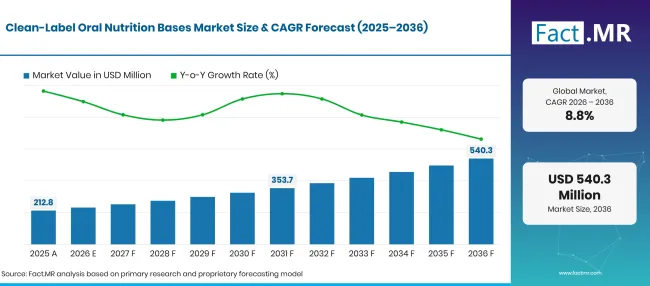
Clean Label Oral Nutrition Bases Forecast Global | Source: Fact.MR
What are the defining numbers behind Clean-Label Oral Nutrition Bases Market growth?
USD 308.7 million in additional market value between 2026 and 2036.
- Demand Drivers in the Market
- Growing use of dietary supplements has driven the growth of the market. The U.S. National Center for Health Statistics reported in May 2026 that 60.2% of adults aged 20 and older used at least one dietary supplement in the previous 30 days during the August 2021–August 2023 survey period.
- Rising nutritional needs among older populations has increased demand for the clean-label oral nutrition bases. China’s National Bureau of Statistics reported in February 2026 that 323.38 million people were aged 60 or older at the end of 2025, representing 23.0% of the population.
- Demand for specialized nutrition formulations supports market growth. Consumers and healthcare providers increasingly distinguish products by their intended nutritional purpose. Oral nutrition bases can combine milk or plant proteins with carbohydrates and lipids to support different formulations. Suppliers that offer adaptable ingredient systems can serve supplement brands and medical nutrition manufacturers.
- Key Segments Analyzed
- By Oral Nutrition Base Composition: Milk Protein is projected to lead with a 30.6% share in 2026, reflecting its established role as a source of protein in nutritional formulations.
- By Product Delivery Form: Capsule / Tablet is expected to account for 24.6% of the market in 2026, supported by convenient dosing and established supplement delivery formats.
- By Health Application: Cognitive Health is forecast to hold a 30.3% share in 2026, reflecting demand for nutrition products positioned around brain health and cognitive wellness.
- By Customer Channel: Ingredient Manufacturers are expected to represent 33.5% of the market in 2026, highlighting the role of business-to-business ingredient supply in the value chain.
- Analyst Opinion at Fact.MR
- Shambhu Nath Jha, Principal Consultant at Fact.MR, states, “Clean-label oral nutrition bases can help manufacturers address demand for targeted nutritional products while simplifying formulation decisions. Suppliers that combine reliable nutrient composition with good taste, stability and delivery flexibility can strengthen their position across supplement and medical nutrition applications.”
- Strategic Implications
- Ingredient suppliers should develop protein and lipid combinations that address specific nutritional requirements while retaining recognizable ingredient declarations. Formulation development should consider nutrient concentration and ingredient compatibility alongside taste and processing performance. Suppliers should also provide transparent composition details to help nutrition brands select suitable bases for different oral nutrition applications.
- Nutrition brands need to evaluate taste and texture alongside nutrient density when selecting bases for capsules, powders and ready-to-drink products. Product development trials should assess solubility and mouthfeel under intended consumption conditions. Brands should also consider serving convenience and ingredient transparency to ensure that finished products meet consumer expectations across different nutritional categories.
- Medical nutrition manufacturers must validate ingredient compatibility and stability throughout the intended product shelf life before scaling production. Testing should examine nutrient retention and potential changes in texture or appearance under different storage conditions. Manufacturers should also assess processing requirements and packaging suitability to maintain consistent product quality across commercial batches.
- Formulators can provide clear composition and allergen information to support product transparency and meet labeling requirements across target markets. Documentation should identify protein sources and relevant allergenic ingredients alongside nutritional content. Suppliers should also maintain consistent specifications and traceability records to help manufacturers verify ingredient quality and support regulatory compliance.
The market is projected to expand at different rates across key countries. India is expected to lead with an 11.8% CAGR through 2036, followed by China at 10.7%. The USA is forecast to grow at 8.9%, while the UK is projected to record 8.1% and Germany 7.8%.
How does the Clean-Label Oral Nutrition Bases Market break down by segment?
Fact.MR finds that Milk Protein leads Oral Nutrition Base Composition at 30.6%; Capsule / Tablet leads Product Delivery Form at 24.6%; Cognitive Health Leads Health Application at 30.3%; and Ingredient Manufacturer leads Customer Channel at 33.5%.
Which Oral Nutrition Base Composition dominates?
Milk Protein is set to hold a 30.6% share in 2026.
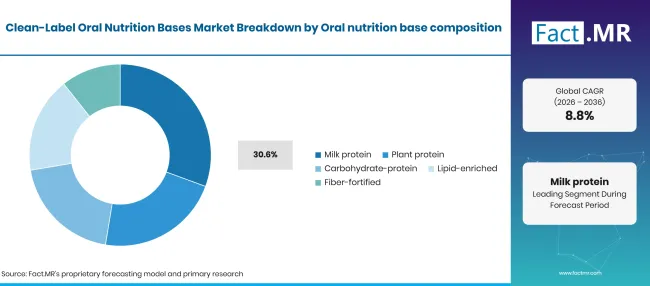
Clean Label Oral Nutrition Bases Breakdown Oral Nutrition Base Composition | Source: Fact.MR
| Oral Nutrition Base Composition | Share (2026) |
|---|---|
| Milk Protein (Leading segment) | 30.6% |
| Other segments combined | 69.4%* |
| Total | 100.0% |
Source: Fact.MR analysis. Updated Nov 11, 2026
Milk protein is widely used in oral nutrition formulations because it provides a concentrated protein source and can be incorporated into different nutritional formats. Its functional properties also support product development across general and specialized nutrition categories. Plant protein and fiber-fortified bases offer alternatives for manufacturers addressing specific dietary preferences or formulation requirements.
What leads the Product Delivery Form segment?
Capsule / Tablet is set to represent 24.6% of the market in 2026.
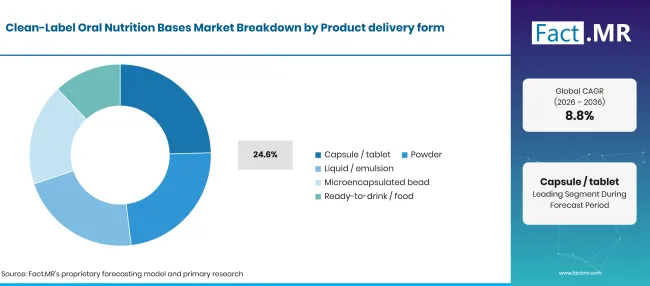
Clean Label Oral Nutrition Bases Breakdown Product Delivery Form 1 | Source: Fact.MR
| Product Delivery Form | Share (2026) |
|---|---|
| Capsule / Tablet (Leading segment) | 24.6% |
| Other segments combined | 75.4%* |
| Total | 100.0% |
Source: Fact.MR analysis. Updated Nov 11, 2026
Capsules and tablets offer measured serving sizes and convenient consumption, making them established formats in the nutritional supplement market. Powder products provide flexibility in serving size and can be mixed into beverages, while liquid and emulsion formats support ready-to-consume applications. Microencapsulated beads can help protect sensitive ingredients and manage their release or incorporation into finished products.
Which Health Application accounts for the largest share?
Cognitive Health is projected to account for 30.3% of the market in 2026.
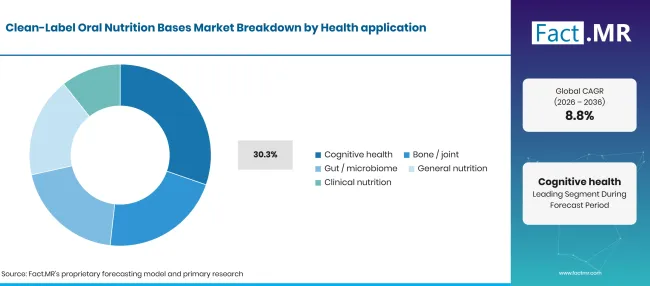
Clean Label Oral Nutrition Bases Breakdown Health Application | Source: Fact.MR
| Health Application | Share (2026) |
|---|---|
| Cognitive Health (Leading segment) | 30.3% |
| Other segments combined | 69.7%* |
| Total | 100.0% |
Source: Fact.MR analysis. Updated Nov 11, 2026
Cognitive health represents the leading application category in the market segmentation. Formulations in this category may combine proteins and other nutritional components with selected ingredients intended to support brain health. Gut and microbiome products address digestive wellness, while bone and joint formulations focus on other nutritional needs. General and clinical nutrition serve broader or more specialized requirements.
Which Customer Channel leads market demand?
Ingredient Manufacturer is expected to account for 33.5% of the market in 2026.
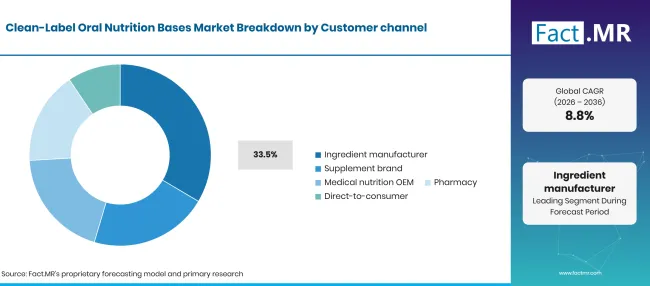
Clean Label Oral Nutrition Bases Breakdown Customer Channel | Source: Fact.MR
| Customer Channel | Share (2026) |
|---|---|
| Ingredient Manufacturer (Leading segment) | 33.5% |
| Other segments combined | 66.5%* |
| Total | 100.0% |
Source: Fact.MR analysis. Updated Nov 11, 2026
Ingredient manufacturers represent the largest customer channel because oral nutrition bases are supplied as formulation inputs to businesses developing finished nutritional products. Supplement brands and medical nutrition OEMs also purchase these ingredients to develop products for defined consumer or patient groups. Pharmacy and direct-to-consumer channels represent routes through which finished products reach end users rather than necessarily purchasing the base ingredients directly.
What is accelerating Clean-Label Oral Nutrition Bases Market growth, and what is holding it back?
Growing supplement use and demand for targeted nutrition support market expansion, while formulation costs and technical requirements can constrain adoption.
Drivers Impact Analysis
| DRIVER | (~) % IMPACT ON CAGR | GEOGRAPHIC RELEVANCE | IMPACT TIMELINE |
|---|---|---|---|
| Wider use of dietary supplements | +1.0% | North America, Europe | Short term (≤ 2 years) |
| Demand for age-related nutrition | +0.9% | Europe, Asia | Medium term (2–4 years) |
| Growth in targeted health formulations | +0.8% | Global | Medium term (2–4 years) |
| Preference for recognizable ingredients | +0.6% | North America, Europe | Medium term (2–4 years) |
| Expansion of convenient oral formats | +0.5% | Global | Long term (≥ 4 years) |
Source: Fact.MR analysis. Updated Nov 11, 2026
Opportunity Impact Analysis
| OPPORTUNITY | (~) % IMPACT ON CAGR | GEOGRAPHIC RELEVANCE | IMPACT TIMELINE |
|---|---|---|---|
| Protein-rich clean-label base development | +0.8% | North America, Europe | Medium term (2–4 years) |
| Plant-based and hybrid nutrition systems | +0.7% | Europe, Asia | Medium term (2–4 years) |
| Cognitive and healthy-aging formulations | +0.6% | Global | Long term (≥ 4 years) |
| Ready-to-drink and liquid nutrition bases | +0.5% | North America, Asia | Medium term (2–4 years) |
| Custom premixes for nutrition brands | +0.4% | Global | Short term (≤ 2 years) |
Source: Fact.MR analysis. Updated Nov 11, 2026
Restraints Impact Analysis
| RESTRAINT | (~) % IMPACT ON CAGR | GEOGRAPHIC RELEVANCE | IMPACT TIMELINE |
|---|---|---|---|
| High cost of specialized ingredients | -0.8% | Global | Short term (≤ 2 years) |
| Taste and texture limitations | -0.6% | Global | Medium term (2–4 years) |
| Ingredient stability and compatibility | -0.5% | Global | Medium term (2–4 years) |
| Regulatory and labeling differences | -0.4% | Global | Short term (≤ 2 years) |
| Allergen and dietary restrictions | -0.3% | North America, Europe | Medium term (2–4 years) |
Source: Fact.MR analysis. Updated Nov 11, 2026
Which countries are scaling the Clean-Label Oral Nutrition Bases Market through 2036?
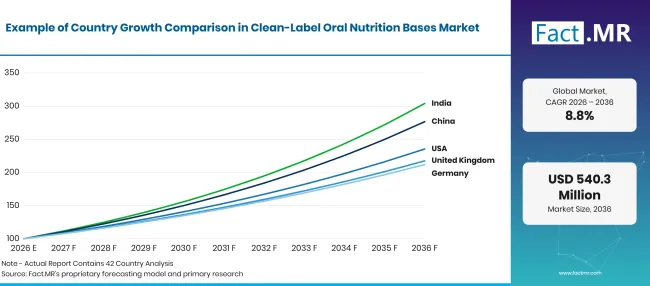
Clean Label Oral Nutrition Bases Growth Index | Source: Fact.MR
| Country | CAGR (2026–2036) |
|---|---|
| India | 11.8% |
| China | 10.7% |
| USA | 8.9% |
| UK | 8.1% |
| Germany | 7.8% |
Source: Fact.MR analysis. Updated Nov 11, 2026
What supports growth in the USA?
8.9% CAGR, supported by established dietary supplement use and demand for specialized nutrition products.
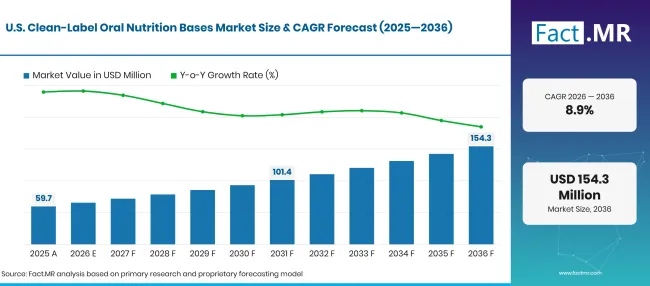
Clean Label Oral Nutrition Bases Forecast Usa | Source: Fact.MR
The U.S. market benefits from an established consumer base for nutritional supplements. The National Center for Health Statistics reported in May 2026 that 60.2% of adults aged 20 and older had used a dietary supplement in the previous 30 days during the August 2021–August 2023 survey period. This creates a broad commercial base for protein-rich and function-specific oral nutrition products. Ingredient suppliers can strengthen their position through formulations that combine nutritional value with convenient delivery formats.
How is Germany developing the market?
7.8% CAGR. shaped by an aging population and interest in maintaining nutritional well-being.
Germany's older population creates opportunities for specialized nutrition products designed around changing dietary requirements. The German Federal Institute for Risk Assessment reported in August 2026 that approximately 19 million people were aged 65 or older in 2024, representing 23% of the population. Oral nutrition suppliers can address this market through well-tolerated formulations with suitable protein and micronutrient profiles. Clear product information and professional guidance remain important for responsible use.
What supports growth in China?
10.7% CAGR, driven by a large older population and expanding demand for nutrition products.
China's demographic profile supports opportunities for products addressing age-related nutritional requirements. The National Bureau of Statistics reported that 323.38 million people were aged 60 or older at the end of 2025, accounting for 23.0% of the population. Nutrition manufacturers can develop oral formulations with milk or plant proteins and other functional ingredients to serve different consumer groups. Product accessibility and formulation suitability will influence wider market development.
How is India expanding the market?
11.8% CAGR, supported by growing interest in nutritional supplementation and convenient nutrition formats.
India's market opportunity is supported by a large consumer base and demand for accessible nutritional products. Manufacturers can address different dietary preferences through milk protein and plant protein formulations, while powders and ready-to-drink products offer convenient consumption options. Suppliers that develop cost-conscious bases with clear ingredient declarations can improve their reach among supplement brands and nutrition product manufacturers.
What supports growth in the UK?
8.1% CAGR, driven by an aging population and established interest in health and nutrition products.
The UK's older population creates a relevant consumer base for products designed to support nutritional intake at different life stages. The Office for National Statistics reported in October 2026 that an estimated 645,000 people were aged 90 or older in 2025, an increase of 3.1% from mid-2024. Suppliers can address this opportunity with oral nutrition bases that prioritize palatability and convenient use while meeting the formulation requirements of supplement brands and medical nutrition providers.
Who leads the Clean-Label Oral Nutrition Bases Market?
Fact.MR finds that dsm-firmenich, Balchem Corporation, Kerry Group, Glanbia and International Flavors & Fragrances (IFF) are profiled across the clean-label oral nutrition bases value chain. The competitive landscape includes companies with capabilities in nutritional ingredients, protein systems, customized premixes and oral delivery technologies. dsm-firmenich has a medical nutrition portfolio that combines science-backed ingredients with customized premix solutions. Its capabilities include taste and sensory expertise as well as formats designed to improve nutritional product acceptance.
Balchem Corporation serves the human nutrition and health market through minerals, nutrients, encapsulated ingredients and functional ingredient systems. Its portfolio also includes application expertise for food and beverage products, supporting its relevance to nutritional formulation development.
Kerry Group plc offers nutritional lipids and bases, soluble dietary fiber, dairy ingredients and milk- and plant-based proteins. Its customizable nutritional base capabilities make it relevant to manufacturers developing products for infants, athletes and other nutrition applications. Glanbia plc participates in the nutrition ingredients market through protein and nutritional ingredient capabilities. Its relevance to this market should be assessed through specific protein systems and formulation solutions rather than assuming that its entire nutrition portfolio consists of clean-label oral nutrition bases.
International Flavors & Fragrances Inc. (IFF) has food and health ingredient capabilities that can support nutritional product formulation. Its potential relevance includes ingredient functionality and sensory development. However, the specific availability of complete clean-label oral nutrition bases should be confirmed at the product level.
Competition depends on the ability to provide consistent nutrient composition and formulation performance. Suppliers need to support customers with ingredient documentation and technical guidance. Manufacturers also evaluate taste, stability, processing compatibility and delivery format before selecting a base for commercial production.
Which companies are the key providers?
The companies profiled in this market include:
- dsm-firmenich
- Balchem Corporation
- Kerry Group plc
- Glanbia plc
- International Flavors & Fragrances Inc. (IFF)
Bibliography
- Balchem Corporation. (n.d.). Human Nutrition and Health.
- dsm-firmenich. (n.d.). Medical Nutrition.
- German Federal Institute for Risk Assessment. (2026, August 24). Benefits and risks of micronutrient supplements in older age.
- National Bureau of Statistics of China. (2026, February 28). Statistical Communiqué of the People’s Republic of China on the 2025 National Economic and Social Development.
- National Center for Health Statistics. (2026, May 21). Dietary Supplement Use: United States, August 2021–August 2023. Centers for Disease Control and Prevention, Data Brief No. 561..
- Office for National Statistics. (2026, October 23). Estimates of the very old, including centenarians, UK: 2002 to 2025.
This Report Answers
- The report examines how clean-label oral nutrition bases are used across the specified nutritional composition categories.
- Segment analysis compares milk protein, plant protein, carbohydrate-protein, lipid-enriched and fiber-fortified formulations.
- Product delivery analysis evaluates capsules and tablets alongside powders, liquids, microencapsulated beads and ready-to-drink formats.
- Country analysis discusses the USA, Germany, China, India and the UK using demographic and nutrition-related indicators.
- The competitive overview profiles dsm-firmenich, Balchem, Kerry Group, Glanbia and IFF.
- Application analysis compares cognitive health, bone and joint, gut and microbiome, general nutrition and clinical nutrition.
What does the Clean-Label Oral Nutrition Bases Market cover?
The market covers clean-label ingredient bases formulated for oral nutritional products. These bases may contain milk or plant proteins, carbohydrates, lipids and dietary fiber. The analysis includes formulations supplied for different health applications and product delivery formats, including powders, capsules, tablets and liquid preparations.
What is included in the scope?
Included products are nutritional ingredient bases intended for incorporation into oral nutrition formulations.
The scope covers single-source and blended nutritional compositions across the specified delivery formats and health applications. It also considers business-to-business ingredient supply to supplement brands and medical nutrition manufacturers.
What is excluded from the scope?
The analysis excludes standalone pharmaceutical drugs and prescription medicines that are not marketed as oral nutrition products.
It also excludes general food ingredients without an intended nutritional formulation role. Finished medical devices and enteral feeding equipment are outside the ingredient market boundary. Capsule shells and delivery technologies are considered only where they form part of the relevant oral nutrition value chain, not as substitutes for nutritional bases.
How Was the Analysis Built?
The analysis draws on 120+ sources, 35+ company portfolios, 25+ countries and more than 20 industry interviews.
- Primary Research: Primary research includes discussions with ingredient manufacturers, nutrition brands, medical nutrition OEMs, distributors and formulation specialists. These conversations examine purchasing priorities and product development requirements, alongside formulation challenges, ingredient preferences and commercial adoption patterns.
- Desk Research: Desk research covers government demographic statistics, public health publications, company portfolios, annual reports, regulatory publications, nutrition industry developments and technical studies. Sources used to support the market analysis are documented in the bibliography.
- Market Sizing and Forecasting: Market estimates combine historical performance, demand indicators, pricing and volume trends, segment shares, company participation, country-level growth and product adoption patterns. Forecast analysis also consider formulation developments and the expansion of specialized nutrition applications.
- Data Validation and Update Cycle: Findings are validated by comparing primary interviews with public data and company activities. Regular updates review product launches and portfolio changes, as well as partnerships, regulatory developments and shifts in commercial adoption.
Segmentation
What is the report’s scope and coverage?
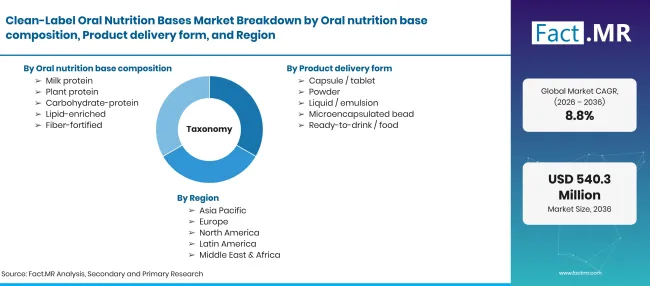
Clean Label Oral Nutrition Bases Taxonomy | Source: Fact.MR
| Attribute | Details |
|---|---|
| Quantitative Units | USD million |
| Market Definition | Clean-label oral nutrition bases are specialized ingredient systems used in oral nutritional products to deliver essential nutrients while supporting nutritional needs and product performance. |
| Oral Nutrition Base Composition | Milk Protein; Plant Protein; Carbohydrate-Protein; Lipid-Enriched; Fiber-Fortified |
| Product Delivery Form | Capsule / Tablet; Powder; Liquid / Emulsion; Microencapsulated Bead; Ready-to-Drink / Food |
| Health Application | Cognitive Health; Bone / Joint; Gut / Microbiome; General Nutrition; Clinical Nutrition |
| Customer Channel | Ingredient Manufacturer; Supplement Brand; Medical Nutrition OEM; Pharmacy; Direct-to-Consumer |
| Regions Covered | North America; Latin America; Western Europe; Eastern Europe; East Asia; South Asia & Pacific; Middle East & Africa |
| Countries Covered | USA; Germany; China; India; UK |
| Companies Profiled | dsm-firmenich; Balchem Corporation; Kerry Group plc; Glanbia plc; IFF |
| Forecast Period | 2026 to 2036 |
| Approach | Market segmentation and scenario-based analysis supported by demographic indicators, nutrition industry developments and company portfolio assessments |
Source: Fact.MR analysis. Updated Nov 11, 2026
How is the market segmented?
-
By Oral Nutrition Base Composition
- Milk Protein
- Plant Protein
- Carbohydrate-Protein
- Lipid-Enriched
- Fiber-Fortified
-
By Product Delivery Form
- Capsule / Tablet
- Powder
- Liquid / Emulsion
- Microencapsulated Bead
- Ready-to-Drink / Food
-
By Health Application
- Cognitive Health
- Bone / Joint
- Gut / Microbiome
- General Nutrition
- Clinical Nutrition
-
By Customer Channel
- Ingredient Manufacturer
- Supplement Brand
- Medical Nutrition OEM
- Pharmacy
- Direct-to-Consumer
-
By Region
- North America
- Latin America
- Western Europe
- Eastern Europe
- East Asia
- South Asia & Pacific
- Middle East & Africa
Frequently Asked Questions
How big is the Clean-Label Oral Nutrition Bases Market in 2026?
What is the CAGR from 2026 to 2036?
Which oral nutrition base composition has the largest share?
Which product delivery form leads the market?
Which health application has the largest market share?
Which customer channel accounts for the largest share?
Which country is expected to record the fastest growth?
Which companies are covered in the report?
Who worked on this report


Preview the report firsthand - request a free sample
Free SampleGet the brochure for pricing and purchase details
Download PDF